Slashdot Mirror
Domain: github.com
Stories and comments across the archive that link to github.com.
Comments · 4,419
-
Best of All = Cobol 2 Javascript
1) Learn javascript
2) Learn cobol
3) Use Cobolscript
4) Profit ! -
Re:Excellent Idea
-
Re:Why not contribute to gparted?
It is based on the blivet storage management library:
https://github.com/dwlehman/bl...
Which is also used by the Anaconda Fedore/Red Hat Enterprise Linux installer:
https://fedoraproject.org/wiki...
And Open LMI:
https://fedorahosted.org/openl...
But it might indeed use libparted to create the actual partitions.
-
Re:Ruby and string/symbols
Heh, yeah, I'm surprised I haven't seen more Ruby yet in this thread, esp. with the proliferation of Chef and gems and rvm and other parts of that ecosystem to keep it puttering along.
For a language that seems to pride itself on its complete OOP-ness, there's so much syntax and different ways of accessing that syntax. I had wondered where all of the PERL masochists had gone...
In my limited experience wrangling with Ruby, it seems very schizophrenic... at once it's supposed to be very clean, yet it's so littered with syntactic sugar. The "best practices" guidelines always seem to be changing, so a common pattern one year will be an anti-pattern the next. There's a little cottage industry of dependency management that has grown up around it, so even as it has become something of a cross-platform glue language like PERL and python, it's such a pain to even maintain consistency among its own minor releases, so we have to use rvm gratuitously to spawn different ruby environments to run different "core" ruby utilities on the same box (chef, foodcritic, rubocop all needing different versions of ruby and libraries and gems, etc.). And it's so slow compared to its peers... for an automation language, I find myself taking a lot of coffee breaks while it goes out and does its thing, and of course that also means all of the code check tools like foodcritic spam me with warnings to do all of the little optimizations like converting my string objects into symbols, so much for the pure object-orientism.
Anyway, I have yet to have an experience with Ruby where it does something that impresses me compared to something else. It seems to be used to write templates for config files a lot, so I suppose that might be its strength. But even there, it seems to be a combination of the worst parts of other languages... all the indeterminate pieces of XSLT, more verbosity than XML, much slower and resource-hungry than other interpreted languages, almost as ugly as PERL, scattered package management in competing and overlapping gems since a lot of the base functionality is somewhat broken ( http://stackoverflow.com/quest... ), and yet seems harder to debug and less accessible too noobs than even compiled languages.
From my experience with Ruby, I'm not exactly sure why this language was developed, other than to provide job security for some devops types. Oh, and I suppose https://github.com/mame/quine-... is cool from an academic standpoint.
-
Re:JAVA
I present... Atmosphere:
https://github.com/Atmosphere/...Check that commit log. This is the most popular library for async/push notifications for Java web applications. It's got tonnes of issues - but the commit log is somewhat telling.
-
Re:I was a member of the YUI team...
The YUI minifier is being maintained by a community member, but we at Yahoo actually use UglifyJS instead now.
You can take a look at our configuration here: https://github.com/yahoo/yuglify
-
Re:The 90's called
Developers are already using the tag today with javascript libraries to backport to noncompliant browsers. As browsers adopt the standard, the transition will be seamless.
-
Re:Are you a programmer?
There's AvxSynth for Linux. As far as I have understood, it's primarily missing source filters (only FFMPEGSource)
-
Re:Are you a programmer?
Actually AviSynth does have a (very basic) UI: AvsPmod It's not the fanciest thing in the world, but it does the job. You're still writing scripts, but it comes with some nice options like error reporting and previewing, which make life a lot easier.
-
Re:Where are these photos?
-
I was a member of the YUI team...First posted on
I was a member of the YUI team until a few months ago. I'm still at Yahoo now, just on a different team, but just wanted to give my own thoughts on this (I don't represent the company or the YUI team).
My software engineering career started with the YUI team - I actually joined as an intern at Yahoo because of a Reddit post on
From the view of some people in the JavaScript community, YUI was always considered a huge, monolithic framework that was only good for widgets. I never thought that was the case - YUI pioneered a lot of the techniques that are popular in advanced JavaScript development today, like modules, dynamic loading, and creating logical view separation in your code. A lot of the influence in RequireJS / CommonJS / ES6 modules can be seen from what YUI did first, which people used to consider "over-engineering".
With a lot of new development in JavaScript though (data-binding, tooling like Grunt / Yeoman, promises and other async handling techniques), it was always hard for YUI to keep up with new features while still being able to maintain backwards compatibility with the constantly deploying products that people were building at Yahoo. We had to support product teams while also building out the framework at the same time, and making sure the user-facing products were the best was more important. Eventually, it was hard when developers who were familiar with newer JavaScript tools tried to use YUI, but ended up having to spend quite some time with the framework just to get it working with the rest of the JS ecosystem.
In the end, I wasn't involved with this decision, but I think it was the right thing to do. A lot of the YUI (now YPT) team and other front-end teams at Yahoo are now working on helping out with more cutting-edge core JavaScript work, like internationalization and ES6 modules, as well as building out components for newer frameworks like React and Ember. Yahoo still has a lot of really strong front-end developers, and working on these more important core components is more beneficial to both Yahoo and the JS community as a whole, than continuing to maintain a framework that's a walled garden.
The one thing to take away from this is that no technology lasts forever, and in the end, what the user sees is the most important, whether it's JavaScript, Android / iOS, or holographic smartwatches.
I'll be a bit melancholy today, but I'll raise a glass to YUI tonight. Cheers to all the folks who worked on YUI, and everyone in the YUI community as well - I made a lot of friends there. RIP.
-
I was a member of the YUI team...First posted on
I was a member of the YUI team until a few months ago. I'm still at Yahoo now, just on a different team, but just wanted to give my own thoughts on this (I don't represent the company or the YUI team).
My software engineering career started with the YUI team - I actually joined as an intern at Yahoo because of a Reddit post on
From the view of some people in the JavaScript community, YUI was always considered a huge, monolithic framework that was only good for widgets. I never thought that was the case - YUI pioneered a lot of the techniques that are popular in advanced JavaScript development today, like modules, dynamic loading, and creating logical view separation in your code. A lot of the influence in RequireJS / CommonJS / ES6 modules can be seen from what YUI did first, which people used to consider "over-engineering".
With a lot of new development in JavaScript though (data-binding, tooling like Grunt / Yeoman, promises and other async handling techniques), it was always hard for YUI to keep up with new features while still being able to maintain backwards compatibility with the constantly deploying products that people were building at Yahoo. We had to support product teams while also building out the framework at the same time, and making sure the user-facing products were the best was more important. Eventually, it was hard when developers who were familiar with newer JavaScript tools tried to use YUI, but ended up having to spend quite some time with the framework just to get it working with the rest of the JS ecosystem.
In the end, I wasn't involved with this decision, but I think it was the right thing to do. A lot of the YUI (now YPT) team and other front-end teams at Yahoo are now working on helping out with more cutting-edge core JavaScript work, like internationalization and ES6 modules, as well as building out components for newer frameworks like React and Ember. Yahoo still has a lot of really strong front-end developers, and working on these more important core components is more beneficial to both Yahoo and the JS community as a whole, than continuing to maintain a framework that's a walled garden.
The one thing to take away from this is that no technology lasts forever, and in the end, what the user sees is the most important, whether it's JavaScript, Android / iOS, or holographic smartwatches.
I'll be a bit melancholy today, but I'll raise a glass to YUI tonight. Cheers to all the folks who worked on YUI, and everyone in the YUI community as well - I made a lot of friends there. RIP.
-
Re:1996 is back
https://github.com/ioquake/ioq3/
Updated 14 hours ago. The updates never ended. -
Re:Kinda amazing
It's always interesting to browse the Linux 0.01 source tree. I would say that it was pretty good code from the very beginning.
-
Re:Or you could blame Chile's MPs
If they're anything like American legislators they just let the lobbyists write the laws
This is all just smoke and mirrors anyway.
Microsoft are a spiteful, thrashing old dinosaur in their death throes. They'll do some damage and win a reprieve occasionally when they buy a politician or two, but the wave is almost ready to peak and overwhelm them. Their last bastions are in lumbering behemoths like the major corps and government, that are unwieldy and slow to change. Many nimbler organisations have already switched to lighter, cheaper options that don't require so much maintenance or risk,
Look at the government involvement in open source on Github - it's an exponential increase, as was the adoption of alternative OSs in the mobile arena.
https://github.com/blog/1874-g... -
Is this unaffiliated substantial coverage?
Since no one answered this question, I did a simple google search which threw up these results
Nimrod: A New Systems Programming Language
Category:Nimrod
Consider the Nimrod Programming Language
What I like about the Nimrod programming language
Araq/Nimrod
Nimrod: A New Approach to Metaprogramming
Nimrod: A new statically typed, compiled programming language which supports metaprogrammingI am just a layman when it comes to Wikipedia editing, but it looks pretty substantial to me. It would appear that the complaint that notability requirements are too strict has just cause.
-
Re:$230
Might I suggest splitting that $5 into $4.50 for the block list maintainers and $0.50 for the software that applies the list? Heck, uBlock won't even take your $5.
-
One Year In
I just had my one year anniversary as a full time Android developer, and it's insane how much I've learned after leaving school. Luckily there's two older guys (well, one now, the other moved on recently) on my team who are _awesome_ mentors.
1. Pay attention to everything you can in the work place. You may be a client side developer, backend, whatever, but pay attention in every meeting or conversation that you can eavesdrop on. You may not understand everything going on with the teams you don't work in, but just being exposed to their terminology and _looking up what they're talking about_ will get you far. This doesn't go for just development, either - listen to the business and sales guys talk and try to understand your clients and what they need so you can build a great product by anticipating what will work for them before they have to ask.
2. Write a blog. Seriously. I'm the first to admit that I don't really know anything when it comes to development, but I've been actively writing new posts to my blog and it forces me to grok whatever I'm writing about. Whatever you're doing, post the code on GitHub so others can read it (mine's here). Developers who read peoples code online tend to be awesome about making suggestions and asking questions that make you realize you screwed up without being jackasses about it.
3. If there are tech meetups in your area, go to them. If you're in a decent sized city (I'm in the Denver/Boulder area, which isn't huge, but it's a lot bigger than where I'm originally from) you can find multiple meetup groups related to tech that you're interested in. It's a great way to learn new things and meet a lot of awesome people in your area.
4. If there's hackathons in your area, no matter how small, go to them. You meet awesome people and learn how to work in teams that are different than the one you're in every other day. Plus there's usually free food and beer, so what's not to like about that?
5. Pick up skills that compliment your work area by doing projects that aren't work related. It helps you understand what other teams are doing and how it affects you, plus it just makes you more awesome while keeping down the monotony. As a client side developer, I've been taking a Udacity course on using AppEngine to make backend APIs, and it's been fun.
6. For the love of God, check for null pointers and other kinds of exceptions. You may not catch all of them due to inexperience in spotting them, but that's what senior devs doing code reviews are for. You don't want code going into the wild that crashes, even when data is bad. Getting a call on a Saturday saying something bad is happening is not what you want - the weekends are yours to do whatever you want, not put out fires that could have been avoided.
7. Open source third party libraries are your friend. People way smarter than me have put together some amazing things that we use every day, like Otto and Picasso from Square. Try libraries out in a sample project, and if they will work for what you're doing, give it a shot. If you can make them better in the process, submit a pull request. Like I mentioned earlier, the open source community is awesome and if your pull request isn't up to par, they'll let you know what you can do to fix it.
8. You're going to fail at some things, and it's alright. Fail early, learn what did and didn't work, and try again. Learning from mistakes is how you get better. Along this same line of thought, if you run into a roadblock that you can't figure out yourself via documentation/stepping back and evaluating the problem, StackOverflow is awesome. -
Re:
What Skuto said, except "are private until a new release is out to the users" is really "6 to 12 months or more down the line" because (I think) they affect the Firefox OS core also which is on a much different schedule. You can actually go through all the bugs here: https://github.com/iSECPartner... but most of them will in fact be 'private'.
-
Also our FOSS Garden Simulator started around 1990
Though only finished and released around 1997: http://www.gardenwithinsight.c...
(Unrelated work and also two years of grad school to learn more about ecological modelling plus excessive ambition caused delays in getting it done...)
And MECC's "Lunar Greenhouse" from 1989 ran on the Apple II:
http://www.worldcat.org/title/...This emulator did not work for me, but seemingly Lunar Greenhouse is online:
http://www.virtualapple.org/me...
http://www.virtualapple.org/J_...But there are other text-based games like Hamurabi which goes all the way back to 1968 where you "plant" crops and harvest them. I played a variation of tha first around 1980 or so.
http://en.wikipedia.org/wiki/H...It can be played online:
http://www.hammurabigame.com/h...I've long wanted to build a general purpose gardening (and maintenance) robot like the ones in "Silent Running". For some reason, there has been economic resistance to supporting general purpose agricultural robots. Cheap illegal labor in that sense harmed my career in robotics in the 1980s when I really, really wanted to make such things.
That's one reason I've just done software, which is cheaper to do on your own than robotics. Or it was, now that robotics is getting so much cheaper for various reasons due to cheap powerful embedded computers and cheaper sensors and actuators and 3D printing and web-based design and manufacturing like via 100K garages and such.
http://www.100kgarages.com/There were a couple times I spoke with academic roboticists about making general purpose agricultural robotics in the late 1980s and early 1990s. Both were interested in industry-fundable specific purpose robots, like for seeding transfer in greenhouses (Rutgers) or for autonomous wheat harvesting with big machines (CMU). Those were no doubt fairly practical ideas, and I may have been well served in a robotics career to have pursued such practical ideas in cooperation with those professors, but they were not the general purpose system I really wanted to work on like the Silent Running-type drones. Still, they might have been stepping stones to better systems -- but it is easy to be too ambitious and impatient when you are young.
Nowadays though, there seems to be a resurgence of interest in agricultural robotics, and I wonder if crackdowns on illegal agricultural labor may even be connected to it?
"Crackdown on illegal immigrants left crops rotting in Georgia fields, ag chief tells US lawmakers
http://blog.al.com/wire/2011/1...Also, this is a problematical statement from the point of view of a robotics engineer: "A robust agricultural guest worker program, properly designed, will not displace American workers," Black said in remarks prepared for the hearing. "As my testimony shows, in Georgia, even with current high unemployment rates, it is difficult for farmers to fill their labor needs."
That guest worker program displaces robotics engineers... Otherwise there would be a much greater demand for general purpose agricultural robots.
Instead, I worked on virtual gardening software for growing virtual plants. My wife and I also made a simpler version of the garden simulator just for breeding virtual plants (mostly her work):
https://github.com/pdfernhout/...
http://www.kurtz-fernhout.com/...That said, there is little that is better for mental health for many people than
-
Re:Stone
Actually, its set in {La,}Tex: https://github.com/cplusplus/d...
-
Re:why- just why?
Except it's not proprietary. It's GPLv2 and on Github.
-
Re:What the fuck happened to gedit's UI?
Check out pluma. It's a fork of gEdit before it got all ridiculous looking.
-
Re: You're welcome to them.
The problem with Vim (and Emacs) is that they do not support anything modern, not even ctrl-z/x/c/v.
VIM has the "VIM Easy" mode, which when used on MSWindows would do Ctrl-Z/X/C/V out of box. And even select text when holding Shift and moving around with cursor keys.
Shortcut to VIM Easy is preinstalled. If you complain about it, then you probably never really used the VIM. Or are you complaining about the *NIX "vi"?
For programming Eclipse or NetBeans or Visual Studio is just miles away what of vi/emacs can do, especially out of the box.
The problem for the professionals is not what the IDE can do out of box, but what can it be made to do. Eclipse or NetBeans or Visual Studio - all suck horribly at everything for what there is no button premade. And when there is a button for everything - they suck at finding this right button.
But I'm not planning to contest the point that VIM is not IDE. No, it is not "VIM is bad IDE" - it is "VIM is not IDE". (This is different for Emacs, though: it is an IDE and then some more. One needs to learn it. And lack of good in-depth tutorials is actually what turned me off from the Emacs.)
The thing about VIM is that it integrates nicely with the system, instead of reinventing it. And it also provides great automation facilities with macros, mappings or scripts. They are fairly simple and can be learned in 1-2 weeks, which is a small price to pay for the ability to control 100% of your text editor. That is the capability no other editor offers.
To get vi/emacs to work nearly as good as good IDE is just too big a job.
(Please do not say "vi" when you really mean "VIM".)
In the project Neovim the work going on to make the Lua the built-in scripting language and improve VIM's plug-in framework. All that to specifically allow to create IDE based the VIM. (Though in my opinion, the direction of the Neovim effort is misguided. They should have went in direction of allowing VIM to be easily embeddable into other applications.)
So in the future, there might be an IDE based on VIM. But not right now.
For example NetBeans ctrl-b (go to declaration). Sure, you can install ctags, configure it, run it, tinker with it, tinker some more, add custom rules, search net, rinse-and-repeat and eventually you'll get something resembling ctrl-b, but not quite the same.
This is probably the most unjustified complain you throw. The tags support in VIM is very good - if you bothered to RTFM. Literally every book and tutorial describe these highly sophisticated and inexplicable 3 steps involved: install the exuberant ctags, put into the
If you use plugins like YouCompleteMe, they would do it for you automagically.
In the end, if you can't bother to read the VIM's help (which is by far the best help for a text editor there is out there) then VIM is definitely not for you.
-
consider an open source ERP
You can throw good money after bad, and you probably will.
If you want to have an alternative, you could do worse than look at Oodo (formerly OpenERP) it is a python based, AGPL licensed ERP package that is modular with a sensible API that is growing an even more sensible API. It is not without it's problems, I wouldn't sugar coat it, but if it is broken, you own all the pieces (http://odoo.com source at https://github.com/odoo/odoo) and that is priceless.
Depending on your specific requirements it might work great, or might be a bigger pain in the ass than your proprietary mess. Like I say, you will almost certainly take the path of throwing good money after bad, but for anyone else at the front end of a decision, the business value of Free Software is huge. -
TOTP
-
OTP is where it's at.
FreeOTP and/or Google Authenticator may be exactly what you want from the client side.
I made a server-side implemention to get started with a little while ago:
-
Re:Laziness
You are going to hate what the Neovim folks are trying to do to VIM's learning curve:
https://github.com/neovim/neov...I fear the day when Eternal September comes to VIM.
-
Github "explore"
-
Customizing chat bubble colors in Messages.app
Apple seems to have removed the ability to customize the chat bubble colors in Messages.app in Yosemite. If you liked that feature (as I did) and want it back, I've got your back! https://github.com/kethinov/Bu...
-
Re:Angler PC malware?
> No, not at all. What you are referring to is that X server doesn't need uid 0 to run. But still there is, amongst others, the problem that every x application can keylog you
Well, on that note wayland is no better. Wayland doesn't really prevent keylogging -- the use of client-side decoration allows a malicious client to create a transparent window covering the entire screen in order to get all input events. Even if that were somehow accounted for, the linux environment provides plenty of other opportunities like malicious use of LD_PRELOAD.
-
Re:Good point
You shouldn't pause too long, as the you might need to re-start the video
This issue killed streaming Youtube videos with mplayer for me, and I'm sad to see it's also an issue with vlc. I've since moved on to using Youtube Center, which places a download option right on the page, and also gets rid of most of the annoyances that made youtube unusable in the first place.
-
Re:Shocked I am! Shocked!
I didn't know C and Excel had a native X.509 parser and cert management built into the language. I'll run and check my copy and K&R, but I'm pretty sure it's not in there.
If you configure any of them to that specific task, there is no technical limitation from their side. But I'm sure you wouldn't consider some scripted operations in Excel to generate and manage certificates a security product, right? That was my point.
In the last two years. Deployed in the main stream in that last year.
And is consistent in every environment? Shall I expect the same quality and behaviour in OpenBSD, Linux and Windows 3.1? Because, you know, this is the actual problem.
Gave the option of using local high rate entropy sources to ensure consistency in the random numbers from it's service interface.
Sure, its called ENGINE API. Did LibreSSL removed it? Doesn't seem so. Check https://github.com/libressl/li...
-
Re:Any questions?
Yup, it's on GitHub in two repositories, one for LLVM and one for clang. We've been pushing the fixes for MIPS IV upstream, but there are some changes to the mid-level optimisers to make them aware that not all pointers are integers and some extensions to the platform-independent code generators for the same.
We've upstreamed all of the FreeBSD changes required for the base processor (BERI) and the development boards, so FreeBSD 10 will run out of the box on CHERI (it just won't expose any of the capability features). The CHERI-enabled version of FreeBSD is also on GitHub.
The code for the processor is just in a tarball at the moment. We're going to move it to some sensible public revision control system once we've worked out how much of our internal svn history wants to be included in the public release.
-
Re:Any questions?
Yup, it's on GitHub in two repositories, one for LLVM and one for clang. We've been pushing the fixes for MIPS IV upstream, but there are some changes to the mid-level optimisers to make them aware that not all pointers are integers and some extensions to the platform-independent code generators for the same.
We've upstreamed all of the FreeBSD changes required for the base processor (BERI) and the development boards, so FreeBSD 10 will run out of the box on CHERI (it just won't expose any of the capability features). The CHERI-enabled version of FreeBSD is also on GitHub.
The code for the processor is just in a tarball at the moment. We're going to move it to some sensible public revision control system once we've worked out how much of our internal svn history wants to be included in the public release.
-
Re:Any questions?
Yup, it's on GitHub in two repositories, one for LLVM and one for clang. We've been pushing the fixes for MIPS IV upstream, but there are some changes to the mid-level optimisers to make them aware that not all pointers are integers and some extensions to the platform-independent code generators for the same.
We've upstreamed all of the FreeBSD changes required for the base processor (BERI) and the development boards, so FreeBSD 10 will run out of the box on CHERI (it just won't expose any of the capability features). The CHERI-enabled version of FreeBSD is also on GitHub.
The code for the processor is just in a tarball at the moment. We're going to move it to some sensible public revision control system once we've worked out how much of our internal svn history wants to be included in the public release.
-
Re:PWM?
You can use a software based solution that utilizes the PWM or PCM chip to generate pulses, and will let you drive 8 or more servos at a time: https://github.com/richardghir... [github.com]
Software PWM is not going to give the same smooth movement, and will result in both audible hum and vibration. It is fine for dimming an LED, but not for precision motor control.
-
Re:PWM?
You can use a software based solution that utilizes the PWM or PCM chip to generate pulses, and will let you drive 8 or more servos at a time: https://github.com/richardghir... [github.com]
-
Re:Real Time Clock?
You can use a software based solution that utilizes the PWM or PCM chip to generate pulses, and will let you drive 8 or more servos at a time: https://github.com/richardghir...
-
GitHub link
In case you don't want to wade through the article, the source code is at https://github.com/edsu/anon
-
LibreSSL vs OpenSSL Speed test
I saw the updated http://www.libressl.org/ page with details for the portable version.
Saw someone else did a speed test https://gist.github.com/bertjw...
and thought I would do the same
I'm not an expert but at this stage it appears
LibreSSL Speed as % of OpenSSL
type 16 bytes 64 bytes 256 bytes 1024 bytes 8192 bytesAes-128 cbc 152.40 152.34 152.66 59.87 59.49
Aes-192 cbc 159.14 158.30 158.25 60.78 60.49
Aes-256 cbc 166.15 166.91 167.14 64.48 64.51Results -
LibreSSL about 50~60% faster for 256 size blocks or smaller
OpenSSL about 50~60% faster for 1024 size blocks or largerNotes: To compile on Ubuntu need to use
There are posts about the same requirement on RH also. -
Re:Comply first. Litigate later.
Yes, I'm sure this configuration file was violating Copyright https://github.com/CyanogenMod...
-
Webhosts should block Cyveillance, PicScout
File Name: https://github.com/justicezyx/...
They claimed copyright on a file called README of 1 byte in size. This is ridiculous.
As Luke on phoronix points out, "Webhosts should block Cyveillance, PicScout, etc. None of those automated copythug bots respect robots.txt and all of them can be construed as violating the TOS or any website that posts a demand that they stay away. One website (https://dcdirectactionnews.wordpress.com) has posted a legal notice that every access by Picscout could cost them $10,000 in liquidated damages, essentially a reverse "Getty Letter" against them. I suspect Cyveillance is about to get added to that notice, along with all their clients,.
GIThub should post similar terms and if they control the server they can also block these bots directly. So should this forum, phoronix itself, and as many websites as possible to shut down these parasites. PicScout in particular uses so much bandwidth that some smaller websites have incurred significant extra data costs until they blocked PicScout."
-
WebODF seems to use Dojo?
https://github.com/kogmbh/WebO...
I like Dojo in part because it attempts to make all the core widgets accessible. From:
http://dojotoolkit.org/referen...
"Dojo has made a serious commitment to creating a toolkit that allows the development of accessible Web applications for all users, regardless of physical abilities. The core widget set of Dojo, dijit, is fully accessible since the 1.0 release, making Dojo the only fully accessible open source toolkit for Web 2.0 development. This means that users who require keyboard only navigation, need accommodations for low vision or who use an assistive technology, can interact with the dijit widgets." -
Re:Cntrl+Click to follow link?
Are you talking about writing text in the webodf editor demo? If you cannot input text on your Galaxy Note 3 there, we might be able to help if you file an issue.
-
Re:Frustrating
What did you need besides the information available here?
Getting started
HOWTO-wodotexteditor.md -
x86, ARM 32-bit, and C?
What's wrong with assembly and its sibling, C?
cgic is very mature (1996-2014), and very stable (version 2.05 released in 2011, version 2.06 in 2014).
-
Re:Wow!
WebODF uses OpenDocument Format (ODF) as the runtime document model. That means that there is 0 (zero) data conversion when loading and saving a document. It does not support OOXML, but it could load an OOXML document if it was converted to ODF. It is not clear that the same approach (style unchanged XML with CSS) could work with OOXML. Have a look with your browsers 'Inspect Element' function in the demo. The DOM is ODF XML, not HTML.
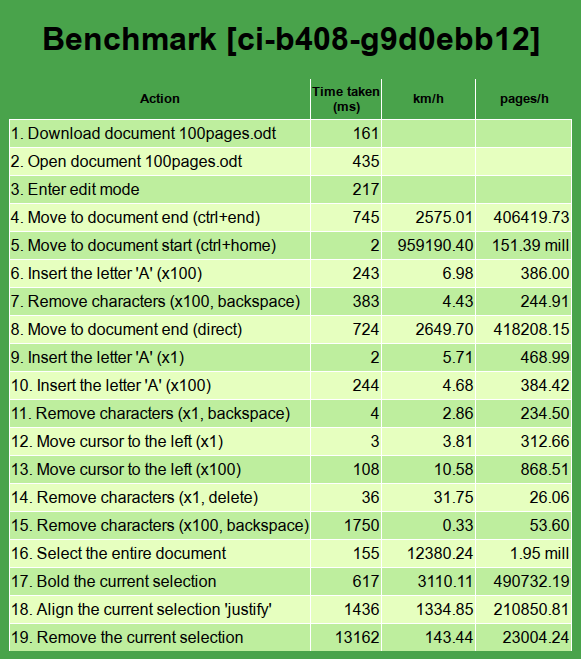
A lot of work was done on responsiveness. A mischievous edit bot is used to do heavy editing testing and a detailed benchmark is available for every build.
-
Re:How about a home brew dynamic DNS system?
-
Re:Different than the SLAMM stuff at Carnegie Lab
they used PTAM and replicated Jens Nyman's thesis from 2 years ago