Slashdot Mirror
Domain: gnu.org
Stories and comments across the archive that link to gnu.org.
Comments · 13,360
-
It's potentially a good thing
Now, the question is whether this is good for Wikipedia (more people see its contents) or bad (fewer people even know that they could/should improve Wikipedia)?
The results are always labeled as being from Wikipedia, which should increase awareness of the WIKIPEDIA brand, prompting Google searches for Wikipedia, and then people would find the English Wikipedia main page and learn what it's all about. In addition, at the bottom of the article:
This article is licensed under the GNU Free Documentation License. It uses material from the Wikipedia article "Lebesgue integration".
The second link goes to the live article on en.wikipedia.org.
-
Re:I can't see this helping...While the GPL is "unmodifiable", there's nothing stopping you from adding additional permissions to a GPL'd project whose copyright belongs to you and other consenting individuals.
For example, Linus explicitly allows non-GPL'd software to run over Linux, though an addition to the LICENSE file. In this case, Torvalds wasn't modifying the GPL, he was essentially adding an additional license.
This is allowed because a license (as opposed to an EULA) is just a set of permissions. Each set of permissions adds to any you already have (including your default set of "fair use" privileges.) You can license any project you own under as many licenses you wish, and end users can pick and choose which (complete) licenses they want to agree to. (The word "complete" in that sentence is important.)
Also, while the GPL is unmodifiable for existing projects that do not belong to you, if you have a strong enough case you can persuade the FSF to agree to a modified version for projects you own, on occasion even if the result is a license incompatable with the GPL. For example, the Affero General Public License, whose history you can read about here.
-
Re:Hopefully good will come out of this.
"1. You may copy and distribute verbatim copies of the Program's source code as you receive it, in any medium, provided that you conspicuously and appropriately publish on each copy an appropriate copyright notice and disclaimer of warranty; keep intact all the notices that refer to this License and to the absence of any warranty; and give any other recipients of the Program a copy of this License along with the Program."
found here. So you really do have to advertise the fact your software uses GPL code.
Though I hardly think this is bad for companies as _they_ knew this upfront. If you want to dip into the community well, you better be prepared to put more back in. If that is to onerous then you have zero right to use it. -
Re:Would you have to use it?
From gnu.org:
The copying permission statement should come right after the copyright notices. For a one-file program, the statement (for the GPL) should look like this:
This program is free software; you can redistribute it and/or modify
it under the terms of the GNU General Public License as published by
the Free Software Foundation; either version 2 of the License, or
(at your option) any later version.
(emphasis mine)
So version 3 can't be incompatible with version 2, if it is then it's another license (and has to have another name). It's like creating a legal document that doesn't follow the law, what's the point in that? (unless you want to scam someone)
The Free Software Foundation is good at this though, they won't release anything that's not legaly solid any time soon. -
The Creator
From the eWeek article:
"Linus Torvalds, the creator of the Linux operating system"
Not a good start for this process...
Mod eWeek -50 Flamebait
-
Re:I can't see this helping...I'm worried that it will just add another 'compeletly separate' license
well, the lgpl has been around for a long while and it's caused no serious confusion so far. the fact is, if there are a lot of licenses it's easier to find one that suits your project and organization's requirements. choice good.
-
Re:Trusted Linux is ILLEGALNo. A license in not a type of contract. A contract requires consideration a license does not. A license is a unilateral grant. Eben Moglen, a professor of law at Columbia University School of Law and recognized IP law authority states:
The essence of copyright law, like other systems of property rules, is the power to exclude. The copyright holder is legally empowered to exclude all others from copying, distributing, and making derivative works. This right to exclude implies an equally large power to license--that is, to grant permission to do what would otherwise be forbidden. Licenses are not contracts: the work's user is obliged to remain within the bounds of the license not because she voluntarily promised, but because she doesn't have any right to act at all except as the license permits.
He wrote an excellent article which completely destroys your arguement. -
Re:Stumping for irony.Open source is free software. Can you name any open source software that isn't?
Are you trying to say that the OSI it wholly redundant with the FSF? If it's the case that all the OSI does is clone the FSF Free Software definitions and re-brands them with different labels, that seems pretty supurfluous to me.
But alas, yes, the Open Public License used for some SVG viewer is not Free Software, but is open source (their license says "Open", and they let you get source - so it's open source whether or not they bought a certificate from the OSI). Now if you asked about OSI Certified[tm], instead of "open source", I wouldn't know, because I don't really follow what that organization does very much.
-
Re:Stumping for irony.Obviously you've gotten this idea from somewhere -- that open source is not free software. Could you explain where you got it from?
Well, I got the idea from Here, where the OSI decided to create a different definition than any of the Free Software definitions, including both the Debian Free Software Guidelines (DFSG) upon which the OSI definition was derived from and the FSF's Free Software Definition
If the weren't different, the OSI wouldn't be making up different definitions, would they?
-
Re:Linus Torvalds himself has blessed DRM
Time to re-read this essay. Stallman's disturbing future scenario is getting scarily closer with every new technical or legal development in this field.
Even if you don't normally agree with Stallman, read the essay anyway, and the notes that follow. -
Re:TCG and Linux make sense
When implemented in Linux using Open Source software, TC gives you new options for securing and expanding the capabilities of your computer.
If the upstream routers at my ISP require me to have trusted hardware/software in order to access the Internet, how is my freedom enhanced? If national/international laws are passed requiring all ISPs to restrict my communications in such fashion, how do I choose another ISP in the "marketplace"? Furthermore, if "untrusted" hardware is similarly illegal, am I still free?
Food for thought -
Re:The Future
Ya Steam has rough edges, but look a few years into the future and it's all you'll see.
-
RMS's writing about "trusted" computing
RMS has written a nice article about it: see http://www.gnu.org/philosophy/can-you-trust.html
-
Re:Trusted Linux is ILLEGAL
much open-source software is already signed by the creator / distributor, so you know that the binary you got was actually made by him.
Doing this would, of course, completely nullify the point of signing binaries. Fortunately, nobody but you seems to be under the impression that this violates the GPL. I suggest that the first stop on your crusade against private keys should be these guys, who are not only signing packages, they are doing so to basic GNU software. Or maybe this organization, which is distributing signed binaries of GNU software!.Sure, you can sign binaries. But if you give that binary to someone, and he later demands the source code from you, you'd better include the private key along with it.
-
Words to avoid: "Intellectual "property"
"Intellectual property"
Publishers and lawyers like to describe copyright as "intellectual property"---a term that also includes patents, trademarks, and other more obscure areas of law. These laws have so little in common, and differ so much, that it is ill-advised to generalize about them. It is best to talk specifically about "copyright," or about "patents," or about "trademarks."
The term "intellectual property" carries a hidden assumption---that the way to think about all these disparate issues is based on an analogy with physical objects, and our ideas of physical property.
When it comes to copying, this analogy disregards the crucial difference between material objects and information: information can be copied and shared almost effortlessly, while material objects can't be.
To avoid the bias and confusion of this term, it is best to make a firm decision not to speak or even think in terms of "intellectual property".
The hypocrisy of calling these powers "rights" is starting to make WIPO embarassed.
From: Some Confusing or Loaded Words and Phrases that are Worth Avoiding
So-called "IP-Rights" are also rebutted in the article Tragedy of the Commons. From Wikipedia:
In Hardin's article, the Commons is a shared plot of grassland used by all livestock farmers in a village. Each farmer keeps adding more livestock to graze on the Commons, because it costs him nothing to do so. In a few years, the soil is depleted by overgrazing, the Commons becomes unusable, and the village perishes.
The cause of any tragedy of the commons is that when individuals use a public good, they do not bear the entire cost of their actions. If each seeks to maximize individual utility, he ignores the costs borne by others. This is an example of an externality. The best (non-cooperative) short-term strategy for an individual is to try to exploit more than his or her share of public resources. Assuming a majority of individuals follow this strategy, the theory goes, the public resource gets overexploited.
The tragedy of the commons is a source of intense controversy, precisely because it is unclear whether individuals will or will not follow the overexploitation strategy in any given situation.
A short example: Why should Disney have eternal monopoly on Mickey Mouse, when Disney benefit extremely much from folklore-tales like: Snow-white and the 7 dwarves, Alice in Wonderland, Pochahontas, etc?
In this case, Disney benefit from the Commons, without contributing back. This is so-called "IP-rights" in a nutshell: They take away from the Public Domain, without contributing back. -
Re:Sure there ain't no spyware...
-
Re:The New Freedom
You are confusing freedom with power. It's an easy mistake to make, though, particularly when you grow up in a power-obsessed society {such as the USA is and the UK is becoming}.
If you were allowed to own slaves, your "freedom index" would be higher. But those slaves would by definition have zero freedom index, and so the mean "freedom index" across the whole of society would be lower.
Imposing ownership on software makes users less free. And to say that proprietary, closed-source software, file formats and protocols somehow impinge on human rights less than slavery is grossly to underestimate the importance of computers in the Western world in the 21st century. As long as your data is saved in a Microsoft Word document or Excel spreadsheet, you do not own it: it is subject to the whims and caprices of Microsoft. If Microsoft decide to bring out a new version of Office that will not open the manuscripts of your magnum opus, your life's work is wasted. This will, of course, be sold as a benefit to you.
I don't think software should be banned for having "overly vague comments", but I think that deliberately making it difficult to understand how a programme works should ultimately be an offence. My "roadmap" {I hate that buzz-word but can't think of a better one} for the end to closed-source software would be: Mandate open data formats. At first, simply guarantee everyone the right to examine data formats and protocols and publish their discoveries; eventually, make it binding on software vendors to publish data format documentation. Since the best documentation for developers is the source code, Open Source suppliers probably would be automatically compliant unless they were using deliberate obfuscation. Require guarantees of performance. It isn't enough to say "if this programme does not do what you thought it would, it's your fault". Other products offered for sale have to be guaranteed. Software should be no different. For this purpose, software supplied as source code should be considered analogous to a kit of parts. The purchaser has the opportunity to subject the source code to independent analysis to determine its suitability for a particular application, and is free to make such modifications as are deemed necessary. Source code escrow is the best way I can see to protect guarantees: a software vendor would be obliged to place a copy of the source code to their product in escrow, and it would be un-sealed by order of the Courts anytime a dispute arose which could only be settled by examining the source code. Of course, Open Source code need never be placed in escrow as the recipient already has a copy of the code. There might never be a need for an actual prohibition on secrecy of source code, as long as it remains more economical to distribute Open Source and thus be automatically compliant with the provisions. -
Re:plan9 boots from CD
You almost have a point, and indeed the wording was previously different but with enough pressure from users and developers enough changes have occured that the now OSI Certified Lucent Public License Version 1.02 clearly states
----
7. EXPORT CONTROL
Recipient agrees that Recipient alone is responsible for compliance with the United States export administration regulations (and the export control laws and regulation of any other countries).
----
On 9th Jan the GNU foundation and in particular RMS. changed their stance and agreed that
The current license of Plan 9 does qualify as free software (and also as open source).
-
Re:Having a tough time getting worked up over this
The fact that it costs money is an issue, but hey, you get what you pay for.
The issue isn't money. The issue is freedom.
-
Irony?
This is how we got the widespread misuse of words/phrases like "irony", "it begs the question",
Strict meanings of both irony and begging the question have been used for millennia--literally, for they both originated in ancient Greece--so I wouldn't exactly call them gray areas. But while the (re)definition of "irony" one is more familiar with might indeed be a question of whether one prefers texts written by Plato or Alanis Morissette, copyright infringement is a completely different matter. Copyright infringement is by definition a violation of copyright law which is not a property law. Violating copyright is not theft because duplicating data is not appropriation of any property, much less a dishonest appropriation of property belonging to someone else with the intention of permanently depriving the other of said property. The key word here is "depriving," for theft is wrong not because the thief gets something without paying (the real goal of any theft), but because the victim no longer has that something (a side effect of every theft)--this is crucial. Furthermore, the copyright law was meant to protect authors from publishers, not from readers so reading a book without paying for the right to read or listening to music without paying for the right to listen is not only not theft, but not even a copyright infringment. The "copy-" in "copyright" is rather unfortunate, and should it have been called "publishing rights" there would be much less confusion today when "copying" is something we must do in order to play any kind of digital media. So, copyright infringement is not theft by any stretch of imagination. Nor is it piracy, for that matter, because it has very little to do with robbing or plundering at sea without a commission from a recognised sovereign nation, and quite frankly I have no idea why has that word been chosen in the first place. I know that in the "Don't Copy That Floppy" era, writing "piracy is a crime"--which is true, even if copying floppies is not--on BSA propaganda posters must have had a strong influence on people, but why using piracy and not just theft? My point is that--unlike irony--copyright infringment, theft and piracy, as well as trade secrets and patents, are all very strictly defined by law in any given jurisdiction and it is impossible to confuse them without clear malicious intents. This is not a question of definition or preference, but a matter of fact. So I fully agree with your point, but I wouldn't use the same examples.
-
Re:Nice job, Sun.
I count 29 compatible licenses: GPL-Compatible, Free Software Licenses
-
Really simple, here's how:
If you have a network, and a stack 'o PIII's then you have what you need. It doesn't really matter what kind of network, as long as everything connects via TCP and has enough bandwidth for your needs.
Setup a linux server, with enough disk space for your media collection and whatever else you want to store there. Install gnumpd3 from
here: http://www.gnu.org/software/gnump3d/
Install a desktop linux distro on the machines in each room. Aim a web browser from any machine at the URL of the gnump3d server and viola! you have music from your collection on demand in any room!
Streaming radio style music is easy as well. Install icecast from here:http://www.icecast.org/
and aim the xmms player from here: http://www.xmms.org/ and you have streaming media! woohoo!
If you want to control a distribution system that plays the same songs things get more complicated, you'll need Apple computer's RTSP server and some client software to get everything sync'd throughout the house.
I use secure shell from my zaurus wireless pda and mpg123 and aumix to operate this from a pocket sized device. For everything else I just browse the music library with gnump3d's web interface. FWIW, I use SuSE linux. It came with all the above except for the Darwin Stream Server (or whatever it is that Apple calls it these days). I had to download and compile the icecast source, but what the heck, it wasn't to hard to do either.
HTH
-
This shows why definitions matter.
The FSF has repeatedly told us that words matter. "Free" versus "open" makes a difference because they don't mean the same thing and they don't have the same implications.
The open source movement's philosophy focuses on technical superiority in their aim to benefit businesses. This is an incredibly weak philosophy which means open source proponents end up sometimes stumping for software that doesn't qualify as "open source"--proprietary software, in particular (because there is proprietary software that does a job better than the "open source" equivalent). Free software proponents argue for software freedom for all computer users, and thus never end up in an ironic position of stumping for non-free software. This means that proprietary software is treated two different ways: for open source proponents, proprietary software is an acceptable, if less technically efficient, means to an end. For free software proponents, proprietary software is anti-social and wrong.
The state of Massachusetts will end up watering down their concepts in a similar way: they'll accept Microsoft's proprietary formats as "open formats", and they'll fall back to quibbling about the "terms of usage". Which means Microsoft has either exploited an extant weakness in "open formats" or blown a new one open. Will Massachusetts state government end up placing public documents in a proprietary format? Do they still care about OASIS' OpenDocument? It looks like interoperation for the purpose of helping to keep government documents readable and changeable without losing information is lower on the priority list than it was before.
-
Re:0 comments...
Something to do with the fourth MS article in a row?
Meanwhile, in "News for Nerds. Stuff that matters," GCC has a wiki! woo hoo! -
Re:I'm Sorry...
Why shouldn't it be mandatory that if I write a great piece of software that I be required to simply -hand- you the means to undermine my ability to earn a living on it?
I'm sorry, but this is a nonsense argument. Red Hat gives you sources, so does Mandrake, Hans Reiser, the Apache foundation, IBM, even Sun. They all make money. One should be paid for _writing_ software, not for _reproducing_ it.
(...)-you- won't be able to join me in the market a month later because you stood on my shoulders.
But that is what advance in society is all about! Working on/with the results of others to improve the whole. Evolution works that way, capitalism works that way. What gives you the right to hold back developments that benefit the whole society just for your personal gain? If you made something, but are exploiting it badly, someone else should be able to step in and compete with you. Competition lowers prices, adds incentives to be better and is better for the end-users.
Nobody complains that musicians don't distribute their CD's complete with the original multitrack masters.... this is no different.
Yes, it is. Music is an art form. Software is functional. Big difference. And your comparison fails also: no one is calling for a CVS dump of a project, just the actual end-product.
Code is like music (or any art) (...)
Art is almost by definition non-functional. Software is by definition functional. Big, big difference.
If you don't want it because I won't give you the code, then don't take it... but don't cry about it.,
RMS does not want your software if it is not free. He doesn't cry about it, he simply voices his opinion that non-free software is unethical, and is holding back society as a whole.On the other side of the coin, why SHOULD it be mandatory for users to have these rights?
http://www.gnu.org/philosophy/
I have bills to pay.
No one is stopping you from making money writing free software.
You're right... things evolve. Things change... but you're insane to really think that a 100% OSS world is where it's evolving to.
One simularity in visionaries is that in their time they are called insane by the ones who do not understand them or fail to see the logical flow of things. The world has already been 100% open source, until software writers closed their source to limit their end-users' freedom (to change to another hardware provider for instance). The world will be open source again, as soon as end-users demand it.
-
Be careful regarding the IBM patent deal.
IBM's patent pledge gets considerable praise from RMS here; several times he notes that IBM has undertaken a real step and he says that IBM's step is a substantive one--you are gaining increased access to 500 more patents than you had access to before. I agree that it is a step in the right direction. However, one should consider the terms of the deal before relying on IBM's promise not to sue regarding the listed 500 patents. One of the finer points of the IBM promise gets no mention.
In the last page of the IBM patent promise, you'll find the revocation clause: (all punctuation, and lack of ending punctuation, is theirs)
Subject to the exception provided below, and with the intent that developers, users and distributors of Open Source Software rely on our promise, IBM hereby commits not to assert any of the 500 U.S. patents listed above, as well as all counterparts of these patents issued in other countries against the development, use or distribution of Open Source Software. In order to foster innovation and avoid the possibility that a party will take advantage of this pledge and then assert patents or other intellectual property rights of its own against Open Source Software, thereby limiting the freedom of IBM or any other Open Source Software developer to create innovative software programs, or the freedom of others to distribute and use Open Source Software, the commitment not to assert any of these 500 U.S. patents and all counterparts of these patents issued in other countries is irrevocable except that IBM reserves the right to terminate this patent pledge and commitment only with regard to any party who files a lawsuit asserting patents or other intellectual property rights against Open Source Software
Note what you have to give up in order to enjoy IBM's promise not to sue you--if (someone involved with, I gather) "Open Source Software" infringes upon your copyright (one of the many so-called "intellectual property" rights) by, say, distributing copies of essays on your blog without permission, or distributing derivatives based on programs you hold the copyright to without complying with your license, you are put in a serious conundrum: you have to choose between enforcing your rights under law and continuing to enjoy IBM's non-aggression promise. I think this is an exchange one should consider very carefully, particularly considering how different and numerous so-called "intellectual property" laws are (another essay worth reading which RMS points to in his essay on Sun's "no-op announcement"; an essay one should read with IBM's patent promise as well). The number of laws under that overgeneralized catch-all phrase might catch you off guard, thus making you more vulnerable to patent infringement regarding these 500 patents than you thought you were.
-
Re:Is this really news?Yes, I have -- I'm a particularly big fan of The Right to Read. In fact, I'm a pretty big fan of RMS himself, and agree wholeheartedly with most of his ideas. So I wasn't complaining about RMS just now -- far from it! I was trying to restate what the parent said, except without bashing him.
As far as supporting other licenses, it seemed to me like he complained about all of them because I was looking at http://www.gnu.org/philosophy/philosophy.html#TOCL icensingFreeSoftware last night, and based on that he really does seem to complain about all non-GPL licenses. Look at the [partial] list:- Why You Should Not Use the Library GPL for Your Next Library
- The X Window's Trap
- The Problems of the Apple License
- The BSD License Problem
- The Netscape Public License Has Serious Problems
- The Problems of the Plan 9 License
- The New Motif License
- Free But Shackled - The Java Trap
-
Re:Is this really news?
Would it be too severe a blow to your anti-RMS zealotry to point out that there are nearly 30 non-GPL licences that he likes?
-
Re:About Firefox and Mozilla
*hitting anon coward on the head with a large trout*
The prescribed punishment is one thousand lines of code for the One True Kernel. So write, sinner, and repent, for the Final Compile is nigh! -
"The Right to Read" by Richard Stallman
But at $100 a pop, that would be cheaper than textbooks. Although you would still have to buy the text books, I would imagine Ebooks would be much cheaper
With modern Treacherous Computing techniques, electronic textbooks could be made pay-per-view. This would lead directly to the situation Richard Stallman described in a short story entitled "The Right to Read".
Of course, all of this assumes they mean laptop by portable PC.
Can't put a display into a $100 computer unless you're talking palmtop/GBA size. It might be something with TV output, like the $100 GameCube.
-
Re:Hold on...
from http://www.gnu.org/licenses/license-list.html:
Original BSD license
This is a simple, permissive non-copyleft free software license with a serious flaw: the ``obnoxious BSD advertising clause''. The flaw is not fatal; that is, it does not render the software non-free. But it does cause practical problems, including incompatibility with the GNU GPL. -
Actually, many licenses are GPL compatible
There are quite a few licenses that are GPL-compatible out there. That's why it matters, because they actually exist. The more they number, the more code can be shared among those licenses, which is a goal of the GPL. It's not for anything else than keeping as much code open as possible.
If you don't believe me, check out these 29 licenses listed on the FSF-homepage. -
Incompatible with GPL Section 6From Section 6 of the GPL:
You may not impose any further restrictions on the recipients' exercise of the rights granted herein.
If I take a GPL program, add in Microsoft's XML format under Microsoft's license, then distribute the resulting program, I will have to place a further restriction on redistribution (i.e., redistributors must include Microsoft's patent license notice in all source code and accept Microsoft's license). Section 6 says clearly that I can't add terms and conditions on top of the GPL that are more restrictive than the GPL.That alone makes Microsoft's terms and conditions GPL incompatible.
-
GPL section 8
For those too lazy to look it up, here's the link http://www.gnu.org/copyleft/gpl.html and the text:
8. If the distribution and/or use of the Program is restricted in certain countries either by patents or by copyrighted interfaces, the original copyright holder who places the Program under this License may add an explicit geographical distribution limitation excluding those countries, so that distribution is permitted only in or among countries not thus excluded. In such case, this License incorporates the limitation as if written in the body of this License.
-
Re:GPL compatible?
couldn't people then just write a non-GPL ms-XML plugin for a GPL package, which is downloaded seperate in order to circumvent incompatibility with the GPL?
That depends, but probably not easily. -
Whooops, was that a typo?
You can build things and link to libraries that are GPL and not GPL them.
Whoopsie daysie, that's not true. From gnu.org:
If a library is released under the GPL (not the LGPL), does that mean that any program which uses it has to be under the GPL?
Yes, because the program as it is actually run includes the library.
You can link non-GPL programs only with LGPL libraries. -
Freedom or power?
What is freedom for you? Is more freedom always good? Cerainly not: people should not be "free" to hurt other people right?
Maybe true legitimate freedom is freedom that doesn't affect others. There is a better word to descibe freedom that affects other people: power.
The GPL gives you absolutely all the (personal) freedom you have with BSD licenses: zero restriction on use, you can do absolutely what you want with the program on your computer. However when it comes to other people the GPL does restrics you: contrary to BSD licenses it doesn't grant you power on other people (ie. no freedom to affect, diminish other people's freedom)
http://www.gnu.org/philosophy/freedom-or-power.htm l
So the "BSD more free than GPL" debate all comes to whether you consider power as a legitimate freedom... -
Re:Since When...?*Sigh* Alright, here goes the explaining once again...
I think you're hoping for an ideal that's a little "anti-American" (anti-capitalist, really) for the western world. Companies always want to protect their ip for as long as possible, so they can continue to sell games.
First of all, "intellectual property" is a fiction. There is patent law, copyright law, and trademark law, but not of those things are property, nor are they similar enough to each other to be lumped together into the single term "intellectual property."
Second, maybe my ideal is a little anti-capitalist. But anti-American? Certainly NOT! The Constitution's idea of copyright is not for the benefit of authors or publishers; it's for the benefit of the public. I'm tired of restating this argument myself; instead, please read about it here and here.
Third, DRM systems are by NO means "inevitable." For one thing, is iD going out of business because Doom 3 doesn't have DRM? Also, "selling games" is not the only possible business model -- there are several MMORPGs where the game itself is free, or even Free, but the developers make money by selling subscriptions to the server. And I'm sure there's plenty of other possibilities out there too.
And finally, if ensuring the public's rights results in fewer games, then so be it. If the US has to choose between freedom and economics, the choice must be freedom! -
Re:Since When...?
Saying it "happens to all games eventually" doesn't make it right, and that's the point. Something legally ought to be done about this, whether it's abolishing copyright, or regulating the industry such that if they ever discontinue a (non-recurring-subscription) service they must provide an equivalent that you can use for yourself, or requiring all software to be Free (or at least Open Source), or some other solution. At any rate, the current situation is unacceptable given the social contract that underlies the justification of copyright in the US.
The real "bad news" is that I see only two possible outcomes for all this DRM stuff, and Stallman neatly summed them up in Right to Read . And it's only "bad news" for Valve et al. because they can have control of my computer -- and tax the entirety of culture -- when they can pry it and my gun from my cold, dead hands. At the rate we're going, the Lunarian Revolution isn't as far off as Stallman thought (at least if I have anything to say about it!)... -
The GPLAh, once again Newsforge calls the faithful to worship. Gather together, O ye who believe. Come forth and bow down before the heathen altar of the great God GNU and its Prophet, the anointed RMS, and receive their blessing.
I will admit I like the GPL for some things. Example: My girlfriend and I were searching high and low for a copy of the book The Science of Getting Rich online the other day. The book of course is 90 odd years old, and we knew it was in the public domain. However, the only place where we were able to find it was on Wikisource where it was licensed under the GFDL. This sort of application is where copyleft really shines...in that it allows people to make derivative works, but simply serves to prevent the original work from being removed from the public domain. In the case of The Science of Getting Rich you might be wondering what I mean...A particular woman has set up a website and is making money selling a number of products based around Wattles' philosophy as espoused in that book. Great, you say. Where's the problem there? The problem is that Wikisource was the only place I could find the book...and it wasn't through lack of searching, either...we scoured both Google and eMule. I strongly suspect that a number of people who were making money from derivative works of the book had taken pains to make sure the original wasn't available online, in order to prevent others from also making money from derivative works in the same way they had. It is highly lamentable that keeping such public domain works available in practice requires legal enforcement...but apparently it does.
Something on the other hand that bothers me about the GPL in particular is the confusion that has arisen apparently in a lot of people's minds about software being free as in speech as opposed to free as in beer. I wouldn't know how many times I've seen someone suggesting the idea of selling GPL licensed software, while being perfectly happy about also making source available, only to have some misinformed fanatic materialise out of the woodwork and begin screeching about how it is supposedly a violation of the license to DARE to try and make money with it, as well as being demonically evil in the process.
If there are any such fanatics reading this comment, immediately go and read this, and educate yourselves. <heavy sarcasm> It flowed from the immaculate keyboard of your spiritual leader himself as well, so you can be comforted that it is authoritative on the subject. It so happens, incidentally, that the Prophet was actually selling copies of Emacs on tape for a few hundred bucks each at some point in the 80s, so I'm assuming he himself obviously isn't opposed to using GPL licensed software to make money, even if you are.</heavy sarcasm>
-
The GPL is not properly credited to "open source".
You may be thinking, "I can do that already with software that's in the public domain, or covered by other open source licenses, like the BSD-style license.
I'm not thinking that because I know the history of the open source and free software movements better than to credit the GNU General Public License to the open source movement. As RMS pointed out to someone wanting to help trademark GCC to help the "open source community":
Open source advocates do contribute to our community, when they work on free software packages, but our community is older than that movement, and owes its existence to the idealism that movement rejects. It was built by the free software movement, so it is the free software community. If you help us, please keep in mind that what you're helping is the free software movement.
Speaking more specifically to what Joe Barr said, it is a relatively trivial thing to create a set of rules and list a license as conforming to those rules, than to write the license and define a movement. By the time the open source movement came into existence, the GPL was in widespread use. The ideas the GPL speaks of (software freedom, chief among them) are the ideas the open source movement was founded, in part, to move away from.
As the FSF explains quite clearly, the open source movement was started by people who wanted to "sell" free software to business and thought that freedom talk would get in the way. So they droppped it and pursued a different philosophy which is essentially a development methodology.
As the essay also indicates, the term "open source" is no more clear to people at first blush than "free software", hence it is not really an improvement on free software at all. I'd argue that open source is actually considerably weaker than free software because open source proponents are sometimes compelled to argue for software that doesn't qualify as open source. Their insistence on technical achievement (borne from their devotion to speaking to business) makes an odd message to send to others. Free software proponents are never put in the position of stumping for proprietary software because proprietary software, by definition, doesn't give users freedom. The goal is not to pursue technological achievements at the expense of software freedom. Technological improvement will happen over time, but freedom may not if we don't work to preserve it.
The reason I love the GPL is because it has made one of the richest men in the world -- some would say that makes him one of the most powerful men in the world -- impotent against the surging growth of Linux and its user base.
Then perhaps you'd be willing to consider giving GNU a share of the credit, since the GNU GPL came from the need to ensure software freedom for covered works and their derivatives. The Linux kernel is a fine and useful program, but it is not the entirety of the OS, and Linus Torvalds' political views on software matters--pragmatism, basically--are not that of the GNU project, the free software movement, or those who appreciate software freedom. It is ahistorical to give his views sole credit (essentially, crediting him for work he did not do) and to lead people to look to his philosophy when explaining the importance of the entire operating system of which the Linux kernel is a part.
-
The GPL is not properly credited to "open source".
You may be thinking, "I can do that already with software that's in the public domain, or covered by other open source licenses, like the BSD-style license.
I'm not thinking that because I know the history of the open source and free software movements better than to credit the GNU General Public License to the open source movement. As RMS pointed out to someone wanting to help trademark GCC to help the "open source community":
Open source advocates do contribute to our community, when they work on free software packages, but our community is older than that movement, and owes its existence to the idealism that movement rejects. It was built by the free software movement, so it is the free software community. If you help us, please keep in mind that what you're helping is the free software movement.
Speaking more specifically to what Joe Barr said, it is a relatively trivial thing to create a set of rules and list a license as conforming to those rules, than to write the license and define a movement. By the time the open source movement came into existence, the GPL was in widespread use. The ideas the GPL speaks of (software freedom, chief among them) are the ideas the open source movement was founded, in part, to move away from.
As the FSF explains quite clearly, the open source movement was started by people who wanted to "sell" free software to business and thought that freedom talk would get in the way. So they droppped it and pursued a different philosophy which is essentially a development methodology.
As the essay also indicates, the term "open source" is no more clear to people at first blush than "free software", hence it is not really an improvement on free software at all. I'd argue that open source is actually considerably weaker than free software because open source proponents are sometimes compelled to argue for software that doesn't qualify as open source. Their insistence on technical achievement (borne from their devotion to speaking to business) makes an odd message to send to others. Free software proponents are never put in the position of stumping for proprietary software because proprietary software, by definition, doesn't give users freedom. The goal is not to pursue technological achievements at the expense of software freedom. Technological improvement will happen over time, but freedom may not if we don't work to preserve it.
The reason I love the GPL is because it has made one of the richest men in the world -- some would say that makes him one of the most powerful men in the world -- impotent against the surging growth of Linux and its user base.
Then perhaps you'd be willing to consider giving GNU a share of the credit, since the GNU GPL came from the need to ensure software freedom for covered works and their derivatives. The Linux kernel is a fine and useful program, but it is not the entirety of the OS, and Linus Torvalds' political views on software matters--pragmatism, basically--are not that of the GNU project, the free software movement, or those who appreciate software freedom. It is ahistorical to give his views sole credit (essentially, crediting him for work he did not do) and to lead people to look to his philosophy when explaining the importance of the entire operating system of which the Linux kernel is a part.
-
The GPL is not properly credited to "open source".
You may be thinking, "I can do that already with software that's in the public domain, or covered by other open source licenses, like the BSD-style license.
I'm not thinking that because I know the history of the open source and free software movements better than to credit the GNU General Public License to the open source movement. As RMS pointed out to someone wanting to help trademark GCC to help the "open source community":
Open source advocates do contribute to our community, when they work on free software packages, but our community is older than that movement, and owes its existence to the idealism that movement rejects. It was built by the free software movement, so it is the free software community. If you help us, please keep in mind that what you're helping is the free software movement.
Speaking more specifically to what Joe Barr said, it is a relatively trivial thing to create a set of rules and list a license as conforming to those rules, than to write the license and define a movement. By the time the open source movement came into existence, the GPL was in widespread use. The ideas the GPL speaks of (software freedom, chief among them) are the ideas the open source movement was founded, in part, to move away from.
As the FSF explains quite clearly, the open source movement was started by people who wanted to "sell" free software to business and thought that freedom talk would get in the way. So they droppped it and pursued a different philosophy which is essentially a development methodology.
As the essay also indicates, the term "open source" is no more clear to people at first blush than "free software", hence it is not really an improvement on free software at all. I'd argue that open source is actually considerably weaker than free software because open source proponents are sometimes compelled to argue for software that doesn't qualify as open source. Their insistence on technical achievement (borne from their devotion to speaking to business) makes an odd message to send to others. Free software proponents are never put in the position of stumping for proprietary software because proprietary software, by definition, doesn't give users freedom. The goal is not to pursue technological achievements at the expense of software freedom. Technological improvement will happen over time, but freedom may not if we don't work to preserve it.
The reason I love the GPL is because it has made one of the richest men in the world -- some would say that makes him one of the most powerful men in the world -- impotent against the surging growth of Linux and its user base.
Then perhaps you'd be willing to consider giving GNU a share of the credit, since the GNU GPL came from the need to ensure software freedom for covered works and their derivatives. The Linux kernel is a fine and useful program, but it is not the entirety of the OS, and Linus Torvalds' political views on software matters--pragmatism, basically--are not that of the GNU project, the free software movement, or those who appreciate software freedom. It is ahistorical to give his views sole credit (essentially, crediting him for work he did not do) and to lead people to look to his philosophy when explaining the importance of the entire operating system of which the Linux kernel is a part.
-
Re:Here's why I love it:
The point is that if you use a BSD license, you are might as well call yourself an unpaid M$ employee: Chairman Gates can take your hard work and make millions selling it (of course, with the help of their legal hounds and rabid anti-open source public relations team).
If you want your code to accessible to the public FOREVER, license it under the GNU General Public License.
Secondly, you, the developer, CAN MAKE MONEY off using the GPL, by dual licensing your work (follow QT's example, the foundation of the KDE project).
If a big company does steal your work (e.g. inclused it in a proprietary, closed source product), sue their asses off and you may just become richer that you ever thought! You can't do that with the BSD license, now can you? -
Seems there is a lack of knowing what longhorn ...
...is by many of the slashdot commentors.
Soooo try this tree of links out for insight as to what is planned for in longhorn
Of course there is the DOJ having already established their bias in MS favor regarding punishment and MS's attitude of what fines and claimed constraints have been made are just the "cost of doing business"... -
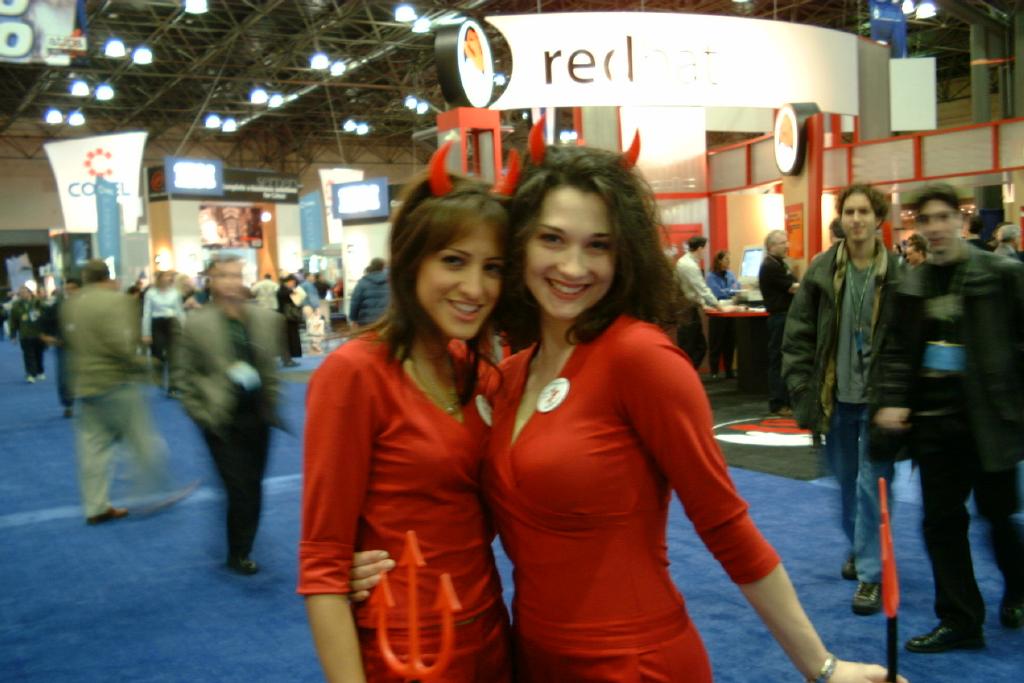
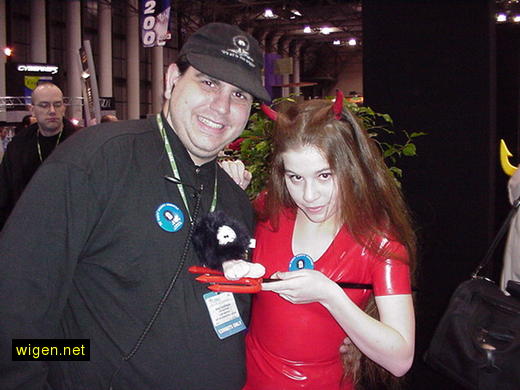
I don't know about arson, but Ceren is on fire!
IMPORTANT UPDATE: Please show your support for Ceren in this poll of Geek Babes!
Is it any wonder people think Linux users are a bunch of flaming homosexuals when its fronted by obviously gay losers like these?! BSD has a mascot who leaves us in no doubt that this is the OS for real men! If Linux had more hot chicks and gorgeous babes then maybe it would be able to compete with BSD! Hell this girl should be a model!
Linux is a joke as long as it continues to lack sexy girls like her! I mean just look at this girl! Doesn't she excite you? I know this little hottie puts me in need of a cold shower! This guy looks like he is about to cream his pants standing next to such a fox. As you can see, no man can resist this sexy little minx. Don't you wish the guy in this pic was you? Are you telling me you wouldn't like to get your hands on this ass?! Wouldn't this just make your Christmas?! Yes doctor, this uber babe definitely gets my pulse racing! Oh how I envy the lucky girl in this shot! Linux has nothing that can possibly compete. Come on, you must admit she is better than an overweight penguin or a gay looking goat! Wouldn't this be more liklely to influence your choice of OS?
With sexy chicks like the lovely Ceren you could have people queuing up to buy open source products. Could you really refuse to buy a copy of BSD if she told you to? Personally I know I would give my right arm to get this close to such a divine beauty!
Don't be a fag! Join the campaign for more cute open source babes today!
$Id: ceren.html,v 9.0 2004/08/01 16:01:34 ceren_rocks Exp $ -
Why FORTRAN makes people think FORTRAN-66 (or 77)
The p/o'd response basically sounds like "He's equating Fortran with FORTRAN-66 (or 77)".
I know that I do this too. When someone says "It's written in FORTRAN" I don't think Fortran-95, I think FORTRAN-77... and I'm usually right.
I suspect that there are two reasons for this:
- FORTRAN-77 was the big thing during FORTRAN's heyday, so most of the legacy FORTRAN code out there is FORTRAN-77.
- For a long time, the best Free Software FORTRAN compilers out there (g77, f2c) have been FORTRAN-77 compilers. g95 is still fairly young.
-
Why FORTRAN makes people think FORTRAN-66 (or 77)
The p/o'd response basically sounds like "He's equating Fortran with FORTRAN-66 (or 77)".
I know that I do this too. When someone says "It's written in FORTRAN" I don't think Fortran-95, I think FORTRAN-77... and I'm usually right.
I suspect that there are two reasons for this:
- FORTRAN-77 was the big thing during FORTRAN's heyday, so most of the legacy FORTRAN code out there is FORTRAN-77.
- For a long time, the best Free Software FORTRAN compilers out there (g77, f2c) have been FORTRAN-77 compilers. g95 is still fairly young.
-
customization
feh, too much work. i'd rather distract myself with emacs.
-
Re:OOo is for the weak.