Slashdot Mirror
Domain: gnu.org
Stories and comments across the archive that link to gnu.org.
Comments · 13,360
-
Re:please explain>>Answer: Is your work a derivative of the
>>GPLed code or not? Derivative works must also be
>>GPLed. I'm inclined to think that the
>>situation you describe would be a pretty clear
>>example of a derivative work.>Then so would the binary drivers of all the
>vendors. Wrong.>If the parent's program is a binary _patch_ , it
>doesn't have to be GPLed. The recipient is free to
>download the original (unpatched) code under GPL.
This is addressed in the FAQ for the GPL: Can you distribute your changes as a diff to the original GPLed code, rather than distributing the source to the full program? No. So, wheather you are distributing your patch as a diff against the source, or as a binary patch, you must distribute all the source to what the end user runs, if you choose to distribute at all.
So, what's wrong with your logic about binary drivers? I haven't a clue. Perhaps if you explain yourself, we can figure out where you went wrong, but I'd suggest that you spend some time studying the GPL first. Try taking the quiz, too.
-
Re:Free is a subset of Open?
Well, here is a good place to start.
Note that this page doesn't mention using the capital 'F' to distinguish between the two definitions of "free." It's a common convention but I'm not sure where or how it started.
Both Freedom 1 and Freedom 3 require that software be Open Source in order for it to be Free.
-
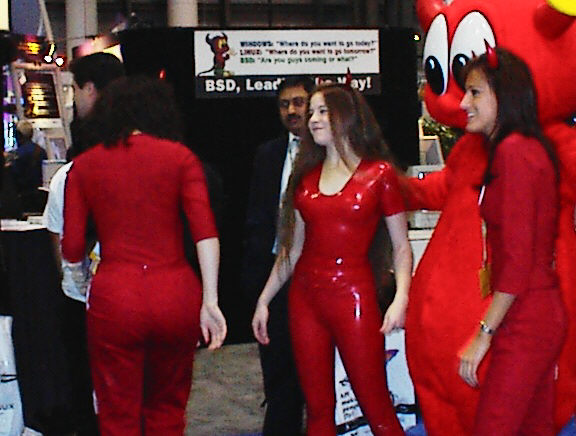
BSD releases custom babe!
You just can't take Linux seriously when its fronted by losers like these. Would you buy software from them? I don't think so! You Linux groupies need to find some sexy girls like her! I mean just look at this girl! Doesn't she excite you? I know this little hottie puts me in need of a cold shower! This guy looks like he is about to cream his pants standing next to such a fox. As you can see, no man can resist this sexy little minx. I mean are you telling me you wouldn't like to get your hands on this ass?!
With sexy chicks like the lovely Ceren you could have people queuing up to buy open source products. Could you really refuse to buy a copy of BSD if she told you to? Come on, you must admit she is better than an overweight penguin or a gay looking goat! Don't you wish you could get one of these? Personally I know I would give my right arm to get this close to such a divine beauty!
Join the campaign for more cute open source babes today! -
Gosling's beef with RMS: Full DisclosureHeehee, time to dish out some dirt!
Some of you may know this already, but for those who don't, RMS and James Gosling had a feud in the 80s over Gosling's Emacs (which was a TECO Emacs workalike). Apparently, there were agreements between Gosling and several other developers to the effect that they could modify and redistribute the source to Gosling's Emacs. RMS decided to base the original GNU Emacs on Gosling's code. Apparently, this happened after Gosling decided to sell the rights to his Emacs clone to Unipress, and bitter legal threats ensued. This seems to have been one of the primary motivations for the GPL. I've never seen Gosling speak or write about the incident since. RMS gave a speech in 1986 where he recounted the incident, and he didn't have a lot of good things to say about Gosling:
"In the summer of that year, about two years ago now, a friend of mine told me that because of his work in early development of Gosling Emacs, he had permission from Gosling in a message he had been sent to distribute his version of that. Gosling originally had set up his Emacs and distributed it free and gotten many people to help develop it, under the expectation based on Gosling's own words in his own manual that he was going to follow the same spirit that I started with the original Emacs. Then he stabbed everyone in the back by putting copyrights on it, making people promise not to redistribute it and then selling it to a software-house. My later dealings with him personally showed that he was every bit as cowardly and despicable as you would expect from that history."
That speech also has a few memorable quotes, and I highly recommend you read it. I haven't heard or read RMS referring to Gosling personally since, but I believe that the incident itself has been recalled by him a few times since.
Now for my part of the disclosure: I currently attend the University of Calgary, where James Gosling is the only persona anywhere near to fame that the Computer Science department has ever produced (Theo de Raadt doesn't count, unless your definition of "produce" involves scandal and legal threats).
The above is mostly just hearsay and speculation, and should not be taken as authoritative, except the excerpt from RMS's speech.
-
Re:Gosling's RMS comments show him to be anti-Free[RMS has] taken a basic word, "free" and redefined it.
Without context, "free" has about as much objective meaning as "good." You'll find a simple description of the context in which RMS uses the word in Categories of Free and Non-Free Software. Compared to Gosling's parroted pejoratives, like "viral infection," this is a much more useful basis for discussion.
-
Re:The webserver shoulda been running apache...actually, that is actual output from the tcsh shell. I started under bash, but help actually did provide some help, so I had to switch shells
Of course, there's also this classic snippet:
Let's look at a typical novice's session with the mighty ed:
golem$ ed
?
help
?
?
?
quit
?
exit
?
bye
?
hello?
?
eat flaming death
?
^C
?
^C
?
^D
?
---
Note the consistent user interface and error reportage. Ed is
generous enough to flag errors, yet prudent enough not to overwhelm
the novice with verbosity. -
Re:Great!
There are Free open source implementations of Java already. Not quite up to the same level as the Sun's offerings yet, but it is difficult to hit a moving target...
-
Re:Great!
There are Free open source implementations of Java already. Not quite up to the same level as the Sun's offerings yet, but it is difficult to hit a moving target...
-
Libsafe protects against buffer overflow exploitsDoes anyone use Libsafe This library protects against buffer overflow vulnerabilities, and is very easy to install (basically you just install the RPM and you're done)
If more sysadmins installed this, perhaps we wouldn't have problems with so many Linux compromises? Of course it's no substitute for patching, but seems like a good additional security measure.
This is from the gnu.org software directory
The exploitation of buffer overflow and format string vulnerabilities in process stacks are a significant portion of security attacks. 'libsafe' is based on a middleware software layer that intercepts all function calls made to library functions known to be vulnerable. A substitute version of the corresponding function implements the original function in a way that ensures that any buffer overflows are contained within the current stack frame, which prevents attackers from overwriting the return address and hijacking the control flow of a running program.
The true benefit of using libsafe is protection against future attacks on programs not yet known to be vulnerable. The performance overhead of libsafe is negligible, it does not require changes to the OS, it works with existing binary programs, and it does not need access to the source code of defective programs, or recompilation or off-line processing of binaries.
-
Imagine...
...a beowulf cluster of self-fulfilling
From: http://www.gnu.org/fun/jokes/lawyers.html
A man went to a brain store to get some brain for dinner. He sees a sign remarking on the quality of proffesional brain offerred at this particular brain store. So he asks the butcher:
"How much for Engineer brain?"
"3 dollars an ounce."
"How much for Computer Scientist brain?"
"4 dollars an ounce."
"How much for lawyer brain?"
"100 dollars an ounce."
"Why is lawyer brain so much more?"
"Do you know how many lawyers you need to kill to get one ounce of brain?" -
So...
...do they like lawyers or not?
-
texinfoTexinfo is used to make printed manuals and online docs for GNU programs. It uses a simple, Scribe-like syntax and is implemented as TeX macros (for printing) and as a standalone C program for conversion to online docs (HTML or GNU Info format). There's an Emacs mode for editing it that works pretty well. It's about the easiest thing I can think of.
-
Re:Why is DRM bad?
I can see that you're not a troll by reading your comment history. This is a common question that has a simple answer:
Read the above two links, and see if you don't get the idea. It's not about the content, or access to it. It's about freedoms that we're not willing to give up. Hardware-controlled DRM for content distribution is just one step away from hardware-level control over what software you can and can't install on your machine. Imagine a future where you don't have sufficient priviledges to install Mozilla (for example) on your home computer. Should they be the ones determining what I can and can't install on my own computer? No. That's my decision. This is the problem with "trusted" computing.
-
Choice leaves freedom unsatisfied.
I think this thread exemplifies the reason why the FSF asks people to consider giving GNU a share of the credit (not just the Linux kernal) and encourage people to teach those who join our community to value software freedom.
Having a choice in programs is a far weaker criteria than having freedom. One can have two proprietary programs to choose from (XNews and Microsoft Outlook, for news reading) and choice is satisfied. More choices might be preferable, but one can't complain that there are no choices available. So if we focus on software choice we're less likely to think anything is wrong so long as proprietors serve our needs. Software freedom, on the other hand, remains unsatisfied with these two choices. It isn't until one introduces free software like Pan, slrn, and Mozilla that one can begin to satisfy the desire to share and modify software and build self-sufficient communities around these freedoms. We can provide choice for ourselves if we have the freedom to do so.
One of the most underrated FSF essays I've read is the one describing the difference between the free software and open source movements. I highly suggest reading it, whether one is familiar with these movements or not. The story it retells about what happens when we dismiss software freedom and accept mere openness (what happened at the "Open Source Developers Day" meeting in August 1998) is instructive and the logic about why we should value software freedom (in the section called "Fear of Freedom") is compelling.
-
Choice leaves freedom unsatisfied.
I think this thread exemplifies the reason why the FSF asks people to consider giving GNU a share of the credit (not just the Linux kernal) and encourage people to teach those who join our community to value software freedom.
Having a choice in programs is a far weaker criteria than having freedom. One can have two proprietary programs to choose from (XNews and Microsoft Outlook, for news reading) and choice is satisfied. More choices might be preferable, but one can't complain that there are no choices available. So if we focus on software choice we're less likely to think anything is wrong so long as proprietors serve our needs. Software freedom, on the other hand, remains unsatisfied with these two choices. It isn't until one introduces free software like Pan, slrn, and Mozilla that one can begin to satisfy the desire to share and modify software and build self-sufficient communities around these freedoms. We can provide choice for ourselves if we have the freedom to do so.
One of the most underrated FSF essays I've read is the one describing the difference between the free software and open source movements. I highly suggest reading it, whether one is familiar with these movements or not. The story it retells about what happens when we dismiss software freedom and accept mere openness (what happened at the "Open Source Developers Day" meeting in August 1998) is instructive and the logic about why we should value software freedom (in the section called "Fear of Freedom") is compelling.
-
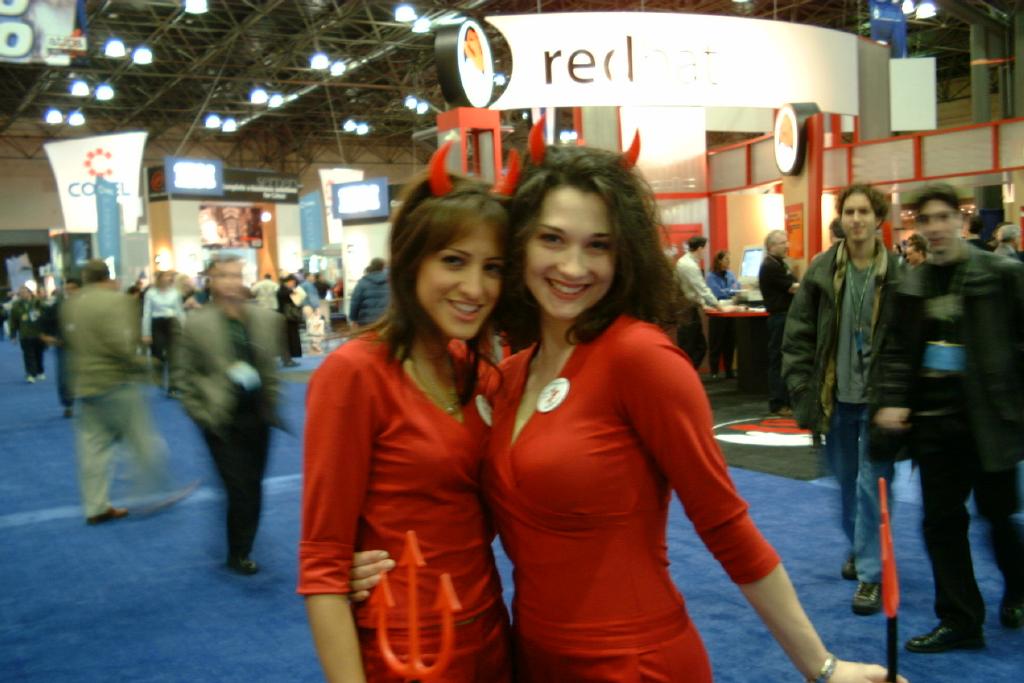
Increase the babe cycle!
Is it any wonder people think Linux users are a bunch of flaming homosexuals when its fronted by obviously gay losers like these?! BSD has a mascot who leaves us in no doubt that this is the OS for real men! If Linux had more hot chicks and gorgeous babes then maybe it would be able to compete with BSD! Hell this girl should be a model!
Linux is a joke as long as it continues to lack sexy girls like her! I mean just look at this girl! Doesn't she excite you? I know this little hottie puts me in need of a cold shower! This guy looks like he is about to cream his pants standing next to such a fox. As you can see, no man can resist this sexy little minx. I mean are you telling me you wouldn't like to get your hands on this ass?! Wouldn't this just make your Christmas?! Yes doctor, this uber babe definitely gets my pulse racing! Oh how I envy the lucky girl in this shot! Linux has nothing that can possibly compete. Come on, you must admit she is better than an overweight penguin or a gay looking goat! Wouldn't this be more liklely to influence your choice of OS?
With sexy chicks like the lovely Ceren you could have people queuing up to buy open source products. Could you really refuse to buy a copy of BSD if she told you to? Don't you wish you could get one of these? Personally I know I would give my right arm to get this close to such a divine beauty!
Don't be a fag! Join the campaign for more cute open source babes today! -
Not exactly.
There are two reasons this decision is somewhat controversial for those of us maintaining FSF-related projects:- The decisions are made in a closed environment.
- The Savannah admins have not demonstrated sufficient competence nor responsiveness. (Not meant to be a personal attack; I think they only have a few part-time volunteers.)
For example, GCC is under constant pressure by RMS to move from its own server (that happens to be hosted at Red Hat) and onto Savannah. But this pressure has been resisted for the same reasons, and it will continue to be resisted regardless of what "packaged development environment" Savannah is using.
With regard to the pair above, (1) the GCC maintainers have never been invited to share their concerns with the Savannah maintainers; when they speak up, they're ignored, and (2) Savannah gets fscked up on a regular basis, and complaints are ignored. For example, Savannah is supposed to be mirroring the GCC CVS repository, but it falls over constantly, leading to even higher load on the GCC servers as users switch over. The Savannah team has a long long way to go if they want to hold themselves up as a reliable open development site.
-
Re:Richard Stallman in hospital
I once watched a video of him making a speech and his arm was in a cast or splint at the time it was recorded.
His biography mentions at least one ankle injury.
I get the impression he isn't a very careful man. -
RMSs history on security
For Stallman, the opposition to security was both ethical and practical. On the ethical side, Stallman pointed out that the entire art of hacking relied on intellectual openness and trust. On the practical side, he pointed to the internal structure of ITS being built to foster this spirit of openness, and any attempt to reverse that design required a major overhaul. -- Free as in Freedom
The decision to move to GForge was made by Bradley Kuhn and the system adminitrators, according to Richard Stallman. They considered Savane could not be made secure enough. -- Sylvain Beucler, 2004
Seems like Stallman has lost sight of his roots! -
Top Geek Girl awards!
Is it any wonder people think Linux users are a bunch of flaming homosexuals when its fronted by obviously gay losers like these?! BSD has a mascot who leaves us in no doubt that this is the OS for real men! If Linux had more hot chicks and gorgeous babes then maybe it would be able to compete with BSD! Hell this girl should be a model!
Linux is a joke as long as it continues to lack sexy girls like her! I mean just look at this girl! Doesn't she excite you? I know this little hottie puts me in need of a cold shower! This guy looks like he is about to cream his pants standing next to such a fox. As you can see, no man can resist this sexy little minx. I mean are you telling me you wouldn't like to get your hands on this ass?! Wouldn't this just make your Christmas?! Yes doctor, this uber babe definitely gets my pulse racing! Oh how I envy the lucky girl in this shot! Linux has nothing that can possibly compete. Come on, you must admit she is better than an overweight penguin or a gay looking goat! Wouldn't this be more liklely to influence your choice of OS?
With sexy chicks like the lovely Ceren you could have people queuing up to buy open source products. Could you really refuse to buy a copy of BSD if she told you to? Don't you wish you could get one of these? Personally I know I would give my right arm to get this close to such a divine beauty!
Don't be a fag! Join the campaign for more cute open source babes today! -
Re:Free not Free Enough
The freedom he is talking about is the one defined by the Free software foundation's free software definition.
Others are "free" to choose how they want to distribute thier property, but that isn't good enough for him, he wants it to be free on his and only his terms.
Oh, but they're not only "free" to choose how *they* distribute "their property". They also dictate that *you* shall not distribute "your property". Copyright is not a basic property right as you seem to be implying, it's something originally created to encourage creating various kinds of works. While property rights seem to be a very basic right to human beings, exercised probably since prehistoric times, copyright is a fairly recent invention. The free software foundation has a pretty insightful essay on copyright as well, found here.
What exactly is freedom is naturally an issue of much debate, but you cannot draw conclusions from what applies to tangibles here and you must acknowledge that there must be limits placed to individual freedom so that they not stomp on the freedoms of others. A dictator like Saddam Hussein was indeed free to do whatever he please and arresting a murderer is indeed punishing him for exercising his free will. In the same way giving the author total control of his work is restricting the freedoms of others.
In my opinion, freedom isn't about being able to restrict the freedom of others, it is not being bound by arbitrary restrictions placed by others. Hurting others may be part of free will but it's not a freedom that needs any protection.
-
Re:Free not Free Enough
The freedom he is talking about is the one defined by the Free software foundation's free software definition.
Others are "free" to choose how they want to distribute thier property, but that isn't good enough for him, he wants it to be free on his and only his terms.
Oh, but they're not only "free" to choose how *they* distribute "their property". They also dictate that *you* shall not distribute "your property". Copyright is not a basic property right as you seem to be implying, it's something originally created to encourage creating various kinds of works. While property rights seem to be a very basic right to human beings, exercised probably since prehistoric times, copyright is a fairly recent invention. The free software foundation has a pretty insightful essay on copyright as well, found here.
What exactly is freedom is naturally an issue of much debate, but you cannot draw conclusions from what applies to tangibles here and you must acknowledge that there must be limits placed to individual freedom so that they not stomp on the freedoms of others. A dictator like Saddam Hussein was indeed free to do whatever he please and arresting a murderer is indeed punishing him for exercising his free will. In the same way giving the author total control of his work is restricting the freedoms of others.
In my opinion, freedom isn't about being able to restrict the freedom of others, it is not being bound by arbitrary restrictions placed by others. Hurting others may be part of free will but it's not a freedom that needs any protection.
-
Re:Definitely needs a non-commercial Windows licen
{or not released at all, just used within an organisation}
That's a myth; but one that even the FSF has helped spread (although not in the exact same form).
However, actually reading the text of the GPL will reveal that there is no special exception for organizations (or corporations). According to the license, you must apply the GPL whenever you "distribute" the modified software.
Some organizations have thousands of locations and a million members. To give a modified program to all those people would undeniably qualify as "distribution"; the fact that they're all "internal users" is irrelevant.
(Note that copyright law also has no exception for members of an organization) -
Re:Definitely needs a non-commercial Windows licen
{or not released at all, just used within an organisation}
That's a myth; but one that even the FSF has helped spread (although not in the exact same form).
However, actually reading the text of the GPL will reveal that there is no special exception for organizations (or corporations). According to the license, you must apply the GPL whenever you "distribute" the modified software.
Some organizations have thousands of locations and a million members. To give a modified program to all those people would undeniably qualify as "distribution"; the fact that they're all "internal users" is irrelevant.
(Note that copyright law also has no exception for members of an organization) -
Re:Y'know
Your analogy of software security to (presumably) physical world "invasion" tools (e.g., lock picks, etc.) causes me to make a prediction.
RMS already made that prediction, in The Right To Read (which is a really interesting read, by the way). The relevant passage:
There were ways, of course, to get around the SPA and Central Licensing. They were themselves illegal. Dan had had a classmate in software, Frank Martucci, who had obtained an illicit debugging tool, and used it to skip over the copyright monitor code when reading books. But he had told too many friends about it, and one of them turned him in to the SPA for a reward (students deep in debt were easily tempted into betrayal). In 2047, Frank was in prison, not for pirate reading, but for possessing a debugger.
Dan would later learn that there was a time when anyone could have debugging tools. There were even free debugging tools available on CD or downloadable over the net. But ordinary users started using them to bypass copyright monitors, and eventually a judge ruled that this had become their principal use in actual practice. This meant they were illegal; the debuggers' developers were sent to prison.
Programmers still needed debugging tools, of course, but debugger vendors in 2047 distributed numbered copies only, and only to officially licensed and bonded programmers. The debugger Dan used in software class was kept behind a special firewall so that it could be used only for class exercises.
His version of the prediction is a bit different, but it's the same idea. If you read through the entire story you will find an astonishing list of seemingly absurd predictions which are coming true one at a time. It's a bit unnerving to read, really.
-
Re:Because I like PHP was: Um...
neither Java nor Flash are Open Source and as such I don't care to learn them unless I specifically get paid for it.
Sounds like you need to check out OpenSWF, Kaffe, SableVM, GNU Classpath, GCJ, etc etc. -
Re:Because I like PHP was: Um...
neither Java nor Flash are Open Source and as such I don't care to learn them unless I specifically get paid for it.
Sounds like you need to check out OpenSWF, Kaffe, SableVM, GNU Classpath, GCJ, etc etc. -
Re:I don't think so
You see, while Microsoft clearly doesn't own ECMA C#, Sun owns the Java platform and large chunks of its implementation, with no free alternatives.
No free alternatives? Who is spreading FUD now?
http://www.kaffe.org/
http://www.japhar.org/
http://www.blackdown.org/java-linux.html
http://www.gnu.org/software/classpath/classpath.ht ml
http://gcc.gnu.org/java/
Sure, a lot of these projects are far behind the official Java in version and capabilities today, but if Sun would suddenly change the licensing or start to charge people for using Java, there are a huge amount of companies (IBM, Oracle, BEA...) with too much invested in Java, and a huge number of experienced Java programmers. Don't you think they would sponsor these projects to quickly get a viable open source alternative up and running?
-
Re:I don't think so
You see, while Microsoft clearly doesn't own ECMA C#, Sun owns the Java platform and large chunks of its implementation, with no free alternatives.
No free alternatives? Who is spreading FUD now?
http://www.kaffe.org/
http://www.japhar.org/
http://www.blackdown.org/java-linux.html
http://www.gnu.org/software/classpath/classpath.ht ml
http://gcc.gnu.org/java/
Sure, a lot of these projects are far behind the official Java in version and capabilities today, but if Sun would suddenly change the licensing or start to charge people for using Java, there are a huge amount of companies (IBM, Oracle, BEA...) with too much invested in Java, and a huge number of experienced Java programmers. Don't you think they would sponsor these projects to quickly get a viable open source alternative up and running?
-
Rethinking intellectual property
I'm all for a resistance to things like the RIAA, companys that abuse copyright law, and absurd notions of what constitutes intellectual property.
However I feel that when people use P2P networks as the only way to fight back, but don't use things like creative commons or the the GNU than they are really hurting the resistance movement that people have created to fight back aginst abuse copyright laws, and absurd notions of intellecutal property.
IMO There has to be more reason to use P2P than "I don't have to pay for it," there has to be the desire to make a political or philosophical statement.
Anyway, I'm just preaching to the converted here... -
Re:The Langauge should be up to the Developer ...Sure, but what about core projects? For example, the GNOME project decides to write a GUI log reader. Also, if they rewrite core components of GNOME and don't want to use C, which language are they going to use? What they want is a language that will be used for such projects, a standard language for the project. Take for example the GNU project, in their coding guidelines, they advocate the usage of the C language. The requirements for that language GNOME wants are as follow:
- High-level language
- Safe language
- Good programmer productivity
- Good library
- Widely known
- Reasonably fast
- Free software
-
BSD uses hot geek babe to beat Linux
Is it any wonder people think Linux users are a bunch of flaming homosexuals when its fronted by obviously gay losers like these?! BSD has a mascot who leaves us in no doubt that this is the OS for real men! If Linux had more hot chicks and gorgeous babes then maybe it would be able to compete with BSD! Hell this girl should be a model!
Linux is a joke as long as it continues to lack sexy girls like her! I mean just look at this girl! Doesn't she excite you? I know this little hottie puts me in need of a cold shower! This guy looks like he is about to cream his pants standing next to such a fox. As you can see, no man can resist this sexy little minx. I mean are you telling me you wouldn't like to get your hands on this ass?! Wouldn't this just make your Christmas?! Yes doctor, this uber babe definitely gets my pulse racing! Oh how I envy the lucky girl in this shot! Linux has nothing that can possibly compete. Come on, you must admit she is better than an overweight penguin or a gay looking goat! Wouldn't this be more liklely to influence your choice of OS?
With sexy chicks like the lovely Ceren you could have people queuing up to buy open source products. Could you really refuse to buy a copy of BSD if she told you to? Don't you wish you could get one of these? Personally I know I would give my right arm to get this close to such a divine beauty!
Don't be a fag! Join the campaign for more cute open source babes today! -
Linux considering response to BSD Babe
Is it any wonder people think Linux users are a bunch of flaming homosexuals when its fronted by obviously gay losers like these?! BSD has a mascot who leaves us in no doubt that this is the OS for real men! If Linux had more hot chicks and gorgeous babes then maybe it would be able to compete with BSD! Hell this girl should be a model!
Linux is a joke as long as it continues to lack sexy girls like her! I mean just look at this girl! Doesn't she excite you? I know this little hottie puts me in need of a cold shower! This guy looks like he is about to cream his pants standing next to such a fox. As you can see, no man can resist this sexy little minx. I mean are you telling me you wouldn't like to get your hands on this ass?! Wouldn't this just make your Christmas?! Yes doctor, this uber babe definitely gets my pulse racing! Oh how I envy the lucky girl in this shot! Linux has nothing that can possibly compete. Come on, you must admit she is better than an overweight penguin or a gay looking goat! Wouldn't this be more liklely to influence your choice of OS?
With sexy chicks like the lovely Ceren you could have people queuing up to buy open source products. Could you really refuse to buy a copy of BSD if she told you to? Don't you wish you could get one of these? Personally I know I would give my right arm to get this close to such a divine beauty!
Don't be a fag! Join the campaign for more cute open source babes today! -
BSD patents hot geek chicks!
Is it any wonder people think Linux users are a bunch of flaming homosexuals when its fronted by obviously gay losers like these?! BSD has a mascot who leaves us in no doubt that this is the OS for real men! If Linux had more hot chicks and gorgeous babes then maybe it would be able to compete with BSD! Hell this girl should be a model!
Linux is a joke as long as it continues to lack sexy girls like her! I mean just look at this girl! Doesn't she excite you? I know this little hottie puts me in need of a cold shower! This guy looks like he is about to cream his pants standing next to such a fox. As you can see, no man can resist this sexy little minx. I mean are you telling me you wouldn't like to get your hands on this ass?! Wouldn't this just make your Christmas?! Yes doctor, this uber babe definitely gets my pulse racing! Oh how I envy the lucky girl in this shot! Linux has nothing that can possibly compete. Come on, you must admit she is better than an overweight penguin or a gay looking goat! Wouldn't this be more liklely to influence your choice of OS?
With sexy chicks like the lovely Ceren you could have people queuing up to buy open source products. Could you really refuse to buy a copy of BSD if she told you to? Don't you wish you could get one of these? Personally I know I would give my right arm to get this close to such a divine beauty!
Don't be a fag! Join the campaign for more cute open source babes today! -
Just in: Linux useless without Sexy Mascot
Is it any wonder people think Linux users are a bunch of flaming homosexuals when its fronted by obviously gay losers like these?! BSD has a mascot who leaves us in no doubt that this is the OS for real men! If Linux had more hot chicks and gorgeous babes then maybe it would be able to compete with BSD! Hell this girl should be a model!
Linux is a joke as long as it continues to lack sexy girls like her! I mean just look at this girl! Doesn't she excite you? I know this little hottie puts me in need of a cold shower! This guy looks like he is about to cream his pants standing next to such a fox. As you can see, no man can resist this sexy little minx. I mean are you telling me you wouldn't like to get your hands on this ass?! Wouldn't this just make your Christmas?! Yes doctor, this uber babe definitely gets my pulse racing! Oh how I envy the lucky girl in this shot! Linux has nothing that can possibly compete. Come on, you must admit she is better than an overweight penguin or a gay looking goat! Wouldn't this be more liklely to influence your choice of OS?
With sexy chicks like the lovely Ceren you could have people queuing up to buy open source products. Could you really refuse to buy a copy of BSD if she told you to? Don't you wish you could get one of these? Personally I know I would give my right arm to get this close to such a divine beauty!
Don't be a fag! Join the campaign for more cute open source babes today! -
BSD authorized hot babe!
Is it any wonder people think Linux users are a bunch of flaming homosexuals when its fronted by obviously gay losers like these?! BSD has a mascot who leaves us in no doubt that this is the OS for real men! If Linux had more hot chicks and gorgeous babes then maybe it would be able to compete with BSD! Hell this girl should be a model!
Linux is a joke as long as it continues to lack sexy girls like her! I mean just look at this girl! Doesn't she excite you? I know this little hottie puts me in need of a cold shower! This guy looks like he is about to cream his pants standing next to such a fox. As you can see, no man can resist this sexy little minx. I mean are you telling me you wouldn't like to get your hands on this ass?! Wouldn't this just make your Christmas?! Yes doctor, this uber babe definitely gets my pulse racing! Oh how I envy the lucky girl in this shot! Linux has nothing that can possibly compete. Come on, you must admit she is better than an overweight penguin or a gay looking goat! Wouldn't this be more liklely to influence your choice of OS?
With sexy chicks like the lovely Ceren you could have people queuing up to buy open source products. Could you really refuse to buy a copy of BSD if she told you to? Don't you wish you could get one of these? Personally I know I would give my right arm to get this close to such a divine beauty!
Don't be a fag! Join the campaign for more cute open source babes today! -
Re:hmm
I wrote that software, cheers for the pimping! As a small note though you should use either the GNU Address, or the gnump3d.org domain.
Since it became part of the GNU Project everything was migrated away from SourceForge.
-
Re:Just curiousI do write scientific software and we use a bunch of x86 harware under Linux, and we are evaluating Dual G5, but the Apple linker gives us trouble
ld: xxx.o relocation overflow for relocation entry 587 in section (__TEXT,__text) (displacement too large)
So we're looking at Linux with its pile of out of the box working dev tools.
Laurent
PS: I'll never see the MaxOS GUI, all boxes are accessed through an xterm under ssh
-
Re:Cost Them Money
Isn't "Hard Radio" what we are going to call legacy radio hardware after Soft Radio replaces it. ? You know, like analog watches and film cameras ?
-
If only they could fix their linker...As mentionned on the GCC list
ld: xxx.o relocation overflow for relocation entry 587 in section (__TEXT,__text) (displacement too large)
I guess that would make at least me an happier MacOSX developper (even if with Ada -
Distribution vs Use
In this case Sun is probably taking advantage of the "system libraries" exception in GPL section 3
As another poster pointed out, the relevant parts of GNOME are actually LGPL. This is why KDE/QT is still not fully embraced by much of the community -- because QT is licensed under the GPL (on linux) and therefore cannot be used for proprietary apps. You can purchase a commercial license for QT, but I'm not sure if that would extend to the rest of KDE whose license must remain compatible with the GPL version.
But you make a good point -- in fact, it seems that it's not just "system libraries", but also compiler libraries (which seems like a loophole if someone distributes a proprietary compiler package with a bunch of proprietary libraries).
From the GPL FAQ:
I'm writing a Windows application with Microsoft Visual C++ (or Visual Basic) and I will be releasing it under the GPL. Is dynamically linking my program with the Visual C++ (or Visual Basic) run-time library permitted under the GPL?
Yes, because that run-time library normally accompanies the compiler or interpreter you are using.
Another aspect I've been pondering is defining "distribution" versus "usage". If the GPL only restricts distribution, then what is to prevent the creation of a program (to be invoked by users) that automatically downloads (from various sources) and combines GPL code and some proprietary code?
It seems like a loophole that I'm sure someone else has thought of, so I'm probably missing something. But without restricting certain modification or "usage" of a program, I'm not sure how this could be overcome. -
Re:XFree86
It's not really about credit, but the form of the credit and technically incompatible licenses. GPL provides for credit in the copyright line as well as prominent notices of change.
From the GPL:
You must cause the modified files to carry prominent notices stating that you changed the files and the date of any change.
From the GPL FAQ:
I want to get credit for my work. I want people to know what I wrote. Can I still get credit if I use the GPL?
You can certainly get credit for the work. Part of releasing a program under the GPL is writing a copyright notice in your own name (assuming you are the copyright holder). The GPL requires all copies to carry an appropriate copyright notice.
I agree that it is a terrible shame that so many "free" licenses are subtley incompatible with one another, but such is the nature of law. -
Re:XFree86
It's not really about credit, but the form of the credit and technically incompatible licenses. GPL provides for credit in the copyright line as well as prominent notices of change.
From the GPL:
You must cause the modified files to carry prominent notices stating that you changed the files and the date of any change.
From the GPL FAQ:
I want to get credit for my work. I want people to know what I wrote. Can I still get credit if I use the GPL?
You can certainly get credit for the work. Part of releasing a program under the GPL is writing a copyright notice in your own name (assuming you are the copyright holder). The GPL requires all copies to carry an appropriate copyright notice.
I agree that it is a terrible shame that so many "free" licenses are subtley incompatible with one another, but such is the nature of law. -
What about Software Radio
What would a requirement to use the broadcast flag mean for a software radio like the GNU Radio? It seems to me that once software radio matures to the point where we can interpret these transmissions in real-time then all the software has to do is ignore the broadcast flag. Or do will they try to require all software to adhere to this flag as well?
-
Re:XFree86
The GPL applies to the entire work, but ONLY the entire work. It does not apply to stuff that the licensor did not create. Specifically, a KDE program under the GPL does not virally infect the X11 libraries. They are SEPARATE works.
Of course a library doesn't become GPL-ized just because a GPL program links against it. But the "combined work" consisting of the program + shared libraries inherits ALL of the licenses of its components. This is at least the interpretation of GNU, as stated in the preamble to the LGPL:
When a program is linked with a library, whether statically or using a shared library, the combination of the two is legally speaking a combined work, a derivative of the original library. The ordinary General Public License therefore permits such linking only if the entire combination fits its criteria of freedom.
As you point out, the existence of several libraries with the same API but under different licenses weakens this claim. But I suspect most Linux distributions intend to respect it in order to take the most conservative path (legally speaking), so as not to become a test case for this claim in court.
Gnome runs on Solaris. Solaris ships with a GPL-incompatible proprietary Openwindows X11 implementation. Yet Sun also ships with GPL applications (like Gnome) that link to it.
In this case Sun is probably taking advantage of the "system libraries" exception in GPL section 3:
However, as a special exception, the source code distributed need not include anything that is normally distributed (in either source or binary form) with the major components (compiler, kernel, and so on) of the operating system on which the executable runs, unless that component itself accompanies the executable.
I admit that I don't see how they are getting around the "unless that component itself accompanies the executable" clause. But in any case, your statement that the GPL applies only to an executable, and not to the combination of executable + shared libraries, is at best undecided.
-
Pine Problems and Alternatives
It's not that pine is not GPL, it's that pine is altogether Not Free Software. Specifically, the University of Washington will not allow anyone to distribute modified versions, they've even threatened to sue people who do this with older versions of Pine. This makes it hard to work the software into a distribution like Red Hat, and even harder to want to.
Personally, I use Mutt, and I love it. Other people seem equally pleased with elm. With both of these clients, "all you need is an xterm".
If you really prefer Pine, there are two projects to create an Free replacement for it: Hydrant and OSERP. I don't know how far along and usable either project is. If you just miss Pico, there's an excellent Free clone called Nano, which is very usable and included in most Linux distros already. -
Pine Problems and Alternatives
It's not that pine is not GPL, it's that pine is altogether Not Free Software. Specifically, the University of Washington will not allow anyone to distribute modified versions, they've even threatened to sue people who do this with older versions of Pine. This makes it hard to work the software into a distribution like Red Hat, and even harder to want to.
Personally, I use Mutt, and I love it. Other people seem equally pleased with elm. With both of these clients, "all you need is an xterm".
If you really prefer Pine, there are two projects to create an Free replacement for it: Hydrant and OSERP. I don't know how far along and usable either project is. If you just miss Pico, there's an excellent Free clone called Nano, which is very usable and included in most Linux distros already. -
Why is PNG a good format to use?
Why is PNG a good format to use? This has already been discussed on slashdot but for those of you that are new to: PNGs
First PNG is an open standard that doesn't rely on proprietary formats like LZW for compression like in Gif that is owned by Unisys. PNG has a better compresses algorithm than GIF anyway.
PNG is a loss-less compression method meaning that you open and save and get back to original data. Think of it like a ZIP file, you can always get the data back from a ZIP files as you stored it in.
PNG supports three main image types: true color, grayscale and palette-based. Good for Normal Pictures, Documents and Web Based Images. -
But it isn't even _compatible_ with GPL!
Nobody said it had to be GPL to be acceptable, but the CPL isn't even compatible with the GPL!
It seems to be a minor technical issue, here's the text from GNU:
This is a free software license but it is incompatible with the GPL.
The Common Public License is incompatible with the GPL because it has various specific requirements that are not in the GPL.
For example, it requires certain patent licenses be given that the GPL does not require. (We don't think those patent license requirements are inherently a bad idea, but nonetheless they are incompatible with the GNU GPL.)
So it "shouldn't" be an issue, but as soon as you actually mix GPL and CPL you start running into trouble. Why else do you think SWT-Qt never got released?
-
"Needs clarification"
Why don't you actually go read the GPL?
It's not that long, or hard to understand, and while I can conceive of some obscure edge-case scenarios that a simple reading of the license wouldn't be sufficient to explain, this isn't one of them.
As for the scenario presented, here's what the GPL says:
When distributing something GPLed that you've modified, you must other provide the source at the same time, or provide a written offer to provide the source to any third party. (When I ordered Debian disks from LSL years ago, they printed their GPL compliance written offer in small print on the front of the CD) Note that this isn't "any third party who somehow gets a copy of the binary" or "any third party to whom I sold a copy of the binary". (sect. 3a and 3b)
When redistributing binaries of something you haven't modified, you need to do the same - also provide the source too, or a written offer. There is a very narrow exception for noncommercial distribution in this case: you may pass along a written offer from someone else instead of extending your own offer, so long as you didn't modify the source. However, once you're making money selling the binary, you can't pass someone else's offer along. (sect. 3a, 3b, and 3c - see also this explanation of the "written offer valid for any third party" bit)
Note that because of the annoyance factor present in maintaining written offers, especially since now people will almost always make their GPL-licensed source available over the internet, many people will license their code under a variation of the GPL, which is still GPL-compatible: "GPL with unmodified binary distribution allowed". Basically, this means that anyone is allowed to dispense with the written offer stuff if they only distribute the same binary as the original author does.