Slashdot Mirror
Domain: google.com
Stories and comments across the archive that link to google.com.
Comments · 95,278
-
Well, now the "refine theory" part of science
Just remember that 10 years ago "skeptics"(how exactly they define that term, I don't know) were pointing to how little ice was being lost from Antarctica in the preceding 5 years as indisputable evidence of a hoax.
As evidence that people believed this: http://www.google.com/url?sa=t&rct=j&q=antarctica+gaining+ice&source=newssearch&cd=1&ved=0CDMQqQIwAA&url=http%3A%2F%2Fwww.csmonitor.com%2F2002%2F0118%2Fp02s01-usgn.html&ei=Yko0T6zmIYrXtgegk4mwAg&usg=AFQjCNHtA3NtryZuUSi1k3FLEueaP9NWfg
Whoops, right?
-
Re:The Obvious Answer
I'm happy that your personal experience marks you as an outlier. This does not alter the fact that folic acid supplements and breastfeeding should be encouraged. "Theory of the day" my arse.
I'm not saying that they shouldn't be encouraged, indeed they should. However, that doesn't mean that they are the cause of more intelligent children.
-
Re:Yes
Even if they don't admit it, I'm pretty sure Google already has this if you're searching while logged in.
Uh, of course they do, and they do admit it; it's very clearly listed on their Privacy FAQ.
What they're asking here is the list of all the websites you visit, coming from their search engines or not. That's why they need a browser extension.
-
Nuclear Waste not a problem.
-
Fairewind comments on AP1000
"The NRC thinks the probability of three nuclear reactors having a meltdown within 3 days is ZERO. They chose this to minimize the cost of development of the AP1000 reactor."
That's because the NRC is a sock puppet for the Commercial Nuclear Industry.
https://plus.google.com/107839599438746451936/posts/gEhU26JjGWV
-
Try the #1 Linux contributor or the #1 Linux users
Intel was the top contributor to Linux 3.0 (by lines) (source)
IBM is in there, too at #8
Google pushed the Linux kernel and WebKit into an uncountable number of handhelds
Apple deploys Webkit, too, on a smaller number of handhelds
Amazon deploys Android, too (just without Market support), and they use Linux in their cloud offerings.
If you hate Microsoft, give in to your anger and join Oracle (there are a lot of angry JCP and OpenSolaris fans but hey, they made that Linux list, too!)
Remember those handhelds that run the Linux kernel and/or WebKit?
- Broadcom
- Atheros (are they are part of Qualcomm now? You can check out Qualcomm, part of "Qualdroid")
- Marvell
all made the top Linux contributor list, too.
I'll assume that other posters will cover the Red Hat and Novell bases.
-
Re:Worst idea ever.
I guess that Facebook must be the reason that Google has not had increasing profits? (Hint: They have been)
Marketing dollars do not immediately go up with a new ad platform (see iAds for an example of an unsuccessful launch), but Facebook provides a completely different medium for marketing. Even ignoring that, the amount put into marketing does change (both up and down with the economy), and with that wealth is created and spread.
Additionally, Facebook has created wealth in ways other than pure ads. For instance, the various games like Farmville out there that make money on the users through their own ads as well as microtransactions (which I believe Facebook gets a cut of).
That is indeed new wealth, and wealth that did not exist there before.
-
Re:What about drag
And your point is... what, exactly?
Most things that fly require a computer to constantly make tiny adjustments. Try throwing a dead duck, and observing its aerodynamic qualities.
The F-117 might well be a "flying brick"-- but that is a term that describes an oversized power plant used to compensate for bad aerodynamics and has nothing to do with management of the control surfaces. There is nothing inherently bricky about fly-by-wire aircraft. Now that we have the capability to build computer controlled aircraft, we can begin to evolve our airplanes beyond the limitations of aerodynamic static stability and consider airplanes that know how to reshape their wings to match current conditions, etc. Birds manage incredibly tight turns because they reduce the stall speed of the inside wing while simultaneously reducing the drag of the outside wing. We should see UAVs that are capable of doing the same RSN.
-
Re:Frankenstein isn't mad, though
Mary Shelley wrote very early & original SF by 1818, but before her, Rétif de la Bretonne (Nicolas-Edme Rétif) wrote La découverte australe par un homme-volant: ou Le Dédale français; nouvelle très-philosophique: suivie de la Lettre d'un singe, & ca in 1781.
Rétif de la Bretonne did "arguably" not only "invent" SF, but also communism and shoe fetishism.
-
Re:EPIC
Okay, so those approximately match my first and second sharing types in my list of three. For #1, they state that they will not do this in the new policy:
We do not share personal information with companies, organizations and individuals outside of Google unless...
The "unless" includes a bunch of exceptions, which I don't see as a big deal but you may disagree. In summary, a) if you give them permission, b) if you have a domain administrator (doesn't apply to normal users), c) with a third party affiliate for "processing", which must also agree to the privacy policy (not quite sure what that means), d) if compelled to by a court.
For #2, that isn't what they meant at all by "sharing information between services". It does NOT imply that, for example, your calendar would be randomly shared on Google+. It only means that they will share data with you and you alone, across services (for example, to give you relevant results and ads). If you haven't used Google+, the sharing is very straightforward and very tightly controlled: only things you explicitly post on there get shared, and every time you share something, it explicitly asks that you nominate a group of people or individuals to share it with, and once posted, that group of people cannot be changed.
-
Re:EPIC
Maybe it is not because Google will combine the privacy policies into a single one, but also all the users data across all its services?
Yep, that's certainly the idea. Note that most of Google's existing privacy policies already did give them the ability to share user's data across all its services. For example, YouTube already shows videos that your friends share on Google+. The problem was that they were inconsistent. Google cannot currently share data from YouTube with other sites. Their new policy allows them to do that. This is all explained in their letter to U.S. Congress.
Now what exactly is the problem with this? It seems to me that if Google is going to share my data, there are three sets of people they could share it with:
- Third-party companies, such as advertisers (e.g., selling your personal data for profit)
- Your social connections (e.g., sharing your personal information without your permission)
- You (e.g., showing you ads relevant to your interests)
I see a significant harm if they were to engage in the first two. I don't really have a problem with the third. And this privacy policy specifically prevents them from doing the first two. So what this allows them to do is share my information, from one Google service to another, for the purposes of showing me relevant links and ads. In that case, where is the harm? Further, how am I worse off having, for example, Google search results informed by what YouTube videos I've been watching. It sounds like it could give me more relevant search results.
Further, I would much rather know that anything I upload to any Google service might be used by any other Google service, than have to remember a complex set of rules about which products' privacy policies allow Google to share data with which other products.
Perhaps the move will no longer let you share individual services data, like sharing your Google+ data but withhold your Calendar?
What does this mean? What do you mean by "share" in this context? Withhold your Calendar from whom? As far as I am concerned, the only people who have access to my calendar are me and Google's servers. If the Google+ app had access to my calendar (for example, it might show appointments on the side), that doesn't increase the people who have access to my calendar: It's still just me and Google's servers.
Since when did any company give you explicit control over how the data is stored on their servers? With Google's new policy, it is simple: if you use a service, your data for that service will be stored on Google and may be used by any other service within that company (and not sold to third parties). How is that harmful? How is that different to any other company?
-
Re:One more issue
Liar, I dropped 3500$ on property taxes last year here in Texas. Click the first result.
-
Re:We didn't really know how things worked before
Feedbacks are a consequence of the forcing. Both should be counted. Also, keep in mind that 2C is the difference between a glacial and interglacial period - not insignificant. Human influence is both positive (greenhouse gasses) and negative (aerosols). Damn I hope you read through this post - it took way too long to compile
Granted, they are not a coherent movement so I can't say that all skeptics have predicted global cooling. The leaders of the movement who are willing to predict anything at all have predicted or promoted global cooling. They are right of course. If CO2 is not a major driver then global cooling has indeed been imminent for the last couple decades. Here is the solar output since 1985: http://www.woodfortrees.org/plot/sidc-ssn/mean:138/from:1985
Here are examples from leaders of the skeptic movement predicting or promoting global cooling:
Joseph D'Aleo: http://en.wikipedia.org/wiki/Joseph_D'Aleo
John McLean: http://www.skepticalscience.com/mclean-exaggerating-natural-cycles.html
Christopher Monckton: http://icecap.us/images/uploads/monckton-global_warming_has_stopped.pdf
Anthony Watts: https://www.google.com/search?q=%22global+cooling%22+site%3Ahttp%3A%2F%2Fwattsupwiththat.com
Piers Corbyn: http://www.mediaite.com/tv/global-warming-skeptic-predicts-brutal-winter-warns-you-aint-seen-nothing-yet/
James Dellingpole: http://blogs.telegraph.co.uk/news/jamesdelingpole/100055500/global-cooling-and-the-new-world-order/
Don Easterbrook: http://wattsupwiththat.com/2008/12/29/don-easterbrooks-agu-paper-on-potential-global-cooling/
Henrik Svensmark http://wattsupwiththat.com/2009/09/10/svensmark-global-warming-stopped-and-a-cooling-is-beginning-enjoy-global-warming-while-it-lasts/
Alan Caruba, "An Icy End for Mankind?" Science and Environmental Policy Project, November 26, 2005; and Robert W. Felix, "Not by Fire, But by Ice: The Next Ice Age Now," Bellevue, WA: Sugarhouse Publishing.
Lawrence Solomon: http://network.nationalpost.com/NP/blogs/fpcomment/archive/2010/05/03/lawrence-solomon-arctic-ice-sets-records-in-april-could-auger-global-cooling.aspx
The only notable people missing are McIntyre, McKitrick, Spencer, and Lindzen. None of these people are willing or able to make predictions.
My prediction? We've just had the hottest La Nina on record - hotter even than all but one of the El Nino's of the previous century. La Nina's are cooler part of the ENSO. ENSO neutral 2010 was tied for hottest year on record. Even a small El Nino (warm part of ENSO) will push us into the hottest year on record. So the hottest year on record will come with the next El Nino. Probably within 2 years?
-
Re:Buy?
The first hit for gphoto2 support canon rebel t1i is http://gphoto.sourceforge.net/doc/remote/ so either you picked a really bad example or you're just making shit up.
The quality of the results usually reflect the quality of the question. Try advanced search and you'll very rarely need scan more than 1 - 2 pages.
-
Re:Buy?
The first hit for gphoto2 support canon rebel t1i is http://gphoto.sourceforge.net/doc/remote/ so either you picked a really bad example or you're just making shit up.
The quality of the results usually reflect the quality of the question. Try advanced search and you'll very rarely need scan more than 1 - 2 pages.
-
Re:Why limit it to space?
Why is the focus so much on space applications?
This project was originally an academic project from what I understand [Scholar]. In order to get something like this published you need to demonstrate it's feasibility and it's usefulness in some scenario. That's why they came up with the space scenario. In space the helmet would not impede the wearer so much (weight is the number one issue that hinders all HMD's). On earth you'd have this huge bulky thing strapped to your head, wires pulling you down, making it rather ineffective.
-
Re:Some help with "Morgen regnet es" in TFA
Nope, you actually "morgen regnet es" (it rains tomorrow) is much more common than "morgen wird es regnen" (it will rain tomorrow), surely in informal language. Or let's take the more realistic use case, expressing the hope that it won't rain tomorrow: "hoffentlich regnet's morgen nicht" is a way more common than "hoffentlich wird es morgen nicht regnen". Same for "morgen werde ich nach Hause gehen"... sure it's the correct form, but "morgen gehe ich nach Hause" is what we actually say in actual conversation most of the time.
But don't trust me, trust Google!
"hoffentlich wird es morgen nicht regnen" (227 results)
"hoffentlich regnet's morgen nicht" (344 results)
"hoffentlich regnet es morgen nicht" (14,300 results)"regnet's"is just a contraction of "regnet es", so I guess you could add those two up. And that's written language on the interwebs, not even speech.
Note that I haven't read the TFA and it might very well be silly, but what you claimed is simply incorrect as well. Having spoken (what bits you knew of) German a while ago doesn't equate to knowing the daily use of the language by native speakers, and I'm tired of that arrogance/stupidity. No offense to you personally, but you're not the first American who makes claims about German because they can say some gibberish in it. It actually seems to be the norm. Just cut it out? Learn the language or don't, but don't fucking teach it before you learned it.
-
Re:Some help with "Morgen regnet es" in TFA
Nope, you actually "morgen regnet es" (it rains tomorrow) is much more common than "morgen wird es regnen" (it will rain tomorrow), surely in informal language. Or let's take the more realistic use case, expressing the hope that it won't rain tomorrow: "hoffentlich regnet's morgen nicht" is a way more common than "hoffentlich wird es morgen nicht regnen". Same for "morgen werde ich nach Hause gehen"... sure it's the correct form, but "morgen gehe ich nach Hause" is what we actually say in actual conversation most of the time.
But don't trust me, trust Google!
"hoffentlich wird es morgen nicht regnen" (227 results)
"hoffentlich regnet's morgen nicht" (344 results)
"hoffentlich regnet es morgen nicht" (14,300 results)"regnet's"is just a contraction of "regnet es", so I guess you could add those two up. And that's written language on the interwebs, not even speech.
Note that I haven't read the TFA and it might very well be silly, but what you claimed is simply incorrect as well. Having spoken (what bits you knew of) German a while ago doesn't equate to knowing the daily use of the language by native speakers, and I'm tired of that arrogance/stupidity. No offense to you personally, but you're not the first American who makes claims about German because they can say some gibberish in it. It actually seems to be the norm. Just cut it out? Learn the language or don't, but don't fucking teach it before you learned it.
-
Re:Some help with "Morgen regnet es" in TFA
Nope, you actually "morgen regnet es" (it rains tomorrow) is much more common than "morgen wird es regnen" (it will rain tomorrow), surely in informal language. Or let's take the more realistic use case, expressing the hope that it won't rain tomorrow: "hoffentlich regnet's morgen nicht" is a way more common than "hoffentlich wird es morgen nicht regnen". Same for "morgen werde ich nach Hause gehen"... sure it's the correct form, but "morgen gehe ich nach Hause" is what we actually say in actual conversation most of the time.
But don't trust me, trust Google!
"hoffentlich wird es morgen nicht regnen" (227 results)
"hoffentlich regnet's morgen nicht" (344 results)
"hoffentlich regnet es morgen nicht" (14,300 results)"regnet's"is just a contraction of "regnet es", so I guess you could add those two up. And that's written language on the interwebs, not even speech.
Note that I haven't read the TFA and it might very well be silly, but what you claimed is simply incorrect as well. Having spoken (what bits you knew of) German a while ago doesn't equate to knowing the daily use of the language by native speakers, and I'm tired of that arrogance/stupidity. No offense to you personally, but you're not the first American who makes claims about German because they can say some gibberish in it. It actually seems to be the norm. Just cut it out? Learn the language or don't, but don't fucking teach it before you learned it.
-
There's a book that purports to revive the debate.Cool coincidince -- just yesterday I checked out this book from my local library:
Through the language glass: why the world looks different in other languages
By Guy Deutscher
(GoogleBooks Preview).
From the introduction:In the pages to follow, however, I will try to convince you, probably against your initial intuition, and certainly against the fashionable academic view of today, that the answer to the questions above [e.g. “Can different languages lead their speakers to different thoughts and perceptions”] is – yes. In this plaidoyer for culture, I will argue that cultural differences are reflected in language in profound ways, and that a growing body of reliable scientific research provides solid evidence that our mother tongue can affect how we think and how we perceive the world. But before you relegate this book to the crackpot shelf, next to last year’s fad-diet recipes and the How to Bond with Your Goldfish manual, I give you my solemn pledge that we will not indulge in groundless twaddle of any kind. We shall not be imposing monistic views on any universes, we shall not soar to such loft questions as which languages have more “esprit,” nor shall we delve into the mysteries of which cultures are more “profound.” The problems that will occupy us in this book are of a very different kind.
I've only gotten 10 pages in so I'm not sure what his foundation will rest on, but the author has a precise and smooth writing style that promises to make the book an enjoyable read -- which is often a toss-up in nonfiction even when you're very interested in the topic.
I took some linguistics classes in college, and I remember learning about the Sapir-Worf Hypothesis, which the professor explained with obvious contempt. I've also read some of the work of both Pinker and Chomsky, and honestly, as persuasive and brilliant as both those men are, I never was convinced that there isn't a link between a group's native language toolset and the resulting thought process which might tend to be used to solve a problem such as differentiating between concepts or assigning priority or order to objects.
Furthermore, in this decade we have seen research indicating that native speakers of tonal languages may be more likely to develop the musical skill known as "perfect pitch". (Short version here). If the very tonal structure of a language can dramatically shape the brain's ability to acquire/process/interpret/sort tones in general, can we so easily scoff at the possibility that the semantic structure of a language might shape the brain's ability to acquire/process/interpret/sort concepts in general? -
Re:They should have worked out...
Powered by what? You are in a mandatory shutdown situation. Where do you get the heat to run a turbine?
How long after a mandatory shutdown until the core is too cold to generate electricity? When you need to cool it (the problem they were running into), you have waste heat. Capture that and you'll have emergency power as long as you need it.
Apparently its not hot enough to generate any significant heat for very long, and boiling water to steam in enough volume to run even a small turbine takes a boat load of heat.
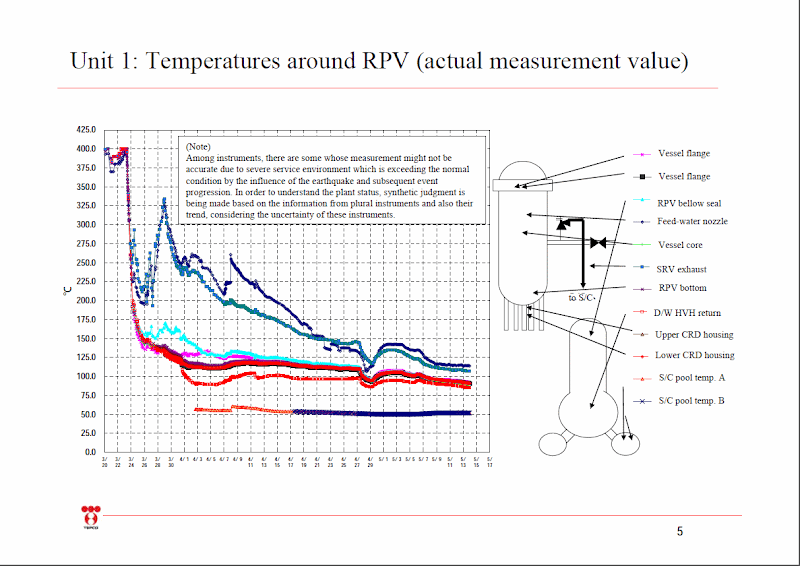
See this image. The vertical line shows temps dropping all over the reactor immediately after the scram.
This chart shows that the core was at 4000 degrees at 14:46 at the time of the quake (and scram), and by 15:30 when the wave struck it was at around 250 degrees. You won't produce enough steam to run a turbine with that amount of heat. (If you could there would be no reason for normal operation at 4000 degrees).
Diesel generators were the right choice. Indeed the only choice. Used in reactors all over the world.
The location of those generators was wrong. We both agree on that.
They knew, or should have know it was wrong, just as JD Posted Above. The risk assessment used to design the plant didn't take into account the very strong quake AND the very large wave, because the original design used ONLY a 100 year window. JDs point is that the 100 year window was too short.
But plant operators are handed a plant to run, and its almost impossible to go back and say this is dangerous, we need to totally rebuild this plant, or move it. That doesn't happen in Japan, and it doesn't happen in the US either.
Once built, you couldn't make this plant safe. $10,000 doesn't come close. There are 5 reactors on site. Even raising the generators, indeed, the entire plant 50 feet couldn't make it safe against a quake of that magnitude and a tsunami of that size. All it takes is a cooling water pipe to shake and break, or a pump to fail, or salt water contamination of the cooling system.
It should not have been built there. A proper risk assessment window would have prevented it.
-
Re:A language that compiles to JS
Dependency injection exists in GWT, see Google Gin, which is a subset of Google Guice. They also hava Google Guava (it's similar to Apache Commons) for GWT.
You are correct that none of the Java Reflection framework is there, but you can work around that most of the time. Google publishes a list of which classes of the JRE they emulate in GWT
-
Re:A language that compiles to JS
Dependency injection exists in GWT, see Google Gin, which is a subset of Google Guice. They also hava Google Guava (it's similar to Apache Commons) for GWT.
You are correct that none of the Java Reflection framework is there, but you can work around that most of the time. Google publishes a list of which classes of the JRE they emulate in GWT
-
Re:A language that compiles to JS
Dependency injection exists in GWT, see Google Gin, which is a subset of Google Guice. They also hava Google Guava (it's similar to Apache Commons) for GWT.
You are correct that none of the Java Reflection framework is there, but you can work around that most of the time. Google publishes a list of which classes of the JRE they emulate in GWT
-
Re:A language that compiles to JS
Dependency injection exists in GWT, see Google Gin, which is a subset of Google Guice. They also hava Google Guava (it's similar to Apache Commons) for GWT.
You are correct that none of the Java Reflection framework is there, but you can work around that most of the time. Google publishes a list of which classes of the JRE they emulate in GWT
-
Re:Perspective
According to Google, you can. Is there some bug that we should know about?
-
Re:Oh really?
-
Re:In perspective
I don't care if 15 astronauts died in that disaster (the stoppage in space exploration in the other hand isn't, but that's another debate). You can all argue with me as much as you want, those astronaut live doesn't worth more in my eye as human being than the millions that die around the world each week. Sometime, I found it deeply immoral that we put so much value in people only because we see them in the news.
Strawman argument on multiple levels, the biggest of which is that "we" think that the dead astronauts are worth "more" than the people who die through famine, disease, war, and so on. Death is an abstraction to most people to begin with, and the human mind can't really comprehend tens of thousands of dead, especially when they're people about whom we know nothing and to whom we have no connection. Hence the quotation attributed to Stalin (which probably didn't originate with him, but it looks likely that he said a version of it): "A single death is a tragedy, a million deaths is a statistic."
The counterpoint to that, though, comes from the Talmud: "Whoever saves one life saves the world entire." And what that acknowledges is the particularity of human compassion and cognition: we can't grasp what it means for ten thousand to die, but we can grasp saving one specific life -- and that when ten thousand lives are saved, then that experience isn't just a large number couched in abstraction, but represents the experience of saving one life, ten thousand times over.
In saying that you don't care about the dead astronauts, but do care about the tens of thousands, you're essentially saying that for you, caring is a political act, expressed not in terms of empathy but in terms of strategy. Fine, if that's your bag. But if there's no reason to care about 15, there's really no reason to care about ten thousand. It's just those same 15, multiplied by...heh, a rather devilish number.
As soon as death becomes a matter of indifference to you on the most human level -- the level where you can see their faces, hear their stories, know that they're generally accomplished and intelligent people who gave more to their societies than they took -- then it's hard to believe that your empathy suddenly kicks in when it's a sea of meaningless strangers who are doing the dying.
-
Re:Is Yahoo dead, or can they come back?
So where do I make a blog or a Yahoo! store? Finding an uncluttered launch page doesn't change the basic problem: Yahoo! is a confusing mess, and the individual things you can do are not as good as what competitors offer.
I'm sure there's a nice, clean, straight forward link for making a Yahoo! store too... visitors just don't know what it is.
(I just found it here: http://www.google.com/search?q=Yahoo!+store)
-
Doesn't seem to have had much effect
Doesn't seem to have had much effect
http://www.google.com/finance?q=YHOO
I'd give a link to a YHOO page for their financials but no one uses YHOO anymore.
-
Competing to answer dumb questions
Google has been optimizing their system to provide better answers to dumb questions. This reflects the most popular searches asked of Google. Google has strengthened their emphasis on currency, locality, and popularity, at the expense of depth. The general observation is that Google has been "dumbed down".
That emphasis puts Google in direct competition with social networks, which are, of course, focused on currency, locality, and popularity. That's a problem for Google. Especially since the social networks all have their own internal search capabilities.
Google still has some big competitive advantages. The biggest is that ads on search results are presented when someone is looking for something, and thus aren't an annoyance. Ads on social networks just get in the way. Ad clutter on Myspace was a major factor in their demise. Spam on Twitter is becoming more of a problem. Facebook traffic stopped growing in mid-2011. The social networks may be hitting a wall on advertising revenue.
From a business perspective, Google has the problem that they don't pay a dividend. They try to pretend they are still in their growth phase. But their stock peaked in 2007. There's nothing wrong with being a profitable company, #1 in the field, and paying a dividend. But Google keeps trying to grow in other areas, none of which make money. Google's revenues are 96% ads, 4% everything else. Investors would prefer they get out of phones and social and focus on their core business. Meanwhile, Bing nibbles off another 2% or so of Google's market share each year. Microsoft has staying power - the entire first generation XBox effort lost money. Now they're winning in game consoles, while Sega is nowhere and Sony is in trouble.
-
Eclipse + Chromium
I suggest Eclipse IDE for JavaScript Web Developers: http://www.eclipse.org/downloads/packages/eclipse-ide-javascript-web-developers/heliosr
and Chromium Eclipse Debugger: http://code.google.com/p/chromedevtools/Everyone else seems too busy engaged in the language flame war to answer your question
-
Another word or 3
GWT (Google Web Toolkit). Write/debug in Java (Eclipse), have the final GUI working in browser.
-
Re:Very frustrating
Unfortunately the HTC Thunderbolt, one of the first attempts at a 4G handset in the US, is plagued with battery issues. A quick Google search shows that it's not just you. There are also many things you can do to try to extend the battery life such as using a resource manager like JuiceDefender that aggressively manages your radios and display options when not in use. You can also use the phone's built-in power saving mode which can be found in your phone's settings menu. This will perform the same task in a less aggressive manner.
I used Verizon's other 4G-launch handset, the Samsung Droid Charge, and regularly got about a day and a half out of the battery. I could stretch to 2 days orso with less use. After using the JuiceDefender app I was able to get a solid 3 days. However, this was a different handset from a different manufacturer YMMV.
-
Re:GWT
I second this. I've been using the Google Web Toolkit (GWT, http://code.google.com/webtoolkit/) for about 5 years now with good results. Write in Java, compile to Javascript, and let GWT handle the browser differences. The source is all there if you want to see how their Javascript works, and you can insert you're own Javascript code when and where you want it. Finally, the user's group has been an excellent source of advice.
-
Use Google's 'Closure Compiler'
http://code.google.com/closure/compiler/ It's exactly what you're looking for. It does type checking, it checks syntax and variable reference, it does file dependancy, and has a great inheritance system so you can get back to your Java/C++ ways. It's just awesome.
-
Re:A language that compiles to JS
On the topic of languages that complile to JS, GWT is very nice, especially if you're using a Java back-end.
-
Re:Where is the Source Code?
The source is linked to from the Chrome for Android developer FAQ; see http://code.google.com/chrome/mobile/docs/faq.html
The actual tarball is at http://chromium-browser-source.commondatastorage.googleapis.com/chrome_android.v0.16.4130.199.tgz and contains ordinary, buildable source code, not binaries.
-
Re:Stop masturbating over apple
Actually, they are as of Q4 2011. They surpassed HP as the number one manufacturer of laptops and desktops.
Your using old data.
-
Re:Didn't Android *always* have Chrome?
Where are you getting that Chrome for Android is not single-process? I think you completely made that up. There's even a special single-process mode (com.android.chrome.tests.SingleProcessActivity) that you would have to manually launch to use, which strongly implies the main activity is multi-process. As Calos points out, the official docs also state that it's multi-process.
-
Re:Didn't Android *always* have Chrome?
Gingerbread's Web Browser also gets 100 on the Acid3 test.
That 100 isn't the whole story, if the rendering isn't also correct.
Acid3 is also a cherry-picked group of tests, some of which are still drafts, some of which have no real use in standard practice.
AND... most importantly, here - it doesn't test HTML 5. That's one of the big things Google is pushing with Chrome for Android, hardware-accelerated HTML 5 rendering and support.
(This could be related to the ICS requirement - GPU acceleration of UI elements)
Chrome for Android also is single-process.
Do you have a source? TFA says otherwise, official docs say otherwise.
Yes, this seems to be the only *real* distinction between Chrome and Android's Web Browser.
Clearly you're ignorant on the subject, so please don't take offense if I continue to ignore your claims.
Now, I don't have an exhaustive list... But there are the things mentioned above, addition of the Omnibox, better developer tools, Incognito Mode, pre-loading and rendering pages as an option for don't/wifi only/always, no limit for number of tabs to have open, hardware accelerated rendering, redesigned UI that seems to be both better and more consistent with the desktop platform... Sandboxing isn't there yet, though they claim to be working on it.
Chrome and Android's web browser are both WebKit + V8, in which there was a fork from Chromium at Version 4, as outlined in the Google Android Commit Logs. Seems more as though Android's web browser has always been Chrome, with modifications to support mobile devices, from what was at the time a Current Chromium version (read: Chrome). Seems as though Google has simply made a more up-to-date build of their web browser available.
Chrome 4 was ages ago. At the time, sure, maybe the Android browser was Chrome 4 + enhancements for mobile devices - really don't care to go research the state of Chrome 4 and what Android Browser had then and what has been added since. But how well has the Android stock browser kept up with Chrome development?
There's some obvious, fundamental differences to how the two versions worked. They apparently was a fair amount of neutering done to make it work on the phone quickly and easily, or it was from such an early Chrome build that a lot of the features associated with Chrome weren't present yet.
That's a big part of this. They're working to keep both versions working off the same codebase. This will keep the Android browser more current going forward.
-
Re:Occupy Fragmentation
well.. it would be really great if that 1% could access it.. i have android 4.0.3, but i live in austria, so i'm still out of luck.. https://support.google.com/chrome/bin/answer.py?hl=en&answer=2393487&p=market_countries
-
Re:Really?
Typically compulsory licensing requirements include that the price must be fair.
You're obviously a legal genius compared to me, because I'm not even aware that such things exist. I'm sure you'll enlighten us all with numerous examples.
Your sarcasm is as obvious as your lack of knowledge.
Here is a USA example Search for the term "reasonabl" (last character purposely left off so you can hit the variations of the word).
Here is a WIPO Study. Check out page 9. It seems to apply to the EU.
Next time, do your own homework. =D -
But the patents can be BS
TFS doesn't say (probably to drive more views to the linked page) but this is all about thermostats.
Some of the patents include "thermostat is round and can be rotated", "thermostat asks the user questions", and stuff like that. Considering how skeptical many people are about Apple's "design patents" on "rounded rectangles with touch screens", I would be skeptical of some of these as well.
Now some of the other patents, like leeching power off of the main system, may hold up under more scrutiny (though this technique has been in wide use throughout the industry; I recall two-wire sensors that derive their power parasitically from the data line, and if the patent covers similar technology then it should be revoked).
Also, FYI, you can compel some patents to be licensed. FRAND patents, for instance; Samsung got into hot water when they tried to use FRAND patents as a weapon against Apple.
IMO, you shouldn't be able to use patents to shut down competitors. Especially competitors that outsmarted you by building a better product than you could.
-
But the patents can be BS
TFS doesn't say (probably to drive more views to the linked page) but this is all about thermostats.
Some of the patents include "thermostat is round and can be rotated", "thermostat asks the user questions", and stuff like that. Considering how skeptical many people are about Apple's "design patents" on "rounded rectangles with touch screens", I would be skeptical of some of these as well.
Now some of the other patents, like leeching power off of the main system, may hold up under more scrutiny (though this technique has been in wide use throughout the industry; I recall two-wire sensors that derive their power parasitically from the data line, and if the patent covers similar technology then it should be revoked).
Also, FYI, you can compel some patents to be licensed. FRAND patents, for instance; Samsung got into hot water when they tried to use FRAND patents as a weapon against Apple.
IMO, you shouldn't be able to use patents to shut down competitors. Especially competitors that outsmarted you by building a better product than you could.
-
Re:Perfect example of not keeping up...
And yet they are still growing.
The danger of the internet is anybody can say whatever they want, regardless of the facts.
http://www.google.com/search?client=safari&rls=en&q=RIM+declining&ie=UTF-8&oe=UTF-8
-
Re:Stop masturbating over apple
Yeah, that 30% cut for handling all the credit card processing, hosting, bandwidth, servers, storefront etc... Such a travesty.
Seriously, the 30% cut just for managing the payment stuff *alone* is a bargain, as anyone who has ever had to handle a merchant account and payment processing will tell you, especially for small transactions. It is very expensive and time consuming to deal with.
There are other cheap options. Apple's flat 30% is cheaper if you're selling your things for less than $1.11, google checkout is cheaper for anything at that price or above. Depending on how many customers you have downloading the thing per month, hosting and bandwidth can be found for free. If you've got thousands of customers paying you over $1.11 in one month, you'd have to pay for hosting, but you'd be doing pretty well, and you'd be better off handling it yourself rather than letting apple do it.
Also, "responsible for translating the closed console ecosystem to phones"? How short is your memory?! Phones were anything *but* open before Apple entered the market. If anything Apple has made it more open, by driving the success of its main competition - Android.
I had a WinCE smartphone before the iPhone days. There used to be a special version of Visual Studio 6 for embedded systems. Compile, run anything you want. And that was MICROSOFT.
-
Line-by-line rebuttal to the buggy-whip advocate
Future generations may know little of the days when buying a movie meant you owned it even if the Internet went down
That's why intelligent people don't patronize services that don't "sell" movies but either sell access to streaming content, or sell downloadable files locked up in some sort of network-dependent DRM. Everything I've downloaded from The Pirate Bay works just fine when the Internet goes down.
... and when getting a movie meant you had to scour aisles of boxes in search of one whose cover art called back a story that echoed your interests.
And nowadays I use a search engine. But I suppose some people miss the days where traveling meant feeding and grooming a horse, cleaning up its crap, and riding on its back exposed to the elements, rather than riding in an enclosed, climate-controlled automobile where one just pours gas in or plugs the thing in.
Josh Johnson, one of the filmmakers behind the upcoming documentary 'Rewind This!' hopes to tell the story of how and why home video came about, and how it changed our culture giving B movies and films that didn't make the silver screen their own chance to shine. 'Essentially, the rental market expanded, because of voracious consumer demand, into non-blockbuster, off-Hollywood video content which would never have had a theatrical life otherwise,' says Palmer.
And nowadays, people don't even need the minimal budgets or producer interest that a B movie needed to get made. Anyone with a camera and a YouTube account can produce, upload, promote, and distribute a movie now. The advent of the Internet has expanded the number of movies out there by an even larger percentage than the advent of VHS did.
While researching the documentary Palmer found something interesting: there is a resurgence taking place of people going back to VHS because a massive number of films are 'trapped on VHS' with 30 and 40 percent of films released on VHS never to be seen again on any other format.
I find plenty of VHS rips on The Pirate Bay. Google yields 43,000 results. Just because the companies that make profit off of distributing content don't see any reason to re-distribute old direct-to-VHS movies as downloads doesn't mean the movies are not available. If there be any contemporary interest in an old movie, it has probably been uploaded to TPB or a similar service. And if not, and you have the VHS copy of it... go rip it and upload it!
-
Re:'bout time!
Actually, Flash has been sandboxed in Chrome for about a year, but it's not fully sandboxed. To explain, the Chrome sandbox architecture supports five levels on Windows. Chrome's web content and its native PDF reader run at USER_LOCKDOWN and JOB_LOCKDOWN (level 5), which means a deny-only token. Right now Chrome's Flash sandbox runs at USER_INTERACTIVE (level 2) plus low-integrity level (just a bit better than IE's sandbox). However, we've been working for almost two years on a version of Flash that runs in as strong a sandbox as native Chrome content. My post was explaining how to test an alpha release of that improved Flash sandbox.
-
Re:Why Apple is good
You obviously didn't understand what I was talking about *at all*. You mentioned VirtualBox, Fusion 4, and Parallels. Try running OS X in VirtualBox or Parallels without using a hacked up OSx86 version. Oh wait you can't.
You did not say "run OS X virtually" or any such wording, you said How about virtualization? Let's now look at virtualizing OSX, Google is your friend...
- How to Virtualize OS X Lion on Windows
- How to Run Mac OS X in VirtualBox on Windows
- How To Run Leopard (Retail) in VMware Fusion - Virtualize OSX on your Mac
- [Updated] Virtualize OS X Lion 10.7 Windows 7
- OS X Lion Allows Running Multiple Copies on the Same Machine (Virtualization)
That's 5 of Google's more than 150,00 results. Are you again going to say I didn't understand what you meant?
You apparently didn't bother to *read* any of the links you gave, otherwise you'd find out that all of them are illegal methods as they are violations of the EULA, and your last link even explains why they are illegal. Again, you can't virtualize OS X client prior to Lion at all, you can virtualize OS X Server and OS X Lion client, but only if you are running on OS X as a host OS, ie not VMWare ESX or Citrix XenServer, or Microsoft Hyper-V, or any other bare-metal hypervisor, in other words, a useless non-feature.
In response to my asking about terminal services, you respond "OSX has terminal". Clearly you have no idea what I'm talking about and didn't even bother to do the five seconds of googling to find out.
Just like you didn't spend the fives seconds to Google virtualize OSX. You didn't bother doing what you accuse me of not doing, Google terminal services osx. When I just did Google suggested "terminal services osx" and "terminal services osx client". I'm sure you're competent enough to look at some of the results yourself, if not I see no reason to continue.
Falcon
Again, you clearly didn't bother to give even a cursory glance at the results. Half of them are forum posts asking if OS X will ever have the ability to host terminal services (because it doesn't at the moment), and the other half are TS *clients* for accessing *Windows* terminal servers. The one relevent link, iRAPP, explicitly says that in order to conform to Apple's EULAs, they only allow multiple connections to OS X Server, not Client, which misses the entire point of having terminal services in the first place, and again makes it nothing more than VNC with a few more bells and