Slashdot Mirror
Domain: google.org
Stories and comments across the archive that link to google.org.
Stories · 19
-
Google Tests A Software That Judges Hollywood's Portrayal of Women
Slashdot reader theodp writes: Aside from it being hosted in a town without a movie theater, the 2016 Bentonville Film Festival was also unusual in that it required all entrants to submit "film scripts and downloadable versions of the film" for judgment by "the team at Google and USC", apparently part of a larger Google-funded research project with USC Engineering "to develop a computer science tool that could quickly and efficiently assess how women are represented in films"...
Fest reports noted that representatives of Google and the White House Office of Science and Technology Policy appeared in a "Reel vs. Real Diversity" panel presentation at the fest, where the importance of diversity and science to President Obama were discussed, and the lack of qualified people to fill 500,000 U.S. tech jobs was blamed in part on how STEM careers have been presented in film and television... In a 2015 report on a Google-sponsored USC Viterbi School of Engineering MacGyver-themed event to promote women in engineering, USC reported that President Obama was kept briefed on efforts to challenge media's stereotypical portrayals of women. As for its own track record, Google recently updated its Diversity page, boasting that "21% of new hires in 2015 were women in tech, compared to 19% of our current population".... -
Google and Gates-Backed Khan Academy Introduces "Grit"-Based Classroom Funding
theodp writes: Their intentions are no doubt good, but some will be troubled by Google and Khan Academy's recently-concluded LearnStorm initiative, which pitted kids-against-kids, schools-against-schools, and cities-against-cities in a 3-month learning challenge for prizes based not only on students' mastery of math skills on Khan Academy, but also their perceived 'hustle' (aka 'grit'). "Points are earned by mastering math skills and also for taking on challenging new concepts and persevering," explained a Khan Academy FAQ. A blog entry further explained, "They've earned points and prizes not only for mastering math skills but also for showing 'hustle,' a metric we created to measure grit, perseverance, and growth. They competed over 200,000 hours of learning and 13.6 million standards-aligned math problems. In addition, thanks to the generosity of Google.org, DonorsChoose.org, and Comcast's Internet Essentials, 34 underserved schools unlocked new devices for their classrooms and free home internet service for eligible families, increasing student access to online learning tools like Khan Academy." Apparently funded by a $2 million Google grant, the Google, Khan Academy, and DonorsChoose grit-based classroom funding comes on the heels of the same organizations' gender-based classroom funding initiative. Supported by some of the world's wealthiest individuals and corporations, Khan Academy's Board members include a Google Board member (Diane Green), spouse of a Google Board member (Ann Doerr), and the Managing Partner of Bill Gates' bgC3 (Larry Cohen); former Board members include Google Executive Chairman Eric Schmidt. -
Two Google Engineers Say Renewables Can't Cure Climate Change
_Sharp'r_ writes Two Stanford PhDs, Ross Koningstein and David Fork, worked for Google on the RE<C project to figure out how to make renewables cheaper than coal and solve climate change. After four years of study they gave up, determining "Renewable energy technologies simply won't work; we need a fundamentally different approach." As a result, is nuclear going to be acknowledged as the future of energy production? -
Lessons Learned From Google's Green Energy Bust
the_newsbeagle writes In 2007, Google boldly declared a new initiative to invent a green energy technology that produced cheaper electricity than coal-fired power plants. Sure, energy researchers had been hammering at this task for decades, but Google hoped to figure it out in a few years. They didn't. Instead, Google admitted defeat and shut down the project in 2011. In a admirable twist, however, two of the project's engineers then dedicated themselves to learning from the project's failure. What did it mean that one of the world's most ambitious and capable innovation companies couldn't invent a cheap renewable energy tech? -
Education Chief Should Know About PLATO and the History of Online CS Education
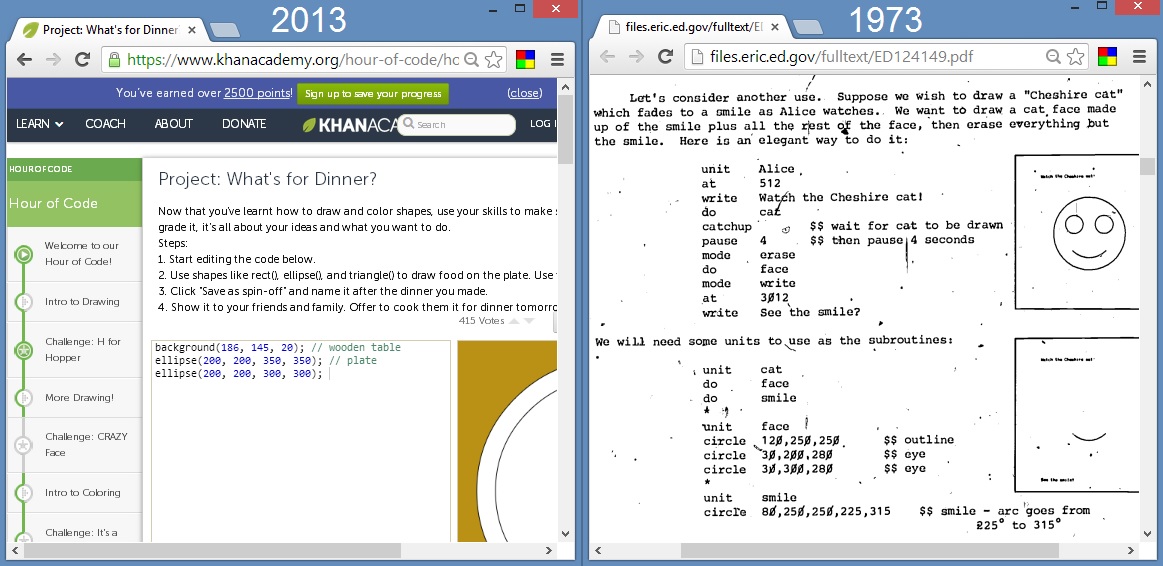
theodp writes Writing in Vanity Fair, U.S. Secretary of Education Arne Duncan marvels that his kids can learn to code online at their own pace thanks to "free" lessons from Khan Academy, which Duncan credits for "changing the way my kids learn" (Duncan calls out his kids' grade school for not offering coding). The 50-year-old Duncan, who complained last December that he "didn't have the opportunity to learn computer skills" while growing up attending the Univ. of Chicago Lab Schools and Yale, may be surprised to learn that the University of Illinois was teaching kids how to program online in the '70s with its PLATO system, and it didn't look all that different from what Khan Academy came up with for his kids 40 years later (Roger Ebert remarked in his 2011 TED Talk that seeing Khan Academy gave him a flashback to the PLATO system he reported on in the '60s). So, does it matter if the nation's education chief — who presides over a budget that includes $69 billion in discretionary spending — is clueless about The Hidden History of Ed-Tech? Some think so. "We can't move forward," Hack Education's Audrey Watters writes, "til we reconcile where we've been before." So, if Duncan doesn't want to shell out $200 to read a 40-year-old academic paper on the subject (that's a different problem!) to bring himself up to speed, he presumably can check out the free offerings at Ed.gov. A 1975 paper on Interactive Systems for Education, for instance, notes that 650 students were learning programming on PLATO during the Spring '75 semester, not bad considering that Khan Academy is boasting that it "helped over 2000 girls learn to code" in 2014 (after luring their teachers with funding from a $1,000,000 Google Award). Even young techies might be impressed by the extent of PLATO's circa-1975 online CS offerings, from lessons on data structures and numerical analysis to compilers, including BASIC, PL/I, SNOBOL, APL, and even good-old COBOL. -
How Google Can Get the Flu Right
An anonymous reader writes Google Flu Trends was developed in 2009 to improve forecasts of flu levels in the U.S. by utilising Google search data. This early example showcased the potential which lies in the exploitation of human digital traces which all of us leave behind by using online services. The rise of Google Flu Trends was only stopped when the service dramatically overestimated the number of flu incidences recently. The fall raised questions about the value of online data for predictions in general. However, a study published yesterday demonstrates that it is not only about data but also about the adaptiveness of algorithms used for predictions. Scientists combined historic flu levels as reported by the CDC with Google Flu Trends data using an algorithmic framework which is able to adapt to changes in human search behaviour. Their results show that Google Flu Trends data sets significantly add information to the forecasts of current flu levels. -
Dealing With 'Advertising Pollution'
theodp writes: "Everyone gets that advertising is what powers the internet, and that our favorite sites wouldn't exist without it," writes longtime ad guy Ken Segall in The Relentless (and annoying) Pursuit of Eyeballs. "Unfortunately, for some this is simply license to abuse. Let's call it what it is: advertising pollution." CNN's in-your-face, your-video-will-play-in-00:25-seconds approach, once unthinkable, has become the norm. "Google," Segall adds, "is a leader in advertising pollution, with YouTube being a showcase for intrusive advertising. Many YouTube videos start with a mandatory ad, others start with an ad that can be dismissed only after the first 10 seconds. Even more annoying are the ad overlays that actually appear on top of the video you're trying to watch. It won't go away until you click the X. If you want to see the entire video unobstructed, you must drag the playhead back to start over. Annoying. And disrespectful." Google proposed using cap and trade penalties to penalize traditional polluters — how about for those who pollute the Internet? -
Does Google Have Too Much Influence Over K-12 CS Education?
theodp writes:Google recently announced Global Impact Awards for Computer Science, part of the company's $50 million investment to get girls to code. But Google's influence over K-12 CS education doesn't stop there. The Sun-Times reports that Chicago Public School (CPS) teachers are participating in a summer professional development program hosted by Google as part of the district's efforts to "saturate" schools with CS within 3 years: "The launch of CS4All [Computer Science for All], in partnership with Code.org and supported by Google, starts this fall in 60 CPS schools to try to bridge the digital divide and prepare students." And in two weeks, the Computer Science Teachers Association [CSTA] and Google will be presenting the National Computer Science Principles Education Summit. "Attendees at this event have been selected through a rigorous application process that will result in more than 70 educators and administrators working together to strategize about getting this new Advanced Placement course implemented in schools across the country," explains CSTA. The ACM, NSF, Google, CSTA, Microsoft, and NCWIT worked together in the past "to provide a wide range of information and guidance that would inform and shape CS education efforts," according to the University of Chicago, which notes it's now conducting a follow-up NSF-funded study — Barriers and Supports to Implementing Computer Science — that's advised by CPS, CSTA, and Code.org. -
Does Google Have Too Much Influence Over K-12 CS Education?
theodp writes:Google recently announced Global Impact Awards for Computer Science, part of the company's $50 million investment to get girls to code. But Google's influence over K-12 CS education doesn't stop there. The Sun-Times reports that Chicago Public School (CPS) teachers are participating in a summer professional development program hosted by Google as part of the district's efforts to "saturate" schools with CS within 3 years: "The launch of CS4All [Computer Science for All], in partnership with Code.org and supported by Google, starts this fall in 60 CPS schools to try to bridge the digital divide and prepare students." And in two weeks, the Computer Science Teachers Association [CSTA] and Google will be presenting the National Computer Science Principles Education Summit. "Attendees at this event have been selected through a rigorous application process that will result in more than 70 educators and administrators working together to strategize about getting this new Advanced Placement course implemented in schools across the country," explains CSTA. The ACM, NSF, Google, CSTA, Microsoft, and NCWIT worked together in the past "to provide a wide range of information and guidance that would inform and shape CS education efforts," according to the University of Chicago, which notes it's now conducting a follow-up NSF-funded study — Barriers and Supports to Implementing Computer Science — that's advised by CPS, CSTA, and Code.org. -
Google Flu Trends Gets It Wrong Three Years Running
wabrandsma writes with this story from NewScientist: "Google may be a master at data wrangling, but one of its products has been making bogus data-driven predictions. A study of Google's much-hyped flu tracker has consistently overestimated flu cases in the US for years. It's a failure that highlights the danger of relying on big data technologies.
Evan Selinger, a technology ethicist at Rochester Institute of Technology in New York, says Google Flu's failures hint at a larger problem with the algorithmic approach taken by technology companies to deliver services we all want to use. The problem is with the assumption that either the data that is gathered about us, or the algorithms used to process it, are neutral. Google Flu Trends has been discussed at slashdot before: When Google Got Flu Wrong." -
Massive Storm Buries US East Coast In Snow and Ice
First time accepted submitter anthonycarlson writes "The second wintry storm in two weeks to hit the normally balmy south U.S. has encrusted highways, trees and power lines in ice, knocking out electricity to nearly a half-million homes and businesses." Kids are out of school, and houses are out of power, in much of a region that normally gets much rarer and lighter snowfall. If you're socked in, or if you're in the East Coast storm zone but have to venture out anyhow, what's been your experience? Some of the pictures are pretty impressive. Update: 02/13 17:24 GMT by T : Google Maps has a handy guide to weather alerts, shelters, and traffic info for those affected by the storm. (Hat tip to Chris DiBona.) -
Explosions at the Boston Marathon
Reports are coming in that the headquarters at the Boston Marathon have been locked down after two explosions were reported near the finish line. According to reports "dozens of people have been seriously injured." CNN has live coverage. Google has a Person Finder up for Boston.
Update: The Boston Police Dept. says 2 people have died and 23 are injured. News conference scheduled for 4:30 ET. -
Google Releases Geothermal Potential Map of the US
a_hanso writes "The Google funded Enhanced Geothermal Systems research at the Southern Methodist University has produced a coast-to-coast geothermal potential map of the United States. Having invested over $10 million on geothermal energy, Google seems to believe that it is our best bet at kicking the oil habit (especially now that nuclear power has suddenly become disproportionately unpopular)." -
West Virginia Is Geothermically Active
sciencehabit writes "Researchers have uncovered the largest geothermal hot spot in the eastern United States. According to a unique collaboration between Google and academic geologists, West Virginia sits atop several hot patches of Earth, some as warm as 200C and as shallow as 5 kilometers. If engineers are able to tap the heat, the state could become a producer of green energy for the region." -
Global Deforestation Demoed In Google Earth
eldavojohn writes "On Google's official blog, they claim a 'new technology prototype that enables online, global-scale observation and measurement of changes in the earth's forests.' Ars has more details on what Google unveiled at Copenhagen. If you have Google Earth installed, you can find a demonstration here. Many organizations and government agencies are on board with this initiative to put deforestation before the eyes of the public. If only satellite data of North America existed before the logging industry swept in!" It's interesting to contemplate the implications for intelligence gathering of Google's automated tools to compare satellite photos. -
For Some Medical Workers, a Flu Shot Or Possible Job Loss
theodp writes "Want to work at Winthrop Hospital? Roll up your sleeve, and we'll talk. TIME reports that every employee at the Long Island hospital — from doctors and nurses who care for patients to the administrative, housekeeping and food-service personnel — must be vaccinated against both seasonal and H1N1 flu or face termination. The mandate comes from the health department of New York, the first state to require all health-care workers to be vaccinated against influenza. Meanwhile, two-thirds of parents say they'll avoid flu shots for their little ones like, well, the flu. So who should you believe — Dr. Bill Frist or 'Dr.' Bill Maher? Before you decide, perhaps a consultation with Dr. Google is in order." -
Twitter Considered Harmful To Swine-Flu Panic
judgecorp writes "Twitter is being criticized for spreading panic about swine flu. This is not just knee-jerk Luddism 2.0: it's argued that Twitter's structure encourages ill-informed repetition, with little room for context, while older Web media use their power for good — for instance Google's Flu Trends page (which we discussed last winter), and the introduction of a Google swine flu map." On a related note, reader NewtonsLaw suggests that it might be a good idea, epidemiologically speaking, to catch the flu now vs. later. -
Google Can Predict the Flu
An anonymous reader mentions Google Flu Trends, a newly unveiled initiative of Google.org, Google's philanthropic arm. The claim is that this Web service, which aggregates search data to track outbreaks of influenza, can spot disease trends up to 2 weeks before Centers for Disease Control data can. The NYTimes writeup begins: "What if Google knew before anyone else that a fast-spreading flu outbreak was putting you at heightened risk of getting sick? And what if it could alert you, your doctor and your local public health officials before the muscle aches and chills kicked in? That, in essence, is the promise of Google Flu Trends, a new Web tool ... unveiled on Tuesday, right at the start of flu season in the US. Google Flu Trends is based on the simple idea that people who are feeling sick will tend to turn to the Web for information, typing things like 'flu symptoms; or 'muscle aches' into Google. The service tracks such queries and charts their ebb and flow, broken down by regions and states." -
The Philanthropic Arm of Google
GoatJuggler writes "I accidentally visited google.org recently and ended up at a different Google site that appears to be a placeholder for Google's future foray into the world of philanthropy. A quote from Sergey Brin & Larry Page is there now, 'We hope that someday this institution will eclipse Google itself in overall world impact by ambitiously applying innovation and significant resources to the largest of the world's problems.' Not much to see there now, but it's certainly refreshing to see a successful company leveraging their success to do good. Googling part of that quote led me to a blog that references the uniqueness of Google's SEC filing. The Google Foundation is referenced, and Google's job page now mentions that they are looking to fill the position of Executive Director for the Google Foundation. So, expect Good Things(TM) (like saving 3-legged kittens) from Google soon."