Slashdot Mirror
Domain: hmc.edu
Stories and comments across the archive that link to hmc.edu.
Comments · 168
-
Copyleft Awareness Week
In response to copyright awareness week, consider taking part in Copyleft Awareness Week. After all, how can you trust an organization that refers to it's "friends" in quotes?
--Ben -
Re:I love CA*Net3
at hmc, last I heard, our situation was this:
The older dorms are wired with 10mbit copper
The newer dorms and academics buildings are wired with 100mbit copper.
we've got some number of T1 lines connected to our primary ISP, qwest.
just recently, we acquired a second ISP (verizon), and a t3 from them.
We also went live with a gigabit connection to internet2.
while this is technically split between 6 small schools, our one school uses the majority of it....
its nice. very very nice. -
Re:I must admit that i didn't think it would happe
One of the main things that I still haven't figured out (and I have looked) is how to go to the address bar using the keyboard. In Opera you hit F8. In IE you hit Alt-D. I'm sure Mozilla must have this really obvious feature or people would go insane, but I just can't seem to find it.
Ctrl+L. For other shortcuts see http://www.cs.hmc.edu/~jruderma/mozilla/keyboard-h elp/
The other thing that's a bit annoying, though has improved greatly since I first tried the 0.9.3 release, is the feeling that Mozilla is a little sluggish. I don't know if it's actually slower rendering an average page than Opera is (perhaps a tiny bit), but it feels slower. Opera seems to get everything worked out in the background before drawing a page; Mozilla seems to draw it as it goes.
What's wrong with incremental rendering? One thing that often annoys me when I use Opera is that it will download an entire 4MB page before displaying anything. Mozilla sometimes does that as well, but we consider it a bug (129640) when it does. Mozilla has an optimization that makes not display anything for the first 1.2 seconds of interpreting a page (unless it finishes in under 1.2 seconds), so once the first screenful of the page appears, you can usually read it while the rest of the page loads quietly. -
Re:Different interpretation of 3.14159265... joke
Yes. They do. Benjamin happens to do it with nmemonic tricks, I believe.
(just for reference, this is also the same mudd professor who can multiply 5 digit numbers in his head, tell you which day of the week any date falls on, and a few other mind numbing math tricks) -
No
-
Re:Harvey Mudd???From "About Harvey Mudd College" (http://www.hmc.edu/abouthmc.html):
Harvey Mudd College was founded in 1955 by the family of Harvey S. Mudd, a mining engineer and co-founder of one of the richest copper mines in the world, Cyprus Mines. Although Harvey Mudd died shortly before the college was established in 1955, the Mudd family went forward with plans to make this important institution a reality. Designed to overcome many of the shortcomings of traditional, narrow technical training, HMC has become a leader in science, mathematics and engineering education. Our mission is to educate undergraduate men and women in a demanding academic setting, focusing on mathematics, science and engineering and to provide a rich background in the humanities and social sciences.
Shameless karma whori...wait, I'm not logged in! -
www.hmc.edu
www.hmc.edu But you should really check out my alma matter down the street, Pomona College
-
What do you define as a teacher?Does a professor at a 4-year college count as a teacher? How about at a Ph.D.-granting university? How about a grad student who is a T.A.?
My experience is that quite a few Slashdot readers are teachers of some flavor, from junior high through top universities. I'm a professor at a very good undergraduate institution. Windows is almost nonexistent in the CS department. We use it mostly under duress.
I was just curious to know if people who really are very tech-savvy desire to be teachers at all.
Before I decided that teaching would be a lot more fun than the dot-com butterfly chase, I spent 15 years in industry. I won't bore you with my resume, but I have to say that the people I have encountered in academia are generally just as "savvy" as those outside, if not more so. However, the savviness is of a different sort, because the needs are different. If you want to know which video card works best on a PCI bus, don't ask me. I don't have a clue. The time that someone else spends learning that information, I spend learning about the latest research in schedulers or file systems.
I make no value judgments here. Both types of knowledge are useful. Just don't make the error of assuming that because another person's knowledge isn't a precise superset of your own, he is ignorant.
-
Re:What's in that query bar packet?
If the URL for a search engine changed, they could always update their fwd script and prevent users from going to a broken page
Google would never break old URL patterns for searches. There are zillions of forms pointing at Google search, as well as links to specific queries. Heck, I even have a Google form on my start page. -
It's toughI'm really the wrong guy to answer this (the right ones work down the hall from me), but given the dearth of responses I thought I'd take a stab at it. Our math department is carrying out a faculty search right now. IIRC, they are expecting 200-300 applications for the job. Purely on statistics, it beats the hell out of the lottery but you shouldn't quit your day job.
However, the statistics are a bit pessimistic. About 50% of the applications are pretty wildly unqualified (the extreme example being MS holders applying for a Ph.D. position). If the search is looking for particular expertise and you have it, another 50% of the survivors will get tossed out. Obviously, it's still tough, but not impossible -- especially if (a) you're good at what you do and (b) you persevere.
You can also do research outside universities. In fact, if you don't have a desire to teach, it can be better to avoid academia. Some industrial research labs want mathematicians. There are also pure industry spots: for example, I think Wall Street is quite fond of math right now (though a lot of it might not be research, depending on how you define "research").
A lot of the above applies to other "paper and pencil" disciplines, such as CS theory.
An upcoming bright spot is biology. After centuries of trying to get a handle on a complex topic, the bio folks have finally started to develop models that are tractable with the help of computers. If you develop an interest in that particular sort of math, you might discover that there is huge demand by the time you graduate. The field is hot enough that we've added a new bio/math major.
Above all, though, my advice to all people seeking a career is the same: follow your heart. You're going to be doing it for 40 years or so, and that's a lot easier if you're having fun. Also, getting from high school to a math Ph.D. is going to take around 8 years, maybe more (I took 13, not counting time spent working, but I'm in a time-consuming field). Who knows what the job situation is goinig to look like 8 years from now? Maybe Enron Jr. will be hiring all the mathematicians it can get its hands on to develop models of how to scam the energy market.
-
It's toughI'm really the wrong guy to answer this (the right ones work down the hall from me), but given the dearth of responses I thought I'd take a stab at it. Our math department is carrying out a faculty search right now. IIRC, they are expecting 200-300 applications for the job. Purely on statistics, it beats the hell out of the lottery but you shouldn't quit your day job.
However, the statistics are a bit pessimistic. About 50% of the applications are pretty wildly unqualified (the extreme example being MS holders applying for a Ph.D. position). If the search is looking for particular expertise and you have it, another 50% of the survivors will get tossed out. Obviously, it's still tough, but not impossible -- especially if (a) you're good at what you do and (b) you persevere.
You can also do research outside universities. In fact, if you don't have a desire to teach, it can be better to avoid academia. Some industrial research labs want mathematicians. There are also pure industry spots: for example, I think Wall Street is quite fond of math right now (though a lot of it might not be research, depending on how you define "research").
A lot of the above applies to other "paper and pencil" disciplines, such as CS theory.
An upcoming bright spot is biology. After centuries of trying to get a handle on a complex topic, the bio folks have finally started to develop models that are tractable with the help of computers. If you develop an interest in that particular sort of math, you might discover that there is huge demand by the time you graduate. The field is hot enough that we've added a new bio/math major.
Above all, though, my advice to all people seeking a career is the same: follow your heart. You're going to be doing it for 40 years or so, and that's a lot easier if you're having fun. Also, getting from high school to a math Ph.D. is going to take around 8 years, maybe more (I took 13, not counting time spent working, but I'm in a time-consuming field). Who knows what the job situation is goinig to look like 8 years from now? Maybe Enron Jr. will be hiring all the mathematicians it can get its hands on to develop models of how to scam the energy market.
-
It's toughI'm really the wrong guy to answer this (the right ones work down the hall from me), but given the dearth of responses I thought I'd take a stab at it. Our math department is carrying out a faculty search right now. IIRC, they are expecting 200-300 applications for the job. Purely on statistics, it beats the hell out of the lottery but you shouldn't quit your day job.
However, the statistics are a bit pessimistic. About 50% of the applications are pretty wildly unqualified (the extreme example being MS holders applying for a Ph.D. position). If the search is looking for particular expertise and you have it, another 50% of the survivors will get tossed out. Obviously, it's still tough, but not impossible -- especially if (a) you're good at what you do and (b) you persevere.
You can also do research outside universities. In fact, if you don't have a desire to teach, it can be better to avoid academia. Some industrial research labs want mathematicians. There are also pure industry spots: for example, I think Wall Street is quite fond of math right now (though a lot of it might not be research, depending on how you define "research").
A lot of the above applies to other "paper and pencil" disciplines, such as CS theory.
An upcoming bright spot is biology. After centuries of trying to get a handle on a complex topic, the bio folks have finally started to develop models that are tractable with the help of computers. If you develop an interest in that particular sort of math, you might discover that there is huge demand by the time you graduate. The field is hot enough that we've added a new bio/math major.
Above all, though, my advice to all people seeking a career is the same: follow your heart. You're going to be doing it for 40 years or so, and that's a lot easier if you're having fun. Also, getting from high school to a math Ph.D. is going to take around 8 years, maybe more (I took 13, not counting time spent working, but I'm in a time-consuming field). Who knows what the job situation is goinig to look like 8 years from now? Maybe Enron Jr. will be hiring all the mathematicians it can get its hands on to develop models of how to scam the energy market.
-
Saw his demo last monthDr. Faloutsos gave a colloquium talk to the CS department at my college recently, including a dozen or so simple examples of his DANCE system. It was really very impressive.
Faloutsos' work is not actually focused on the physics models, but on the control programs for the virtual actors. This allows dynamic, force-based animation (as opposed to kinematic, position-based animation). Each model has a set of controllers for various tasks like walking, running, jumping forward, moving from a prone position to a standing position, etc. Each controller knows its "competencies" -- the conditions under which it can successfully guide the model. These are used to hand off control from one controller to the next as the model goes through a complex motion or reacts to external forces.
The sample movies that Faloutsos showed were mostly unscripted. They would start with a model in a simple standing state, which would then respond to user-controlled forces like pushing or throwing simulated balls at the model from various angles. Various balance-recovery controllers would take over depending on how the model was displaced; if none of them were succesful then the model would fall down, and then use one of its controllers for returning to a standing position. All of this appeared incredibly realistic and human.
Also, as another poster noted, DANCE is available under a "free for non-commercial use" license (not free under the FSF or Debian definitions, but a good deal in my opinion). He encouraged us to try it out, explaining that research like his has suffered from a lack of common infrastructure, leading to a lot of reinvented wheels. He expressed hope that the DANCE framework would allow more innovative research with less duplicated work.
-
Re:Things that cannot be done
It's not a question of how you measure the particle's position. A particle with a definite position (at some point in time) does not have a definite speed. That's because particle's location is a sum of a bunch of waves. The only way you can get the sum of waves to have a single sharp peak is to use a whole bunch of frequencies, which correspond to multiple momenta. The thinner and taller you try to make the peak, the larger the spread in frequencies becomes.
You're not alone in being uncomfortable with the idea of particles not having definite positions. Einstein didn't mind the statistical methods used when talking about gas molecules, but he didn't like the Copenhagen Interpretation of QM and the uncertainty principle, which describes individual particles as having probabalistic properties. I think Einstein's "God does not play dice with the universe" quote comes from this debate.
At least, that's what I got out of the first month of quantum. (And I thought I could escape quantum homework by reading Slashdot. Hah!) -
Typo in above link ...
Due to security precautions, I'm only allowing specially authenticated viewing of this paper. Thus, please use this link:
MSN Tracking Prodecures Whitepaper.
It's definitely worth a read. -
Re:Same as hotmail
hotmail information is tracked closely by IP, subnet, and MSN friends lists..
Microsoft uses databases with specialized indexing software to track users with multiple accounts by monitoring and recording IP's, subnets, and similar MSN Messenger buddy lists.
You may think you cant be traced, but believe me my friend, you can. -
Re:story is wrong
And for those of you who prefer to play with these things yourself ("strings virus.xxx" always turns up something interesting...), I posted a copy (which happened to come from two people on the FreeBSD security mailing list), here (standard disclaimer: it's not my fault if you run it instead of saving it, blah blah blah). On a slightly related note, I espescially like the popup message displayed when you run the virus
-
Re:Now, if only...
I'm not entirely impressed
we've had switches in the wall jacks for quite a while... -
Re:These are the days
I tried a few more sites, and it worked on one of them.
A slashdot comment form: Ctrl+Z works.
A bugzilla bug comment form: Ctrl+Z doesn't work. The form also loses focus, but putting focus back in the form doesn't make Ctrl+Z work.
My start page (Google search form): Ctrl+Z doesn't work. -
My answer is *Yes*- we are very close
I'm surprised that there's an overwhelming response of "no". My department (at my last company) was known and respected for the fact that it was so closeknit and tight. There was so much drama and backstabbing going on in every single other department and both IT departments were so close.
I strongly believe that there is a powerful drive for camaraderie when you have a common enemy. My college was like that. We were all very close - we were all fighting the school that was trying to beat us down. In my department, we were fighting the users and the upper management. We were close. We stayed late on weekends together. We went out drinking with each other. We took care of each other and were protective of each other. I would stand up for my guys if they got shit from anyone, and my guys would defend me and were loyal to me - especially when I was laid off. (One guy commented to me that he was shocked at how concerned everyone was if someone was out sick or was overly late for something/didn't show up.) We are still very close friends. Every single one of them (excluding of course those two or three out eight of that we didn't socialize with or didn't get along with because they were power/knowledge-mongers). Granted the department was small, but as far as I am concerned, it still proves the point that IT can be close-knit too.
I think that when you're not under fire all the time, you start competing with each other, trying to oust the others. When you're all afraid for your lives/wellbeings/somethings, you stand together to be strong. I miss the guys that I worked with. They're all terrific and they're all great friends. But then again, we/I hired people who are Good People, so my sample base may be tainted. -
Re:Marketing part of the problem
This is how it is at UCR atleast
Which is why at an increasing number of schools nearly all tests are open-note and open-book. At my school they're actually nearly all take-home as well, though they are timed (you're expected to follow the time requirement on your own, which surprisingly nearly everyone does). This, IMHO, corresponds well to a real-world situation - you have notes and computers/calculators available, but you also need to have enough knowledge to be able to solve the problems in a reasonable period of time without spending 10 hours reading books. -
text version
for those who prefer text over
-
Gimp-O-Lantern
This was last year but it turned out pretty nicely: Gimp-O-Lantern.
--Ben -
Re:would this...
sad thing is
-
Re:Hmm...Interesting this should come up now.
I just finished interfacing my old Nintendo Powerglove to an HC11 based miniboard, so I can use it to control a Holonomic Killough Platform, loosely based on the Palm Pilot Robot Kit
I like the powerglove over a conventional joystick, because it's pretty easy to interface, and it supplies a large amount of data - X,Y, and Z coordinates, roll data, finger positions, and the 16 keys on the keypad (which usefully send data as if they were a hex keypad, even though they aren't laid out that way).
I have most of the parts I need, including the wheels, and I just finished modifying some cheap servos for continuous motion. Unfortunately, the wheels I bought weren't really designed to be driven, so I'm going to have to find a way to attach the motors. The Palm Pilot Robot kit just uses glue, but since the servos weren't really designed to take the lateral stresses that will be imposed by gluing them to the wheels and making them act as as a suspension system, I'm hoping to work out something a bit more robust.
The only problem I forsee is having to be tethered to the robot in order to control it (it'll eventually be autonomous and won't require a tether, though I plan to still be able to control it with a tether.) I think I'm leaning towards a cheap RF solution, so I can sit at the computer, and control the robot wirelessly.
Just another geek hobby (and ALL of the technology I'm using so far, with the possible exception of the wheels, is from the '80s).
OH - and there's no sacrifice necessary - I haven't had to modify the glove at all, and am not really planning to.
-
Re:God Bless America.
and once more, i point you to: http://boris.st.hmc.edu/~jeff/american.jpg
-
Re:US is being intelligent; So should we
http://boris.st.hmc.edu/~jeff/american.jpg
... that's all i have to say . -
Cool "No FTAA" photoEarlier this year, protesters put up some anti-FTAA posters in my Seattle neighborhood. I have a pretty good picture of one of them. It might be useful for an anti-FTAA web page or something. Feel free to use it however you want.
By the way, the article's first link to the EFF is wrong (points to eef.org instead).
-
Re:bearshare/napster/etc
my school has a slightly different solution
I've actually challenged the "its hard to exceed this legally" nonsense, because I download quite a few operating system ISO every few weeks, usually all in one day, when I need to use them, but as a whole, it's a decent policy. As an student sysadmin, I know that very rarely does anyone actually exceed a gig a day, and on top of that, I know that most of the emails go ignored as "one time accidents"... Only once do I know of the school actually cutting someone off at the router, because the person thought it was cool to run a warez box from the dorms. -
Converting 2-D into laser outlines
Oddly enough, the college Clinic project I worked on last year was an attempt to convert a picture of a two-dimensional pattern to a laser pattern. I can't be too specific since the patent application is still being processed, but you can see a very brief project statement at HMC's Clinic Page (look under Oregon Medical Laser Center) Our main problem was in eliminating distortion, as we were on a limited budget and had to buy a consumer digital camera to take pictures of our sample. Also, none of us had had experience with image processing, so it was a bit of a pain. This plugin seems like it could be very useful for those in the laser marking business, as they won't have to draw extremely complicated 3D objects themselves in order to get the pattern they want to mark -- but they would need to have a 3D model of it.
-
Confusing prompts?
export PS1="]" # Apple ][e
export PS1="C:\>" # DOS...
export PS1="What?\n:" # ex!
export PS1="?\n" # ed!
export PS1="\n$( -
Corporate Funding Can be a Good Thing (TM)
if it's run correctly. At my school (Harvey Mudd College - a small undergraduate school) our engineering department runs a "Clinic Program". Companies who would like to participate give the department a sum of money and a project proposal that they would like a team of students to work on. The team of five (a mixed combination of seniors and juniors) work on the project for a year's period of time, meeting with a liason for the company and presenting to the students. Note that this isn't research, as we do not have a graduate program. I worked on a very rewarding project last semester, and the company who sponsored the project filed an application for patent (we waived our rights, as all of us considered it more a valuable learning experience than a way to make money.) Our Clinic Program has been going on for years, and while there are some projects that students don't enjoy for various reasons, nobody really considers it as $elling out to "the man".
-
Re:Correction
Interestingly enough, this "new algorithm" was taught to me by Art Benjamin, who teaches some math classes (combinitorics, discrete, number theory, etc) at Harvey Mudd College
-
Re:Correction
Interestingly enough, this "new algorithm" was taught to me by Art Benjamin, who teaches some math classes (combinitorics, discrete, number theory, etc) at Harvey Mudd College
-
Commencement Speach at Harvey MuddI might be wrong about this, but wasn't Douglas Adams going to give the commencement speach at Harvey Mudd College this weekend?
don't take my word for it, but i do remember hearing that. Anyway, I never read any of his books.... but it is still sad to see a person so many people have heard of die.
-
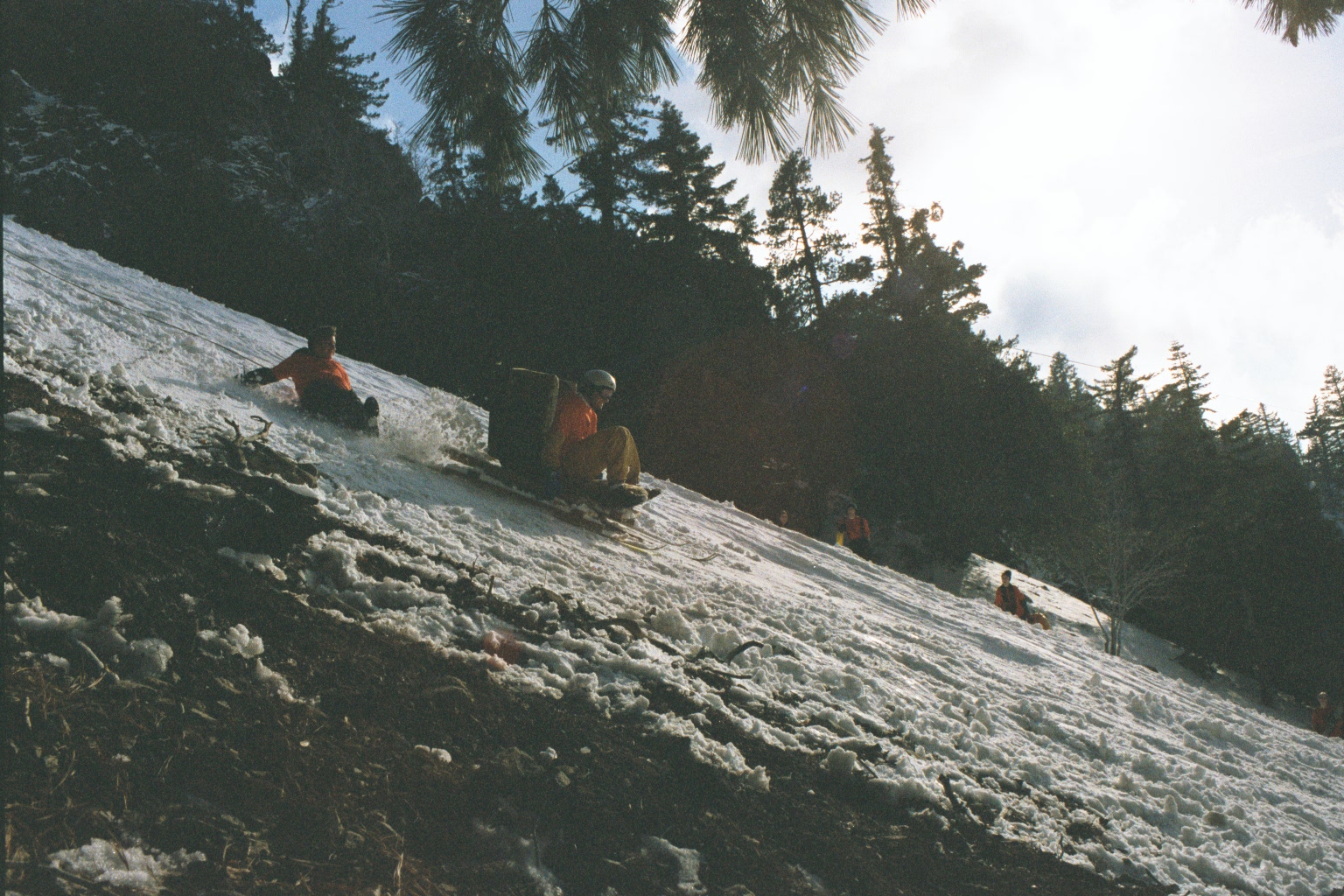
Re:Ahh...Real Genious is great. I didn't realize just how acurate it was untill I watched it last month. Try to remember the sceen in which the dorm is frozen over an someone rides a home-made chair/sled down the stiars. Compare that image with this
picture from a recent dorm trip from Harvey Mudd College.
--Ben
-
Re:Ahh...Real Genious is great. I didn't realize just how acurate it was untill I watched it last month. Try to remember the sceen in which the dorm is frozen over an someone rides a home-made chair/sled down the stiars. Compare that image with this
picture from a recent dorm trip from Harvey Mudd College.
--Ben
-
Text of bill
The text of this bill is available by searching http://thomas.loc.gov for "spam".
(thomas.loc.gov is the first site that I've encountered that not only uses temporary URLs for search results and uses POST forms for searching, but also won't accept the form if I tell my browser to GET it instead.) -
A few clarificationsI'm the Adam Bliss mentioned in the article. You'll just have to take my word for that, I guess. I'm really from Lawrenceville, not Norcross. Nowadays I attend Harvey Mudd College in Claremont, CA (where Zach Walters told me I was on Slashdot... Thanks Zach!). I noticed a few things in the threads below that I'd like to clarify.
First and foremost, I don't think the theorem is actually called the Klehr-Bliss theorem. AFAIK it's the van Lamoen theorem, since he was the first to furnish a full proof. Lou Talman had a quicker (and simpler) proof that was purely geometric, but I believe it was found to be flawed. I was working on a brute-force algebraic manipulation, but Floor van Lamoen carried essentially the same technique to its completion before I was able to. You can read about his proof here.
Josh's conjecture was pretty accurately summarized in the article. The point E mentioned is actually the circumcenter, the center of the only circle passing through the three vertices of the triangle. Also, it is not exactly correct to say that the lines through A, B, and C intersect in "a point" inside the triangle. The three lines are concurrent (they all pass through a common point, a rare thing for three lines to do), but Josh's slope-reciprocal construction is really just a reflection about the line y=x in the coordinate plane, and changing the orientation of the coordinate axes relative to the triangle makes the point of concurrence wander around inside the triangle. The kicker that I noticed is that as it wanders, it stays on the nine-point circle, or Feuerbach circle of the triangle. I've actually found that there's a lot more to be said along these lines, and to my knowledge none of it has been published.
For the public/private thread... I think that Josh was and is attending a private school (Paideia, an excellent school by the way) though I attended a public one (Collins Hill... not too bad as public schools go).
Not only does the theorem have little to no practical value, it also is of little interest to mathematicians. I've always thought of it as simply a little ditty in triangle geometry. I haven't yet read van Lamoen's article in the AMM, but I believe he mentions it only in passing.
And yes, it is vitally important to have an encouraging mentor. Steve Sigur, Josh's teacher, is a great guy and an excellent math teacher. I don't mean this to trivialize Josh's accomplishment--it's also vitally important to have a creative mind and be willing to explore--but Mr. Sigur deserves the real praise here.
I'd also like to take this opportunity to shamelessly plug The Geometer's Sketchpad. It's a great piece of software that dynamically creates geometric constructions. It's excellent for visualization. I used it to see the generalizations I was after, and I think Josh was using it when he first made his conjecture. If you've any interest in geometry--or are willing to have some anew--you should check this out. You can download a free sample version.
Anyway, I just wanted to post and settle a few things... If anyone has any questions, you can post them here or email me (I'm abliss at freeshell.org). Thanks for your attenton!
-
Done in `97 by a high-school studentResearch published in the journal "Artificial Life" reveals that autonomous agents [...] can communicate with one another as they work to achieve a common goal. They actually develop a language of sorts...."
I judged a science fair in Hilo, Hawaii in 1997 that had an entry that demonstrated something almost identical. The 1st place entry was by a student named Ben Schmidel, whose topic was "Virtual Mating: An Exploration In Artificial Communication".
His project was hotly debated amongst the judges by those "in the know" and some "science" teachers who would have been better off as assistant gym teachers. In the end, Ben also went on to win first prize in the state fair. It was actually a very interesting and thought-provoking project, especially for a high school student. I'm not quite sure what he's up to now.
If he didn't play any role in the research mentioned in the article, it is yet another example of parallel evolution. (or maybe an obvious progression of ideas) Either way, i'll remember Ben as "the guy who did it first".
-
*shudder*...
Background: the only shell I've ever really used is bash. Bash has always seemed to be the standard UNIX shell (or, at least, the standard default UNIX shell)...
An asumption like this should earn himCheers...
--
"No se rinde el gallo rojo, sólo cuando ya está muerto." -
Re:Super Bowl - It Super SUCKED!!Perhaps it's just a nerd thing, but here at Harvey Mudd the 3D effects got more audience response than most of the rest of the game. It's very cool technology and instant replays are a great place to debut it.
BTW: The people making it have a web page which I havn't seen linked to: http://www.cs.cmu.edu/virtualized-reality/main.ht
m l
--Ben
-
Re:Isn't it obvious this data is garbage?
What you need most is a sense of scale.
First, asking climate studies to be accurate on a scale of 3-4 years is stupid - pure chaos theory: noise. They're not talking about predicting whether a thunderstorm's going to hit your house today, but the average temperature of the globe. Ask someone to predict the position and velocity of a baseball and they'll do pretty well, because it's huge. An electron - no dice; too damn small (see, there was this guy called Heisenburg
Second, re: above, 5.8 degrees is a fucking huge difference. Again, not to you sitting in the heating/air-conditioning, and not on a yearly/seasonal scale. Averaged over the course of decades, though, such changes can wreak serious havok: melting ice caps, rising oceans.
Thirdly, you should really do some research on climate simulation. Here's a handy Google link to start you off If you really think climate simulation is bullshit, you're pitting yourself against some of the most hardcore and brilliant mathematical analysis ever done - WTF are your credentials?
Finally, let's be clear about what really matters here: Mother Earth is in absolutely no danger from us humans. Nothing we could do short of saturation-bombing the entire planet with nukes is going to "destroy the earth." She's been around 4 billion years and, on that scale, we're barely hiccups. The real danger is that we make our environment so toxic that we ourselves can't survive it. That's well within our power, even on such a short scale as 100 years.
question: is control controlled by its need to control?
answer: yes -
Re:As a Caltech Student....
Of course, we at nearby Harvey Mudd already have switched 100BaseT in the dorms, so such projects are unecessary. =P
-
Power Crisis Impact on Colleges and UniversitiesFirstly, there is a great web page at: http://www.cs.hmc.edu/~matt/power.html
It grabs numbers from SoCal Edison and charts previous power consumption with current power consumption and projected black-out times.
Anyway,
I'm an undergrad in college in California. We've been having regular power outages ordered by the power company since early this summer. The school saves money by electing to cut our power first in exchange for reduced (slightly) power rates. This power crisis has had the following negative impacts on our lives:
-If we have to keep the power on (Finals, presentation days, etc.) we pay 10x the rate we would normally pay. This translates into $4000 an hour if we keep the dorms lit and turn off the other buildings.
Note: if a stage 3 emergency is called, we still lose our power.
Besides financial woes:
-The chemistry department closes down because the fume hoods aren't powered. I'm all for noxious chemicals, but if you can't control them you're sunk.
-The library loses power. Lost research time.
-The cafeteria closes or only serves cold-cuts and fruit. Cafeteria food is bad enough, but to add insult to injury.
-Night labs have to be rescheduled. You can't collect data on a swinging pendulum in the physics lab without electricity.
-Without electricity to power the lights, homework is really hard to get done. The gym has an emergency generator, but it only accomodates so many people. And the more people working in one area, the louder the noise becomes, the harder it is to do work.
-
Re:Patience
Well.... just to nitpick.
Before there was DirectX, there was WinG, a different "high-speed" graphics library. For example, see this thing I found on Google.
WinG originally came out for Windows 3.1, I think around 1992.
So it was at least thirteen years before there was any explicit gaming support in a Microsoft OS.
Torrey Hoffman (Azog) -
Christmas lightsOBTW-- For those who think the Christmas lights are the big villain - think again. The alert was called at 5:15PM, before the lights went on.
Alerts are usually called before 5:15 pm. They try to predict whether they will have to interrupt power as early as possible, and they even have a page lists the forecasted peak throughout the day. (Another student at my school uses gnuplot to turn the on that page into a nice-looking graph.) So just because the alert was called before people started turning on Christmas lights doesn't mean the lights didn't affect the electricity use at the peak time (which is usually around 6 pm).
Also, some of the shortages are due to annual pollution credits for individual plants running out, so it's possible that using electricity even late at night could contribute to additional plants running out by the end of the year.
--
-
Interruptible powerMy school is on interruptible power. This means that when the supply is low, we are told to shut off our power during part of the evening (which is when power consumption is highest); in return, we get substantially lower electricity rates.
In a stage two emergency, they tell one or more blocks to shut off power during some part of the evening. (The evening is when power consumption is highest.) If we don't shut off our power, we get charged about 90 times as we normally do (from our lowered rate). This has happened about 10 times this semester (which is much higher than any other semester during the last 10 years).
Since finals are next week, the school decided to leave power on for the dorms during the outages, but only leave emergency lights on in academics. This is costing a lot of money, so most students try to turn off their computers when they find out that our block is supposed to be interrupted.
Btw, CA was at stage 3 for a while yesterday (pdf link), but I don't know if they actually started involuntary rolling blackouts.
--
-
Re:Wow .. someone told the truth :P
I would say that the length of time it takes is about 50% dependent on who you know, and 50% on how desperate companies are for your skills. A person on my Clinic project team at Harvey Mudd went for three days of interviews in San Jose after his job that he thought was certain fell through. On the morning of the second day, he was offered a position with a startup, on the spot. The salary negotiation consisted of them asking him to name a figure sufficient for him to cancel the remainder of his interviews and work for them once he left school. He named that figure, the recruiter added some stock options to the offer, and that was that. Now, this is person from a prestigious tech school with a degree in CS, so he's going to be in demand. In any case, by your formula this would have been an 8 week search...
I chose to spend a lot longer on my search (and could afford to, being in school and all), and it ended up taking in the range of time that you're talking about. However, this was to do real research, fly up for a week of interviews, and do protracted salary negotiations (one of the parties was a government contractor).
I'd say that this has a lot to do with the skill set of your average tech support callcenter person.
Walt -
Prioritizing network trafficMy college says they have set up their routers to allow Napster traffic but give it lower priority than other traffic. Do you know if other colleges are doing this?
--