Slashdot Mirror
Domain: japaninc.net
Stories and comments across the archive that link to japaninc.net.
Comments · 14
-
That is up for debatehttp://www.japaninc.net/article.php?articleID=653 tells of a japanese person who claims to have invented the floppy disk as early as 1952, 4 years before this ramac machine. How true it is I can't determine but the story is repeated in several places
This ramac seems to be the first practical commericially available disk drive available. You can blame
-
Asia going IPv6
From what I've been reading asia is going IP6 much faster then we (USA) are. In China & other places I think it's because they're still building a lot of infrastructure so they can start with the latest.
-
Toshiba's "Cutting Edge Designs" Aren't So GreatRef ( Here Here And Here )
Essentially this is just a word of caution, Toshiba has in the past had faulty designs on overpriced hardware and screwed over the people who buy their products. I'm not just pulling this out of my ass, Toshiba claimed guilt on both of their laptop design class action law suits.
-
Even more interesting...
I did some google research and found some interesting stuff.
Gendlin, the CEO of AtomChip and Dr. NakaMats founded the Gendlin-NakaMats Institute. NakaMats is either a dreamer, a genius inventor or just simply nuts - his website. Here is an interview and an article about that guy.
NakaMats admits, that he's getting royalties from IBM for every single floppy drive sold.
It all sounds very strange to me, but on the other hand... who knows. -
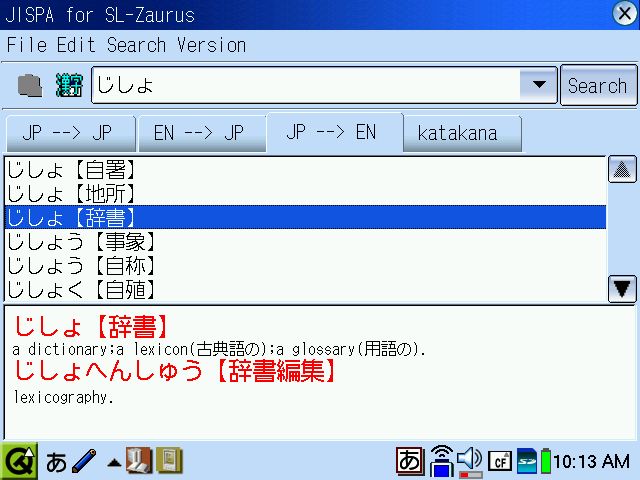
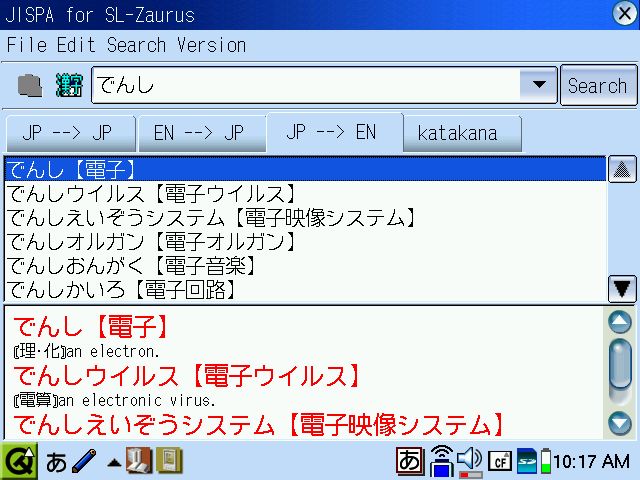
Re:Get a Zaurus SL-C760
Hmm...it seems you're mostly right. No place better than slashdot to get a correction I suppose
In support of what you said: it turns out Jisho is correct, but that denshi jiten is also right. No wonder Japanese exchange students were looking at me funny, but not correcting me, when I said "denki jisho". It's a shame nobody said anything to me before you did, but thanks for the correction. *memorizes denshi jiten*
Strange, though, but the default menu option for the dictionary calls it Jisho.
You're probably also technically correct about kanji handwriting recognition. I'm just a third semester student, and I can usually sketch out an unfamiliar kanji well enough for the Zaurus to understand it. Sometimes I put two strokes where one goes, sometimes I put one stroke where two strokes go, sometimes I get the order wrong. Almost always, for unfamiliar kanji, the one I wanted isn't the first one that comes up. I just tap the kanji with the pen and it shows me a list of other possibilities.
If the one I need isn't in there, I look at any similirities between the ones that *are* in the list, and make sure my next attempt at writing it looks different from that.
So I think you're right...it probably does really take about four years to be able to do that accurately and reliably. I think I'm right also -- if the student has a little bit of skill, the Zaurus's handwriting recognition is smart enough to look past most mistakes. By contrast, the simple handwriting recognition in the Zaurus app KanjiNirvana doesn't tolerate *any* errors.
I don't know if you've used the Zaurus's kanji handwriting recognition, but apparently Zauruses are famous for theirs. I make a lot of handwriting mistakes, especially with new and unfamiliar kanji, and the Zaurus picks up what I intended most of the time -- when I'm already kinda familiar with the stroke order. The Zaurus picks up what I meant to write about a third of the time, when I'm unfamiliar with the stroke order and just roughly copying down what I see, and don't mind scrolling through a list of alternates.
So I'd say: if this is your first semester learning kanji, I don't think you'll be able to use the handwriting recognition the way I do. If this is your second semester or later of studying kanji, go for it. It's my second semester also, and it works for me. -
japan's had this for awhile
See this article from the August 2000 issue of Japan, Inc which talks about paying for vending machine purchases this way. The technology has also been adopted by convenience stores, etc. I don't think south korea is exactly breaking any new ground here.
-
More Hype?
This may or may not be hype. The Japanese have been known to do it before. In the 1980s Japan's Ministry of International Trade and Industry (MITI) launched a grand 10-year project to develop "5th generation" computer technology. They expected to leapfrog existing technology by orders of magnitude and create compnents for "intelligent" computing in the process. By most accounts, that project failed. It was a huge and embarrassing failure.
To be fair, the project did achieve some success. And I give them credit for at least finishing what they started. Nevertheless, just because they hype a fantastic multi-year project doesn't mean they'll succeed, and the Japanes have been known to hype projects deliberately just to drum up interest (also not a totally bad thing). I'll believe it when I see it. -
More wisdom from the blond-dreadlock crowd....just a reiteration of some of the nastier racist formulas
Well then, Shuji Nakamura must be a nasty anti-Japanese racist too, since he makes essentially the same arguments. I guess that's just 'drivel' to you, and never mind that he is the most accomplished Japanese scientist since Shinichiro Tomonaga.
Did you bother to read the link I provided? Would you please do so, and then also go read this white paper from a representative of the Japanese ministry of science and technology. It not only reiterates many of the same points I have made, but provides quantitative statistics and pertinent examples to back them up. Oh, and read this article from the Japan Times, too.
Nasty racism, indeed. Chirping politically-correct twits like you cheapen the term 'racist' and dishonor the memory of true victims of racism. You think calling someone a 'racist' or 'mean-spirited' or 'bourgeois' settles all arguments. Wait until you get out of college, you stupid little nose-picker, and see how things really are in the world.
-ccm
-
Re:Why is Japan so far ahead??Q: Why is Japan so much more advanced than the U.S. and other 1st world nations?
You are begging the question here, assuming as true that which you wish to prove.
In some regards Japan is more advanced (robots, miniaturized consumer electronics, catering to every bizarre sexual fetish.) In other fields it is not (stealth aircraft, computer operating systems, GPS.)
Since WWII, Japan has not been allowed greater than a 1000 person National Guard
This is complete rubbish. The SDF is an army in all but name and far larger than 1000 men, although rather lacking in airlift and heavy weapons capability.
and is otherwise protected by the US's armed forces.
True. Damn freeloaders. But better that, than reviving the Greater East Asian Co-Prosperity Sphere.
This has many effects. One is more money to spend on technological R&D.
Japan's government has poured billions down the R & D rathole, trying to choose technology winners in advance and shape their development. Remember fifth-generation computing? Most of this money is wasted, or at best can be described as subsidies for non-competitive but politically connected corporations.
Another is more money to spend on education, which leads to a smarter population capable of making huge technology leaps.
Much of the extra time spent on education in Japan is devoted to learning the 10,000 (or is it 25,000?) ideographic characters that an educated Japanese must know. We, on the other hand, learn our alphabet in first grade and add modest increments of orthography up to about sixth grade, after which it ceases to be taught at all.
Moreover, the Japanese educational milieu is brutally suppressive of creative thinking and independence. Regimented rote learning begins in early childhood and continues through the high school years, suppplemented by "cram schools" to prepare for the rigorous but irrelevant college entrance examinations. Once in college, students snooze through four years of studies. Even the mighty Todai is a joke compared to any second-tier research university in America, much less Harvard or Cal Tech.
After college, the salaryman goes to work in a big company doing mind-numbing work in a rigid hierarchy, churning out well-made but derivative consumer goods. Or he stays in academia where the hierarchy is, if anything, even worse. Maybe after he has been a professor's dogsbody for fifteen years he can get his name on a paper, or maybe not, if the lab director doesn't like him.
In truth, you could hardly imagine a system that would stifle independent thought more effectively. If the Japanese succeed in scientific endeavors like the blue LED, it is in spite of their educational system rather than because of it. And most of the true scientific breakthroughs seem still to come from us hairy gai-jin barbarians; the reams of patents the Japanese file are typically concerned with minor variations on trivial matters like building a better dildo or toilet.
As a final note, I have seen the inside of a Japanese classroom. It is spartan to a degree that would not be believed in even a poor neighborhood in the US. I guarantee you that we spend more per student per year in this country, especially in big-city systems where teaching and learning are secondary to providing jobs for otherwise unemployable union thugs and political hacks.
Furthermore, the Japanese have other cultural factors that contribute alongside these economic factors to create an environment suited very well for developing bleeding edge technology.
Since you brought it up-- I assume what you are likely referring to is the racial and social strictures that would boggle the mind of most young Americans.
The Japanese are the most racist people on earth, by a wide margin. Koreans whose families have lived in Japan for centuries are denied citizenship and barely tole
-
MORE Interesting: SONY HANDHELD WIFI FILESERVER!!
hmm... their palm announcements are hardly as cool as their other announcement (thanks glenn fleischman):
Sony's Wi-Fi equipped pocket Web server:
GadgetWatch identifies (and offers an English explanation of) a Wi-Fi-enabled portable fileserver! Nifty. 70,000 yen. -
Heck,how do you know whether nobody died just yet?
It isn't a crime in most places.
Condoning spam actually encourages spammers, not just to continue their business at everyone else's expense, but sometimes even to sue people who refuse to pay for receiving the pitches for their scams.
This means that as long as spam is considered a legitimate business, fighting it can be dangerous, even though it is spying out your personal data and usage patterns as well as inundating your entire families' inboxes (including those of children!) with UCE for all sorts of fraud and porn.
Fortunately the voices of reason are finally being heard, therefore much of this is changing:
Spam has just become illegal (article 13) in the entire European Economic Area.
Soon spam will swamp everything else. (...)
OK, spam is not a good thing, but aren't we getting a little carried away here?
The one point you're forgetting could actually be seen as implied in your own statement: Spammers spam everything, everyone, every address, everywhere, all the time. If it's legal, their numbers will continue to rise.
Digital convergence brings eMail addresses to phones, and pagers have also had them for a long time (now tell me how you click "opt out" on any of these!). If the phone or pager of a doctor becomes unusable due to this "perfectly legal activity", it won't be long before people are dying. If the same happens to the device of a firefighter, a hospital's or an airport's system administrator, people are dying all the same, in the name of spam.
If you think this threat is greatly exaggerated, Japan is a few years ahead in mobile technology (page 3), and with spam making up more than 80% of all messaging, their experience with what will globally become everyone's future of electronic communications is just devastating.
Make sure there will be a federal law against spam - and you'd better speak up before it's too late...
Your congress(wo)man is waiting for your mail.
Just now. And tomorrow. And all week/month/year through, until they finally stop the spam. -
Living Room on Wheels
I've heard that there is a growing trend in Japan to make cars more homey and luxurious, like little living rooms, as mentioned here and here for example. Partly because they spend so much time in their cars due to heavy traffic. The pictures and diagrams really brought this home. Check out the size of that mother, and look at the flat-floor diagram, with the wide seat sideways and the others arranged around it. I could easily imagine adding a coffee table and a lamp.
-
Re:Typoing your email address can be a drag
It's worse when it happens in, say, a news release.
Also, (under "UBS Warburg Makes Expensive Gaffe on Dentsu IPO") UBS once had a typo with an IPO, offering 610,000 shares of Dentsu at 16 yen each instead of 16 shares at 610,000 yen each. Ouch. -
Re:Yeah, but
Here's the correct links: Yankee Group
and
Jap@n, Inc
Sorry... long day.