Slashdot Mirror
Domain: joeclark.org
Stories and comments across the archive that link to joeclark.org.
Comments · 18
-
Re:Thunderbird
I'm a bit miffed about the lack of format=flowed support in email clients. How can the pile of horse manure that is HTML mail become widely supported but not a simple and elegant solution like format=flowed?
-
I much prefer
Building Accessible Websites by Joe Clark. By far the most insightful and interestnig book on the subject that I've seen. A great designer needs to keep all the "who" in mind - not just the "why" or "how".
-
Re:Buying newer versions
When I was young, my mother bought me a set of World Book encyclopedias. Each year, they would mail me a Year in Review (General news) and Science Year update which would have a set of stickers (the lick-em, stick-em kind) that would indicate which book and which page the new article was on, and you would add that sticker to your original encyclopedia entry. That way you would be able to know where and when the original entry had been updated.
Personally, I think it's a darned clever little idea. Even in this day and age, I still prefer my dead tree versions of things. I think any reference book should offer addendums and errata. Joe Clark has a good example of how this can be done with Building Accessible Websites. -
Others.... are not so good either
The sites of the "Others" you mention are (IMO) not very good themselves
http://www.zeldman.com/ - Darkish Green on Light Green poorly readable colours. No sitemap. Search box filled with a junk phrase that needs deleting before starting, and as filled not much space to click after this existing contents when about to delete it. Unclear section titles, alt text no better.
http://www.joeclark.org/ - Bigger than users chosen size text (as every thing is in lists) makes page too long. Use of non-standard 8-bit characters. No Sitemap.
http://www.webstandards.org/ - No search. No sitemap. Otherwise OK.
http://www.alistapart.com/ - No sitemap. No contents or short titles list in each section, you have to "More articles->" 10 at a time instead. Instead of link "Home" it is "Up Front" (Never heard of standard practices?)
The ALA site publishers include Zeldman, the Zeldman site contributors includes Joe Clark, the web standards site former major people includes Zeldman. The AC probably just likes this circle of styles, but on the other had maybe he is Zeldman himself?
-
Building Accessible Websites
It may be a little late to post this, but this book (which was mentioned on Slashdot, partly because of the 'goatse'-like cover), 'Building Accessible Websites' is really great. It's available free on-line, and the whole site is a great example of accessibility. (Turn CSS on and off it your browser allows it, Opera does, change the font sizes, etc. It works great by screen reader too.) Fairly practical, much more so than certain 'reccommendations' from accessibility standards groups.
-
Re:Editor Queue enhancements?
Please...no, stop!! More links a in a story submission means the submission is likely to be inferior.
For example, here is part of a made-up submission:
Joe Clark writes "Nearly a year after an interview with this correspondent highlighted a few problems with Slashdot's HTML, Daniel M. Frommelt...
-
Web development for the colorblindJoe Clark's book, Building Accessible Websites has an very good chapter on colorblindness. It has an excellent explanation of colorblindness based on two full weeks of scientific research and interviews with researchers in colour vision, which will prove useful even for non-web development.
You can also use this greyscale bookmarklet (IE only) to get a rough idea of how a web page may look to some colorblind users.
-
Web development for the colorblindJoe Clark's book, Building Accessible Websites has an very good chapter on colorblindness. It has an excellent explanation of colorblindness based on two full weeks of scientific research and interviews with researchers in colour vision, which will prove useful even for non-web development.
You can also use this greyscale bookmarklet (IE only) to get a rough idea of how a web page may look to some colorblind users.
-
Re:One of the funniest Beavis and Butthead episode
Meh.
Taco and friends need to read this book. -
Re:......my belly-button
"Who the fuck cares?"
Obviously not website designers, that's why governments around the world feel compelled to legislate website designers into doing the right thing.
As Joe Clark points out, if you are making your website accessible because of legislation, then you are doing the right things for the wrong reasons.
To pre-empt the "its only government sites that need to be accessible" crowd, here's a counter-argument to the South Western misruling. -
Cover Photo
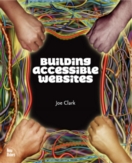
Joe Clark has written a book. Does anyone else notice a striking similarity between the cover photo and a certain infamous image.
Sorry, not meaning to troll. I like Joe Clark, I also work in accessiblity. It's just that that image(the book cover) is right on his main page, and I can't go there without having my visual memory of things I would rather not remember activated. -
Book cover
Was the design of your book's cover influenced by the goatse man?
-
Commerce vs. "Access for all"
Frankly, the impression I get when I hear "accessible websites" is that they will appear spartan and/or dated. (your website is a good example, ATTAIN, Inc. a non-profit accessibility provider and previous employer is another)
This is all very well for government or non-profit sites that are services for awareness and public information; all US government and most US non-profits are compelled by law to abide by some accessibility guidelines. They aren't the problem, private businesses and entities are. The impressions of "accessibility" is at odds with business sites that need to "capture" visitors with compelling visuals and/or content before they move on to the competition. The fact that typical internet user attention spans are measured in seconds and waning fast is a major drive of the design of online commerce sites.
How can the goals of business and "access for all" coexist? Do any examples of fully accessible sites that are also compelling enough to compete in today's online business environment exist? -
Poor Choice for a Book Cover
Is it just me or do you also think that Joe's book cover look like goat.cx?
-
Bookcover
is it just me or does that book cover bare a little too much resembalance to goatse?
(link to image of book cover http://joeclark.org/book/images/bawcover50.jpg ) -
Yuck...
The cover of this guy's Web Site Accessibility book is bizzarely reminiscent of that goatsx guy. Ugh.
http://joeclark.org/book/images/bawcover25.jpg
-
Re:Question The FirstFollow the links, stupid.
Particularly, this one.
-
Client side scripts break accessibility (& laws)If sites become dependent upon client side niceties like Flash, data binding and Javascript for their basic functionality, they stop being accessible to those using assistive technologies which don't support those capabilities.
Now you may not be aware of this, but in many countries, sites must be accessible.
- In the US, the Americans with Disabilities Act means that all federal services (and many state ones) must be accessible.
- In the UK, any site which offers a public service (nb this includes all online stores) must be accessible, thanks to the 1995 Disability Discrimination Act.
- In Australia, the Sydney Olympic Games Organising Committee were successfully sued for being inaccessible to the blind
With this going on, an IE-only web is going to get further away, not closer. The only way to be accessible is to ensure that basic HTML standards-compliant pages will allow users to access the basic functionality of their sites.
More info: