Slashdot Mirror
Domain: kde.org
Stories and comments across the archive that link to kde.org.
Comments · 3,588
-
Re:Takes the idea of "open source" to a new level
For others' information: http://techbase.kde.org/Development/Languages/Smoke
Smoke looks more like a COM-style marshalling system than a mere language binding. From what I've read, basically Smoke wraps every object in special qobject proxy. If this is correct, then my original reasoning stands. C++ requires wrappers or proxies to work well with other languages. gobject C-based libraries, as nasty as they are to develop, require much much less of this.
So no. Smoke bindings haven't proved me wrong.. in fact they've proved my original point. No the binding arguments aren't stupid. Besides all this, arguing that core Gnome APIs should be C++ based is just silly because they are already C-based. If we rewrote everything we'd just end up with KDE/Qt anyway.
-
Re:If happens: KDE here I come!
And even before QtScript there was KJSEmbed, which has mailing list archives dating back to 2003.
Of course TFA itself pointed out QtScript and how it is used by Amarok...
-
Re:It's official...
Look Here
License(s):
Libraries: LGPLv2
Some helper binaries: GPLv2
Some code may have more permissive licenses. -
Re:It's official...
That is factually incorrect: KDE applications can be (and are) released under a number of Free software licenses, including the BSD license, LGPL, GPL, MIT, X11, etc... you can see the licensing policy here: http://techbase.kde.org/Policies/Licensing_Policy
So what really changes here is people not being required to purchase a license to do proprietary development and the people in the FOSS world who felt that was such a problem that they wouldn't touch Qt can now rest easy and use it.
-
KDE 4 has major UI issues
Fact is, KDE 4, even 4.2, still has some horrendous UI issues that the developers just dismiss. I switched from GNOME to KDE to avoid Mono/.NET, but with KDE 4 I feel like they're heading even further in the wrong direction as far as UI design is concerned. KDE 3 had too many settings but behaved more or less as you'd expect from other UIs; KDE 4 has hardly any settings and behaves in weird and freaky ways unlike any other desktop environment.
-
SWT/Qt ?
Does this mean SWT/Qt can be released?
-
Re:KDE is a perfect cross-platform environment
http://websvn.kde.org/trunk/KDE/kdebindings/csharp/
The C# support has been steadily worked on for the last few years and should be quite mature by now.
--
Simon -
Re:KDE is a perfect cross-platform environment
See the package qyoto-examples in ubuntu or check out the code here.
-
Re:It's official...
Correct me if I'm wrong (and I hope I am) but since KDE and it's libraries is based on the GPL'ed version of QT, it is itself GPL'ed, which means that you need to GPL your code is you want your app to integrate with KDE..????????
The KDE libraries have always been LGPL.
Read http://techbase.kde.org/index.php?title=Policies/Licensing_Policy for details. -
Re:I like KDE 4
"Konqueror -> Settings -> Configure Konqueror -> Crypto -> SSL Signers -> Import."
Maybe this is fixed in the nightly builds or in 4.2? I am using 4.1.3 right now, and yes, that option *exists* but it does not work, it does not propagate the public keys globally, and it does not retain those settings after hitting "OK." Claiming that is the solution to my problem is kind of like calling your alpha release "version 4.0 stable." Hmm...
"the "OLE framework" in KDE is called KParts, and the infrastructure hasn't changed one bit between KDE3 and KDE4."
Except that the use of KParts has changed. In KDE3, all the KParts components played well with each other (except for the Kontact KParts, which only embedded in Kontact), which is exactly what OLE is supposed to do. In KDE4, a few components still embed in one another, but nothing on the level of KDE 3. The OP was claiming that KDE 4.1 was approaching 3.5 in terms of functionality; where are the useful, play-nice-with-others KParts?
"it doesn't embed into Dolphin, no, because that's not Dolphin's design goal. i don't have 4.1 nearby to test this on, but in 4.2 you can navigate directly into tarballs seamlessly in Konqueror."
Then Dolphin was poorly designed. I do not need a file manager if all it does is browse normal, already mounted file systems. Dolphin certain supports some level of OLE, the fact that it cannot embed an ArK component is, once again, an oversight, and an embarrassing one. Maybe this will be fixed in 4.2.x? 4.3?
"currently Ark relies on KParts for previewing files without extracting. an "open with" that would extract to a temporary location and launch the app would be nice, though."
And once again, they do not play well with others. Why not have an Okular component embed into ArK? Why force me to extract a PDF file just to view it? If the file manager does not embed an ArK component, and ArK cannot embed an Okular component, then why would I use Dolphin/ArK when I could just use a terminal? In 3.5, there was no question: KPDF embedded in ArK, ArK embedded in Konqueror, and the software stack was more useful than trying to navigate using just a terminal.
"which shortcuts would those be? actually, better yet, go to bugs.kde.org and report it there so it can be handled."
http://bugs.kde.org/show_bug.cgi?id=165441#c2
Notice that they did not even PLAN to fix it in 4.1. Maybe it will be fixed in 4.2? I can only hope so, because it is clumsy, annoying, and frankly stupid for shortcuts to fail. What is very odd, though, is the kxkb shortcuts work in Fluxbox; oh wait, that is confirmed too:
http://markmail.org/message/dxz6fntbrp73cljl
Again, NO PLANS to fix. Why are there no plans to fix this? Keyboard shortcuts are the only way to keep a large GUI like KDE from being too clumsy to use, but they are sitting around scratching their heads and not even trying to get this working. Again, one is forced to ask just what design methodology they are adhering to, if any. Another commenter noted that there are other shortcut daemons; is that really what we are stuck with? -
Re:KDE simply isn't a factor
Catch up with the times, QT 2.2 was released under LGPL. The license issue is no longer an issue and is old news.
Do you have a source for that? All the links I've found on google say that isn't true. For example:
"Qt 2.2 To Be Released Under the GPL" http://freshmeat.net/articles/view/180/
"Qt 2.2 Released under the GPL" http://www.kde.org/whatiskde/qt.php -
Re:Where is Konqueror?
Because KDE on Windows is still not user-ready. Expect some interesting time after its completion.
-
Wasted Effort
I'm posting this from Konqueror on Linux as god intended and all that; but http://windows.kde.org/ [kde.org] is the place to look if you want Konqueror goodness on Windows.
Technical limitations, M$'s long history of technical sabotage and the eminent collapse of M$ and Windows market share makes Windows ports a huge waste of effort. Privacy and security on Windows is impossible because the system is rooted by design and you a little more than a renter of a system you can never own. KDE could provide improved performance but M$ sabotage will eliminate that, the same way iTunes, AV and other popular software are routinely broken under Vista. Finally, Vista has failed and Windows market share is already starting to slip. What's the point of porting to eight year old XP, a failed Vista or an expensive and soon to fail Windows 7? It's time to tell your friends that software goodness is best found in the free software world.
-
Re:Konqueror and Safari should not be left out.
Now, I'm posting this from Konqueror on Linux as god intended and all that; but http://windows.kde.org/ is the place to look if you want Konqueror goodness on Windows. Quite possibly still in the rough edges stage, but a large amount of KDE 4 stuff is being brought over to Windows.
-
5 Distros, 2 being Ubuntu?
How about some individual projects? Amarok 2 came out in 2008. Other things that existed before but which improved mightily in '08 were:
Flock (released v2)
KDE Released 4x series, abysmal at first, but it's great now.
BasKet Probably doesn't belong on a Best Apps Ever list, but it is pretty useful. This existed before, but I just found it this year and it's great, and it has become a lot more stable for me through the year. Someone help get them to qt4!
There are lots of great apps out there that deserve some love this year. -
5 Distros, 2 being Ubuntu?
How about some individual projects? Amarok 2 came out in 2008. Other things that existed before but which improved mightily in '08 were:
Flock (released v2)
KDE Released 4x series, abysmal at first, but it's great now.
BasKet Probably doesn't belong on a Best Apps Ever list, but it is pretty useful. This existed before, but I just found it this year and it's great, and it has become a lot more stable for me through the year. Someone help get them to qt4!
There are lots of great apps out there that deserve some love this year. -
Re:Where are they going to go?
Personally I wonder why they want to abandon Windows XP support at all, Windows XP looks like a perfect cash cow for me, no need for further investments, most of the bugs are fixed and you can even skin it to look like Vista.
I don't understand why they want to abandon XP. I other word, they want to leave the Netbook market to Linux. Fine with me as long it is not Xandros. If you take LXDE instead of GNOME and KDE it still provides you with all you need. The Desktop is mature. It doesn't matter which operating system you run as long as it is fast and saves your battery.
Microsoft does not get it. The Desktop is mature. You don't need to provide Vista to your users. No one likes Vista. Instead they come up with Windows 7, in other words Vista++. Be sure Windows7 will eat even more memory. And users will again say: get us XP or we switch to Linux or we switch to Mac.
The real debacle for Microsoft is the merging business of software reselling. In other words, if Microsoft does not get you a Windows license, your used software vendor will, and you also have all the old machines and their licenses you can sell for cheap. Because Microsoft is going to get "cheap XP" and zero-cost Linux as competitors of "Windows Azurecloud".
If you run XP and your computer gets damaged then why do you have to get a new XP license with your new notebook? Bundling is a total ripoff! Time to complain. In some nations the courts made bundling illegal!
The day the bundling business dies we kiss Microsoft goodbye.
-
Re:Um, no thanks
I believe you're thinking of the wrong context, Symantec (the company, as in Norton) vs the indexing and usage of semantic web metadata about files stored on your machine, in this case, in your own home folder by default. this actually gives you the ability to search through your files by various methods, including tags, timestamps, and the source of the file just to name a few, instead of just searching by filename or type, giving you the ability to find what you're looking for in your home folder alot faster. I'd advise you to look further into it here: http://nepomuk.kde.org/discover/user before you jump to any conclusions about this.
-
Re:I doubt it will catch on...
The Nepomuk Web site wants to make me chew my own arm off.
ha, good one.
Why why can't researchers spend 15 minutes thinking about how to convey the importance and excitement of what they are trying to do in terms of practical examples.
There are some, but they are not very elegant:
http://dev.nepomuk.semanticdesktop.org/wiki/UsingNepomuk
http://dev.nepomuk.semanticdesktop.org/wiki/UsingDropBox
Or check out the KDE stuff:
http://nepomuk.kde.org/discover/user
also in cute little moving pictures:
http://www.youtube.com/watch?v=_8oavLQeAjM -
Re:I doubt it will catch on...
-
Can GNOME do these KDE equivalents?
Sir, you seem to be familiar with GNOME, so I'll throw out some more questions about KDE equivalents in GNOME, and maybe you can convince me to switch.
- Customizing keyboard shortcuts in GNOME. E.g. I want the "reload" key to be "Alt-Shift-B" rather than "Ctrl-R" in Firefox (for example), or Win-Shift-D to bring up the clipboard list of items for cut&paste. How do I do this?
- Controlling GUI programs via command-line/script. The equivalent of DCOP in KDE3. If I want Konqueror (web browser) to go to the web page in Klipper (the clipboard) memory, I say: dcop konqueror-6500 konqueror-mainwindow#1 openURL `dcop klipper klipper getClipboardContents` I think GNOME uses either DBUS or something called "Bonobo". Same sort of scripting ease/flexibility?
- File requester dialogues, specific to each program. When I want to open a file in Kolourpaint (for example), the file search dialogue box has bookmarks which I can preset to jump to commonly used directories (see here: http://api.kde.org/4.0-api/kdelibs-apidocs/kio/html/kfiledialog.png for image). GNOME has the same, but I don't know how to get them to be program-specific. That is, the bookmarks for Kolourpaint, which point to my image directories, should be different from KWrite's bookmarks, which point to where my text files are stored.
- When I Drag & Drop in KDE, a menu pops up: "Copy? Move? Link?" If I press Ctrl before "dropping" the file (releasing the mouse), KDE will know I want to copy. If it's Shift, then KDE will move the file. If it's Alt, then it will link. Equivalent in GNOME?
- Equivalent of Norton Commander/Midnight Commander for GNOME? (In KDE, it's Krusader.)
These are the main things that keep me with KDE. In particular, there are a whole bunch of scripts I've written with DCOP calls.
There are a few things inducing me to consider GNOME.- KDE is switching to KDE4. It uses DBUS, not DCOP. If I have to re-write my scripts, I'll take a close look at whether KDE4 really is better than GNOME.
- Ubuntu uses GNOME. Yes, there's Kubuntu, but it's treated like a second-class citizen. They don't address the weaknesses in KDE: "New! We're going to use Beagle search! Oh, it's not compatible with KDE? Ah, well, you guys go mess around with Strigi or something." They don't address the strengths of KDE: "Breakthrough: after pouring tons of man-hours into Ubuntu, we have improved utilities! What's that? KDE already had that three years ago? Who cares --don't you have to run along and go compile some code?" And the last straw: "Oh, we can't support KDE3 long term. But we're not supporting KDE4 long term either. In fact, we're decided to forget to mention anything about Long Term Support in Kubuntu."
- My mom and dad switched to Linux and are using Ubuntu with GNOME. They keep asking me how to set things, and I have no idea since I use KDE.
So, if I can get comfortable with GNOME, it might be worth serious consideration.
Thanks for any help you can give.
-
Re:I don't get it
THIS is what will truely switch people fast, when I can multi-tag files on my OS or programs are smart enough to do it for you.
A file extension is not enough 'tagging' for a type of data now, it's a poor identifier and not helpful overall, I want to see machines much easier to find files I want, when I want and store them easily and convieniently with a fast, intuitive UI to access the data quickly.
A reasonable request.
http://nepomuk.kde.org/
http://nepomuk.kde.org/discover/user
http://www.internetnews.com/dev-news/article.php/3688606Which has already been granted.
KDE4 rocks, and it beats Vista pointless for speed.
-
Re:I don't get it
THIS is what will truely switch people fast, when I can multi-tag files on my OS or programs are smart enough to do it for you.
A file extension is not enough 'tagging' for a type of data now, it's a poor identifier and not helpful overall, I want to see machines much easier to find files I want, when I want and store them easily and convieniently with a fast, intuitive UI to access the data quickly.
A reasonable request.
http://nepomuk.kde.org/
http://nepomuk.kde.org/discover/user
http://www.internetnews.com/dev-news/article.php/3688606Which has already been granted.
KDE4 rocks, and it beats Vista pointless for speed.
-
Re:It's right for you. Will you be allowed to buy
I'll start off by saying I've never used XFCE. But... looking at Desktop benchmarks it appears that XFCE acts a lot like a pure window manager (WMaker is the comparison). That is much lower footprint until you start treating it like a full GUI. With only 500 megs of ram losing 80-100 on pure overhead....
Wikipedia also has a good comparison. They put XFCE & ROX in a kind of 1/2 GUI 1/2 Window manager category.
I should say looking at those numbers (from 2006) I was shocked how bad Gnome did on minimal configurations. So I"m not seeing where you are getting the "more memory than Gnome" unless you mean when loaded up to the gills which is of course the point.
-
Re:Some real opinions
now that was a post from somebody involved. thanks.
i just wanted to suggest checking out kde-edu and related applications. kalzium hooked me on chemistry basics despite having an advanced chemistry course (and forgetting most of it). kanagram, khangman and klettres (and others) provide some basic language skill teaching.
there are applications for plain mathematics, a bit more advanced algebra, geometry...you get kgeography for, surprise, geography stuff - and even kturtle for very, very basic introduction to programming (hey, still advanced for me
things like kstars, marble and step are pretty darn advanced and should create interest in most students.
and i have just mentioned apps i have tried myself - i surely missed some other important ones, that one could find at http://edu.kde.org/
so, is there an area that is missing ? if that is a missing functionality in one of the existing apps, talk to the devs. it might just get implemented. a whole now application might be less likely to appear, but you never know until you rrreally talk about it
-
Re:Learn C and Python
Python is absolutely unusable on real world projects (any project where you aren't the sole developer) due to that indentation crap.
Would you mind repeating that? I don't think the guys developing the following projects heard you:
I could go on... but you get the point.
If your software team is having problems with the significance of white spaces in Python, my bet would be that, no offense, the team was to blame.
The trick is to coordinate the "white space rules" between members of the team. If it can't pull that one off, I wouldn't trust them to write code for a production system anyways.
-
Re:OOo failings
Cheers then, thanks for responding. I too chafe sorely at the MS tax, and long for the day when I can totally rely on FOSS and fully open formats for my business needs. "Proliferat[ing] the closed format files on everyone else", indeed --
Cheers,
-
Why not Konqueror?
Why does no-one include Konqueror in these tests? It's even available for Windows these days.
-
Re:Comic is on topic
What would help me a lot more is the ability to quickly switch to a particular window in mind: http://bugs.kde.org/show_bug.cgi?id=121349 [kde.org] Even if you don't have all your windows maximized, it would save a fair bit of time. Alt-Tab only works well if you are switching between two windows.
Another semi-solution I guess, but KDE has the option to "show Window list". I've mapped that to Window+W. It doesn't get you a subset of windows, it gets you all windows grouped by desktop, but if all the windows you need are on one desktop, then that kinda does the trick. And if not, it's still an easy-to-read list
-
Comic is on topic
How's the comic offtopic?
Back in my school days, one form of _punishment_ was being made to hold your hands up or out for many minutes. Imagine if you had to keep your arms extended for so long - talk about asking for a new set of RSI problems.
The full 3-D gesture stuff is overrated.
What would help me a lot more is the ability to quickly switch to a particular window in mind:
http://bugs.kde.org/show_bug.cgi?id=121349
Even if you don't have all your windows maximized, it would save a fair bit of time. Alt-Tab only works well if you are switching between two windows.
You can kind of do this on the Linux/BSD console but it's more limited. I'm looking for something like the text console but for the GUI and where you get to pick your "working set" of 9 or so windows from as many windows you have open.
-
Re:Brilliant but clueless
Oh yeah there is Konqueror. It requires me uninstall Windows Vista, give up on ms office,
Not any more:
http://windows.kde.org/ -
KOffice
I'm a big fan of KDE and their products, but KOffice is a very different beast than MS Office and OOo. To some that is a very good thing, but it isn't going to replace OOo for me, despite being lean and mean. I'm not entirely sure it is meant to compete in the same arena.
However, run it for yourself and make your own determinations. Pull the packages in your distro if you're on Linux, or grab them here on Windows.
http://techbase.kde.org/Projects/KDE_on_Windows/Installation
There should be native packages for Mac and OpenSolaris as well.
-
Re:Amarok!
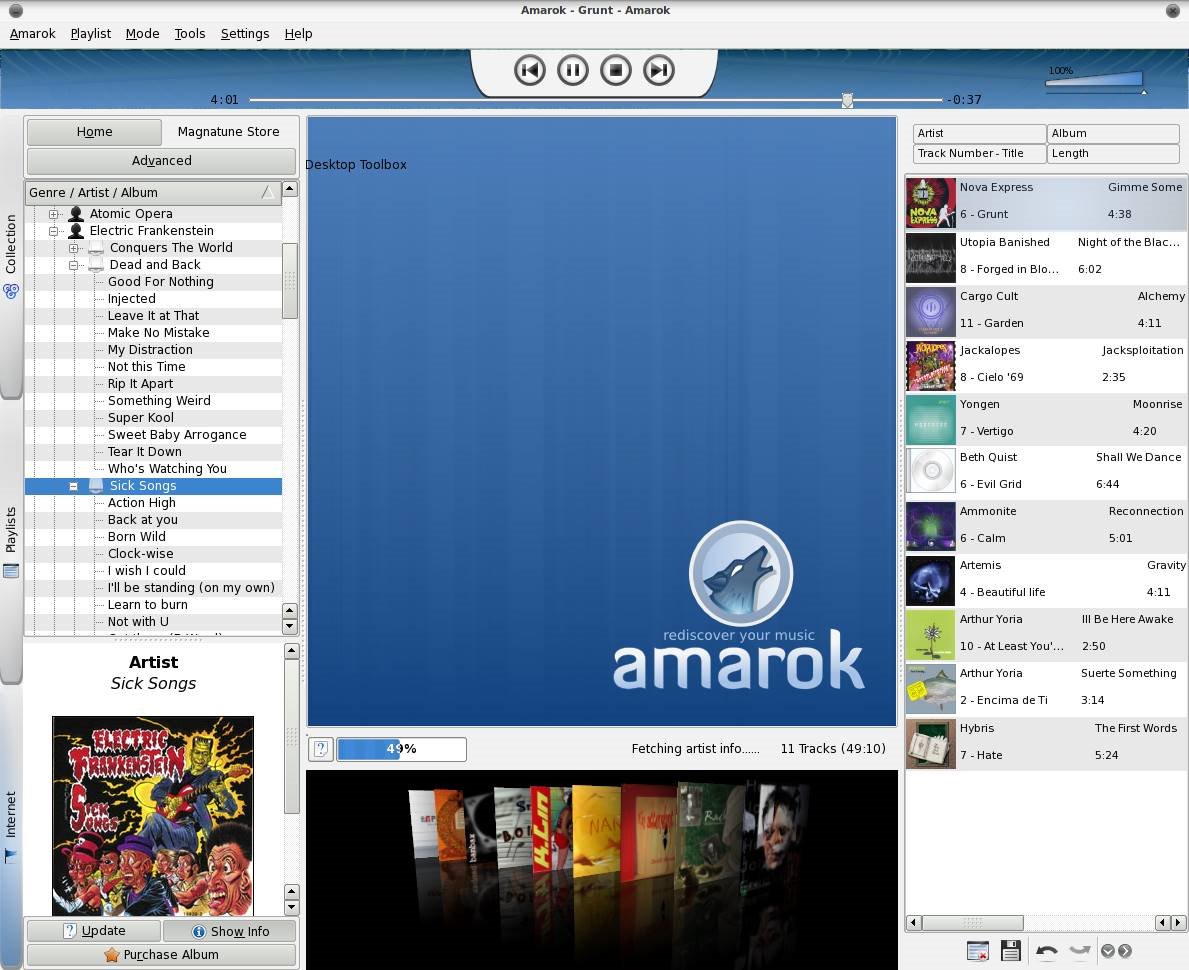
In 1.4.9, yes, that works. In Amarok 2, the playlist is not tabular data like in 1.4.x, instead it's one "column" with each track having several fields in two rows per track, it looks like this.
The number to the left of the track name is the track number, which I don't care about. I sort of really prefer the tabular data since it let you move your eye straight down whichever column you're interested in, rather than have to include or reject things based on context.
Anyway, the context menu for these track entries only gives you the options to play, remove from playlist or edit the track details. Nowhere to add or remove fields. -
Re:Some possible problems, here?You joke, but I'd love to have something akin to Kpackage, running on Windows.
The great thing about open source is that if somebody wants something, it generally happens.
-
Re:Just a personal opinion, but...
Is it just me, or does Amarok appear to be damn ugly?
In short, the beta is ugly, the final version won't be. =) Amarok 2.0 is still just a beta - I imagine the polish will come eventually...
I was just surprised that they want to woo Apple users and then they pick the ugliest imaginable rendering as a representative screenshot, when they have already demonstrated long before that the future default theme isn't all that bad and you can even customise it.
-
Re:Amarok: The undisputed champion
You are missing one of the most powerful features of Amarok then!
-
Re:Does this...
Kernel modesetting is a good thing, but there is no need to put the drivers into the kernel. KMS gets you lots of good things: BSoD (much better than the display freezing with no error message), flicker-free boot, and X could be moved away from needing to run as root.
As far as the drivers themselves, the best thing for them will be the move to the Gallium3D driver model, which will greatly reduce the amount and complexity of code needed to write a new driver. [1][2][3]
Keith Packard talks in his blog [4] about kernel mode drivers, but this seems to be KMS + memory management (GEM or TTM), not having, say, the entire Radeon driver in kernel. I guess it depends on how you define drivers. or maybe the difference between classic 2d drivers and DRM drivers (I have never figured out the details of that)?
>Today's X servers still support all kinds of usermode drivers, just so that 95% of configurations can thunk it all to the kernel.
All X drivers are usermode. There are graphics drivers that are in the kernel (fbdev), but these are unrelated to X.
Note: I am not a X dev or even a real programmer, but I follow X blogs, mailing lists, etc, and I try to learn as much as possible about X. If I am wrong about anything here, please correct me!
[1] http://www.tungstengraphics.com/wiki/index.php/Gallium3D
[2] http://akademy.kde.org/conference/presentation/9.php
[3] http://zrusin.blogspot.com/search/label/Gallium3D
[4] http://keithp.com/blogs/kernel-mode-drivers/ -
Re:SVG too
Here are two pages with some fancy animated SVG.
and a very heavy javascript test (try it in IE hehehe)
-
Re:SVG too
Here are two pages with some fancy animated SVG.
and a very heavy javascript test (try it in IE hehehe)
-
Semantic desktop
Merging the efforts of Nepomuk and new file systems like brtfs are the way to go with this. Handling of file events can be done better than what we have now with inotify. File systems should allows plugins to update indexes on files within the file system structure and file systems should allow queries and query monitors directly.
DBPedia shows the power of SPARQL and implementing an efficient storage for it into a file system is the first step forward. Then user interfaces in GNOME and KDE can take advantage of the queries that are currently very expensive to do.
Ubuntu is in a good position to help out on the Nepomuk effort. Mandriva is already sponsoring this work. More support for this desktop-independent project would be a boon for achieving the file system Mark is looking for.
-
Re:Teach them fun...
1) Teach them to understand that a computer does what a computer is told.
Logo Turtle. Yep, I'm showing my age -- but it worked great for this. What's the best equivalent now? I rather like comment about Python & Blender below, but what are the other options today? KTurtle perhaps? Who's had hands-on experience with this stuff in the modern classroom?
-
Re:Why is that even possible?
Discussion at KDE News. They seem to have Windows mixed in with the Linux, although there's disagreement among various people claiming inside knowledge as to what's where.
-
Re:Hey, Mozilla: Learn what "Never" means
Adobe? Try Okular Its updates dont do that to me.
-
Re:j-track 3d
Of course, there are several Free (capital F) equivalents. I'd rather use Cartes or KStars than Starry Night given the choice, even ignoring the whole free software aspect.
Cartes du Ciel
KStars
Stellarium -
Re:Firefox Damage Control Is More Than Enough
Link for the google-handicapped: http://windows.kde.org/ actually lists KDE 4.1 as a release for Windows. I'm surprised there wasn't more news about it though. It seems to still be alpha/true beta quality software though but interesting nevertheless. Nice for people like me who like KDE apps but also like Windows (gasp).
-
Re:Webkit
Going with Webkit is an interesting choice. It seems like there are a lot of minor browsers using it rather than Gecko these days.
Apple chose KHTML as the foundation of WebKit for the size and quality of the codebase compared with Gecko, despite having Gecko experts working on the project. It makes sense that others would choose WebKit for the same reasons.
-
Re:Gamers shall...
Just use Kaffeine or something similar. The problem is your DVD player, not your DVD.
-
Re:evidence free
Wow, that article on the French is an evidence-free zone. The only actual French OSS project they mention is some middleware doodah that I've never even heard of. Trying to think of some myself... um:
1. Mandrake
2.
3.
I'm sure there are others but none springs to mind.Actually it's Mandriva. Using Mandrake is no more allowed, because of Mandrake the magician ( http://en.wikipedia.org/wiki/Mandriva_Linux#Name_changes )
Well Mandriva is just an example of software tagged "French" (not by Mandriva itself, but it's often referred as "French distro" or something).
As you guessed, we can find some other examples of software started by french people (videolan, Xfce, azureus, libcaca, sympa, frozen-bubble[2] etc.).
But is it important ? Is Mandriva really a French distro ? Mandriva now owns Conectiva (from Brazil) and Lycoris (from USA). So it's more 50% French, 25% US and 25% Brazilian. But wait it's using a kernel started by a Finnish guy, and a Desktop Environment born in (and still hugdely attached to) Germany...
You know were i'm heading. I don't think counting the number or "French OSS projects" is a good measure of how much France is involved or not in FLOSS. Perhaps we can find more valuables way to measure it. For instance by finding some projects where French people are really involved- Gnome :
- http://www.gnome.org/~jdub/random/GnomeWorldWideHuge.jpg (I agree, we don't see much here. Just a bunch of points somewhere in West Europa)
- KDE :
- Debian
- http://www.debian.org/devel/developers.loc (Same remark as Gnome)
We can also looks at studies and statistics :
- http://www.infonomics.nl/FLOSS/report/Final-2b.htm#_Toc14094379
- http://news.cnet.com/8301-13505_3-9992379-16.html
This part was only about FLOSS development, we could also study FLOSS use or lots of different things. Well, i think my post is long enough already (sorry when i start, i just can't stop) so i won't cover all this. One last thing : I have no clue about other countries, but there is a lot of movement around FLOSS : Events :
- RMLL/LSM (Libre Software Meeting) : http://2008.rmll.info/?lang=en
- Paris Capitale du Libre (Paris http://en.paris-libre.org/index.php?option=com_frontpage&task=&id=0&Itemid=1
- Solutions Linux : http://www.solutionslinux.fr/
- FOSSDEM http://fosdem.org/ (That's true i lied again, it's not in France, but in Belgium. In Brussels, the French speaking part of Belgium)
There are also powerful Associations and usersgroups like April ( http://april.org/index.html.en )
Well April is Involved in so many things (promotion of FLOSS, lobyying, meetings with politics, action groups against tying, against treacherous computing, against software patents, against OOXML normalizat - Gnome :
-
Re:DRM on FONTS?!
Observe this: http://www.kde.org/screenshots/images/large/kde2final_4.jpg I suspect you're probably spoiled when it comes to computer typography and rarely have to put up with anything bad, since Microsoft airbrushed their fonts to perfection from day one. See how all of the lower-case "w"s don't look quite right? That's why typographers are nitpicky; they spend all of their time getting the hinting correct to prevent this kind of ugliness. The hinting information in Arial took a long time and a lot of co-operation with Monotype to develop; in fact, it developed alongside hinting technology. If you try to scale a vector image to a very small size with no anti-aliasing, you will see rather quickly that it looks even worse than the image above. Fonts are augmented with all sorts of information that makes them stretch the right way when you go from 10pt to 11pt, and this is what typographers spend all of their time doing.
-
Re:Nice but...
Why in the world would you want it to? KDE 3.5.7 FTW for now. KDE 4.4 maybe. Maybe.
Uhhh...... I was using 3.5.9 before I made the switch to 4.1. What distro are you using... Corel Linux?
http://www.kde.org/announcements/announce-3.5.9.php