Slashdot Mirror
Domain: kde.org
Stories and comments across the archive that link to kde.org.
Comments · 3,588
-
Why Mandrakesoft has got it
As has been mentioned, Mandrakesofts donations page came about after numerous requests from the users. I for one am glad to see it -- I've used Mandrake since years ago, and until now I've never paid a cent for it. I love the distro and I would like some way to show it monetarily
Now the great thing about Mandrakesoft is that they hire lots of developers from many free software projects, like KDE, GNOME, PHP-Nuke, Plex86, Apache and many others. When you make a donation, you can mark those money for, say, KDE development. This way KDE will get better, KDE developers will eat, Mandrakesoft will save some dough and I can sleep at night.
In my opinion Mandrakesoft is heading in the right direction -- their way of income is a lot better than that of SuSE, which seeks to sell more boxes by making it extremely difficult to download their distro. And it's better than that of Red Hat, which charges for services such as automated software updates (which is included free with Mandrake).
Indeed, I think Mandrakesoft is discovering the future ideal way of making free software and still eat three meals a day. Their method is in many ways compliant with The Street Performer Protocol, in that users will pay up if and only if they actually like what they get.
-- -
Polarisation
Is polarisation always in everyone's best interests? Let's suppose we have one Big And Scary player in a field, and lots of little guys. The little guys decide to band together in order to be a match for Big And Scary, and what have we got? Two big and scary players instead of one, and a lot less diversity of choice. (Think of how often you've heard people say that Gnome and KDE should unify, because if they combined efforts they'd be able to be a strong contender against Windows: an attempt to increase consumer choice by killing off diversity.)
And I know "aligning" with someone, as Transmeta are doing with AMD, doesn't make you exactly the same as them. And I'm not saying standards are evil. I'm just saying that "them and us" thinking leads nowhere but multiple "them"s.
my plan -
Re:My 2 centsimagine installing a fresh copy of Debian on a Pentium, and giving it to your grandmother?
My grandma's 94, and can't use a calculator. But if your grandma's never used a computer before, she's not got the Windoze history, she can learn one as easily as another.Obviously she can't call the guys at GNOME for customer support, or the guys at KDE to ask why Konqueror isn't rending a webpage properly
And you *can* call M$?!! The only thing I've ever had is "call your OEM", even with an obvious and unfixed Windows bug. Do M$ even *have* a tech support team?!!! OTOH, I recently raised a Konqueror bug, and got back a straight answer. Admittedly, that answer was, "IE does the same, so it must be right...", but it's more than I'd get from M$.a telnet server running, in fact its a huge security risk for the average home user
And M$ win on this? Last I heard, a standard Win9x to Win2k upgrade left the Administrator password blank, a telnet server running, with the ability to set up remote Admin control.Thats the only thing I give Windows, I can install it for my parents, show them the icon for IE, put a few games on for my Dad, show him the icons, show my mom the "Word" icon, and how to print, and they're set, happy and have little problems.. I only need to teach them when blue screens pop up, or things lock up, press the reset button and start over.
Now I must admit, that my parents both use Win9x, as does my wife. My folks are both (I don't get this one myself...) into digital cameras and camcorders, and I know of nothing under Linux which will do this at all. My wife just refuses on basic principles: Linux takes up all your free time, so I want nothing to do with it...
So why can't you show them the icon for Konqueror, Mozilla, Netscrape or Opera, and the icon for StarOffice, AbiWord or KOffice?
For myself, I [have to] use StarOffice at work. It crashes more than M$ Office under Solaris, less under Windows, and is totally stable under Linux (though thrashes the disk most under Linux).
#include <stddiscl.h>
-
What the article failed to mention
Was KDE. Eazel may be dead, but KDE continues to get better and better. Konqueror is arguably the best browser on any platform (and is at least as good as MSIE), and yet is still a relativly new project. KOffice is coming along in leaps and bounds, and given that the KDE team were able to make a Mozilla-beater in far less time, *from scratch* (Mozilla is based on pre-existing NS code remember), I have high hopes. It's already extremely useable for day-to-day tasks, and above all is quick.
I continue to use AbiWord for its MS Word importing features.
Linux isn't dead on the desktop, you just need to look in the right places.
-- -
Re:Who gave the trolls moderator points to "5" thiLook, my post was certainly inflamitory but not a troll by most definitions.
Nautilus is no easier to use than most of the other "big" file managers for X desktops (konqueror, gmc, the old kde file manager, gentoo, etc). As far as I can tell the only real advancement over them is the extensive (yet useless!) previewing capabilities and the MacOS Xesque look. But it is in not an improvement over the old GNOME file manager. The stability is terrible and the "features" are useless for real world work. It chokes on large directories and randomly crashes on small ones. The interface is showy at the expense of both speed and desktop real-estate. Fullscreen icons are great to look at and seem cool for the first 15 minutes, but after that they just get in the way. I don't think you're full of shit, I have no doubts that in 6 months the stability will be there, but that doesn't change the fundamental problem of giving up efficency (both speed and screen-space) for WORK for a few showy features. Nautilus, much like the company who made it, can get your attention but can't deliver what it should have been focusing on.
-
Re:It's all about the $$$
ONE misstep, and Microsoft could find Linux with 10% or more of the desktop market, and StarOffice/OpenOffice being rolled out en masse on corporate desktops.
StarOffice isn't the only one out there. KOffice (part of the KDE project is also coming along nicely. It is part of the RedHat 7.1 release (despite their push for GNOME) and is quickly showing itself to be capable and fast evolving.
Once the Microsoft file formats are reverse engineered to provide full import and export capability, you could easily see something like KOffice show up in corporate offices. Most people don't use 80% of the features in MS Office, so why pay for them?
-
Re:It's all about the $$$
ONE misstep, and Microsoft could find Linux with 10% or more of the desktop market, and StarOffice/OpenOffice being rolled out en masse on corporate desktops.
StarOffice isn't the only one out there. KOffice (part of the KDE project is also coming along nicely. It is part of the RedHat 7.1 release (despite their push for GNOME) and is quickly showing itself to be capable and fast evolving.
Once the Microsoft file formats are reverse engineered to provide full import and export capability, you could easily see something like KOffice show up in corporate offices. Most people don't use 80% of the features in MS Office, so why pay for them?
-
All in All, Rather Accurate
All in all, I found what was said to be rather accurate, and it is interested to see Microsoft moving itself towards a Shared Source model. 2 years ago, I never saw any source. I found it kind of humerous that they included their "samples" as a significant contribution of source code, and that they boasted that "100 universities" had the source code. But all in all, it was rather rational.
This is coming from a guy who volunteered for the GNU booth at LISA (sysadmin conference), writes GPL'ed software at home, advocates Free and Open Source software at work, and teaches free classes on programming twice a week in his free time. Honestly, this article seems like a nice concise representation of the issues that we are facing in the technical world, and the licensing tradeoffs as well. It is a remarkably centered piece, especially considering that it's coming from Microsoft. Maybe it's coming from their Biz department, rather than Marketting.
However, I wouldn't take the article as a sign of the impending doom or non-use of GPL'ed software. As another
I believe quite strongly that Free and OpenSource software will overcome Microsoft.
First, the very thing that allowed Linux to exist in the first place, the life blood of Free/OpenSource Software, namely, communication, is becoming cheaper and easier. We are watching a bandwidth and connection revolutions. As barriers to communication come down, the success of Free and OpenSource software will increase.
Second, as more and more people become involved in the computing world (and they are coming, they are definitely coming- just look overseas) and the online world, the # of Free and OpenSource developers will increase. I believe that our numbers as Free/OS software developers are, and will, increase faster than the # of employees at Microsoft.
That KDE and GNOME (particularly KDE) would cease development because OS/Free software isn't a viable business model would be a faulty conclusion. KDE is not a business. Go to the KDE web page and tell me that they're running a business. It's very clearly a community.
We can build our own operating system, and as developers, it's just sort of our nature to do so.
Anyways, Kudo's to MicroSoft for a well written summary, and a "Yay" if they actually follow through on their commitment to share their source.
Back to my side of the fence: Yay KDE! Yay GNOME!
-
KDE does that and more...1. KWord
2. KSpread
3. Aethera
4. KDE PIM
5. Kapital
6. KDevelop and Kylix (Delphi for Linux. You have to here my Delphi-mad housemate ranting about how great this is...)
7. KMatplot
8. Licq
9. LOTS more that I don't have time to type, however http://apps.kde.com will show you.There's KIllustrator (photo-editing), Konqueror and Mozilla (web browsing, HTML editing etc), and again a good many others.
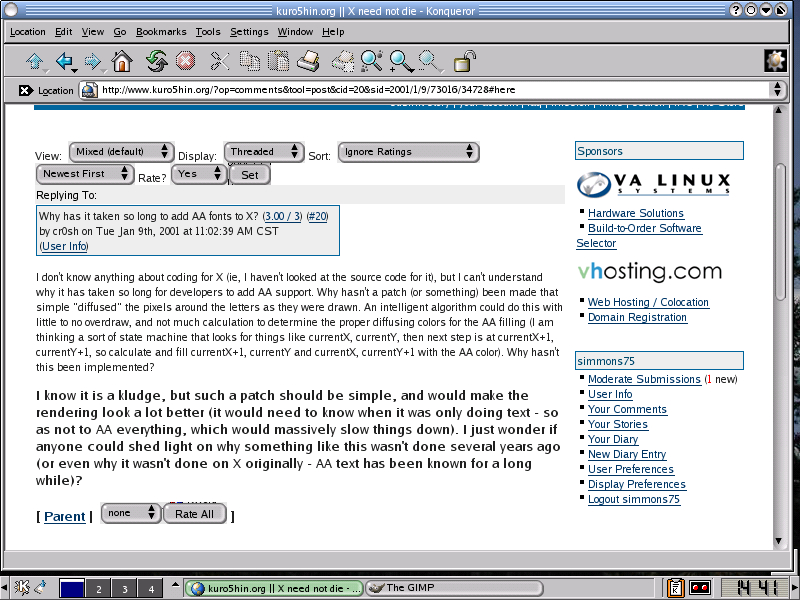
Oh, and anti-aliased fonts are very very nice, but that's just a bonus of a superior toolkit...
-
KDE does that and more...1. KWord
2. KSpread
3. Aethera
4. KDE PIM
5. Kapital
6. KDevelop and Kylix (Delphi for Linux. You have to here my Delphi-mad housemate ranting about how great this is...)
7. KMatplot
8. Licq
9. LOTS more that I don't have time to type, however http://apps.kde.com will show you.There's KIllustrator (photo-editing), Konqueror and Mozilla (web browsing, HTML editing etc), and again a good many others.
Oh, and anti-aliased fonts are very very nice, but that's just a bonus of a superior toolkit...
-
Re:Is there a simple solution?Here, by the way, is an example where some silly issues got in the way of a well-meaning project, objections were raised in a courteous way and the situation was resolved to everyone's satisfaction. Fortunately it was all cleared up before the story made it to Slashdot.
Unsettling MOTD at my ISP.
-
Re:KDEHowever, as something in their favour, the most 'vocal' critics of KDE shut up and started refining Gtk, which also runs on both platforms. I believe those people had and have the right to criticize KDE for their choices. Thankfully, as I perceive it, these are the most pragmatic people, and the ones now working the hardest on interoperability.
That's fair enough
I didn't know if the GPL is specific to Free Operating Systems, or that proprietary Unix vendors (eg Sun) can use Qt under the GPL as well. I understand from your words that this is the case?
"yes". Trolltech's website, if you'll look for "free edition", specifically mentions it being a Unix/X11 solution. (sorry for the marketspeak)
-
Tutorial for widget style developmentFrom Rik Hemsley's original post:
http://www.geoid.clara.net/rik/widget_style_tutor
i al.htmlTutorial on writing your own KDE widget style from scratch.
Includes a full working example and an easy-to-use empty framework you can use to start from.
Other tutorials can (will) be found here
Daniel.
-
Tutorial for widget style developmentFrom Rik Hemsley's original post:
http://www.geoid.clara.net/rik/widget_style_tutor
i al.htmlTutorial on writing your own KDE widget style from scratch.
Includes a full working example and an easy-to-use empty framework you can use to start from.
Other tutorials can (will) be found here
Daniel.
-
Re:I'm not a KDE userInstalling KDE from source is pretty easy. First, I should tell you that it will run best if QT2 has been configured with -no-g++-exceptions, which I believe Slackware does. This basically will cut memory use and increase speed noticeably. That said...
Pick a mirror to download from, and get the packages from the stable/2.1.1/distribution/tar/generic/src/ directory. Installing KDE is done with the standard
-
Re:Bullshit, absolute bullshitHELL YEAH they *are* the good guys!!
well, some of them anyway. What you don't realise is that back when IBM were the bad guys they emploed different people.. now they are employing cool linux geeks and putting $1,000,000,000.00 into linux.The way I see it, IBM is now made up of different groups of people and some of them are really cool. You even see evidence of confrontations between the different factions within IBM.. Look at THIS
The do have good guys thereIBM will do great things for linux. Yes, because it suits them, but I don't mind.
"just connect this to..."
BZZT. -
Re:anti-aliasing
Try http://www.kde.org. Right now, most of the apps that support AA text use the QT toolkit (e.g. Konqueror).
-
Konqueror is based on mozilla, NOTat least, if it were, they majorly violated the give-credit principle on which open code survives.
You grab kdebase-2.1.1.tar.bz2; you grep it for mozilla, netscape, etc; you'll find nothing of significance. A couple of user-agent strings, and grumbles about Moz still falling short of its compliance claims. Nothing along the order of "we hoiked this from the Mozilla project".
Try framing and answering some very easy verifications before unrolling nonsense like that.
-
Re:Are we coming up to an "S1B" bug?What moron moderated this flamebait?
In fact, the poster is absolutly correct- Kmail did have exactly the kind of bug he's talking about - a one billion second buffer overrun bug. They issued a patch a few weeks ago.
read about it here
-henrik
-
Re:Gnome 1.4?
-
good on Win?
Now if only I could compile Qt on my XFree/Cygwin setup I could get these working with KDE on my Windows box.
-
Re:Mmore applications with the obligatory "K"?
Of course KDE does not have KKK agenda. If you look at kde developers photo gallery you'll see one of the core KDE developers is named Sirtaj Singh Kang and is from India. Obviously, the KKK hates all non-caucasians including Indians, and one of the KDE developers is an Indian.
-
Re:So much power on one company...
Actually, while theKompany.com has contributed significant applications to the KDE family, it is a relatively new company that was only incorporated last year, and in fact does not back the majority of KDE development.
KDE's development is driven by the developers themselves and is primarily independant of theKompany.com.
I'm part of the KDE community; I do some development work for KDE (specifically, I've contributed to the KWebStat application), and am involved in the KDE Zine project, so I have reason believe that my views on this should be more or less accurate.
-- -
We still have a LOT of WORK to do!
An operating system is not only the kernel and a bunch of device drivers! We didn't even start the most important project of them all: consolidating our manpower and our technologies. We could really use a component object model. The good news is: we have that technology. The bad news is we are working on more than one.. XPCom part of the Mozilla web browser project and ORBit part of the Gnome Desktop project. Speaking of desktops, like Doug said, we are working on two competing projects, Gnome and KDE. We already have all the technologies Doug thinks put Microsoft ahead in the game. Mainframe / AS400 connectivity? Linux-SNA. A kick-ass web browser? Mozilla vs. Internet Explorer. Word processor, spread-sheet, Business presentations? Star-Office. I could go on and on but I guess you get the picture. What we have to do now is to consolidate all that into a coherent system.. I want to be able to manipulate Star-Office spread-sheets using a system-wide scripting language (how about perl? python?..?).. I want to be able to embed that spread-sheet into any application, not only into Star-Office's word processor (XPCom? ORBit?) I want to be able to use the same printer driver from Star-Office and any other application on the system (anybody working on a printing subsystem for X? Or do we put it into GTK's GDK?).. There's still a lot of work for us to do before we can really kick their asses on the desktop. I'm looking forward to both.
-
LTSP solves the "too much choice" problem
I think the whole issue of Linux acceptance outside of the server realm comes down to this: there is TOO much choice in how to set up Linux.
The Linux Terminal Server Project provides one solution to this. As far as IT issues go, it should provide a "win-win" -- you get to use standard, cheap PCs as a "thin client" AND you get the centralized control over everyone's configuration that IS loves so much (and that does help lower TCO).
For a look at how this works in the "real world," read Major Law Firm Installation of Linux. This provided a standardized KDE desktop for the administrative staff. Since the customer was a long-time WordPerfect user, the staff did not require application retraining, and only required minimal training on the Win* to KDE conversion.
This also had the nice effect of changing an IT manager's nightmare into an IT manager's dream. The law firm ended up with a single point of control for all their desktops, which they could then even oursouce many operations back to Unique Systems, the company which did the rollout in the first place.
What IT manager wouldn't like to be able to say to their boss "Look, for a small consulting charge and minimal retraining, I managed to cut our license fees AND support costs, preserve our legacy data and applications, outsource our administrative overhead, and I did this without purchasing any new hardware"?
(And no, I don't work for Unique Systems, I'm just familiar with them from them from their good work with the Toledo Area Linux Users Group, and from considering just this setup for a former employer.)
-
Re:KDE 2 and GnomeOoohhh....heres a good one:
http://www.kde.org/screenshots/large/kde2b3_3.png
Gee....doesnt that look an awful lot like the display properties in Win9x? Like I said..shameless.
-
Re:If Netscape would just get off their ass
Actually, it can do both. Granted, using Gecko is a bit harder to configure, and I think it's only in CVS at the moment, but it is technically possible. But there's nothing wrong with KHTML. I've been using it for the past few months and I've found very few sites that don't render properly.
-
Just a thought...
It seems to me that Konqueror hits 2,3,4,5,6,13,15,16(SMB) and 18, of the Nautilus wish list. Mind you that this is without commercial backing (and with a clear conscience now that Qt has been GPL'd).
Maybe eazel could write an IO slave for Konqueror that can access the eazel services, that could increase thier potential revenues, no?
-
Re:IE for Linux
Try Konqueror 2.1 - it's fscking amazingly quick at rendering, and is far more standards compliant that IE5.5.
I really can't over-state how great it is..
-- -
Re:Enforced contributions...The Linux kernel, glibc, gcc, RPM, GNOME, KDE, Linuxconf, newt, popt, GTK+, Inti, PAM, pwdb, procps, GtkHTML, Pango, Piranha, ORBit, Mozilla, eCos, Cygwin, gcj, gdb, Insight, Source-Navigator, autobook, autoconf, automake, binutils, bzip2, CGEN, docbook-tools, GNATS, GSL, Guile, libffi, libstdc++, Mauve, newlib, PSIM, pthreads-win32, SID, Win32-X11, Xconq, libxml
I could make that list even longer with many more projects that Red Hat either funds, maintains, develops or contributes to, but I think I've already proven my point.
-
KDE has it... It's called konqueror
Okay, great. But KDE has all that since 2.0:
File browsing & full access on local/ftp/nfs/
SMB browsing w/o write, separate client for that
Previewing of files in window, or edit in repective app
Web browsing (guess where I'm writing this)
they call it konqueror. The look depends on the UI skin... can be as pretty as Eazel.
Greets
Anno
-
You're welcome.
Hi,
Nautilus is a all-in-one explorer (files, web, etc.).
It requires Gnome 1.2.
The closest linux alternative is Konqueror which requires at least kde 2.0.
Go to Eazel's web site for some screenshots.
-- -
Re:Debian (Unstable) Users had this 2 weeks ago.
Well, does matter that Debian had Qt Xft AA two weeks ago? For your information, I have had Qt Xft since 3 months ago. But I'm not going to go about bragging that my distro got it before all the others. I'm not a Debian user. I use Linux, but I don't even use a distro. All I had to to was to get qt-copy from KDE CVS (i.e. cvs -d
-- -
�QT != QuickTime
video codec
You're thinking of QuickTime, rather than the communist-looking Qt toolkit used as KDE's widget set.
textual display information imbedded into movies now?
<OT>This has been in quicktime for a while (since at least 3.0).</OT>
Back on topic: will qt free edition (or xfree86) ever be ported to windows 9x?
All your hallucinogen are belong to us. -
..and in other news...This was announced yesterday and since dot.kde.org is down with ISP trouble I figured I'd mention it here:
since some minutes ago the audiocd: io-slave can save the ripped audio files in mp3- (using LAME) or Ogg-Vorbis format (using libvorbis). Kudos go to Carsten Duvenhorst . There are additional top-level dirs "MP3" and "Ogg Vorbis", under them the tracks are listed with extension ".mp3" and ".ogg". When copied from there the destination is automatically compressed by one of the methods. If the CD-info was backed by CDDB also Id3V1 tags are created for the mp3 case, and normal tags for vorbis.
You can now simply rip the contents of a complete CD from konqui by simply opening the "MP3/" directory selecting all files there, and copy them to another real directory, which is rather cool. (The only thing which must be done, is to give the dest dir a good name, as the mp3 dir has no subdir identifying the CD). The bitrate for mp3 can be selected by an "br=196" (e.g. to set it to 196 KBps) query argument to the URL.
Unsettling MOTD at my ISP.
-
KDE-logo schwag
Want to show your support for KDE ? Check out the KDE-logo store at CafePress. All profits are donated to KDE e.V.
-
i hate those kde/gnome flamewars
i never could get into one.
i didn t use kde1 because it did crash my pc every session. i had not time to look for what was doing it nor for going into a "kde sucks" thing. so i used gnome a lot. i found it ugly but it worked well. i also used enlightenment alone a lot
then kde 2. it is just wonderfull. simply wonderfull. there are a few bugs but
their developpment rate is incredible. and they release good stuff!!
mozilla is still better than khtml but too heavy. i fire it only when i know konqueror won t do the stuff.
but i don t find myself going into a "kde rules" frenzy.
and i m sure gnome2 will be great when it s ready.
but there are discussions i lack which should happen here, on slashdot:
-in the kde world, the kompany is doing a great deal of fast and efficient work for the kde project. but at the same time it s releasing closed source programms in order to finance itself. In particular, they plan to release an outlook killer, keeping the server side closed.Also they are really sincere about giving to the community, just finding a way to fund themselves.
-in the gnome world, there seems to be a lot of effort put into tunnelling apps into the user desktop and deals between those entities: eazel, ximian and red hat . a lot of marketing
the analogy between the difficulties that compagnies related to those projects face stroke me more than the differences
I m sure such matters should be discussed here more often than , say, lego stories as there are plenty of solutions which could come from here to help all of them. -
Re:Huh?
What's KDE? What's Linux?
KDE stands for "Kid: DAMN Excellent!!"[1]
At least it does in this release =)))
Now if only I can get at the binaries!!! You call those mirrors?? Where's instantly indexing, synchronistically diffuse P2P when you freakin' need it??!! Pshaw. In my day, we could sneaker' a new rpg around the earth faster than than the time it takes to get kde.org to freakin' resolve (yeah, I mean DNS), let alone let us peek at the dough.
My God, what is this world coming to?-
3-state.ps. "Linux", FYI, is a flavor of power known to the geniuses among us simply as Catharsis. You try spending seven hours of your night recompiling your kernel and tell me that doesn't get your mind off your ex. Go on. I dare ya'. I tell you, that CPU just hums smoother when it's running rock-hard code.
[1] is "kid" for "dude" solely a Bostonism? It sounds perfectly normal to me... -
Re:ASIAN SCAT POST!!! DO *NOT* GO THERE!!!
Huh? The link is http://www.kde.org/mirrors.html. Am I missing something?
-
One important consideration....From a related announcement (There's more, but this is a taste):
"
This second major release of the KDE 2 series is a real improvement in terms of stability, performance and features," said David Faure, release manager for KDE 2.1 and KDE Representative at Mandrakesoft. "KDE 2 has now matured into a solid, intuitive and complete desktop for daily use. Konqueror is a full-featured and robust web browser and important applications like the mail client (KMail) have greatly improved. The multimedia architecture has made great strides and this release inaugurates the new media player noatun, which has a modular, plugin design for playing the latest audio and video formats. For development, KDE 2.1 for the first time is bundled with KDevelop, an outstanding IDE/RAD which will be comfortably familiar to developers with Windows development backgrounds. In short, KDE 2.1 is a state-of-the-art desktop and development environment, and positions Linux/Unix to make significant inroads in the home and enterprise.""KDE 2.1 opens the door to widespread adoption of the Linux desktop and will help provide the success on the desktop that Linux already enjoys in the server space," added Dirk Hohndel, CTO of Suse AG. "With its intuitive interface, code maturity and excellent development tools and environment, I am confident that enterprises and third party developers will realize the enormous potential KDE offers and will migrate their workstations and applications to Linux/KDE."
"KDE boasts an outstanding graphical design and robust functionality," said Sheila Harnett, Senior Technical Staff Member for IBM's Linux Technology Center. "KDE 2.1 significantly raises the bar for Linux desktop functionality, usability and quality in virtually every aspect of the desktop."
" -
Re:Wrong kind of documentation.Hmm...
besides books, the KDE API is documented at about the level of saturation and the online docs which, by the way can be generated from the code, are very comprehensive.
Besides this, the API's are very clean and complete. In fact, user interface programming is the type of code which is the best suited to object oriented approach, and the KDE libs are a good example of this.
Highly optimized kernel and driver code is naturally more difficult to grasp, so the comparison with the Linux kernel is not a good one.
Lotzi Boloni
http://www.geocities.com/boloni2
-
KDE 2.1 ain't gonna be released tomorrow, you know
See details here. It kinda kills your theory.
-
One solution! :-)Just think of a dumbass name that no real company would try and use.... Ximian, LoserJabber, Pygmy, Knoqueror, hell -- anything with a K, G, Gnu, or GTK at the beginning... like gtktalog. Or anything with an annoying mix of capital and lower-case letters: SQmaiL.
I mean, seriously... if you're writing open-source software and don't have a dumb/geeky/clever name for it, how good can it be, ya know?
-
Re:KDE installer will get many more users...Now helix (err, ximian) has this nice little installer to help you get it set up, and a nice little updater to tell you whats out of date. [...] KDE, AFAIK, hasnt had that so far.
Yes it has... it's called MandrakeUpdate, or apt-get, or any of a dozen other distro specific apps.
Although no one within KDE is saying "stop", the KDE team has, over and over again, said that it will NOT make an installer - in fact the KDE team dosen't release packages... for a Good Reason: they see packaging and installation as a distro's job. That way, the distro can choose your own flavor of packaging (deb, RPM, tarfile), your own path system (/usr/bin,
As a philosophy, this makes a helluva lot of sense: Slackware and Red Hat are on even footing when it comes to releasing KDE's latest and greatest. And if the new IBMinstall uses ".iop" files, then they can be easily packaged to that. Also, to address the monolithic nature of the structure of KDE, except for a few, well documented outside dependancies, KDE satifies it's own dependancies at compile and runtime. Most KDE apps are located outside of the KDE project as a result (or at least are not in the core groups: kdecore, kdegraphics, etc.) Many more can be found at: apps.kde.org, a freshmeat like listing.
All in all, the philosophies of KDE are well thought out, and make sense (IMO)... it just takes reading or talking to a few developers.
--
Evan -
Re:So shiny...
It is indeed shiny. I can't wait this this become standard for the two main toolkits. KDE has the capability too.
Now all they need to do is work out a consistent UI between GTK and QT apps. Roll on the unified UI Style Guide! -
Some Information
First of all, don't give up. It is true that Microsoft has almost complete domination of Israel due to its complete Hebrew support in its OS, but a lot progress has been made in that area in the Unix world in recent months.
For those of you who didn't know, KDE's Konqueror web browser can display any Hebrew web page, including Microsoft IE's "logical Hebrew". In addition, the QT library on which KDE is based will have full support for displaying and writing RTL Unicode text in its next major release. Check out these two screenshots for an example of these capabilities that are currently in development:
http://trolls.troll.no/~lars/unicode1.png, and
http://trolls.troll.no/~lars/unicode2.png.
After having this version of QT released, a lot of our Hebrew problems will be solved.
For more information on Hebrew in KDE, check out http://www.kde.org/il/. -
Some Information
First of all, don't give up. It is true that Microsoft has almost complete domination of Israel due to its complete Hebrew support in its OS, but a lot progress has been made in that area in the Unix world in recent months.
For those of you who didn't know, KDE's Konqueror web browser can display any Hebrew web page, including Microsoft IE's "logical Hebrew". In addition, the QT library on which KDE is based will have full support for displaying and writing RTL Unicode text in its next major release. Check out these two screenshots for an example of these capabilities that are currently in development:
http://trolls.troll.no/~lars/unicode1.png, and
http://trolls.troll.no/~lars/unicode2.png.
After having this version of QT released, a lot of our Hebrew problems will be solved.
For more information on Hebrew in KDE, check out http://www.kde.org/il/. -
KDE2KDE has excellent i18n support, probably the best of all unix desktop enviroments. It also provides most of what you need in a desktop enviroment.. I belive KDE has full support for unicode and right-left writing. So if you absolutly must avoid MS, i'd look into KDE. http://www.kde.org/il/hebrew/ is the page devoted into translating KDE into hebrew.
[taken from that site]
Version 2.0 of KDE featured several improvements in the field of Hebrew support in its interface. Among these improvements:- KDE is now based on Unicode. There is no longer a need for special fonts for Hebrew.
- The translation of KDE applications is complete. Every part in the interface of KDE applications is translated into Hebrew, including all of the menus, messages, and quick help. All of the applications in the kdebase, kdeadmin, kdegames, kdegraphics, kdemultimedia, kdenetwork, kdepim, kdetoys and kdeutils packages are available translated into Hebrew.
- The Konqueror web browser which comes with KDE supports displaying any type of Hebrew on the web, including logical Hebrew. However, all other KDE and KOffice applications do not yet support logical Hebrew.
-henrik
-
Use Konqueror
Use Konqueror. Full support for right-to-left languages, including Hebrew. Plus it is the best browser for Linux anyway. A (somewhat old) screenshot.
-
I think your "cool" gauge is busted...
It also has a much greater cool factor than Linux, which is important when in college.
Oh yeah, using the exact same shell UI that's been around for 6 years is way, way cooler than, say, KDE2.
OOH! but Windows 2000 has fady menus!!
Please.....
--