Slashdot Mirror
Domain: koehntopp.de
Stories and comments across the archive that link to koehntopp.de.
Comments · 33
-
Re:I'd quit
You buy bitcoins with your USD
Ah, the transaction costs we all love.
There is no transaction cost. A little exchange fee, if that what you mean. But unlike with bank with quasi monopoly, there is actual competition.
magically send them over the Interwebs
"Magic" is an apt description of most pro-Bitcoin arguments.
Magically as in the 'magic of the Interwebs' figure of speech. eg: You are a moron for thinking I meant bitcoin is actually magic.
they then get converted back to USD
Which may or may not be anything remotely near what you put in in the first place, due to the high volatility and utter lack of any guarantee about convertibility. I guess a system run on "magic" would have these properties.
In the time frame of the transaction the volatility is negligible. If you ever bought thing internationally you would be used to little variance on what was billed to you credit card. Also the more peoples participate in the system the faster the transaction are completed. And it is the 'interwebs' that look like magic to the gullible, like you, that think that any bank fee are reasonable with today's technologies. P2P money transfer is a welcomed competition to these bank monopolies.
Unlike bank transfer, the whole process only take a few minutes
Credit card transactions take seconds.
To be check, it take several days for the merchant to have to money deposited in his bank account.
it cost nothing
False.
True. The only cost of having a Bitcoin 'account' is a PC, electricity to run it and internet access to do transaction.
is anonymous
This was repeatedly shown to be false.
With enough effort you can always trace anything back to the origin. In practice it is anonymous enough for most. Just like cash is.
just like cash in your wallet.
Except that Bitcoin cannot be used for secure offline payments, the way cash can. Oh, what, you think that digital cash is always online? Think again:
The purpose of bitcoin is to transfer money over the internet without bank overhead. You still don't get it...
http://blog.koehntopp.de/uploads/chaum_fiat_naor_ecash.pdf
When I first read the Bitcoin paper, I was shocked by the lack of background research it presented. No mention of Chaum's work at all. No mention of previously developed or deployed digital cash systems. This seems to be the MO of the Bitcoin community: lack of background research. Why should we take you people seriously if you have not even bothered to read papers that can be found in minutes just by reading overview articles on Wikipedia?
TL;DR
Therefore during the 21st century, USD will become a toy currency popular among old peoples and irrelevant to everyone else
Not even remotely accurate. Unless you think the US government is going to stop demanding tax payments made in USD, the overwhelming majority of American adults will require USD. The added overhead of Bitcoin, the added risk and volatility will keep it an obscure anarchist toy compared to USD.
What part of 'transfer back to USD' you didn't understand? You can do that to pay due taxes. In the meanwhile everyone buy everyday products and serviced over the Interwebs and only old peoples go to a brick and mortar store with their purse full of antiquated paper money. Electronic money is here to stay. Bitcoin or a other system that have yet to come, you will know a system became the norm when the state tried and failed to ban it.
-
Re:I'd quit
You buy bitcoins with your USD
Ah, the transaction costs we all love.
magically send them over the Interwebs
"Magic" is an apt description of most pro-Bitcoin arguments.
they then get converted back to USD
Which may or may not be anything remotely near what you put in in the first place, due to the high volatility and utter lack of any guarantee about convertibility. I guess a system run on "magic" would have these properties.
Unlike bank transfer, the whole process only take a few minutes
Credit card transactions take seconds.
it cost nothing
False.
is anonymous
This was repeatedly shown to be false.
just like cash in your wallet.
Except that Bitcoin cannot be used for secure offline payments, the way cash can. Oh, what, you think that digital cash is always online? Think again:
http://blog.koehntopp.de/uploads/chaum_fiat_naor_ecash.pdf
When I first read the Bitcoin paper, I was shocked by the lack of background research it presented. No mention of Chaum's work at all. No mention of previously developed or deployed digital cash systems. This seems to be the MO of the Bitcoin community: lack of background research. Why should we take you people seriously if you have not even bothered to read papers that can be found in minutes just by reading overview articles on Wikipedia?Therefore during the 21st century, USD will become a toy currency popular among old peoples and irrelevant to everyone else
Not even remotely accurate. Unless you think the US government is going to stop demanding tax payments made in USD, the overwhelming majority of American adults will require USD. The added overhead of Bitcoin, the added risk and volatility will keep it an obscure anarchist toy compared to USD.
-
Re:Bitcoin haters
Bitcoin is an incredible idea
Unless you want to make offline payments, in which case it is useless and will take a back seat to government issued currencies.
decentralized exchange
Which David Chaum published work on over a decade before the Bitcoin hype got off the ground. Chaum's system, of course, was based on the idea that currency is a tool of governments and banks, and not just something that materializes on its own, so it received less hype (hint: there was no get-rich-quick scheme with Chaum's systems).
totally anonymous
Except that there are anonymity-breaking attacks on Bitcoin.
no central body to print it out of existence
Thus no central body to give it value. Money without a strong source of demand is worthless; Bitcoin has a moderate source of demand arising from hype and promises of secure electronic payments, but government-issued currency has a much stronger source of demand: taxes and the legal structure that surrounds the money. When a court instructs on person to pay damages to another person using government issued money, that creates demand for that money. If courts were handing out judgements in Bitcoin, if governments were accepting Bitcoin tax payments, Bitcoin might have a chance in the real world, if it could overcome the offline payments problem (but there is every reason to think it cannot, since the amount of data that needs to be stored and transmitted will grow in the depth of the transaction chain, and there is no central authority to exchange used-up currency for fresh currency).
Would I want to store all of my wealth in bitcoin? No.
Thus creating another obstacle for Bitcoin: people are willing to store all their wealth in other currencies.
Do I like the idea of being able to convert my money into an exchange medium that is untraceable? Of course.
We already have one: paper money. What you really want is one that is electronic, so that you can spend your money securely on the Internet and not have to worry about being tracked or having your bank account raided (the latter being far more important in terms of economic security). That problem was solved a long time ago, with robust systems that go beyond what Bitcoin is capable of:
http://www.springerlink.com/content/ft361212m4256246/
http://blog.koehntopp.de/uploads/chaum_fiat_naor_ecash.pdfTo me bitcoin is the currency equivalent of TOR and shouldn't be hated on.
No, digital cash is the equivalent of Tor; Bitcoin is one attempt at digital cash, which has more shortcomings than benefits.
-
Why Internet Content Rating does not work
http://kris.koehntopp.de/artikel/rating_does_not_
w ork/
Why Internet Content Rating and Selection does not work
In April and May 1999 my wife and I were working with others on a study on controlling harmful and prohibited content on the Internet. The study favoured Internet Content Rating and Selection as the premier method of content control, but during our work on the study we found that ICR&S systems have a lot of fundamental problems which stem from the nature of the media and which make it impossible to create a useful ICR&S system.
- Internet Content Rating and Selection applies only to the Web
- Labeling content that is not harmful nor prohibited is a requirement but cannot be enforced
- Establishing a metric invites a dysfunction
- Translating from one metric into another does not work
- E-commerce and ICR&S are natural adversaries
- Proxy-based ICR&S cannot work in an E-commerce enabled environment
- Recipient-based ICR&S can only work in a cooperative setting
- Third Party Rating cannot be based on URLs
- Third Party Rating cannot keep up
- Third Party Rating creates privacy issues
- Third Party Rating has no standard complaints procedure
- First Party Rating cannot be enforced
- First Party Rating does not scale down the problem enough
- Labels need to be tamperproof and tamperproof labels are expensive
- Wildcard labels cannot be checksummed
- Content rating cannot keep up with dynamic content creation
- Dynamically creating content labels is expensive in current implementations
- ICR&S systems may make error diagnosis more complicated and will decrease performance
- False application
- False positives destroy trust into ICR&S and into the Internet
Summary: The easiest way out for everybody is just to rate their website as "XXX" no matter what content is on there. That way you are on the save side of the law liability-wise, and if some kiddo cannot view your side, let that kid complain to their parents.
Now, what exactly is the penalty for overrating your site? -
Background
The article in N&T is based on ideas by Scott Wheeler (and Till Adam, and Aaron Seigo and others). See Beyond Hierarchical Data: Search and Meta Data as Fundamental Interface Elements, Scotts lecture on query-based interfaces at aKademy.
"Google like" here means just "searching", but the result will in fact be more like WinFS than Google in that it is using file data and file metadata to index and find things. Interface-wise expect more quicksearch bars like the one in Kmail 1.7 (KDE 3.3.0, Till Adam) and JuK (Scott Wheeler).
See also a Blog entry of mine (german language) in the same vein. -
Time for a new "Matrix" iconHere are a few starting points for something other than the current use of Alka-Seltzer Cold Plus caplets:
Not sure what this is about...topless women in leather pants. (SFW)
What's cooler than a Toyota Matrix, all decked out in racing stickers?
Oh yeah, baby...Matrix, the board game
How about the Matrix folding bike? Before or after
The Vic-20 fans out there might appreciate a look at the Matrix game for that platform.
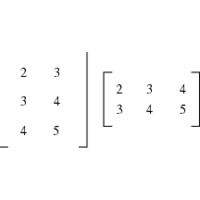
Flashback to math class! Matrix multiplication!
So you see, taco, you're only limited by your imagination. Of course, that could be like saying your writing is limited by your spelling and grammar but still...maybe someone can help you come up with something better. -
Re:Wow
Like they haven't already:
http://www.koehntopp.de/kris/pics/iwerb/msad1.jpg
http://www.theregister.co.uk/content/4/19396.html
http://support.microsoft.com/default.aspx?scid=kb; EN-US;q247804
The most famous: http://www.microsoft.com/ntserver/nts/news/msnw/li nuxmyths.asp
has apparently been removed but you can read about it here or here -
Why rating systems do not work...
http://www.koehntopp.de/kris/artikel/rating_does_
n ot_work/ has the detailed reasoning and background. -
Don't learn an IDE...
... learn a language first. Command line, no tools. Just you, an editor and a compiler.
Learn C first, then move on to Java. Then choose your IDE.
Unless you have seen the machinery and worked between the wheels and pistons, you cannot expect to get a clue how the system really works on the inside, and which approaches to debugging make sense. Only after such an experience, you'll be able to choose a proper environment for yourself, and be free to leave it, should it become necessary in the process of coding or debugging.
© Copyright 2000 Kristian Köhntopp
All rights reserved. -
... and most important of all:
Damn good Internet security.
© Copyright 2000 Kristian Köhntopp
All rights reserved. -
Re:M$ behaves as if they are selling, not licencin
Of course they behave as if they were selling something. If they were actually licensing something under German law, there would be a continous liability of the licenser to the licensee. This is a situation where Microsoft would not like to find itself in, given their quality of code.
© Copyright 2000 Kristian Köhntopp
All rights reserved. -
Shouldn't...
they now be called the Philistines, as they allow
Quake, but ban Playboy?
© Copyright 2000 Kristian Köhntopp
All rights reserved. -
Where IBM can help
The most important thing for Linux is always market penetration, especially market penetrations in large companies. The best and simplest thing IBM can do for Linux is to sell it, especially sell it to large companies.
Then there are a lot of interesting things that are part of AIX. These ideas are usually ahead of their time and they are badly implemented.
Take the AIX system administration tool SMIT for example. It is using a binary registry for much configuration data which is a pain in the ass to maintain - text files and a binary cache regenerated from the text files dynamically, as KDE does it, is much better.
But SMIT is the only system administration tool which I have ever used which is actually helpful and easily extensible. SMIT is based on a number of command line programs to edit system configuration, things like adduser and deluser, but for anything on the system. SMIT generates command lines to execute system administration functions and you can preview these command lines before they are executed. So while SMIT is a GUI tool for the inexperienced user, at the same time it educates this user and brings the user onto the path to automated system administration.
SMIT has menus, and these menus are nowhere hardcoded. If you know the SMIT extension API, you can add menus and functions to SMIT and integrate your own software into the tool. That makes SMIT a truly universal administration tool, which can be taylored to a sites needs.
And finally SMIT keeps a log of all changed done to the system in the form of an endless shell script. So if you actually use SMIT to do your everyday system administration, you get a complete protocol of all changes to the system since the last install.
SMIT comes in two variants, SMIT with an X interface and SMITTY, with a tty interface. Both have a command line interface which allows you to shortcut into any menu screen from the command line so that you do not need to navigate through a menu hierarchy for the 1000st time, but can jump directly into medias res.
SMIT is broken in current AIX, but it can be fixed - get rid of the binary object database aka registry and enter a KDE style binary cache for textual configuration file to speed access to large parseable text files.
Also, SMIT was lacking cryptographically authenticated and encrypted remote administration capabilities the last time I checked (early AIX 4.x releases), so you still had to rlogin in order to administrate a remote station. A mass administration utility that can remotely control each single remote workstation as well as groups of them would be a great extension to SMIT.
There are other parts of AIX which are worth a very close look and evaluation. Much of it does not really fit the current Unix model as it is, but is extremely interesting and just needs a good ripoff session and a heavy dose of realworldly interaction in order to become a great addition to Linux.
© Copyright 2000 Kristian Köhntopp
All rights reserved. -
To make CPRM work
The current groups of people against CPRM can be divided into two camps. One camp is the OSS camp, which is against CPRM on principle. The other group of people against CPRM is against it because the implementation is bad and violates basic principles of operating system design. This second group includes at the moment companies like Microsoft.
CPRM can be made to "work" in a way that the second group is - massively - in favor of it and I expect it to become so in about five years. In order for the second group to adopt CPRM it is necessary to make a CPRM-like mechanism compliant with the file system abstraction. This is easily done as soon as you abandon the sector based ATA concept for a file based storage device.
Imagine a lot more intelligence as part of your hard disk, and imagine the hard disk running an operating system independent file system abstraction on the hard disk electronics itself. In fact, only the lower half of a file system abstraction is needed, that is, free space management and block-to-file mapping. The upper half of the file system, name space management, is not sensitive to copy control and can remain in an untrusted device.
In such a device CPRM would run on top of the filesystem abstraction and therefore not interfere with it. Currently, CPRM runs below a filesystem abstraction and inhibits low level reorganisational operations. A device implementing file level access at the device itself would offer a standardized interface for such operations which would be able to deal with the details of copy control management in the context of such operations on the device itself.
This is a very scary idea, and it will be much harder to lobby against it, because the OSS lobby will not have backing of the software industry that time.
© Copyright 2000 Kristian Köhntopp
All rights reserved. -
Re:I'm fed up of this windbagRemember what he said before Windows 2000 came out? It was 60000 bugs this and overdue schedule that, and now it's out without any problems at all.
60k bugs is either fact or not, and pretty much irrelevant anyway, so I won't comment. I don't know about the schedule, so I won't comment there either. What I do know about though is the 'without any problems' nonsense. I'll cheerfully acknowledge that win2k is by far the best windows yet, but if it ran without any problems, I'd get over 100 hours uptime on a regular basis, which I don't. Almost without fail, windows crashes (or becomes unusably tangled) between about 75 and 125 hours uptime. That's a damn sight better than the ~5 hours uptime I'd get with win95, but hardly problem-free.
Imagine if MS spokesmen spent their time with unfouded attacks on Linux. They don't - which is a sign of self confidens and maturity.
Do you live in a box? We have a german MS ad insinuating that the many flavors of linux are bad. Has anyone counted the number of versions of windows in the last 5 years (I seem to recall there are about 10 versions each of win95 and 98, not including the different language versions (which, by the way, have different sets of bugs in each), though winME and win2K are too new to have fragmented yet) and compared it with the number of linux distros?
How about the Naked PC page which insinuates that anyone who doesn't buy windows with their computer must be stealing it later.
For my third exhibit, I present The Linux Myths Page:- "Myth: Linux performs better than Windows NT." The fact is that linux does many things better than NT, but NT also does some things better than linux. They at least support their argument with 'independent' benchmarks.
- "Myth: Linux is more reliable than Windows NT" - No comparisons, no statistics, no substance. The fact that more companies guarantee windows uptime than those that guarantee linux uptime has nothing to do with the reliability of either operating system, merely that windows is currently more popular.
- "Myth: Linux is Free" - after which they cite a single comparison between UNIX and winNT, which links to a MS article comparing winNT and Solaris on Sparc, NOT linux. In my book, thats an unfounded attack: if they can't find proof, there's no foundation, and thus it's unfounded.
- "Myth: Linux is more secure than Windows NT" - The first bulleted point under this header is as follows: "Linux only provides access controls for files and directories. In contrast, every object in Windows NT, from files to operating system data structures, has an access control list and its use can be regulated as appropriate." Right. What would an OS data structure be, if not a file? How about simple things like the floppy drive? That's a file under linux, and thus can be controlled by file permissions, as can ports, peripherals, etc. Next, we have MS's claim that a single source of security information for windows makes NT more secure than linux, with myriad sources of information. To my of thinking, just the opposite is true.
- Lastly, "Myth: Linux can replace Windows on the desktop," supported by such false statements as "Linux does not support important ease-of-use technologies such as Plug and Play, USB, and Power Management" Which explains why adding a NIC to my RH installation caused the appropriate drivers to be installed at startup (after I gave the go-ahead, unlike Windows which randomly adds code to your installation whenever it gets confused). It also explains why my USB cordless Logitech trackball works marvelously (right out of the box, with no tweaking, might I add?), and why ACPI functions are supported out of the box.
I should stop now, as this is becomming a rant, but surely you see my point? If not, I'll summarize: You're wrong. If MS were self-confident, they'd ignore linux and continue to push windows on its own merits. Unfortunately, it has comparatively few, so they've got to try to make everyone else look bad to make themselves look good. Maturity?!?
If you don't agree with RMS' style, that's fine. In fact, you should say so. Claiming that RMS' faults somehow make his arguments invalid is not the way to go about it though. -
Some words on the matter
Since my wife is one of the persons on the list of people actually working on this, I may add a few words to it. Marit has a publications list online.
How does it work? Well, have a look at project anonymity and unobservability on the Internet. A MIX network is like a system of remailers, just for IP packets. There are several kinds of attacks against a MIX network ("nix the MIX") and they are categorized and discussed in that paper.
Specifically, the problem of cooperating MIX network node operators is being discussed. Have a look at the properties of ideal MIXes: It is sufficient for the MIX network to have a single trustworthy node in your path in order to protect your anonymity (section 1.2 of that paper).
Marit has a paper on anonymity terminology online, too (txt version of that paper). Have a look at it in order to get your vocabulary. Additionally, there is a web page on identity management on her server. This relates P3P and anonymity/pseudonymity.
© Copyright 2000 Kristian Köhntopp
All rights reserved. -
Some words on the matter
Since my wife is one of the persons on the list of people actually working on this, I may add a few words to it. Marit has a publications list online.
How does it work? Well, have a look at project anonymity and unobservability on the Internet. A MIX network is like a system of remailers, just for IP packets. There are several kinds of attacks against a MIX network ("nix the MIX") and they are categorized and discussed in that paper.
Specifically, the problem of cooperating MIX network node operators is being discussed. Have a look at the properties of ideal MIXes: It is sufficient for the MIX network to have a single trustworthy node in your path in order to protect your anonymity (section 1.2 of that paper).
Marit has a paper on anonymity terminology online, too (txt version of that paper). Have a look at it in order to get your vocabulary. Additionally, there is a web page on identity management on her server. This relates P3P and anonymity/pseudonymity.
© Copyright 2000 Kristian Köhntopp
All rights reserved. -
Some words on the matter
Since my wife is one of the persons on the list of people actually working on this, I may add a few words to it. Marit has a publications list online.
How does it work? Well, have a look at project anonymity and unobservability on the Internet. A MIX network is like a system of remailers, just for IP packets. There are several kinds of attacks against a MIX network ("nix the MIX") and they are categorized and discussed in that paper.
Specifically, the problem of cooperating MIX network node operators is being discussed. Have a look at the properties of ideal MIXes: It is sufficient for the MIX network to have a single trustworthy node in your path in order to protect your anonymity (section 1.2 of that paper).
Marit has a paper on anonymity terminology online, too (txt version of that paper). Have a look at it in order to get your vocabulary. Additionally, there is a web page on identity management on her server. This relates P3P and anonymity/pseudonymity.
© Copyright 2000 Kristian Köhntopp
All rights reserved. -
Some words on the matter
Since my wife is one of the persons on the list of people actually working on this, I may add a few words to it. Marit has a publications list online.
How does it work? Well, have a look at project anonymity and unobservability on the Internet. A MIX network is like a system of remailers, just for IP packets. There are several kinds of attacks against a MIX network ("nix the MIX") and they are categorized and discussed in that paper.
Specifically, the problem of cooperating MIX network node operators is being discussed. Have a look at the properties of ideal MIXes: It is sufficient for the MIX network to have a single trustworthy node in your path in order to protect your anonymity (section 1.2 of that paper).
Marit has a paper on anonymity terminology online, too (txt version of that paper). Have a look at it in order to get your vocabulary. Additionally, there is a web page on identity management on her server. This relates P3P and anonymity/pseudonymity.
© Copyright 2000 Kristian Köhntopp
All rights reserved. -
Some words on the matter
Since my wife is one of the persons on the list of people actually working on this, I may add a few words to it. Marit has a publications list online.
How does it work? Well, have a look at project anonymity and unobservability on the Internet. A MIX network is like a system of remailers, just for IP packets. There are several kinds of attacks against a MIX network ("nix the MIX") and they are categorized and discussed in that paper.
Specifically, the problem of cooperating MIX network node operators is being discussed. Have a look at the properties of ideal MIXes: It is sufficient for the MIX network to have a single trustworthy node in your path in order to protect your anonymity (section 1.2 of that paper).
Marit has a paper on anonymity terminology online, too (txt version of that paper). Have a look at it in order to get your vocabulary. Additionally, there is a web page on identity management on her server. This relates P3P and anonymity/pseudonymity.
© Copyright 2000 Kristian Köhntopp
All rights reserved. -
Some words on the matter
Since my wife is one of the persons on the list of people actually working on this, I may add a few words to it. Marit has a publications list online.
How does it work? Well, have a look at project anonymity and unobservability on the Internet. A MIX network is like a system of remailers, just for IP packets. There are several kinds of attacks against a MIX network ("nix the MIX") and they are categorized and discussed in that paper.
Specifically, the problem of cooperating MIX network node operators is being discussed. Have a look at the properties of ideal MIXes: It is sufficient for the MIX network to have a single trustworthy node in your path in order to protect your anonymity (section 1.2 of that paper).
Marit has a paper on anonymity terminology online, too (txt version of that paper). Have a look at it in order to get your vocabulary. Additionally, there is a web page on identity management on her server. This relates P3P and anonymity/pseudonymity.
© Copyright 2000 Kristian Köhntopp
All rights reserved. -
A creative way to fight spammers
Throw them into a tar pit. This keeps them online, and makes them vulnerable as they are a target as long as they are connected.
© Copyright 2000 Kristian Köhntopp
All rights reserved. -
Advantages of ApacheThe advantages of Apache over IIS are for most
web hosters:
- delegation of configuration
knowing users can configure their part of Apache themselves using
As an added plus, each users authentication data is kept in separate password files, and independent of the system authentication data. This is crucial in a hosting environment.
- self-healing process model
The Apache process modell with a single manager process accepting requests and delegating them to a farm of worker processes is built with the idea of unstable or unsafe modules being present in the worker processes. Apache can recover from core'ing or memleaking worker processes and keeps your server online, albeit with higher system load.
Both properties are priceless in a hosting environment and are the main reason why Apache is consistently chosen in mass hostings over IIS. The completely scriptable configuration is another plus, too. So is the abundance of useful modules and server extensions. Price is secondary.
© Copyright 2000 Kristian Köhntopp
All rights reserved. - delegation of configuration
-
French...
My French is awful, but I do want to learn the language.
If your french were okay, you would not need the language...
© Copyright 2000 Kristian Köhntopp
All rights reserved. -
Re:Why is this under 'privacy'?
I like his argument, but his
pisses me off. Slashdot's forum is a public
place. Anything you say here can be quoted
as if you yelled it on the streets of Miami.
That is the result of public expression.
Quoting, or more properly, citation, is covered under fair use. Look it up at Brad Templeton's site: Myth 4, third paragraph:
Fair use is almost always a short excerpt and almost always attributed. (One should not use more of the work than is necessary to make the commentary). It should not harm the commercial value of the work -- in the sense of people no longer needing to buy it (which is another reason why reproduction of the entire work is generally forbidden.)
Also, by simple act of posting my comments here on Slashdot, I obviously implicitly allow copying of my content for the purpose of conducting a discussion on Slashdot. This includes viewing, printing, quoting, and all other uses necessary to have a discussion here on this site. Copyright law explicitly protects such uses.
Use of my text outside of Slashdot, for example in a book published by Andover, or on a Best Of Slashdot CD-ROM, or in other places or for purposes other than discussion here on Slashdot requires a license. That is, I have to explicitly grant you the right to use my words.
Copyright does not cover names, trademark law does that.
Copyright does not cover ideas, patent law does that.
So if you like what I write, but I would not grant you a license to use my words, you could always phrase the ideas I convey in your own words, or express them differently (i.e. using no words at all). That should be differently enough in order not to qualify as a derived work, though.
And finally, when asked, I usually grant the license to use my words for free - completely, unaltered and with correct attribution as well as a pointer to my homepage. I do like to get 1-3 free reference exemplars of printed matter, and pointers to the sites where my words are hosted. Also, I will not grant license to use my words for free, if you sell them. If you make a living by selling my words and my works, I demand a sensible share of that money.
If you want to read my words, and my works, please go to my homepage. You find it at http://www.koehntopp.de/kris. I keep freely accessible online copies of everything I have written and deemed useful, whether sold or not. I make my contracts in such ways that I can maintain this website with my works so that you can access all my published articles and USENET posts as well as my open source projects.
Copyright law may be not an ideal solution, and may be an annoyance sometimes. But there is (or at least was at some point in time) reason behind it and used sensibly and nonoffensively, it can be actually useful to protect the interests of the public as well as the interests of the author. Just try to think, and use Google, before you flame.
© Copyright 2000 Kristian Köhntopp -
Re:Why is this under 'privacy'?
I like his argument, but his
pisses me off. Slashdot's forum is a public
place. Anything you say here can be quoted
as if you yelled it on the streets of Miami.
That is the result of public expression.
Quoting, or more properly, citation, is covered under fair use. Look it up at Brad Templeton's site: Myth 4, third paragraph:
Fair use is almost always a short excerpt and almost always attributed. (One should not use more of the work than is necessary to make the commentary). It should not harm the commercial value of the work -- in the sense of people no longer needing to buy it (which is another reason why reproduction of the entire work is generally forbidden.)
Also, by simple act of posting my comments here on Slashdot, I obviously implicitly allow copying of my content for the purpose of conducting a discussion on Slashdot. This includes viewing, printing, quoting, and all other uses necessary to have a discussion here on this site. Copyright law explicitly protects such uses.
Use of my text outside of Slashdot, for example in a book published by Andover, or on a Best Of Slashdot CD-ROM, or in other places or for purposes other than discussion here on Slashdot requires a license. That is, I have to explicitly grant you the right to use my words.
Copyright does not cover names, trademark law does that.
Copyright does not cover ideas, patent law does that.
So if you like what I write, but I would not grant you a license to use my words, you could always phrase the ideas I convey in your own words, or express them differently (i.e. using no words at all). That should be differently enough in order not to qualify as a derived work, though.
And finally, when asked, I usually grant the license to use my words for free - completely, unaltered and with correct attribution as well as a pointer to my homepage. I do like to get 1-3 free reference exemplars of printed matter, and pointers to the sites where my words are hosted. Also, I will not grant license to use my words for free, if you sell them. If you make a living by selling my words and my works, I demand a sensible share of that money.
If you want to read my words, and my works, please go to my homepage. You find it at http://www.koehntopp.de/kris. I keep freely accessible online copies of everything I have written and deemed useful, whether sold or not. I make my contracts in such ways that I can maintain this website with my works so that you can access all my published articles and USENET posts as well as my open source projects.
Copyright law may be not an ideal solution, and may be an annoyance sometimes. But there is (or at least was at some point in time) reason behind it and used sensibly and nonoffensively, it can be actually useful to protect the interests of the public as well as the interests of the author. Just try to think, and use Google, before you flame.
© Copyright 2000 Kristian Köhntopp -
Re:Why is this under 'privacy'?
I like his argument, but his
pisses me off. Slashdot's forum is a public
place. Anything you say here can be quoted
as if you yelled it on the streets of Miami.
That is the result of public expression.
Quoting, or more properly, citation, is covered under fair use. Look it up at Brad Templeton's site: Myth 4, third paragraph:
Fair use is almost always a short excerpt and almost always attributed. (One should not use more of the work than is necessary to make the commentary). It should not harm the commercial value of the work -- in the sense of people no longer needing to buy it (which is another reason why reproduction of the entire work is generally forbidden.)
Also, by simple act of posting my comments here on Slashdot, I obviously implicitly allow copying of my content for the purpose of conducting a discussion on Slashdot. This includes viewing, printing, quoting, and all other uses necessary to have a discussion here on this site. Copyright law explicitly protects such uses.
Use of my text outside of Slashdot, for example in a book published by Andover, or on a Best Of Slashdot CD-ROM, or in other places or for purposes other than discussion here on Slashdot requires a license. That is, I have to explicitly grant you the right to use my words.
Copyright does not cover names, trademark law does that.
Copyright does not cover ideas, patent law does that.
So if you like what I write, but I would not grant you a license to use my words, you could always phrase the ideas I convey in your own words, or express them differently (i.e. using no words at all). That should be differently enough in order not to qualify as a derived work, though.
And finally, when asked, I usually grant the license to use my words for free - completely, unaltered and with correct attribution as well as a pointer to my homepage. I do like to get 1-3 free reference exemplars of printed matter, and pointers to the sites where my words are hosted. Also, I will not grant license to use my words for free, if you sell them. If you make a living by selling my words and my works, I demand a sensible share of that money.
If you want to read my words, and my works, please go to my homepage. You find it at http://www.koehntopp.de/kris. I keep freely accessible online copies of everything I have written and deemed useful, whether sold or not. I make my contracts in such ways that I can maintain this website with my works so that you can access all my published articles and USENET posts as well as my open source projects.
Copyright law may be not an ideal solution, and may be an annoyance sometimes. But there is (or at least was at some point in time) reason behind it and used sensibly and nonoffensively, it can be actually useful to protect the interests of the public as well as the interests of the author. Just try to think, and use Google, before you flame.
© Copyright 2000 Kristian Köhntopp -
Re:Why is this under 'privacy'?
I like his argument, but his
pisses me off. Slashdot's forum is a public
place. Anything you say here can be quoted
as if you yelled it on the streets of Miami.
That is the result of public expression.
Quoting, or more properly, citation, is covered under fair use. Look it up at Brad Templeton's site: Myth 4, third paragraph:
Fair use is almost always a short excerpt and almost always attributed. (One should not use more of the work than is necessary to make the commentary). It should not harm the commercial value of the work -- in the sense of people no longer needing to buy it (which is another reason why reproduction of the entire work is generally forbidden.)
Also, by simple act of posting my comments here on Slashdot, I obviously implicitly allow copying of my content for the purpose of conducting a discussion on Slashdot. This includes viewing, printing, quoting, and all other uses necessary to have a discussion here on this site. Copyright law explicitly protects such uses.
Use of my text outside of Slashdot, for example in a book published by Andover, or on a Best Of Slashdot CD-ROM, or in other places or for purposes other than discussion here on Slashdot requires a license. That is, I have to explicitly grant you the right to use my words.
Copyright does not cover names, trademark law does that.
Copyright does not cover ideas, patent law does that.
So if you like what I write, but I would not grant you a license to use my words, you could always phrase the ideas I convey in your own words, or express them differently (i.e. using no words at all). That should be differently enough in order not to qualify as a derived work, though.
And finally, when asked, I usually grant the license to use my words for free - completely, unaltered and with correct attribution as well as a pointer to my homepage. I do like to get 1-3 free reference exemplars of printed matter, and pointers to the sites where my words are hosted. Also, I will not grant license to use my words for free, if you sell them. If you make a living by selling my words and my works, I demand a sensible share of that money.
If you want to read my words, and my works, please go to my homepage. You find it at http://www.koehntopp.de/kris. I keep freely accessible online copies of everything I have written and deemed useful, whether sold or not. I make my contracts in such ways that I can maintain this website with my works so that you can access all my published articles and USENET posts as well as my open source projects.
Copyright law may be not an ideal solution, and may be an annoyance sometimes. But there is (or at least was at some point in time) reason behind it and used sensibly and nonoffensively, it can be actually useful to protect the interests of the public as well as the interests of the author. Just try to think, and use Google, before you flame.
© Copyright 2000 Kristian Köhntopp -
Re:DMCA and Deja
Could you pleasy state your reason for doing so?
I own my works and I do not want them put in a context I cannot control by another entity - I want them to be shown as original as feasible. Current US and German copyright laws give me the power to control the use of my works, and so I do exercise my rights.
It seems your Usenet posts would be a loss for lots of people looking for help on deja.com
You are not missing anything: All my works I consider worthy to be preserved are available on my own website, including my printed articles and my USENET posts. I make them available unedited, without banner ads and without ad links overlayed. Also, I refuse to sign author contracts which will prohibit me from publishing my works on my own website - I do accept a 6 month delay clause, though.
This results in a 60 meg website with 2.5 GB traffic/mo. Not much compared to
© Copyright 2000 Kristian Köhntopp -
Re:DMCA and Deja
Could you pleasy state your reason for doing so?
I own my works and I do not want them put in a context I cannot control by another entity - I want them to be shown as original as feasible. Current US and German copyright laws give me the power to control the use of my works, and so I do exercise my rights.
It seems your Usenet posts would be a loss for lots of people looking for help on deja.com
You are not missing anything: All my works I consider worthy to be preserved are available on my own website, including my printed articles and my USENET posts. I make them available unedited, without banner ads and without ad links overlayed. Also, I refuse to sign author contracts which will prohibit me from publishing my works on my own website - I do accept a 6 month delay clause, though.
This results in a 60 meg website with 2.5 GB traffic/mo. Not much compared to
© Copyright 2000 Kristian Köhntopp -
Re:[offtopic]Copyrighting our posts ?
At several points in its history, Slashdot's
owners had a very liberal attitude towards
the ownership of the words of its contributors.
For example, Slashdot once had a notice claiming
copyright of the entire page when in fact most
of that page were user contributed comments. Also,
Slashdot was trying to bundle and print a number
of user posts as a book without contacting the
original authors first.
I added the Copyright notice to my posts in order
to visibly claim ownership of my words - not that
this would be necessary under current Copyright
legislation in Germany or the US. But it works
fine to remind everyone of the current legal
situation with respect to the content I and
you and everyone else here creates.
Note that I am usually very generous with
my own content: I maintain a page where I keep
everything that I have written
and sold online and readable for everyone for
free. If you ask me beforehand, I will usually
grant you the needed rights to republish something
I have written. I also maintain or have maintained
a number of FAQs (currently the de.comp.lang.php
FAQ) or HOWTOs (formerly the Linux Partition
Mini-HOWTO) and I maintain a popular PHP package
(PHPLIB).
But I want to know where I am published and why
and that is why I require that you ask me before
you work with my words. Hence the disclaimer below
my posts.
© Copyright 2000 Kristian Köhntopp -
Rating Does Not WorkWhy Internet Content Rating And Selection Does Not Work
In April and May 1999 my wife and I were working with others on a study on controlling harmful and prohibited content on the Internet for the German Ministry of Commerce. The study favored Internet Content Rating and Selection as the premier method of content control, but during our work on the study we found that ICR&S systems have a lot of fundamental problems which stem from the nature of the media and which make it impossible to create a useful ICR&S system. The referenced text lists lists the problems inherent to any selection mechanism...
© Copyright 1999 Kristian Köhntopp -
Become a portal to protect your domain
I registered my family name as a domain name in Germany: www.koehntopp.de. To protect me from lawsuits, and to offer other people of the same name an opportunity to have their family name as a domain name, I offer free links to homepages and mail aliases for that domain, if they live in Germany and go by the proper family name.
Some other people I know are doing just the same, even linking companies of that name. Avoids confusion and creates fair access to the name.