Slashdot Mirror
Domain: levenez.com
Stories and comments across the archive that link to levenez.com.
Comments · 185
-
Re:Kernel not just plug and play
If you are debating about BSD's pedigree on the desktop in general, I refer you to Darwin / OS X.
This misinformation is too damn common: Darwin is BSD as much as UNIX is BSD as much as Solaris is BSD, although "Darwin"/NEXTStep/OSX took various old bits of BSD userland at various points in time they also took various bits of GNU userland and Mach which became the XNU kernel... Not to mention all of their own extended development of their kernel and all the other technologies on top of that system 20+ years ago before it even became the basis of OS X today.
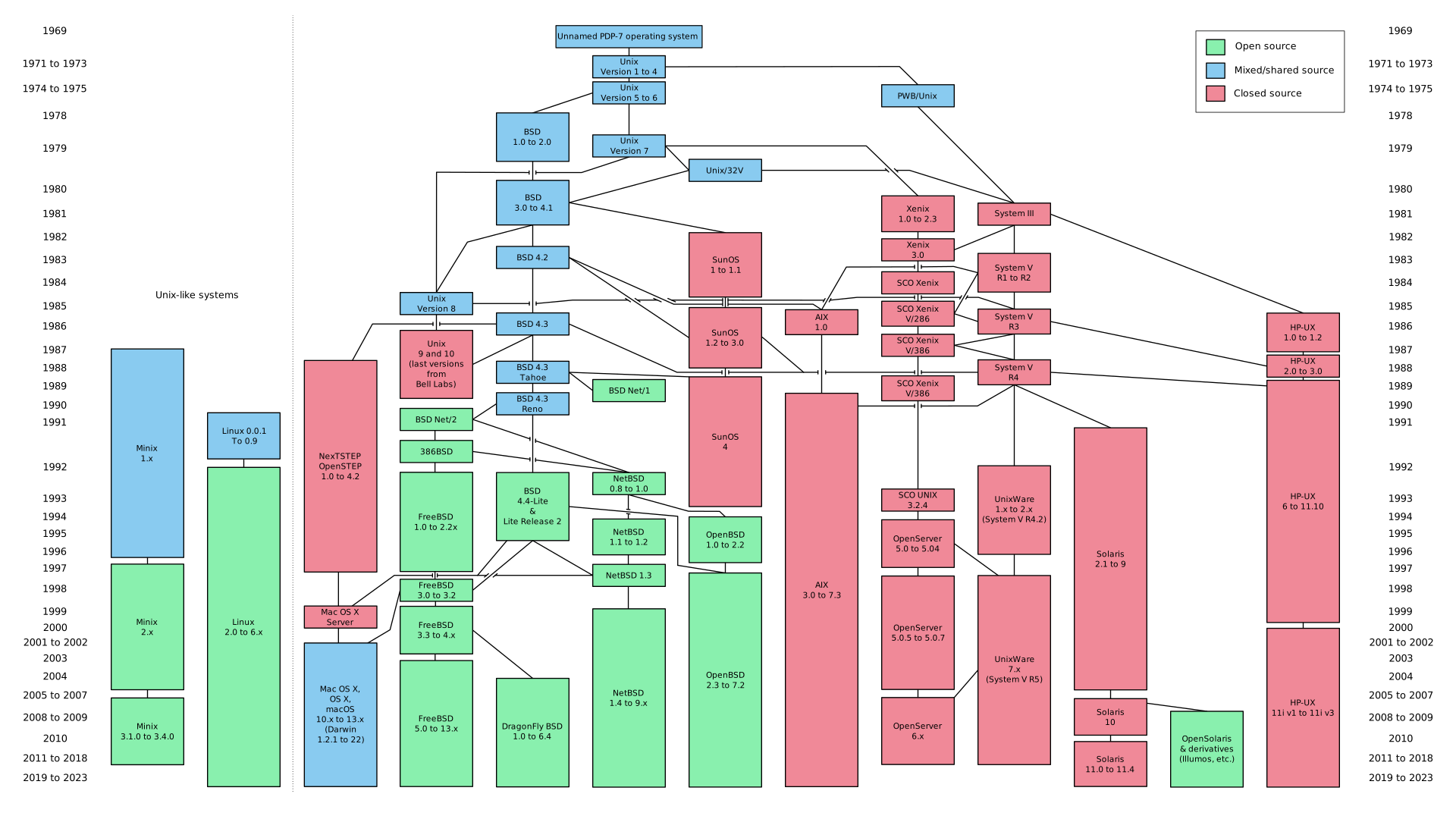
Sitation: https://www.levenez.com/unix/ (huge unixy inheritance tree)
All sorts of things are BSD because it's good reusable code that gets used for all sorts of systems, that doesn't automatically make OS X anything like equivalent to running a full BSD desktop on the same hardware.... and that's without even getting into the GUI and everything a normal user interacts with.
-
Re:The Big Three
Darwin is every bit as much a BSD variant as FreeBSD, NetBSD or OpenBSD is. It can trace its roots in both design and code directly back to 4.3BSD. It's basically FreeBSD with a different kernel and driver model.
You're aware that the Mach microkernel was originally designed as a drop-in replacement for the BSD kernel? They abstracted more functions into the microkernel as the project went on. MachOS was always intended to be a BSD system, with the option of running other environments on Mach in the future.
NeXT was BSD before the Great Divide from AT&T code. Jobs paid a license fee to AT&T to use Unix.
Take a look at the Unix family tree and note where Mach, NeXTSTEP, Darwin and Mac OS X reside.
Mac OS X is Unix, specifically a variant of BSD Unix. Not exactly sure why this is a problem for you, unless you helped build BSD and NeXT killed your father?
-
Re:This is quite amusing....
If you're ready to get your UNIX nerd on, check out this UNIX family tree.
That list is BS. It doesn't even have Ubuntu on it.
-
Re:This is quite amusing....
...considering that Android -- at its core -- is a form of Linux. So is OS X and therefore so is iOS....
NOOOOOOOOOOOOOOO
Mac OS X is largely derived from NeXTStep, which was built on top of 4.4BSD UNIX variants (mostly NetBSD with a lot of FreeBSD userland). Stock Android uses a Linux kernel, but the Android app SDK is completely different from a desktop Linux distort, just as the iOS SDK offers zero overlap with a BSD UNIX desktop experience.
Both Android and iOS have their roots in UNIX-derived operating systems (though neither are "classic" SVR4-based systems). But although they are both derived from POSIX and "UNIX-alike" systems, they share (essentially) no code and no development tree. Additionally, I personally would argue that from a OMG UNIX has conquered the world perspective that Android == Linux as little as Mac OS X == NetBSD since all the parts that people care about are derivative or proprietary.
If you're ready to get your UNIX nerd on, check out this UNIX family tree.
-
Re:I wish them good luck.
who cares, BSD is just some long forgotten Linux like operating system that nobody uses any more.
I hope that's
-
Re:why ?
Of course it will be useless for you if you already have some understanding of the UNIX heritage. As with all metaphors, its value is for people who know very little about the topic, in that it helps them relating the topic to something which they're already familiar with.
For someone without a previous knowledge in the history of UNIX, the metaphor provides a mental map to navigate intuitively what was perceived as an impenetrable technical mess. It can provide the idea that there is a heritage of branching from a common origin, a sense of what are the main branches, their relative antiquity and importance.
Moreover, it's funny and light-hearted. Why does everything has to have a practical purpose?
-
Re:Use a language that no one ever heard of
Try the listing / chart at http://www.levenez.com/lang/ . Good luck...
-
For those wanting a bit more MEAT
I had a look through this timeline tracing from the origin at NeXTSTEP 0.8, and now my brain is slightly melted O_o... but I managed to find all of the inheritance from other systems (excluding integrations between derivatives of itself like Darwin, OS X Server, OS X and iOS etcetera):
- 1988, NeXTSTEP 0.8, inherited from: 4.3 BSD, Mach 2.0
- 1989, NeXTSTEP 1.0, inherited from: Mach 2.5
- 1996 - 1997, OPENSTEP, inherited from: None
- 1997, Rhapsody DR1, inherited from: 4.4 BSD lite 2
- 1998, Rhapsody DR2, inherited from: NetBSD 1.3
- 1999, Mac OS X DR1, inherited from: Mach 3, FreeBSD 3.1
- 1999, Mac OS X DR2, inherited from: FreeBSD 3.2
- 2002, Mac OS X 10.1.5, inherited from: FreeBSD 4.5
- 2003, Mac OS X 10.3 beta, inherited from: FreeBSD 4.8, FreeBSD 5.1
- 2004, Mac OS X 10.4 beta, inherited from: FreeBSD 5.2.1
So it looks like mostly FreeBSD and a little of the old Mach, I think NetBSD was used as a means for porting between architectures more than a literal inheritance. interesting how the last bit of FreeBSD was way back in 2004 from FreeBSD 5 (The timeline goes all the way up to present with OS X Mavericks). of course there are probably newer bits of FreeBSD used that are only known internally to Apple.
Not having looked this closely at the OS X part of this timeline before i found the transition between OPENSTEP and OS X quite confusing... according to the timeline Rhapsody (what OPENSTEP turned into after Apple started working on it) directly became Mac OS X Server and Darwin, but OS X was not derived from any of them itself and seems to be directly linked to Mach 3.
Then the timeline proceeds with Mac OS X as what appears to be where all of the development is taking place (including inheriting from FreeBSD), with Darwin and OS X Server only ever taking from OS X like mirrors. Then suddenly in 2006 this model changes and the OS X 10.5 beta inherits from Darwin 9.0 beta, when OS X 10.5 and Darwin 9 mature the model goes Darwin -> Mac OS X -> Mac OS X Server... Then in 2007 during the OS X 10.7 beta the model changes again when the server branch is eradicated all together and gets integrated into OS X and OS X gets integrated into Darwin so the model goes OS X -> Darwin again but without the server.
This suggests OS X didn't inherit from Rhapsody at all until the period between 2006 and 2007, not sure if this is true or not, but interesting none the less. Also makes you wonder how much of the original OPENSTEP was inherited, perhaps it's more that it was not publicly disclosed how much of the technologies became proprietary Apple technologies at the beginning of OS X rather than a lack of direct inheritance at the beginning.
-
Re: More Than You Might Think
This is getting slightly off topic, but it is interesting how FreeBSD code finds it's way into so many other systems, but not too surprising when you consider the fairly widespread opinion of it's high code quality and statistically proven fewest bugs per lines. Darwin has already been mentioned and probably has the closest resemblance. You can also include the AT&T UNIX systems and their many derivatives which have all pulled code from the BSDs into their source tree's at various points, important to note that the literal code inheritance for the 386 derived BSDs of today is BSD -> UNIX and not the other way around, I know i make that point a lot
If you include not only the systems that maintain a fuller closer resemblance to the original FreeBSD userland then smaller components of FreeBSD are likely to have been included in many systems that we aren't aware of... probably the most unlikely that most people would think of is windows, it's TCP/IP stack is derived from FreeBSD. But the same is probably true for GNU, so it's not really useful to try to compare how widely used they are, it's just good that both of them have liberal enough licensing to be so useful in so many different things.
-
Re:Ambiguity !== Sensationalism
What does being grammatically correct have to do with being knowledgable in a specific part of computing history. For your information I know the difference and i've always had difficulty remembering to only use the apostrophe on one, if you want to discredit me entirely on that basis then i'm not interested in your opinion. I'm not an expert but the guy who assembled this is... would you discredit him as an expert if you found an inevitable grammatical error in his writing somewhere. I hope you understand rhetoric... do not reply otherwise i will assume troll... i also hope my excessive use of ellipsis do not melt your grammatically pedantic brain... or do i... go away useless person
-
Re: Uh huh
Yeah; I've been wondering what exactly they mean by UNIX here -- are we talking POSIX compliant OS (they almost all are these days), something based on BSD/AT&T code (BSD derivatives like OS X and FreeBSD, plus SVr3+ derivatives like HP:UX) are are we talking purely SVR 4+, and thereby mean SCO offerings when we say UNIX?
See http://www.levenez.com/unix/ for a nice list of UNIXes. Interestingly, Windows NT isn't there, even though it is POSIX compliant.
-
UNIX family tree
Whenever I see announcements of "We're creating a fork!!!" the first thing I think of:
http://www.levenez.com/unix/Lots of tiny branches that just stop.
-
Re:UNIX family tree
And this is even a better version than that.
-
Re:UNIX family tree
That's just the "Light" version.
A more complete version is here:
http://www.levenez.com/unix/Includes IRIX, Reliant, SINIX, Risc, Unicos, Dynix.
And more fun stuff like iOS.
-
Re:UNIX family tree
This is a much better tree, has atleast a hundred different versions on it...
-
Unix timeline
Dennis Ritchie had an impact on the technology world FAR beyond what Jobs and Apple could ever dream of...or how many hundreds of thousands (if not millions) of Unix-derived systems are running?
It becomes more obvious when you look at all the derivatives that have come to be. A Unix timeline is a good way to visualize it and the Levenez Unix timeline shows the highlights of the last 40+ years. It gives a good idea of how much amazing activity there has been.
-
Possible source data???
Maybe this or a Linux-specific version of the same thing for mappable data.
-
Re:So BASIC, C, and Lisp are all related?
I didn't RTFA since, after all, I am on Slashdot.... but I didn't realize that Fortran & C were both part of the Algol language family.
Nope, Algol is a descendent from FORTRAN loins. Here's a nifty graphic describing the family tree:
http://www.levenez.com/lang/lang_letter.pdf -
Re:I forget...
From the ipsec(4) manpage for Mac OS X 10.6, history section:
The implementation described herein appeared in WIDE/KAME IPv6/IPsec stack.
The KAME stack is the same stack used in NetBSD and FreeBSD.
Even though NeXTSTEP was forked earlier from the BSD codebase than the other BSD flavors there has still been considerable sharing between it, Mac OS X, and the other BSD flavors. OpenBSD is one exception to this since it tends to be a more closed ecosystem than the other BSD variants.
-
Re:like...WHATever, dood...
He thinks that 2000 was the last pure NT code before XP got tainted by included 98 code.
However, the NT line was derived from the OS/2 codebase by the DEC-VAX engineering team on the alpha processor and later ported to the i386.
Right after that it got tainted by the Win 3.0 codebase and was slowly nurtured into maturity to be introduced as NT3.1Anyway, for people interested there is a timeline here: http://www.levenez.com/windows/redirect_windows_a4_pdf.html
-
Re:BSD is dead
If you mean that OSX is a descendant of FreeBSD then you are mistaken. OSX is a descendant of Mach, which shares a distant common ancestor with FreeBSD.
-
Re:What did happen to UNIX?
If that's Unix_history-simple.svg (which it is), I'd hate to see Unix_history-complex.svg.
Here you go. Well, not svg.
-
Re:Tru64 goodness
http://en.wikipedia.org/wiki/Tru64 http://www.levenez.com/unix/history.html#03 Just one of the best Operating Systems ever made for clusters
-
Unix history chart
Here it is. http://www.levenez.com/unix/
It is like an equivalent of a nice map hanging on the wall. -
Re:History of programming languages
Levenez also has one of those for UNIX history. Both of which are sufficiently nerdy for a CS dept wall.
http://www.levenez.com/unix/ -
History of programming languages
http://oreilly.com/pub/a/oreilly/news/languageposter_0504.html
http://www.levenez.com/lang/
An instructor at my college has those running along the hallway outside his office. -
Re:*BSD!
here is the real history of unix:
http://www.levenez.com/unix/history.html -
Everything old is new again
Sometimes, it seems, there are no new ideas. As others have said, what we have here is a glorified sail. Nothing wrong with that, but as fossil fuels become more expensive, we'll find more and more "old tech" make a comeback.
The biggest deal in alternative energy right now is the windmill, which have been used for what, 1,200 years? Now we have a (gasp!) sailing ship! Pretty soon we'll go back to using the electric car which was very popular in the early days of the automobile.
No, basic technologies are not new - what's new are refinements. For example, Linux is a re-implementation of a 35 year old Operating System having the chief innovation of a license change. I'm not knocking the quality that Linus has put into the Linux kernel, but Linux is written to be POSIX compliant, so while drivers are nice, Linux is basically no different than any other UNIX but for the license difference.
Innovation can come from some incredibly low-tech, unlikely places. For example, this guy has won numerous awards for sticking a pot inside a pot and filling the middle with wet sand - managing to solve a serious problem in Africa for low-cost refrigeration.
I guess what it comes down to is this: Technology is valuable when it works, not when it's complex. There's lots of very, very, very simple technology that nonetheless works very, very, very well. -
Re:i was a basic kid
the older ones among us will instead fight between FORTRAN and COBOL
ALGOL was also around (nice Computer Languages History Chart). My camp, on a machine like this.
CC. -
Re:Sun?
Go to the Unix History page. Look at the diagram. Anyone telling you they know the full history of UNIX is lying. Period.
Currently UNIX is 2 things: a trademark and a concept. The trademark can be bought from the Open Group, the concept is basically enshrined in POSIX.
Wikipedia is your friend. -
history, anyone?Well, calling it a "programming language" certainly qualifies as "fantasy"...
Har har har.
The guts of FORTRAN is the conversion of formulas written in typical mathematical notation, like x=(y+23)*z, into computer code. Almost every programming language in use today is a descendant of FORTRAN (except, like, shell scripts and original LISP, but I think most LISPs now include evaluation of mathematical formulas).
Choosing a computer language today in most cases is answering the question, "What form of program flow control do you want with your FORTRAN?"
(What would slashdot be without over-generalizations and intentionally inflammatory statements?)
-
Not so fast!
Not so fast! Solaris' roots go back to before UnixWare. UnixWare wasn't released until 1992. The SVR4 code that went into Solaris split off before then, according to the UNIX History Timeline. The sale of UnixWare to Novell took place later. And don't forget that a lot of the Solaris code was supposedly taken from BSD-based SunOS, plus there's no doubt that a lot of it was also written by Sun or for Sun.
Somehow, I don't see Sun and its top-notch legal team making a mistake on this matter. This isn't the sort of scenario that would have been overlooked.
- John -
Re:Maybe my computer has a virus?
Well some people admired of MacOS works and millions of hours multimedia, billions of mainstream newspapers, millions of scientific research done with it. The stuff you watch on your HDTV if produced back in 1990s is probably completely produced on that poor old OS which you claim to have sucked.
Try SGI or Amiga. Macs were likely used in simple things, but I doubt in any serious capacity.Also Mac OS X is not Unix Based, it is Mach+FreeBSD hybrid OS.
FreeBSD and Mach are Unix based. So is OSX. -
Re:Proprietary forks not bad for end users ...
"I couldn't be so certain if I were staring at the screen of a display attached to a Tivo device, it seems."
Indeed. An update can turn your Tivo off permanently. And you do not have the cryptographic keys needed to make it work again. Which is one thing the GPL v3 tries to address.
"I'd like to have somebody draw up for me the big bloody flow diagram of 'failed' BSD systems."
There's a fairly good one (which includes most unixes, both successful and otherwise (it lacks some tho, DG/UX is one I've worked with which I note is not there)) at http://www.levenez.com/unix/. -
Linux roots are older then Microsoft
The basic for Linux comes from roots that are from the year 1969. You can see it here.
http://www.levenez.com/unix/ -
Re:Slashdotting
-
Re:3D Chess is everywhere!
one more: nextstep chess
-
Mac OS X is BSD. Yes, it is.
Five seconds with Google would have spared you this lashing.
Mac OS X System Architecture
Architecture of Mac OS X
UNIX family tree
Please do try to keep up. -
Re:Unix vs. Linux
The real question is how Linux is different than Unix. Unix is far older and mature than Linux. Linus (and his classmates) used Unix as a model. Without Unix there might not be Linux, or it might look vastly different. Many of the features of Linux come from one or another commercial version of Unix (or BSD) and were developed as robust, "commercial quality" (if that actually means anything) products. See UNIX History for more information (scroll down for many UNIX / Linux information links).
-
Re:You're probably fine
See http://www.levenez.com/lang/history.html. Note that most of the recent stuff is just things like "Python 2.3.2". Look how many "new" languages have appeared since 2000 on that chart (close to 0). Hell, even Ruby dates to 1993.
Be careful:
- new versions of languages sometimes have significant new features
- the graph doesn't have a consistent scale: on the left, it's labelled every 5 years, then the 5 year spans get wider, then they're eventually replaced with 1-year spans on the right
- languages drop off the chart, even though they're still changing a lot; for example, ECMAscript has a lot of new features in the pipeline, but it stops at 2002 on that chart
- it could be because he's taking a wait-and-see approach for new languages.
For example, where's D (1999), Io (2002), Fortress (still in progress), or Arc (still in progress)? I'd call these some of the most important languages of the past 10 years. If you have a chart that omits the most important new languages, *of course* it's going to look like there's no new work being done with programming languages! -
Re:You're probably fine
I said innovation has slowed, not what's commonly used or used by a particular programmer. A lot of what's happened recently has been implementation of older ideas and incremental change. There are a lot less "left-field" languages being dreamed up, less entirely new paradigms for languages. Java is not exactly new. C# is probably the "newest" of those, dating to ~2000. Java and Javascript are circa 1995 (11 years old), and Python is 1991 (16 years old).
See http://www.levenez.com/lang/history.html. Note that most of the recent stuff is just things like "Python 2.3.2". Look how many "new" languages have appeared since 2000 on that chart (close to 0). Hell, even Ruby dates to 1993.
Back in the 1980's (and into the 90's) there was an entire magazine devoted to this area called "Computer Language". -
Re:graphics software and Linux
Don't be afraid of the command line and you will be rewarded.
Though it's been a long tyme since I have I have worked with CLIs. Abut ten years ago I took a class in Linux, er unix, however the PCs we used had coherent as the OS. Before that, I first started progamming on the Trash, er TRS80, when RadShack released it in the 1970's. I learned basic programming on it, the Apple 2, and a dumb terminal connected to an IBM 360 series 60 mainframe. I admit I need to learn or relearn a lot to proficiently use the command line, however I'm wondering how well I'll be able to use it as my memory is impaired, damaged.
I've used Maya its a pretty nice 3D modeling system, and its relatively simple to learn as compared to Blender.
I'd like to get a good book on learning either Blender or Maya.
Just remember one thing with Linux: its not about finding programs that are equivalent to Windows programs.
As it is now I don't really use much in the way of Windows apps, programs in general really, other than browsers and a text editor. However when I get around to it I want to install a webserver, perl, a database, and maybe Ruby on Rails or other web tech as I want to learn web development.
Falcon -
Re:evolution of languages has to be gentle
Pascal. It was a wonderful language. It worked well. It was easy to use also with low level stuff. Wirth developed Modula, then Oberon. These were so radical changes that Pascal was killed.
Is this opinion or somehow provable fact? I'm just curious because
a) Pascal isn't dead. Delphi uses Object Pascal and it has a large developer base. I would hazard to guess a larger user base than Ruby or Eiffel or the like, and I wouldn't call them dead.
b) How many freaking variants of c/c++ do we have? ObjectiveC, C#, C with Classes, C++, so on and so forth. Just go to http://www.levenez.com/lang/history.html and you'll see. I think the better argument for Pascal not being the big cheese (like C/C++) is that there had to be a winner and a loser. Call it the Anthropic C principle if you like -
Re:COBOL hasn't been topdog for a while
I like this little diagram for language relationship:
http://www.levenez.com/lang/history.html -
Re:Most subjective list EVER
Do not assume what I believe! I believe thouth that Unix does deserve the number one spot. Take a look at it's history (History of unix)
There's more lines on the Unix history chart than hair left on your head most likely. Then talk about some dead piece of software that was written in ancient times and was great. I think tha author's original idea was not on a "single piece of sotware" ever written, it was more about the impact it has had on the world. When you find one that surpasses Unix, then by all means bring it up, make your case, and we will give it the number 1 spot -
Let me be the first to link to
The Unix Haters Handbook a great read.
Unix is probably the greatest bit of software ever, but "Unix" doesn't exist per se, it's almost like you could say, that it's had a long branching history, oh well, I can't fault him for his choice, I probably would have said the same as well...but seriously...
Excel is on the list? Not say, VisiCalc?. -
Re:Did they alreay win?
Ack. When is this rumor going to die?
OS X, back when it was called NEXTSTEP, forked off of BSD 8 years before FreeBSD did, even before 4.4lite came on the scene. You can trace its lineage yourself, if you'd like. Since then, there's been a lot of code borrowing but everyone borrows from FreeBSD and FreeBSD is far from the only OS whose code Darwin has borrowed. Using just that to say that Darwin is based on FreeBSD would make little more sense than using the same fact to claim that GNU/Linux and Windows XP are based on FreeBSD.
But as to your point about BSD in general beating Linux to the desktop with OS X, yeah, you're right. I think Apple showed how it really needs to be done, too. In my experience with trying to teach people to use Linux, the thing that consistently hurts Linux on the desktop is what I'd call its unixyness - stuff like complicated directory hierarchies based on abbreviated names only serves to intimidate the non-geek; even if you tell them they don't need to care about anything outside their home directory, they still know it's there. A lot of Linux's celebrated choices are bad; too. The moment a user ever has to care about QT vs GTK+ and figure out why they are behaving a bit differently, or what the heck CUPS is, or any of that, Linux starts to feel like a border town on the edge of the Wild. -
Re:Jonathan Schwartz's previous company was awsome
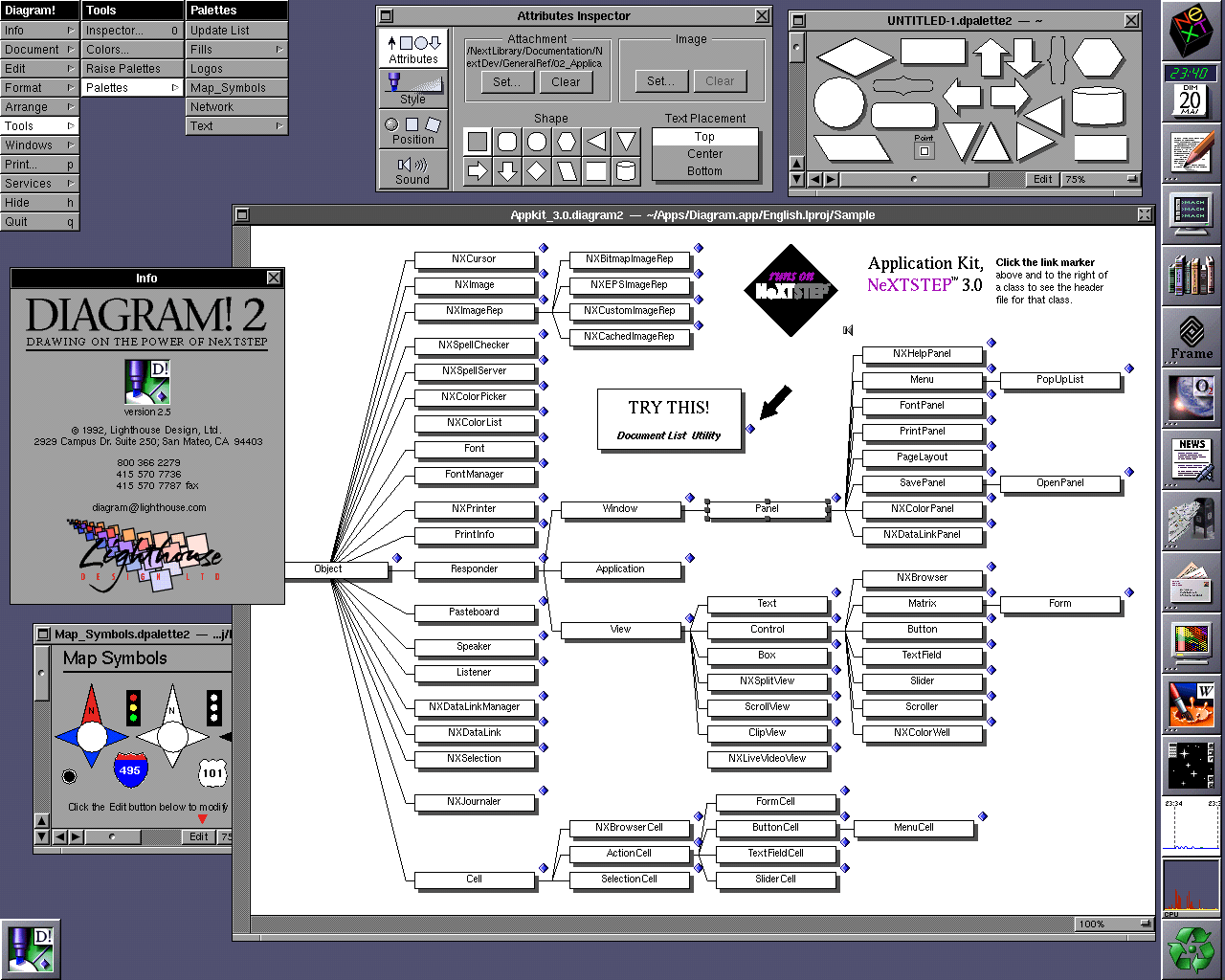
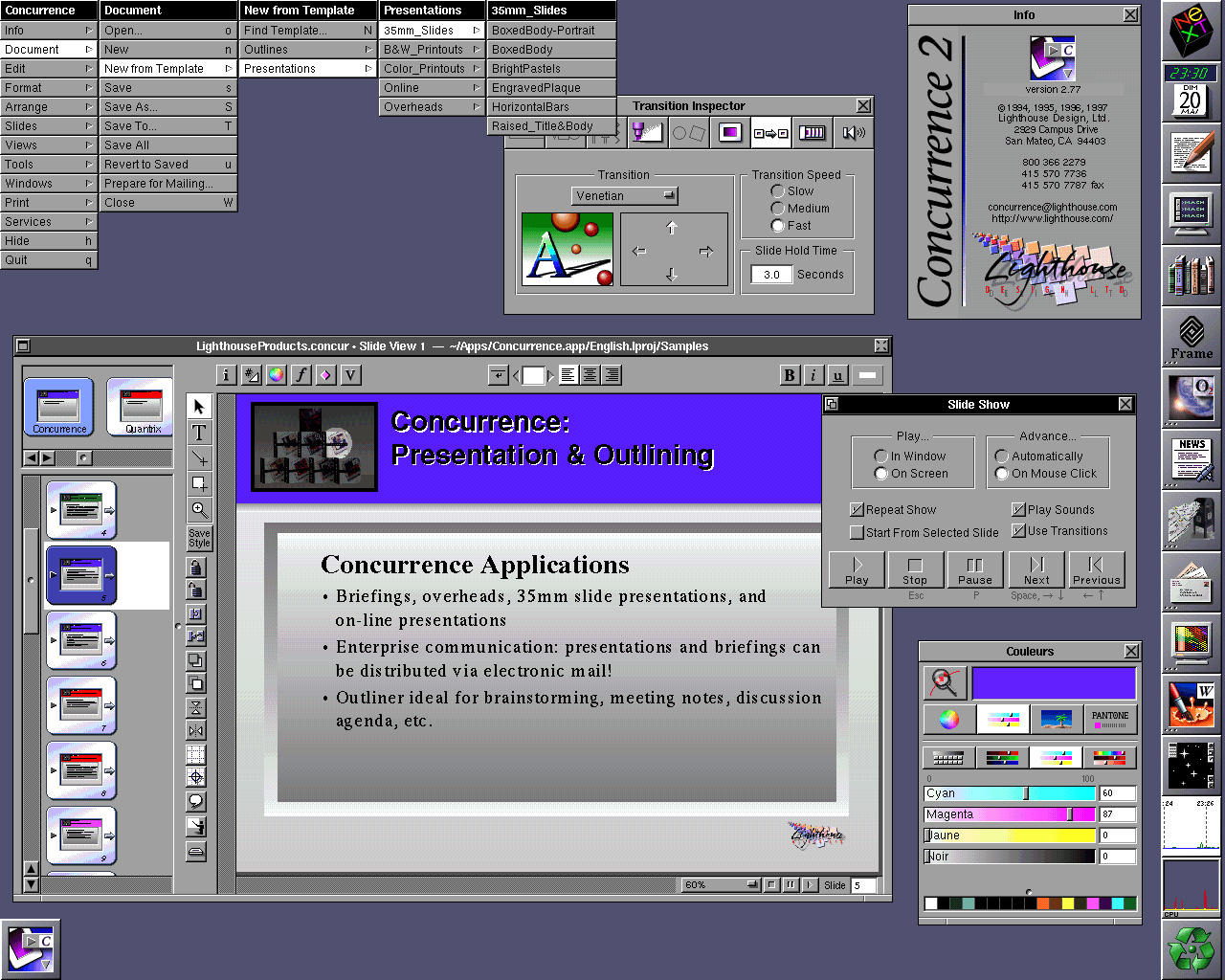
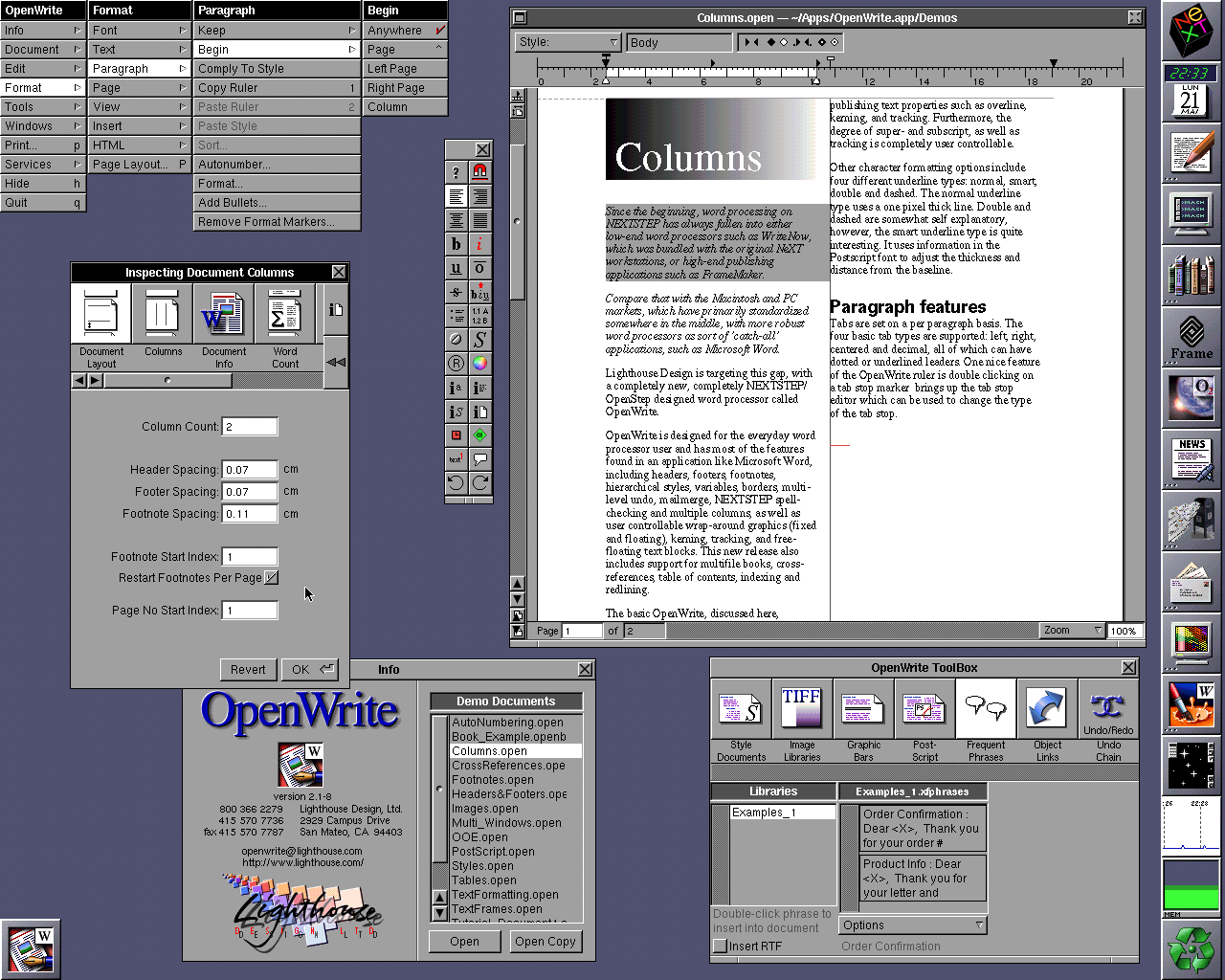
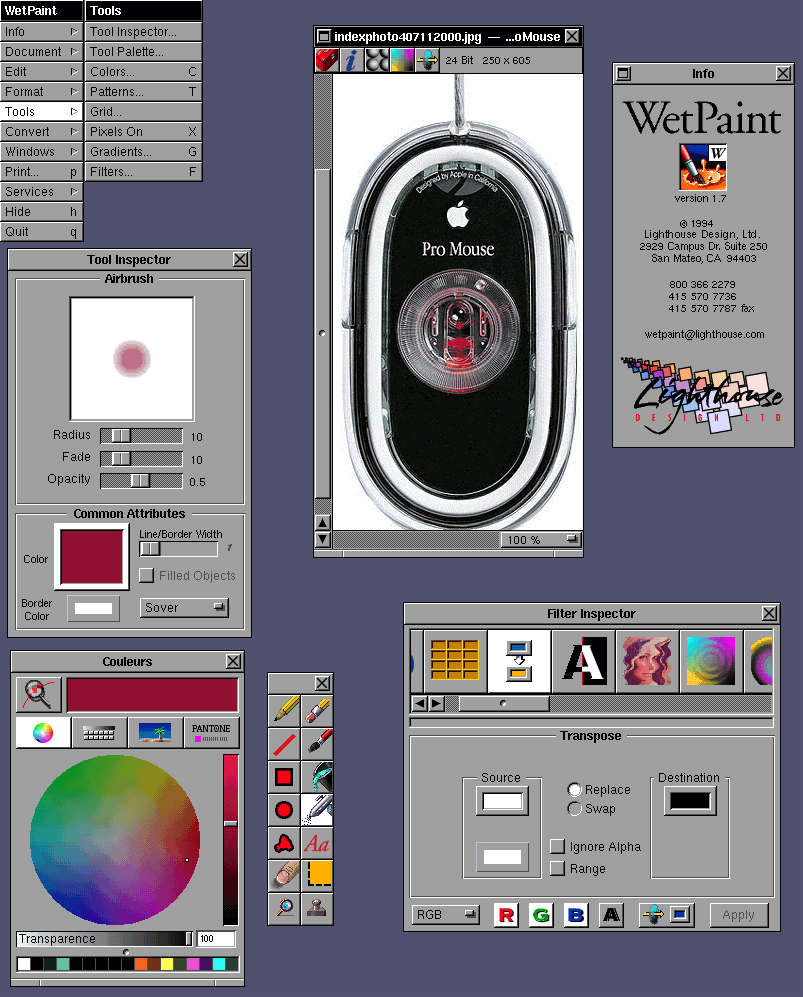
Screen shots of Lighthouse apps: [Be gentle with the poor host that provides these shots]
http://www.levenez.com/NeXTSTEP/Diagram.gif
http://www.levenez.com/NeXTSTEP/Concurrence.gif
http://www.levenez.com/NeXTSTEP/OpenWrite.gif
http://www.levenez.com/NeXTSTEP/Quantrix.gif
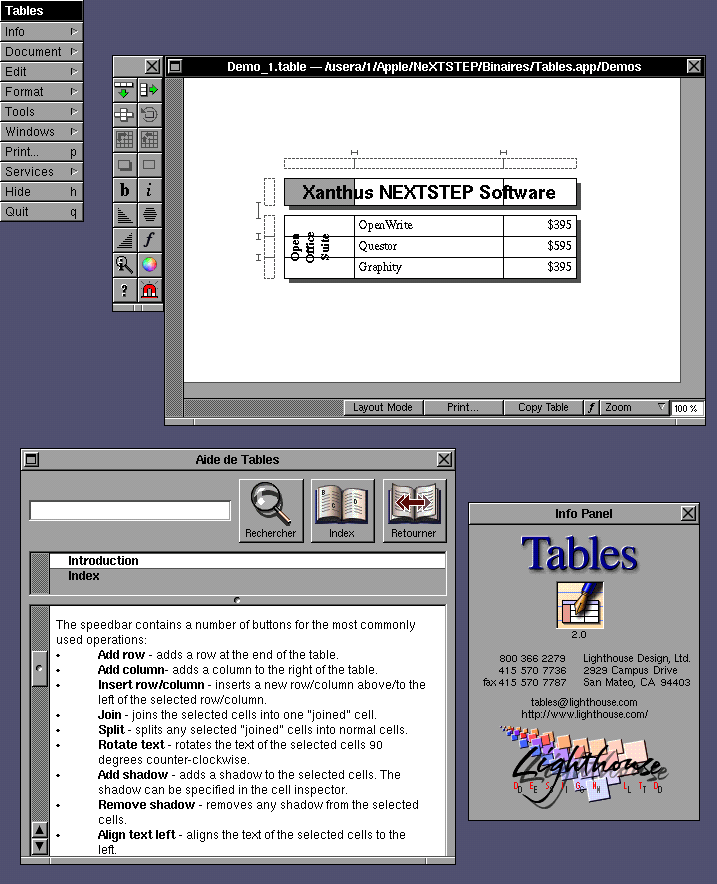
http://www.levenez.com/NeXTSTEP/Tables.gif
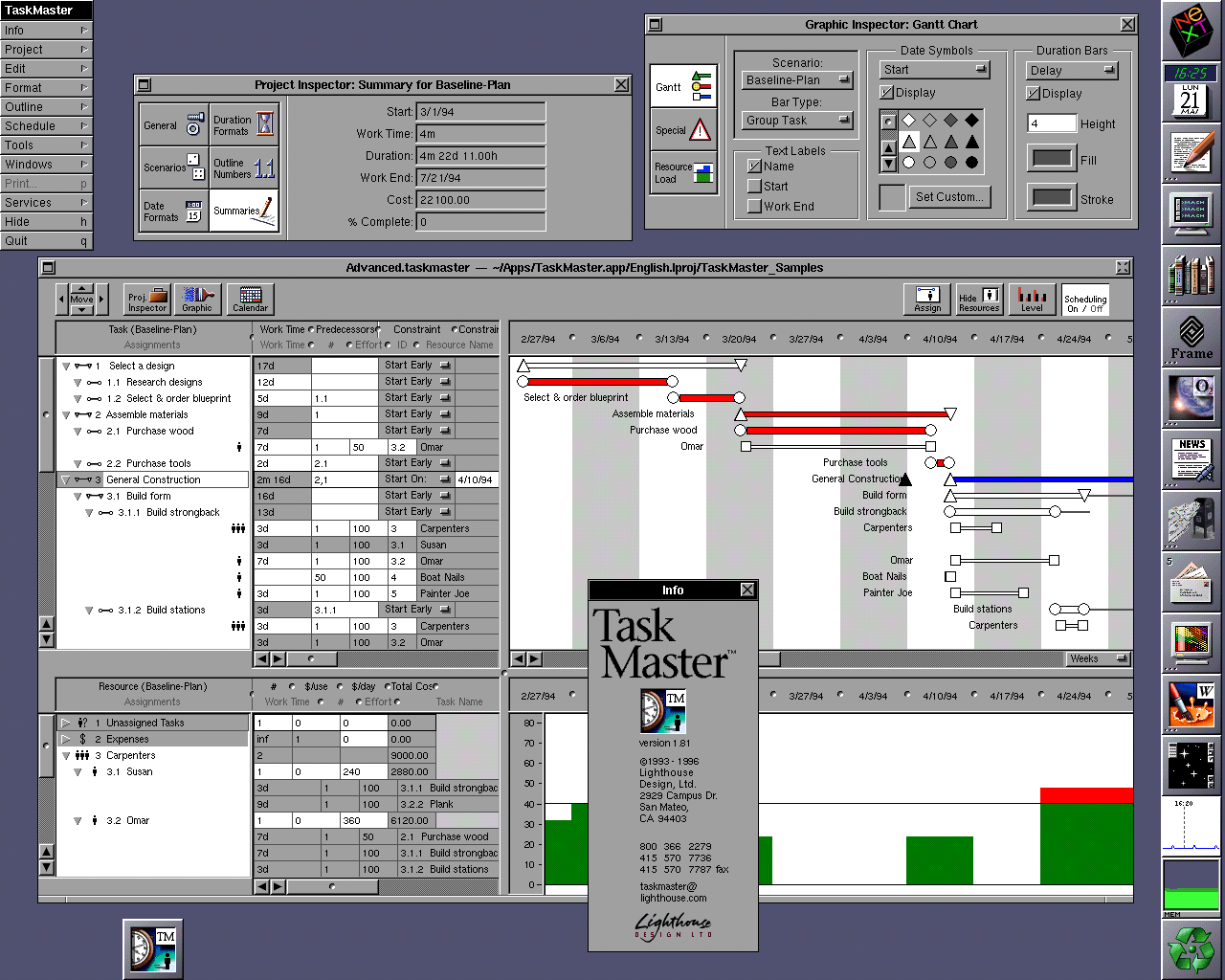
http://www.levenez.com/NeXTSTEP/TaskMaster.gif
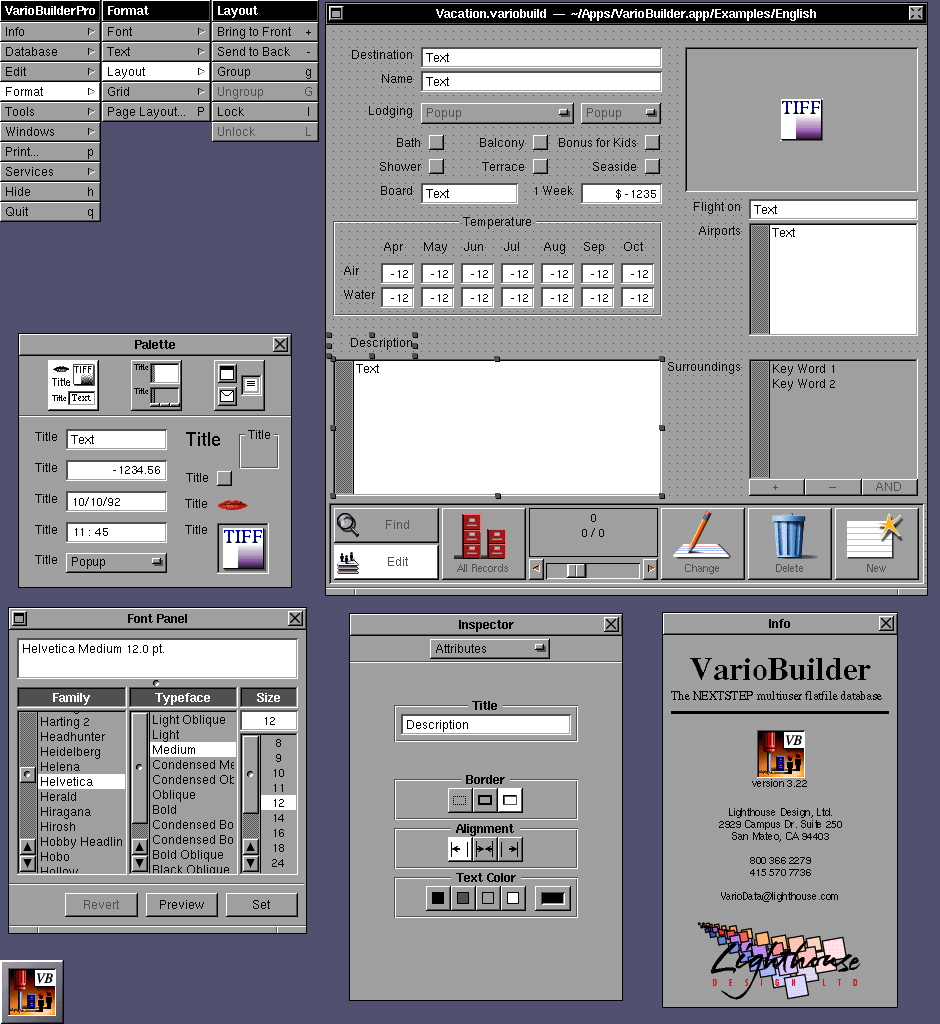
http://www.levenez.com/NeXTSTEP/VarioBuilder.gif
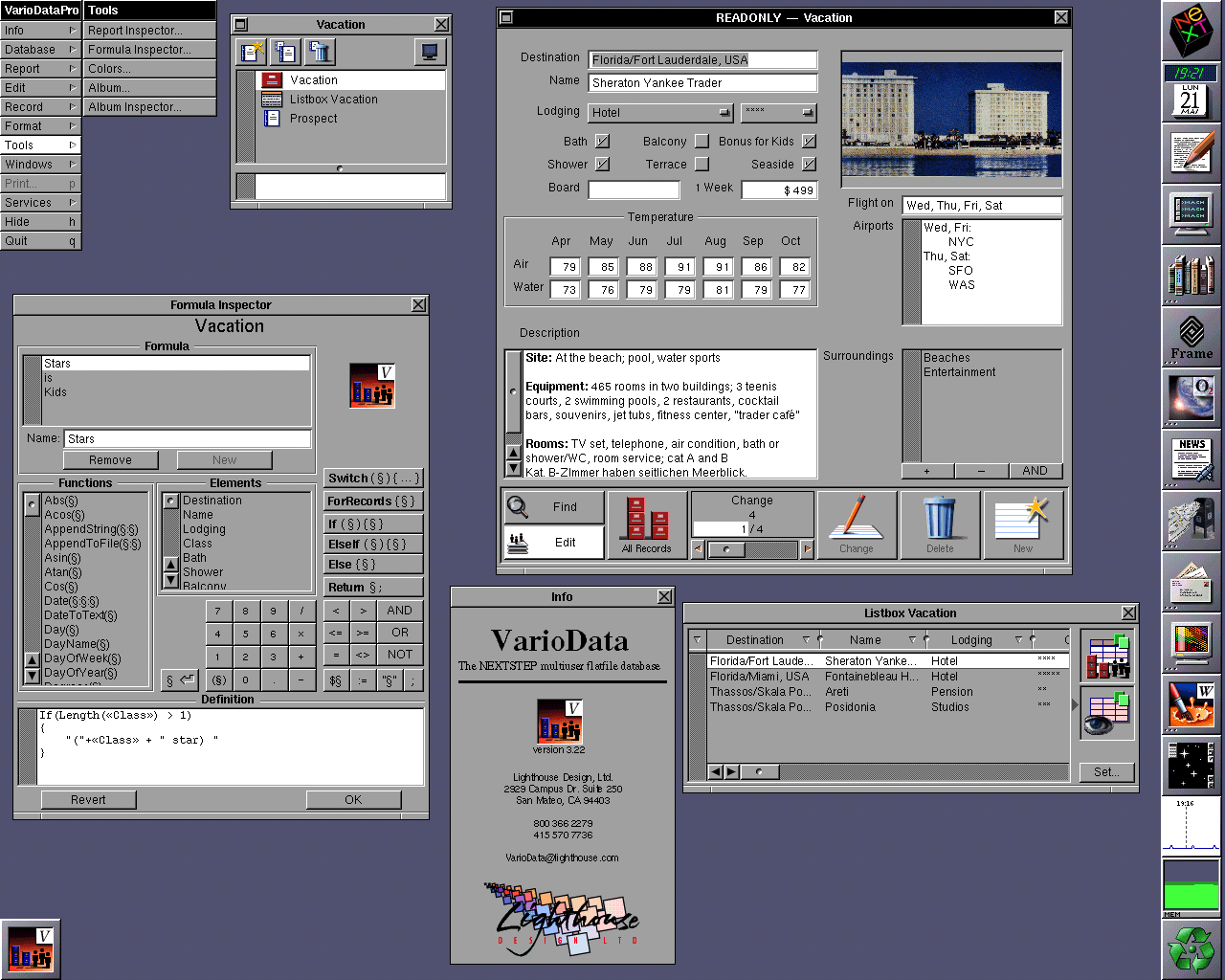
http://www.levenez.com/NeXTSTEP/VarioData.gif
http://www.levenez.com/NeXTSTEP/WetPaint.gif
Doom just for fun:
http://www.linuks.mine.nu/openstep/doom.png -
Re:Jonathan Schwartz's previous company was awsome
Screen shots of Lighthouse apps: [Be gentle with the poor host that provides these shots]
http://www.levenez.com/NeXTSTEP/Diagram.gif
http://www.levenez.com/NeXTSTEP/Concurrence.gif
http://www.levenez.com/NeXTSTEP/OpenWrite.gif
http://www.levenez.com/NeXTSTEP/Quantrix.gif
http://www.levenez.com/NeXTSTEP/Tables.gif
http://www.levenez.com/NeXTSTEP/TaskMaster.gif
http://www.levenez.com/NeXTSTEP/VarioBuilder.gif
http://www.levenez.com/NeXTSTEP/VarioData.gif
http://www.levenez.com/NeXTSTEP/WetPaint.gif
Doom just for fun:
http://www.linuks.mine.nu/openstep/doom.png -
Re:Jonathan Schwartz's previous company was awsome
Screen shots of Lighthouse apps: [Be gentle with the poor host that provides these shots]
http://www.levenez.com/NeXTSTEP/Diagram.gif
http://www.levenez.com/NeXTSTEP/Concurrence.gif
http://www.levenez.com/NeXTSTEP/OpenWrite.gif
http://www.levenez.com/NeXTSTEP/Quantrix.gif
http://www.levenez.com/NeXTSTEP/Tables.gif
http://www.levenez.com/NeXTSTEP/TaskMaster.gif
http://www.levenez.com/NeXTSTEP/VarioBuilder.gif
http://www.levenez.com/NeXTSTEP/VarioData.gif
http://www.levenez.com/NeXTSTEP/WetPaint.gif
Doom just for fun:
http://www.linuks.mine.nu/openstep/doom.png