Slashdot Mirror
Domain: levenez.com
Stories and comments across the archive that link to levenez.com.
Comments · 185
-
Uhmm...The original was better
Don't tell me no one here has ever seen this. I can get my own copy there and print it. O'Reilly merely remade it, and gave a small credit to Eric Levenez.
-
Re:Reminds me of
I think not sir. I think they might have been influenced by the very chart that they ripped off.
-
Easier to Read Version
Here's a more size friendly version. of the diagram
-
What do they mean by programming language?
They didn't define what they consider a programming language (Turing complete? General purpose?). Powerbuilder and m4 are general purpose languages but I didn't see them on the diagram.
If domain-specific languages are allowed, I think these were overlooked:
- JCL
- Music V (including Csound)
- pd
- RPG
- SQL (including PL/SQL)
- SuperCollider
- troff (chem/grap/groff/pic/tbl/et al.)
- Xbase (dBASE/Clipper/FoxPro/et al.)
- XSLT
BTW, you can download a more printer-friendly version here: Eric Levenez's Computer Languages History
Also, a German version is available here: German PDF
-
Éric Lévénez did this
Éric Lévénez did this already.
We have had his poster on our wall since last year.
-
Did they give credit to the original?
Looks like they colorized the one found here: http://www.levenez.com/lang/
-
That might be of interest
Unix History also following the links you might get to windows hostory as well!! somewhere in there you will find programmign languages history too!
-
Same here but much more readable
... and existing for a while now. The same exists for Open Systems (UNIX) and Closed Systems (Windows) history on the same site.
-
Same here but much more readable
... and existing for a while now. The same exists for Open Systems (UNIX) and Closed Systems (Windows) history on the same site.
-
Re:QNX is the bad touchMan, you're a troll. QNX2 came on 5.25" floppies in 1987. Here are some examples of some other things that happened in 1987:
- IBM introduced the fantastic new "VGA" graphics standard, blowing everyone away with its 256 colours of fury.
- Windows 2.0 came out.
Surely you'll concede that QNX 2 is superior to Windows 2?
-
Very cool
Levenez is very cool. He's the only person online with a substantial history of NeXT and NeXTSTEP, for example.
http://www.levenez.com/NeXTSTEP/ -
Re:No "real depth" here...Wow... I can't believe you could get it so wrong!!
While it is true that OS/2 was originally developed as a joint projects by MS and IBM, and it is also true that the Santa Cruz Operation's Xenix was originally a MS product... the two projects were over a decade apart at MS and Xenix was written under license from AT&T.
Unix System IV -- and later, System V (ultimately SVR4) -- and Xenix have completely separate lineage. You can check this history diagram for yourself. Of course, there's no mention of OS/2 there.
The current SCO Group (ne Caldera) only has a fleeting and coincidental relationship with OS/2 (via MS and Xenix) through their purchase of the Santa Cruz Operation (which purchased something Unix related from Novell (who really bought Unix from USL (which was born out of AT&T))).
Now that I've clarified all of that... and looking at the mindless drivel that spouts from SCOX... I wouldn't put it past them to make some sort of twisted claim against the JFS from OS/2. But, if they did that... they might as well stake claim to NT and Win2K as well (following the same logic). Of course SCOX's puppet master would never let that happen... now would they.
-
Unix timline mostly has it at [levenez.com]
Please don't re-do work already done. Consider the following.
Here's a useful history in PDF format (current as of early 2004):
http://www.levenez.com/unix/unix_letter.pdf
Several other formats of the document are available at the same site. -
Unix History Tree
I suppose they want to track it down on the almost individual source file level.
The Unix History still makes a good wall poster though. -
This has already been done
This has already been done here and if I'm not mistaken, SCO is right... (haha, made you look!).
-
Slightly OT: Darl and the UNIX tree
Looky here! Our favorite guy Darl of SCO presenting the Unix History in Caldera. Scroll Down to see a nice blurry photo.
Man, I can't go a day without some SCO thing in my face. -
Re: IRIX != Solaris != HPUX != AIX != SCO != OS X
You might want to check out this nice UNIX family tree..
You can easily see who's related to who. I might note that Solaris is much further from what we modernly call BSD than some of the others you named. I won't speak of IRIX, but AIX is a weird kind of BSD variant, as is HPUX. OSX is very very close to FreeBSD. -
No wonder Linux doesn't get any respect...
> Pretty cool picture though; It'll look real nice alongside the Unix Family Tree on the wall.
Per the photo gallery at the bottom, Linus needs to grow a beard. -
But where's the fairy cake?I thought looking at the whole of creation, as extrapolated from a piece of fairy cake, was supposed to screw with my mind or something. It doesn't appear to have done so, and I can't see any fairy cake either... I'm sooo disappointed!
Pretty cool picture though; It'll look real nice alongside the Unix Family Tree on the wall. If only there was a landscape version... time for some PostScript hacking I guess.
-
Re:Horse hockey.
Thoroughly offtopic, but in response to above:
Here's a throughly convoluted but informative unix timeline.
Here is Microsoft's history of Windows; 1983 seems a bit suspect as the year of Windows' announcement. However, if you take the dates when either system first became fairly usable to actually work on, the picture becomes a bit clearer. And as for at least semi-reliably handling load-intensive server tasks, well, let's not even go there... -
Re:Scott Meyers
C++ has problems, yes; pretty unavoidable since it was the first real object oriented language.
This comment alone summarizes the posters knowledge of programming languages. For a better understanding of C++, check it out on the Computer Languages History website
My reply: Cute, but it unfortunately does mean something. C++ has more features that are so easily misused (not abused), that Scott Meyers wrote 3 large volumes on the subject. Other languages have similar featuers, but not in near the quantity of C++. Java has been jokingly refered to as C++--++. The "--" refers to the stripping away of all the majority of the problems that Scott Meyers addresses in his books.
PS Object Oriented is a concept adapted from functional programming languages, i.e. LISP.
-
Re:Even older prior artFrom TALK(1) System General Commands Manual
HISTORY
The talk command appeared in 4.2BSD.
You can find 4.2BSD at Unix History or more precisely Unix History 1983 Pane.
-
Re:Even older prior artFrom TALK(1) System General Commands Manual
HISTORY
The talk command appeared in 4.2BSD.
You can find 4.2BSD at Unix History or more precisely Unix History 1983 Pane.
-
Re:Wonder if they used this?
SCO have reused the diagram put together by Eric Levenez. The original is here. Note that at the bottom of the diagram it states: "an arrow indicates an inheritance like a compatibility, it is not only a matter of source code". They seem of neglected to copy that part. Given that they're clearly deliberately misrepresenting the meaning of the diagram I'm suprised Levenez continues to allow them to use it.
-
Re:Wonder if they used this?A friend of mine sent me this mind-boggling link, which is also supposed to support SCO's claim.
SCO claims
Original UNIX history chart created by Eric Levenez. Copyright (C) 1996-2003, Eric Levenez. January 2, 2003. Used with permission.
(Emphasis added.)
I do not know too much about Eric Levenez; however, judging from his web site it seems extreamly unlikely that he gave SCO permission to use his chart, much less deface it in the derivative work they produced.
IANAL but I don't think SCO's use qualifies under Eric's note "You can freely use this diagram for non-commercial purpose. "
-
Wrong page to start on.On this page he explains:
Note 1 : an arrow indicates an inheritance like a compatibility, it is not only a matter of source code.
Note 2 : this diagram shows complete systems and [mirco]kernels like Mach, Linux, the Hurd... This is because sometimes kernel versions are more appropriate to see the evolution of the system.
Note 3 : I have now a page where I explain how I build this chart.
I pray SCO marches this document into court. It does not mean what they think it means. -
Re:Wonder if they used this?As the webpage for that diagram mentions, an arrow doesn't mean source code inheritance.
This means that for SCO this diagram is irrelevant, since it doesn't refer to IP, but ofcourse that doesn't stop them from using it anyway.
(They do imply the diagram is about "intellectual property" so they seem to be misrepresenting the facts a bit... *shudder* who would have thought they'd do such a thing!
-
Re:Wonder if they used this?Interesting, on the main page it says:
Note 1 : an arrow indicates an inheritance like a compatibility, it is not only a matter of source code
Of course SCO's version conveniently fails to mention this -
Re:Wonder if they used this?
Read this at the bottom of SCO's page: "Original UNIX history chart created by Eric Levenez. Copyright (C) 1996-2003, Eric Levenez. January 2, 2003. Used with permission."
And go the Levenez's wallpaper site and search for McBride -
Re:Wonder if they used this?
SCO's graph asserts that the Linux codebase evolved out of Minix. That's where the dotted green line becomes a solid green line.
Unfortunately for SCO, that's not correct. Linus used Minix as his operating system during some of the early work on Linux and he even used some of their file structures, but none of the Minix codebase was incorporated into Linux.
The UNIX History graph that's based on does not show a strict flow of property nor even a comprehensive flow of ideas. It merely shows the general direction that the development of unix-related systems took. -
Copyrtight infringed?
SCO Intellectual property pedigree chart looks like this UNIX History.
You can make your own graphics. -
Copyrtight infringed?
SCO Intellectual property pedigree chart looks like this UNIX History.
You can make your own graphics. -
Care to compare to the original?
The orignal tree.
As others have noted, this tree really means nothing in terms of actual code.
For instance, Linux appears to be an offspring of Minix, which in turn is an offshoot of the original Unix.
Now, anyone who's read the preface to Andy Tanenbaum's book (where the entire Minix code is listed) knows that Minix is a clean re-implementation of unix, and contains no UNIX code whatsoever.
Linus, in turn, used some Minix code to get started with Linux, but this was quickly replaced. Linux hasn't contained any Minix code for years.
So this chart, although correct with respect to 'influence' or 'inspiration'
has nothing to do with actual code. Naturally, it doesn't provide any real support to SCO's claims.
That would be something like Digital Research suddenly claiming ownership of Windows, since it's based on DOS, which in turn was based on QDOS, which was a CP/M clone. -
Re:Wonder if they used this?That is it!
Now we just need to get a hold of Mr. Eric Levenez and have him sue SCO for publishing an incorrectly marked up, derivative work of his Unix history diagram, I expect without his permission.
-
Re:Wonder if they used this?
Yeah, he has it online here: http://www.levenez.com/unix/. Though obviously without the prominence of SCO and without the inference that SCO owns anything and everything Unix related.
-
connect the dots
Looks like the guys at sco took this and drew some immaginary lines over it. Makes you wonder if using that without permission is a copyright infrinegment...
-
Re:Wonder if they used this?
Nothing new, already a part of the history.
-
Re:Could you clarify this?
That's what happened with Unix: Hardware vendors made sure that only their proprietary version would run on it, so the original BSD-code became useless.
Here shows a convoluted history of UNIX.
Who wrote SysV? Was it derived from BSD-code?
Tell the NetBSD folks that their code cannot run on a multitude of platforms.
Wrong. If you use GPL-code, you agree to wave any rights of patents you might have.
If you develop with GPL code, you are not allowed to have patents on the code. Use is a different matter. Also, I believe the original poster was stating the fact that just because you develop under the GPL does not protect you from suits from patent holders.
If Sony and JVC do a joint project under the BSD license, and Sony has some obscure patent on it, JVC is screwed and Sony essentially owns their work.
Most companies are smart enough to agree on mutual patent use for the project when they do joint work. A license is weak protect in court compared to a signed agreement between companies.
As far as I know, IBM has not been harmed from working on Apache.
If Sony and JVC do a joint project under the GPL license, and Sony has some obscure patent on it, nobody is screwed because Sony would not be allowed to use the project under the GPL if they want to enforce their patent.
If they want to sue, they still can and do. I see SCO's suit has not been thrown out no matter how invalid it is. -
Re:Other uses?you mean like this?
granted, it's not based on source code comparisons, but rather history.
-
Damn are SCO reading my slashdot posts?
Here is something very interesting for you SCO followers. It's interesting to note that SCO have annotated the unix family tree that I posted here.
You can see their L33t photoshop work here
Whats interesting is they claim they "own" Unics,
that UNIX TSS is the parent to OpenServer and that SCO Linux is older than original Linux!For a start i wouldnt say the levenez tree is anything near an official unix family tree, more of a best estimate in some cases. I wonder if they got permission from him to use it?
pass me the crack pipe!
-
Unix family tree
If like me, your are getting a bit fuzzy on your UNIX history (dating back to '69) you could always check out this.
It shows where SCO/Unixware fit into the Unix derivative tree, (and also where Linux got its roots) quite interesting really..
(it claims V7->Minix->Linux).
-
My Hero!
"Torvalds: They are smoking crack."
Go Linus! Damn! That's freaking excellent!!
Man, I need a picture of Linus to put on my wall above my Unix history timeline 8 foot long poster -
Re:Classic Linus
Dont know about IRIX (which i
IBM obviously didnt do anything with OSF/1, as AIX is not based on it, its some kind of bastardisation of SysVr2 or 3. HP I dont think did anything with OSF/1 either, as HP-UX is a BSD4. derivative, IIRC.
Tru-64 though would be completely in the clear. (though Tru-64 does have a SysVr4 compatibility layer, licenced from AT&T / USL).
There's a unix family tree somewhere on the net that details it all, its.....
HP-UX - SysVr4
AIX - SysVr2
IRIX - BSD4.2
(hmm.. but i thought they switched with IRIX6 to SysV?)
Tru-64 - Mach (which tends to be more BSDish)
geneology's a fascinating thing. -
Re:*scratches head*
-
Re:Sequent
The Opensource organisation have an evolution chart. This is a simplifed version from the UNIX timeline history. Bang up to date as well (July 31st is the most recent update). It's in a similar style to those civilisation charts that nearly every History teacher has pinned on the wall. Looks like one civilisation is about to become extinct.
-
Re:Missed the best
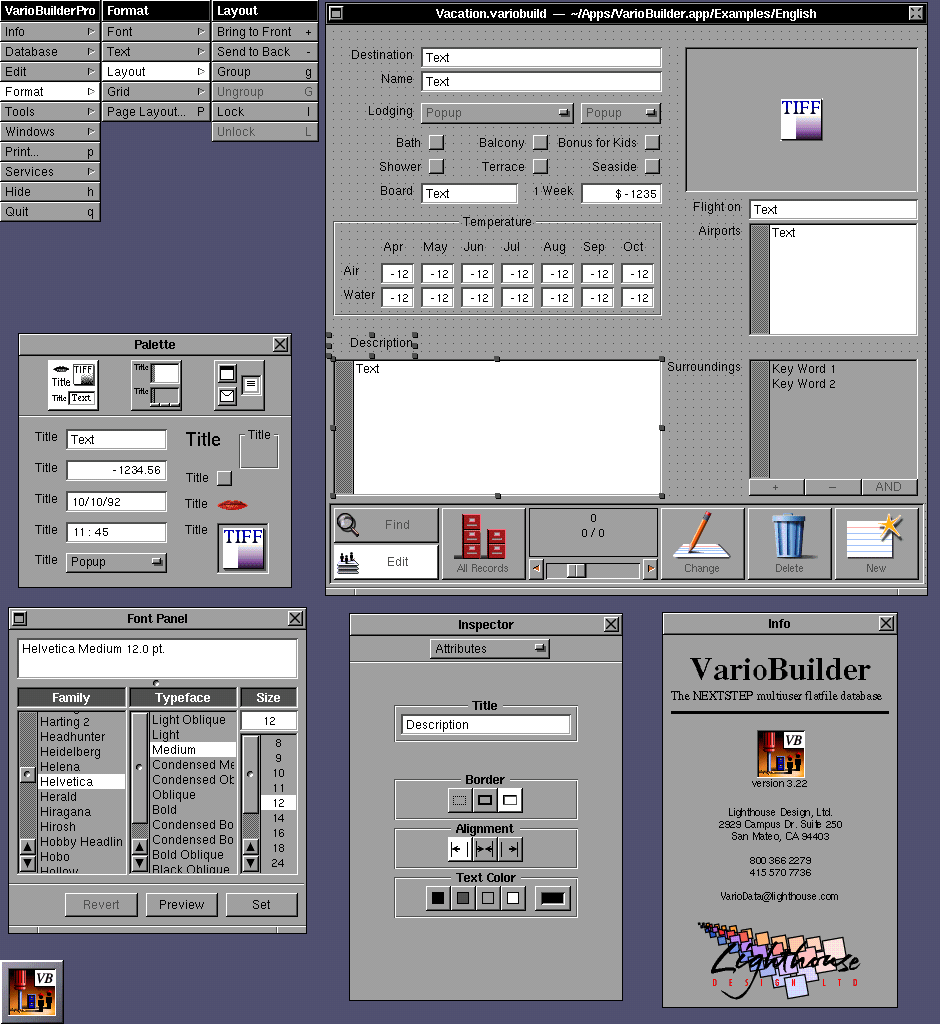
I should also add that it will be *really* great if more people sign the petition to ask Sun to release the LighHouse Design applications ! the petition is here : http://www.petitiononline.com/laafs/petition.html Sun doesn't use thoses software at all, yet some are really great (for example, Quantrix, a multidimensionnal spreadshit, or VarioBuilder, a tool to create small database-based applications like MSAccess).
If Sun choose to release some of theses apps, it would be possible to port them on GNUstep and MacOSX !
So please, sign the petition ! -
Re:Missed the best
I should also add that it will be *really* great if more people sign the petition to ask Sun to release the LighHouse Design applications ! the petition is here : http://www.petitiononline.com/laafs/petition.html Sun doesn't use thoses software at all, yet some are really great (for example, Quantrix, a multidimensionnal spreadshit, or VarioBuilder, a tool to create small database-based applications like MSAccess).
If Sun choose to release some of theses apps, it would be possible to port them on GNUstep and MacOSX !
So please, sign the petition ! -
Re:New "UNIX" Map idea...
The author briefly explains the semantics of the arrows here.
-
New "UNIX" Map idea...
Remembering that really awesome UNIX history map that Eric Levenez has, we could do a new map, the SCO Lawsuit Map.
It would start out at the beginning with the conclusion and subsequent sealing of records from Novell's days of UNIX and their court case. We could then move on, with the slow beginning to the conversion of Caldera Inc into SCOX, and discuss the posturing between SCO and IBM, moving on to SCO's lawsuit against IBM, SCO's unenforceable "deadline", their personal attacks against the likes of Linus Torvalds, discussions on their failure to provide code examples repeatedly, and the like. We can then get into their license extortion, the additional lawsuits, the countersuits, and the like.
I'd offer to do it, but I don't have powerful enough software to create such a map, according to SCO's claims on my OS... -
New "UNIX" Map idea...
Remembering that really awesome UNIX history map that Eric Levenez has, we could do a new map, the SCO Lawsuit Map.
It would start out at the beginning with the conclusion and subsequent sealing of records from Novell's days of UNIX and their court case. We could then move on, with the slow beginning to the conversion of Caldera Inc into SCOX, and discuss the posturing between SCO and IBM, moving on to SCO's lawsuit against IBM, SCO's unenforceable "deadline", their personal attacks against the likes of Linus Torvalds, discussions on their failure to provide code examples repeatedly, and the like. We can then get into their license extortion, the additional lawsuits, the countersuits, and the like.
I'd offer to do it, but I don't have powerful enough software to create such a map, according to SCO's claims on my OS...