Slashdot Mirror
Domain: llnl.gov
Stories and comments across the archive that link to llnl.gov.
Stories · 62
-
Heavier Rainfall Will Increase Water Pollution In the Future (nationalgeographic.com)
An anonymous reader shares a report from National Geographic: If climate change continues to progress, increased precipitation could mean detrimental outcomes for water quality in the United States, a major new study warns. An intensifying water cycle can substantially overload waterways with excess nitrogen runoff -- which could near 20 percent by 2100 -- and increase the likelihood of events that severely impair water quality, according to a new study published by Science. When rainfall washes nitrogen and phosphorus from human activities like agriculture and fossil fuel combustion into rivers and lakes, those waterways are overloaded with nutrients, and a phenomenon called "eutrophication" occurs. This can be dangerous for both people and animals. Toxic algal blooms can develop, as well as harmful low-oxygen dead zones known as hypoxia, which can cause negative impacts on human health, aquatic ecosystems, and the economy. In the new study, researchers predict how climate change might increase eutrophication and threats to water resources by using projections from 21 different climate models, each of which was run for three climate scenarios and two different time periods (near future, 2031-2060, and far-future, 2071-2100). -
Physicist Declassifies Rescued Nuclear Test Films (llnl.gov)
Eloking quotes a report from Lawrence Livermore National Laboratory: The U.S. conducted 210 atmospheric nuclear tests between 1945 and 1962, with multiple cameras capturing each event at around 2,400 frames per second. But in the decades since, around 10,000 of these films sat idle, scattered across the country in high-security vaults. Not only were they gathering dust, the film material itself was slowly decomposing, bringing the data they contained to the brink of being lost forever. For the past five years, Lawrence Livermore National Laboratory (LLNL) weapon physicist Greg Spriggs and a crack team of film experts, archivists and software developers have been on a mission to hunt down, scan, reanalyze and declassify these decomposing films. The goals are to preserve the films' content before it's lost forever, and provide better data to the post-testing-era scientists who use computer codes to help certify that the aging U.S. nuclear deterrent remains safe, secure and effective. To date, the team has located around 6,500 of the estimated 10,000 films created during atmospheric testing. Around 4,200 films have been scanned, 400 to 500 have been reanalyzed and around 750 have been declassified. An initial set of these declassified films -- tests conducted by LLNL -- were published today in an LLNL YouTube playlist. -
World's Most Powerful Laser Diode Arrays Deployed
Zothecula writes: The High-Repetition-Rate Advanced Petawatt Laser System (HAPLS) under construction in the Czech Republic is designed to generate a peak power of more than 1 petawatt. The key component to this instrument – the laser "pump" – will be a set of solid-state laser diode arrays recently constructed by Lawrence Livermore National Laboratory. At peak power, this electronic assemblage develops a staggering 3.2 million watts of power and are the most powerful laser diode arrays ever built. -
Nuclear Weapons Create Their Own Security Codes With Radiation
Zothecula writes "Nuclear weapons are a paradox. No one in their right mind wants to use one, but if they're to act as a deterrent, they need to be accessible. The trick is to make sure that access is only available to those with the proper authority. To prevent a real life General Jack D Ripper from starting World War III, Livermore National Laboratory's (LLNL) Defense Technologies Division is developing a system that uses a nuclear weapon's own radiation to protect itself from tampering. -
Cometary Impacts May Have Provided Key Elements of Life
trendspotter writes with news of research indicating that impact events might be responsible for seeding the Earth with reactive forms of the precursors to amino acids. From the article: "Early Earth was not very hospitable when it came to jump starting life. In fact, new research shows that life on Earth may have come from out of this world. Lawrence Livermore scientist Nir Goldman and University of Ontario Institute of Technology colleague Isaac Tamblyn (a former LLNL postdoc) found that icy comets that crashed into Earth millions of years ago could have produced life building organic compounds, including the building blocks of proteins and nucleobases pairs of DNA and RNA. Comets contain a variety of simple molecules, such as water, ammonia, methanol and carbon dioxide, and an impact event with a planetary surface would provide an abundant supply of energy to drive chemical reactions." The paper (PDF). -
LLNL/RPI Supercomputer Smashes Simulation Speed Record
Lank writes "A team of computer scientists from Lawrence Livermore National Laboratory and Rensselaer Polytechnic Institute have managed to coordinate nearly 2 million cores to achieve a blistering 504 billion events per second, over 40 times faster than the previous record. This result was achieved on Sequoia, a 120-rack IBM Blue Gene/Q normally used to run classified nuclear simulations. Note: I am a co-author of the coming paper to appear in PADS 2013." -
Laser Fusion Put On a Slow Burn By US Government
gbrumfiel writes "Those hoping to laser their way out of the energy crisis will have to wait a little longer. The U.S. government has unveiled its new plan for laser fusion, and it's not going to happen anytime soon. It all comes down to problems at the National Ignition Facility (NIF), the world's most powerful laser at Lawrence Livermore Lab in California. For the past six years researchers at NIF have been trying to use the laser to spark a fusion reaction in a tiny pellet of hydrogen fuel. Like all fusion, it's tougher than it looks, and their campaign came up short. That left Congress a little bit miffed, so they asked for a new plan. The new plan calls for a more methodical study of fusion, along with a broader approach to achieving it with the NIF. In three years or so, they should know whether the NIF will ever work." -
Is It Time For the US Government To Back Fusion At NIF Over ITER?
ananyo writes "Laser beams at the National Ignition Facility have fired a record 1.875 megajoule shot into its target chamber, surpassing their design specification. The achievement is a milepost on the way to ignition — the 'break-even' point at which the facility will finally be able to release more energy than goes into the laser shot by imploding a target pellet of hydrogen isotopes. NIF's managers think the end of their two-year campaign for break-even energy is in sight and say they should achieve ignition before the end of 2012. However, with scientists at NIF saying that a $4 billion pilot plant could be putting hundreds of megawatts into the grid by the early 2020s, some question whether the Department of Energy is backing the wrong horse with ITER — a $21-billion international fusion experiment under construction at St-Paul-lez-Durance, France. Is it time for the DoE to switch priorities and back NIF's proposals?" Perhaps a better idea, given the potential benefits of fusion research, would be for the DoE to throw their weight behind multiple projects, rather than sacrificing some to support others. -
UK Joins Laser Nuclear Fusion Project
arisvega writes with this quote from the BBC: "The UK company AWE and the Rutherford Appleton Laboratory have now joined with [the National Ignition Facility in the U.S.] to help make laser fusion a viable commercial energy source. ... Part of the problem has been that the technical ability to reach 'breakeven' — the point at which more energy is produced than is consumed — has always seemed distant. Detractors of the idea have asserted that 'fusion energy is 50 years away, no matter what year you ask,' said David Willetts, the UK's science minister. 'I think that what's going on both in the UK and in the US shows that we are now making significant progress on this technology,' he said. 'It can't any longer be dismissed as something on the far distant horizon.'" -
ITER Fusion Reactor Enters Existential Crisis
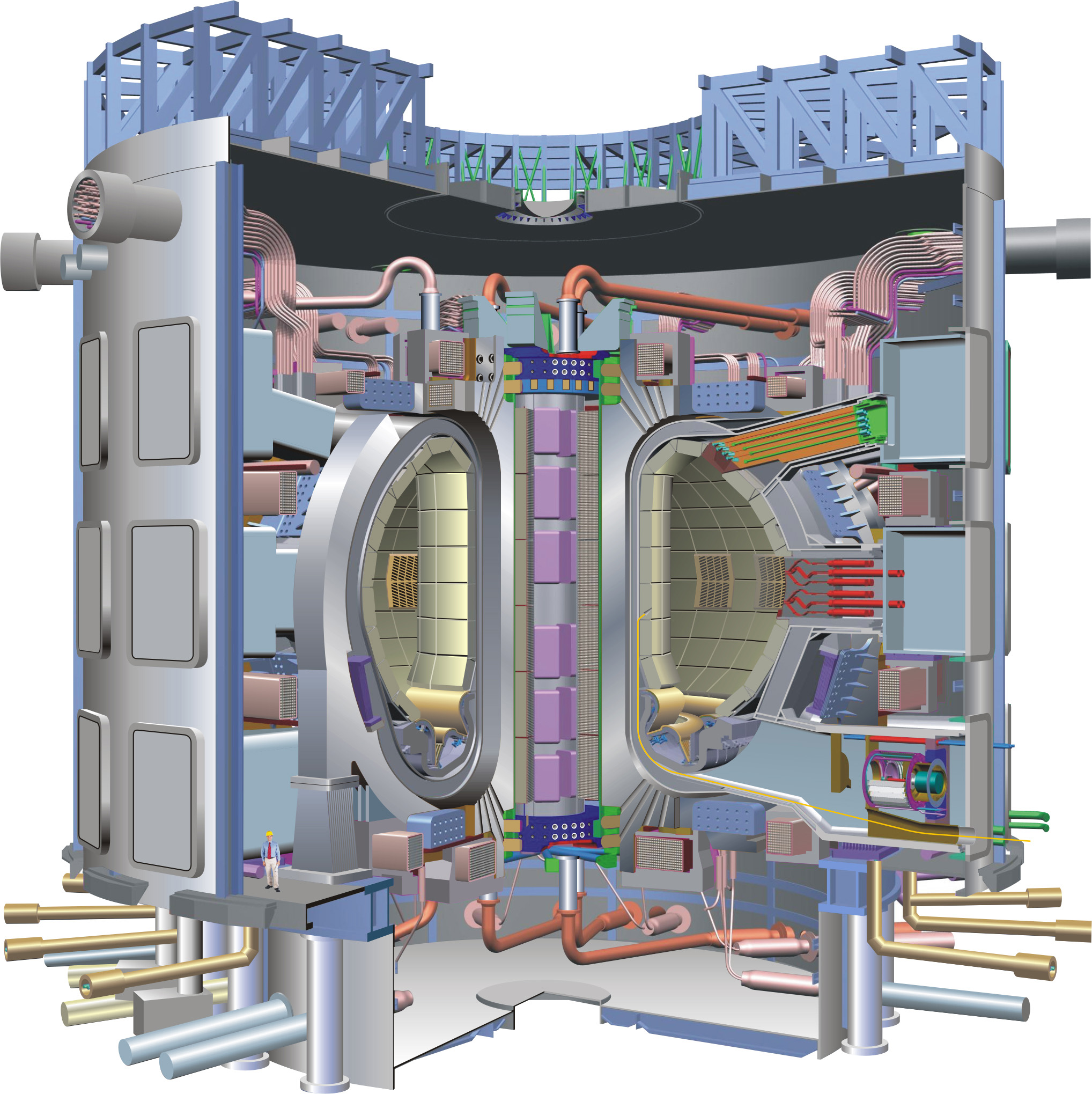
deglr6328 writes "The long beleaguered experimental magnetic confinement fusion reactor ITER is currently in what some are calling the worst crisis of its 25 year history. Still existing only on the paper of thousands of proposed design documents, the latest cost estimates for the superconducting behemoth are soaring to nearly 20 billion USD — roughly twice the estimates from as recently as a few years ago. Anti-nuclear environmentalist organizations have seized upon the moment as an opportunity to use the current global economic crisis as a means to push for permanently killing the project. If ITER is not built, the prospect of magnetic confinement fusion as a technique to reach thermonuclear breakeven and ignition in the laboratory would be in serious question. Meanwhile, the largest laser-driven inertial confinement fusion project, the National Ignition Facility, has demonstrated the ability to use self-generated plasma optical gratings to control capsule implosion symmetry with high finesse, and is on schedule to achieve ignition and potentially high gain before the end of the year." -
ITER Fusion Reactor Enters Existential Crisis
deglr6328 writes "The long beleaguered experimental magnetic confinement fusion reactor ITER is currently in what some are calling the worst crisis of its 25 year history. Still existing only on the paper of thousands of proposed design documents, the latest cost estimates for the superconducting behemoth are soaring to nearly 20 billion USD — roughly twice the estimates from as recently as a few years ago. Anti-nuclear environmentalist organizations have seized upon the moment as an opportunity to use the current global economic crisis as a means to push for permanently killing the project. If ITER is not built, the prospect of magnetic confinement fusion as a technique to reach thermonuclear breakeven and ignition in the laboratory would be in serious question. Meanwhile, the largest laser-driven inertial confinement fusion project, the National Ignition Facility, has demonstrated the ability to use self-generated plasma optical gratings to control capsule implosion symmetry with high finesse, and is on schedule to achieve ignition and potentially high gain before the end of the year." -
NIF Aims For the Ultimate Green Energy Source
theodp writes "Edward Moses and his team of 500 scientists and engineers at Lawrence Livermore's National Ignition Facility are betting $3.5B in taxpayer money on a tiny pellet they hope could produce an endless supply of safe, clean energy. By the fall of 2010, the team aims to start blasting capsules containing deuterium-tritium fuel with 1.4 megajoules of laser power, a first step towards the holy grail of controlled nuclear fusion. Not all are convinced that Moses will lead us to the promised land. 'They're snake-oil salesmen,' says Thomas Cochran, a scientist with the Natural Resources Defense Council. Moses, for his part, seems unfazed by the skepticism, saying he's confident that his team will succeed." -
National Ignition Facility Fires 192-Beam Pulse
An anonymous reader writes "The construction and test firing of the National Ignition Facility have been completed. NIF was designed as the first facility ever to achieve self-sustaining nuclear fusion and, in particular, to reach the point of ignition in which more energy is generated from the reaction than went into creating it. While the recent 192-beam pulse only produced 80 kilojoules worth of energy, all signs point to NIF being able to reach an order of magnitude higher (PDF) than that in the coming year." -
National Ignition Facility Fires 192-Beam Pulse
An anonymous reader writes "The construction and test firing of the National Ignition Facility have been completed. NIF was designed as the first facility ever to achieve self-sustaining nuclear fusion and, in particular, to reach the point of ignition in which more energy is generated from the reaction than went into creating it. While the recent 192-beam pulse only produced 80 kilojoules worth of energy, all signs point to NIF being able to reach an order of magnitude higher (PDF) than that in the coming year." -
Anti-Matter Created By Laser At Livermore
zootropole alerts us to a press release issued today by Lawrence Livermore National Laboratory, announcing the production of 'billions of particles of anti-matter.' "Take a gold sample the size of the head of a push pin, shoot a laser through it, and suddenly more than 100 billion particles of anti-matter appear. The anti-matter, also known as positrons, shoots out of the target in a cone-shaped plasma 'jet.' This new ability to create a large number of positrons in a small laboratory opens the door to several fresh avenues of anti-matter research, including an understanding of the physics underlying various astrophysical phenomena such as black holes and gamma ray bursts." The press release doesn't characterize the laser used in this experiment, but it may have been this one. -
Anti-Matter Created By Laser At Livermore
zootropole alerts us to a press release issued today by Lawrence Livermore National Laboratory, announcing the production of 'billions of particles of anti-matter.' "Take a gold sample the size of the head of a push pin, shoot a laser through it, and suddenly more than 100 billion particles of anti-matter appear. The anti-matter, also known as positrons, shoots out of the target in a cone-shaped plasma 'jet.' This new ability to create a large number of positrons in a small laboratory opens the door to several fresh avenues of anti-matter research, including an understanding of the physics underlying various astrophysical phenomena such as black holes and gamma ray bursts." The press release doesn't characterize the laser used in this experiment, but it may have been this one. -
Cell-based "Roadrunner" Tops Elusive Petaflop Mark
prunedude writes "The NY times is reporting that an American military supercomputer, assembled from components originally designed for video game machines, is more than twice as fast as the previous fastest supercomputer, the I.B.M. BlueGene/L. To put the performance of the machine in perspective, Thomas P. D'Agostino, the administrator of the National Nuclear Security Administration, said that if all six billion people on earth used hand calculators and performed calculations 24 hours a day and seven days a week, it would take them 46 years to do what the Roadrunner can in one day." -
World's Newest, Most Powerful Laser Comes Online
deglr6328 writes "The OMEGA EP laser at the University of Rochester's Laboratory for Laser Energetics was dedicated today at the Robert L. Sproull Center for Ultra High Intensity Laser Research. The new laser, which has been in design since ~2002 will, at 1 kilojoule per 1 picosecond pulse, be the highest energy petawatt-scale laser ever created by far. For a fleeting fraction of a second, it will deliver a beam of infrared light at 1054 nm that is more powerful than the total energy consumption of all human activity on the planet, to a tiny spot the size of the head of a pin. Previous petawatt scale lasers such as the one created at Lawrence Livermore labs in the late '90s and (dismantled in 1999) were capable of only several hundred joules per pulse. The new OMEGA EP laser will be able to manifest power densities sufficient to examine Unruh and Hawking radiation-like phenomena in the laboratory and will have the capability to directly produce nuclear reactions through ultra high electric field initiated photodisintegration." -
67-Kilowatt Laser Unveiled
s31523 writes "Lawrence Livermore National Laboratory in California has announced they have working in the lab a Solid State Heat Capacity Laser that averages 67 kW. It is being developed for the military. The chief scientist Dr. Yamamoto is quoted: 'I know of no other solid state laser that has achieved 67 kW of average output power.' Although many lasers have peaked at higher capacities, getting the average sustained power to remain high is the tricky part. The article says that hitting the 100-kW level, at which point it would become interesting as a battlefield weapon, could be less than a year away." -
A 'salty' source of coherent light
Roland Piquepaille writes "Coherent light is produced by a beam of photons that all have the same frequency and are all at the same phase. And today lasers are the only form of technology that we know able to create such light. But by sending shock waves inside a humble crystalline material -- kitchen salt -- researchers from Lawrence Livermore National Laboratory (LLNL) have found a new way to produce coherent light for the first time in 50 years -- at least in the terahertz frequency range. This could lead to applications in optical communications, quantum computing or shock diagnostics. Read more for additional details and references about this discovery." -
Echoes from Ancient Supernovae Found?
Scientists at the Lawrence Livermore National Laboratory are claiming that they may have found echoes left over from ancient supernovae. From the article: "Just as a sound echo can occur when sound waves bounce off a distant surface and reflect back toward the listener, a light echo can be seen when light waves traveling through space are reflected back toward the viewer. The light echoes were discovered by comparing images of the Large Magellanic Cloud (LMC) taken years apart. By precisely subtracting the common elements in each image and analyzing what variable objects remain, the team looked for evidence of dark matter that might distort the light of stars in a transitory way, as part of a second-generation sky survey called SuperMACHO. SuperMACHO builds on the discoveries of the MACHO project, which started at Lawrence Livermore National Laboratory in 1989." -
Building the World's Most Powerful Laser
Bill writes "Lawrence Livermore National Laboratories is attempting to create the world's largest laser. The NIF's goal is to focus the laser on a pea-sized hydrogen pellet and result in fusion ignition." -
U.S. Plans to Tighten Nuclear Power Plant Security
CDMA_Demo writes "The 103 nuclear reactors running in USA can voluntarily agree to follow a new 15 page update to a 1996 regulatory guide. The update notes possibility of "unauthorized, undesirable, and unsafe intrusions", and recommends measures aginst such activities. It also recommends such facilities to be cut off from external networks: "Remote access...[that may pose a potential security risk]...should not be implemented". The Slammer worm in 2001 managed to bring down the network at Ohio's David-Besse nuclear plant and concerns kept growing at the United Nations' International Atomic Energy Agency (IAEA)." -
With Linux Clusters, Seeing Is Believing
Roland Piquepaille writes "As the recent release of the last Top500 list reminded us last month, the most powerful computers now are reaching speeds of dozens of teraflops. When these machines run a nuclear simulation or a global climate model for days or weeks, they produce datasets of tens of terabytes. How to visualize, analyze and understand such massive amounts of data? The answer is now obvious: using Linux clusters. In this very long article, "From Seeing to Understanding," Science & Technology Review looks at the technologies used at Lawrence Livermore National Laboratory (LLNL), which will host the IBM's BlueGene/L next year. Visualization will be handled by a 128- or 256-node Linux cluster. Each node contains two processors sharing one graphic card. Meanwhile, the EVEREST built by Oak Ridge National Laboratory (ORNL), has a 35 million pixels screen piloted by a 14-node dual Opteron cluster sending images to 27 projectors. Now that Linux superclusters have almost swallowed the high-end scientific computing market, they're building momentum in the high-end visualization one. The article linked above is 9-page long when printed and contains tons of information. This overview is more focusing on the hardware deployed at these two labs." -
Open Source SpeedShop Project Opened
drjzzz writes "Federal Computer Week reports that the National Nuclear Security Administration of the US Department of Energy is paying about $3 million of a $6.8 million collaboration between Silicon Graphics and the Universities of Maryland and Wisconsin to develop an open-source version of SpeedShop, SGI's performance analysis tools. This will redress what a SGI engineer characterizes as scarce analysis software for Linux. A "Pro" version will also be developed and sold by SGI. Maybe even those of us without access to ASCI White can tweak our boxen to do 3D simulations of complete nuclear detonations, NNSA's main interest. Now that's what I call homeland security and real respect for the spirit of the second amendment." -
National Ignition Facility is Firing Up
VernonNemitz writes "Over near San Francisco in California, USA, the Lawrence Livermore National Laboratory is starting to reach the end of 15 years of development work on the National Ignition Facility. The goal is to use 192 high-powered laser beams to blast a pellet of frozen hydrogen isotopes, turning it into a tiny (and thus safe) hydrogen bomb. Currently 4 of the lasers have been commissioned for use in tests; the eventual goal is to get more energy out of the exploding pellet than is dumped into it. Personally I think they'd have an easier time of it if they combined different ideas, but what do I know?" -
National Ignition Facility is Firing Up
VernonNemitz writes "Over near San Francisco in California, USA, the Lawrence Livermore National Laboratory is starting to reach the end of 15 years of development work on the National Ignition Facility. The goal is to use 192 high-powered laser beams to blast a pellet of frozen hydrogen isotopes, turning it into a tiny (and thus safe) hydrogen bomb. Currently 4 of the lasers have been commissioned for use in tests; the eventual goal is to get more energy out of the exploding pellet than is dumped into it. Personally I think they'd have an easier time of it if they combined different ideas, but what do I know?" -
National Ignition Facility is Firing Up
VernonNemitz writes "Over near San Francisco in California, USA, the Lawrence Livermore National Laboratory is starting to reach the end of 15 years of development work on the National Ignition Facility. The goal is to use 192 high-powered laser beams to blast a pellet of frozen hydrogen isotopes, turning it into a tiny (and thus safe) hydrogen bomb. Currently 4 of the lasers have been commissioned for use in tests; the eventual goal is to get more energy out of the exploding pellet than is dumped into it. Personally I think they'd have an easier time of it if they combined different ideas, but what do I know?" -
National Ignition Facility is Firing Up
VernonNemitz writes "Over near San Francisco in California, USA, the Lawrence Livermore National Laboratory is starting to reach the end of 15 years of development work on the National Ignition Facility. The goal is to use 192 high-powered laser beams to blast a pellet of frozen hydrogen isotopes, turning it into a tiny (and thus safe) hydrogen bomb. Currently 4 of the lasers have been commissioned for use in tests; the eventual goal is to get more energy out of the exploding pellet than is dumped into it. Personally I think they'd have an easier time of it if they combined different ideas, but what do I know?" -
National Ignition Facility is Firing Up
VernonNemitz writes "Over near San Francisco in California, USA, the Lawrence Livermore National Laboratory is starting to reach the end of 15 years of development work on the National Ignition Facility. The goal is to use 192 high-powered laser beams to blast a pellet of frozen hydrogen isotopes, turning it into a tiny (and thus safe) hydrogen bomb. Currently 4 of the lasers have been commissioned for use in tests; the eventual goal is to get more energy out of the exploding pellet than is dumped into it. Personally I think they'd have an easier time of it if they combined different ideas, but what do I know?" -
National Ignition Facility is Firing Up
VernonNemitz writes "Over near San Francisco in California, USA, the Lawrence Livermore National Laboratory is starting to reach the end of 15 years of development work on the National Ignition Facility. The goal is to use 192 high-powered laser beams to blast a pellet of frozen hydrogen isotopes, turning it into a tiny (and thus safe) hydrogen bomb. Currently 4 of the lasers have been commissioned for use in tests; the eventual goal is to get more energy out of the exploding pellet than is dumped into it. Personally I think they'd have an easier time of it if they combined different ideas, but what do I know?" -
National Ignition Facility is Firing Up
VernonNemitz writes "Over near San Francisco in California, USA, the Lawrence Livermore National Laboratory is starting to reach the end of 15 years of development work on the National Ignition Facility. The goal is to use 192 high-powered laser beams to blast a pellet of frozen hydrogen isotopes, turning it into a tiny (and thus safe) hydrogen bomb. Currently 4 of the lasers have been commissioned for use in tests; the eventual goal is to get more energy out of the exploding pellet than is dumped into it. Personally I think they'd have an easier time of it if they combined different ideas, but what do I know?" -
National Ignition Facility is Firing Up
VernonNemitz writes "Over near San Francisco in California, USA, the Lawrence Livermore National Laboratory is starting to reach the end of 15 years of development work on the National Ignition Facility. The goal is to use 192 high-powered laser beams to blast a pellet of frozen hydrogen isotopes, turning it into a tiny (and thus safe) hydrogen bomb. Currently 4 of the lasers have been commissioned for use in tests; the eventual goal is to get more energy out of the exploding pellet than is dumped into it. Personally I think they'd have an easier time of it if they combined different ideas, but what do I know?" -
National Ignition Facility is Firing Up
VernonNemitz writes "Over near San Francisco in California, USA, the Lawrence Livermore National Laboratory is starting to reach the end of 15 years of development work on the National Ignition Facility. The goal is to use 192 high-powered laser beams to blast a pellet of frozen hydrogen isotopes, turning it into a tiny (and thus safe) hydrogen bomb. Currently 4 of the lasers have been commissioned for use in tests; the eventual goal is to get more energy out of the exploding pellet than is dumped into it. Personally I think they'd have an easier time of it if they combined different ideas, but what do I know?" -
Trained Rats for Mine Detection
rikomatic writes "The dangerous profession of anti-personnel mine detection is getting a surprising new tool: giant Gambian rats (NY Times reg). Some resourceful Belgians have figured out how to train these 30-inch rodents to hunt out landmines. They are cheaper and work harder than dogs and are more reliable than metal detectors. Plus, if one of them blows up, who's going to cry?" -
North America's Fastest Linux Cluster Constructed
SeanAhern writes "LinuxWorld reports that 'A Linux cluster deployed at Lawrence Livermore National Laboratory and codenamed 'Thunder' yesterday delivered 19.94 teraflops of sustained performance, making it the most powerful computer in North America - and the second fastest on Earth.'" Thunder sports 4,096 Itanium 2 processors in 1,024 nodes, some big iron by any standard. -
North America's Fastest Linux Cluster Constructed
SeanAhern writes "LinuxWorld reports that 'A Linux cluster deployed at Lawrence Livermore National Laboratory and codenamed 'Thunder' yesterday delivered 19.94 teraflops of sustained performance, making it the most powerful computer in North America - and the second fastest on Earth.'" Thunder sports 4,096 Itanium 2 processors in 1,024 nodes, some big iron by any standard. -
The Future of Flight
Roland Piquepaille writes "With "High Times," the Economist delivers a very long and extremely well-documented article about the future of aviation during the next fifty years. It tells us about pilotless planes, with 32 countries currently developing more than 250 models of unmanned aerial vehicles (UAV), primarily for combat purposes. The article also looks at future civilian pilotless planes and at the future of personal aviation. But what captivated my attention in this article was the last part about future commercial supersonic and hypersonic (at least five times the speed of sound) planes. In particular, the Economist describes the HyperSoar. "The HyperSoar is a concept for a craft flying at ten times the speed of sound and able to reach any point on the globe within two hours." This overview contains more details and references about the HyperSoar which would fly from Los Angeles to New York in 35 minutes." -
High Performance Diskless Linux At AX-Div, LLNL
Lee Busby writes "As a co-author, I am biased, but I think that our recent paper describing a diskless Linux deployment at Lawrence Livermore National Lab (PDF)may be of general interest. It's a little different than most diskless systems -- simpler, and designed to be high performance." -
Warfare at the Speed of Light
unassimilatible writes "From the They Said It Couldn't Be Done Dept., the Oakland Tribune reports that the Lawrence Livermore Labratory is ensuring that the Pentagon, inside of a decade, could be armed with a beam weapon that is near-instantaneous, gravity-free and truly surgical, focusing to such hair-splitting accuracy that it could avoid civilians while predetonating munitions miles away - perhaps someday even being mounted on Humvees." -
Protein Researchers Win Nobel Prize In Chemistry
nucal writes "The 2003 Nobel Prize in Chemistry was awarded to Rod MacKinnon and Peter Agree for their work on proteins that form ion and water channels in cell membranes. In particular, solving the structure of potassium channels was a major achievement, since this was the first multispan transmembrane protein structure to be solved by X-ray crystallography. There is also structural information on aquaporins (water channels) as well." -
Building a Better Bomb
dr who and the darlix writes "There is a nice article here about carbon composite warheads being tested. They destroy their targets while minimizing collateral damage." -
Linux Clusters Finally Break the TeraFLOP barrier
cworley submitted - several times - this well-linked submission about a slightly boring topic - fast computers. "Top500.org has just released its latest list of the world's fastest supercomputers (updated twice yearly). For the first time, Linux Beowulf clusters have joined the teraFLOP club, with six new clusters breaking the teraFLOP barrier. Two Linux clusters now rank in the Top 10: Lawrence Livermore's "MCR" (built by Linux NetworX ) ranks #5 achieving 5.694 teraFLOP/s, and Forecast Systems Laboratory's "Jet" (built by HPTi) ranks #8 reaching 3.337 TeraFLOP/s. Other Linux clusters surpassing the teraFLOP/s barrier include: LSU's "SuperMike" at #17 (from Atipa ), the University at Buffalo at #22 and Sandia National Lab at #32 (both from Dell ), an Itanium cluster for British Petroleum Houston at #42 (from HP ), and Argonne National Labs at #46 (from Linux NetworX ) reached just over the one teraFLOP/s mark with 361 processors. In the previous Top500 list compiled last June, the fastest Intel based Netfinity 1024 processor clusters from IBM were sub-teraFLOP/s and the University of Heidelberg's AMD based "HELICS" cluster (built by Megware ) held the top tux rank at #35 with 825 GFLOP/s." -
Slashback: Livermore, Privacy, Nixieness
Slashback's amplifications and updates tonight include more on Best Buy's worst practices for data security, how the proposed Federal government restructuring will affect Lawrence Livermore labs,a long-overdue Maglev for those of us outside France or Japan, and even more on building Nixie-tube toys. Read on for the details.Fancy titles attract bigger budgets. SeanAhern writes: "Following up on last week's Slashdot article about LLNL's role in the new Department of Homeland Security, it turns out that LLNL will not change its role or change hands. Instead, LLNL may become a 'center for excellence,' essentially taking on a research role for the new Department. More information can be found in a couple of articles around the press."
Why not just shout it cashier-to-cashier? jqcoffey writes: "A while ago it was discovered that Best Buy was using wireless LANs to transmit cash register data back to accounting servers. The problem was it was UN-encrypted data. They turned them off for a while and now, according to this Computerworld story, they are back on."
Maglev for the Maglevians! LighthouseJ writes: "The Hampton Roads Virginia paper, the Pilot recently reported that my current school, Old Dominion University, recently installed the very first maglev train in the United States on the elevated track already built the previous school year. This train won't go that fast (40 mph) compared to the bullet trains that travel at 300 mph, but at the same token, it won't be traveling that far. The service has been scheduled to start September 1st.
There is some information I have about the maglev that's not mentioned. First, the school is in a rectangle, with the maglev built in the center length-wise. It connects the main campus with the new construction happening across the major road, Hampton Rd and has 3 stations planned now with more to come as the track may extend in the future. They are building more housing, education and meeting places, and the maglev will facilitate safe transportation across that road for students and faculty."
Can this really be the first Mag-lev train in the U.S.? A nifty project regardless.
When a Rolex just isn't good enough. fixitsan2 writes: "I know this thread has been gone over before, when it appeared at the start of February, but ironically, about the same time as the thread ended a group was started on Yahoo!. Not only was it a fast-growing newsgroup, but the technical standard is extremely high. Covering all aspects of building nixie tube clocks as well as other nixie devices including safe power generation, and all display methods from direct drive to multiplexing, as well as lots of circuits and tube sources.
A quick look at the welcome page will give you a fuller idea of what gets discussed."
-
Lawrence Livermore Lab On The Chopping Block?
guttentag writes "According to the San Francisco Chronicle, Bush's Homeland Security plan calls for transferring $1.2 billion of Lawrence Livermore National Laboratory's $1.5 billion budget to a new Department of Homeland Security under Tom Ridge. However, the plan transfers only 4 percent of the lab's employees. Ridge's explanation of the numbers: "I cannot give you the kind of explanation you need to deal with that imbalance." LLNL funded and houses the ASCI White supercomputer, among other cool projects." While Livermore has an impressive research record, we would miss most the laser lab from Tron. -
Lawrence Livermore Lab On The Chopping Block?
guttentag writes "According to the San Francisco Chronicle, Bush's Homeland Security plan calls for transferring $1.2 billion of Lawrence Livermore National Laboratory's $1.5 billion budget to a new Department of Homeland Security under Tom Ridge. However, the plan transfers only 4 percent of the lab's employees. Ridge's explanation of the numbers: "I cannot give you the kind of explanation you need to deal with that imbalance." LLNL funded and houses the ASCI White supercomputer, among other cool projects." While Livermore has an impressive research record, we would miss most the laser lab from Tron. -
Lawrence Livermore Lab On The Chopping Block?
guttentag writes "According to the San Francisco Chronicle, Bush's Homeland Security plan calls for transferring $1.2 billion of Lawrence Livermore National Laboratory's $1.5 billion budget to a new Department of Homeland Security under Tom Ridge. However, the plan transfers only 4 percent of the lab's employees. Ridge's explanation of the numbers: "I cannot give you the kind of explanation you need to deal with that imbalance." LLNL funded and houses the ASCI White supercomputer, among other cool projects." While Livermore has an impressive research record, we would miss most the laser lab from Tron. -
A Supercomputing Cluster For FPS Gaming
Paul E writes: " An atlanta company seems to have developed (modified?) a linux clustering platform that is very conducive to FPS games. These guys apparently have built a cluster that will be pushing 2 TerraFlops, which would easily put it between Blue Pacific and Blue Mountain . Interesting that the same time the .mil starts making FPS's, FPS platforms are outperforming some of the top defense labs." -
Nitrogen Fullerenes - Powerful Chemistry
wildsurf writes "A post in sci.energy points to recent confirmation of the stable existence of N60 , through supercomputer simulation. Large-scale synthesis of this material could form the basis for tremendously powerful rocket fuel. Here is an in-depth article on the subject. What would you do with a few million liters of this stuff?" -
ASCI White Detonates The First E-Bomb
totallygeek writes "Redefining the term vaporware, research scientists at Lost Alamos and Lawrence Livermore Labs detonated two computer simulations. ASCI White, the world's fastest supercomputer, ran the simulations of nuclear explosions. Scientists can now study nuclear weapon replacement components without violating the nuclear test ban, in effect since 1992. Each simulation used more than 6.6 million CPU hours, which would take home machines 1000 years to complete. The data for each experiment was equivalent to 35 times the information available in the Library of Congress. ASCI White currently operates at 12 teraflops, but by early next year, Los Alamos expects to operate at 30 teraflops. The seven month research project ended last Friday, and now the system is ready for use, after its sucessful testing."