Slashdot Mirror
Domain: msdn.com
Stories and comments across the archive that link to msdn.com.
Comments · 3,271
-
Re:Ok, well, it's a different architecture
so are they doing x86 emulation?
The traditional "WoW" 32-bit x86 on 64-bit x86 engine (which has existed since 64 bit Windows has) is augmented with a x86->arm transcompilation system. (There's also some advanced stuff where various windows-standard user-mode DLLs are (specially) compiled to have the same struct layout in 32-bit x86 and ARM, so the x86 implementation becomes 'thunk to ARM code.)
Video of it all in action (on real hardware). x86 32 bit code will run.
-
Re:Hmm I don't know...
This is basically the same thing.
Except Windows 10 on ARM has x86 Win32 compatibility. That's a huge difference.
-
How practical is "Let 'em drink Wine"?
Native apps work
Only on one operating system. Good luck (legally) running a native app distributed as a
Nope. Windows runs Linux binaries. FreeBSD runs Linux binaries. Linux, BSD, and macOS run Windows binaries. Windows 10 on ARM runs x86 Win32 binaries.
Then what else runs macOS binaries? I thought this was clear from "distributed as a
So until a particular developer can scrape together the budget to produce multi-platform releases, is the solution to test in Windows and in Wine on either FreeBSD or GNU/Linux, distribute Windows binaries, and expect users of GNU/Linux, FreeBSD, and macOS to use Wine? If so, this strategy still misses mobile.
And that's not even mentioning of cross platform native applications. I use the same web browser and email client on all three operating systems I regularly use.
That's because the Chrome and Firefox web browsers and the Thunderbird mail client have enough of a budget for multi-platform development and testing. A hobbyist or startup may not have enough financial resources to launch simultaneously on all native platforms. "Just use Qt" isn't enough; a developer still has to buy the appropriate hardware (namely a Mac with enough RAM to run the other operating systems in VMs) and spend labor on testing on all supported operating systems.
-
Re:Native apps are also OS-specific.
Native apps are also OS-specific. Only on one operating system.
Nope. Windows runs Linux binaries. FreeBSD runs Linux binaries. Linux, BSD, and macOS run Windows binaries. Windows 10 on ARM runs x86 Win32 binaries.
And that's not even mentioning of cross platform native applications. I use the same web browser and email client on all three operating systems I regularly use.
How are native applications only on one operating system again?
-
Re:The Big Question Is...
Run a test yourself as I pointed out and see the results live.
Your test is flawed. Windows 10 on ARM's x86 emulation doesn't work that way. Microsoft has a Channel 9 video discussing the emulation system.
-
Re:Desktop Windows has more users than X11/Linux
The article was not written by Microsoft. And Microsoft has made it ubuntantly clear (couldn't help myself) that they are providing a native Ubuntu image that runs on top of the Windows Subsystem for Linux.
A Canonical representative was present at the announcement and said the following:
it's the exact same root filesystem, the same root tarball, identical--bit for bit, checksum for checksum--as Ubuntu in Azure, or any other public cloud, on a bear metal machine or virtual machine if you install Ubuntu, or if you are running Ubuntu in a Docker container or LXD container or any other container
It's identical to what you would download off Canonical's site except:
- WSL translates user mode system calls to the NT kernel instead of using a real Linux kernel
- requisite init tweaks from the default (since it isn't actually booting the machine) -
The "Click Next Admin" is next
I'm seeing this automation trend as well in IT. Cloud and software-defined everything is messing with the clear line between software development and systems administration. Unless it turns out to be just hype, and companies decide to keep their equipment onsite (not likely,) only a chunk of systems people will survive the next wave of automation. "DevOps" may be poorly defined now and the stuff of ironic-moustache, skinny jeans wearing SV startup hipsters, but it's definitely more mainstream now than it was just a couple years ago. It'll take companies ages to fully move to it, but I do feel it's coming. I just got involved in a project being deployed in Azure, and it really is a different world compared to the single-server-per-application universe. You can build an entire solution out, IaaS and PaaS, with a script. Systems guys who will make it to the next level need to be able to be the ones designing these things, and able to troubleshoot the software defined mess when it goes awry.
Jeffrey Snover (the guy who invented PowerShell) gave a talk about the "click next admin" who isn't going to make it to the next era of IT. I still know people who do Windows system administration who don't automate anything because they can't or don't want to learn how. As big companies either deploy their own private cloud stuff or go to public clouds like AWS or Azure for everything, the skills IT guys have learned over 20 years aren't going to cut it except in a very few small niches. Yes, nothing has changed under the hood, but the fact that it's abstracted away and you're no longer hand-feeding the servers configs, etc. means that a lot of people who have lots of knowledge on that front are going to either need to retrain or find something else to do. And with the rest of the workforce being automated as well, that "something else" is in serious doubt.
-
Free ebook from Microft
I've found value on the material from MS Virtual Academy for System Center, SQL, Windows Server, and Windows Client: http://blogs.msdn.com/b/micros...
-
Windows 10: The Missing ManualBetween the Missing Manual and some books Microsoft has announced (but not yet published), might find more-or-less what you're looking for.
Missing Manual:
http://www.amazon.com/Windows-...
Microsoft Books:
-
Kernel-mode code signing in Windows
Perhaps a different approach might be for someone to take the Linux code and create a decent open-source Windows driver
"Open-source Windows driver" is a contradiction in terms.
Since Windows Vista 64-bit, Microsoft has placed a policy in Windows to require device drivers to be digitally signed with a kernel-mode code signing certificate from a commercial certificate authority. As of Windows 10, Microsoft has tightened this policy to require disclosure of the binary code of all drivers to Microsoft, and new drivers submitted since November 2015 must be signed with an Extended Validation (EV) certificate. An EV certificate is substantially more expensive than an ordinary code signing certificate (hundreds of USD per year according to digicert.com), and only an organization, not an individual developer, appears to qualify. It appears that Microsoft really wants the hardware manufacturer, not a third-party developer, to make and publish drivers.
-
Kernel-mode code signing in Windows
Perhaps a different approach might be for someone to take the Linux code and create a decent open-source Windows driver
"Open-source Windows driver" is a contradiction in terms.
Since Windows Vista 64-bit, Microsoft has placed a policy in Windows to require device drivers to be digitally signed with a kernel-mode code signing certificate from a commercial certificate authority. As of Windows 10, Microsoft has tightened this policy to require disclosure of the binary code of all drivers to Microsoft, and new drivers submitted since November 2015 must be signed with an Extended Validation (EV) certificate. An EV certificate is substantially more expensive than an ordinary code signing certificate (hundreds of USD per year according to digicert.com), and only an organization, not an individual developer, appears to qualify. It appears that Microsoft really wants the hardware manufacturer, not a third-party developer, to make and publish drivers.
-
Re:Article paid by Apple to boo over it.
Umm...Why would I be Satya? If you read my post history, I'm a pretty big critic of Windows Phone. It's biggest problem is that it's just not relevant...to anybody...And that starts with its UI. A few years back, somebody at Microsoft created this blog post:
http://blogs.msdn.com/b/thinku...
It's a well written post, with a few wonderful examples of why information overload is bad. Even with their UI talent knowing information overload is a real problem, they go and create a UI that looks like this:
http://in4mactiondotcom2.files...
Now look at Android's stock UI, which has these variations depending on OEM:
-
Windows 10 programming
I know that this is kind of politically incorrect to say in Slashdot, but Channel 9 has great series of tutorials in beginning programming UWP apps. Instead of tinkering with crusty old algorithms, that could be a fresh platform for the kid to get into the real-life business.
-
Re:Wondering how long
Which is an especially ironic comparison in light of e.g. this.
-
Re:Upgrade from 7 to 10 failed
I experienced [upgrade failure] on 2 different computers and it turned out to be that the reserved system partition was nearly full. I used a partition manager and increased the size a little and the upgrade ran just fine. Ref: http://blogs.msdn.com/b/buckh/...
-
Re:Not sure it matters, ultimately?
Sorry, what you are saying is not only wrong, its just down right paternalistic. Maybe people do know whats best for them and they don't need you and your ilk trying to push something on them.
I live in a mid-sized metropolitan area. I work a technical job that forces me to remote in sometimes.I play some PC based video games. I have the lowest internet speed offered and I would go lower if they would offer a good price break. Some of us care where our money goes and can make the choice between getting the game update in minutes or having to wait an hour before we get to waste our time on the game.
Remote Desktop - 1mbps should be plenty, you can get away with less
http://blogs.msdn.com/b/rds/ar...WoW -
http://citeseerx.ist.psu.edu/v... -
Re:It is obvious that support most be provided...
If MS put real effort into providing good security [...]
You're bitching about an OS with mandatory access controls, DEP, ASLR, virtualized filesystem access, application whitelists, secure boot, and that runs its own authentication daemon in a VM so that not even the kernel itself can directly manage password hashes. You're doing this bitching in an article about a tool they maintain so you can harden and sandbox third-party programs, even when those programs weren't built with stack smashing or ASLR or all those neat Visual Studio canaries in mind.
[...]it would destroy the lucrative market for anti-malware software.
They bundle anti-malware software with the OS. They're, clearly, very concerned about not destroying all that filthy McAfee lucre.
-
Re:Change the interface!
It only became intuitive because we got used to it.
The real story is quite different:
But one thing kept getting kicked up by usability tests: People booted up the computer and just sat there, unsure what to do next.
That's when we decided to label the System button "Start".
It says, "You dummy. Click here." And it sent our usability numbers through the roof, because all of a sudden, people knew what to click when they wanted to do something.
So why is "Shut down" on the Start menu?
When we asked people to shut down their computers, they clicked the Start button.The shut down option was put in the Start menu because that's where people looked for it. Source
-
Re:wouldn't hold my breath
The C++ community is already looking at Rust and trying to figure out how to compete with what it offers.
Like what?
Here is Stroustrup talking for over and hour and a half just three weeks ago about how to both narrow and enhance C++ to achieve, among other things, a degree of memory safety, pervasive ownership semantics (std::owner<>) and enabling the compiler do a better job of detecting faulty code. The parallels with Rust are impossible to miss.
It has been a long time since anything challenged the C/C++ paradigm. In that time a large number of non-"systems" languages have emerged, leaving the low-level stuff to C/C++, and a smaller number of systems languages (Objective C, D, etc.) have also emerged, but nothing so far has provided enough value to motivate broad adoption. I think Rust is a language that does bring sufficient value. I am certain it is inspiring people to use and advocate it, as evidenced by this story.
It's disappointing to see the sheer number of Rust haters emerging from among C/C++ programmers. You can pan around the comments in this story yourself and read an abundant supply of irrational, ignorant and petulant comments. If Rust disappeared tomorrow it wouldn't cause a ripple, yet it's hated like Java or SQL. Sad.
-
Re:DRM Thwarted by Printscreen
If ever there was a more stupid thing to try to put drm on...
-
Re:Key rules.
The notion that Windows 9x series was simply a windowing system built on top of MS-DOS is a widely-believed myth. Windows 95 was a true 32-bit OS with backwards compatibility for legacy 16-bit drivers and software, and introduced preemptive multi-tasking. It was only the 3.1 and earlier versions (I'm guessing that's what you meant when you said Windows 3.5 earlier) that provided coorperative (non-preemptive) multi-tasking only.
Summary from link follows. You can read more in detail if you want, as it's fairly interesting:
MS-DOS served two purposes in the Windows 9x series.
It served as the boot loader.
It acted as the 16-bit legacy device driver layer. -
Re:Bjarne should not be writing that
There is nothing wrong with C++ exceptions. There are many features in C++ that can make your code difficult to reason about, but this doesn't mean that these features are mistakes. It just means that you don't know the language well enough to safely and readably employ such features.
I can hear your objections now. "But Google bans the use of exceptions in their C++ codebases! Surely they must be a mistake!" This is the same company that brewed up its own language because one of their senior developers basically came out and said that Google's younger developers are too stupid to be trusted with C++.
He's probably right.
Face it. Most "C++ developers" don't actually know C++. They know bits and pieces of C++, and are mystified and spooked by the parts that they don't know, be it templates, exceptions, whatever.
For those of us that have actually bothered to learn the entire language and keep up to date on its development, "mistakes" like exceptions mean that I can write less code with less bugs in less time.
-
Re:Killer apps
Visual Studio for Linux (kind of): https://code.visualstudio.com/...
.NET is also supported on Linux, now. http://blogs.msdn.com/b/dotnet... -
Re: Sorry, but Apple still deserves most of the cr
Actually that isn't the purpose of hPrevInstance at all. It was designed so that you could run multiple copies or instances of the same program and the copies could share data with each other.
A few programs simply used the parameter to display an error if another copy was already running but that was not it's intended purpose and doing so generally indicates the developer was too lazy to test cases that required running multiple copies of the application.
More information about hPrevInstance can be found at The Old New Thing -
Re: 15?
Win95 "ran on" DOS the same way that your Linux machine runs on JavaScript. Just because you have a VM spun up running a compatibility layer for legacy programs doesn't mean your OS is based on what that VM emulates.
Put yourself on the right side of ignorance: read this
-
Re:15?
You certainly could boot DOS, but then you were using DOS, not Win95. Win95 was not "running on top of DOS" in the same way that 3.1 was.
As others have said, it had its own memory manager and disk access, which is pretty much what DOS did (in a crappier way). So, if you booted DOS, you weren't booting the lower levels of Win95, you were booting DOS 7.0: another operating system entirely which Win95 just happened to be very backward compatible with, boot-loaded from and was used for 16-bit driver access.
Some details:
http://blogs.msdn.com/b/oldnew... -
Re:Right
Just read the WP, it points out an ancient APIC compatibility hack that allows you to escalate from Ring 0 to Ring -1 (SMM). So in other words if you're already running at Ring 0 to start with, you can get into SMM. Sounds like an example of what Raymond Chen calls an "other side of the airtight hatchway" attack, you already have to have complete system privs in order to carry out a privileged attack.
-
Great cross-platform MS Office story
http://blogs.msdn.com/b/rick_s...
Read this years ago, and thought it was interesting at the time...I've saved the link for years. Really detailed story about finding a really complicated bug in MS Word way back in the day.
-
p3p works great!!P3P headers people!!!!
All you have to do is be on Internet Explorer, and trust that a website does what it says it will do in its cryptic http header that was generated by a discontinued, closed source IBM tool, what's the problem?
according to microsoft, only a few inconsequential websites like those losers at Facebook and Google use "technological trickery" to get around this very important abandoned web standard from 2002 that only Internet Explorer implements.
seriously the MSDN article I linked is hilarious, here is a gem:Unfortunately, a small number of websites (like YouTube and Facebook) circumvent P3P settings by sending a P3P statement that consists of only undefined tokens, like this one:
P3P: CP="This is not a P3P policy! See -
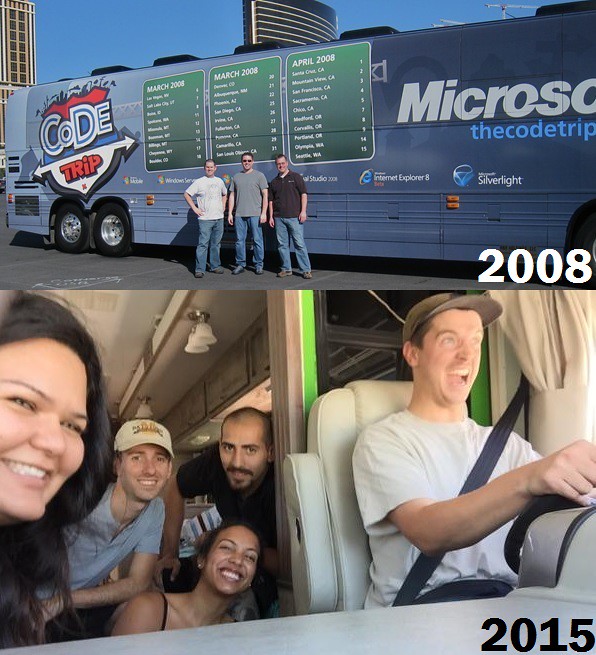
2015 'Code Trip' a Remake of 2008 'Code Trip'?
Coincidentally, Microsoft in 2008 launched its own Code Trip project, which it described as "a road trip, a bunch of developers cruising around in a tour bus and geeking out. It's also an online TV show (or video podcast, or vodcast, or whatever the kids call it nowadays) chronicling their adventures throughout the western United States." So, the Microsoft-funded, Roadtrip Nation-branded 2015 Code Trip PBS show looks like a remake of sorts of Microsoft's own 2008 Code Trip, albeit with a more diverse cast
-
Difficulty
Windows 3.1 was so complicated that even a Boeing propulsion scientist couldn't figure out how to open a word processor.
What a useless statement. An astrophysicist might have had a difficult time setting his VCR to record All My Children while he was away at work. Just because someone is an expert in one field doesn't make them all-knowing.
Raymond has also posted several articles about the history of the Explorer interface, including one about the origin of the Start Button and one about the taskbar.
-
Difficulty
Windows 3.1 was so complicated that even a Boeing propulsion scientist couldn't figure out how to open a word processor.
What a useless statement. An astrophysicist might have had a difficult time setting his VCR to record All My Children while he was away at work. Just because someone is an expert in one field doesn't make them all-knowing.
Raymond has also posted several articles about the history of the Explorer interface, including one about the origin of the Start Button and one about the taskbar.
-
Windows 10 is secured against hobbyist HW
Windows 10 is "secured" against use with hobbyist hardware. It requires new device drivers to not only be signed with an Authenticode certificate but more specifically to be signed with the more expensive EV certificate. (Source) The cost of obtaining an EV certificate and of setting up a corporation or LLC that qualifies for an EV certificate can make it cost-prohibitive for hardware hobbyists to produce low-volume peripherals that work with Windows 10.
-
Re:Hacked Computer with air gap not completely sec
You screwed it up yet again. Here you go
-
Re:Welcome to Windows 7
Welcome to Vista (Beta 2, http://blogs.msdn.com/b/michae... )
-
Re: ... and the hype for Windows 10 begins....
The name of that setting is outdated. It doesn't necessarily improve performance, it makes a tradeoff that was more optimal for really old computer architectures but actually less optimal for modern architectures. What it does is change the rendering from GPU-based and using GPU memory to CPU-based and preferring software recalculation.
You might want to read this: http://blogs.msdn.com/b/oldnew...
-
Re:Is it 64-bit yet?
Sounds like the answer is "64 bit is hard work and we'd rather do other things + it'd break our plugins". Same issue everyone else faced when porting to 64 bit. And apparently it's easier to port code to run on the
Secondly, from a cost perspective, probably the shortest path to porting Visual Studio to 64 bit is to port most of it to managed code incrementally and then port the rest. The cost of a full port of that much native code is going to be quite high and of course all known extensions would break and we’d basically have to create a 64 bit ecosystem pretty much like you do for drivers. Ouch.
But the
-
Re:C++11
If we look at the table from late last year, C++11 support seems quite well-rounded. If there's a bug, file a report.
-
Re:How sad
Apparently, you missed the news from a while ago about Microsoft releasing the CLR under a free software license. Check it out.
I've been a Slashdot reader since back when it was called Chips & Dips. Back then, Microsoft deserved the M$ appellation. Today, not so much. They're cooperating a lot more with the libre software community. Now, you can either shake your fist at them and scream how they'll never be forgiven for their sins... or you can smile, extend a hand, and welcome them to the party.
The world works better if more people choose the latter. And that applies to life in general, not just Microsoft.
-
Re:Good day
Ugh. Visual Studio 2015 requires Windows 8.1. No thanks.
* https://www.visualstudio.com/e...
Here is the list of bugs fixed in
* GCC 5.2 compiler issues
* MSVC 2015 compiler issuesAdditional MSVC 2015 bug fixes
* MSVC 2015 Features
* MSVC 2015 (C++11/14/17)
* MSVC 2015 STL part 1
* MSVC 2015 STL part 2 -
Re:Good day
Ugh. Visual Studio 2015 requires Windows 8.1. No thanks.
* https://www.visualstudio.com/e...
Here is the list of bugs fixed in
* GCC 5.2 compiler issues
* MSVC 2015 compiler issuesAdditional MSVC 2015 bug fixes
* MSVC 2015 Features
* MSVC 2015 (C++11/14/17)
* MSVC 2015 STL part 1
* MSVC 2015 STL part 2 -
Re:Good day
Ugh. Visual Studio 2015 requires Windows 8.1. No thanks.
* https://www.visualstudio.com/e...
Here is the list of bugs fixed in
* GCC 5.2 compiler issues
* MSVC 2015 compiler issuesAdditional MSVC 2015 bug fixes
* MSVC 2015 Features
* MSVC 2015 (C++11/14/17)
* MSVC 2015 STL part 1
* MSVC 2015 STL part 2 -
Re:Good day
Ugh. Visual Studio 2015 requires Windows 8.1. No thanks.
* https://www.visualstudio.com/e...
Here is the list of bugs fixed in
* GCC 5.2 compiler issues
* MSVC 2015 compiler issuesAdditional MSVC 2015 bug fixes
* MSVC 2015 Features
* MSVC 2015 (C++11/14/17)
* MSVC 2015 STL part 1
* MSVC 2015 STL part 2 -
Re:Good day
Ugh. Visual Studio 2015 requires Windows 8.1. No thanks.
* https://www.visualstudio.com/e...
Here is the list of bugs fixed in
* GCC 5.2 compiler issues
* MSVC 2015 compiler issuesAdditional MSVC 2015 bug fixes
* MSVC 2015 Features
* MSVC 2015 (C++11/14/17)
* MSVC 2015 STL part 1
* MSVC 2015 STL part 2 -
Re: OpenSSH on Windows
They've already announced they want to add SSH/SCP to Windows Server 10/2016.
Did they? All I saw was that PowerShell team will support and contribute to the OpenSSH community. They also said The team is in the early planning phase, and there're not exact days yet..
That is a lot of wiggle room there.
-
For Windows insights
-
Re:The five bullet points
No, it's not. In fact, they're still adding new features to the language (though largely in sync with C# now, and catching up in some cases).
-
Re:If there are patent issues
> Remember Windows Phone 7? The next big thing (tm) and they ditched it, for WP8, and all the devs were screwed. Again.
Yes just look at how screwed the were!
-
Re:SFLC's brief explains parts of this well
I don't think the distinction is necessarily unimportant just because it is fuzzy. But I don't feel all that strongly about it.
As for signed pointer arithmetic: a[i] isn't really a good example because i has to be positive. But I was wrong anyway - I was thinking about things like this but now that I look at it again, the language really does need to let you subtract pointers and get a negative answer - the real problem in that example is the silly implicit conversion from signed to unsigned.
-
Re:Vorbis defunct
Microsoft supports Opus in WebRTC. Opus is built from the combination of CELT codec from Xiph and SILK codec from Skype, which Microsoft now owns. So it'll be a shame if they don't support end up supporting Opus for at least HTML5 audio as well as WebRTC in Edge.