Slashdot Mirror
Domain: nasa.gov
Stories and comments across the archive that link to nasa.gov.
Comments · 16,365
-
Two weeks? You can get the data in ~8 days.
STEREO A and B are more than 70 degrees apart, so you'd only need to wait 8.25 days from when it leaves the sight of STEREO A 'til it's seen by STEREO B. In a few years, we'll have real-time view of the far side of the sun. (until they come back around near Earth again)
-
Re:Sunspots down... temperature down?
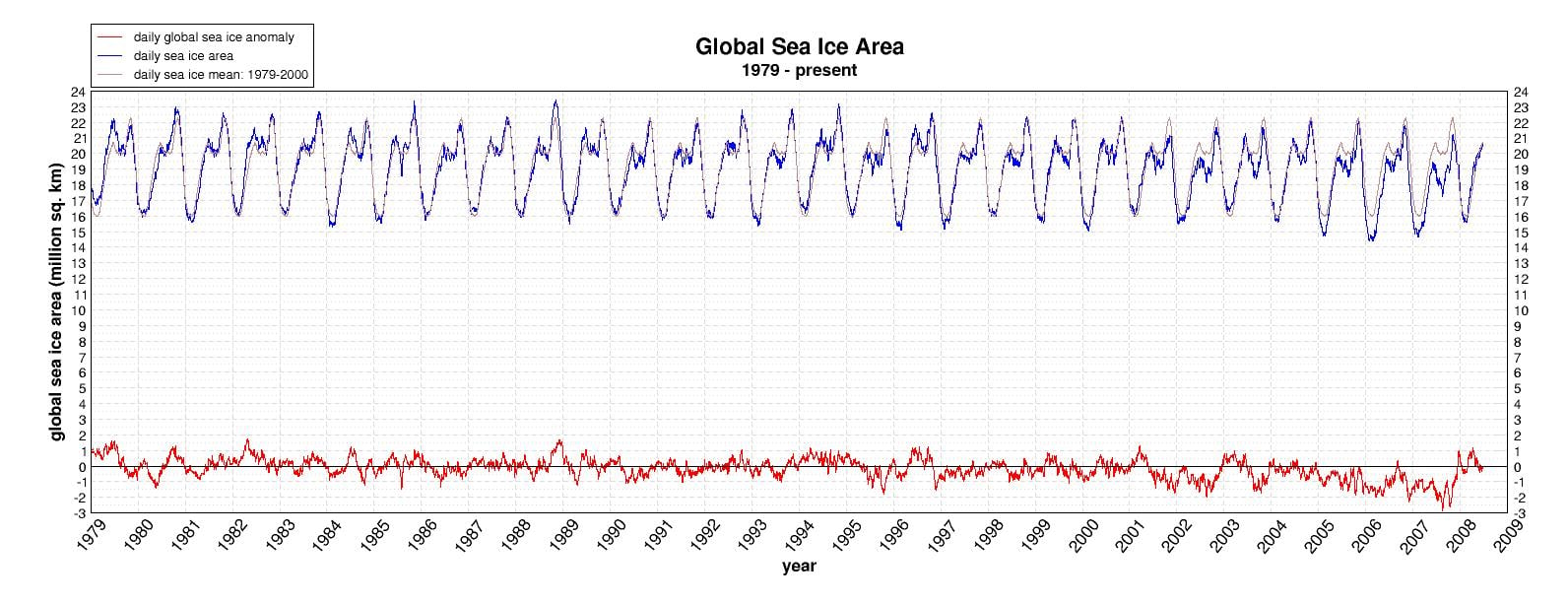
Here's another version of that graph... with additional data. It shows something interesting, I feel.
Up to 94% of Arctic melt is due to dirty snow caused by soot changing it's albedo, rather than CO2 related warming, according the researchers at University of California and a certain Dr. Hansen[PDF warning].
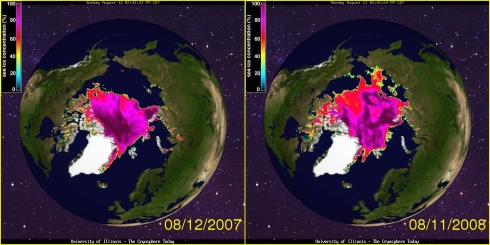
The Antarctic and the Arctic are both up on last years ice, in the case of the Arctic by 10% (according to the NSIDC).
Is it possible that the melting in the Arctic is more to do with other emissions than CO2? After all, the majority of the worlds industry is in the northern hemisphere. I would think it is.
The Northern Passage, by the way, has been navigated at least 100 times since the start of the century, and in 1922 there was open sailing very close to the North Pole [PDF warning]. Submarines regularly surface there, too. 2007 had a shocking decrease in the amount of ice at the pole, definitely. But we cannot be certain WHY.
We should still be tackling pollution, though.
-
Re:Sunspots down... temperature down?
Here's another version of that graph... with additional data. It shows something interesting, I feel.
Up to 94% of Arctic melt is due to dirty snow caused by soot changing it's albedo, rather than CO2 related warming, according the researchers at University of California and a certain Dr. Hansen[PDF warning].
The Antarctic and the Arctic are both up on last years ice, in the case of the Arctic by 10% (according to the NSIDC).
Is it possible that the melting in the Arctic is more to do with other emissions than CO2? After all, the majority of the worlds industry is in the northern hemisphere. I would think it is.
The Northern Passage, by the way, has been navigated at least 100 times since the start of the century, and in 1922 there was open sailing very close to the North Pole [PDF warning]. Submarines regularly surface there, too. 2007 had a shocking decrease in the amount of ice at the pole, definitely. But we cannot be certain WHY.
We should still be tackling pollution, though.
-
The quiet before the storm.
Has anyone asked Ken Shatten about this? For the latest weather on the sun -- http://solarscience.msfc.nasa.gov/.
As for global warming, I was reminded by a friend that "the maximum temperature of Earth can be no higher than the maximum temperature of an equivalent black body, and the earth is approximately spherical and receives light from the sun on a cross-sectional area of a circle, but radiates thermal energy from the area of a sphere. The ratio of the spherical area to the circular area is four. Dividing the incoming energy flux by that gives the Earth an approximate maximum temperature of 285Kelvin. Again we have another inconsistency as this maximum temperature is below the widely reported global average temperature of 288Kelvin (17C). The maximum temperature found on the moon is approximately 390Kelvin." On Earth our maximum, like that of the moon, could be 117C. The official highest is around 57C, so we have another 60C possible increase! -
Re:Is this really history?
If I understand correctly, we should be moving towards the maximum after the minimum in 2006-ish, but we are not; instead the number of spots is still going down. See the raw data, and take into account that the cycle is on average about 10.5 years long.
-
Re:A mile?
According to that list, there are 12 objects with a probability >1/10,000, and 2 with a probability > 1/1000.
Note that the uncertainty on these orbits is frequently many 1000's of km; the orbits of things in LEO are much better determined.
-
Re:A mile?
-
NASA JPL Video
The canonical NASA JPL Video...
I would say, "Learn enough Java to know what you're talking about," and then mention Java's limitations in your interview.
-
Re:1 in 12 odds.
Seriously, you would think that the US would take a more "global" approach to space and start truly cooperating with other countries, say like uh.. Canada, UK, Japan, China, India, etc...
I think that's why it's called the International Space Station because some 15 nations are involved in its construction.
Problem is Russia is acting like a thug and saying "we're an irreplaceable ISS partner so suck it..." We have to show Russia that she isn't irreplaceable otherwise she'll keep behaving like a thug. Since we don't want to start shooting, replacing Russia in places where she can be replaced is one of the things we'll have to do instead.
-
Oh, and at least one is already ahead of schedule
When was the last time any NASA program was ahead of schedule?? http://www.nasa.gov/offices/c3po/home/spacex_9enginefire.html
-
Maybe we could give COTS a try?
I mean, NASA already has the program in place and already has participants. It would take a hell of a lot less than $4B/year to speed up COTS.
More info: http://www.nasa.gov/directorates/esmd/ccc/
-
Re:More Mars color BS
Here's the I believe:
http://marsrovers.nasa.gov/mission/spacecraft_instru_pancam.html
Now, as to the likely.
I have determined the source: The vertical spikes are caused by the sky. A simple sampling of that portion of the image would have told me this originally.
This begs the question: What is it about the atmosphere of Mars that would cause it's color values to appear in three narrow bands? The atmosphere of Mars is mostly carbon dioxide, with a bit of nitrogen, and a bit less of argon. These gasses would impart no color at all on their own, meaning that the only thing which would color the atmosphere of Mars is its refractive index, and dust. The refractive index of an atmosphere, if too great, would be a milky white, and if too little, would be black. In between, it's blue. We are talking the same light source here mind you - the sun. Nothing between here and Mars that is changing the character of the light, other than there being a bit less of it.
That leaves dust. The only possible thing that can be refracting the RGB light into three areas of the spectrum which almost do not overlap at all, is dust.
Now, what is that dust made of? Silicon, Iron, Calcium, Aluminum, Magnesium, and Sulfur. Totally non-exotic stuff. Furthermore, stuff that, note this carefully, does not refract light into three separate bands.
Ok, then, given an atmosphere that is not in any way exotic, and atmospheric dust that is equally non-exotic, can you explain to me, in any rational manner, how atmospheric dust could cause the color of the light which reaches Mars to be refracted into three separate bands which hardly overlap? There is only one answer: It Can't. Period.
There is only one other possibility: NASA is not using RGB filters to take these images. Now, that would be exceedingly strange all by itself, given that the panam camera in question certainly has RGB filters and NASA claims that these images which they are posting are full-color images. What ELSE would they be using than the RGB filters?
I stand, firmly, on my original statement: NASA deliberately shifts the RGB histograms of these images to make Mars look exotic. Why? I don't know.
-
Re:Kind of a wasteLet me see a Martian sunset.
-
Re:Engineering Ramifications?
The Voyagers was the first thing that came to my mind, too. If the rate of radioactive decay is dependent on neutrino flux from the sun, then shouldn't their RTGs have long since gone dead as the rate of decay slowed (due to increasing distance), rather than maintaining better performance than originally anticipated (due to better performance of the thermocouple than anticipated)? (NASA link) Given that both spacecraft are alive and well out past the heliosphere, I think we can safely conclude that the rate of decay of the plutonium onboard is not meaningfully influenced by solar neutrino flux.
-
Re:PCR? With what primers?
Kind of like the microscope on Phoenix? http://www.nasa.gov/mission_pages/phoenix/news/phoenix-20080814.html
100nm resolution. DNA however is only 3nm wide. -
Re:Gamma Ray astro at ISU
I used to do work study for some of the folks working with the GLAST project at Iowa State University their website is here and has some more information about Gamma Ray Astrophysics.
Why not link to the official Fermi (GLAST) websites directly www-glast.stanford.edu and http://glast.gsfc.nasa.gov/, instead of linking to an institution who has not contributed significantly to GLAST?
Btw, I used to work with GLAST.
-
Re:media for millenia
NASA has already tackled the problem of long-term access of unsupported storage
-
Re:Complicated?
This is neither interesting or correct. Even though "NASA hasn't designed a space capsule in 40 years", they have designed and successfully used parachutes all over the solar system.
Here's a picture of the Phoenix Lander with a deployed parachute on it's way to a successful landing this year: http://www.nasa.gov/mission_pages/phoenix/images/press/9227-PHX_Lander.html Here's how they landed the Mars Rovers using parachutes: http://marsrovers.nasa.gov/mission/spacecraft_edl_parachute.html
In fact, NASA has ongoing parachute development projects. Here's a link to research being done at Rice University that shows how the Orion parachute works: http://www.media.rice.edu/media/NewsBot.asp?MODE=VIEW&ID=11138
To sum up, you are wrong and ignorant. The Genesis probe failure had nothing to do with parachutes. All you did was notice that two objects of roughly the same shape hit the ground too hard. This is about as intelligent as getting the round peg in the round hole.
Then, showing that you stupidity is matched by your arrogance, you said that the people doing this work were incompetent. All you really showed is that you are a pathetic excuse for a human being, and the only way you can try and build yourself up is by saying nasty things about people who are far better then you. I would be completely unsurprised if you were the kind of jerk who kicks dogs and pushes around small children.
-
Re:Complicated?
This is neither interesting or correct. Even though "NASA hasn't designed a space capsule in 40 years", they have designed and successfully used parachutes all over the solar system.
Here's a picture of the Phoenix Lander with a deployed parachute on it's way to a successful landing this year: http://www.nasa.gov/mission_pages/phoenix/images/press/9227-PHX_Lander.html Here's how they landed the Mars Rovers using parachutes: http://marsrovers.nasa.gov/mission/spacecraft_edl_parachute.html
In fact, NASA has ongoing parachute development projects. Here's a link to research being done at Rice University that shows how the Orion parachute works: http://www.media.rice.edu/media/NewsBot.asp?MODE=VIEW&ID=11138
To sum up, you are wrong and ignorant. The Genesis probe failure had nothing to do with parachutes. All you did was notice that two objects of roughly the same shape hit the ground too hard. This is about as intelligent as getting the round peg in the round hole.
Then, showing that you stupidity is matched by your arrogance, you said that the people doing this work were incompetent. All you really showed is that you are a pathetic excuse for a human being, and the only way you can try and build yourself up is by saying nasty things about people who are far better then you. I would be completely unsurprised if you were the kind of jerk who kicks dogs and pushes around small children.
-
Direct video link
-
Apollo chute test failed tooJanuary 11, 1968
A Parachute Test Vehicle (PTV) test failed at El Centro, Calif. The PTV was released from a B-52 aircraft at 15,240 meters and the drogue chute programmer was actuated by a static line connected to the aircraft. One drogue chute appeared to fail upon deployment, followed by failure of the second drogue seven seconds later. Disreefing of these drogues normally occurred at 8 seconds after deployment with disconnect at deployment at plus 18 seconds. The main chute programmer deployed and was effective for only 14 out of the expected 40 seconds' duration. This action was followed by normal deployment of one main parachute, which failed, followed by the second main parachute as programmed after four-tenths of a second, which also failed. The main chute failure was observed from the ground and the emergency parachute system deployment was commanded but also failed because of high dynamic pressure, allowing the PTV to impact and be destroyed. Investigation was under way and MSC personnel were en route to El Centro and Northrop-Ventura to determine the cause and to effect a solution. TWX, George M. Low, MSC, to NASA Hq., Attn: Apollo Program Director, Jan. 11, 1968.
Source: http://www.hq.nasa.gov/office/pao/History/SP-4009/v4p2h.htm
-
Re:Oh goody...Where exactly do you get your figures from? NASA would beg to differ
The year 2007 tied for second warmest in the period of instrumental data, behind the record warmth of 2005, in the Goddard Institute for Space Studies (GISS) analysis. 2007 tied 1998, which had leapt a remarkable 0.2ÂC above the prior record with the help of the "El Niño of the century".
-
Correcting disinformation
Wrong. That is only for the US; we are talking world climate. The tiny correction made a slight difference in ranking of US warmest year records, not global. In terms of global temperature, all of the 10 warmest years have been since 1989, and the tiny correction (below the level of statistical significance) to the US temperature records did not alter that.
And by the way, it is not even true that NASA previously ranked 1998 as the hottest year. NASA ranked has always ranked 1934 as the hottest year (in the US only, of course, and by a statistically insignificant margin). The tiny correction did not change that, either.
You might want to think about the source you cited, and what their motivation might be for promulgating such disinformation, still uncorrected months after scientists have pointed out the falsity of the claim.
-
Re:Oh goody...
artifact of coding mistakes
Oh no, not the Hansen mistake discovered by Steve McIntyre, again! This has been discussed before here on slashdot. The mistake only affected the US temperature curve, with very little impact on the global temperature. You can check Nasa's diagrams from early 2008 for the global trends, and the curves are definitely pointing upwards.
-
Re:Oh goody...
Well, what you say may be true for the USA, but for the world NASA, WMO [PDF] and the MET office all disagree. Nice mis-information there.
USA != World -
Re:Global Warming
To borrow a phrase I have grown to hate.... citation needed. Every chart I have ever seen showed ever increasing temps until we all DIE.
Perhaps you should cite your images.
The graphs I've seen generally seem to be full of local maxima and minima. A hot period, followed by a cool period but with the overall trend continuing being upwards (ie each hot/cold cycle is warmer than the previous hot/cold cycle).
The El Nino and La Nina temperature fluctuations seem to be fairly well understood.
Ten years is not that long a time in terms of geographical-scale phenomena. It's pointless to look at the last ten years outside the context of the last 100.
BZZZZZZT! Try again.
Figures on this page were prepared by Dr. Makiko Sato. Please address questions about the figures to Dr. Sato or to Dr. James Hansen.
Don't believe anything with James Hansen's name on it. Let's see what we can find on his Wikipedia page:
Hansen was trained in physics and astronomy in the space science program of Dr. James Van Allen at the University of Iowa.
(Funny, I don't see Climatology or even Meteorology on there)Hansen was elected to the National Academy of Sciences in 1996[7] and he received a $250,000 Heinz Environment Award[8] for his research on global warming in 2001.
(Heinze, Heinze, Heinze? Where have I heard that name. Oh, yeah, I remember. She was that moonbat freak who was married to that Herman Munster Senator who ran for president this last go-round. She is an extreme liberal, right? So, liberals paid Hansen? Isn't that the same thing as scientists who are paid by big oil companies? Why is Hansen credible, but the guys paid by big oil are not?)More from his
wiki
page:
Correcting Climate Record Database
In August 2007 statistician Stephen McIntyre noticed that many U.S. temperature records from the Historical Climatology Network (USHCN) displayed a discontinuity around the year 2000.
In a website commentary[33], Hansen indicated that he felt that Fox [News] and the Washington Times, among others, had overreacted to this mistake, stating that they had "gone bananas." Hansen quoted the United States Founding Fathers and a Native American mystic and argued that "The deceit behind the attempts to discredit evidence of climate change reveals matters of importance. This deceit has a clear purpose: to confuse the public about the status of knowledge of global climate change, thus delaying effective action to mitigate climate change", and that "The contrarians will be remembered as court jesters. There is no point to joust with court jesters
[edit] Statement About Extreme Scenarios
A controversy[citation needed] over his support for "objective" and "realistic" climate scenarios centers on what critics call a justification for "extreme" scenarios in this quote:
"Emphasis on extreme scenarios may have been appropriate at one time, when the public and decision-makers were relatively unaware of the global warming issue, and energy sources such as âoesynfuelsâ, shale oil and tar sands were receiving strong consideration. Now, however, the need is for demonstrably objective climate forcing scenarios consistent with what is realistic under current conditions. Scenarios tha
-
Re:Stupid sunspots...( or lack thereof )
-
Re:Global Warming
To borrow a phrase I have grown to hate.... citation needed. Every chart I have ever seen showed ever increasing temps until we all DIE.
Perhaps you should cite your images.
The graphs I've seen generally seem to be full of local maxima and minima. A hot period, followed by a cool period but with the overall trend continuing being upwards (ie each hot/cold cycle is warmer than the previous hot/cold cycle).
The El Nino and La Nina temperature fluctuations seem to be fairly well understood.
Ten years is not that long a time in terms of geographical-scale phenomena. It's pointless to look at the last ten years outside the context of the last 100.
-
Re:Global Warming
People are worried about the long term trends right, not the yearly variation?
Absolutely. Thing is, all of these predictions are being made on relatively short term data. 2005 peaked at
In fact, if the average, as the article states, comes in -
Re:Interesting tweak
According to this page, it looks something like this only designed for cryogenic temperatures.
-
Re:Hooray for more weight...
-
Re:cost?
-
Re:wrong approach
I guess NASA needs to waste money to justify a bigger budget.
Considering that NASA operates on about 0.6% of the GDP ($17.318 billion) and that a typical space shuttle launch burns around 835,958 gallons of liquid propellants costing NASA around $450 million per launch I think that they are doing quite well with their meager budget. Especially once you factor in the fact that if it wasn't for their splurging on the ballpoint pen you would still be using your No.2 Pencil and Big Chief writing pad. Not to mention the fact that the communist would have won the space race.
-
Re:wrong approach
When we wanted to analyze moon rocks, we didn't send a microscope to the moon, we brought the moon rocks to the microscope (on Earth).
Unfortunately the process of bringing them back alters their chemistry.
It's very challenging to get samples back here unadulterated. -
Re:Why banned on airplanes?
"dropping it would probably put it out"
I dunno, it's from the batteries getting very hot, so it's not caused by something being ignited, it's a hot high energy chemical fire, so it's not like dropping a lit cigarette which you can stamp out, is more like dropping a bunch of sparklers that would just burn through the rubber on the bottom of your shoes. And it could be in ya pocket, so option for just letting go and dropping it mightn't be there anyway.
Also, while the chances do appear low, the chances of laptops going up must also be pretty low, but (occording to the article) that has happened on planes. No mention of planes crashin etc due to it though. But considering how easy a risk it is to mitigate, it does seem silly not to. Even the space shuttle, which only had one ipod on board (that we saw) used an alternative battery for it.
-
Source info and images
-
Worth a look
I was expecting to see a speck of dust, and instead I see flaming green projectiles landing on a red carpet.
Are these simply toxic meteorites, or did the gov't slip up and accidentally post photos of aliens arriving at the Martian Academy Awards? -
Re:Smoke detectors?
it can even happen by chance, in nature
-
NASA Spinoff List -- Nasa funding advances us
http://spaceplace.nasa.gov/en/kids/spinoffs2.shtml
There are thousands and thousands of them, but here's a few:
What do all the things pictured on this page have in common? They all use technologies or materials that were originally developed for the space program.
TV satellite dish TV Satellite Dish
NASA developed ways to correct errors in the signals coming from the spacecraft. This technology is used to reduce noise (that is, messed up picture or sound) in TV signals coming from satellites.
MRI image of head Medical Imaging
NASA developed ways to process signals from spacecraft to produce clearer images. (See more on digital information and how spacecraft send images from space.) This technology also makes possible these photo-like images of our insides.
Eye chart Vision Screening System
Uses techniques developed for processing space pictures to examine eyes of children and find out quickly if they have any vision problems. The child doesn't have to say a word!
Ear thermometer Ear Thermometer
Instead of measuring temperature using a column of mercury (which expands as it heats up), this thermometer has a lens like a camera and detects infrared energy, which we feel as heat. The warmer something is (like your body), the more infrared energy it puts out. This technology was originally developed to detect the birth of stars.
Fire fighter Fire Fighter Equipment
Fire fighters wear suits made of fire resistant fabric developed for use in space suits.
Smoke detector Smoke Detector
First used in the Earth orbiting space station called Skylab (launched back in 1973) to help detect any toxic vapors. Now used in most homes and other buildings to warn people of fire.
Sun glasses Sun Tiger Glasses
From research done on materials to protect the eyes of welders working on spacecraft, protective lenses were developed that block almost all the wavelengths of radiation that might harm the eyes, while letting through all the useful wavelengths that let us see.
Sport utility vehicle Automobile Design Tools
A computer program developed by NASA to analyze a spacecraft or airplane design and predict how parts will perform is now used to help design automobiles. This kind of software can save car makers a lot of money by letting them see how well a design will work even before they build a prototype.
Dust Buster vacuum cleaner Cordless Tools
Portable, self-contained power tools were originally developed to help Apollo astronauts drill for moon samples. This technology has lead to development of such tools as the cordless vacuum cleaner, power drill, shrub trimmers, and grass shears.
Bicycle Aerodynamic Bicycle Wheel
A special bike wheel uses NASA research in airfoils (wings) and design software developed for the space program. The three spokes on the wheel act like wings, making the bicycle very efficient for racing.
Skier Thermal Gloves and Boots
These gloves and boots have heating elements that run on rechargeable batteries worn on the inside wrist of the gloves or embedded in the sole of the ski boot. This technology was adapted from a spacesuit design for the Apollo astronauts.
Pen Space Pens
The Fisher Space Pen was developed for use in space. Most pens depend on gravity to make the ink flow into the ball point. For this space pen, the ink cartridge contains pressured gas to push the ink toward the ball point. That means, you can lie in bed and write upside down with this pen! Also, it uses a special ink that works in very hot and very cold environments.
Football player Shock Absorbing Helmets
These special football helmets use a padding of Temper Foam, a shock absorbing material first developed for use in aircraft seats. These helmets have three times the shock absorbing ability of previous types.
Ski boot Ski Boots
These ski boots use accordion-like folds, similar to the design of space suits, to allow the boot to flex -
Re:Let's end the ruse
A superbly crude, one-dimensional comparrison of budget size past and present.
It ignores the projected span of time to re-reach the moon and that the $2B figure is a yearly addition to the budget, not a one-time grant. It underestimates what $2 buys: a shuttle(!) or 4 to 5 launches. It also neglects to mention that space exploration is no longer an "us against them" war, but a combined effort (though granted the U.S. is a major contributor to international efforts), spreading the cost and reducing waste-by-redundancy. In its haste to condemn Obama and trash NASA it also promots ignorance of decades' worth of research and experience in engineering, which significantly reduces cost, complexity and risk.
While I applaud the skepticism politicians deserve, it's up to us skeptics to be better than the politicians by providing actual arguments. Leave the empty rhetoric to campaigners.
And to all the "Privatization solves all problems!!!-nuts" out there, where exactly do you expect private industry to find the revenue to outnumber the overwhelming investment and risk involved in such endeavors? How many $200,000 tickets do you think Branson's will sell? Not all millionaires are so foolish as to spend money at that rate, risking their lives- he's got a rather limited clientele with which to attempt to reduce the cost and create sustaining business. Sure- there's place for a market for lifting cargo into orbit. But to the moon? Mars? What possible business model is there for anything beyond Low-Earth Orbit? Nobody is crazy enough to put their money into such a high risk and long term venture.
Whether the Federal government should be doing it is still a valid question. I found Bush's selfish, legacy-oriented declaration of going to Mars another example of terrible leadership. I don't know that enough scientists have immediate use of Moon/Mars missions, especially considering how useful the money would be to education and infrastructure projects in the U.S. and abroad. If there's enough desire on part of the scientific community for these, I'd be happy to have my tax dollars go there. Otherwise, I'd be more interested in my paying for the reduction of war, disease, corruption, crime and hunger around the world.
-
Re:Let's end the ruse
A superbly crude, one-dimensional comparrison of budget size past and present.
It ignores the projected span of time to re-reach the moon and that the $2B figure is a yearly addition to the budget, not a one-time grant. It underestimates what $2 buys: a shuttle(!) or 4 to 5 launches. It also neglects to mention that space exploration is no longer an "us against them" war, but a combined effort (though granted the U.S. is a major contributor to international efforts), spreading the cost and reducing waste-by-redundancy. In its haste to condemn Obama and trash NASA it also promots ignorance of decades' worth of research and experience in engineering, which significantly reduces cost, complexity and risk.
While I applaud the skepticism politicians deserve, it's up to us skeptics to be better than the politicians by providing actual arguments. Leave the empty rhetoric to campaigners.
And to all the "Privatization solves all problems!!!-nuts" out there, where exactly do you expect private industry to find the revenue to outnumber the overwhelming investment and risk involved in such endeavors? How many $200,000 tickets do you think Branson's will sell? Not all millionaires are so foolish as to spend money at that rate, risking their lives- he's got a rather limited clientele with which to attempt to reduce the cost and create sustaining business. Sure- there's place for a market for lifting cargo into orbit. But to the moon? Mars? What possible business model is there for anything beyond Low-Earth Orbit? Nobody is crazy enough to put their money into such a high risk and long term venture.
Whether the Federal government should be doing it is still a valid question. I found Bush's selfish, legacy-oriented declaration of going to Mars another example of terrible leadership. I don't know that enough scientists have immediate use of Moon/Mars missions, especially considering how useful the money would be to education and infrastructure projects in the U.S. and abroad. If there's enough desire on part of the scientific community for these, I'd be happy to have my tax dollars go there. Otherwise, I'd be more interested in my paying for the reduction of war, disease, corruption, crime and hunger around the world.
-
Re:not too surprising
That the Nile changed it's course in man's pre-history is a bit more than speculation. The people of the Indus valley were also forced out when a river changed course in the highlands and created the modern Ganges river. But yeah, it's fantastic that we have found archological evidence to show that not only did people pass thru the Sahara but that they (and their prey) lived in the same spot for many generations.
-
Re:Water = civilization
I'm not discussing what plant is better at making oxygen.
I'm discussing where most of our current oxygen comes from. Phytoplankton may or may not be less efficient than other plants at producing Oxygen. That fact is irrelevant, since the sheer volume of phytoplankton provides MORE than half (my bad, not "about half" like I said earlier) of the Oxygen that is produced on Earth.
References?
http://en.wikipedia.org/wiki/Phytoplankton
Nasa's take on the stuff
http://earthobservatory.nasa.gov/Library/Phytoplankton/
This one claims two-thirds of the photosynthesis on the planet occurs within them
http://seagrant.gso.uri.edu/factsheets/phytoplankton.htmlAs a side note...
What started as a desire to create an Algae that would be the perfect fish tank decoration (one that fish would not eat, one that would flourish in a wide variety of waters and conditions, one that would proliferate easily) has turned into one of the world's greatest threats. One that could extinguish us.
http://www.press.uchicago.edu/Misc/Chicago/519228.html
In a nutshell, we made the stuff in Germany, it was studied at the Jacque Cousteau Oceanographic Museum of Monaco, and it got out... as it was first discovered in the Mediterranean under this very building. It is extraordinarily hard to kill, and it drives off all other sea life in any area where it grows. It drive off and suffocates other sea plant life, which drives off the little fish that eat that stuff, which drives off the larger fish that eat the small fish.
Go ahead. Search for Killer Algae. See what it has taken to eradicate the outbreak in a lagoon in Australia... and the outbreak in Southern California (I hear it is threatening the Florida coast in some spots). If we destroy the ocean's ecology, we are soon to follow. And apparently our desire for the perfect fish tank may be our downfall.Also, it is possible to desalinate salt water, making it into fresh water. So sorry, I'm not with you that protecting our fresh water is more important. We've got to get on the ball and protect that which sustains our oxygen production, and ocean life. Else we die with lots of fresh water.
-
Re:False color?
Different features are seen in different light at different wavelengths.
For an everyday example: I am using an old video camera with infra-red "night-vision" mode as a baby monitor. My newborn can sleep in the dark and I can still tell if he's breathing from the other room without disturbing him. If I switch back to "normal" colour spectrum, I see nothing but a black screen. That's because my baby emits and reflects differently in infra-red than he does in visible light.
Well objects in space are much more extreme. They don't live in the same 50 degree celicius range that we humans almost always do. Temperatures range from just above absolute zero to millions of degrees. They don't live at almost exactly the same distance from our sun like we do. Within our own solar system, the further you go from the sun the less reflected light there is and the harder it is to capture images of large objects in visible light because there is less of it. (Ever tried to capture pictures at night or in a rock concert. If there's no fast motion you take long exposures, but if there is you're hosed. Well think about how fast space craft move).
So instead of give up altogether scientists turn to other wavelengths and see that some features show up better in different frequencies, and in space that works well. If you want to see what the sky looks like at different frequencies, take a look here. They have images of much of the sky at different wavelengths.
http://skyview.gsfc.nasa.gov/docs/easy.html
http://skyview.gsfc.nasa.gov/cgi-bin/query.plUnfortunately here on earth the atmosphere absorbs too much at most frequencies so a lot of observation is limited to use in orbital observatories and spacecraft.
Note: I have an Astronomy masters but have never worked in the field. I did the degree "for fun".
-
Re:False color?
Different features are seen in different light at different wavelengths.
For an everyday example: I am using an old video camera with infra-red "night-vision" mode as a baby monitor. My newborn can sleep in the dark and I can still tell if he's breathing from the other room without disturbing him. If I switch back to "normal" colour spectrum, I see nothing but a black screen. That's because my baby emits and reflects differently in infra-red than he does in visible light.
Well objects in space are much more extreme. They don't live in the same 50 degree celicius range that we humans almost always do. Temperatures range from just above absolute zero to millions of degrees. They don't live at almost exactly the same distance from our sun like we do. Within our own solar system, the further you go from the sun the less reflected light there is and the harder it is to capture images of large objects in visible light because there is less of it. (Ever tried to capture pictures at night or in a rock concert. If there's no fast motion you take long exposures, but if there is you're hosed. Well think about how fast space craft move).
So instead of give up altogether scientists turn to other wavelengths and see that some features show up better in different frequencies, and in space that works well. If you want to see what the sky looks like at different frequencies, take a look here. They have images of much of the sky at different wavelengths.
http://skyview.gsfc.nasa.gov/docs/easy.html
http://skyview.gsfc.nasa.gov/cgi-bin/query.plUnfortunately here on earth the atmosphere absorbs too much at most frequencies so a lot of observation is limited to use in orbital observatories and spacecraft.
Note: I have an Astronomy masters but have never worked in the field. I did the degree "for fun".
-
Re:False color?The real colors would be boring to the scientists. Different wavelengths confer different information, and information is what they made the machines for.
For example here is a picture of a plume from Enceladus that was colorized for emphasis:
http://saturn.jpl.nasa.gov/multimedia/images/image-details.cfm?imageID=1874But more specific examples for your question are these images:
http://www.nasa.gov/mission_pages/cassini/multimedia/pia06139.html
From the caption: "Red and green colors represent infrared wavelengths and show areas where atmospheric methane absorbs light."http://chandra.harvard.edu/press/00_releases/press_030100a2142.html
In this case a picture in the X-ray spectrum allows them to see the temperature of the gas surrounding two colliding galaxy clusters; 50 to 100 million degrees C! -
Re:False color?The real colors would be boring to the scientists. Different wavelengths confer different information, and information is what they made the machines for.
For example here is a picture of a plume from Enceladus that was colorized for emphasis:
http://saturn.jpl.nasa.gov/multimedia/images/image-details.cfm?imageID=1874But more specific examples for your question are these images:
http://www.nasa.gov/mission_pages/cassini/multimedia/pia06139.html
From the caption: "Red and green colors represent infrared wavelengths and show areas where atmospheric methane absorbs light."http://chandra.harvard.edu/press/00_releases/press_030100a2142.html
In this case a picture in the X-ray spectrum allows them to see the temperature of the gas surrounding two colliding galaxy clusters; 50 to 100 million degrees C! -
Re:Still doesnt solve jack
"what exactly do you think happens inside the cylinders of an gasoline engine? "
I'm going to have to go with, "Carefully engineered vaporization of a gasoline aerosol, mixed with just the right ratio of air, and then pressurized to several times higher than atmospheric pressure to make it react in a way that it never would in normal atmospheric conditions."
Seriously. Gasoline has nothing on hydrogen when it comes to danger. Not even close. And NASA would know; they've used the stuff more than pretty much anyone else on the planet.
-
Re:IEEE Spectrum is not a government source
You're absolutely right that it's an unbelievably complex problem. And just quoting a risk value of 1:45 doesn't quite tell the whole story either. Because when a satelite (or the Shuttle) breaks up on entry, there's not just one piece. I've visited KSC where they have much of the Columbia debris, and it's quite a lot.
The risk estimate is meant to be an average estimate, that will have quite a bit of uncertainty. And that's supposed to include ocean splashdowns as well. Truthfully, there's probably at least an order of magnitude uncertainty on either side of any such result.
The estimate I remembered (not quoted) for the Shuttle accident was from http://caib.nasa.gov/, (find the actual value in one of the many volumes) an after the event estimate. If the Shuttle had come down over Dallas, the casualty expectation was over 1. That doesn't mean that it was a guarantee that someone would have been injured. It means that the probability of 1 injury times 1 + the probability of 2 injuries times 2 + and so on was greater than one. And that took buildings into account.
Like I said, no one can guarantee that estimate is anywhere near exact. Plus there's so many possibilities that such numbers are just meant to be an average estimate
Typically a normal satellite will quote around 1000 sqft of 'casualty area' if it came back in. But who knows what it would actually be when it actually happens? And where the 'targets' are.
-
Johnson Space Center is in Houston, TX..
The one in Hunstville, Alabama is Marshall Space Flight Center: