Slashdot Mirror
Domain: nasa.gov
Stories and comments across the archive that link to nasa.gov.
Comments · 16,365
-
Re:An attempt to discredit WP with lies, I say.
he might mean http://nepp.nasa.gov/whisker/reference/tech_papers/2007-brusse-metal-whiskers.pdf page 5 where a '0.5% to 1%' lead coating prevents whiskers. the source is cited on wikipedia.
ROSH laws require less than 0.1% though... i think they need to rethink that on lead, if 1% lead stops whiskering, it's well worth it.
cadmium is also banned, and was the first metal to ever verify whiskering. chromate actually accelerates whiskering, so finding an additive that is better than lead might be hard. -
According to the web
Tin Whiskers appear real:
http://nepp.nasa.gov/WHISKER/background/index.htm
http://www.calce.umd.edu/lead-free/tin-whiskers/
From what I can tell from these links there issue is still present in lead-free solder, and very much an issue in certain conditions. I have not seen any pages which indicate long-term solutions, though it would be interesting if someone can turn one up.
Another link:
http://www.national.com/analog/packaging/leadfree -
NASA Are Worried
Well, NASA Goddard are worried about the situation and they have done extensive studies on the subject:
http://nepp.nasa.gov/WHISKER/
Ganty -
Re:solar power?
An RTG will give you consistent power for a long time, whereas the solar cells will have issues managing eclipses and long-term degradation from radiation exposure.
The orbit of Ulysses goes from a perihelion of 1.34 AU, to an aphelion of 5.4 AU (period 6.2 years) (from a NASA position paper) ; that's a factor of 4.03 difference in heliocentric range and 16.24 in sunlight intensity through it's orbit. That's without any variations in cell efficiency at different temperatures, pointing issues, or long-term degradation.
Given that the orbit has an inclination of 80deg to the plane of the Earth's orbit (and thus 63-97deg to the orbits of the other planets), eclipses are unlikely to be a major problem. -
Re:Don't know how to mod this
Definitely informative. Slowly failing RTG's due to degradation of the thermocouples that convert heat into electricity is a likely cause of the eventual end of the Voyager missions. More info at http://voyager.jpl.nasa.gov/spacecraft/spacecraftlife.html
-
Re:solar warming, that's why.I have yet to see a model that takes solar variability into account. I don't know what models you're talking about, but most if not all of the GCMs are forced by historical solar data. See, e.g., GISS ModelE for one example. They fix future solar irradiance to be constant (or cyclic about a constant mean) since, as you say, we can't predict it very well. But when comparing model output to past observations, e.g. to study the effect of the Sun on 20th century climate, they do use variable solar data.
-
Mark Hammil is quaking in his boots
Are you kidding? It's clearly an evolutionary precursor to a storm trooper suit
-
Re:Too bad this focused only on vehicles ...
Oh, you'd be talking about this: CLARAty
-
Re:Wait wait wait
Whoa- more and more the democrats are the party of the cities.
compare this: http://apod.nasa.gov/apod/ap970830.html
and this: http://www.usatoday.com/news/politicselections/vote2004/countymap.htm
You can babble about whatever you want, but at least back it up with something. And most of us here at slashdot know that the blue areas contain, say : Silicon Valley, NY, etc. The things that separate america from the rest of the world. How come? -
Re:A lot of energy and CO2 for one guy's amusementlaunching yourself into orbit dwarfs the effect on the environmental most people would ever cause. The technological advancements achieved from space programs alone offset any sort of emissions chemically powered rockets emitted in order to get us into orbit (and that's not to mention the potential for human unity that trans-national space programs have nor any other human benefits technological advancements space programs have introduced). If we (as a human race) had never engaged in the challenging exercise of optimizing existing technologies or creating new technologies in a way that is necessary for operations in space, we may instead be using technologies that are much less efficient with resources and thus the net effect would be MORE carbon emissions.
NASA has a site dedicated to listing some of these technologies that have been a direct result of the space program (never mind the somewhat awkward UI).
Are we (as a human race) damaging this planet? Yes. Are we (again as a whole) being irresponsible in some ways with our resources? Yes. Is the net effect of human space activity anywhere near a leading contributor towards atmospheric pollution? No!
Now, you may not have been challenging the ethics of space programs, but space tourism (let alone space programs in general) are the wrong environmental trees to bark up. -
It's not the heat, it's the humidity.
Seriously, though, it's not quite that simple. "The area around the sun" is very hot, but it's not very dense. IANAThermalEngineer, but I imagine they have one or two at NASA, and I'm guessing that they can come up with some kind of effective radiative cooling system. (Though perhaps they'll just rely on a Thermal Protective System (aka "heat shield"), like they did for the original Solar Probe.)
-
Re:solar warming, that's why.
The warming of Jupiter relative to other planets should probably also take into account the impact of the comet Shoemaker-Levy in July of 1994.
-
Sun Spot Cycle Normal
The new cycle started back in February and is proceeding normally. http://www.swpc.noaa.gov/SolarCycle/
You can view current solar activity here and there is at least one spot. http://umbra.nascom.nasa.gov/images/latest.html -
Re:solar warming, that's why.
Dear Moraelin,
If you want to do science, you have to use numbers properly.
You can put some numbers into the Stefan-Boltzmann law (this guy does the same thing), and if the Sun's radiation was all that was keeping the Earth warm, the average temperature would be 278 degrees Kelvin, or 5 degrees Celsius. In fact, the average temperature of Earth is closer to 15 degrees Celsius.
Why the discrepancy? The atmosphere traps heat, allowing the sun's visible light to penetrate to the ground, but preventing much of the infrared light form escaping. This is referred to as the "greenhouse effect". This is roughly why almost all scientists agree that changes to the atmosphere (such as volcanic eruptions or human emissions of carbon dioxide and methane) can change the Earth's temperature.
Could the Sun be getting brighter, thus explaining global warming? Interestingly, in 28 years of monitoring from space-based observatories, the solar irradiance has only varied in amplitude by about 0.2% (that's 0.002). That represents changes in the brightness of the Sun caused by the 11 year solar cycle. There is no evidence that the solar irradiance has increased (e.g., Frohlich & Lean 2004, Astronomy & Astrophysics Review, 12, 273; sorry I can't easily find something freely available outside of a university library). By your estimate, we require about a 1.2% increase in the Sun's intensity to account for global warming. There is no evidence the Sun could be the main cause of global warming.
Incidentally, Jupiter is not getting warmer. A large storm is redistributing heat in the atmosphere, which is very different (I'd say the science media interpreted that one wrong). The Mars data is controversial, because it covers a short time span, and was measured with two different instruments. The measurements on Earth are more reliable.
Please spend some quiet time in the Chapel of Science, considering these facts.
--Endstar
-
Re:solar warming, that's why.
Dear Moraelin,
If you want to do science, you have to use numbers properly.
You can put some numbers into the Stefan-Boltzmann law (this guy does the same thing), and if the Sun's radiation was all that was keeping the Earth warm, the average temperature would be 278 degrees Kelvin, or 5 degrees Celsius. In fact, the average temperature of Earth is closer to 15 degrees Celsius.
Why the discrepancy? The atmosphere traps heat, allowing the sun's visible light to penetrate to the ground, but preventing much of the infrared light form escaping. This is referred to as the "greenhouse effect". This is roughly why almost all scientists agree that changes to the atmosphere (such as volcanic eruptions or human emissions of carbon dioxide and methane) can change the Earth's temperature.
Could the Sun be getting brighter, thus explaining global warming? Interestingly, in 28 years of monitoring from space-based observatories, the solar irradiance has only varied in amplitude by about 0.2% (that's 0.002). That represents changes in the brightness of the Sun caused by the 11 year solar cycle. There is no evidence that the solar irradiance has increased (e.g., Frohlich & Lean 2004, Astronomy & Astrophysics Review, 12, 273; sorry I can't easily find something freely available outside of a university library). By your estimate, we require about a 1.2% increase in the Sun's intensity to account for global warming. There is no evidence the Sun could be the main cause of global warming.
Incidentally, Jupiter is not getting warmer. A large storm is redistributing heat in the atmosphere, which is very different (I'd say the science media interpreted that one wrong). The Mars data is controversial, because it covers a short time span, and was measured with two different instruments. The measurements on Earth are more reliable.
Please spend some quiet time in the Chapel of Science, considering these facts.
--Endstar
-
Re:solar warming, that's why.Dear Moraelin,
If you want to do science, you have to use numbers properly.
I've put some numbers into the Stefan-Boltzmann law (see also http://farside.ph.utexas.edu/teaching/sm1/lectures/node85.html), and if the Sun's radiation was all that was keeping the Earth warm, the average temperature would be 278 degrees Kelvin, or 5 degrees Celsius. In fact, the average temperature of Earth is closer to 15 degrees Celsius (see "terrestrial atmosphere" on http://nssdc.gsfc.nasa.gov/planetary/factsheet/earthfact.html).
Why the discrepancy? The atmosphere traps heat, allowing the Sun's visible light to penetrate to the ground, but preventing much of the infrared light form escaping. This is referred to as the "greenhouse effect". This is roughly why almost all scientists agree that changes to the atmosphere (such as volcanic eruptions or human emissions of carbon dioxide and methane) can change the Earth's temperature.
Could the Sun be getting brighter, thus explaining global warming? Interestingly, in 28 years of monitoring from space-based observatories, the solar irradiance has only varied in amplitude by ~0.2% (thats 0.002; http://data.giss.nasa.gov/gistemp/2007/). The only long-term trends in the brightness of the Sun are those of the 11 year solar cycle. By your estimate, we require a ~1.2% increase in the Sun's intensity to account for global warming. There is no evidence the Sun has brightened that much, even if we try to apply recent measurements to data taken over the last few centuries (e.g., Frohlich & Lean 2004, Astronomy & Astrophysics Review, 12, 273; sorry I can't easily find something freely available outside of a university library).
You don't have to trust me --- you can examine all this yourself.
--Endstar
-
Re:solar warming, that's why.Dear Moraelin,
If you want to do science, you have to use numbers properly.
I've put some numbers into the Stefan-Boltzmann law (see also http://farside.ph.utexas.edu/teaching/sm1/lectures/node85.html), and if the Sun's radiation was all that was keeping the Earth warm, the average temperature would be 278 degrees Kelvin, or 5 degrees Celsius. In fact, the average temperature of Earth is closer to 15 degrees Celsius (see "terrestrial atmosphere" on http://nssdc.gsfc.nasa.gov/planetary/factsheet/earthfact.html).
Why the discrepancy? The atmosphere traps heat, allowing the Sun's visible light to penetrate to the ground, but preventing much of the infrared light form escaping. This is referred to as the "greenhouse effect". This is roughly why almost all scientists agree that changes to the atmosphere (such as volcanic eruptions or human emissions of carbon dioxide and methane) can change the Earth's temperature.
Could the Sun be getting brighter, thus explaining global warming? Interestingly, in 28 years of monitoring from space-based observatories, the solar irradiance has only varied in amplitude by ~0.2% (thats 0.002; http://data.giss.nasa.gov/gistemp/2007/). The only long-term trends in the brightness of the Sun are those of the 11 year solar cycle. By your estimate, we require a ~1.2% increase in the Sun's intensity to account for global warming. There is no evidence the Sun has brightened that much, even if we try to apply recent measurements to data taken over the last few centuries (e.g., Frohlich & Lean 2004, Astronomy & Astrophysics Review, 12, 273; sorry I can't easily find something freely available outside of a university library).
You don't have to trust me --- you can examine all this yourself.
--Endstar
-
Re:So now we have thewrong, there has been 5 degrees raise in the past 30 years I repeat: Over the last 30 years, there has been less than 1 degree F of warming, globally. That is, averaged over the surface of the globe. Locally, there have been places which have warmed more, warmed less, or cooled. See here. But at the poles, the change has been a whopping 14 degrees. No, not over the last 30 years; see the map I linked earlier (the West Antarctic ice shelf area is the only place that comes close to that). But you're right that the Arctic warms much faster than the rest of the world. (The Antarctic not so much, except for WAIS.)
-
Here's the list
For all the naysayers of ISS science, here is the list of past and present experiments for your review:
ISS Experiments by Expedition
Please note the count of experiments currently stands at 561, and the focus ranges from virology, to fluid mechanics, to relativity, to astronomy, and even engineering validation (not simply of space station components, but also of fully independent technologies). That's nothing to sneeze at.
And while a fairly large portion of them are relatively minor or PR projects like sleep habits in 0g and the Buzz Lightyear "teaching from space" program, there is an ample number of experiments designed specifically to take advantage of the unique environment the ISS offers and with a variety of potential future applications.
And don't forget the majority of these so far were conducted prior to the installation of the two primary laboratory modules on the ISS: Columbia, launched late last year, and Kibo, which is 2/3 delivered as of last week. These have also been done mainly by 2 or 3 man crews, with occassional help from shuttle crews. Once the ISS switches to a 6 man crew rotation, the rate at which science work is completed will be greatly enhanced.
But of course, carefully planned, executed, and generally useful science isn't as fun to talk about as broken toilets, so we'll just continue ignoring the successes of the ISS and focus only about the cost overruns, deleted components, and occassional operating problems. -
Re:Global warming my blue butt
Your own link shows that there indeed has been no warming in the last 10 years
-
Re:solar warming, that's why.
I find it interesting that a single drop in month over month average temperatures constitutes a cooling trend. Not to mention that temperatures climbed back up, and back down.... http://data.giss.nasa.gov/gistemp/graphs/Fig.C.lrg.gif
Really, get a grip on statistics. You come across like a complete crackpot when you claim that single data point indicates any trend whatsoever. -
NASA disaggrees with you
Even NASA's data seems to disagree with you. We had twice your number since 1970 alone. Go figure. A 0.05% increase per decade, over a century, is 0.5%. (And over 150 years, it's 0.75%.) Now it doesn't go the full 1.2% we'd need to explain the Global Warming (unless it went up as a different rate before), but it almost halves the effect we can blame ourselves for.
-
Re:Global warming my blue buttNASA disagrees with Wikipedia then. They changed their mind on this and now think that 1934 was the warmest year on record. Something about that NOAA data not necessarily being very accurate... http://data.giss.nasa.gov/gistemp/graphs/Fig.D.txt http://www.norcalblogs.com/watts/2007/08/1998_no_longer_the_hottest_yea.html Look at the 5-yr mean in your own reference, and you'll see the problem with that argument. 1934 was clearly an anomaly year, while the last 7 years have all had very high 5 year averages. Remember that global warming is an average trend over large time scales (decades, even), and a single year bump is not evidence of a trend.
-
Re:Global warming my blue butt
Actually, the warmest year on record is 2007 (See this NASA site which includes a table of the top ten warmest temperatures. 1998 is tied for second place with 2005.
.But, it is good that you mention 1998. It was an anomalously high temperature year that skewed the temperature trend line going into the 21st century, giving rise to conservative climate change deniers assertions that temperatures have been declining in recent years. They have not.
-
Re:Global warming my blue butt
NASA disagrees with Wikipedia then. They changed their mind on this and now think that 1934 was the warmest year on record. Something about that NOAA data not necessarily being very accurate... http://data.giss.nasa.gov/gistemp/graphs/Fig.D.txt http://www.norcalblogs.com/watts/2007/08/1998_no_longer_the_hottest_yea.html
-
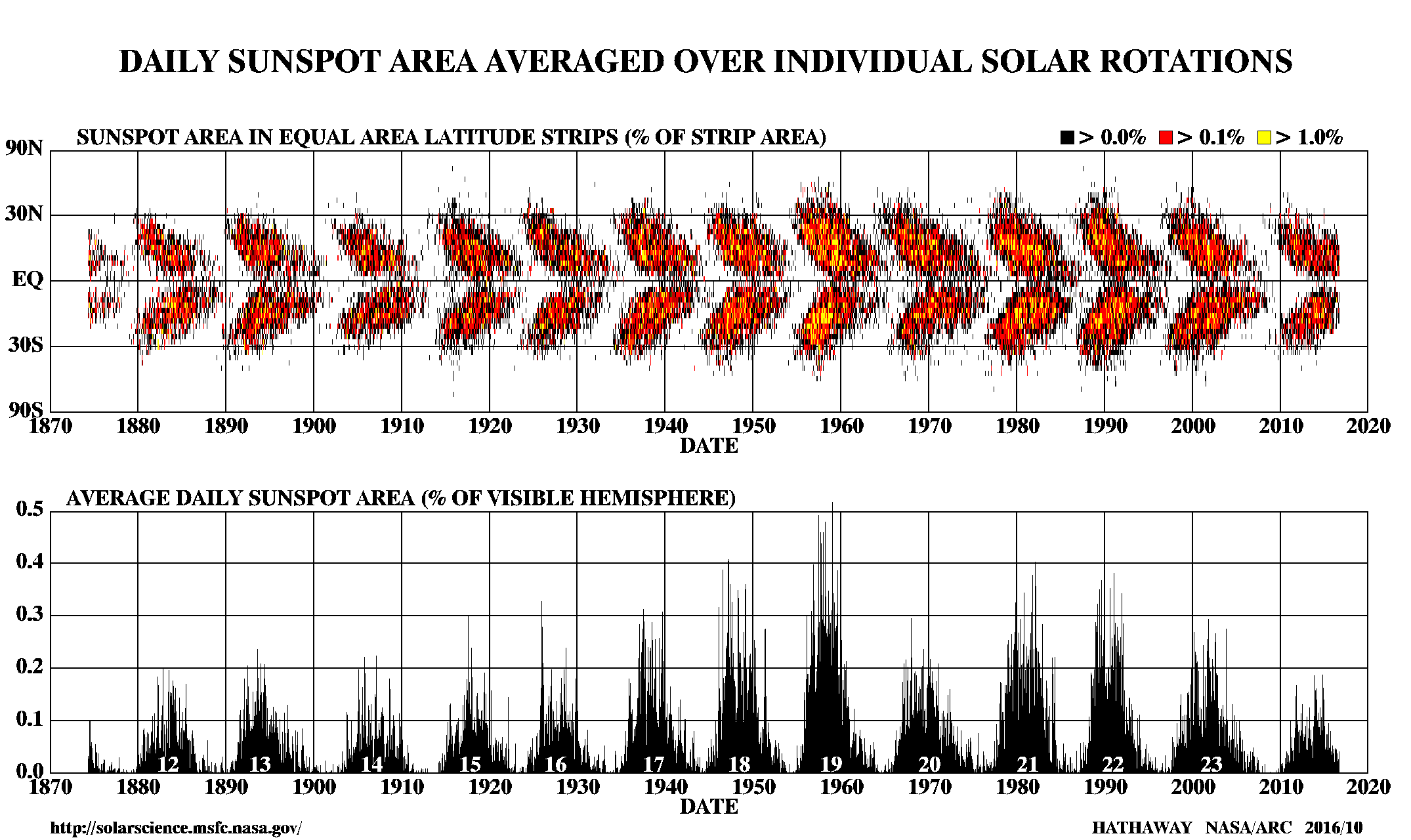
sunspot cycle page at NASA/Marshall Solar Phys.
http://solarscience.msfc.nasa.gov/SunspotCycle.shtml
Especially illustrative is the butterfly diagram:
http://solarscience.msfc.nasa.gov/images/bfly.gif
There is indeed a relatively unusual lull in sunspots, but not too different from, say, the situation around 1900. -
sunspot cycle page at NASA/Marshall Solar Phys.
http://solarscience.msfc.nasa.gov/SunspotCycle.shtml
Especially illustrative is the butterfly diagram:
http://solarscience.msfc.nasa.gov/images/bfly.gif
There is indeed a relatively unusual lull in sunspots, but not too different from, say, the situation around 1900. -
What a fluke
In an age where we are more and more dependent on electronics, radio (e.g. mobile phones), and satellite radio services (e.g. GPS), it is an incredible fluke that we are not being unduly affected by the sun's radiation.
Though I'm glad the threat of solar flares and radiation is being taken seriously (e.g. NASA's STEREO project) I do wonder if at least some of the technology we thrive under won't fail miserably when the next solar maximum takes place?
-
Re:Global warming my blue butt
Incidentally this lull in solar activity coincides with there having been no discernable warming since 2000.
Even if that were true, which it isn't, one would expect *cooling* during this half of the cycle. -
Re:Global warming my blue butt
No discernible warming since 2000? Then this article from NASA must be all wrong then. Thanks for letting us know! *rolleyes*
-
Re:So now we have theBut how is it that man is causing the supposed temperature rise? The enhanced greenhouse effect. I lived in the same area for 30 years and the summers still have 100+ degree days, and the winters are still freezing cold. If this is suppose to be global warming, where is the warming? Over the last 30 years, there has been less than 1 degree F of warming, globally. It's questionable whether you would notice that in the daily temperatures unless you looked at the historical trends. Even then, not all locations warm at the same rate, and not all of them warm at all. There is just more warming than cooling. here is a map showing the amount of warming in the last 30 years relative to the previous 30.
-
Peer-reviewed work
It would be nice to have a peer-reviewed paper cited, rather than a climate-change denialist (and another site, probably also denialist). So here's a link to Running's publication page. The relevant NASA presentations appear to be here. Have fun, folks.
-
Update 2: Vibrator works
The following image sequence confirms that the screen vibrator works, because the soil on the screen slumped down after a vibrating session. This rules out one device problem, but does not rule out problems with the soil detection sensor inside, below the screen. It appears they believe clumpy soil is the likely culprit for the problem and they are devising and testing work-arounds to use on the other ovens. This means they may abandon the first oven, at least for a while.
http://www.nasa.gov/mission_pages/phoenix/news/phoenix-20080609.html -
Re:Mod OP down.I hope these aren't the same engineers that designed an oven the diam. of a pencil lead.
What the heck were they thinking? Yeah, go metric! Silly Americans, with their inches and pencil leads. To be fair, everything on NASA's website (e.g. in the press kit PDF) about Phoenix is in metric. The measurements have been butchered about by American media, the 1cm-long, 2mm-diameter oven is given as 1 inch long in the summary.
Also, they obviously have those pencils you give to children when they're learning to write, if they think pencil leads are 2mm diameter. -
Funny, maybe. Insightfull, no.
"I'll go with waiting for science to get all the facts right and remove political/personal agendas."
Assuming you are serious, what is your definition for "facts" and how will you know when you have ALL of them?
I mean there are 11,000+ google scholar hits for papers using or citing the SEAWIFS data set. I don't even see the paper referenced in either link let alone a credible understanding of the biosphere. This is not to say the paper is wrong, it's just that the spin in the article is making me dizzy and I want to vomit.
As you can see from all the amount of research using the SEAWIFS data set there is no need for you to wait. And that's just one data set, our collective knowledge of climate (and the biosphere in general) has exploded since the 80's and the only political/personal agendas you need remove are the ones that are stopping you from being a true skeptic and practicing the scientific method.
Unfortunately this means getting a basic grasp of the existing body of knowledge and evidence, if that's too much then you may find reputable blogs worth a try, especially for mythbusting.
BTW: Whoever modded you insightfull also does not understand the scientific method. Science will never "get all the facts", waiting for that oxymoronic event to occur implies either ignorance or some sort of political/personal agenda. -
Re:Mod OP down.
Better yet, skip the tech blogs and go to the source: http://phoenix.lpl.arizona.edu/ http://www.jpl.nasa.gov/news/phoenix/main.php
-
Moondust problem
Moon dust isn't as stable as you might think. Static electricity from solar wind causes dust bunny issues up there. http://science.nasa.gov/headlines/y2005/07dec_moonstorms.htm
-
add a radio telescope too...
"Two or more such telescopes spanning the surface of the Moon can work together to take direct images of Earth-like planets around nearby stars and look for brightness variations that come from oceans and continents."
Two telescopes plus a very long radio-telescope array would look like this:
http://www.nasa.gov/images/content/54799main_mars_smiley_face.gif -
Re:mythbuster
Until twilight hits...
http://science.nasa.gov/headlines/y2005/07dec_moonstorms.htm -
Re:Why do they have to do this much coding?
Not quite :
And the developers, who used the C programming language to build their own software for a Linux operating system, are expected to be dealing with that challenge for about three months
That, to me, says that they wrote the command software in C, not that they use C to program the lander.
However, if they did, it wouldn't be unprecedented - Forth is used to control a bunch of satellites and astronomical gear, and in my experience you do have to write Forth programs to get things done in that environment. The old Viking Landers were controlled by writing in assembly language, which is even worse, and which eventually killed Lander I, when bad commands were sent to the Lander after everyone familiar with the computers used had been let go. -
Re:Compression at it's finest
Here are the links to segments of the high res jpegs. You have to click on the word jpeg.
http://gallery.spitzer.caltech.edu/Imagegallery/image.php?image_name=ssc2008-11a
Here's a link to one of the pictures:
http://ipac.jpl.nasa.gov/media_images/ssc2008-11a4.jpg -
Flame tunnel materials
Since I haven't seen this mentioned elsewhere, this NASA article talks about the refactory materials and specifications of the flame tunnel...
Obligatory quote:
"The selection of a refractory surface for the walls, floor, and an area outside of the flame trench was exacting. Such a surface had to withstand temperatures of 1,922 kelvins and flame velocities four times the speed of sound. Special refractory fire bricks were held to the walls by interlocks, mechanical anchors, and a modified epoxy cement. All concrete surfaces protected by the brick had to have a smoothness tolerance of 0.3 centimeters in 3 meters to provide a bonding surface. This careful work was to limit the maximum temperature in the adjacent concrete structure during launch to 310 kelvins (37 degrees C)."
-
Re:how?
the rockets are causing the damage, so the damage occurs while the rockets are nearby, right?
Well, the rocket exhaust isn't the only high-pressure fluid rushing out through the flame trench in the launch process.
The Sound Suppression Water System dumps about 300,000 gallons of water into the launchpad base and exhaust flame ports in the first 20 seconds after engine ignition, so that flow can't be good for the stability of the flame trench insulating blocks as they start to work loose.
-
Re:Economics is not a closed system
"Having money does you no good if you are dead and dying right?"
Tell that to the homeless and people in prison, there is plenty of money in the world, When the very rich can afford to do things like this:
http://earthobservatory.nasa.gov/Newsroom/NewImages/Images/ISS010-E-22273_lrg.jpg
But we have basic social problems still in existence (not being able to afford food or shelter, etc), something is very wrong.
Closed vs open has nothing to do with human beings ripping each other off or in genral making really bad decisions whose consequences they don't understand. For instance the efficiency you can extract out of power generation will never be more then 100% (perpetual motion) the idea that a system is not "closed" is quite irrelevant to whether or not certain large groups of human beings are destroying the social fabric, or the planet in extreme ways preferring cheap goods and wars over a decent world.
The idea that everyone is rational is quite disproved by the amount of religious nutbars in the world and the success of shitty products.
Just look at the world of the internet where you have spam, malware, or the software industry: You never really own anything you buy. A kind of Fuedalist/serf relationship exists between consumers and corporations who depend on them for profits, while most people are too time strapped and concerned about their own situation to understand and keep on top of the exploits corporations WILL find within the world system to benefit themselves or special people over others.
Consider the fact that rich people and investors get special priveledges, for instance George Soros was able to get enormous leverage that no average person could, thereby compounding feedback effects where a rich person gets richer by virtue of having priveledged access to opportunities no one else below a certain income has. -
Re:Disturbed by the landing?And they shut off a couple of meters above the ground to further reduce the effects
Strange that they got so much dirt on the pads then. From the Phoenix landing press kit[pdf]:
By the time the lander gets to about 30 meters (98 feet) above the surface, it will have slowed to about 2.4 meters per second (5.4 miles per hour) in vertical velocity. Continuous adjust- ments to the thruster firings based on radar sensing will also have minimized horizontal veloc- ity and rocking. Touchdown will be about 12 seconds away. For that final piece of the journey, Phoenix will maintain a steady descent velocity with accelerometers until it reaches the surface for a soft touchdown. It will shut off the thrusters when sensors on the footpads detect contact with the ground. -
Re:Lets get our priorities straight!
instead of this pointless intellectual drivel.
NASA is the catalyst behind much of the research and development in areas that might help solve this problem you are so worried about.
Fuel Cells, Solar Technology, and a better understanding of the Sun and it's fission come to mind.
Planetary geology, atmospheric science, agriculture (thanks for the weather satellites and accurate maps of the Earth guys) gee I could go on.. all these things are directly beneficial to humanity and the quest of sustaining our existence on this planet.
I just can't fathom how anyone thinks planetary science and exploring space is pointless intellectual drivel. Wow. -
Re:Lets get our priorities straight!
instead of this pointless intellectual drivel.
NASA is the catalyst behind much of the research and development in areas that might help solve this problem you are so worried about.
Fuel Cells, Solar Technology, and a better understanding of the Sun and it's fission come to mind.
Planetary geology, atmospheric science, agriculture (thanks for the weather satellites and accurate maps of the Earth guys) gee I could go on.. all these things are directly beneficial to humanity and the quest of sustaining our existence on this planet.
I just can't fathom how anyone thinks planetary science and exploring space is pointless intellectual drivel. Wow. -
Re:Its sadAccording to wikipedia, solar flares release mostly protons in a so called proton storm. Dunno what "rads" (in only know radians) are, but they seem to be an old unit for absorbed radiation dose, like Gray. 50 rads would be 0.5 Gy, then. Using a quality factor of 5 for protons with energy > 5 MeV this should equate to a dose equivalent of 2.5 Sv -> radiation poisoning exposure level. Well, certainly not good. But also certainly not "everyone would've died".
And after all this guesswork I found this: Sickening Solar Flares
-
Re:non-compete?
SpaceShipOne cost $25 million to develop; how much do you think NASA would have spent to develop a manned sub-orbital plane from scratch?
Did spend to develop a manned sub-orbital plane from scratch. The X-15 program, from full R&D to a 199-mission flight program, cost $300 million 1969 dollars. Taking away the operating costs of the actual flights (199 x $600k each), that leaves the development part of the program at approximately $180 million. 1969 dollars. Adjusted for inflation in 2007 dollars, that's about $1.1 billion.
Of course, the X-15 program wasn't primarily about manned sub-orbital space flight. It was primarily high-altitude hypersonic aircraft research. Think "manned hypersonic strategic bombers". Not everyone in the US's strategic planning cabal was fond of unmanned intercontinental missiles being the fastest way to deliver nukes to the Russkies, since that denied rated aircrews perfectly good mission slots (and, more practically, also has the tactical shortfall of not being retargetable or recallable.)
But yeah, I've never heard of a government space program going small the way commercial ones tend to. The profit motive is powerful, and it can cut both ways depending on whether you profit more by going big (North American Aviation, X-15 program) or by going small and pocketing the difference (current commercial development programs, a la X-Prize).
-
the original photo
here: the thing in the air and the thing on the ground