Slashdot Mirror
Domain: nasa.gov
Stories and comments across the archive that link to nasa.gov.
Stories · 2,550
-
NuStar Observatory To Launch On Wednesday
First time accepted submitter TWToxicity writes "NuSTAR is to be launched from a Pegasus XL rocket carried by an Orbital Science Corp. L-1011 "Stargazer" plane. It will orbit at 550 km above Earth's surface. A week after launch, NuSTAR will deploy its 10 meter boom, which allows the telescope to focus X-rays and capture images that will help scientists survey black holes in other galaxies, study the black hole at the heart of the Milky Way, and study supernovae to discover how atomic elements are formed." -
The Venus Transit and Hunting For Alien Worlds
astroengine writes "Forget simply detecting a slight 'dip' in brightness as an exoplanet transits in front of its star; soon we'll be able to image the event. What's more, by doing this we'll see that exoplanetary transits look exactly like the historic Venus transit that wowed the world on Tuesday. This is according to astronomer Gerard van Belle, of Lowell Observatory near Flagstaff, Ariz., who hopes to use an interferometer to carry out the mind-blowing goal of capturing the silhouettes of exoplanets drifting in front of distant stars. But that's not all: this whole effort may help us track down the first bona fide Earth-like alien world." In case you missed it, NASA posted a bunch of great footage and pictures of the Venus transit, as did Boston.com's The Big Picture. Phil Plait pointed out a cool shot from Thierry Legault of a transit during a transit. -
NASA Tool Shows Where Forest Is Being Cut Down
terrancem writes "A new tool developed by NASA and other researchers shows where forest is being chopped down on a quarterly basis. The global forest disturbance alert system (GloF-DAS) is based on comparison of MODIS global vegetation index images at the exact same time period each year in consecutive years. GloF-DAS could help users detect deforestation shortly after it occurs, offering the potential to take measures to investigate clearing before it expands." -
GRAIL Probes Complete Primary Mission Ahead of Schedule
Zothecula writes with an update on NASA's lunar mapping probes. From the article: "After entering orbit around the Moon at the start of the year, NASA's twin GRAIL probes, Ebb and Flow, have completed their primary mission to study the Moon's interior structure ahead of schedule. Operating around the clock since March 8, NASA says the spacecraft have provided unprecedented detail about the interior structure and evolution of the Moon and the data they have gathered will provide insights into how Earth and its rocky neighbors in the inner solar system developed." And their extended mission? From NASA: "The extended mission goal is to take an even closer look at the moon's gravity field. To achieve this, GRAIL mission planners will halve their current operating altitude to the lowest altitude that can be safely maintained. 'Orbiting at an average altitude of 14 miles (23 kilometers) during the extended mission, the GRAIL twins will be clearing some of the moon's higher surface features by about 5 miles (8 kilometers),' said Joe Beerer of JPL, GRAIL's mission manager." -
Astronauts Open Dragon Capsule Hatch
Hexydes writes "Early in the morning (5:53 am EST) on May 26th, 2012, NASA gave the go-ahead for the Expedition 31 crew to begin the procedure to open the hatch on the Dragon capsule, now directly attached to the ISS. 'The hatch opening begins four days of operations to unload more than 1,000 pounds of cargo from the first commercial spacecraft to visit the space station and reload it with experiments and cargo for a return trip to Earth. It is scheduled for splashdown several hundred miles west of California on May 31. Wearing protective masks and goggles, as is customary for the opening of a hatch to any newly arrived vehicle at the station, Pettit entered the Dragon with Station Commander Oleg Kononenko. The goggles and masks will be removed once the station atmosphere has had a chance to mix air with the air inside the Dragon itself.' Here is a video of the procedure." -
ISS Captures SpaceX Dragon Capsule
Today at 9:56AM EDT (13:56 GMT) the robotic arm on the International Space Station successfully captured SpaceX's Dragon capsule. It's the first time a commercial craft has connected with the ISS, and the first time a spacecraft made in the U.S. has gone to the station since the retirement of the shuttle. The approach was delayed temporarily as engineers worked out bad sensor readings due to light reflected off the ISS's Kibo laboratory. "To work around the problem, SpaceX narrowed the field of view for the laser sensor so that it wouldn't pick up light from the offending reflector. Dragon then returned to the 30-meter checkpoint and moved in for the final approach." If all goes well today, the capsule will most likely be opened tomorrow. Video of the operation is being broadcast live on NASA TV. -
Moon Methone Meets Cassini
MistrX writes with a tidbit about what the Cassini probe is up to nowadays. From the article: "NASA's Cassini spacecraft made its closest approach to Saturn's tiny moon Methone as part of a trajectory that will take it on a close flyby of another of Saturn's moons, Titan. The Titan flyby will put the spacecraft in an orbit around Saturn that is inclined, or tilted, relative to the plane of the planet's equator. The flyby of Methone took place on May 20 at a distance of about 1,200 miles (1,900 kilometers). It was Cassini's closest flyby of the 2-mile-wide (3-kilometer-wide) moon. The best previous Cassini images were taken on June 8, 2005, at a distance of about 140,000 miles (225,000 kilometers), and they barely resolved this object." -
How NASA and SpaceX Get Along Together
mblase writes "SpaceX and NASA have been working hard to make this weekend's launch happen — and that has meant navigating the cultural differences between this small, young startup and the huge veteran space agency. The relationship involves daily calls and emails between people who live in two different worlds: age versus youth, bureaucracy versus a flat startup-like structure, and a sense of caution versus a desire to move forward quickly. But they both have an almost religious belief in the need for humans to venture forth into space, a geeky love for rockets, and technical know-how — plus, they both need each other to succeed." The launch is scheduled for 4:55AM EDT (08:55 GMT) tomorrow morning. NASA TV will begin coverage at 3:30AM EDT, and there will be a press conference at 8:30AM. SpaceX's press kit (PDF) has mission details. The rendezvous with the ISS is scheduled for day 4 of the mission after a series of maneuvering tests to ensure the Dragon capsule can approach safely. It carries 1,200 pounds of supplies for the people aboard the ISS, and it carries 11 science experiments designed by students. -
How NASA and SpaceX Get Along Together
mblase writes "SpaceX and NASA have been working hard to make this weekend's launch happen — and that has meant navigating the cultural differences between this small, young startup and the huge veteran space agency. The relationship involves daily calls and emails between people who live in two different worlds: age versus youth, bureaucracy versus a flat startup-like structure, and a sense of caution versus a desire to move forward quickly. But they both have an almost religious belief in the need for humans to venture forth into space, a geeky love for rockets, and technical know-how — plus, they both need each other to succeed." The launch is scheduled for 4:55AM EDT (08:55 GMT) tomorrow morning. NASA TV will begin coverage at 3:30AM EDT, and there will be a press conference at 8:30AM. SpaceX's press kit (PDF) has mission details. The rendezvous with the ISS is scheduled for day 4 of the mission after a series of maneuvering tests to ensure the Dragon capsule can approach safely. It carries 1,200 pounds of supplies for the people aboard the ISS, and it carries 11 science experiments designed by students. -
Vesta Is a Baby Planet, Not an Asteroid
astroengine writes "Vesta, the second largest object in the main asteroid belt, has an iron core, a varied surface, layers of rock and possibly a magnetic field — all signs of a planet in the making, not an asteroid (abstract). This is the conclusion of an international team of scientists treated to a virtual front row seat at Vesta for the past 10 months, courtesy of NASA's Dawn robotic probe. Their findings were presented during a NASA press conference on Thursday. As to why Vesta never made it to full planethood, scientists point to Jupiter. When the giant gas planet formed, nearby bodies such as Vesta found their orbits perturbed. 'Jupiter started to act like a spoon in a pot, stirring up the asteroid belt and the asteroids started bumping into one another,' said Dawn lead scientist Christopher Russell. 'If they're just out there gently orbiting and everything is going smoothly, then without Jupiter in the picture, they would gather mass and get bigger and bigger and bigger. But with Jupiter there, stirring the pot, then the asteroids start bumping into one another and breaking apart, so nothing grew in that region, but started to shrink.'" -
Mars Rover Turns Up Evidence Of Water
New submitter horselight writes "Recent data obtained from Mars indicates the environment is not as hostile to life as once thought. 'An examination of data gathered by NASA's Mars Exploration Rover Opportunity reveals deposits that, on Earth, are only created by water moving through the rock.' The study's lead author, Steve Squyres, said, 'From landing until just before reaching the Endeavour rim, Opportunity was driving over sandstone made of sulfate grains that had been deposited by water and later blown around by the wind. These gypsum veins tell us about water that flowed through the rocks at this exact spot. It's the strongest evidence for water that we've ever seen with Opportunity.' Gypsum veins and other features indicating water movement on the surface of Mars have been observed to be much more common than previously thought." -
Venus To Transit the Sun In June, Not Again Until 2117
revealingheart writes with this quote from ScienceDaily: "On 5 and 6 June this year, millions of people around the world will be able to see Venus pass across the face of the Sun in what will be a once-in-a-lifetime experience. It will take Venus about six hours to complete its transit, appearing as a small black dot on the Sun's surface, in an event that will not happen again until 2117. ...Transits of Venus occur only on the very rare occasions when Venus and Earth are in a line with the Sun. At other times Venus passes below or above the Sun because the two orbits are at a slight angle to each other. Transits occur in pairs separated by eight years, with the gap between pairs of transits alternating between 105.5 and 121.5 years — the last transit was in 2004." You can check this chart to see whether it'll be visible at your location, and when you should look. You'll need a safe way to watch unless you are Vulcan. And yes, there's even a phone app to help you out. -
Massive Methane Release In the Arctic Region
Taco Cowboy writes "Arctic methane release is a well recorded phenomenon. Methane stored in both permafrost (which is melting) and methane hydrates (methane trapped in marine reservoirs) are vulnerable to being released into the atmosphere as the planet warms. However, researchers who are trying to map atmospheric greenhouse gas concentrations on a global basis have discovered that the amount of methane emissions in the Arctic region do not total up. Further research revealed that significant amounts of methane releases came from the Arctic ocean (abstract) — as much as 2 milligrams of the gas is released per square meter of ocean, each day — presumably by marine bacteria surviving in low-nutrient environments." -
Canadian Bureacracy Can't Answer Simple Question: What's This Study With NASA?
Saint Aardvark writes "It seemed like a pretty simple question about a pretty cool topic: an Ottawa newspaper wanted to ask Canada's National Research Council about a joint study with NASA on tracking falling snow in Canada. Conventional radar can see where it's falling, but not the amount — so NASA, in collaboration with the NRC, Environment Canada and a few universities, arranged flights through falling snow to analyse readings with different instruments. But when they contacted the NRC to get the Canadian angle, "it took a small army of staffers— 11 of them by our count — to decide how to answer, and dozens of emails back and forth to circulate the Citizen's request, discuss its motivation, develop their response, and "massage" its text." No interview was given: "I am not convinced we need an interview. A few lines are fine. Please let me see them first," says one civil servant in the NRC emails obtained by the newspaper under the Access to Information act. By the time the NRC finally sorted out a boring, technical response, the newspaper had already called up a NASA scientist and got all the info they asked for; it took about 15 minutes." -
NASA Unveils Greenest Federal Building In the Nation
An anonymous reader writes "NASA just unveiled its new Sustainability Base — an exceptionally efficient building that harnesses technology developed for the International Space Station. The high-tech complex produces more energy than it consumes and it was just awarded LEED Platinum certification, making it the greenest federal building in the nation. The project features an extensive network of wireless sensors that allow the building to automatically react to changes in weather and occupancy and NASA's forward-osmosis water recycling system, which cuts water use by 90% compared to a traditional building." -
SpaceX Dragon Launch To ISS Set For April 30th
Spy Handler writes "NASA announced today a tentative April 30th date for SpaceX launch to the International Space Station on an unmanned cargo mission. 'Everything looks good as we head toward the April 30 launch date,' said Bill Gerstenmaier, NASA associate administrator for Human Exploration and Operations. If successful, SpaceX will become the first private company to launch a space vehicle and dock with the ISS." -
Evolving Sun Cells
An anonymous reader sends this quote from a NASA report: "One day in the fall of 2011, Neil Sheeley, a solar scientist at the Naval Research Laboratory in Washington, D.C., did what he always does — look through the daily images of the sun from NASA's Solar Dynamics Observatory (SDO). But on this day he saw something he'd never noticed before: a pattern of cells with bright centers and dark boundaries occurring in the sun's atmosphere, the corona. ... The coronal cells occur in areas between coronal holes – colder and less dense areas of the corona seen as dark regions in images -- and "filament channels" which mark the boundaries between sections of upward-pointing magnetic fields and downward-pointing ones. Understanding how these cells evolve can provide clues as to the changing magnetic fields at the boundaries of coronal holes and how they affect the steady emission of solar material known as the solar wind streaming from these holes." -
NASA's Kepler Mission Extended For Two Years
An anonymous reader writes "A report just released from NASA's senior review panel recommends extending the Kepler mission(Pdf), initially for two years. 'Kepler is not only a unique source of exoplanet discoveries, but also an organizing and rallying point for exo-planet research. It has enabled remarkable stellar science." The scaled-down budget for the extended mission was broadly expected to include funding only for continued operations and management, with no funding for science. Astronomers have already started seeking private funding to continue their Kepler-related work, through crowd-funding websites like PetriDish and FundaGeek, as well as through the non-profit Pale Blue Dot project." -
Elementary School Kids Explore the Moon At Close Range
sighted writes "The twin robotic spacecraft that make up the new GRAIL mission to map the moon's gravity include small cameras in addition to their primary scientific instruments. The first images from those cameras, as selected by school kids, were downlinked to Earth on March 20. 'MoonKAM is based on the premise that if your average picture is worth a thousand words, then a picture from lunar orbit may be worth a classroom full of engineering and science degrees,' said Maria Zuber, GRAIL mission principal investigator." -
Huge Triangle-shaped Spot Over the Sun
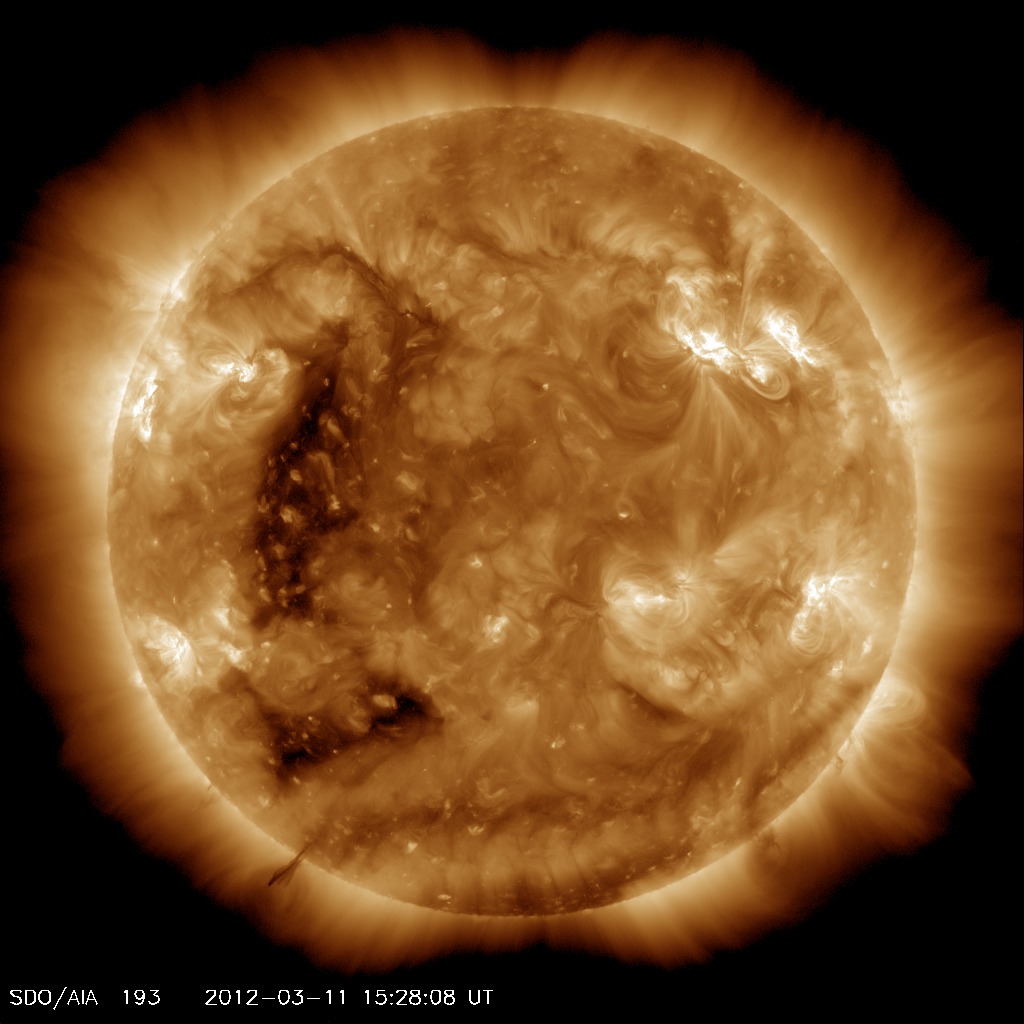
jojo_it writes "NASA Solar Dynamics Observatory photographed a gigantic spot on the sun's corona, that takes the shape of a black triangle. The spot is visible on the AIA 193 channel [of NASA's solar dynamics observatory] since March 11th. 2012 doomsday-theorists should be delighted." -
Huge Triangle-shaped Spot Over the Sun
jojo_it writes "NASA Solar Dynamics Observatory photographed a gigantic spot on the sun's corona, that takes the shape of a black triangle. The spot is visible on the AIA 193 channel [of NASA's solar dynamics observatory] since March 11th. 2012 doomsday-theorists should be delighted." -
NASA Rocket Barrage Will Light Up Mid-Atlantic Coast
coondoggie writes "NASA will this week detail a mission where it will launch five rockets in five minutes from its Wallops Flight Facility in Virginia that will light up the night sky for millions of folks in a swath between New York City and about Wilmington, NC. The five rocket blasts, which could occur between March 14 and April 4, are part of what the space agency calls the Anomalous Transport Rocket Experiment (ATREX), a Heliophysics sounding rocket mission that aims to gather data needed to better understand the high-altitude jet stream located 60 to 65 miles above the surface of the Earth, NASA said." NASA will be hosting a teleconference at 1PM EST on Wednesday to discuss the mission. They also have brief PDF descriptions of the rockets involved: Terrier-Improved Orion, Terrier Oriole, and Terrier Malemute. -
NASA Rocket Barrage Will Light Up Mid-Atlantic Coast
coondoggie writes "NASA will this week detail a mission where it will launch five rockets in five minutes from its Wallops Flight Facility in Virginia that will light up the night sky for millions of folks in a swath between New York City and about Wilmington, NC. The five rocket blasts, which could occur between March 14 and April 4, are part of what the space agency calls the Anomalous Transport Rocket Experiment (ATREX), a Heliophysics sounding rocket mission that aims to gather data needed to better understand the high-altitude jet stream located 60 to 65 miles above the surface of the Earth, NASA said." NASA will be hosting a teleconference at 1PM EST on Wednesday to discuss the mission. They also have brief PDF descriptions of the rockets involved: Terrier-Improved Orion, Terrier Oriole, and Terrier Malemute. -
NASA Rocket Barrage Will Light Up Mid-Atlantic Coast
coondoggie writes "NASA will this week detail a mission where it will launch five rockets in five minutes from its Wallops Flight Facility in Virginia that will light up the night sky for millions of folks in a swath between New York City and about Wilmington, NC. The five rocket blasts, which could occur between March 14 and April 4, are part of what the space agency calls the Anomalous Transport Rocket Experiment (ATREX), a Heliophysics sounding rocket mission that aims to gather data needed to better understand the high-altitude jet stream located 60 to 65 miles above the surface of the Earth, NASA said." NASA will be hosting a teleconference at 1PM EST on Wednesday to discuss the mission. They also have brief PDF descriptions of the rockets involved: Terrier-Improved Orion, Terrier Oriole, and Terrier Malemute. -
NASA Rocket Barrage Will Light Up Mid-Atlantic Coast
coondoggie writes "NASA will this week detail a mission where it will launch five rockets in five minutes from its Wallops Flight Facility in Virginia that will light up the night sky for millions of folks in a swath between New York City and about Wilmington, NC. The five rocket blasts, which could occur between March 14 and April 4, are part of what the space agency calls the Anomalous Transport Rocket Experiment (ATREX), a Heliophysics sounding rocket mission that aims to gather data needed to better understand the high-altitude jet stream located 60 to 65 miles above the surface of the Earth, NASA said." NASA will be hosting a teleconference at 1PM EST on Wednesday to discuss the mission. They also have brief PDF descriptions of the rockets involved: Terrier-Improved Orion, Terrier Oriole, and Terrier Malemute. -
NASA Rocket Barrage Will Light Up Mid-Atlantic Coast
coondoggie writes "NASA will this week detail a mission where it will launch five rockets in five minutes from its Wallops Flight Facility in Virginia that will light up the night sky for millions of folks in a swath between New York City and about Wilmington, NC. The five rocket blasts, which could occur between March 14 and April 4, are part of what the space agency calls the Anomalous Transport Rocket Experiment (ATREX), a Heliophysics sounding rocket mission that aims to gather data needed to better understand the high-altitude jet stream located 60 to 65 miles above the surface of the Earth, NASA said." NASA will be hosting a teleconference at 1PM EST on Wednesday to discuss the mission. They also have brief PDF descriptions of the rockets involved: Terrier-Improved Orion, Terrier Oriole, and Terrier Malemute. -
One In Eight Chance of a Financially Catastrophic Solar Storm By 2020
An anonymous reader writes "A privately employed solar scientist named Pete Riley estimates there's a 12 percent chance of a massive solar storm comparable to the Carrington Event in 1859 which resulted in breathtaking aurorae across the United States and other temperate regions of the globe. The electromagnetic surge from the 1859 event caused failures of telegraph systems across Europe and North America. A similar storm today could knock out power grids, GPS and communication satellites, data centers, transportation systems, and building and plumbing infrastructures and wreak $1 trillion or more of economic damage in the first year alone, according to a 2008 report from the National Academy of Sciences." -
One In Eight Chance of a Financially Catastrophic Solar Storm By 2020
An anonymous reader writes "A privately employed solar scientist named Pete Riley estimates there's a 12 percent chance of a massive solar storm comparable to the Carrington Event in 1859 which resulted in breathtaking aurorae across the United States and other temperate regions of the globe. The electromagnetic surge from the 1859 event caused failures of telegraph systems across Europe and North America. A similar storm today could knock out power grids, GPS and communication satellites, data centers, transportation systems, and building and plumbing infrastructures and wreak $1 trillion or more of economic damage in the first year alone, according to a 2008 report from the National Academy of Sciences." -
NASA Squandering Technology Commercialization Opportunities
coondoggie writes "The commercialization of all manner of space technologies has always been a forte of NASA, but the space agency faces a number of economic and internal challenges if that success is to continue. A report by released this week (PDF) by NASA Inspector General Paul Martin that assesses NASA's technology commercialization efforts is highly critical of the space agency's ability to identify and get important technologies out of the lab and out the door to commercial applications." -
Stolen NASA Laptop Had Space Station Control Code
astroengine writes "NASA had 5,408 computer security lapses in 2010 and 2011, including the March 2011 loss of a laptop computer that contained algorithms used to command and control the International Space Station, the agency's inspector general told Congress Wednesday. According to his statement (PDF), 'These incidents spanned a wide continuum from individuals testing their skill to break into NASA systems, to well-organized criminal enterprises hacking for profit, to intrusions that may have been sponsored by foreign intelligence services seeking to further their countries’ objectives.'" -
Solid Buckeyballs Detected In Space
astroengine writes with an excerpt from an article at Discovery: "For the first time, 'buckyballs' have been discovered in the cosmos in a solid form. Until now, the only evidence in space for the bizarre little hollow balls of carbon atoms have been in interstellar gases, but with the help of NASA's Spitzer Space Telescope, astronomers have discovered buckyballs accumulating and stacking atop one another to form solid particles. 'These buckyballs are stacked together to form a solid, like oranges in a crate,' said Nye Evans of Keele University in England, lead author of a paper appearing in the Monthly Notices of the Royal Astronomical Society. 'The particles we detected are minuscule, far smaller than the width of a hair, but each one would contain stacks of millions of buckyballs.'" -
Electric Rockets Set To Transform Space Flight
An anonymous reader sends this quote from an article at Txchnologist: "The spectacle of a booster rocket lifting off a launch pad atop a mass of brilliant flames and billowing smoke is an iconic image of the Space Age. Such powerful chemical rockets are needed to break the bonds of Earth's gravity and send spacecraft into orbit. But once a vehicle has progressed beyond low-earth orbit chemical rockets are not necessarily the best way to get around outer space. That's because chemical propulsion systems require such large quantities of fuel to generate high speeds, there is little room for payload. As a result rocket scientists are increasingly turning to electric rockets, which accelerate propellants out the back end using solar-powered electromagnetic fields rather than chemical reactions. The electric rockets use so much less propellant that the entire spacecraft can be much more compact, which enables them to scale down the original launch boosters." -
Moon May Not Be As Dead As We Thought
rivin2e writes "It would seem our neighbor, the moon, has something hidden below the surface. 'Images collected by the Lunar Reconnaissance Orbiter hints the moon has probably seen tectonic activity within the last 50 million years.' It would appear from the article that the moon is changing a lot more than we think, even if it doesn't seem like it. I, for one, am still waiting for that big black obelisk to be dug up." From NASA's press release: "A team of researchers analyzing high-resolution images obtained by the Lunar Reconnaissance Orbiter Camera (LROC) show small, narrow trenches typically much longer than they are wide. This indicates the lunar crust is being pulled apart at these locations. These linear valleys, known as graben, form when the moon's crust stretches, breaks and drops down along two bounding faults. A handful of these graben systems have been found across the lunar surface." -
LIDAR Map Shows Height of Earth's Forests
Hkibtimes writes about a recently released map of the Earth's forests. From the article: "A group of scientists from NASA and the University of Maryland have created a unique map that shows the heights of the Earth's forests. The map ... has been created using 2.5 million carefully screened and globally distributed laser pulse measurements sent from space." -
LIDAR Map Shows Height of Earth's Forests
Hkibtimes writes about a recently released map of the Earth's forests. From the article: "A group of scientists from NASA and the University of Maryland have created a unique map that shows the heights of the Earth's forests. The map ... has been created using 2.5 million carefully screened and globally distributed laser pulse measurements sent from space." -
LIDAR Map Shows Height of Earth's Forests
Hkibtimes writes about a recently released map of the Earth's forests. From the article: "A group of scientists from NASA and the University of Maryland have created a unique map that shows the heights of the Earth's forests. The map ... has been created using 2.5 million carefully screened and globally distributed laser pulse measurements sent from space." -
Successful Test Flight and Landing for Xombie Rocket Lander and GENIE
An anonymous reader sends word that Masten Space Systems' Xombie rocket has successfully demonstrated vertical takeoff and landing for NASA's Flight Opportunities Program. It was guided autonomously by the GENIE system from Draper Laboratory. "The rocket rose 164 feet, moved laterally 164 feet, and then landed on another pad after a 67-second flight. The flight represents the first step in developing a test bed capability that will allow for landing demonstrations that start at much higher altitudes-several miles above the ground." This navigation technology is laying the groundwork for future exploration of planets, moons, and asteroids. -
Congress Warns NASA About Shortchanging SLS/Orion For Commercial Crew
FleaPlus writes "NASA and the White House have officially released their FY2013 budget proposal, the first step of the Congressional budget process. As mentioned previously on Slashdot, the proposal decreases Mars science funding (including robotic Mars missions) down to $361M, arguably due in part to cost overruns by the Webb telescope. The proposal also lowers funding for the in-house SLS rocket and Orion capsule to $2.8B, while doubling funding for the ongoing competitive development of commercial crew rockets/vehicles to $830M. The ranking member of the Senate science committee, Sen. Hutchison (R-TX), expressed her frustration with 'cutting SLS and Orion to pay for commercial crew,' as it would allegedly make it impossible for SLS to act as a backup for the commercial vehicles." -
White House Wants Devastating Cuts To NASA's Mars Exploration
The Bad Astronomer writes "The White House released its proposed NASA budget for FY13, and while much of it remains the same from last year, one particular program got devastating news: Mars exploration got a crippling $226 million cut, more than 38% of its budget. This means killing two future missions outright and threatening others. The reasons for this are complex, including huge cost overruns on James Webb Space Telescope and the Curiosity Mars rover, but it also points to a political lack of valuing science in America." A followup to news from before the budget was released, this has details on the actual proposed cuts and re-allocations. -
ESA Discovers Unexpected 'Haze' of Microwave Transmissions
astroengine writes "The European space observatory Planck has discovered something peculiar about our galaxy: it's humming in microwaves and, for the moment, the source of the 'hard' radiation surrounding the galaxy's core is a complete mystery. Also, the Milky Way is home to previously unknown 'islands' of cold carbon monoxide gas, helping astronomers uncover the distribution of star-forming regions." -
Water Droplets In Orbit On the International Space Station
BuzzSkyline writes "Astronaut Don Pettit, who is aboard the International Space Station right now, puts charged water droplets into wild orbits around a knitting needle in the microgravity environment of the ISS. A video he made of the droplets is the first in a series of freefall physics experiments that he will be posting in coming months." -
NASA Finds Interstellar Matter From Beyond Our Solar System
An anonymous reader writes "For the very first time, a NASA spacecraft has detected matter from outside our solar system — material that came from elsewhere in the galaxy. This so-called interstellar material was spotted by NASA's Interstellar Boundary Explorer (IBEX), a spacecraft that is studying the edge of the solar system from its orbit about 200,000 miles (322,000 kilometers) above Earth. 'This alien interstellar material is really the stuff that stars and planets and people are made of — it's really important to be measuring it,' said David McComas, IBEX principal investigator." -
NASA Releases New High-Definition Image of Earth
New submitter klchoward writes "Working for NOAA, I have been really pleased to see the weather data from the new Suomi NPP satellite coming into our computer models already but have been blown away by its capability to take stunning high-definition images of our planet. See the article at Huffington Post or go straight to the image at NASA's website." Reader derekmead has some images from further afield, too: these beautiful images of Mars come from NASA's High Resolution Imaging Science Experiment camera, mounted on the Mars Reconnaissance Orbiter. -
2011 Was the 9th Hottest Year On Record
The Bad Astronomer writes "Last year was the 9th hottest year out of the past 130, according to NASA and the NOAA. That's no coincidence: nine out of the ten hottest years on record have been since the year 2000. It's long past time to face facts: the Earth is getting hotter, and to deny it is an exercise in fantasy." -
Can NASA Warm Cold Fusion?
TomOfAmalfi writes "Andrea Rossi says he can provide domestic energy sources (about 10 kW) based on his E-Cat system (a Low Energy Nuclear Reaction or Cold Fusion energy source) for between 100 and 150 US$/kW and begin shipping this year. Many people are skeptical about Rossi's claims because he has not explained how his 'reactors' work (apparently the reactors contain ingenious security devices to prevent reverse engineering), there is no theoretical basis to support his process, and no one has supplied independent measurements to support the specs on his black boxes. However, buried at the bottom of a NASA web page there is a comment about progress in 'cold fusion' research and a link to the slides used in a September 2011 presentation (PDF) which talks about LENR research. NASA has also released a video describing the great benefits we will get from NASA LENR research. Could Rossi be on to something?" -
Can NASA Warm Cold Fusion?
TomOfAmalfi writes "Andrea Rossi says he can provide domestic energy sources (about 10 kW) based on his E-Cat system (a Low Energy Nuclear Reaction or Cold Fusion energy source) for between 100 and 150 US$/kW and begin shipping this year. Many people are skeptical about Rossi's claims because he has not explained how his 'reactors' work (apparently the reactors contain ingenious security devices to prevent reverse engineering), there is no theoretical basis to support his process, and no one has supplied independent measurements to support the specs on his black boxes. However, buried at the bottom of a NASA web page there is a comment about progress in 'cold fusion' research and a link to the slides used in a September 2011 presentation (PDF) which talks about LENR research. NASA has also released a video describing the great benefits we will get from NASA LENR research. Could Rossi be on to something?" -
Can NASA Warm Cold Fusion?
TomOfAmalfi writes "Andrea Rossi says he can provide domestic energy sources (about 10 kW) based on his E-Cat system (a Low Energy Nuclear Reaction or Cold Fusion energy source) for between 100 and 150 US$/kW and begin shipping this year. Many people are skeptical about Rossi's claims because he has not explained how his 'reactors' work (apparently the reactors contain ingenious security devices to prevent reverse engineering), there is no theoretical basis to support his process, and no one has supplied independent measurements to support the specs on his black boxes. However, buried at the bottom of a NASA web page there is a comment about progress in 'cold fusion' research and a link to the slides used in a September 2011 presentation (PDF) which talks about LENR research. NASA has also released a video describing the great benefits we will get from NASA LENR research. Could Rossi be on to something?" -
The Challenges of Building a Mars Base
ambermichelle writes with an excerpt from an article in Txchnologist: "Going to Mars? Expect to stay a while. Because of the relative motions of Earth and Mars, the pioneering astronauts who touch down on the Martian surface will have to remain there for a year and a half. For this reason, NASA has already started experimenting with a habitat fit for the long-term exploration of Mars. Last year, students at the University of Wisconsin won the XHab competition to design and build an inflatable loft addition to a habitat shell that NASA had already constructed. The final structure now serves as a working model that is being tested in the Arizona desert. Like any home, it's a sacred bulwark against the elements; but not just the cold, heat, and pests of Arizona. A Mars habitat will have to protect astronauts from cosmic rays, solar flares, and unknown soil compositions all while keeping inhabitants happy and comfortable." -
NASA Launches Open Source Portal
sproketboy writes "NASA has launched code.nasa.gov, which will become a portal for NASA's open source software development activities. In its current form, it hosts a directory of the organization's open source software projects and provides documentation about NASA's open source software processes." -
NASA Launches Open Source Portal
sproketboy writes "NASA has launched code.nasa.gov, which will become a portal for NASA's open source software development activities. In its current form, it hosts a directory of the organization's open source software projects and provides documentation about NASA's open source software processes."