Slashdot Mirror
Domain: nasa.gov
Stories and comments across the archive that link to nasa.gov.
Comments · 16,365
-
Re:Hey..?
They appearantly sling-shot it by using several planets.
Check the Spacecraft Trajectory
Appearantly they used nuclear power too.
It's all I could find though -
Re:Hey..?
They appearantly sling-shot it by using several planets.
Check the Spacecraft Trajectory
Appearantly they used nuclear power too.
It's all I could find though -
Great news!
I submitted a story about this at 7 am, but it got rejected.. go figure.
Anyway, there's already some interesting photos, and more will be arriving during the day. check NASA TV for live video from mission control.
-
Pictures.
Not sure when the article was written but there are already raw and press images released as well as some others. The quality isn't as good as some may think and it really doens't show much detail into the rings at all.
-
Okay but not okay
Actually Robert Goddard was first in a number of these desiagns. Konstantin Eduordovich Tsiolkovsky has many ideas that in some cases predate Goddard's, for example the use of liquid fuels, or ideas that follow Goddard's, such as the use of multiple stages in a rocket, which Goddard received a U.S. patent for in 1914. Of the two, Tsiolovsky was more the theoretical scientist and Goddard more the technical specialist or engineer. I'll leave the Hermann Oberth research to somebody else.
-
oil independence - closer than you thinkThe numbers for replacing foriegn oil are:
- $169 billion to build the algae farms
- $33B/year operating costs
You can look at them for yourself at the University of New Hampshire site here This is largely based on research successfully completed at DOE in the mid 1990s and shelved because cheap oil looked like forever back then.
Other than that, remember $250/ton shipping to LEO? Follow the links from the slashdot article, to JP Aerospace and to evaluations by experts. From what I saw at the JP Aerospace site, the only reason why it's going to take 7 years for them to get to orbit is lack of funding. They're getting DOD experimental contracts for high-altitude transportation, but even with this, they're bootstrapping. The NASA space power satellite system was planned on a basis of $400/kg shipping cost. $250/ton is a lot cheaper than $400/kg.
The only thing keeping these technologies from becoming a viable alternative in the very near term is bad habit on the part of what passes for our business and governmental leadership. They're obsessed with the idea that the only way to get oil is the traditional methods. Even if the cost estimates for biomass oil and the SPS are off by a factor of 10, they look awfully good next to the projected $16T (yes, that's $16,000 billion) dollar cost of "business as usual"... based on an unproven and unlikely assumption that "enough" oil is there to be found. (see below)
Hint: The Bush Administration defunded the Space Power Satellite project.
Concrete steps to get this running? For the oil side, how about government loans, tax credits, and temporary price supports in case the oil cartel gets desperate enough to try to put the new energy replacements out of business by dropping their oil prices to cost of production? A promise to the rest of the world that the algae oil biomass production technology will be freely exported as soon as it is ready to go? These are the first things that occur to me.
For the space side, direct government funding, and or payload guarantees (e.g. the government will guarantee payment for X-million pounds per year of payload to any vendor(s) who can prove the ability to get it to LEO for, say, under $10/pound?) would be a good start. Or start contracting for lots and lots of solar cells and designate JP Aerospace as the prime contractor to get them to orbit.
The alternative: The International Energy Agency wants $16 TRILLION DOLLARS to be spent on new oil exploration and development and facilities to "prevent" energy crisis. This makes the happy assumption that there's enough oil to solve the problem. A few minutes spent googling on "peak oil" will convince you that there isn't.
The $16T does NOT include the military costs of dealing with the Middle East.
Personally, I'd rather see $16T spent on something useful.
-
Excellent - back to sneakernet!
I'm in the middle of downloading 30 GB of data from one of the SOHO instruments; it will take 3 days to get it over our T1. The only advantage of doing the transfer over the net is that putting it on DVDs for mailing would require somebody on their end to monitor and swap out 6-7 DVDs as they're burned, and then somebody on my end to monitor and swap out those DVDs as they're read onto my hard drive. With a Blu-Ray disk they could burn a single medium then drop it in the mail. And I'd still get the data at the same time as my network transfer will finish.
-
Re:interestingIndeed, with unlimited resources it would be interesting to see if microfractures develop due to small meteorite impact / radiation / day/night temperature cycle and such, but it would seem that these can be learned via separate means without the need of a dedicated rover mission.
NASA already explored this.
It was called the Long Duration Exposure Facility, or LDEF. It was a 10+ ton structure filled with 57 different experiments that the space shuttle carried to orbit in 1984 and retrieved from orbit in 1990.
-
Obligatory pictures
I haven't seen them linked to yet, so here's some info pages with pics of this:
"Habot" mobile lunary base
Mobitat (mobile lander?)
Does anybody know if scientists in Antartica use mobile habitats? If they do, then this would seem much more plausible. -
Obligatory pictures
I haven't seen them linked to yet, so here's some info pages with pics of this:
"Habot" mobile lunary base
Mobitat (mobile lander?)
Does anybody know if scientists in Antartica use mobile habitats? If they do, then this would seem much more plausible. -
Pictures
-
Pictures
-
Problem Solved
NASA's already got this monstrosity (the Mobile Launcher Platform, not the shuttle), so why can't they just throw some bunk beds in it and blast it into space?
Oh, and food. They'd need food as well. -
What if...
What if the mobitat (or whatever) runs into the same problem the rover[s] ran into? In general what if the mobitat runs into any problems? This page shows a mobitat that also acts as a lander. I'm guessing it would also act as the return vehicle. Do you really want to put your ticket back home into more jeopardy than absolutely necessary? For example, by having it move around, possibly through difficult terrain and such. Of course one would have to weigh the benefit of not having to travel to get back to your return vehicle over the mobility of this type of habitat and the equipment-carrying capability it implies.
-
Re:Pheobe as a source of iceAh, good point! The only thing in Phoebe's favor might be that it orbits a lot farther out from Saturn, so it would take less energy to lift the ice out of Saturn's gravity well, but then, I guess the whole premise was that propulsion was cheap. This link does seem to imply that the rings are dense enough to pose a real hazard to navigation, though.
We don't need to grab a whole moon
I was just talking about digging ice out of it, not moving the whole moon. -
Re:Cassini's Real Interaction with the Rings
I think the analogy is more like trying to sail between Oahu and Midway, but yeah, there still is a pretty big gap of ocean there.
Check out this webpage to get further details. It is going to travel between the "F" and "G" rings, which are pretty faint by themselves. There will be a larger likely hood of running into something in that region of space, probabaly an order of magnitude higher than would normally be found within the Saturnian system of moons, but still fairly low. -
Re:Pheobe as a source of iceSolar power doesn't provide a lot of energy in deep space.
Solar-powered ion drives don't require a lot of power; they use low thrust over long periods of time. Check out this link for an example. Note that the name of the craft is "Deep Space 1." It went to the asteroid belt, but even if it went out as far as the orbit of Saturn, it would just have to operate at lower thrust.That why Cassini needed a nuclear reactor.
Cassini doesn't have a nuclear reactor, it has a radioactive source that provides energy by passive heating. (A reactor uses a chain reaction.) -
Re:Pheobe as a source of ice
Cassini does NOT use a nuclear reactor. It uses Radioisotope Thermoelectric Generators. Please do no feed misinformation to the nuclear ignorant torch burning masses.
-
Re:Sound in space?
The Huygens probe will be recording the sounds of Titan (which has an atmosphere).
-
Re:450 watts?
That's a bit low, but not too far off. Cassini uses 3 RTG power sources to generate the ~700-800 W necessary for the science instruments. Solar cells are not practical at that distance.
This PDF file details the power supply situation on the spacecraft.
It's pretty remarkable how little power spacecraft like this consume (and I'm pretty sure that Cassini is the most power hungry of the 'outer-solarsystem' probes NASA has launched).
-
Re:Not even 0.5kilowatts..
On the other hand, it's not like your average HAM has the Deep Space Network at his disposal. 70m antennas are bigger that you might expect.
-
Re:Not even 0.5kilowatts..
On the other hand, it's not like your average HAM has the Deep Space Network at his disposal. 70m antennas are bigger that you might expect.
-
I call bullshitHere's one set of lists from among many. Yes, many real scientists are creationists.
The scientist on the right is a creationist, and wrote the TERRA software being discussed on that page. In its time, it was regarded as the single best Earth-modelling package available and is still very well regarded (Linux and ForTran afficiondos will be pleased by that too, since it's written in ForTran-90 and runs on Beowulves).
Dr D Russell Humphreys predicted the whacko magentic fields of Naptune and Uranus from creationist principles; the predictions of materialists were well wide of the mark.
I could go on to labour the point, but there is real science and real scientists on the side of creationism.
GAME OVER
PLAYER <1>
Consider yourself called. (-: -
at $250/ton to LEO, the project is practicalThe original NASA numbers were based on $400/kg.
A cheaper alternative not only to rocket boosters, but to the obsolete Space Elevator concept is under development. For more about blimps to space, go to this slashdot article and follow the links.
Remember the art deco artist's conceptions done in the 1930s of skycars we'd all be driving in 2000? Shove the Space Elevator into those pictures and let's start actually putting stuff into space instead.
Unlike the space elevator, the blimp doesn't require solving some rather fundamental materials problems involving taking a lab process and scaling up fibers a few inches long into linear structures thousands of miles long, or building a giant ribbon which in and of itself is a safety hazard (YOU want to be aroud one that breaks? Or on your way up/down?), the blimp-to-space project is simply a logical extension of technologies we already know.
The NASA 20TW configuration orginally discussed would probably be a lot cheaper to build using the new space transportation methods even including building the transportation than the original would have been. At $250/ton, we can simply buy the solar cells, build modular structures to put them in, and assemble them around L5.
-
Nukes and the ocean
We're all missing it. Luanch a bird with a nuclear reactor in it and when the sludge builds up or the core is depleted, send it on a trajectory for the sun. Keep the platform small so that it won't have a large impact at the sun. References include:
The other point mentioned briefly in the Japan article is that even if high-energy beams were used, they could be pointed out to sea. Put it out far enough and bouys would be easy to post or, better yet, a small unmanned receiving platform with a cable to the land.
-
Re:Outstanding idea. . . and will never happen. .
Solar satellite power generation is particularly poor in this regard. Sunlight is concentrated using mirrors (with some losses) onto a boiler (with some of the light reflecting instead of being converted to heat, and some of the heat radiating away via black-box radiation). The next few steps are the same as for a coal plant: steam drives a turbine, which drives a dynamo, which generates electricity. At that point, all you have to do is to deliver it, but that is not easy with solar satellites.
What the heck?!! The guy who made this "critique" is a complete idiot. The technology doesn't even work this way - it uses photovoltaics instead*. According to this guy's logic, photovoltaics should come out way ahead, since they have only one conversion (sunlight -> electricity directly). That's not necessarily true, though - it depends on the efficiency of the solar cells (currently ranging from 5% to 20%, as far as I know).
But anyway, if the guy can make such a huge error at the beginning of his argument, his entire credibility is shot completely to hell anyway!
*look here, at the first bullet under "Technical Approach" -
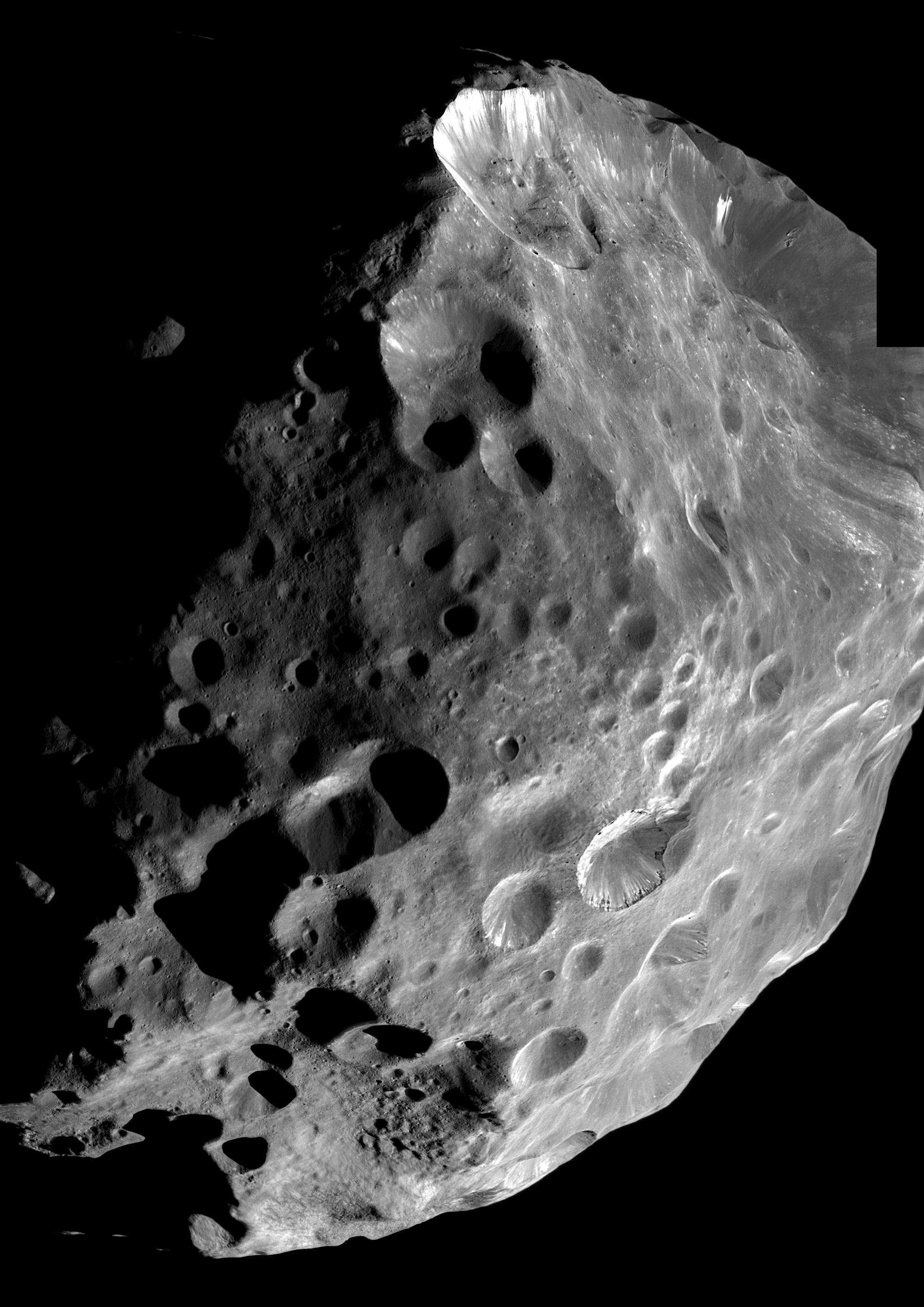
The good photos.Closeup (2050x2900 pixels) Look for the bright crater right at the top (on the solar terminator line) and the fresh crater on the lower right.
Ultraviolet comparison. Interesting for the brightest UV location being in shadow in the visible light photo.
-
The good photos.Closeup (2050x2900 pixels) Look for the bright crater right at the top (on the solar terminator line) and the fresh crater on the lower right.
Ultraviolet comparison. Interesting for the brightest UV location being in shadow in the visible light photo.
-
Re:Excellent...
Now maybe a private company can develop it for 2% of the cost and we'll have cheap, environmentally benign power.
Or, now maybe we can continue to be dependent on (mostly foreign) oil, established oil companies with little incentive to develop newer and ultimately cheaper energy sources, and politicians who make sure NASA doesn't undermine those vested interests.
"NASA officials cited a policy shift toward the International Space Station and the space shuttle program."
Now, I know the Shuttle has been so tremendously successful, and the International Space Station isn't just the leftovers of the lasts gasps of the old Soviet Manned Space Flight Program, both have been so well funded since the "policy shift" three years ago in 2001 -- so, if you're going to be intellectually honest, you have to ask yourself, "what occasioned this policy shift?"
I'm not just trying to be annoyingly partisan here; I'm trying to make the point that even when it comes to science, politics takes over, and when politics takes over, you have to follow the money. -
Re:There is no material strong enough... ever.
Not true, i've read many articles on the strength required, and current carbon nanotube research is within the same order of magniture of required strength or better. We just have to learn how to make a composite cable in bulk.
From Nasa
Fiber materials such as graphite, alumina, and quartz have exhibited tensile strengths greater than 20 GPa...
The desired strength for the space elevator is about 62 GPa...
Carbon nanotube exhibits extraordinary mechanical properties: the estimated tensile strength is 200 Giga-Pascals.
-
Re:How Far?
NASA says geosynchronous orbit is 36000 km = 22000 miles. I think the 62000 miles part must be so the centrifugal force keeps the cable taut. You could build a solid tower up to 62 miles, but a cable-elevator just wouldn't work at that distance.
-
Re:Filtering software
I agree that having filtering software on the spacecraft rather than on the ground does not change anything for this particular project, but there are some situations where having such software would be very beneficial.
If your spacecraft has a limited bandwidth where you are forced to throw some data away, you will want some onboard processing to determine what's "interesting" or not so that you will have a better probability of getting better science data on the ground. Such software is also vital for spacecraft which have capabilities similiar to Deep Space 1's autonav system. Imagine the possibilities of a spacecraft that can fly itself with very little ground interaction and able to automatically determine which instruments to use and when. Currently, deep space missions get planned out years and years in advance in order for the spacecraft to be completely utilized all the time. It would be nice to at least have an "autopilot" feature for not only attitude control but also automatically find opportunties when the instruments could be best utilized.
If you have a typical earth orbiting satellite with a high transfer rate, just return all of the data and do the processing on the ground. We have a number of large databases of satellite data just so we can do our own filtering and analysis on the data years and years after the fact. Some of our processing requires days or weeks to execute and sometimes we still don't know if the data is "interesting" or not. If we let the spacecraft determine everything, there will be things we miss. I'd prefer to use the flight software to only gather data and package it up rather than try to make fancy decisions for us. Of course, all of this also depends on the role of your data. Certain datasets will benefit from such advances. My data won't -- we need as much of it as we can get. But if we didn't have a large data rate, the best possible solution would then be to put some processing on the spacecraft to increase our odds on getting good data.
What does all this mean? It means that you need to do what's appropriate for your data and as always, your mileage may vary. -
What's the big deal?
I mean - NASA has been doing autonomous navigation with DS-1 since 1999 Other autonomous duties don't seem like such a stretch when it only takes a second to communicate - not 10 minutes! Now that's net lag!!!
-
Re:The "R Prize"
Actually, robotics is one of the expected areas that NASA's under-development Centennial Challenges Program for cash-prize contests will cover. I'm quite excited to see what sorts of results we'll see from that.
-
Re:ISS helps USA?Go figure, NASA decides to abandon the ISS once the USA's commitment is finished, and somehow, the science used to build the ISS due to international collaboration just might save one of our most invaluable satellite telescopes.
Actually, the canadarm has been on shuttles since very early in the shuttle program. Using them to work on Hubble is nothing new, reference this photo . That's the shuttle variation of the arm holding Hubble in preparation for a past repair mission. The real difference in this proposal, is the use of a second arm from the same folks, with more manipulators etc, to do the repair work, instead of sending an astronaut out for a walk. Nasa is risk adverse, with only 3 years to perform the mission, they wont try find a 'new' contractor at this stage, they'll go with a known quantity, the folks that have been building them arms for as long as they've been in use on shuttles.
About the only downside to this style of repair mission, it'll emphasize the lack of relavence of 'manned missions' with modern robotic technology available. Cant help but wonder if that's really a bad thing. A robotic mission to service the Hubble will likely cost a LOT less than a manned shuttle launch, and achieve the same end result. Cant see any downside to it.
-
ISS helps USA?
Go figure, NASA decides to abandon the ISS once the USA's commitment is finished, and somehow, the science used to build the ISS due to international collaboration just might save one of our most invaluable satellite telescopes. I think as long as something is done to save the HST for a few more years, we're in excellent shape. FYI -- the HST is the only instrument that can observe the lyman alpha/beta/gamma/etc. emission lines from the furthest galaxies (z >= 7)... despite all the redshifting, the James Webb Space Telescope won't be able to observe the most powerful of emission lines as the HST still can!
-
Re:At first i thought this post was stupidThanks. And here it is with the HTML active.
This evening, I learned that one meter equals 39.3700787 inches. While this may come as no surprise to some people, it was one to me - for years, I had mistakenly believed a meter was 39.77 inches, and now I know it's basically 39.37.
Of course, I'm not alone in my confusion. A bit of research on Google revealed quite a few different conversions from meters to inches. Here are some of them:
- 38 inches according to a page at Arkansas State University and another at Microflex Technologies.
- 38.16 inches according to a rounding-happy math teacher at Norfolk Collegiate School in Virginia.
- 38.37 inches according to Honeywell's Sensotec folks.
- 38.8 inches according to some numerological babble
- 39 inches according to Fife Products and some folks who sell quilting products.
- 39.14 inches according to the specifications on a measuring wheel for engineers. (uh-oh!)
- 39.15 inches according to an October 30 2002 entry in a blog.
- 39.21 inches according to Richard Bowles.
- 39.27 inches according to pages at University of Wisconsin Stevens Point and the National Optical Astronomy Observatory.
- 39.28 inches according to Jonathan Brooks at Penn State University.
- 39.3 inches according to some laser folks.
- 39.34 inches according to a page about photography, and another about a role-playing game. Hey, it's only a game, their meters can be whatever length they want.
- 39.36 inches according to some ham radio sorts and some NASA folks among others. Pretty close... but... shouldn't NASA know better by now?
- 39.38 inches according to people who race 1-meter model yachts, talk about prehistory in California, and, um, other NASA folks. Again, pretty close!
- 39.39 inches according to someone ranting against metric (how ironic), as well as a page about UFOs.
- 39.4 inches according to a list of conversions from a company that makes electric motors and such things, and the Secretary of the Navy.
- 39.45 inches according to a set of math problems f
-
Re:At first i thought this post was stupidThanks. And here it is with the HTML active.
This evening, I learned that one meter equals 39.3700787 inches. While this may come as no surprise to some people, it was one to me - for years, I had mistakenly believed a meter was 39.77 inches, and now I know it's basically 39.37.
Of course, I'm not alone in my confusion. A bit of research on Google revealed quite a few different conversions from meters to inches. Here are some of them:
- 38 inches according to a page at Arkansas State University and another at Microflex Technologies.
- 38.16 inches according to a rounding-happy math teacher at Norfolk Collegiate School in Virginia.
- 38.37 inches according to Honeywell's Sensotec folks.
- 38.8 inches according to some numerological babble
- 39 inches according to Fife Products and some folks who sell quilting products.
- 39.14 inches according to the specifications on a measuring wheel for engineers. (uh-oh!)
- 39.15 inches according to an October 30 2002 entry in a blog.
- 39.21 inches according to Richard Bowles.
- 39.27 inches according to pages at University of Wisconsin Stevens Point and the National Optical Astronomy Observatory.
- 39.28 inches according to Jonathan Brooks at Penn State University.
- 39.3 inches according to some laser folks.
- 39.34 inches according to a page about photography, and another about a role-playing game. Hey, it's only a game, their meters can be whatever length they want.
- 39.36 inches according to some ham radio sorts and some NASA folks among others. Pretty close... but... shouldn't NASA know better by now?
- 39.38 inches according to people who race 1-meter model yachts, talk about prehistory in California, and, um, other NASA folks. Again, pretty close!
- 39.39 inches according to someone ranting against metric (how ironic), as well as a page about UFOs.
- 39.4 inches according to a list of conversions from a company that makes electric motors and such things, and the Secretary of the Navy.
- 39.45 inches according to a set of math problems f
-
Re:It matters becauseDude, this Dan Birchall is not a NASA administrator of any kind (look at his home page). He's a freelance writer/web page designer/executive director of SpamCon, if I have the right Dan Birchall.
There is, in fact, no Birchall in administration at NASA, and as far as I can find, there is no Birchall associated with NASA.
The program director of NASA's Mars program is Scott Hubbard. http://mars.jpl.nasa.gov/newsroom/pressreleases/0
0 -10-26.html (search for mars program director) -
Can NASA learn from NSF and Darpa?
I can't help but wonder if NASA would be more effective if it took on a model much more like NSF's or DARPA's. Instead of splitting up tasks between their own field centers and painstakingly managing everything, it could become more focused on providing funding to foster the nation's space infrastructure and using programs like Centennial Challenges to accomplish specific tasks. Existing NASA centers could compete for this funding just like other organizations like universities and private companies. Doing things in this manner would also limit NASA's PR liability in the event of catastrophe, keeping the space program from becoming completely paralyzed every time a disaster happens.
Of course, this would also limit the potential for pork-barrel spending, and would thus experience difficulties in actually becoming enacted. -
This is old news: NASA's Centennial Challenges
The Wired article uses information from this Reuters article by Deborah Zabarenko.
Reuters: "Within hours of the first private flight to outer space on Monday, a NASA official said the agency might offer millions of dollars in prizes..." This is misleading. NASA's Centennial Challenges program has been in the planning stage for quite some time now.
- Centennial Challenges - NASA
- NASA Needs Prize Contest Ideas - Slashdot
- Centennial Challenges - Wikipedia
My opinion on prizes: Prizes are great, but they should complement grants, not replace them. An analogy: If we want to catch Osama bin Laden, we should put a big bounty on him. But that doesn't mean we should call off the military and the CIA. We should post a big bounty AND fund the military and the CIA. Same thing with space: Put a big 'bounty' on space achievements, but fund NASA too.
-
NASA's Centennial Challenges Program
Here's the official and wikipedia links to information on NASA's Centennial Challenges Program, which is what the article is presumably referring to. The contests haven't been decided on yet, but currently things like "very low cost spacecraft missions", "breakthrough robotic capability competitions", and "revolutionary technology demonstrations" are under consideration.
Speaking of, has anybody heard about what happened at the Centennial Challenges Workshop on June 15-16? I haven't been able to find any reports on it. Hopefully at least one slashdotter attended... -
NASA's Centennial Challenges Program
Here's the official and wikipedia links to information on NASA's Centennial Challenges Program, which is what the article is presumably referring to. The contests haven't been decided on yet, but currently things like "very low cost spacecraft missions", "breakthrough robotic capability competitions", and "revolutionary technology demonstrations" are under consideration.
Speaking of, has anybody heard about what happened at the Centennial Challenges Workshop on June 15-16? I haven't been able to find any reports on it. Hopefully at least one slashdotter attended... -
how about 100 billion for a space drive?
100 billion USD to the first person to invent a workable interstellar propulsion system that could theoretically make it to alpha-centauri within 300 of our years (yes, you'd have to have sex in space). Any takers?
-
Re:This isn't what I expected
20 Capsules: $50 million dollars (1965 dollars).
1 capsule: $2.5 million
Adjusted for inflation...
20 Capsules: $281 million (2002 Dollars)
1 Capsule: $14.5 million
So for bit more, we got two planes and room to play with M&Ms
Source: NASA
SP -
Don't be too harsh
Consider as well that even the big boys have had their fair share of problems, and still managed to get out with everyone alive.
Space flight is dangerous. What amazes me is that even big problems don't result in fatalities whereas, in the case of Challenger(maybe Columbia), a minor problem resulted in the death of the crew. -
Re:Question
Since nobody answered the question correctly, the lowest stable orbit is about 115mi(185km) at 17,390mi/hr(7.79km/sec). At 185mi(300km) where the Shuttle orbits the velocity is about 1 percent less. A geosynchronous satellite orbits at 35,800 km and has a orbital velocity of 6720mi/hr(3.01km/sec). The Moon at 238,000(384,400km) travels at about 1km/sec.
All that crap about escape velocity was just that. All energy is spent on climbing out of the gravity well(aside from aerodynamic losses, of course). The orbital velocity is energy spent to fall around the earth.
All esoterica: air-launch, sea-launch, equator launch sites, airship-to orbit, and aerospikes are meant to maximize efficiency in the least efficient realm of traditional rocketry, the low altitude, high air pressure troposphere that kills specific impulse of rocket nozzles designed for space. All are looking for a better way to punch through that first 15-20 miles without burning rocket fuel. If you're going 200-300 miles why not hitch a free(or almost) ride for the most troublesome 5-10%?
Here's a javascript orbital period and velocity calculator.
Incidently, for that other questioner, if you simply go straight up, you will "fall into" orbit. It will simply be an elliptical orbit with near-infinite eccentricity.... and it will intersect with the surface of the Earth at whatever point is below you now that the Earth has had some time to turn.
You'll make one hell of an impression. -
Re:Question
See for yourself. L4 is 93,000,000 miles out. Or are we talking Earth/Moon L points? That would still be 200,000 miles out for L1.
-
Re:Pop open the champagne, my boy Rutan made histo
Take a few minutes today and Google 'Gemini Series'. This is what Burt Rutans craft is compareable to. The early Gemini rockets did not achieve orbit. The went up, and came back down again.
All manned Gemini missions achieved orbit. I think you're thinking of Project Mercury. The first two manned Mercury flights (Freedom 7 and Liberty Bell 7) were 15-minute suborbital flights. Later Mercury missions were launched on more powerful booster rockets, and they achieved orbit.
Project Gemini, on the other hand, was far more advanced than Mercury. It was the proving ground for technologies and procedures that would be used in the Apollo moon landings (rendezvous, space suits, long duration flights, etc.). Gemini XI reached an altitude of 1368 km, which is several times higher than even the Space Shuttle can reach.
-
Re:Pop open the champagne, my boy Rutan made histo
Take a few minutes today and Google 'Gemini Series'. This is what Burt Rutans craft is compareable to. The early Gemini rockets did not achieve orbit. The went up, and came back down again.
All manned Gemini missions achieved orbit. I think you're thinking of Project Mercury. The first two manned Mercury flights (Freedom 7 and Liberty Bell 7) were 15-minute suborbital flights. Later Mercury missions were launched on more powerful booster rockets, and they achieved orbit.
Project Gemini, on the other hand, was far more advanced than Mercury. It was the proving ground for technologies and procedures that would be used in the Apollo moon landings (rendezvous, space suits, long duration flights, etc.). Gemini XI reached an altitude of 1368 km, which is several times higher than even the Space Shuttle can reach.