Slashdot Mirror
Domain: nasa.gov
Stories and comments across the archive that link to nasa.gov.
Comments · 16,365
-
Re:I'm kind of surprised...
Actually, that was suppose to happen. the current admin was trying to kill it. Now, that they are supposedly going after the moon and mars, who knows? Perhaps, W's people will quit trying to kill good stuff.
-
Re:USATODAY.com for all your science needs...
Too bad Gene Roddenberry is not alive to see the beginning...
Hmm, I always thought it begun on my 17th birthday
>>>>> The Apollo 8 Christmas Eve Broadcast
CC. -
Um...not quite
It's a white dwarf, the diamond would be sorrounded by plasma and gas.
-
Re:Lava Tubes!!
[Olympus Mons has] nearly 3 times as high as the Everest summit... less gravity to escape, less fuel to burn.
The gravity at Olympus Mons is higher than average. Check out this gravity map of Mars. All of the black spots (the spots with the highest gravity) are volcanoes; the leftmost black spot on the left hemisphere is Olympus Mons.Gravity decreases as you get farther away from the surface, but when you're at the surface, it is the mass of the stuff under your feet that matters.
-
Re:So the question is
The account continues in verse seven if you don't know how it turned out. I agree with Groklaw's advice. Leave it be!
Please choose your worldview;
worldview 1)
Well, unfortunately they did not leave the forbidden fruit alone.
Since we all are descendants of Adam and his transgression, we inherit the propensity to commit sin.
Therefore there are those of us among us who cannot resist the temptation, will partake of the sweet fruit, and will be beguiled by the evil forces once again.
We should prepare for the worst, and be ready to watch episodes of "Cops" busting nerds for copyright violations. Or at the very least read on Groklaw the fate of nerd souls as they are the subject of much legal action, most of which is unfair.
The outcome is nerds repent, and align themselves with the forces of good. They become resolute in their purpose, forming alliances among themselves that allows them to produce OSS that is competitive in a market economy, and embraced by all. Corporate propriety code is rendered irrelevant.
worldview 2)
The same evolutionary forces that gifted fish with the ability to walk will once again affect the evolution of humans. As those nerds who are jailed for their infringing OSS projects they are effectively removed from the nerd genepool and cannot reproduce. Other nerds through fear, uncertainty and doubt are driven into deeper social isolation and fail to reproduce also. The remaining nerds who through acts of pity from the opposite sex produce progeny who have the ability to produce functional code on their own, free from infringing material.
However, because the number of nerds has actually been reduced through this attrition, they are at a competitive disadvantage to corporate propriety interests. They are subsequently harassed into submission and have to work for "The Man" producing closed-source software.
worldview 3)
There is a malevolent alien on a mountain trapped by lasers somewhere. His name is a lot like element Xenon atomic number 54 except the end rhymes with "gnu" or "boo". Anyway there are these harmful things that are called "thetans" that are removed through a strange process called "auditing". In order to prevent harm from these malicious forces, nerds "audit" their OSS projects and learn that it is actually composed of software owned by corporate interests.
They also learn that corporations produce superior code through their closed-source ways. It becomes obvious that they should obey whatever the corporate interest wants concerning their IP. If somebody questions anything, they are "silenced" one way or another, usually by suing them into oblivion. Nerds are at peace with this.
worldview 4)
Comet C/2002 T7 (Linear) is about to swing by in May. This is actually a spaceship, and with the way things are going your gonna want to be on it.
-
Re:Imagine a Beow...
Well, a lot of this stuff just happened to be written by people who work at NASA. They're not necessarily programs that NASA is using.
I guess NASA developed the Beowulf cluster for the fun of it. It's not like they need supercomputing for anything they do there. Here's a search for linux at NASA's website. Most of what they do there needs a real OS, and Linux is probably the most feature rich OS that fits that description.
-
They already did ...
Hubble images of M78 (The originating nebula from which this star is emerging) were NASA's Astronomy Picture Of the Day late last January and can be found here
-
Re:Government Copyright
Although I will say that NASA seems to act like it owns the copyright on the images it produces.
It seems to be pretty clear to me:
Photographs are not protected by copyright unless noted. If copyrighted, permission should be obtained from the copyright owner prior to use. If not copyrighted, photographs may be reproduced and distributed without further permission from NASA. If a recognizable person appears in a photograph, use for commercial purposes may infringe a right of privacy or publicity and permission should be obtained from the recognizable person.
-
on the same day...
NASA goes open source and I find out that they have a newsfeed!
-
Worth reading?
Here are a couple of resources which might be interesting. The first, a software crew They Write the Right Stuff. It's just over seven years old but it's a fascinating read about extraordinary expectations, even if it were to have appeared in a current inssue. It would be very interesting to see an updated version. Secondly, here's a site which some might be interested in (NASA's Software Engineering Laboratory).
-
examples of NASA Open Source
Examples I know of: NASA STEP Testbed, and Express Engine, though they're not the glamourous or sexy type of software most of you seem to be thinking of in this article. Not rocket or Mars-related, at least.
-
Re:Not limited to space applications, by any means
If you're refering to Maestro, that is not the code I was refering to. If you look on this page, you will see this picture, which shows some pretty darn good 3d processing for only using a few still cameras! And if you look here, you will find this picture which shows a representation of what the Spirit rover's software uses to find its own way, without need of constant instruction from Earth. Pretty good software, if you ask me! The public Maestro program is pretty slow, but so is Java in general for high-performance applications. Maestro doesn't actually generate the 3d range information from the raw images, it just displays it (and apparently is used to figure out the rover's schedule of stuff to do).
-
Re:Not limited to space applications, by any means
If you're refering to Maestro, that is not the code I was refering to. If you look on this page, you will see this picture, which shows some pretty darn good 3d processing for only using a few still cameras! And if you look here, you will find this picture which shows a representation of what the Spirit rover's software uses to find its own way, without need of constant instruction from Earth. Pretty good software, if you ask me! The public Maestro program is pretty slow, but so is Java in general for high-performance applications. Maestro doesn't actually generate the 3d range information from the raw images, it just displays it (and apparently is used to figure out the rover's schedule of stuff to do).
-
Re:Not limited to space applications, by any means
If you're refering to Maestro, that is not the code I was refering to. If you look on this page, you will see this picture, which shows some pretty darn good 3d processing for only using a few still cameras! And if you look here, you will find this picture which shows a representation of what the Spirit rover's software uses to find its own way, without need of constant instruction from Earth. Pretty good software, if you ask me! The public Maestro program is pretty slow, but so is Java in general for high-performance applications. Maestro doesn't actually generate the 3d range information from the raw images, it just displays it (and apparently is used to figure out the rover's schedule of stuff to do).
-
Re:Not limited to space applications, by any means
If you're refering to Maestro, that is not the code I was refering to. If you look on this page, you will see this picture, which shows some pretty darn good 3d processing for only using a few still cameras! And if you look here, you will find this picture which shows a representation of what the Spirit rover's software uses to find its own way, without need of constant instruction from Earth. Pretty good software, if you ask me! The public Maestro program is pretty slow, but so is Java in general for high-performance applications. Maestro doesn't actually generate the 3d range information from the raw images, it just displays it (and apparently is used to figure out the rover's schedule of stuff to do).
-
There won't be any good/useful stuff
sure I'm interested in seeing the code to a space shuttles OS...
but I doubt the code to any really useful stuff like the image stabilization software VISAR will be available. -
Soviet spacecraft
Also, the only landers ever to return pictures from the surface of Venus were Soviet. See here. It's pretty amazing what was accomplished there, considering that surface temperatures are hot enough to melt lead. Venera 7 (1970) was also the first man-made craft to return signals from another planet.
-
Re:Stairway to Mars
I will conceed that the SCSC was a "big science" project with costs going totally out of control. There were some legitamate reasons for killing the program in terms of serverely underestimated costs for completion and the technical hurdles that needed to be resolved in order for the project to get meaningful results.
The point I'm making here is that it was killed largely because of political infighting from other scientific researchers who weren't a part of the project, and they were jealous that they weren't getting their "piece of the pie". I am also pointing out that, IMHO (and obvisouly not yours) the spending had already crossed the threashold that it really should have been completed. Portions of the accelerators are still being used for some particle physics experiments, but it could have been so much more, and achieved results not simply available anywhere else.
Perhaps the biggest demonstration of what real people can do on real science missions is the example of Harrison Schmitt on Apollo 17, where he, the only scientist (not jet test pilot) to ever walk on another celestial body, went exploring on foot for lunar geology. He discovered rock samples that would never have been found by any robotic survey, made quick assements while being physically on site, and I believe will eventually be remembered as _THE_ pioneer for exogeology field work. Much of his research is being used by the Spirit and Opportunity rover research teams, and forms a foundation for much of the current ideas about rock formation for smaller astronomical bodies. Yes, I know he was one of a team of geologists working for NASA, and I find it unfortunate that the Apollo program was killed before more members of that team were able to get up to the moon. He is also one of the biggest proponents of a manned return to the moon, and is currently involved with the He3 mining projects. His arguments about the problems with robotic exploration are even better than mine, primariliy because he has had to defend his own work for the past 30 years. -
Re:Stairway to Mars
I will conceed that the SCSC was a "big science" project with costs going totally out of control. There were some legitamate reasons for killing the program in terms of serverely underestimated costs for completion and the technical hurdles that needed to be resolved in order for the project to get meaningful results.
The point I'm making here is that it was killed largely because of political infighting from other scientific researchers who weren't a part of the project, and they were jealous that they weren't getting their "piece of the pie". I am also pointing out that, IMHO (and obvisouly not yours) the spending had already crossed the threashold that it really should have been completed. Portions of the accelerators are still being used for some particle physics experiments, but it could have been so much more, and achieved results not simply available anywhere else.
Perhaps the biggest demonstration of what real people can do on real science missions is the example of Harrison Schmitt on Apollo 17, where he, the only scientist (not jet test pilot) to ever walk on another celestial body, went exploring on foot for lunar geology. He discovered rock samples that would never have been found by any robotic survey, made quick assements while being physically on site, and I believe will eventually be remembered as _THE_ pioneer for exogeology field work. Much of his research is being used by the Spirit and Opportunity rover research teams, and forms a foundation for much of the current ideas about rock formation for smaller astronomical bodies. Yes, I know he was one of a team of geologists working for NASA, and I find it unfortunate that the Apollo program was killed before more members of that team were able to get up to the moon. He is also one of the biggest proponents of a manned return to the moon, and is currently involved with the He3 mining projects. His arguments about the problems with robotic exploration are even better than mine, primariliy because he has had to defend his own work for the past 30 years. -
Re:You are kind of sillyi find it extremely hard to believe that we don't have the technology to get a picture, scan, radio imagery or whatever of some hardware we left on the moon of which some are 5 meters in diameter (and mostly metals).
We left mirror reflectors on the moon so that we could bounce laser beams off them and accurately measure how far away the moon really is. More info here and here.
-
well, survival is considered more important...There are better references available. Or look at the ASPO STATISTICAL REVIEW OF WORLD OIL AND GAS (warning - MS WORD FORMAT)
Given the growing energy consumption of the Third World, it is exceedingly unlikely that earth-based renewable energy will replace the need for oil. So we need a new source of power to permanently replace the old.
This is why I've been calling for a Space Power Satellite program instead of a Mars program. In 20 years, we might be able to get a 20 TW power satellite system up capable of replacing Middle East oil if we start now. This will require infrastructure items like a lunar mining and processing facility and a railgun to get processed silicon to an orbital factory capable of cheaply turning silicon into solar cells and other semiconductors.
It will be expensive, it will require pushing some technologies to the limit. It will not relieve us of the necessity of conserving energy in the meantime. The incandescent light bulb needs to become a thing of the past. We should already have started looking for low-hanging fruit type items, i.e. easy to do that would save substantial energy.
Bush should defund the Mars project in favor of reviving the Space Power Satellite.
It beats the hell out of the alternatives.
-
Re:We can't land a big air bag on Mars
Err... Not only can we land an airbag on Mars, but we just did it successfully. Twice.
-
Re:Dependence on atmospheric pressure
Yeah, and this is actually an old idea that was used extensively by the Soviets during their push for planetary exploration. Since the atmosphere of Venus was so hot and dense, they were able to float the balloons with extremely heavy loads. The scheme worked well during the Venusian "night," until the sun came and expanded the volume of gas in the balloon, bursting it. The idea for balloons on Mars has been "floated" before, but it looks like it just might happen this time...
-
Pie in the sky
This is funny because I work for NASA's Balloon Program Office, and I think this was an idea that we rejected. From what I remember, the relationship between Global Aerospace and the BPO went sour, so I assume that after we rejected their proposal on this, they went around trying to sell it to different parts of NASA.
We're developing our own balloon trajectory control system that hasn't been publicised yet, and it will be what flies on mars and earth, not this pile of garbage from GAC. I beleive the model they showed us was flawed in many ways, so we decided we could design it better in-house. Not really sure why there's an article on this, but you might as well not worry about any advancements on this particular project, as it will never materialize. -
Re:My idea
Kill the mars program and fix the Hubble. We will go more places this way.
Are you kidding? First of all, science is about a diversity of observations. Space based optical wavelength, small telescope astronomy is nice, however it provides only a tiny portion of the measurements needed to understand the universe. The observations that we are making on Mars could seal the case that life is probable to exist elsewhere in the universe, perhaps even nearby! The Hubble, currently, can do little in the way of the search for life or habitable planets. Secondly, the hubble is an ancient piece of technology. The money used to run the program is better spent on new, much more powerful types of observatories, for instance Gossamer Telescopes, next generation x-ray observatories, or the Terrestrial Planet Finder. For exploring the furthest reaches of the universe, you must use infrared telescopes like the James Webb Telescope due to the massive redshift. Also it is important to set up a method of making groundbreaking observations of gravitional waves using something like LISA is essential to furthering our understanding of general relativity and cosmology. Also planetary exploration helps us develop propulsion systems that will eventually be used to launch interstellar probes.
There's so much to explore, and we're never going to make progress by continuously dumping money into a dying technology... Hubble's service record has been amazing, especially considering its flaws, however it is time to move on, to discover new and different things that Hubble cannot see.
Eliminating planetary science in order to take more pretty pictures, IMHO, is unacceptable. I'm glad to see that NASA agrees with this.
Disclaimer: I work on the Mars Exploration Rovers mission, so I'm a little biased
Cheers,
Justin Wick -
Re:My idea
Kill the mars program and fix the Hubble. We will go more places this way.
Are you kidding? First of all, science is about a diversity of observations. Space based optical wavelength, small telescope astronomy is nice, however it provides only a tiny portion of the measurements needed to understand the universe. The observations that we are making on Mars could seal the case that life is probable to exist elsewhere in the universe, perhaps even nearby! The Hubble, currently, can do little in the way of the search for life or habitable planets. Secondly, the hubble is an ancient piece of technology. The money used to run the program is better spent on new, much more powerful types of observatories, for instance Gossamer Telescopes, next generation x-ray observatories, or the Terrestrial Planet Finder. For exploring the furthest reaches of the universe, you must use infrared telescopes like the James Webb Telescope due to the massive redshift. Also it is important to set up a method of making groundbreaking observations of gravitional waves using something like LISA is essential to furthering our understanding of general relativity and cosmology. Also planetary exploration helps us develop propulsion systems that will eventually be used to launch interstellar probes.
There's so much to explore, and we're never going to make progress by continuously dumping money into a dying technology... Hubble's service record has been amazing, especially considering its flaws, however it is time to move on, to discover new and different things that Hubble cannot see.
Eliminating planetary science in order to take more pretty pictures, IMHO, is unacceptable. I'm glad to see that NASA agrees with this.
Disclaimer: I work on the Mars Exploration Rovers mission, so I'm a little biased
Cheers,
Justin Wick -
FORGET MARS!!!We know that the oil is going to run out. Best possible case, we have two generations, more likely one, and the military is already planning scenarios for sudden climate change which will blow previous estimates of oil demand to hell.
For the amount of money a new major space initiative is going to cost, we need more than a few hundred pounds of Mars rocks and a thousand research publications which is all we're likely to get from the alleged Mars project.
NASA has already worked on a Space Power Satellite project, it estimates the costs for a 250MW demo for $10 B and discusses a 10,000 gigawatt system capable of replacing all other earth energy sources.
Throwing in a moon mining and processing facility and a space crew shack and either a Space Elevator or earth-to-orbit railgun might add tens or hundreds of billions to the cost but would make building the powersat system capable of rendering oil a non-issue a believable investment for the private sector.
We can get cost numbers down by buying
If the major oil companies want to continue selling energy, they can pay for the space power satellite systems which will make it possible to stop buying oil out of the Middle East.
As in the days of the railroads in the American West, a government/private sector initiative is needed to make a new place for industry and habitation and research available to the rest of us.
The best news about this is that the space infrastructure we need to build will make a trip to Mars a lot cheaper and safer and probably happen sooner than in the original Bush "plan". Fueling a Mars probe is a lot cheaper if one can simply order propellant shipped from a Moon facility to L-5.
For more discussion of this and other initiatives proposed to get America's brainpower working for the profit of everyone instead of sitting wasted and idle as current outsourcing promises to do, click here. The links on which this post and my further discussion are based can be found there.
-
Re:safety issues
You're arguing the same negativity about Hubble's replacement as they were about Hubble's ability to supplement or replace ground-based observatories.
Not at all. I'm not saying don't lauch Webb!
Service costs money, and NASA only has so much of it to go around. They're making a pragmatic decision to save funds for the next 'scope rather than spend it to extend the life of Hubble.
But that's not the case that they're making! They're claiming safety issues, not cost issues.
Just drive the old one until the wheels fall off, then buy your new one. Spending $10,000 to repair an old car is silly when you're not far from buying a new one altogether.
Except that in this case, there's a substantial possibility that your new car will blow up or suffer a serious breakdown on the way home.
Launch failure rate is 5 to 10%; then consider the number of space science missions that have suffered partial or total failures after launch. Counting both U.S. and Soviet/Russian missions since 1980, we have Hubble itself, Phobos 1 and 2, Mars Observer, Clementine, Mars 96, Mars Climate Orbiter, and Mars Polar Lander/Deep Space 2.
Given these conditions - and that your "new car" isn't scheduled to be ready until 2011 at the earliest anyway - if you rely on your car it would be wise to make the investment to keep the "old car" running until the new one is safely home. Especially if you can make good use of two cars anyway.
I'd also point out that a lunar observatory would give nearly all the same advantages (no atmos. distortion, no X-ray filtering, etc.) of an orbiting 'scope with much easier maintenance requirements.
Total agreement there. We should have had a small research base there a long time ago; if Apollo had been more than a "beat the Russians" game there'd be men and women up there now looking out at the stars in a crystal-clear sky. -
Re:HmmI wonder what else american public schools forgot to teach me...
Let me try and guess:
That the first artificial object to orbit the earth was Soviet Sputnik (1957)?
That first living being to orbit the earth was dog Laika, launched by soviets in 1957?
That first animals to orbit the earth and get back were dogs Belka and Strelka along with 40 mice, 2 rats and variety of plants on Sputnik 5 (1960)?
That first man in space (and the first one to orbit it) was Yuri Gagarin (1961)? He beat Alan B. Shepard's non-orbital entry into space by 23 days.
That youngest man in space was Gherman Titov, sent on second orbited mission in 1961 (he was 25)?
That the first man to walk in space was Alexei Leonov (1965)?
That Soviets had a functioning space station as early as 1986?
That the Soviets own Space Shuttle flew and landed unmanned on its maiden mission (and was then scrapped mostly due to lack of funds as USSR fell apart)?
-
Re:Hubble
When the Hubble goes it will be an extreme loss, replace it with something more grand as soon as possible
You mean with something like this. -
Re: Compression
As mentioned here (pdf, google-converted, orriginal pdf here) the rovers use The ICER Progressive Wavelet Image Compressor, which according to JPL (googlified de-pdfing again, original here)
Both lossless and lossy compression will be used, depending on how critical or scientific the data is.
The 2nd pdf goes into depth about how the algorthims are used and is probably an interesting read for someone who has a greater understanding of maths and compression techniques -
Public hearing live NOW
-
Inspiring taglinesKennedy:
We choose to go to the moon in this decade and do the other things, not because they are easy, but because they are hard, because that goal will serve to organize and measure the best of our energies and skills, because that challenge is one that we are willing to accept, one we are unwilling to postpone, and one which we intend to win, and the others, too.
BushWe choose to explore space because doing so improves our lives and lifts our national spirit.
Couldn't he come up with something better? -
Re:Interesting.
I hate to be the one to tell you this, but no. No.
First of all, the calibration strip: yeah, the MERs each have something similar as well.
You can't rely solely on them, though. If the light that filters down to the surface is tinted any color other than whitish-blue (like her on Earth), trying to match the calibration device to the one back here on Earth is going to produce the wrong coloration.
Secondly, it's widely known that the Viking lander images showing the Martian sky as blue were colored incorrectly.
Thirdly, the Martian atmosphere is mostly CO2, which doesn't scatter blue light all that much AFAIK. Throw in a surprising amount of reddish-orange dust that's almost always there, and the probability that the Martian atmosphere is usually reddish (or butterscotch) is pretty good. Now, it isn't always reddish, or so I've read. Hubble took a photo of Mars, IIRC, and near the edges the atmosphere looks bluish. This is probably because the light has much more atmosphere to go through at sunrise and sunset than it does during the day, and so what little oxygen is in the Martian atmosphere has a chance to scatter the blue light. There's even a Mars Pathfinder image to back this up right here.
The image doesn't prove that the Martian atmosphere is blue, but it does show that there is a lot of dust in the atmosphere over there, and that under the right conditions it can be a little bit blue in some places. -
Re:Dust?
While Mars' atmosphere is thinner than Earth's, it's far dustier AFAIK.
At no point did I say that the dust was sufficient to block sunlight from reaching the Martian surface. Rather, I just said that Mars' atmosphere tints the sunlight a little bit red, just like Earth's atmosphere tints the sunlight a little bit blue (though our eyes have adapted to correct for the minor blue tint, and the tint isn't nearly as severe on Earth as it is on Mars).
If the Martian atmosphere didn't contain an amount of dust sufficient to tint the light at least a little bit reddish, why doesn't the Martian sky look blue?
And when it comes to wind, Mars occasionally has sandstorms that cover the entire planet. Even when planet-wide sandstorms aren't raging, atmospheric measurements taken by the various spacecraft we've landed on Mars have indicated that the Martian atmosphere is constantly full of dust.
Lastly, the Mars Pathfinder image that I referred to in my original post (the one that wasn't obviously tinted red) can be found here. Yes, the soil composition is probably different than the soil at the Spirit and Opportunity sites, but look at the rocks. See how the parts of them that aren't covered in dust are gray? They wouldn't look that way if NASA had simply tinted the whole image reddish orange. -
This isn't something new or secret
I just wanted to set the record straight and say that I did learn about this in public school in Texas when I was a child. And this is not something new or secret, I had several childrens space books too that had the Luna missions in them. While I agree the education system in the US is junk it isn't as bad as the author of this letter states. So please mister author don't make blanket statements about people in the US, you just end up making the rest of us who are in the "know" look the fool too.
I also learned about how the CCCP had sample return missions and successfully landed probes on Venus (of course the US dropped probes on Venus too, just not landers). -
This isn't something new or secret
I just wanted to set the record straight and say that I did learn about this in public school in Texas when I was a child. And this is not something new or secret, I had several childrens space books too that had the Luna missions in them. While I agree the education system in the US is junk it isn't as bad as the author of this letter states. So please mister author don't make blanket statements about people in the US, you just end up making the rest of us who are in the "know" look the fool too.
I also learned about how the CCCP had sample return missions and successfully landed probes on Venus (of course the US dropped probes on Venus too, just not landers). -
This isn't something new or secret
I just wanted to set the record straight and say that I did learn about this in public school in Texas when I was a child. And this is not something new or secret, I had several childrens space books too that had the Luna missions in them. While I agree the education system in the US is junk it isn't as bad as the author of this letter states. So please mister author don't make blanket statements about people in the US, you just end up making the rest of us who are in the "know" look the fool too.
I also learned about how the CCCP had sample return missions and successfully landed probes on Venus (of course the US dropped probes on Venus too, just not landers). -
Beeing in the middle
"Thanks to my American science education, I had never heard of this feat."
Well, i'm glad to be from Europe (Austria to be exact), because we were - as a neutral country - beeing subject to both western AND eastern brainwashing and so got information of both sides of the space race
Well, to get the truth to it: Science experiments of Austria have flown on both sides; we even got an astronaut (or Austronaut) to MIR, which is quite a feat for such a small country...
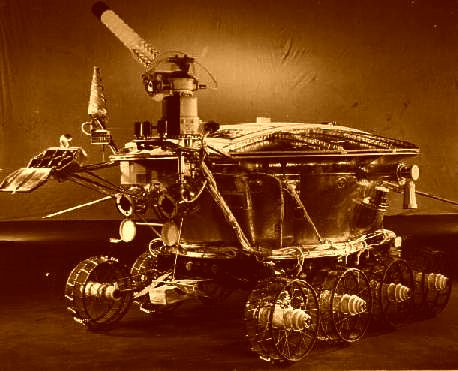
BTW, look at quite a nice Lunokhod picture and also see the US Ranger Program to get a better view of the real pressures in NASA's side of the space race. -
Re:Ignorance isn't bliss.
Let's place the blame where it belongs, with yourself.
Well said. I found about these rovers when I was in grade school from reading science encyclopedias in the library. I remember it being described as looking like a Victorian bathtub.
You can't learn about every space endeavour through school, you have to be curious enough to find out for yourself some things. -
Apollo Lunar Rovers
Does anyone remember that the US landed three rovers on the moon that were driven by astronauts?
"U.S. astronauts drove three Lunar Rover Vehicles on the last three Apollo missions..." -
Apollo Lunar Rovers
Does anyone remember that the US landed three rovers on the moon that were driven by astronauts?
"U.S. astronauts drove three Lunar Rover Vehicles on the last three Apollo missions..." -
Americans are from Mars, Soviets are from VenusThe Soviets also were the first ones to land probes on Venus in a series of missions known as Venera. These probes, amazingly, were a part of a mission that lasted over 20 years time, and brought us lots of goodies, including how anyone landing on Venus would encounter a lovely environment where lead melts on the ground and sulphuric acid rains from the sky... kind of like Los Angeles.
-
Come On...
These rovers were far from secret - they even carried a joint experiment with the French, a set of retroreflectors for Lunar Laser Ranging, which (together with similar retroreflectors installed by the Apollo astronauts) are still used for a variety of fundamental measurements in celestial dynamics.
-
Comm Gaps?
I notice that in some navigation images there appear to be gaps with empty or scrambled data. I wonder if this is communications problems, or perhaps other kinds of data that trumps image data temporarily.
-
Re:IT'S TOO COLD!
When it comes to CCD's, sometimes cold is a good thing: low temperatures reduce thermal noise. That why imagers used in astronomy often use cryogenic cooling units.
But, the imagers on the rovers don't have that performance requirement - they're doing terrestrial imaging in daylight.
As it turns out the rovers have internal heaters to keep the electronics at nominal temps, as well as aerogel insulation to reduce heat loss. So it's not really an issue.
There's more about the science imagers here and here (both PDF files.) Enjoy. -
Re:IT'S TOO COLD!
When it comes to CCD's, sometimes cold is a good thing: low temperatures reduce thermal noise. That why imagers used in astronomy often use cryogenic cooling units.
But, the imagers on the rovers don't have that performance requirement - they're doing terrestrial imaging in daylight.
As it turns out the rovers have internal heaters to keep the electronics at nominal temps, as well as aerogel insulation to reduce heat loss. So it's not really an issue.
There's more about the science imagers here and here (both PDF files.) Enjoy. -
DSN
Deep Space Network website:
http://deepspace.jpl.nasa.gov/dsn/
Not very detailed but a nice overview of the setup.
-
Deep Space Network (DSN) - More Info
More info on communications between Mars/Earth and the DSN (Deep Space Network):
- NASA's MER2004 Communications with Earth Overview
- DSN (Deep Space Network) Main Page
- Wikipedia entry on Deep Space Network
--
For news, status, updates, scientific info, images, video, and more, check out:
(AXCH) 2004 Mars Exploration Rovers - News, Status, Technical Info, History. -
Deep Space Network (DSN) - More Info
More info on communications between Mars/Earth and the DSN (Deep Space Network):
- NASA's MER2004 Communications with Earth Overview
- DSN (Deep Space Network) Main Page
- Wikipedia entry on Deep Space Network
--
For news, status, updates, scientific info, images, video, and more, check out:
(AXCH) 2004 Mars Exploration Rovers - News, Status, Technical Info, History.