Slashdot Mirror
Domain: nasa.gov
Stories and comments across the archive that link to nasa.gov.
Comments · 16,365
-
Re:The best thing NASA can do ...> *ALL* future shuttle flights should be equipped with a Canadarm, ISS docking ring, EVA packs, and enough fuel to get to the ISS.
That's a moot point. If you check NASA's launch schedule, you'll find that the missions for the forseeable future after Columbia's were dedicated to ISS:
- March 1: STS-114 Atlantis to the ISS.
- May 23: STS-115 Endeavour to the ISS.
- July 24: STS-116 Atlantis to the ISS.
- Oct. 2: STS-117 Endeavour to the ISS.
- Nov. 13: STS-118 Columbia to the ISS.
- [see the rest]
A shuttle at ISS doesn't need Canadarm, ISS has got Canadarm2 which is bigger and better. A shuttle at ISS doesn't need EVA packs, ISS has got both Russian and US EVA packs and two separate airlock systems. A shuttle at ISS doesn't need a rescue system, the astronauts can camp out there (albeit uncomfortably) for as long as it takes to bring them down with Soyuz or other shuttles (or OSP in the future).
Basically, NASA was extremely unfortunate by having this failure happen on the last flight it could have happened on.
-
Amateur radio satellites even cooler..
-
Re:In the exalted words of our esteemed former VP.
Maybe we can get ole Danny Boy to ride along with the next Mars mission. Let's tell him he'll be allowed to play fetch with Red Rover...
-
Re:Terraforming wont be so hard after all..
This is a very big fantasy some people have.
There are a couple of reasons Mars has an atmosphere 1/100th of our own.
One reason is because Mars has less mass than the Earth. Hence there is less gravity to "hold" onto a thick atmosphere like what we have on Earth.
Secondly, Mars did have a denser atmosphere at one time, but was probably eroded away by the solar wind. The loss of a strong magnetic field probably didn't help things either.
To prevent the erosion of some future atmosphere, you probably would need to restart the magnetic field. Maybe you could drill down to the core and plant a big bomb to restart it.
So terraforming is still (extremely) hard after all. I didn't get into the astronomical amount of energy required to do it either.
So it looks like that if you wanna live on Mars you're gonna have to strap on some airtanks.
And don't forget the long-johns either, because it's cold there too. -
Re:Terraforming wont be so hard after all..
This is a very big fantasy some people have.
There are a couple of reasons Mars has an atmosphere 1/100th of our own.
One reason is because Mars has less mass than the Earth. Hence there is less gravity to "hold" onto a thick atmosphere like what we have on Earth.
Secondly, Mars did have a denser atmosphere at one time, but was probably eroded away by the solar wind. The loss of a strong magnetic field probably didn't help things either.
To prevent the erosion of some future atmosphere, you probably would need to restart the magnetic field. Maybe you could drill down to the core and plant a big bomb to restart it.
So terraforming is still (extremely) hard after all. I didn't get into the astronomical amount of energy required to do it either.
So it looks like that if you wanna live on Mars you're gonna have to strap on some airtanks.
And don't forget the long-johns either, because it's cold there too. -
Re:Water's not the only liquid in universe
OK one step further: Martian Atmosphere
Surface pressure: 6.36 mb at mean radius (variable from 4.0 to 8.7 mb depending on season)
[6.9 mb to 9 mb (Viking 1 Lander site)]
Surface density: ~0.020 kg/m3
Scale height: 11.1 km
Total mass of atmosphere: ~2.5 x 10¹⁶ kg
Average temperature: ~210 K (-63 C)
Diurnal temperature range: 184 K to 242 K (-89 to -31 C) (Viking 1 Lander site)
Wind speeds: 2-7 m/s (summer), 5-10 m/s (fall), 17-30 m/s (dust storm) (Viking Lander sites)
Mean molecular weight: 43.34 g/mole
Atmospheric composition (by volume):
Major : Carbon Dioxide (CO2) - 95.32% ; Nitrogen (N2) - 2.7%
Argon (Ar) - 1.6%; Oxygen (O2) - 0.13%; Carbon Monoxide (CO) - 0.08%
Minor (ppm): Water (H2O) - 210; Nitrogen Oxide (NO) - 100; Neon (Ne) - 2.5;
Hydrogen-Deuterium-Oxygen (HDO) - 0.85; Krypton (Kr) - 0.3;
Xenon (Xe) - 0.08So we're talking carbon dioxide. Pressure is 7mb or 7hPa or 0.7kPa (earth pressure beeing around 1000hPa or 100kPa)
So at such low pressures, CO2 is vapor at diurnal temperature ranges. My theory seems not to hold. Please go back to sleep.
-
Somewhat unrelated...
Today's APOD has a pic of Jupiter in IR (can't see the pole though).
-
The Universe is Flat, not Doughnut shaped.
From their site:
"The Inflationary Theory, an extension of the Big Bang theory, predicts that density is very close to the critical density, producing a flat universe, like a sheet of paper. WMAP has determined, within the limits of instrument error, that the universe is flat"
Last I heard doughnuts aren't flat. -
The WMAP site says otherwise
From http://map.gsfc.nasa.gov/m_mm/mr_content.html:
"WMAP has determined, within the limits of instrument error, that the universe is flat."
Hmm...
Honestly, I've often thought that the Universe was in a donut shape. However, the question still remains: what the hell's outside of it? -
Obligatory free link
no registration required link in printer friendly format (otherwise it's five pages)
More images from probe homepage -
Viewable Pics here
Just to the project's main page: http://www.jpl.nasa.gov/srtm/
Better than trying to download TIFFs that your system will choke on anyways.
--
hecubas -
Re:Crash?
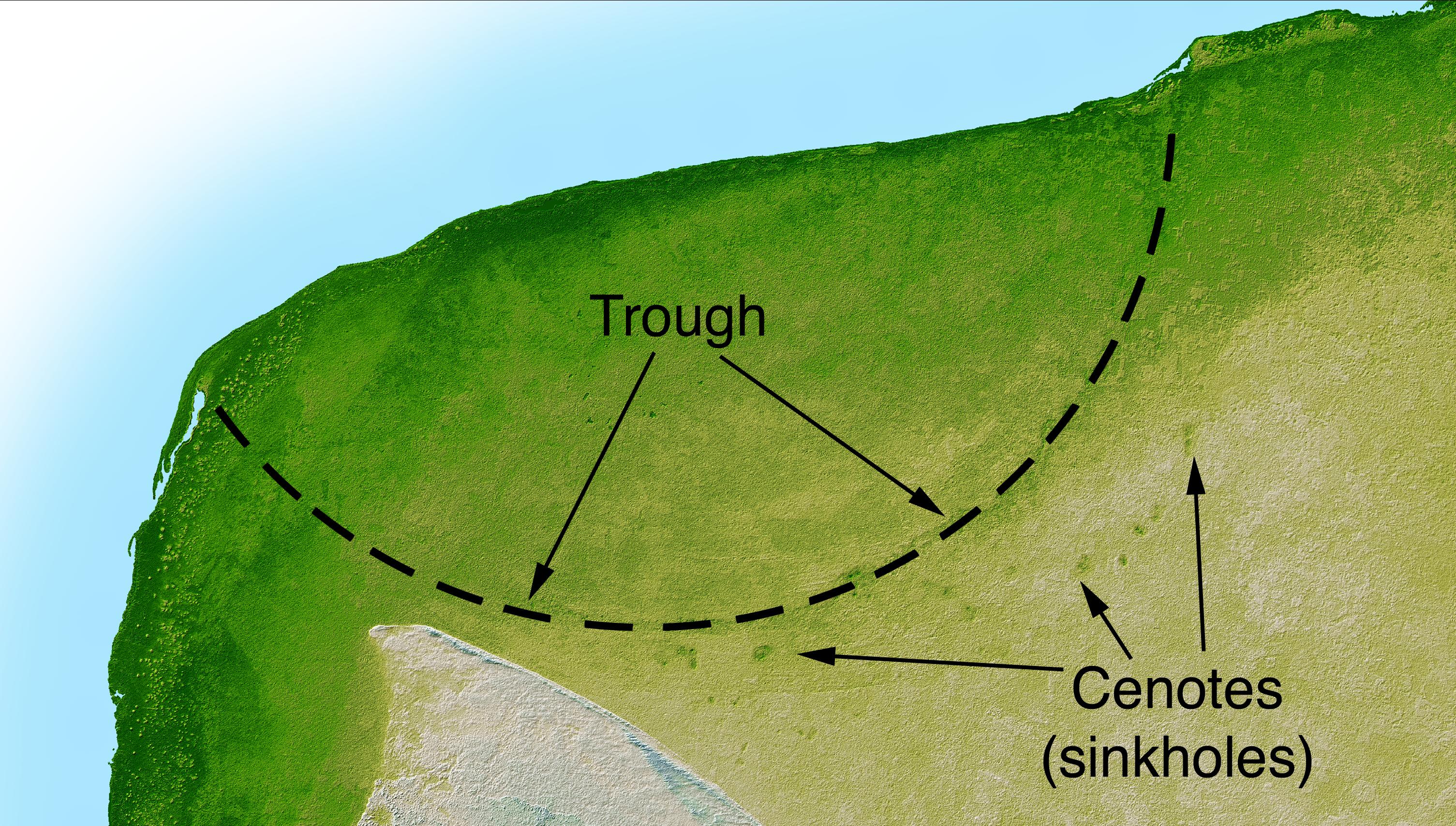
So much for reading the article... If you go to the original new s release, you will notice a picture clearly captioned "Chicxulub impact crater region, Yucatan Peninsula, Mexico".
The picture also clearly shows the center of the impact being just off the coast of the Yucatan Peninsula, and not in the middle of the Gulf of Mexico.
-
Main site-links.
What about the rest?
And yes I have a copy of the 30MB sized one already (I'm not crazy enought to download the CD sized one).
PIA03381:Shaded Relief with Height as Color and Landsat, Yucatan Peninsula, Mexico[30.85MB]
PIA03380:Anaglyph, Yucatan Peninsula, Mexico[5.193MB]
PIA03378:Anaglyph, North America[208.5MB]
PIA03377:Shaded Relief with Height as Color, North America[208.5MB]
PIA03379:Shaded Relief with Height as Color, Yucatan Peninsula, Mexico[617.7MB]
BTW wget is your friend. -
Main site-links.
What about the rest?
And yes I have a copy of the 30MB sized one already (I'm not crazy enought to download the CD sized one).
PIA03381:Shaded Relief with Height as Color and Landsat, Yucatan Peninsula, Mexico[30.85MB]
PIA03380:Anaglyph, Yucatan Peninsula, Mexico[5.193MB]
PIA03378:Anaglyph, North America[208.5MB]
PIA03377:Shaded Relief with Height as Color, North America[208.5MB]
PIA03379:Shaded Relief with Height as Color, Yucatan Peninsula, Mexico[617.7MB]
BTW wget is your friend. -
Main site-links.
What about the rest?
And yes I have a copy of the 30MB sized one already (I'm not crazy enought to download the CD sized one).
PIA03381:Shaded Relief with Height as Color and Landsat, Yucatan Peninsula, Mexico[30.85MB]
PIA03380:Anaglyph, Yucatan Peninsula, Mexico[5.193MB]
PIA03378:Anaglyph, North America[208.5MB]
PIA03377:Shaded Relief with Height as Color, North America[208.5MB]
PIA03379:Shaded Relief with Height as Color, Yucatan Peninsula, Mexico[617.7MB]
BTW wget is your friend. -
Main site-links.
What about the rest?
And yes I have a copy of the 30MB sized one already (I'm not crazy enought to download the CD sized one).
PIA03381:Shaded Relief with Height as Color and Landsat, Yucatan Peninsula, Mexico[30.85MB]
PIA03380:Anaglyph, Yucatan Peninsula, Mexico[5.193MB]
PIA03378:Anaglyph, North America[208.5MB]
PIA03377:Shaded Relief with Height as Color, North America[208.5MB]
PIA03379:Shaded Relief with Height as Color, Yucatan Peninsula, Mexico[617.7MB]
BTW wget is your friend. -
Main site-links.
What about the rest?
And yes I have a copy of the 30MB sized one already (I'm not crazy enought to download the CD sized one).
PIA03381:Shaded Relief with Height as Color and Landsat, Yucatan Peninsula, Mexico[30.85MB]
PIA03380:Anaglyph, Yucatan Peninsula, Mexico[5.193MB]
PIA03378:Anaglyph, North America[208.5MB]
PIA03377:Shaded Relief with Height as Color, North America[208.5MB]
PIA03379:Shaded Relief with Height as Color, Yucatan Peninsula, Mexico[617.7MB]
BTW wget is your friend. -
Re:Not a bad day...
a GOOD day for the earth as it got a major influx of material and upped its accretion rate, helping out in the race to be the biggest object orbiting the sun, though it still trails several other bodies
Well, considering that the Earth tips the scales at 5.97x10^24 kg and that the next highest planet is Uranus at 86.8x10^24 kg, I'd say that the Earth doesn't have much of a chance. Oh well, at least we are ahead of Pluto, Mercury, Mars, and Venus.
(Information is found at The Planetary Fact Sheet - Metric, you can check out the US measures at The Planetary Fact Sheet - U.S..) -
Re:Not a bad day...
a GOOD day for the earth as it got a major influx of material and upped its accretion rate, helping out in the race to be the biggest object orbiting the sun, though it still trails several other bodies
Well, considering that the Earth tips the scales at 5.97x10^24 kg and that the next highest planet is Uranus at 86.8x10^24 kg, I'd say that the Earth doesn't have much of a chance. Oh well, at least we are ahead of Pluto, Mercury, Mars, and Venus.
(Information is found at The Planetary Fact Sheet - Metric, you can check out the US measures at The Planetary Fact Sheet - U.S..) -
Re:Not a bad day...
a GOOD day for the earth as it got a major influx of material and upped its accretion rate, helping out in the race to be the biggest object orbiting the sun, though it still trails several other bodies
Well, considering that the Earth tips the scales at 5.97x10^24 kg and that the next highest planet is Uranus at 86.8x10^24 kg, I'd say that the Earth doesn't have much of a chance. Oh well, at least we are ahead of Pluto, Mercury, Mars, and Venus.
(Information is found at The Planetary Fact Sheet - Metric, you can check out the US measures at The Planetary Fact Sheet - U.S..) -
Re:Not a bad day...
a GOOD day for the earth as it got a major influx of material and upped its accretion rate, helping out in the race to be the biggest object orbiting the sun, though it still trails several other bodies
Well, considering that the Earth tips the scales at 5.97x10^24 kg and that the next highest planet is Uranus at 86.8x10^24 kg, I'd say that the Earth doesn't have much of a chance. Oh well, at least we are ahead of Pluto, Mercury, Mars, and Venus.
(Information is found at The Planetary Fact Sheet - Metric, you can check out the US measures at The Planetary Fact Sheet - U.S..) -
Alternate image
If the site is slashdotted, you can just download the full-resolution image [617.7 megabyte TIFF]
-
Re:Earth's moonBlockquoth the poster:
This is wrong. The center of mass is about 30,000 miles from the earths center, about 27000 miles above the earth's surface.
I don't know the exact number and am too lazy to do the calculation myself. But I am absolutely sure that the center-of-mass is not that close to geosynchronous orbit. Your number is about 10% of the total Earth-Moon distance -- this would imply that the ratio of the Earth's mass to the Moon's is about 9:1, which is clearly bogus. The true ratio is much closer to 81:1.
Oh, hell. I might as well get over my laziness. From here -- I assume NASA Goddard SFC is sufficiently respectable? -- we have
Mmoon = 0.073E24 kg
Mearth = 5.97E24 kg
Rearth = 6378 km
D = 0.38E6 km
So doing a little basic physics:
Mearth * 0 + Mmoon * L = (Mearth+Mmoon)*Xcm
Xcm = Mmoon / (Mearth+Mmoon) * L
Xcm = 4590 km
Since 4590 is less than 6378 under most systems of arithmetic, the center-of-mass lies within the Earth's surface. QED. -
Re:Deflect killer astroids, gather comet dust?As one of the scientists mentioned in the article (my website), I think the author of the article, who's a journalist and not a dynamicist, is slightly wrong about material "collecting" at L4.
Material typiclly doesn't come from elsewhere in the solar system and get stuck in some system's L4 points (like the Earth-Moon L4 or L5 points). The material that is there, if any, would have existed in that location since the formation of the system, i.e., anything near the Earth-Moon L4 or L5 points was there when the Moon formed.
Regarding the killer asteroids, you're totally right about deflecting them with small forces. There will be a conference next year, Planetary Defense Conference: Protecting Earth from Asteroids, where people will propose technical plans associated with defending Earth from approaching near Earth objects (comets and asteroids). The threat will be approached from three warning levels: short-term (less than ten years warning); medium-term (ten to 30 years warning); and long-term (more than 30 years warning). The more time we have to deflect it, the smaller the force needs to be.
-
Re:Maybe what we're up against is the universe
And frankly, until there is something that would truly require human study and analysis, we just won't see any strong drive to send a manned mission out of orbit anytime soon. The improved capabilities of orbiting telescopes and robotic exploration have pretty much eliminated the need for manned missions in the short- to medium-term. It's not that we're not exploring, we're just not sticking our (astronaut's) necks out.
-
Oceans
The Earth's oblateness (as measured by changes in the gravity field) has been increasing since about 1997. Speculation points to net movement of water from rapidly melting mountain and subpolar glaciers to the equator. One would suspect this would change the Earth's moment of inertia more than would changes in wind, but it is not mentioned in this most recent article.
-
Re:Why is size an issue?
In that case the Earth is not a planet. I can see it radiating light.
-
Use Star Trek's classification!
Just use the Star Trek planet classifications... Come on, it's time to make use of sci fi in astronomy for once.
-
Pluto Already Gone
Wasn't Pluto declassified as a planet a while back? The Rose Center (Hayden Planetarium) at the Museum of Natural History in New York City no longer classifies Pluto as a planet. That facility was upgraded several years ago, and the stink about Pluto as a planet arose then as well. Fact is this argument will be going on for a while yet.
Nasa's opinion -
Saturn images
A little more recent: Cassini took it's first picture of Saturn! It is 285 million km from the planet, and if it can get images that good then I can't wait to see what it returns when it gets there!
(My best attempt at taking a picture of Saturn is here - hmpf -
Re:First?
Are you sure? Can you prove it? Because, actually, I believe we do know how to build at least the heatshields.
Since I began work at Lockheed Martin (back then it was Martin Marietta), we have made a number of heatshields. If you go to the article linked to above, you will see a picture of the aeroshell. The white cone is one of the backshells we completed for the Mars Exploration Rover missions about this time last year. (The ablator is actually gray, they painted it in Denver.)
A cursory examination of informal records and pictures shows that we've been building them for many of NASA's planetary probes, going back to the Viking probes. I have no doubt that we could make at least Apollo Command Module-class heatshields.
dm
-
Re:First?
Are you sure? Can you prove it? Because, actually, I believe we do know how to build at least the heatshields.
Since I began work at Lockheed Martin (back then it was Martin Marietta), we have made a number of heatshields. If you go to the article linked to above, you will see a picture of the aeroshell. The white cone is one of the backshells we completed for the Mars Exploration Rover missions about this time last year. (The ablator is actually gray, they painted it in Denver.)
A cursory examination of informal records and pictures shows that we've been building them for many of NASA's planetary probes, going back to the Viking probes. I have no doubt that we could make at least Apollo Command Module-class heatshields.
dm
-
Re:First?
Are you sure? Can you prove it? Because, actually, I believe we do know how to build at least the heatshields.
Since I began work at Lockheed Martin (back then it was Martin Marietta), we have made a number of heatshields. If you go to the article linked to above, you will see a picture of the aeroshell. The white cone is one of the backshells we completed for the Mars Exploration Rover missions about this time last year. (The ablator is actually gray, they painted it in Denver.)
A cursory examination of informal records and pictures shows that we've been building them for many of NASA's planetary probes, going back to the Viking probes. I have no doubt that we could make at least Apollo Command Module-class heatshields.
dm
-
Re:Lagrange Points
This should make ion engines such as these much more useful for space exploration. If all you need is a little push to get you from one manifold to another, ion engines sound perfect for facilitating a nice surf on the Interplanatary Superhighway!
-
Whoever it is who keeps posting these...
please carry on posting them! WOW! I mean some of the pics are incredible. This is the best page for the pics.
-
Re:I'm trying not to be anti NASA here,"little more than"? how about:
design and build the instrument
extend the 2nd antenna 60 meters out of the Shuttle payload bay
develop the algorithms to get topographic data out of microwave radar interference patterns
process and calibrate data for 80% of the Earth's land surface at 30 meter resolution
you're hard to please
more info: SRTM: Instruments -
Lagrange Points
This technique uses a concept called a Lagrange Point, where gravity from multiple bodies (usually in a orbiting situation) cancel each other out -- which results in a place where a parked object can sit and stay in place in relation to the orbiting system.
This technique is used to keep the SOHO sun observation satellite at Lagrangian point 1 in the earth/sun system, so that it keeps a constant view of the sun.
The concept behind this is extended in this instance to reveal tunnels which offer the 'path of least resistance.'
In fact, this has been discussed on Slashdot before. Slashdot users have also discussed Lagrangian points in relations to one or both of Earth's sub-moons.
-
Re:yeah, but you got to hit the missles early
The flame from the O-ring burned through the hydrogen tank, but also burned through through the lower SRB mounting strut, which caused the SRB to rotate around the upper strut and puncture the oxygen tank just above the intertank area. At about the same time, the rupture in the hydrogen tank caused the the entire bottom of the external tank to fail, releasing the pressurized contents. This in turn added almost 3 million pounds of thrust to the tank itself, and drove the hydrogen tank upward into the oxygen tank which had already been punctured by the SRB, causing the explosion.
The sequence of events is explained in much more detail in Chapter III of the Rogers Commission report, which can be found here -
try these images
It is more clear without the dashed line in the way.
http://www.jpl.nasa.gov/images/earth/centralameric a/pia03379_combined_340_264.jpg -
Mir
How quickly everyone has forgotten Mir.
-
Re:Images are available from lots of missions/craf
-
Re:Images are available from lots of missions/craf
-
Re:Images are available from lots of missions/craf
-
Maybe I'm a little dense, but ...
From the article:
The Chicxulub data show a subtle, yet unmistakable, topographic indication of the impact crater's outer boundary: a semicircular trough 3 to 5 meters (10 to 15 feet) deep and 5 kilometers (3 miles) wide. Good picture here.
I just can't tell that there is a crater there. Maybe this is because I'm an engineer and not a geoscientist or geologist. Can somebody explain to me how to tell that there are ridges where they claim there are? Without this explanation, I just feel that there are interpretting the data to fit their preconcieved idea. -
Re:Bogus science
From the same website two months later here's a link that shows that two months after the largest hole ever, the hole disappeared. I argue that these fluctuations are naturally-occurring and you can't scientifically make the jump from CFC concentration to ozone depletion. After all, at the point in time when these articles were written the CFC concentration had peaked but not yet started the very slow decline we're seeing now. By your argument, if the CFCs were causing the depletion that created the largest hole ever witnessed, how could it completely disappear in two months? I think that there are many factors affecting ozone concentrations, CFCs being one, but a minor one.
-
Old stuff, durability, costs, & the space prog
That, my friend, is because the only things that are still around from 30 years ago are the ones that were durable. In another 30 years, people will say the same thing about today's things, because the crap will already be broken and disposed of. Sure, there will be millions of Huffy bicycles in the trash. But people will have forgotten them, and will marvel at the amazing durability of the high-end Treks and whatnot that survive.
And the space program differences are all about cost. The Pathfinder mission (which landed on mars) was part of the Discovery series of missions, capped at $150 million. Cassini, the last of the Voyager/Pioneer-type "heavy engineering" designs cost $3.4 BILLION. Pioneer 10 cost $350 million, in 1970. Voyager 1 and 2 cost $875 million together, in 1977. (those obviously need some inflation adjustment to be fair to a 1996 mission, but even Pioneer is more than double the cost without adjustment!) Of course there's going to be a performance difference when you pay many times as much. Even so, Galileo (another old-school nasa design) cost $1.6 billion, and its main antenna never opened. Would you rather have 10 cheap missions where 8 fail, or one expensive mission that fails?
Sure, we've lost lots of recent mars missions. But all added together, they barely cost as much as some of those single probes.
Links:
pioneer cost
cassini cost
voyager cost
pathfinder cost
-
Old stuff, durability, costs, & the space prog
That, my friend, is because the only things that are still around from 30 years ago are the ones that were durable. In another 30 years, people will say the same thing about today's things, because the crap will already be broken and disposed of. Sure, there will be millions of Huffy bicycles in the trash. But people will have forgotten them, and will marvel at the amazing durability of the high-end Treks and whatnot that survive.
And the space program differences are all about cost. The Pathfinder mission (which landed on mars) was part of the Discovery series of missions, capped at $150 million. Cassini, the last of the Voyager/Pioneer-type "heavy engineering" designs cost $3.4 BILLION. Pioneer 10 cost $350 million, in 1970. Voyager 1 and 2 cost $875 million together, in 1977. (those obviously need some inflation adjustment to be fair to a 1996 mission, but even Pioneer is more than double the cost without adjustment!) Of course there's going to be a performance difference when you pay many times as much. Even so, Galileo (another old-school nasa design) cost $1.6 billion, and its main antenna never opened. Would you rather have 10 cheap missions where 8 fail, or one expensive mission that fails?
Sure, we've lost lots of recent mars missions. But all added together, they barely cost as much as some of those single probes.
Links:
pioneer cost
cassini cost
voyager cost
pathfinder cost
-
Old stuff, durability, costs, & the space prog
That, my friend, is because the only things that are still around from 30 years ago are the ones that were durable. In another 30 years, people will say the same thing about today's things, because the crap will already be broken and disposed of. Sure, there will be millions of Huffy bicycles in the trash. But people will have forgotten them, and will marvel at the amazing durability of the high-end Treks and whatnot that survive.
And the space program differences are all about cost. The Pathfinder mission (which landed on mars) was part of the Discovery series of missions, capped at $150 million. Cassini, the last of the Voyager/Pioneer-type "heavy engineering" designs cost $3.4 BILLION. Pioneer 10 cost $350 million, in 1970. Voyager 1 and 2 cost $875 million together, in 1977. (those obviously need some inflation adjustment to be fair to a 1996 mission, but even Pioneer is more than double the cost without adjustment!) Of course there's going to be a performance difference when you pay many times as much. Even so, Galileo (another old-school nasa design) cost $1.6 billion, and its main antenna never opened. Would you rather have 10 cheap missions where 8 fail, or one expensive mission that fails?
Sure, we've lost lots of recent mars missions. But all added together, they barely cost as much as some of those single probes.
Links:
pioneer cost
cassini cost
voyager cost
pathfinder cost
-
Re:Bogus scienceOk, I found some data, from NASA . As far as I can tell, it is completely consistent with the idea that the reduction in ozone is dominated by increased CFC's.
If you can refute that, I would be interested in hearing about it.
-
Re:Bogus scienceWhere on earth did you get the idea that the size of the ozone hole has shrunk "down to the size it was then they first started measuring it"? As far as I know, it is roughly the same size now as the LARGEST it has ever been. 10 years after the Montreal Protocol was introduced, it was in fact still increasing in size.
a few seconds of googling later....
Have a look at this graph , which shows the area of the ozone hole. True, there is a big drop at the very last data point, but look at the size of the error bar, that could mean anything, and certainly doesn't indicate that it has 'stabilized'.