Slashdot Mirror
Domain: nasa.gov
Stories and comments across the archive that link to nasa.gov.
Comments · 16,365
-
Re:NASA site mission STS-107
"Is space worth the risk?"
No, it's not. More precisely, manned space travel isn't worth the risk. (Unmanned missions are risk-free by comparison)
Just look at the kinds of leading edge science this crew died to perform:
http://www.wff.nasa.gov/~sspp/sem/about.html
Manned space flight (both shuttle trips, and the International Space Station) are today worth neither the risk nor the money. I like what John Pike said about the ISS: "The value of the science that can be done on the Space Station is trivial compared to the cost of the Space Station. Piloted spaceflight is about politics."
Let's look specifically at the ISS, which is the destination for most of the recent shuttle flights. Keeping humans supplied in space takes many extra trips up and down: all the air, water, food, living space, and exercise equipement takes up valuable cubic meters. And all of the provisions for safety and gentle re-entry further reduce the fuel efficiency of the rockets.
The ISS program, and the supply flights to build & support it, will have a total price tag of at around $100,000,000,000.
Scientific-notation kinds of fundage ($1e11)!! You'd have to be a NASA researcher just to count it all.
Virtually all of the science and maintenannce done on Shuttles and the ISS could be accomplished by semi-autonomous robots. Sure, today maybe our robotics and AI technology isn't good enough to substitute for some of the tricky things where a dynamic, flexible human is needed. Well, try investing a fraction of the $1e11 budget into researching those systems, and then tell me how well they work!
Developing better robots to operate space equipment won't only make extra-planetary research safer and cheaper- it'll also produce technological advances that will benefit civilians around the world!
(Rocket-boosters are only needed by astronauts and admirals. But reliable robot manipulators could be useful to anyone)
I fear for the public reaction agenst NASA and space traval from this day forward.
I hope the public wises up that manned space flight is an expensive and dangerous form of esteem-boosting entertainment. -
RTGs
Radioisotope thermoelectric generators (RTGs) have been used for decades as power sources for aircraft, as some of the others have mentioned. Here is some information on their construction. Basically the plutonium is in a more stable ceramic form PtO2 (the risk of plutonium isn't so much the radioactivity, it's that plutonium is incredibly toxic) formed into spheres. Each sphere is encased in iridium, and a stack of these is in graphite. Suffice to say there's more construction on top of this, but the whole module is designed to withstand reentry by itself, and I believe are supposed to take a powered descent (rocket takes off, does a 180 and slams into the ground with engines still burning).
-
TRI-nation disaster
In the chatter about Israel's first astronaut, Illan Ramon, it seems to be forgotten that Kalpana Chawla was born in India, and got her BSc there, before getting her PhD in the US. Although she now appears to be a US citizen, I would expect that India has been very proud of her, and is probably as much in morning at her loss as Israel is at the loss of Ramon.
-
TRI-nation disaster
In the chatter about Israel's first astronaut, Illan Ramon, it seems to be forgotten that Kalpana Chawla was born in India, and got her BSc there, before getting her PhD in the US. Although she now appears to be a US citizen, I would expect that India has been very proud of her, and is probably as much in morning at her loss as Israel is at the loss of Ramon.
-
! Because They == Easy, But Because They == Hard
One of my favorite quotes was spoken by JFK in 1962 when he said,
"We choose to go to the moon in this decade and do the other things, not because they are easy, but because they are hard."
(Correct me if this is misquoted, I found this version of the quote on the internet.)
Maybe we should have taken Kennedy's words to heart. Maybe we should not have given up so easily on the now canceled and extremely difficult Venture Star project.
From all the bits of news I've read, it sounds like the heat shielding tiles of the space shuttle may have catostrophically failed today. It may have been due to the impact of a piece of foam from the main fuel tank shortly after launch. Apparently the final voice communication from the astronauts was something regarding tire pressure. I speculate that if the heat shield were compromised on reentry, that tire pressure could have gone up due to heat exposure. This would have triggered sensors and informed the crew of a problem seconds before something exploded. The explosion could have been tires or could have been fuel or anything else under pressure or flammable. The shuttle is made of lightweight materials, so any explosion would be disastorous. (Im not saying that lightweight materials aren't strong, but the engineering thresholds probably dont permit NASA from making an explosion proof shuttle; especially considering it was designed in the 1970's.
I read a while back that one of the primary objectives of the Venture Star project was to eliminate the need for heat shielding tiles (which may have catostrophically failed on the Columbia today). Inspecting these space shuttle tiles, if I recall, costs NASA $70,000,000 and a huge number of man years per shuttle mission! Another aim of the Venture Star project was to eliminate external fuel tanks and rocket boosters. The rocket boosters were responsible for the Challenger disaster and now the main fuel tank may have been the cause of the heat shield failure.
Let us not forget one of the main discoveris of this Columbia mission... the burning of Brazillian rainforest is contributing to global climate change.
Dont be fooled by those who say this event will stop manned missions to space. I think this will someday drive us to create much more advanced vehicles. Manned missions are not a practical way to explore space or do science, but heck, I wouldn't mind checking out another planet...or looking back at my planet from far away even if I die doing it. Maybe we need a space tourism agency, with goals separate and apart from NASA.
PS. The quote is an excellent example of chiasmus -
Re:Looks like Feynmann was right :(
Feynmann was very unhappy with the report on the Challenger disaster. As a member of the committee responsible for the report he refused to sign off on it unless he could include his views on shuttle safety as an appendix. As another
http://science.ksc.nasa.gov/shuttle/missions/51-l
/ docs/rogers-commission/Appendix-F.txtDown near the end of the appendix Feynmann places the odds of catastrophic failure for a shuttle to be "on the order of 1%". This does NOT mean he said it was 1%: when a physicist says "on the order of" he means "the same order of magnitude" or (for the less mathematically rigorous) "about the same power of 10 as". He even went on to apologize for being unable to be more specific.
So, Feynmann's estimate was really that the chance of failure is CLOSER TO 1 IN 100 than to 1 in a thousand or 1 in 10.
-
Re:Never mind Mars, what about the ISS?For that matter, are/were there any astronauts/cosmonauts aboard Alpha? How are they going to get home now? I don't think there's going to be any shuttle missions for quite a while. Are we going to have to get lifts from the Russians?
According to the ISS website, the current (Expedition 6) crew is:
- Commander Kenneth Bowersox
- Flight Engineer Donald Pettit
- Flight Engineer Nikolai Budarin
They've been on the station since November 25th 2002 (two days after launch), and were scheduled to return on shuttle mission 114 (Atlantis) on an as-yet-unspecified date no earlier than March 1st 2003.
BBC TV news just mentioned this concern, suggesting that Russia would probably do the crew recovery mission, given that after the Challenger incident, the shuttles were grounded for over two years, and speculated as to whether today's news might render the ISS program unsustainable.
TomV
- Commander Kenneth Bowersox
-
Re:Never mind Mars, what about the ISS?For that matter, are/were there any astronauts/cosmonauts aboard Alpha? How are they going to get home now? I don't think there's going to be any shuttle missions for quite a while. Are we going to have to get lifts from the Russians?
According to the ISS website, the current (Expedition 6) crew is:
- Commander Kenneth Bowersox
- Flight Engineer Donald Pettit
- Flight Engineer Nikolai Budarin
They've been on the station since November 25th 2002 (two days after launch), and were scheduled to return on shuttle mission 114 (Atlantis) on an as-yet-unspecified date no earlier than March 1st 2003.
BBC TV news just mentioned this concern, suggesting that Russia would probably do the crew recovery mission, given that after the Challenger incident, the shuttles were grounded for over two years, and speculated as to whether today's news might render the ISS program unsustainable.
TomV
- Commander Kenneth Bowersox
-
Re:Never mind Mars, what about the ISS?For that matter, are/were there any astronauts/cosmonauts aboard Alpha? How are they going to get home now? I don't think there's going to be any shuttle missions for quite a while. Are we going to have to get lifts from the Russians?
According to the ISS website, the current (Expedition 6) crew is:
- Commander Kenneth Bowersox
- Flight Engineer Donald Pettit
- Flight Engineer Nikolai Budarin
They've been on the station since November 25th 2002 (two days after launch), and were scheduled to return on shuttle mission 114 (Atlantis) on an as-yet-unspecified date no earlier than March 1st 2003.
BBC TV news just mentioned this concern, suggesting that Russia would probably do the crew recovery mission, given that after the Challenger incident, the shuttles were grounded for over two years, and speculated as to whether today's news might render the ISS program unsustainable.
TomV
- Commander Kenneth Bowersox
-
Re:Never mind Mars, what about the ISS?For that matter, are/were there any astronauts/cosmonauts aboard Alpha? How are they going to get home now? I don't think there's going to be any shuttle missions for quite a while. Are we going to have to get lifts from the Russians?
According to the ISS website, the current (Expedition 6) crew is:
- Commander Kenneth Bowersox
- Flight Engineer Donald Pettit
- Flight Engineer Nikolai Budarin
They've been on the station since November 25th 2002 (two days after launch), and were scheduled to return on shuttle mission 114 (Atlantis) on an as-yet-unspecified date no earlier than March 1st 2003.
BBC TV news just mentioned this concern, suggesting that Russia would probably do the crew recovery mission, given that after the Challenger incident, the shuttles were grounded for over two years, and speculated as to whether today's news might render the ISS program unsustainable.
TomV
- Commander Kenneth Bowersox
-
Re:Toxic Substances : prevent shit like this
While the some materials of the shuttle may be toxic, any of the little fuel carried on re-entry should have burnt up.
I might be wrong but I think they may be saying that to stop people from collecting pieces to keep
and any shit like this SPACE SHUTTLE COLUMBIA DEBRIS! (Even though that one is obviously fake)
anyway Red Fuming Nitric Acid is nitrogen tetroxide (N2O4) and Hydrazine is monomethyl hydrazine (MMH)
From John F. Kennedy Space Center - KSC Fact Sheets and Information Summaries
Hypergolic propellants are fuels and oxidizers which ignite on contact with each other and need no ignition source. This easy start and restart capability makes them attractive for both manned and unmanned spacecraft maneuvering systems. Another plus is their storability -- they do not have the extreme temperature requirements of cryogenics.
The fuel is monomethyl hydrazine (MMH) and the oxidizer is nitrogen tetroxide (N2O4).
Hydrazine is a clear, nitrogen/hydrogen compound with a "fishy" smell. It is similar to ammonia. Nitrogen tetroxide is a reddish fluid. It has a pungent, sweetish smell. Both fluids are highly toxic, and are handled under the most stringent safety conditions. Hypergolic propellants are used in the core liquid propellant stages of the Titan family of launch vehicles, and on the second stage of the Delta.
The Space Shuttle orbiter uses hypergols in its Orbital Maneuvering Subsystem (OMS) for orbital insertion, major orbital maneuvers and deorbit. The Reaction Control System (RCS) uses hypergols for attitude control.
The efficiency of the MMH/N2O4 combination in the Space Shuttle orbiter ranges from 260 to 280 seconds in the RCS, to 313 seconds in the OMS. The higher efficiency of the OMS system is attributed to higher expansion ratios in the nozzles and higher pressures in the combustion chambers. -
Dates in US space tragedy
Jan 27, 1967: Apollo 1 fire
Jan 28, 1986: Challenger explosion
Feb 1, 2003 Columbia breakup
--LP -
Re:More links and info
According to a middle-school levelNASA handout about shuttle descent, 16 minutes before landing is the beginning of a maneuver called "roll reversal" to slow down the shuttle. I imagine that this is one of the times that places the highest amount of stress on the shuttle airframe.
-
Re:Now we have a stranded ISS crew...
Checking the schedule, the next flight to the station was scheduled to be STS114, which was supposed to launch in March. That clearly won't happen now.
-
The first israeli astronaut: Some Details
NAME: Ilan Ramon (Colonel, Israel Air Force) Payload Specialist
PERSONAL DATA: Born June 20,1954 in Tel Aviv, Israel. Married to Rona. They have four children. He enjoys snow skiing, squash. His parents reside in Beer Sheva, Israel.
Sounds like a nice guy -
why is the shuttle still show at orbital tracker?
Did I find the shuttle or just a ghost? check these NASA sites... on them the shuttle is still moving - http://spaceflight.nasa.gov/realdata/tracking/bet
a e x.html I had been watching NASA this morning since 6:30 am Eastern... then, just before the planned landing, NASA said they lost contact... Watch REAL PLAYER: rtsp://163.205.10.21:8080/redundant/nasatv.rm -
why is the shuttle still show at orbital tracker?
Did I find the shuttle or just a ghost? check these NASA sites... on them the shuttle is still moving - http://spaceflight.nasa.gov/realdata/tracking/bet
a e x.html I had been watching NASA this morning since 6:30 am Eastern... then, just before the planned landing, NASA said they lost contact... Watch REAL PLAYER: rtsp://163.205.10.21:8080/redundant/nasatv.rm -
BBCTV and NASA TV
BBC news live (needs Real/Helix player)
http://www.bbc.co.uk/newsa/n5ctrl/live/now2.ram
Story
http://news.bbc.co.uk/1/hi/world/2716369.stm
NASA TV Live (Real/Helix Player)
http://quest.nasa.gov/ltc/ram/nasalive-v.ram
-
NASA site mission STS-107
Here's the yet not-updated NASA site for mission STS-107.
-
More links and infoThis was my submission, seconds later than this story post:
The U.S. Space Shuttle Columbia, flying STS 107 apparently dissentegrated over north Texas during re-entry according to CNN, CBS, and NBC TV reports. Columbia launched on January 16 for that orbiter's 28th journey. Communication was lost at 8:00 Central Time (14:00 GMT), 16 minutes prior to the scheduled landing, at an altitude of 200,000 feet (61km) and velocity of 12,000 miles per hour (19,000 km/h). NASA advises people to report and avoid debris in the area because it may inlude toxic propellants.
-
No
You dont know what you are talking about.
NASA uses IBM AP-101 chips in the shuttle. See here and here
Also most space based applications use 8/16 bit chips because most spaced based applications don't require more than that and the wider the CPU register, the more parity bits are required. Thats why most satellites use 8-16 bit chips.
The robot used on mars was an 8 bit 8085.
Please get your facts straight before posting. -
No
You dont know what you are talking about.
NASA uses IBM AP-101 chips in the shuttle. See here and here
Also most space based applications use 8/16 bit chips because most spaced based applications don't require more than that and the wider the CPU register, the more parity bits are required. Thats why most satellites use 8-16 bit chips.
The robot used on mars was an 8 bit 8085.
Please get your facts straight before posting. -
Holy quote-appropriating, Batman!
It's nice to see that the entire explanatory text of yesterday's APoD made it in to the Slashdot article.
Unless MagnetarJones is one of APoD's authors, though, you should give credit where credit is due. -
Another link
Something I saw yesterday on the Astronomy Picture of the Day site. Same thing and it has an explanation about it and such.
The APoD site is pretty cool, the day before they had an awesome picture of the Horsehead Nebula -
Another link
Something I saw yesterday on the Astronomy Picture of the Day site. Same thing and it has an explanation about it and such.
The APoD site is pretty cool, the day before they had an awesome picture of the Horsehead Nebula -
Nice MPEG's
Especially this one. The solar flares are awesome.
-
energy is mass
you can move a whole electron with a single photon, and the conversion happens all the time. The energy of anilhiation shows up on gamma spectrometers, letting you know that mass to energy conversion is ongoing. Think I'm silly? Check out a whole buch of antimater. While moving electrons one puny light photon at a time might not work, more energetic photons may.
-
Propagation Delays with IP in space?
Here is a good FAQ about IP in space is available here. It says "This is a misconception that is brought about by confusing IP, a layer 3 network protocol, with TCP, a layer 4 transport protocol."
-
Re:Isn't this a new first for Linux?
-
Re:Isn't this a new first for Linux?
BTW, that astronaut lady looks cute. Too bad they couldn't get a better picture of her.
-
FlightLinux Project at NASA
It seems NASA had a Flight Linux project that ended in June 2002. Interestingly enough, they link back to slashdot in their publications listing.
-
Would you like fries with that?At least 300 miles, probably much more. Project Babylon "would place a net payload of about 200 kg into orbit at a cost of $600 per kg." and HARP Of course, with the acceleration, you'd probably get mashed potatoes delivered to the space station.
First it was Pringles cans for war-driving, now this. Obviously the potatoes are terrorist tools, and must be banned!
-
Re:NASATwo sites:
This link will let you apply to most nasa jobs, including the aerospace engineering jobs. The company I work for built most of this site.
This link will let you apply to become an astronaut.
-
Re:NASATwo sites:
This link will let you apply to most nasa jobs, including the aerospace engineering jobs. The company I work for built most of this site.
This link will let you apply to become an astronaut.
-
Preserving CD-ROMsI was looking for ROM to old games (MOO, MOO2, Starflight) a while back, and recalled that I had a box of floppies that also had some old games on them. Hardly any of the 3 1/2 floppies were any good and I couldn't even read the 5 1/4 inch ones I found. That got me curious about what will happen to my meticulously ordered and cataloged CD-R/ROM collection.
While I was indulging my data storage daydreams, I came across a discussion board thread which talks about the various issues surround storing digital media (pictures, in this case). It was pretty intersting reading. I hadn't thought about gold-plated CDs before, and that sounds like a great idea as long as the hardware to read them exists for the duration of the media's shelf life. Even NASA has been having trouble in that area.
At first blush, I'd say the way to save all the images would be some sort of distrubuted filesystem, a la Freenet. Package an ASCII metafile with the ROMs file format info along with the actual image file and that should do it. Some sort of centralized system of making sure that at least N copies exist in "the wild" and the data could be reasonably safe. I'm oversimplifying, of course, but it occurred to me that data integrity and file formats might not be the only barriers to long-term data storage. Governments aren't especially data-friendly 100% of the time, either. If you really want to save data for all posterity, you have to protect it from yourself as well.
-B
-
Voyager
is in its 25th year, and still communicates daily. I'm sure the bus has been running the same code for the whole mission, although I'm sure the payload may have had some code revisions uploaded along the way.
-
Re:And they have the source!
Windows just isn't as secureable as unix's
Oh, yes, of course! The Internet could never be effectively shut down for days by a UNIX-based worm! -
Re:Who will rule the world?
Yes. It's called Urban Sprawl.
-
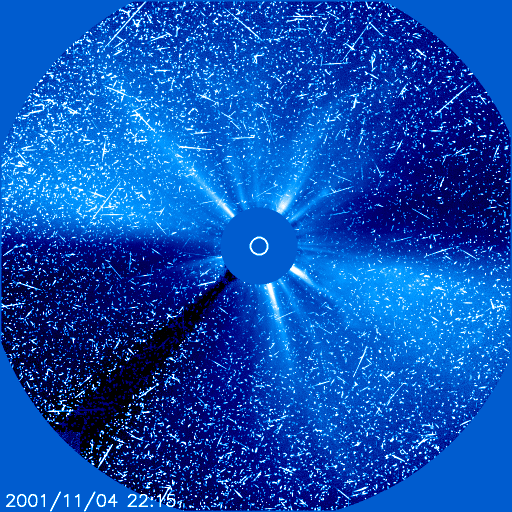
Re:I don't believe, but...I'm not working on SOHO, but the SOHO Deputy Project Scientist just dropped me a note about their stuff, so I guess I should try...
It is very hard to analyze that if you don't know what has happened to the picture. The planet is easy enough, that's an over-exposed planet. The "exhaust fumes" is I guess what you're pointing at which is not straight. You would expect it to be straight if it is pixel bleeding, not if it is e.g. a cosmic ray. And if you look at it closely, you'll see that the streak consists of no more than 7-8 pixels, some in pairs, other alone on a line. What you're seeing there is actually the lines in the CCD, the image has been resampled to a resolution much greater than that of the detector, and then smoothed. I would say that a cosmic ray that has hit the detector in the vicinity of the planet. If you look at how many rays you would see during a sun storm, it is very unlikely that no cosmic would never be close to a planet in the field... Also, it is a very weak cosmic, it didn't even saturate the detector.
-
Major League Baseball
I recently came across this press release on NASA's satellite monitoring of wheat fields, cunningly disguised as a project to aid agriculture (yeah right!). I fear for the poor crop-circle artists. Can even the stealthiest stalk-stomper evade the watchful satellite's malevolent eye?
-
Something real now on SOHO cameras, LIVE.
With all this nonsense about UFOs flying around, I'd like to point that there is something actually interesting on SOHO's LASCO C3 camera images right now. The comet Kudo-Fujikawa has entered the camera's field of view. See the "live" pictures at the SOHO site. The comet is entering from the top of the picture.
-
Aren't the pictures from SOHO exciting enough?!
What really gets me is that the people searching for UFOs in the SOHO data obviously find that more exciting that the SOHO data... and that's tragic.
I mean, it takes some effort to follow the detailed science SOHO was designed to support, but the images alone should be worth looking at. Go look at this hotshot of four planets and the Sun's outer layers. Tell me you don't find that image awe-inspiring, or that you don't think the ability to get that image is among man's most impressive achievements.
(Yes, I'm a scientist by training, and do find this stuff genuinely awe-inspiring and have no time for those who refuse to learn and chase after UFOs. I never worked with SOHO, but I sat in a lab for three years across from someone who was doing a PhD on SOHO data. I was working on something much more boring for my PhD.) -
USAF UFO detector networkThe U.S. Air Force has operated a large scale UFO detector network since about 1980, the Ground Based-Electro-Optical Deep Space Surveillance System. It was built to identify flying objects launched by the USSR, but it does much more. Two 1-meter computer-controlled telescopes at each site scan the skies for anything bigger than a basketball. The three sites (Diego Garcia, Maui, and Arizona) are run by the USAF 24th Space Wing. Most of the sky is scanned several times every night.
Since the USSR wound down, GEODSS has also been used for finding near-earth asteroids. A few objects show up every month. Here's the list for December, 2002.
MIT's Lincoln Labs also operates an automated skywatch.
Here's an image from GEODSS. The objects that show as streaks are moving relative to the starfield.
If it's out there, one of these systems will pick it up within a few days.
-
USAF UFO detector networkThe U.S. Air Force has operated a large scale UFO detector network since about 1980, the Ground Based-Electro-Optical Deep Space Surveillance System. It was built to identify flying objects launched by the USSR, but it does much more. Two 1-meter computer-controlled telescopes at each site scan the skies for anything bigger than a basketball. The three sites (Diego Garcia, Maui, and Arizona) are run by the USAF 24th Space Wing. Most of the sky is scanned several times every night.
Since the USSR wound down, GEODSS has also been used for finding near-earth asteroids. A few objects show up every month. Here's the list for December, 2002.
MIT's Lincoln Labs also operates an automated skywatch.
Here's an image from GEODSS. The objects that show as streaks are moving relative to the starfield.
If it's out there, one of these systems will pick it up within a few days.
-
Re: DUH ...
HAHAH
I mean, if you really think a second independent group needs to "prove" that you can use photoshop to interpolate a bad pixel, then gimme some money and you've got yourself an article!
Hmm
Now I'd like to see *that* headline in UFO magazine -
Massive cover-up by scientists!
Take a look at this SOHO image! Not only is the Solar system crawling with UFOs, but they've also been concealing the fact that the Sun is mounted on a giant stick! Sure, they say the stick is just a shadow from a pylon in front of the camera, but we know the truth, don't we?
Now the real question is: whose stick is it? And are they likely to come back and probe us? -
Re:This is about research, nothing else
I have been told the US maintains a permanent presence at the South Pole for specifically that reason. Basically, although no country owns Antarctica, the resources there are free for grabs. Although inconceivable due to the expense, the US wants to maintain their claims on the resources in Antarctica, and the only way to do this is to have a permanent human presence.
As a result the US, though the NSF, funds lots of scientific experiments at the pole. Some examples besides Ice Cube are:
- DASI-Degree Angular Scale Interferometer
- BOOMERANG-Balloon Observations Of Millimetric Extragalactic Radiation ANd Geophysics
- TopHat
(Note: BOOMERANG and TopHat are balloon experiments which are not located at the south pole, but are funded by NSF in Antarctica)
Basically the pole is really good for cosmic background radiation (CMB) studies because the atmosphere is incredibly stable. This allows telescopes like DASI and balloons like BOOMERANG and TopHat to observe the sky without much atmospheric interference. IceCube involves drilling a hole in the ice and lowering a string of photomultiplier tubes(PMTs) down into the hole. After adding water, which freezes into very clear ice, the PMTs will look for neutrino interactions within the ice.
So I've gotten a little off topic so I'll conclude by saying that if such a road could be built, it would greatly increase the capacity of the good that can be shipped down. Currently only C-130's equipped with skis and land at the pole, which is so dangerous that there is one fatal accident every year. Also the limit on the weight of the equipment that can be brought down is only about 25 tons; I seem to remember this number for some reason. So any increase in cargo capacity to the south pole would be welcome.
-
Re:Longevity?
If you note this page, you'll see that every geosynchronous satellite follows the same orbit (the cloud around the equator). All the other satellites, such as Iridium or the GPS satellites, are on a tilt and are at varying distances from Earth, and therefore, cannot be geosynchronous.
-
Re:Ironically...
Typical vehicles:
Jacked up pickup trucks: (Ford)
http://www-2.cs.cmu.edu/~kimberly/images/Antarctic a/ben_truck.jpg
http://www-2.cs.cmu.edu/~kimberly/images/Antarctic a/ben_sib_truck.jpg
http://tiger.gsfc.nasa.gov/images/truck_tracks_sm. jpg
Deltas: (built by Canadian Foremost)
http://astro.uchicago.edu/cara/vtour/mcmurdo/delta
http://www.theice.org/gifs/delta.gif
http://www.gmra.org/n0nhp/antarctica/mendelta.jpg
Ivan the Terra Bus: (Foremost)
http://images.google.com/images?q=ivan+terra+bus&i e=UTF-8&oe=UTF-8&hl=en
Other odd specialized vehicles:
Haagelund
http://www-2.cs.cmu.edu/~kimberly/images/Antarctic a/SnowSchool.jpg
Sprite: (Thiokal)
http://tiger.gsfc.nasa.gov/images/sprite.jpg
Nodwell: (Tracked Delta)
http://tiger.gsfc.nasa.gov/images/nodwell.jpg
Tracked Crash/Fire vehicle:
http://www.theice.org/gifs/1frtrax.gif -
Re:Ironically...
Typical vehicles:
Jacked up pickup trucks: (Ford)
http://www-2.cs.cmu.edu/~kimberly/images/Antarctic a/ben_truck.jpg
http://www-2.cs.cmu.edu/~kimberly/images/Antarctic a/ben_sib_truck.jpg
http://tiger.gsfc.nasa.gov/images/truck_tracks_sm. jpg
Deltas: (built by Canadian Foremost)
http://astro.uchicago.edu/cara/vtour/mcmurdo/delta
http://www.theice.org/gifs/delta.gif
http://www.gmra.org/n0nhp/antarctica/mendelta.jpg
Ivan the Terra Bus: (Foremost)
http://images.google.com/images?q=ivan+terra+bus&i e=UTF-8&oe=UTF-8&hl=en
Other odd specialized vehicles:
Haagelund
http://www-2.cs.cmu.edu/~kimberly/images/Antarctic a/SnowSchool.jpg
Sprite: (Thiokal)
http://tiger.gsfc.nasa.gov/images/sprite.jpg
Nodwell: (Tracked Delta)
http://tiger.gsfc.nasa.gov/images/nodwell.jpg
Tracked Crash/Fire vehicle:
http://www.theice.org/gifs/1frtrax.gif