Slashdot Mirror
Domain: nasa.gov
Stories and comments across the archive that link to nasa.gov.
Comments · 16,365
-
Re:A Great Story
-
NASA software bugs
Someone here was claiming that NASA has never had a software bug. That sounded pretty unbelievable to me. And sure enough, it's not true. In the recent Mars missions alone, they had a bunch of software bugs resulting in things varying from non-fatal vehicle failures to outright loss of spacecraft.
Regarding the loss of the Mars Climate Orbiter spacecraft, from nasa.gov: "The 'root cause' of the loss of the spacecraft was the failed translation of English units into metric units in a segment of ground-based, navigation-related mission software"
Also, here are several "software bugs" (their words) relating to the Mars Surveyor Lander Vehicle are described. These bugs were detected and fixed in the field (ie, Mars). At least one of the bugs caused a heater failure in the vehicle on Mars. This failure was recovered from.
Anyways, those are just two quickies, but NASA has their share of bugs. (And generally some pretty ingenious ways to reprogram and update vehicle software post-launch.)
On a related note, here's a paper from NASA entitled "The Infeasibility of Quantifying the Reliability of Life-Critical Real-Time Software".
-
NASA software bugs
Someone here was claiming that NASA has never had a software bug. That sounded pretty unbelievable to me. And sure enough, it's not true. In the recent Mars missions alone, they had a bunch of software bugs resulting in things varying from non-fatal vehicle failures to outright loss of spacecraft.
Regarding the loss of the Mars Climate Orbiter spacecraft, from nasa.gov: "The 'root cause' of the loss of the spacecraft was the failed translation of English units into metric units in a segment of ground-based, navigation-related mission software"
Also, here are several "software bugs" (their words) relating to the Mars Surveyor Lander Vehicle are described. These bugs were detected and fixed in the field (ie, Mars). At least one of the bugs caused a heater failure in the vehicle on Mars. This failure was recovered from.
Anyways, those are just two quickies, but NASA has their share of bugs. (And generally some pretty ingenious ways to reprogram and update vehicle software post-launch.)
On a related note, here's a paper from NASA entitled "The Infeasibility of Quantifying the Reliability of Life-Critical Real-Time Software".
-
NASA software bugs
Someone here was claiming that NASA has never had a software bug. That sounded pretty unbelievable to me. And sure enough, it's not true. In the recent Mars missions alone, they had a bunch of software bugs resulting in things varying from non-fatal vehicle failures to outright loss of spacecraft.
Regarding the loss of the Mars Climate Orbiter spacecraft, from nasa.gov: "The 'root cause' of the loss of the spacecraft was the failed translation of English units into metric units in a segment of ground-based, navigation-related mission software"
Also, here are several "software bugs" (their words) relating to the Mars Surveyor Lander Vehicle are described. These bugs were detected and fixed in the field (ie, Mars). At least one of the bugs caused a heater failure in the vehicle on Mars. This failure was recovered from.
Anyways, those are just two quickies, but NASA has their share of bugs. (And generally some pretty ingenious ways to reprogram and update vehicle software post-launch.)
On a related note, here's a paper from NASA entitled "The Infeasibility of Quantifying the Reliability of Life-Critical Real-Time Software".
-
Re:Quote
Just one?
The Panama Canal.
Lockheed Martin's X-33 single-stage-to-orbit reusable launch vehicle concept.
NASA's Mars Global Surveyor
The NEAR space probe (and it was delivered 9 months ahead of schedule!)
The World Trade Center recovery effort.
The US Navy's Super Hornet (upgrade to the old F/A-18 Hornet Naval strike fighter)
The U2 Spy Plane
Also, I remember hearing from the Discovery Chanel or TLC or Discovery Wings or something that the F-117 Stealth Fighter was developed under budget, but I can't seem to find a reliable link.
Golden Grove Prison at St. Croix in the US Vigrin Islands.
The Grand Staircase-Escalante monument in Utah.
It happens. It's rare percentage wise, but it does happen all the time. With the exception of the last two, which I only found out from google searching for links for the rest, I knew of all of these off of the top of my head, so it's not a big secret or anything. Just think of all the mundane projects that come in under budget too. Government buildings, roadways, etc. -
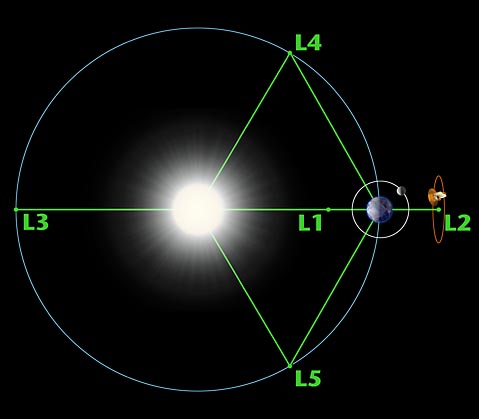
Re:Deja vu all over againFirst off, here's a map showing where the lagrange points in the earth-sun system are. This map works for the earth-moon system as well, as the earth-moon syetem is reduced to a point for earth-sun lagrange calculations.
You're right about L1, L2, and L3 not being stable, but L4 and L5 are. This link explains in a bit more detail , but the L4 and L5 points, despite being peaks of gravitational "hills", would be self stabilizing.
Here's NASA's explanation:
A detailed analysis (In PostScript or PDF) confirms our expectations [of instability] for L1, L2 and L3, but not for L4 and L5. When a satellite parked at L4 or L5 starts to roll off the hill it picks up speed. At this point the Coriolis force comes into play - the same force that causes hurricanes to spin up on the earth - and sends the satellite into a stable orbit around the Lagrange point.Putting a space station at either of these stable points wouldn't be much more difficult than putting something in orbit around the L1 point and would be easier then going around the moon to the L2 point, which NASA has shown they can do with reasonable success.
The radiation would be worse there, but if we have to improve our radiation shielding anyway, we might as well try to make it strong enough so people can be placed at these points.
-
Re:Deja vu all over againFirst off, here's a map showing where the lagrange points in the earth-sun system are. This map works for the earth-moon system as well, as the earth-moon syetem is reduced to a point for earth-sun lagrange calculations.
You're right about L1, L2, and L3 not being stable, but L4 and L5 are. This link explains in a bit more detail , but the L4 and L5 points, despite being peaks of gravitational "hills", would be self stabilizing.
Here's NASA's explanation:
A detailed analysis (In PostScript or PDF) confirms our expectations [of instability] for L1, L2 and L3, but not for L4 and L5. When a satellite parked at L4 or L5 starts to roll off the hill it picks up speed. At this point the Coriolis force comes into play - the same force that causes hurricanes to spin up on the earth - and sends the satellite into a stable orbit around the Lagrange point.Putting a space station at either of these stable points wouldn't be much more difficult than putting something in orbit around the L1 point and would be easier then going around the moon to the L2 point, which NASA has shown they can do with reasonable success.
The radiation would be worse there, but if we have to improve our radiation shielding anyway, we might as well try to make it strong enough so people can be placed at these points.
-
Re:Deja vu all over againFirst off, here's a map showing where the lagrange points in the earth-sun system are. This map works for the earth-moon system as well, as the earth-moon syetem is reduced to a point for earth-sun lagrange calculations.
You're right about L1, L2, and L3 not being stable, but L4 and L5 are. This link explains in a bit more detail , but the L4 and L5 points, despite being peaks of gravitational "hills", would be self stabilizing.
Here's NASA's explanation:
A detailed analysis (In PostScript or PDF) confirms our expectations [of instability] for L1, L2 and L3, but not for L4 and L5. When a satellite parked at L4 or L5 starts to roll off the hill it picks up speed. At this point the Coriolis force comes into play - the same force that causes hurricanes to spin up on the earth - and sends the satellite into a stable orbit around the Lagrange point.Putting a space station at either of these stable points wouldn't be much more difficult than putting something in orbit around the L1 point and would be easier then going around the moon to the L2 point, which NASA has shown they can do with reasonable success.
The radiation would be worse there, but if we have to improve our radiation shielding anyway, we might as well try to make it strong enough so people can be placed at these points.
-
Re:Deja vu all over againFirst off, here's a map showing where the lagrange points in the earth-sun system are. This map works for the earth-moon system as well, as the earth-moon syetem is reduced to a point for earth-sun lagrange calculations.
You're right about L1, L2, and L3 not being stable, but L4 and L5 are. This link explains in a bit more detail , but the L4 and L5 points, despite being peaks of gravitational "hills", would be self stabilizing.
Here's NASA's explanation:
A detailed analysis (In PostScript or PDF) confirms our expectations [of instability] for L1, L2 and L3, but not for L4 and L5. When a satellite parked at L4 or L5 starts to roll off the hill it picks up speed. At this point the Coriolis force comes into play - the same force that causes hurricanes to spin up on the earth - and sends the satellite into a stable orbit around the Lagrange point.Putting a space station at either of these stable points wouldn't be much more difficult than putting something in orbit around the L1 point and would be easier then going around the moon to the L2 point, which NASA has shown they can do with reasonable success.
The radiation would be worse there, but if we have to improve our radiation shielding anyway, we might as well try to make it strong enough so people can be placed at these points.
-
Re:Yeah, right...
This seems to be the main news site for the International Space Station.
They seem to have fun messing around with stuff. Don't ask me what the heck they're up to on the picture. -
Re:Yeah, right...
This seems to be the main news site for the International Space Station.
They seem to have fun messing around with stuff. Don't ask me what the heck they're up to on the picture. -
Re:Gives out more heat that it recieves.The planet itself does this as well... "...Jupiter radiates nearly twice as much heat as it receives from the Sun." Found here
Jupiter is by far the most interesting planet (with it's moons) to me, other than the Earth. More information as well as pictures can be found on NASA's site for the planet itself.
-
Re:Building Infrastructure for the Future
No. Saturn V's cargo wasn't three astronauts, enough food and water for them to survive for a week, space suits, and a golf club. Saturn V's cargo was two complete space ships complete with crew, supplies, and computers powerful enough (with 1960s technology!) for the ships to navigate in space on their own, along with an engine powerful enough and carrying enough fuel to send those two space ships to the moon, let them orbit, and then bring one of them back to the earth. Later Apollo missions threw in an electric car for fun.
Take a typical Apollo/Saturn V stack. Remove the Apollo part (meaning the lunar lander, the command module, the service module, the big engine to shoot them from low-earth orbit to the moon, etc.). Replace it with something that never needs to leave low-earth orbit. For example: a complete space station, which was put up in one shot. Now granted, the ISS is much bigger, but nothing today has the lifting power that Saturn V provided. If a shuttle did, it would be relatively easy to design a craft to fit in a shuttle's cargo bay that could go to the moon, land, and come back again. -
Cell Phones Can Be Dangerous
John Dvorak is a moron. If you look at NASA's Aviation Safety Reporting System (ASRS) database, you will find many reports of cell phones and other passenger carried electronic devices causing harmful interference to aircraft communications and navigation systems. What's worse, many passengers lie when asked if they have turned off their cell phone or laptop computer.
-
Re:third brightest object in the skyAnother fun thing to play with that shows where all known (unclassified) satalites are in a nifty 3d Java thingy is on NASA's site:
http://liftoff.msfc.nasa.gov/RealTime/JTrack/3D/JT rack3D.html
You can zoom in/out, select individual satalites and see their orbit, speed up the motion or let it run real-time. Its interesting to see the patterns they are in, and how far out some are.Tm
-
The Aviation Safety Reporting System
Check out actual reports from PED-related (Personal Electronic Device) incidents.
You might also wish to read a discussion of the problems with PEDs on airplanes.
Finally, here's a list of how the ASRS connect electronic devices to airplane anomalies, according to various reports they've received:
Anomaly: NAV CDI needle swing (off course), Phase: CL, Possible Cause: tape players
Anomaly: CDI needle swings, Phase: ER, Possible Cause: chess player
Anomaly: erroneous nav signal of VOR station, Phase: ER, Possible Cause: dictaphone
Anomaly: loss of VOR capability, Phase: ER?, Possible Cause: cellphone
Anomaly: HSI's discsrepancies, Possible Cause: cellphone
Anomaly: NAV compass & CDI oscillation (off course), Possible Cause: PEDs
Anomaly: off VOR course, Phase: ER, Possible Cause: cellphone
Anomaly: off course, Possible Cause: tape player
Anomaly: music blocked VHF comm's, Possible Cause: FM radio
Anomaly: comm's blocked, Phase: GR/CL, Possible Cause: Nintendo, cellphone, notebooks
Anomaly: off course, Possible Cause: tape machine+Nintendo
Anomaly: off course, Phase: ER, Possible Cause: cellphone
Anomaly: both VORs lost, no VOR audio signal, Phase: ER, Possible Cause: cellphone
Anomaly: all directional gyros lost, Possible Cause: 25 radio's, 1 laptop
Anomaly: compass error; off course, Phase: ER, Possible Cause: laptop, comp.game
Anomaly: 2 missed approaches, Phase: FA, Possible Cause: PED suspected
Anomaly: loss of all autonav functions, Phase: CL, Possible Cause: 3 laptops, cdplayer/radio
Anomaly: loc receiver anomaly; missed app., Phase: FA, Possible Cause: PED suspected
Anomaly: compass precess 10deg, Phase: ER, Possible Cause: laptop
Anomaly: Omega NAV unreliable, Phase: ER, Possible Cause: tv set suspected
Anomaly: HSI errors, Phase: TA,CL,ER, Possible Cause: cellphone
Anomaly: nav compass sys error; off course, Phase: CL, Possible Cause: cellphone
Anomaly: temp loss of com freq., Possible Cause: cd player
Anomaly: INS nav errors, Possible Cause: electronic games
Anomaly: off course, Possible Cause: cellphone
Anomaly: eng fuel ctlr + vhf radio interference, Possible Cause: cellphone
Anomaly: off course, Possible Cause: laptop
Anomaly: EMI interference & radio alt flag, Phase: ER, Possible Cause: cd-players (2)
Anomaly: erratic cdi indications, Phase: ER, Possible Cause: 2 gameboys
Anomaly: autopilot erratic, Phase: AP, Possible Cause: cellphone suspected
Anomaly: off course, Possible Cause: gameboy
Anomaly: nav radio interference; off ILS course, Phase: AP, Possible Cause: computer game
Anomaly: EMI interference causes a split between the compass system in flight ER laptop both LOC and GS 'OFF' flags showed just prior to the Outer Marker
Phase: AP, Possible Cause: PED suspected
Anomaly: significant LOC rate of deflection, Phase: AP, Possible Cause: PED possible
Anomaly: loss of Captain EFIS display, Phase: AP, Possible Cause: 8 laptops
Anomaly: electronic compass erratic, Possible Cause: cd player
Anomaly: interfering transmitter, Phase: AP, Possible Cause: cellphone
Anomaly: NAV and COM radio problems, Phase: PED, Possible Cause: suspected
Anomaly: off approach path, Phase: AP, Possible Cause: PED suspected
Anomaly: off course due to drifting, Phase: FM, Possible Cause: PED suspected
Anomaly: HSI discrepencies, Possible Cause: PED suspected
Anomaly: EICAS interference, airspeed discrep., Phase: ER, DC, Possible Cause: PED
Anomaly: loss of COM frequency, Possible Cause: cellphone
Anomaly: ILS, radio altimeter, and primary flight display went out, Possible Cause: 20 cellphones -
Re:The Club of Rome
Wishful thinking on your part here. The relationship between greenhouse gases and global temperature is quite well known... The average global temperature started to increase in the 1920's.
The relationship between greenhouse gases and global temperature is only well "known" among the environmentalist extreemists and the uninformed. Nobody is claiming that CO2 levels are decreasing in the atmosphere, but there is no evidence scientific or otherwise that can conclusively link a rise in C02 to a rise in global temperature.
Yes, global surface temperatures rose an average of 0.053 degrees C per decade in the 20th century, but at the same time atmospheric temperatures decreased , particularly in the latter half of the century.
It is a historical fact that global temperatures have fluctuated as much as 10 degrees C. The Ice Ages alone prove that global temperatures vary regardless of human involvement. Why is this any different?
Because CFC's were cut out (think back to the Montreal Protocol)
Again, if you check the facts you can see that this is easily disputed. Here is a graph showing the size of the ozone layer since 1980. The 2002 datapoint of about 15 million km^2 isn't even on there (a little more than 1/2 of the 2000 size). CFC aerosol cans were banned in 1976 and the Montreal Protocol was signed in 1989. Can you see any kind of link in the ozone size to this reduction on "greenhouse" gases? Are you honestly trying to convince me that these two are somehow related? Why would the hole in the ozone reach its peak a full 11 years after the Montreal Protocol was signed?
can you name a single peer reviewed scientific publication from that time period which is about this global freezing
I'm sorry, I let my subscriptions to all the 1970's scientific publications run out. I guess that means this is propoganda. Actually, Peter Singer (one of the more lefty whacko's out there) has written several books on a variety of subjects, including the "global freezing" scare of the 1970's.
the simple fact is that the vast majority of the worlds climatical scientists support this theory
Give me a list of scientists that support this theory, and I'll show you a list that don't. Its just plain bad science, and the only reason people think it is supported by a majority of scientists is because it isn't politically correct to argue it. For example, here is the CNN writeup of the shrinking ozone hole this month. The size of the hole reaches a 12 year low, and the only scientific opinion expressed is: "Scientists caution that the data are insufficient to conclude that the fragile ozone layer is on the mend. " -
Re:Here we go ...Well from this old slashdot article, it seems like some big companies use it.
And yes, I do work and we use debian on some of our production servers and all of our development servers.
Others seem to like it as well:"I use a distribution called Debian"
You could also check out www.debian.org/users
"what really sold me on it was its phenomenal bug database"
-- Neal Stephenson
And by the way, NASA uses Debian for their Aeroshark and Ziti clusters. They have put Debian in space as well, but the link seems to be rotten...
- Ost -
Re:Here we go ...Well from this old slashdot article, it seems like some big companies use it.
And yes, I do work and we use debian on some of our production servers and all of our development servers.
Others seem to like it as well:"I use a distribution called Debian"
You could also check out www.debian.org/users
"what really sold me on it was its phenomenal bug database"
-- Neal Stephenson
And by the way, NASA uses Debian for their Aeroshark and Ziti clusters. They have put Debian in space as well, but the link seems to be rotten...
- Ost -
Re:Here we go ...Well from this old slashdot article, it seems like some big companies use it.
And yes, I do work and we use debian on some of our production servers and all of our development servers.
Others seem to like it as well:"I use a distribution called Debian"
You could also check out www.debian.org/users
"what really sold me on it was its phenomenal bug database"
-- Neal Stephenson
And by the way, NASA uses Debian for their Aeroshark and Ziti clusters. They have put Debian in space as well, but the link seems to be rotten...
- Ost -
Re:5/6 is stopping short
Soho has been in a halo orbit around the earth sun L1 point since 1995 (including about a month in 1998 out of contact after a software error) without any maintenence visits.
-
Re:Bottom line: stupid ideaOthers have already pointed out various reasons that your smug troll is off-base. I'll just add that it's dangerous to put things in the L4 or L5 points because they are stable, and therefore filled with potentially dangerous space junk.
If it's really so hard to put things at L1 and keep them there, you better go tell the SOHO team who have successfully kept that satellite at the Sun-Earth L1 point for almost 7 years now, without ever being "headed for Pluto".
-
Re:Radiation Shielding: Just the sleeping closets.
They already do just that. See this article.
-
Save money on shielding! Only $2000 per astronaut!
The First Annual Sean O'Keefe Award for Outstanding Achievement In The Field Of Excellence(tm).You gotta admit, it would probably work...
Ali
-
Re:What about gammas?
I'm no physicist, but from what I can glean from stuff like this, gamma ray telescopes don't "focus" in the same sense that a visible light (or even X-ray) instrument would.
-
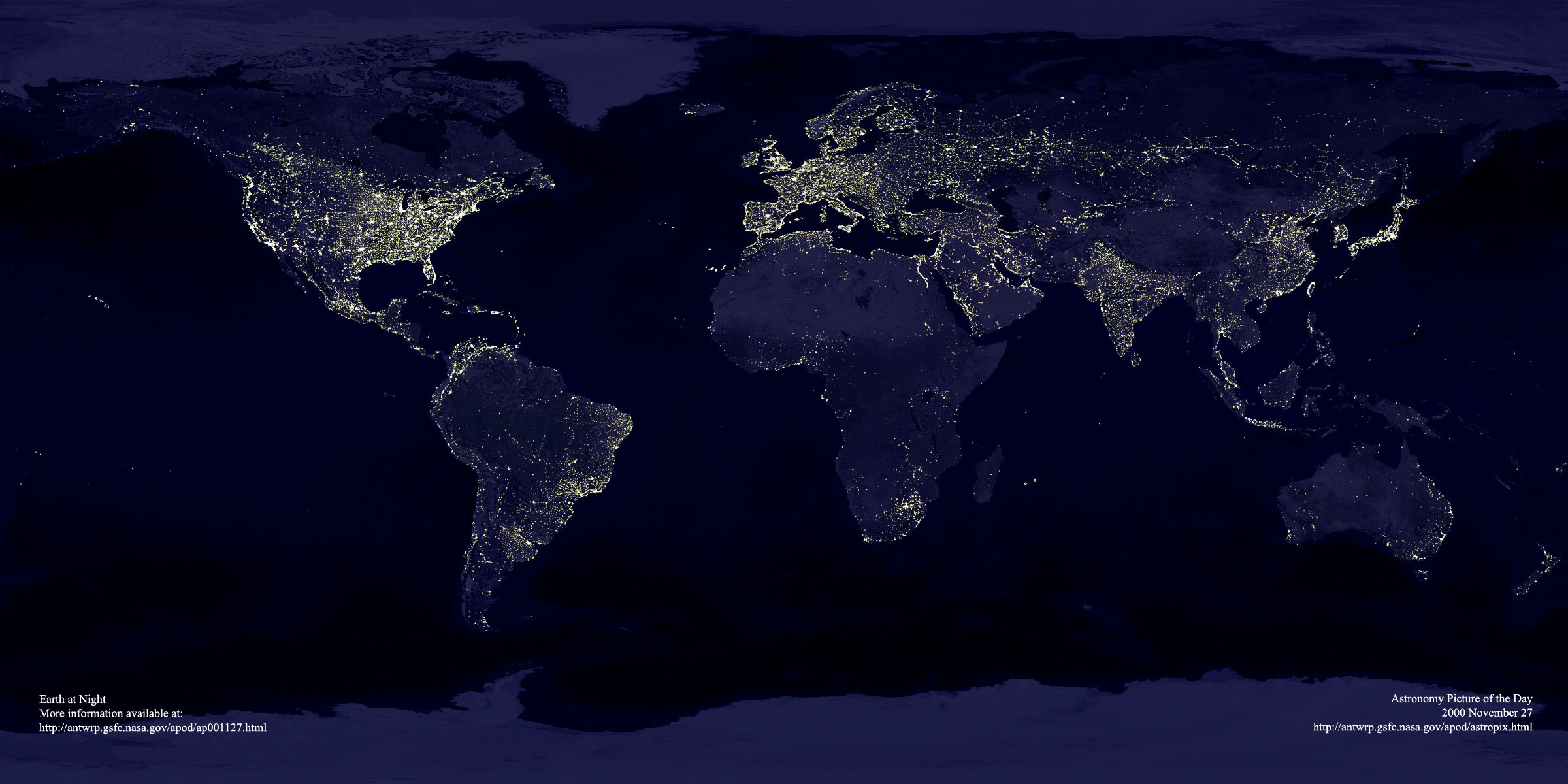
Its a NASA picture!...just squint your eyes a bit.Doesn't the zommed in map of North America look almost exactly like the NASA picture of the earth at night?
I wouldn't be surpirsed if a major source for their map was taking the NASA image and changing the color palette.
-
Re:See the orbital motion for yourself
never comes closer than 3.6 million miles to our planet
For 2002AA29 in particular, you can use link
Keep in mind that the orbital solution is based on only a short arc: only 28 days, about one twelfth of a complete revolution. Our estimates of the orbital parameters -- and behavior -- could change quite a bit over the next few months.
Indeed the orbit needs correction. Take, for instance, July 10th, 2016. On the simulator pointed out in the parent you get a distance earth-asteroid of 0.018 AU=1580587 miles~=1,6 million miles, way less than the least predicted, as quoted in the article.
If you follow chaos theory, you easily estabilish that the initial values needs more precision. -
Re:It's the Death Star
"That's no moon" [It's the death star]
Actually, the Death Star is in orbit around Uranus.
-
Re:See the orbital motion for yourself
It's common in orbital studies to use a moving reference frame that fixes two objects -- in this case, the earth and the sun -- and let everything else move with respect to them. When you do switch to such a reference frame, the asteroid's orbit looks a bit like a horseshoe with the sun at the center. This kind of reference frame is especially useful for viewing the magic of the Lagrange points.
-
Re:Not quite a planet, eh?
Tada! So the cannonball just keeps moving, around the Earth. It's in orbit.
Not quite. The cannonball you mention is in an eliptical orbit, where the perigee is ground level. It will go around the Earth once, (the Earth may spin a bit during this movement,) and land on the ground again. If you fire from a mountain top, and neglect air friction, you have a chance.
The Navy actually did something quite like this.
Much better is to do a apogee kick, a short rocket blast at the highest altitude, to convert the orbit from eliptical to circular. No more pesky dirt or air to worry about! -
Re:Orbits, nodes, & more
*Any* object in orbit around the sun would have to intersect the Earth's ecliptic (which is defined as the plane of the Earth's orbit) at two distinct points, except for the special case where an object has the same orbital plane as the earth. So yes, Jupiter, Pluto, and Halley's Comet all have ascending and descending nodal points and I'm sure 2002 AA29 does as well.
In fact, it seems that they've got all the details worked out. If you scroll down below the java applet they list all sorts of fun orbital parameters, including ascending node, eccentricity, etc. etc. -
See the orbital motion for yourself
JPL has a very nice tool for looking at the orbits of asteroids. Go to
http://neo.jpl.nasa.gov/orbits/
for the general case. For 2002AA29 in particular, you can use
http://neo.jpl.nasa.gov/cgi-bin/db?name=2002AA29&
g roup=all&search=SearchKeep in mind that the orbital solution is based on only a short arc: only 28 days, about one twelfth of a complete revolution. Our estimates of the orbital parameters -- and behavior -- could change quite a bit over the next few months.
-
See the orbital motion for yourself
JPL has a very nice tool for looking at the orbits of asteroids. Go to
http://neo.jpl.nasa.gov/orbits/
for the general case. For 2002AA29 in particular, you can use
http://neo.jpl.nasa.gov/cgi-bin/db?name=2002AA29&
g roup=all&search=SearchKeep in mind that the orbital solution is based on only a short arc: only 28 days, about one twelfth of a complete revolution. Our estimates of the orbital parameters -- and behavior -- could change quite a bit over the next few months.
-
Re:Nicely written...
You can sell it NASA
-
Re:Space Cooling...Have the guys on the ISS (or indeed any space mission/station) ever used the 'cold hard vacuum' of space to get their systems running cool and fast.
Yes, they do. They aren't experiments, they are in fact how the space station works. On the last mission they brought up 3 more ammonia radiators.
These work by taking water which runs past the electronics, exchanging that heat to liquid ammonia, which out the truss, and through these huge metal radiators which then radiate the heat to space. They have to use ammonia because the water would just freeze if it went through the external radiators.
More space station info... -
Re:Space Cooling...Have the guys on the ISS (or indeed any space mission/station) ever used the 'cold hard vacuum' of space to get their systems running cool and fast.
Yes, they do. They aren't experiments, they are in fact how the space station works. On the last mission they brought up 3 more ammonia radiators.
These work by taking water which runs past the electronics, exchanging that heat to liquid ammonia, which out the truss, and through these huge metal radiators which then radiate the heat to space. They have to use ammonia because the water would just freeze if it went through the external radiators.
More space station info... -
The CIA offends?
Why would the CIA World Factbook offend anyone? it's a tremendously good resource.
One thing the US government is really good about is putting out lots of free data archives that it's spent money building. There are *excellent* resources available to the world:
The USGS puts out really great maps and elevation maps for free. Not something you can produce on your own easily.
NASA puts out some of my favorite stuff -- images, huge quantities of data.
The Farm Security Administration has some really nice old photographs.
The Library of Congress has tons of really nice stuff.
The Smithsonian is one of the greatest museums I can imagine.
The US government is one of the most steady and highest-quality provider of useful content (and ad-free!) available to the Internet.
I kind of wish there was some site that listed all the US government sites as a sort of tree...make it easier to browse through them. -
Re:This is offtopic (sorta) but interesting!
-
Re:American Maginot Lineespecially when LIDAR goes into wide use
LIDAR, as in this page? Forgive my ignorance, but the naive approach to defeat this is just to paint the machine a deep shade of black (absorbing all light).. I'm sure it's more complicated than that, but
-
Re:Shares some interesting similarities with past
There are certyain things called "Lifting bodies" which require little wing area to fly. Granted they are not very economic designs but they do have their uses. One problem with them tho is that the more you lesson the wing area, the greater the take off and landing speeds must be (one of the reasons Groom Dry Lake has a huge runway).
-
Re:Shares some interesting similarities with past
There are certyain things called "Lifting bodies" which require little wing area to fly. Granted they are not very economic designs but they do have their uses. One problem with them tho is that the more you lesson the wing area, the greater the take off and landing speeds must be (one of the reasons Groom Dry Lake has a huge runway).
-
The black hole isn't really that big.As it says on today's Astronomy Picture, we have observed a star whose orbit around the center of the galaxy reaches 17 light-hours from a large object, which is the black hole referred to. (That's about 3 times the radius of our solar system.) That does NOT mean that the black hole is that large, just that that's the closest we've seen anything come to it. The radius of the black hole itself is most certainly not near that size.
If the mass of the black hole is 2.6 x 10^6 times that of our sun, the radius would be closer to 150 million km. (That's a very crude pseudo-calculation, so don't quote me.)
-
Re:To clarify...> I 'think' it's this one..
>http://lightspeed.sourceforge.net/ but I could be wrong.More relativistic flight sims and visualizations:
Visual distortions around black holes
Visual effects of special and general relativity.
And finally, an oh-my-God particle - a proton with the mass of a bacterium, the kinetic energy of a brick dropped on your toe, and which, if it were a spaceship, could make it to the edge of the universe in a week and a half (ship-time, that is!).
The universe offered to us by science isn't just stranger than we do imagine. It's stranger than we can imagine. The universe of the mystics and new-age hucksters is positively boring in comparison.
-
This is old news at UCLA
-
THIS is the time to promote APOD
I've stumbled across NASA's Astronomy Picture of the Day site, and I've become addicted to it. Not a day goes by without me browsing back and back through the archive. Lots of wonderful images there, with explanations by a professional astronomer, in language that even I understand. And ofcourse links for people with more understanding of the stuff they are talking about.
Anyway, it's an amazing site, really worth adding to your daily-visit bookmark group. And yes, black holes in or near "our" galaxy are featured there as well.
(Not karma whoring, I've got plenty. Just wish to share this with you) -
THIS is the time to promote APOD
I've stumbled across NASA's Astronomy Picture of the Day site, and I've become addicted to it. Not a day goes by without me browsing back and back through the archive. Lots of wonderful images there, with explanations by a professional astronomer, in language that even I understand. And ofcourse links for people with more understanding of the stuff they are talking about.
Anyway, it's an amazing site, really worth adding to your daily-visit bookmark group. And yes, black holes in or near "our" galaxy are featured there as well.
(Not karma whoring, I've got plenty. Just wish to share this with you) -
Some useful links
I'd check out material from Google, Amazon, The HCI Bibliography, NASA, the W3C, and Joel for starters.
While some may scoff, the ACM has an article on the Windows 95 interface, a little bit aged by now. Though many in this forum dislike Microsoft for its other faults (the constant crashes, draconian business practices, etc.), a big part of their current success comes from the fact that their user interface is simply easy to use. They do their homework when it comes to that.
My mom couldn't spell WWW when I set up my parent's computer for them a couple years ago. She complained that IE wouldn't go to the website after she typed in the address. It took me a while to realize that she wasn't pressing Enter when she finished typing the address in. That's why they have that little "Go" button next to the address box that I always get rid of right away.. Duh!
This is a noble quest, young hero. God speed. -
Re:Is it worth it?
Dude, I'm at 118MB on Galeon with only 46MB shared--and I haven't even been looking at the naughty bits. With high quality images it's really not hard to max the browser out. Try using tabbed browsing on an aster image gallery and you'll see what I mean.
For speed I like to set my RAM cache to either 128MB or 256MB and my disk cache to 0.
-
Re:What about the microbes' working conditions?
Interesting troll (or joke, whatever). But even if the organic LEDs were filled with bacteria (they're not), bacteria aren't animals.
They're not plants, either. Bacteria are a kingdom all their own, neither plant nor animal (nor fungus, nor archaea).
Besides, some bacteria like to be bombarded with radiation (see Deinococcus radiodurans, for example, also known as "Conan the Bacterium"). -
Re:Wishing it to fail is a bit narrowminded
>> Columbus was considered insane to want to sail around the world to reach India. He was ridiculed
>> and almost didn't find funding. His discovery completely changed the world. There was a time when
>> the suggestion that the earth was round and not the center of the universe would get you killed.
>> I'm not going to list any more examples of going against conventional thought but I'm sure all of
>> you can think of plenty of them.
Actually, more people at the time than you would expect knew that the earth was round.
"Sometimes the claim is made that those who opposed Columbus thought the Earth was flat, but that wasn't the case at all. Even in ancient times sailors knew that the Earth was round and scientists not only suspected it was a sphere, but even estimated its size."
(http://www-istp.gsfc.nasa.gov/stargaze/Scolumb. ht m