Slashdot Mirror
Domain: nasa.gov
Stories and comments across the archive that link to nasa.gov.
Comments · 16,365
-
Too late
The evil cult of the astronomers are already represented there.
-
AFTI F/111 Mission Adaptive Wing
This is actually follow-on work to a program run out of Wright-Patterson called Advanced Fighter Technology Integration F-111 Mission Adaptive Wing. (Not to be confused with Advanced Fighter Technology Integration F-16, which I worked on...) Here are some photos and a good synopsis of the program. This link covers the final round of flight testing.
-
AFTI F/111 Mission Adaptive Wing
This is actually follow-on work to a program run out of Wright-Patterson called Advanced Fighter Technology Integration F-111 Mission Adaptive Wing. (Not to be confused with Advanced Fighter Technology Integration F-16, which I worked on...) Here are some photos and a good synopsis of the program. This link covers the final round of flight testing.
-
Dryden Home page
The Dryden home page highlights this project. My last contract position was out there. Aside from some management issues (typical incompetent PHBs), there are a lot of smart engineers solving difficult problems there. It has been previously described as a geek playground. I still rank it as the best environment I ever worked in although the culture is slowly changing
-
Re:Excuse me
From the same article: C. elegans is currently the only animal with a fully-sequenced genome, and DNA microarrays are available that contain nearly every one of the 19,000 genes in the C. elegans genome. Those microarrays don't contain the human genome, and the human genome has great uncertainties and gaps.
-
Karma whoring
Pictures of the ATFI found at NASA.
-
Re:Where is the "oomph?"Wow, I'm in a bad mood tonight. The poster posted:
You obviously didn't see the pictures someone else posted. It uses a a pair of hydraulic cylinders attached to the ground, of course.Actually (speaking with no knowledge of what I'm talking about) it seems like all you'd need would be front and back hardened rods the length of the wing that were only attached at 2 points - the [electric/mechanical] actuator inside, and a hardpoint on the twisty end...
-
wing warping...There is a very intersting applet about wing warping on NASA site.
Actually wing warping was discontinued due to the fact that as modern airplanes became bigger and heavier rigid Duralium(Aluminium+Copper) and steel was used, which was not very conductive to bending, But I guess with carbon fibre based materials that will change.
Wing warping gives a large degree of control. It is Demostrated very well in the java applet which shows the lift, the forces, the mechanics and the attitude on a model plane(like the one used by wright brothers). -
More information on the subject...
I'm a USAF member, and at the office lately we've been tossing around this interesting subject. Honestly, the article presented in the story was pretty lame; here's a few good links we've come up with, if you want to know a bit more about the technology:
NASA Press Release
Air Force Research Laboratory brief
AAW photo collection (NASA) -
More information on the subject...
I'm a USAF member, and at the office lately we've been tossing around this interesting subject. Honestly, the article presented in the story was pretty lame; here's a few good links we've come up with, if you want to know a bit more about the technology:
NASA Press Release
Air Force Research Laboratory brief
AAW photo collection (NASA) -
$41 million
-
Re:Can I be skeptical, too?But the rings are very "wide", of the Sun isn't exctly above the equator the projected shadow will depend on how wide the ring is - potentially 1000's of kms
I agree that that isn't impossible. So if a large asteroid hits us at just the right angle and the mechanics are just right and a ring is formed which is not only optically thick but pretty dang wide, you might have something that could be visible and maybe even dim some light.
It just seems to me to be an awful lot of very improbable conditions for it to be a useful theory to explain some climate change. Essentially, the way I read it, there's some climate change they haven't been able to explain so you come up with this theory that essentially has no physical evidence. So now you are trying to explain "unexplainable" climate change with a theory that, given the odds, is highly unlikely to have even ocurred and for which there is really no evidence, let alone caused the effects on the climate they are predicting.
Me: For earth, I'm quite certain the ring would be on a smaller scale than Saturn.
You: More proof by assertion?I will confess I can't prove how large or thick theoretical rings around the earth would be, nor can you prove that I am wrong.
However, Uranus is smaller than Saturn and all of its rings but one are listed as 0.1km thickness (the other is listed as less than 15km); compare that to a maximum thickness of 1000km for Saturn. The albedo of the rings of Uranus is also listed as 0.03, whereas the albedo of Saturn's rings goes up to 0.60.
Now that doesn't *prove* anything, but it does suggest that smaller planets have smaller rings with lower albedo.
I'm not saying I necessarily belive his idea, but it's not that easy to dismiss out of hand.
I'm not even dismissing the possibility the earth had rings. I just think it is relatively unlikely that earth had rings. And if earth had rings, it is relatively unlikely that they were large, dense, or with a high enough albedo to affect earth's climate. Given so many improbabilities I just don't acccept the theory as a reasonable explanation of "unexplained" climate change on the earth.
Me: Gotta love those climate models of scenarios that are impossible to compare to reality. Heck, the climate models have been SO accurate so far as far as global warming goes, why not duplicate their success with a climate model of something completely impossible to compare with reality to validate the model.
You: Now you are just letting a political opinion about a different matter affect your thinking.No, my opinion of climate models is not political but scientific. I have no reason to believe climate models that actually predict LESS global warming every time they are refined. I have no reason to believe climate models that can't take 1850 climate data and, when run, produce the actual climate of the year 2000. I have no reason to believe a climate model developed by those that run their incomplete models and then turn around and suggest we make drastic changes to our economy based on the results.
As it is, climate scientists issue their doomsday reports precting all hell is going to break loose and we have to change everything now or we're in trouble--oh, and by the way, we're not 100% sure, but then the report continues on stressing the probability of the predicted effects despite the uncertainty.
As scientists making very disturbing claims of immense political and social importance, they should outright preface their predictions with "The following is based on climate models which we cannot guarantee are accurate. Improvements to this model over the last 10 years have consistently reduced the predicted impact, hence we must expect that future improvements to the model will also reduce the impact of the predictions included herein. The predictions in this report should be considered works-in-progress and only reflect one of an infinite number of possible future scenarios."
I wonder if reports had that kind of honest disclaimer whether or not politicians and the public would take them with a more appropriate level of consideration and belief. Who knows, but they probably wouldn't get any more funding.
-
Re:Can I be skeptical, too?Raise that window screen the 1000 feet you mention, you won't be able to detect the drop in insolation it causes. But tell me, if the window screen was a couple of square miles in area, do you think the drop in insolation would still be undetectable?
A window screen a couple of square miles just 1000 feet above the ground, sure, it would be detectable. But you're now putting true ring dimensions at 1000 feet elevation as opposed to their true elevations.
To give you an idea, you have to go to Saturn Ring G at 165,000km from Saturn's center before you get a ring more than 0.1-1km in "thickness." And that's for Saturn. For earth, I'm quite certain the ring would be on a smaller scale than Saturn. And 0.1km-1km at anything more than a few hundred miles is going to be more like the pencil at 1000ft than the huge window screen at 1000ft.
It seems to me the smaller the particle size the greater its ability to block or reflect light. Wouldn't you agree?
Certainly it would depend on the quantity of small particles. The article says "a halo of boulders and rocks would compress around the equator into a thin plane." No mention of dust. I would think that makes sense since a meteor impact on Earth would result in most of the dust staying in the atmosphere since it would be quickly slowed down by the atmosphere given the small particle size, while larger rocks and boulders might make it to orbit. I doubt you'd find much 0.01mm particles in orbit, at least from a meteor impact.
The article also reads: "Boslough, a physicist at the Sandia National Lab in Albuquerque, and colleague Peter Fawcett, an Earth sciences professor at the University of New Mexico, devised a climate model to predict the effects of such a disk." Gotta love those climate models of scenarios that are impossible to compare to reality. Heck, the climate models have been SO accurate so far as far as global warming goes, why not duplicate their success with a climate model of something completely impossible to compare with reality to validate the model.
The article also says: "Under certain conditions, if the angle and mechanics are just right, a big asteroid or comet could create a debris ring by slamming into Earth, scientists theorize." So under certain conditions when the angle and mechanics are just right, we MIGHT get a ring. And that ring MIGHT have an effect depending on its characteristics. And if it has an effect, it MIGHT be detectable.
I would tend to believe that this guy was nearing the end of his research dollars and had to produce something, even if just a theory, in order to justify the research dollars he had received and maybe to score some more. It's always a bummer to receive funds, spend them over the course of a few years, and have nothing to show to the people that funded you.
-
i'm sure it's filled by now
I do not know if the registration has been filled.
since comedy central cancelled battlebots, you can bet those 60 slots have been long since filled
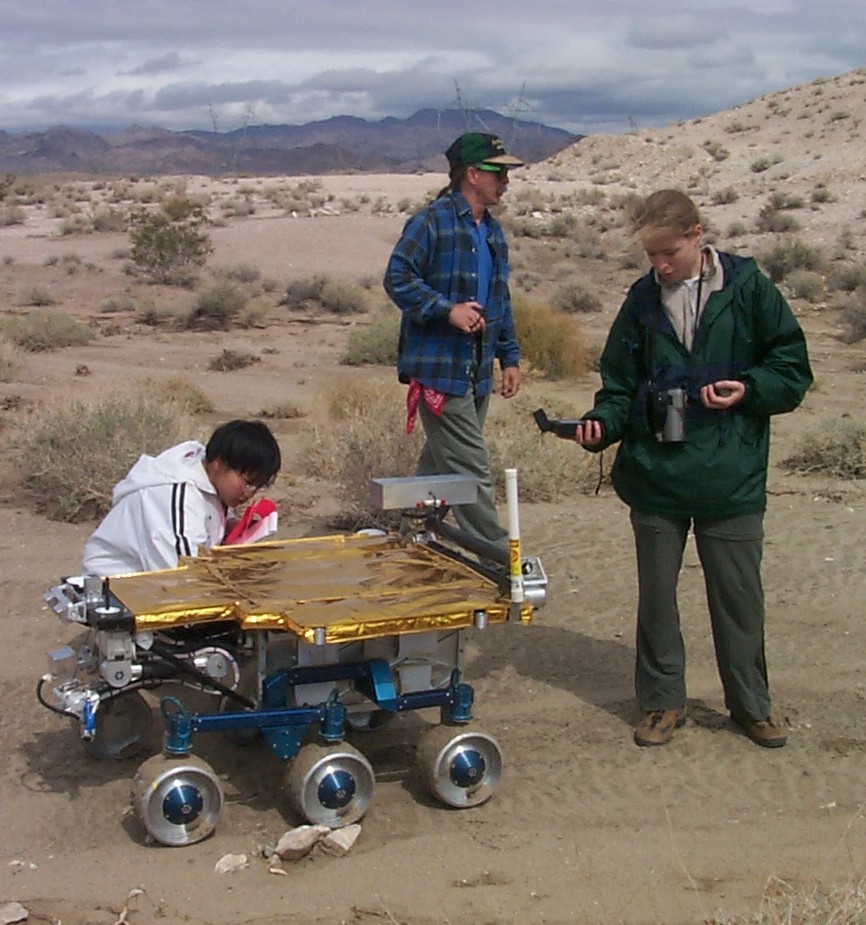
i'm sure the innocuous little moon-rover on the nasa page will soon be outfitted with things like EMP weapons, chemical weapons, flamethrowers, magnetic grapples, swarms of multi-bots, etc. rumor has it Carmen Electra is even in the class (the page does say anyone can audit!)
-
How does that work?OK, this is probably a really stupid question, but...
When astronomers look at really old objects and say "ah, these are 13 billion light years away, therefore we are looking 13 billion years into the past"... how does that work?
If the universe used to be really tiny and it's been expanding, is it expanding faster than the speed of light? Because if it isn't, why didn't that light from 13 billion years ago pass us a long time ago.
What am I missing here?
Here for example, NASA scientists say they discovered a galaxy that they think is 13 billion light years away.
If the universe is 14 billion years old, that would imply that it expanded faster than the speed of light in a very short time, leaving us 14 billion light years from these galaxies, so that the light would take 14 billion years to get to us. Maybe another possibility is that the rate or expansion is just under the speed of light, so that we (or our point in space) used to be fairly close to those galaxies, but the expansion was going on during the entire 14 billion years at such a high speed that the light from those galaxies is only now catching up to us.
On the other hand, if the speed of light always appears to be a constant, that last idea wouldn't work... or would it, since the entire universe would be expanding?
I never heard any of this discussed... what do the physicists say? -
Re:Do they mark down ok as well?
Interesting point that language is constantly evolving, but I don't think that the example you gave is a good one. Check out this page or this one for a rebuttal. Both pages are discussions on the origin of "OK" and although there is not a general consensus, neither page even mentions that "OK" could be a shortened version of "okay".
-
Oxygen is the third most common element
in our Sun, twice as common as Carbon, though dwarfed, it is true, by the amount of hydrogen and helium. I suspect other solar systems have similar ratios.
-
Pepsi already flew at Nasa
Pepsi and Coke already flew on the shuttle. STS51-F according to Loren Acton in the book Space Shuttle the First 20 Years. From the book, "... we did our test in space. The red team did the Pepsi, and the blue team-we were divide into shifts-did the Coke. We took the still photographs, and we showed the logo. And indeed, the Coke can dispense soda kind of like what we're used to drinking on Earth. And the Pepsi can dispensed soda filled with bubbles-fun to play with in zero-g, but not very drinkable."
Earlier he listed for training. "The Pepsi can, when it showed up, looked like a shaving cream can. In fact, the Pepsi logo was just stuck on a paper wrapper, and when we peeled if off, indeed it was just a shaving cream can. It still had the shaving cream logo on it. Pepsi understood that this had nothing whatsoever to do with soda in space. It had to do with PR."
-
Agriculture.
It's not about spying or ICBM's or anything, the key factor here is, believe it or not, agriculture. I know other patriotic Indians have problems accepting this, but India is still largely an agriculture-based economy, with the population especially concentrated in rural areas. With the exploding population creating pressure on food resources, the Indian Council of Agricultural Research actively involves itself in creating better yielding food varieties .
Students of Indian history would have heard about the green revolution that created self-sustainence in food; a crucial post-independence achievement considering food scarcity situations such as the 1943 Bengal Famine (the one on which Amartya Sen did economic research and won the 1998 Nobel Prize for Economics).
Now with satellite technology, ICAR can identify which land areas are suitable for which crops and therefore goad farmers into growing those varieties (remember that India is a sub-continent; you have all sorts of terrain, from deserts to plains to plateaus to, of course, mountains.
So accurately knowing which crop goes best where is critical information for the hungry masses (over-cliched, but it's true). Methinks that this will be the biggest use, followed closely by telecommunications and satellite television AND then by urban planning (Mumbai will have 24.7 million people by 2005).
PS:- Note that I'm not saying that satellite technology wont be used for other purposes; I definitely want India to use cutting-edge technology against a couple of motherfuckers, but talking only about that would be misleading.
-
The High FrontierI'd run my own damn space program. I figure a billion should grease enough wheels to get the stupid laws about space off the books. Then make an O'Niell colony or three and start moving people up there.
Start making solar power satellites and such. Our energy needs didn't grow as fast as they predicted in the 70's, partly because of better computer controls and automatic regulation. But if we could make electricity cheap enough we could save the petroleum for plastics.
See O'Neill's The High Frontier for how to do it with 1970's tech. Imagine what we could do now. We've discovered that it's not trivial to build a small, closed-loop ecology (Biosphere II wasn't run well, but it still learned a few useful things) but we don't have to worry about making it closed-loop from the start.
Heck, if there's water ice on the Moon like they think, it'll be even easier. A billion ought to get things started, no problem.
-
Plus ca change...September, 2002: Medium-size black holes actually do exist, according to the latest findings from NASA's Hubble Space Telescope, but scientists had to look in some unexpected places to find them.
April, 1999: The field of black holes, formerly dominated by heavyweights packing the gravitational punch of a billion Suns and lightweights just a few times heavier than our Sun, now has a new contender -- a just-discovered mysterious class of "middleweight" black holes, weighing in at 100 to 10,000 Suns.
-
Re:implications
Yes, of course we have to do something about places that have unstable, posssibly insane, unelected leaders, maintain massive nuclear stockpiles, regularly violate international treaties, actively block biological and chemical weapons monitoring, fund active space programs and have had a desire to have weapons in space for years (as long as no-one else can have them).
-
Re:Umm, "passive seismometer"?Passive as opposed to what? An active seismometer with giant hammers
Yeah, that's pretty much it - one of the ones used on Apollo missions was called a Thumper. Then there were the mortars which lobbed explosive charges, after the astronauts had taken off. See this or this.
They used active seismometers to do things like measure the depth of the regolith, i.e. the layer of mostly loose rock fragments and sand/dust that make up the outer mantle of the moon (and the Earth for that matter). The moon's regolith was found to be about 35 feet deep in the places they measured, compared to 300 feet in some parts of the Earth.
-
These WHAT!?!
Quoth the msnbc story on the thing hitting the moon:
These nuclear-powered [Apollo Lunar Surface Experiment Packages] included a passive seismometer.
Which caused me to do a bit of a double take, but no, they didn't launch entire nuke plants into space.
Quoth this other article:
A 70-watt power module converted heat from a radioisotope fuel capsule into electricity by means of thermocouples.
That is..... so cool! I WANT ONE! -
What's so great about 'conventional'?
It's interesting that the article completely ignores Helios, NASA's tested and proven high-altitude, entirely solar and battery-powered aircraft.
It seems absurd to say that the only route to a viable ZEV passenger aircraft is to stuff batteries into a conventional aircraft, and try to make it more efficient. Conventional aircraft have evolved based on the assumption of a significant power source.
Avenues of research involving the creation of ZEV aircraft, like Helios or a glider with a battery booster, that work well for their given tasks, are just as, if not more, viable ways to reach the destination of a viable ZEV commuter craft.
Mandating novel energy sources but ignoring novel form factors seems pretty short sighted. I hope it's only the Globe article's author who pooh-poohed such avenues, and not the researchers in the field. -
NASA JPL
Just a link to some more info.
-
Re:Ever wonder ...
Ever wonder why so many broadband companies use the space shuttle lifting off in their commercials? Because they can. For free - no royalties, just ask. Our government online is still the one place where content is made by the people, for the people. When mob mentalities like the RIAA edge ever closer to stifling what the people want to suit their own needs, you have to wonder what kind of ripple effect will result. If (when?) the day comes that this public domain privilege will no longer exist, it will truly send a shudder through those who believe in the right of fair use.
-
Re:Drag and Fuel
That is one of those vague numbers that really does not mean much in the real world. A few years ago, a project I had been working on, SRTM, finally went to Florida to be launched on the shuttle. One of the surprising things I found out was that they were also bolting several hundred pounds of lead weight into the cargo bay, basically to balance the load. This is for the same reason airplane pilots (are supposed to) calculate "weight and balance".
So basically, something as lightweight as this camera, even counting the two S band antennas and transmitters, probably has no real effect on fuel consumption.
-
Re:Scientists suspect object is space junkA new and informative article has, in addition to the news that it's been traced back to Apollo 12, both discussions of how to test the hypothesis and
this MPEG video (1.7MB) to see how J002E3 may have been captured by the Earth
which shows that it is at least in a true-moon orbit and not the horseshoe orbit of moons #2,3,4. Unlike moons 2,3,4, it's more likely to smash into the Moon or our atmosphere than be re-released to solar orbit. -
They had one on the Stardust launch vehicle -
A great movie of the launch from a head-down fuselage camera.
A 3MB version is here - http://stardust.jpl.nasa.gov/movie/part10.html
The biggie is here - http://stardust.jpl.nasa.gov/photo/launchanim.html -
They had one on the Stardust launch vehicle -
A great movie of the launch from a head-down fuselage camera.
A 3MB version is here - http://stardust.jpl.nasa.gov/movie/part10.html
The biggie is here - http://stardust.jpl.nasa.gov/photo/launchanim.html -
Re:Not liftoff
"The good pictures will be from seperation and re-entry."
Um... no. Obviously you haven't seen this flick here (some stills are available here). The video from a similar camera mounted on a Delta II is simply stunning. Seriously, I can't begin to describe how beautiful it is, you need to go watch it. I have yet to get tired of watching it.
Re-entry pictures are going to be few if any. But I'm already drooling at the thought of video like this from a shuttle launch. -
Re:Not liftoff
"The good pictures will be from seperation and re-entry."
Um... no. Obviously you haven't seen this flick here (some stills are available here). The video from a similar camera mounted on a Delta II is simply stunning. Seriously, I can't begin to describe how beautiful it is, you need to go watch it. I have yet to get tired of watching it.
Re-entry pictures are going to be few if any. But I'm already drooling at the thought of video like this from a shuttle launch. -
Re:Not liftoff
Read about the inner workings of the external tank here.
-
Re:webcam? blog! ;)
The Quest Project already provided an early version of journals (blogs) as well as interactive chats and web casts with NASA crew and astronauts. It was primarily aimed at the K-12 audience though.
-
The actual URL, anyone?
Anybody got the actual URL of this thing? I'm thinking y'all could Slashdot it now so it'll be nice and empty come launch time...
That is, assuming it's woodpecker-proof. -
Re:What's in a moon?
Also, because Pluto's orbit is retrograde, highly tilted and very eccentric (it sometimes comes closer to the sun than Neptune), it's thought to be an object that was captured in this orbit after the formation of the solar system. All of the other planets probably coalesced along with the original formation of the solar system.
Pluto's orbit is in a 3:2 resonance with Neptune's (reminiscent of Cruithne's relationship with Earth). In the last ten years, a number of other pluto-like objects have been discovered further out in the Kuiper belt.
NASA has a good article on the subject entitled Much Ado About Pluto.
-
Ephemeris information for the objectThe JPL has an ephemeris generator that now calculates the position of the object.
To see the data:- Click the "Target Body" Button
- Choose "Spacecraft" from the "Select Major Body" dropdown.
- Select "J002E3 Spacecraft (UNCONFIRMED)"
-
Dear Mars
The Interplanetary Internet is pretty much pie in the sky, right now. There are a couple of guys at JPL who have been working on the more focused project of sending an e-mail to Mars, where it would be answered by a natural language auto-responder. Check out their site at Dear Mars - JPL. The site links to a natural language system that answers questions about Mars, built by MIT.
-
Not Really...
It wouldn't take 600 seconds... From this table, it shows Mars being about 1.524 AU from the Sun. This equates to about 227,940,000 km from the Sun, vs. 149,600,000 km for the Earth. The difference is 78,340,000 km. At 300,000 km per second, light would travel that distance in about 261 seconds. This is about 4.3 minutes, not the ten minutes indicated by the 600 second figure.
-
Re:It has 64k of memory
That's a pretty funny statement, considering the first shuttle didn't launch until 1981 [nasa.gov].
I'm well aware that Columbia's first flight was in 1981, since I distinctly remember watching at least 2 launch attempts on TV, the worries over the missing tiles on the OMS pods, and the subsequent safe landing at Edwards. I was 10, not that that should make a blind difference to anyone, but I was a Space Geek then and am one now (2nd class, amateur division).
Are you aware that Columbia (OV-102) is the second Shuttle Orbiter, and that the first, Enterprise (OV-101) flew in 1977, under the ALT (Approach and Landing Test) programme?
And that, despite the lack of SSME engines or indeed any sort of flight-representative thrust structure at the back of the craft, the production AP-101B computer, complete with representative software, was used on those flights (as it had to be, since Shuttle is fly-by-wire..).
Or, that on the last ALT flight (Flight 5), these very computers were if not cause then at least major contributing factor to a rather nasty Pilot Induced Oscillation (PIO) that caused Enterprise to land short? A fault that was corrected, in software, and the fix tested on the original Fly-By-Wire test aircraft, the F-8 FBW, using the exact same AP-101 computers.
Or that that FBW F8 had originally flown in 1973 using a single "DSKY" machine as flight computer, the same computer used on all Apollo spacecraft?
STS is very much a '70s design of a '60s concept (go read up on the StarClipper design to find out about what Shuttle should have been). With recent modifications it approaches the technology levels present in the early '80s, at costs comparable to '00s technologie crashes, with the reliability of a '30s airliner and the safety record of a
-
Re:It has 64k of memory
That's a pretty funny statement, considering the first shuttle didn't launch until 1981 [nasa.gov].
I'm well aware that Columbia's first flight was in 1981, since I distinctly remember watching at least 2 launch attempts on TV, the worries over the missing tiles on the OMS pods, and the subsequent safe landing at Edwards. I was 10, not that that should make a blind difference to anyone, but I was a Space Geek then and am one now (2nd class, amateur division).
Are you aware that Columbia (OV-102) is the second Shuttle Orbiter, and that the first, Enterprise (OV-101) flew in 1977, under the ALT (Approach and Landing Test) programme?
And that, despite the lack of SSME engines or indeed any sort of flight-representative thrust structure at the back of the craft, the production AP-101B computer, complete with representative software, was used on those flights (as it had to be, since Shuttle is fly-by-wire..).
Or, that on the last ALT flight (Flight 5), these very computers were if not cause then at least major contributing factor to a rather nasty Pilot Induced Oscillation (PIO) that caused Enterprise to land short? A fault that was corrected, in software, and the fix tested on the original Fly-By-Wire test aircraft, the F-8 FBW, using the exact same AP-101 computers.
Or that that FBW F8 had originally flown in 1973 using a single "DSKY" machine as flight computer, the same computer used on all Apollo spacecraft?
STS is very much a '70s design of a '60s concept (go read up on the StarClipper design to find out about what Shuttle should have been). With recent modifications it approaches the technology levels present in the early '80s, at costs comparable to '00s technologie crashes, with the reliability of a '30s airliner and the safety record of a
-
Re:It has 64k of memory
Yes, he does mean Core Memory, and yes, the AP-101 as flown in the Shuttle from mid-70s through to mid-90s did indeed use Core memory.
That's a pretty funny statement, considering the first shuttle didn't launch until 1981. And besides, the computers in spacecraft have always been at least ten years old so they used 70s computers in the 80s, 80s computers in the 90s, etc. -
Re:It has 64k of memory
Yes, he does mean Core Memory, and yes, the AP-101 as flown in the Shuttle from mid-70s through to mid-90s did indeed use Core memory. That's a pretty funny statement, considering the first shuttle didn't launch until 1981. And besides, the computers in spacecraft have always been at least ten years old so they used 70s computers in the 80s, 80s computers in the 90s, etc.
-
They could have put it on a paying basis...
So NASA are facing a budget crunch, huh? Well here's a thought: good. That should shake management out of their complacency. They could have been taking paying astronauts up at $20m a pop, but they aren't. How many software upgrades would a single self-financed crewman (or crewwoman - no need to be sexist) have paid for?
When the Shuttle was still just a concept they claimed that the crew wouldn't be super-fit fighter pilots, just ordinarily fit men and women. But they never made the cultural conversion to allow that to happen - it's still fighter pilots and PhDs on the shuttle (check out the crew for STS-112, if proof is required).
What about the dumb, fat gimps that cough up their taxes every year? Don't they get a ride-along if they want one? What are they? Too stupid to go, but dumb enough to pay? How long's that going to last for? You could ask for a ride-along in a cop car, but I guess it's too much to expect that NASA would realise that it's a publicly-funded instution and beholden to the people in exactly the same way.
Now, I'm not saying that they have to give a lift to every spud with $20m in their back pocket, but a flat refusal to even entertain the idea of self-financed crewmen is nothing but profound institutional arrogance. Take their money and give them the groundside training. If they don't make the grade then can their ass and keep the bucks. If they do make the grade then NASA still makes a tidy profit and has another trained astronaut on their books. Win-win.
Maybe, when a few more engineers get pink-slipped, the ones that are left will start pulling out their calculators and pointing out to management that NASA really needs that money. -
Re:No money?
Actually, it isn't that NASA has no money. The problem is that NASA has no real way to make an even slightly accurate accounting to Congress about how the money they HAVE is being spent. I know, because I'm working on the project to put a system in place to do just that... IFMP
-
Re:They should make it open source
They could always look here
http://flightlinux.gsfc.nasa.gov/
maybe a case of the left hand not knowing what the right hand is doing -
The Casimir effect - unlimited energy?
One of the open questions not addressed in that article is that the Casimir effect might be usable as a source of virtually unlimited energy. A brief non-technical introduction to this can be found here.
At this time the plausibility of constructing actual devices that extract this energy is unknown. As are the potential energy densities. For instance as far as I know, nobody has ruled out achieving controllable extraction of more energy than even Einstein's famous equation E=MC^2 allows! (Starting with non-reactive substances that are stable and don't give off any inconvenient radiation.)
Note that more than a few cranks have convinced themselves that they have the secret to unlimited energy here. However there is also serious research on the same, some of which is mentioned here. It may turn out to be nothing. It may make splitting the atom look like a firecracker. -
Re:NASA, Tcl/Tk and Perl
It's not GPLed open source but, within NASA, it is open source.
I guess it's JPLed. -
Why not use a balloon?I was surprised to see that the platform for the telescope is a 747. I was under the impression that most stratospheric observation was done with balloons. This is what BOOMERANG used to map the cosmic microwave background, which (along with COBE) was pretty groundbreaking. So is there something about infrared astronomy that makes a jet a more suitable platform? I would assume that a jet's flight would cause a lot of small-scale vibration in the telescope that would seriously degrade the quality. Is there some way around that? Adaptive optics or something?
Also, slightly OT, but a new ground-based gamma ray telescope has just been put into action. Interesting, because it detects the rays indirectly by observing the Cherenkov radiation.