Slashdot Mirror
Domain: nasa.gov
Stories and comments across the archive that link to nasa.gov.
Comments · 16,365
-
Re:Proof
-
Re:Proof
-
Re:Proof
-
Re:Proof
-
Re:Proof
-
Re:Proof
-
Re:Proof
-
Re:Proof
-
Re:Proof
-
Re:It may not be just a joy ride...
Here is at least one of NASA's pages about balloons.
-
Pictures...
For that matter, it was also covered on APOD today.
-
A lot of good news hereThere's a lot of good news packed into this article. In addition to the Pluto, Mars, and Europa missions, they also approved funding for the Next Generation Space Telescope. And they required NASA to keep the Hubble telescope operating until the NGST is in place.
The NGST will have a primary mirror diameter at least twice that of Hubble, be stationed in higher orbit, and be capable of gathering data farther into the infrared spectrum. Pretty neat.
-
Superiority of B&W films plays a roleDigichromatography is often used in applications where color photographs of objects are needed in high detail. This is because black and white film often has a finer grain than color does (I don't know the specifics, though. I invite comments from more avid photographers than I). It is also used, as in this case, at times when color cameras are not available -- for example, prior to World War I.
Here's how the process works. I plan to try it myself in Photoshop.
Many planetary probes don't carry color cameras but instead use high-resolution black and white cameras to shoot three images of the same scene, which are combined to produce those stunning photos that we see on sites like the Jet Propulsion Laboratory site.
-
Pimpin' science sitez like nobodyz bizness....
SOHO's main page is a blast in general, pardon the pun. The up-to-date images of the Sun just look cool, and it has a pretty comprehensive set of links to information about that big thermonuclear furnace about 93 million miles thataway *points at big glowing thing in sky*.
It's also rather good for reminding oneself that there are things far greater than ourselves, and our own self-made problems and petty arguments. Insert quote from Babylon 5: "And All My Dreams, Torn Asunder" here. -
Re:Find the best time to watch...
Apparently the Leonid Flux Estimator has moved. It's now here. You'll need a Java-capable browser to use it.
-
Find the best time to watch...
...using the Leonid Flux Estimator.
-
Public should reap benefits
Right! American taxpayers spent tens of billions on the development of the space-shuttle now we should balk at spending $300 million per flight to use the danged thing. It'd be like buying a $50,000 car and then leasing it out when the price of gasoline hits $2.00 per gallon. note: Actually the $300 million per flight includes lots of overhead. The direct flight related costs appear to be _only_ $90 million..
-
Re:Read Feynman's report
A new design like the X-33 and its leaky tanks?? When the government throws money at the big boys (Boeing and Lockheed) it makes it so no one wants to invest in the little companies with the really good ideas, like Beal.
The Shuttle was, is, and has always been an experimental vehicle. It was the first vehicle of its kind and if they would have "designed it as an airplane" it would have cost many Billions more to develop.
NASA should stick to researching new technologies and then distributing them for free, as per its charter. NASA should not give subsidies to some companies at the expense of others. -
Except for a tendancy to go boom...
Hydrogen combusts with a fuel/air ratio between 5 and 95%, the widest of any hydrocarbon. Methane, if I remember my combustion engineering, was about 8 to 13%. Hydrogen is a wonderful fuel until your first rear-ender, in which you are practically guaranteed to be incinerated if your fuel tank ruptures. Metal tanks that can take an impact are too heavy to truck around, and tanks from carbon-fibre or such stuff are light, but (as the X-33 project found out) relatively brittle.
Scrrreeecchh, whunk
Could cut down on injury insurance claims though...
Maybe we could used gelled hydrogen.
The Hindenburg BTW was actually supposed to be filled with Helium, but the U.S. wouldn't sell the gas to Germany at the time (for obvious reasons)...
-
Another article, and my 2 cents...
More info on the same subject.
Every time I hear someone talk about the ozone hole that we (humans) are creating, I have a little laugh to myself. I mean, seriously... Human beings populate such an insanely small percentage of the Earth's surface (I mean, far less than half is even land anyway), how can you believe that we could really have such an immediate (read: 80 years) impact on something like the global climate? Come on, I think that's getting just a little bit of a big head... We wish we could control the weather...
-
Re:Cost & Schedule vs. Safe & Right
I agree - scheduling groundbreaking projects is a nightmare. Usually, the only time you'll get an accurate timeline is when the project is done, and putting "no freaking idea, no-one's ever attempted this before" in your budget is pretty much going to torpedo your funding.
This is the edge - some of the most insanely complex, mind-bustingly difficult science in on the planet, with devastating penalties for failure. The entire Mars Climate Orbiter mission failed utterly because of a simple metric conversion error - rigid budgets are going to just add to the difficulty.
We'll either see more mission failures (prompting another round of budget cuts, nice one) or a scaling-back of missions to simple, straightforward, budgetable and LAME projects, like launching weather balloons. -
They don't like euphemismsIn the appendix, which is much more interesting, it says on page 21:
Some of the assumptions behind the selected 1993 Space Station "Alpha" design and cost estimate of $17.4B now appear to be ridiculously optimistic.
The space flight software would total 500,000 source lines of code (SLOC).
It is now projected three times as high, tripleing the costs. And this is only to speak of the software onboard, the whole project software has 4M source lines it says later. Why do I think that in the majority of cases the software costs is the part which is underestimated mostly? Shouldn't they have learned from the Ariane V disaster?
-
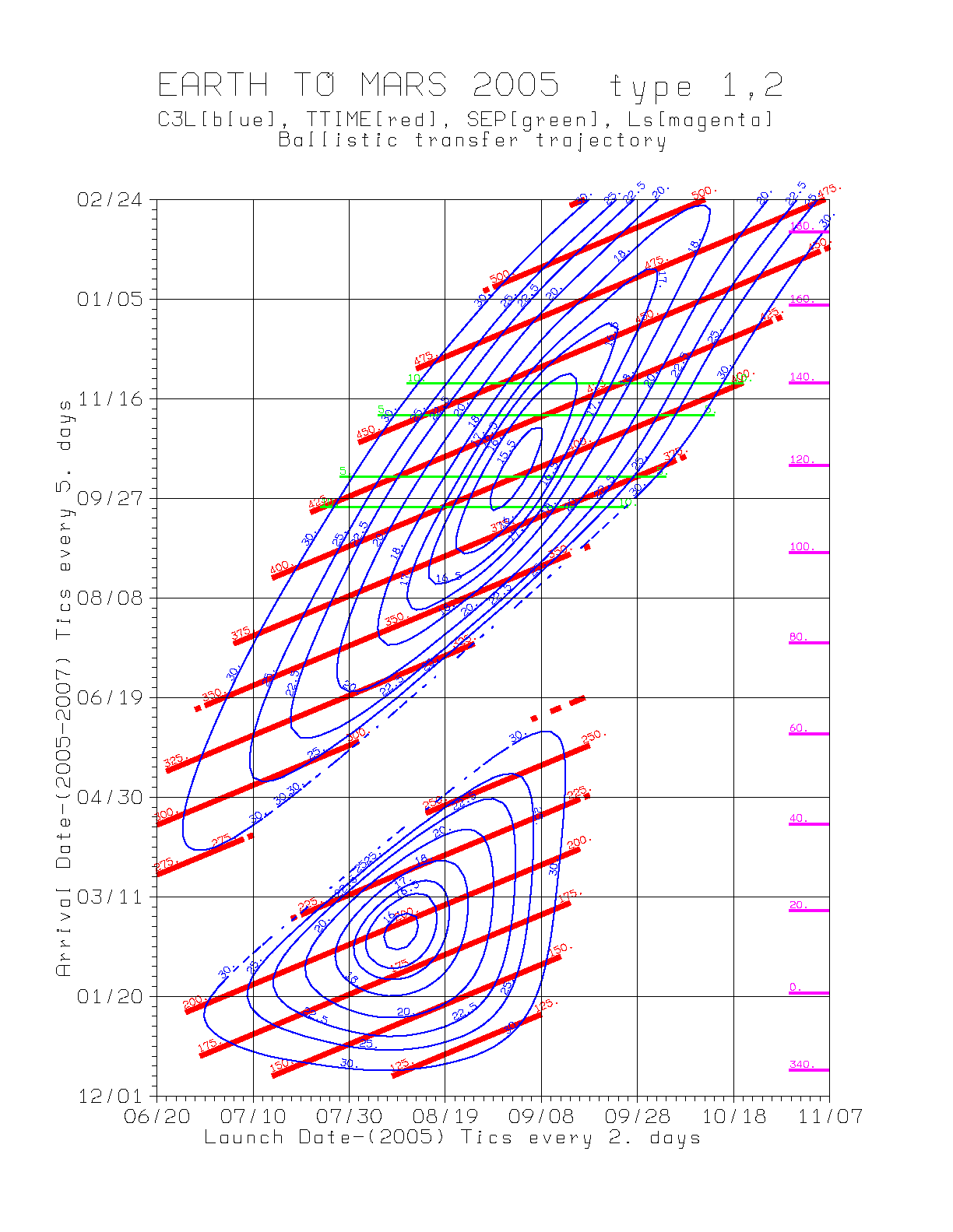
Can you identify the variables?On the porkchop plot, according to the legend at the top, the various curves are plots of the variables:
- C3L
- TTIME
- SEP
- Ls
-
Re:gravity assist finally explainedWhile the "Basics of Spaceflight" page is really nice, the "porkchop" page is quite lame - it wastes 5 pages to convince people that porkchop plots are nice and important tools, but when they show one of the plots on page 2 (!) they don't even explain what one can see there. So I'll try to do it myself:
- The plot is for the two 2005 Earth-to-Mars transfer opportunities, using ballistic transfer (i.e. no propulsion during the flight except for orbital departure/insertion)
- The horizontal axis is obviously the launch time from Earth, while the vertical axis is arrival time on Mars.
- The two possible "windows" to Mars for 2005 seem to be the centers of the two blue coutour plots (if we only knew what the blue "C3L" lines mean!).
- The red lines seem to be lines of constant travel time (labelled "TTIME"), so the lower window is for the shorter route (200 days TTIME as opposed to 400 days TTIME).
The remaining questions are: What are the blue lines ? (very essential as they define the "windows". Maybe arrival velocity?) What are the magenta and green lines ? - The plot is for the two 2005 Earth-to-Mars transfer opportunities, using ballistic transfer (i.e. no propulsion during the flight except for orbital departure/insertion)
-
Re:Holy floating vessels Batman!
You're probably thinking of the Dryden Flight Research Center, where they have all SORTS of cool airplanes. And one of the best aviation photography resources on the net.
-
Re:the Right Stuff
Apparently the moderators don't know who the real John Young is.
-
Near-Earth Asteroid / impact info
http://www.nearearthobjects.co.uk/
White Paper on Comet/Asteroid Impact Hazard
NEAT - NASA Near Earth Asteroid Tracking
Now if someone would only resurrect old USENET news, so I could dig out the posting I wrote about Tunguska circa 1990. -
Re:Creation of normal matter...one must only assume that an event triggered what was to follow - the big bang. Something was there to explode, and something had to cause it.
Once you manage to unlearn that, you'll be on your way towards understanding relativity.
You're still assuming that spacetime has linearly measured dimensions with regularly spaced tickmarks everywhere. It doesn't.
-
Re:Remember the Hubble Space TelescopeActually, good optics were used to correct flawed optics. It wasn't a software solution, but rather a corrective lens that was added to get the good results.
Truthfully, both were done, the corrective lens at a later date, as indicated in the mission press info.
While the launch on the Space Shuttle Discovery more than 3 years ago
was flawless, Hubble was not. Two months after HST was deployed into
orbit 370 miles (595.5 km) high, Hubble produced a disquieting discovery
not about space, but about itself. The curvature of its primary mirror was
slightly Q but significantly Q incorrect. Near the edge, the mirror is too flat
by an amount equal to 1/50th the width of a human hair.
A NASA investigative board later determined that the flaw was caused by
the incorrect adjustment of a testing device used in building the mirror.
The device, called a Rnull corrector,S was used to check the mirror
curvature during manufacture.
The result is a focusing defect or spherical aberration. Instead of being
focused into a sharp point, light collected by the mirror is spread over a
larger area in a fuzzy halo. Images of extended objects, such as stars, planets
and galaxies, are blurred.
NASA has been coping with HubbleUs fuzzy vision with computer
processing to sharpen images. For bright objects, this technique has yielded
breathtaking detail never seen from the ground. NASA also has been
concentrating on the analysis of ultraviolet light, which ground-based
telescopes cannot see because of the EarthUs intervening atmosphere.
-
Re:For a specialized solution
NASA also thought about this, all the way up to Petabytes.
-
Most modern NASA software is open
Most of the software developed for NASA projects these days is open -- at least, the scientific operations and data analysis software. For example, check out the solarsoft distribution of solar physics analysis software, including planning tools for most existing solar instruments. CVS and Sourceforge it ain't -- but you can get your hands on the actual software that is being used in the SOHO, TRACE, Yohkoh, and HESSI missions (and soon STEREO and Solar-B too).
-
Re:NASA
When I was at NASA, I worked at Goddard Space Flight Center's HEASARC group, and all our software was free via an ftp site. (That's been a while, so I can't say where every URL is anymore.) Now, I don't know how useful it is to us unwashed taxpayers, but surely SOMEbody could use free software to do coordinate transformations between cylindrical and spherical coordinates.
-
Re:Sounds GoodCongratulations, everything that you posted is wrong.
See this page for some factual information on the Shuttle's computer systems.
-
APOD has artist's Rendition
The APOD (Astronomy Picture of the Day), has a picture of what this MIGHT have looked like... in natural and false-colouring... and as always, tons of informational links.
M@ -
Re:It Might Smack Into Phobos... Oops...
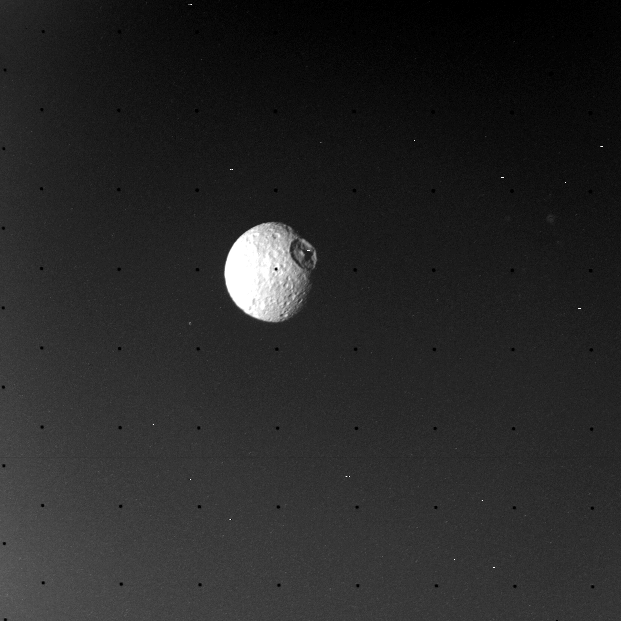
That's no moon. It's a space station.
-
Re:I wonder...Sorry, but NASA did use the Mars Global Surveyor craft to image the "face" in the Cydonia region. Please see http://mars.jpl.nasa.gov/mgs/msss/camera/images/4
_ 6_face_release/ for the actual images and the details of how they were processed. Please note it's a real, honest to god NASA website.At some point, I think a hiking group used the imaging data and laser altimeter data of the hill that makes up the face to create maps of a cool three hour hike over the various features.
FYI, given how MGS worked (it's camera isn't pointable;, it only images what's directly under the spacecraft), the NASA folks sort of went way out of their way to image this region as soon as they could instead of waiting to map it like they are mapping the rest of the planet.
FYII, I don't think Odessey has an imager, it mostly has instruments to measure chemical makes up of the different areas of Mars.
-
Distance, reliability
- When the spacecraft first goes into orbit, you want a reliable, simple telemetry signal to indicate the basics of what is happening with the spacecraft. This means a low-gain, wide-beam transmitting antenna. The high-gain antenna will provide higher rates, but must be aimed much more carefully; such a system would not be robust if something went slightly wrong during orbit insertion.
- From the Where is Mars Odyssey Right Now? page, the spacecraft is currently 1.53e+11 meters from Earth. Even with a directional antenna, signal power drops with distance squared, so the path loss is on the order of 200 dB. That is, if the transmitter power is (say) 50 watts/m^2 at 1 meter away from the spacecraft, as measured from Earth it would be something like 10^-20 watts/m^2, not counting antenna gains. At those powers you'd be lucky to get 40 bits/s, simply by running into Shannon's limit. (Somebody check my math, I haven't had coffee this morning.) Imagine the communications challenge for Voyager 2, which is now heading out of the solar system at a range of billions of kilometers; or Galileo, which lost its high-gain antenna at Jupiter
-
turn off the fault protection software?
here's a cool link about the steps they take to get into orbit. my favorite part is that the first step involves 'turning off the fault protection software'. its not as bad as you think, though my immediate reaction was to imagine mission control saying "Well, we're only 100 kilometers away, we should be safe so let's just turn that fault protection stuff off. Or was it 100 miles?"
-
original NASA press release
The original NASA science news release has way cooler video and audio about the black hole.
-
Thanks for the suggestions
Thanks for taking the time to provide this level of detail. Moderators: consider modding up the parent.
I would say that this kind of advice would be (even) more useful if it could distinguish between protection against internal threats (e.g. aux port -- I can't think of any non-physical level threat there) versus legitimate external vulnerabilities (e.g. telnet access) and stupidity vulnerabilities (e.g. using default passwords or ip redirects). Or to put it another way: it might be more readable as a block-commented script, explaining why you do what you do, rather than this narrative of advice with quoted commands.
But basically, the take-away for novice admins is: know what the f@#$ you're doing, and, if you don't, please get some help. Much of this is not rocket science (speaking of which, check out this); decent security just takes a little spade work. -
Who would you trust
-
Since you're going to site...
don't forget to visit other NASA sites too.
specially the mars global surveior's one, with cool hi-res pics of the "martian face". the link is here:
http://mars.jpl.nasa.gov/mgs/msss/camera/images/mo c_5_24_01/face/index.html -
Re:Yahoo has the sound bites and pictures
Well, a realplay video of the conference is available here.
-
Dust Storm
The Dust Storm which can dramatically change the height and density of the atmosphere, are a particular concern during aerobraking.
A great article on the whole procedure is at this link. -
Dust Storm
The Dust Storm which can dramatically change the height and density of the atmosphere, are a particular concern during aerobraking.
A great article on the whole procedure is at this link. -
Re:640 Newtons
Actually, the NASA page says:
The engine provides 695 newtons, or 156 pounds of thrust.
Weird. I wonder where 640 came from?
-
What it's doing thereTook me a while to work out why they needed another mars probe orbiting the planet when they've still got a perfectly good probe doing a two metre resolution map of the entire surface. The answer is twofold:
High Res Spectrometers
This baby has two spectrometers, one in infrared for working out the mineral composition of the surface to a resolution of 100 metres, and one in gamma rays, for working out how much hydrogen there is near the surface, and consequently how much rocket fuel they can make in different places if/when they land.Comms satellite It acts as a relay between the surface and the Earth, so any new probes (like the twin rovers due to take off next year) wont have to carry big dishes and radios.
All this and more on the website.
-
What it's doing thereTook me a while to work out why they needed another mars probe orbiting the planet when they've still got a perfectly good probe doing a two metre resolution map of the entire surface. The answer is twofold:
High Res Spectrometers
This baby has two spectrometers, one in infrared for working out the mineral composition of the surface to a resolution of 100 metres, and one in gamma rays, for working out how much hydrogen there is near the surface, and consequently how much rocket fuel they can make in different places if/when they land.Comms satellite It acts as a relay between the surface and the Earth, so any new probes (like the twin rovers due to take off next year) wont have to carry big dishes and radios.
All this and more on the website.
-
What it's doing thereTook me a while to work out why they needed another mars probe orbiting the planet when they've still got a perfectly good probe doing a two metre resolution map of the entire surface. The answer is twofold:
High Res Spectrometers
This baby has two spectrometers, one in infrared for working out the mineral composition of the surface to a resolution of 100 metres, and one in gamma rays, for working out how much hydrogen there is near the surface, and consequently how much rocket fuel they can make in different places if/when they land.Comms satellite It acts as a relay between the surface and the Earth, so any new probes (like the twin rovers due to take off next year) wont have to carry big dishes and radios.
All this and more on the website.
-
sh*t happens
too bad, it missed Mars and soon arrives at Pluto as we can see here... how could that happen? Dont they look at their own web pages?