Slashdot Mirror
Domain: nasa.gov
Stories and comments across the archive that link to nasa.gov.
Comments · 16,365
-
Virtual Galaxy, etc.First, there is this Milky Way simulation in VRML format from Nasa, part of the Virtual Universe project; web page here, complete with vrmls of the local galaxy area with a couple thousand galaxies.
Then there is this Freeware Dos program Virtual Galaxy which let's you navigate among the local stars. This one is okay, but needs to be updated to allow for a better grade of graphics. Worth checking out, though. Actually has the most stuff as far as science data goes. Maybe an open source project can be made from it.
There is also this little page, a nice collection of vrmls for the local area of the Milky way
Check out the Vinny the Vampire comic strip
-
*very* cool ...
The same system is used to calculate the present position of the Cassini probe, as well as the present position of the Mars Odyssey probe.
As an aside, the solar system is actually a chaotic system, so the simulator would likely lose accuracy outside of plus/minus a few thousand years from now.
-
*very* cool ...
The same system is used to calculate the present position of the Cassini probe, as well as the present position of the Mars Odyssey probe.
As an aside, the solar system is actually a chaotic system, so the simulator would likely lose accuracy outside of plus/minus a few thousand years from now.
-
Another NASA Solar System Simulator
-
It's a wonderful web
You-you want the moon? Just say the word and I'll type http://space.jpl.nasa.gov in the address bar."
-
Re:Why no Post-crash analysis?
An article from NASA (http://www.dfrc.nasa.gov/gallery/photo/X-43A/) says three seperate tests at mach 5, 7 and 10.
-
More on the X-43A
Check out these cool photos!
I'd like one in my bathroom =)
-
Re:2038 - Now is the time to start workSince in the next few years 64 bit processors will be coming into the mainstream I think now is the time to start work on fixing the Year 2038 issue. Operating systems will need to be changed to move from 32 to 64 bit word lengths so why not take this oppertunity to switch from 32 bit to 64 bit times on Linux and *BSD (and any other Open Source operating systems you care to mention). A further advantage would be to take make better use of the extra bits and switch to milliseconds since 1970, instead of seconds. This extra precision could be useful for some applications and will still be good till 300,000,000 AD
This is useable and sensible. I can see this.
[inserting tongue in cheek]
But we might not need to worry because of all of the other disasters that are proposed to be happening between now then then, including the end of the Maya Epoch (get your Mayan Date TShirt here, and the destruction of civilization by asteroids in 2028 (orbit info here, Seattle Times disinfo here, commentary here)
And, with the crashomatic feature in MS OS software, the world will come to an end well before that when the MS
Check out the Vinny the Vampire comic strip
-
Re:yeah,
A sub-orbital parabola is enough for a Cold War ICBM to hit its target. According to NASA:
(ICBM) - a strategic weapon whose parabolic trajectory arced into space
If the flight is not sub-orbital, then it's orbital meaning the ICBM makes an orbit of the Earth before landing. ICBMs go up and come back down as quickly as possible to minimize the warning. Remember too that the USA and the USSR are not actually 180 degrees apart on the globe in a polar flight.
-
Old News (Literally)...Remember the Huntsville Times
Check the headline: "Reds Deny Spacemen Have Died" headline. I can't quite make out the date, but I suspect it's 4-12-61...
----- -
Other "reports"
In this story, Slashdot posted the front page to the Huntsville Times from the day that Yuri Gagarin was launched into space. In it, you can clearly see the headline "Reds Deny Spacemen Have Died" (lower center of page). It has long been thought that the Soviets lost some astronauts during their initial test flights. The American media has yet to get their hands on any rock-hard evidence, though.
-
Still more
Of course, if you really want gobs upon gobs of astronomy related pictures, the place to go is the Astronomy Picture of the Day. 'tis a great source of wallpaper images...
-
The X-33's Propulsion SPQRLooking for a good con job?
These technopriests are getting more outrageous all the time. Usually they only talk this trash in private conferences when the tape decks are off.
A bell "inside out" is upside down if you turn it upside down it is now where it started... but inside out which is what occurs to a figuire with plane symmetry when so manipulated. What the hell unwraped means is anybodies guess. If you " flatten" it you get a plate which is what the dummy should have said in the first place! What they are trying to say is a flat plate with a large number of tiny rocket combustion chasmbers drilled into a flat plate instead of one combustion chamber.
The only advantage is that the plate is accelerated not only as in opposition to the reaction mass of the rockets but also the ambient air which would also be acellerated if the exhaust blew across the plate. This effect only works in an atmosphere with an efficiency that probably doesn't compare with a simple ram jet.It's a ram jet turned inside out, only a ram jet doesn't carry its own oxidizer, it breathes.
According to the Hitler principle, a government agency can't afford to give you what its set up to give you because they will loose their job.
'You don't need a weather man to tell which way the windza' blowin'
One theory is that one of the dominant species to have developed on earth in the last 128 million years is living on the moon & doesn't want to give up the property at this time. The moon's density is only 60% of the density of the other 'solid' planets & asteroids leading to the conclusion that it might be hollow. Fancy that.
.
-
X-33 Web Site
Nasa's X-33 Website: http://x33.msfc.nasa.gov/
-
Re:Another site
-
spaceflight.nasa.gov
Here is another good one. And this one will also show the shuttle when it is in orbit. http://spaceflight.nasa.gov/realdata/tracking/
-
More giant planet auroras...
Other non-terrestrial auroras can be found:
Neptune's aurorae occur near its equator, due to the alignment of that planet's magnetic field... I couldn't find a definite page or photograph of aurorae on Uranus, although I did find an AAS paper that discusses auroral emissions.
--
Scott Robert Ladd
Master of Complexity
Destroyer of Order and Chaos -
Oh yeah...
Use J-Track or J-Track 3D to see when the ISS will be near your house.
And this is NASA's ISS homepage, if any of you want to know something about the ISS...
-
Oh yeah...
Use J-Track or J-Track 3D to see when the ISS will be near your house.
And this is NASA's ISS homepage, if any of you want to know something about the ISS...
-
Oh yeah...
Use J-Track or J-Track 3D to see when the ISS will be near your house.
And this is NASA's ISS homepage, if any of you want to know something about the ISS...
-
Re:Incorrect Title to article
-
Re:Incorrect Title to article
-
Re:Incorrect Title to article
-
Re:Incorrect Title to article
-
Re:Incorrect Title to article
For the lazy...
http://antwrp.gsfc.nasa.gov/apod/ap001219.html -
Re:Idea
Bastard! Beet me to it. This one is also good for that sort of thing.
This has been another useless post from.... -
Re:Idea
Try here
-
Re:This is not NASA
Actually there were space shuttle experiment in 1992 and 1996 to study the use of tethers. Look here for more. I believe at least one of these experiments ended in failure when the tether broke; both tethers and solar sails are highly susceptible to micrometeorite impacts.
NASA has also flown experimental ion propulsion technology on the Deep Space 1 mission, and has a research team at JPL investigating advanced propulsion concepts. You may have heard of a proposal for magnetic-assisted propulsion to travel to Pluto; IIRC that was one of theirs.
I don't know of any NASA attempt to use solar sails, though.
-
Re:This is not NASA
Actually there were space shuttle experiment in 1992 and 1996 to study the use of tethers. Look here for more. I believe at least one of these experiments ended in failure when the tether broke; both tethers and solar sails are highly susceptible to micrometeorite impacts.
NASA has also flown experimental ion propulsion technology on the Deep Space 1 mission, and has a research team at JPL investigating advanced propulsion concepts. You may have heard of a proposal for magnetic-assisted propulsion to travel to Pluto; IIRC that was one of theirs.
I don't know of any NASA attempt to use solar sails, though.
-
Re:This is not NASA
Actually there were space shuttle experiment in 1992 and 1996 to study the use of tethers. Look here for more. I believe at least one of these experiments ended in failure when the tether broke; both tethers and solar sails are highly susceptible to micrometeorite impacts.
NASA has also flown experimental ion propulsion technology on the Deep Space 1 mission, and has a research team at JPL investigating advanced propulsion concepts. You may have heard of a proposal for magnetic-assisted propulsion to travel to Pluto; IIRC that was one of theirs.
I don't know of any NASA attempt to use solar sails, though.
-
Re:Pretty sad
Seems a lot of back slapping at NASA.
Follow the "40th anniversary" link on today's APOD, and you'll see it leads to the APOD of five years ago, where they talk almost exclusively about the 35th anniversary of first man in space - as well as other early Soviet accomplishments and how the U.S. was behind.
Five years later, they use the APOD to do a little bragging about the space shuttle. I don't fault them for that.
-
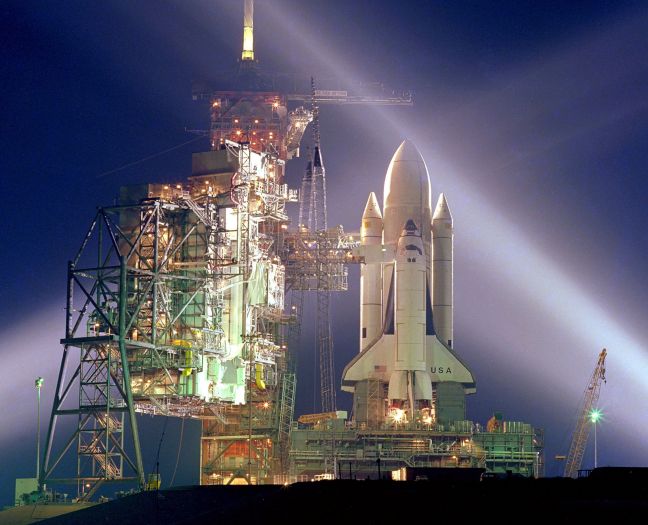
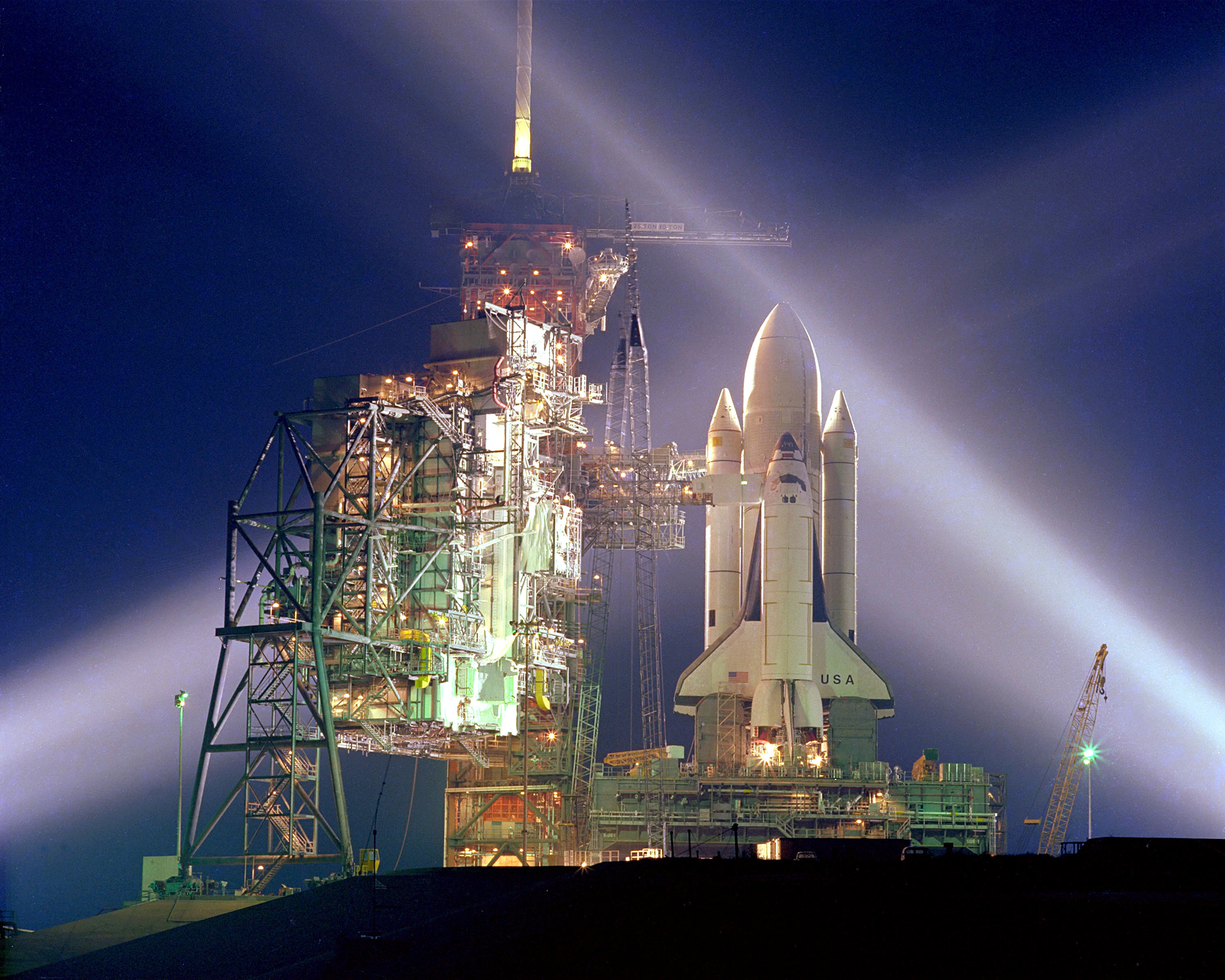
STS-1: First Shuttle Launch pictureNASA's astronomy picture of the day for 4/12 is a really nice picture of Columbia sitting on the launch pad awaiting her first flight.
-
STS-1: First Shuttle Launch pictureNASA's astronomy picture of the day for 4/12 is a really nice picture of Columbia sitting on the launch pad awaiting her first flight.
-
STS-1: First Shuttle Launch pictureNASA's astronomy picture of the day for 4/12 is a really nice picture of Columbia sitting on the launch pad awaiting her first flight.
-
Re:... to celebrate the anniversary?
On this date in 1961, Yuri Gagarin's flight.
On this date in 1981, first flight of the Space Shuttle.
In twenty years we went from a one man capsule to the space shuttle. In the next twenty we went from the space shuttle to...the space shuttle.
NASA isn't a space agency, it's a jobs program. Bring back the Delta Clipper.
-
Homepage of the X-43A project...
...is located here
-
NASA Movies (Simulation) of The FlightNASA has made two movies of the X-34A (Hyper-X) - one of the separation from the B-52 carrier ship, and another of the flight itself. (MPEG-2 is available, use xine to view on Linux.)
-
NASA Movies (Simulation) of The FlightNASA has made two movies of the X-34A (Hyper-X) - one of the separation from the B-52 carrier ship, and another of the flight itself. (MPEG-2 is available, use xine to view on Linux.)
-
Ever SEEN a sonic boom?
That baby will be creating a lot of these. How long before we see experimental aircraft striving for ludicrous speed?! -
hyperx pics
are here
http://lisar.larc.nasa.gov/LISAR/BROWSE/hyperx.htm l
pretty cool. -
Re:mach5 != 5000mph
For some reason I thought Mach was defined as the speed of sound at such a presure and humidity, analogously to c, which is constant, vs the Speed Of Light, which varies.
Nope. Mach number is defined to be relative to the speed of sound in the medium, since that's what is important to an aircraft designer (in terms of calculating stresses and the like).
As for the change in sound speed with altitude, this NASA page discusses the physics involved, and links to a neat simulator that lets you see how pressure, temperature, sound speed, and the like vary with altitude.
--
-
Re:mach5 != 5000mph
For some reason I thought Mach was defined as the speed of sound at such a presure and humidity, analogously to c, which is constant, vs the Speed Of Light, which varies.
Nope. Mach number is defined to be relative to the speed of sound in the medium, since that's what is important to an aircraft designer (in terms of calculating stresses and the like).
As for the change in sound speed with altitude, this NASA page discusses the physics involved, and links to a neat simulator that lets you see how pressure, temperature, sound speed, and the like vary with altitude.
--
-
Speed of Sound at Altitude
If you want to find out how fast the speed of sound is at different altitudes, check this out: Interactive Atmosphere Simulator
The original post does have incorrect numbers (mach 7 ~ 5000 mph) It depends heavily on altitude. At sea level mach 7 is ~ 5300 mph. At 60,000 feet, mach 7 is ~4600 mph. -
Re:Hate to be the pilot.
>
Just like all the X-15 pilots, right?
The X-15 regularly exceeded Mach 6. It just didn't have a scramjet (as far as we know.) -
Your memory semi-fails you!Quoth NASA:
The SR-71 was designed and built by the Lockheed Skunk Works, now the Lockheed Martin Skunk Works. SR-71s are powered by two Pratt and Whitney J-58 axial-flow turbojets with afterburners, each producing 32,500 pounds of thrust. Studies have shown that less than 20 percent of the total thrust used to fly at Mach 3 is produced by the basic engine itself. The balance of the total thrust is produced by the unique design of the engine inlet and "moveable spike" system at the front of the engine nacelles and by the ejector nozzles at the exhaust which burn air compressed in the engine bypass system.
The moveable spike does add a lot of the thrust. But what's being discussed is a scramjet, and as such, it gets all its air without compression. The ramjet is a compromise between the scramjet and the turbojet, really. Also, the ramjet has realistic speed limits, because there is some compression needed to fly, and the craft can't make it to scramjet operational speeds with air-breathing engines.
I'd rant further, but I sold back my propulsion texts when I realized I was going into the church business. Oh well.
-- -
Been there, done that....The SR-71 flew more than mach 3 for extended periods of time. Check out some info at the Dryden Flight Research Center page for the aircraft...
=-=-=-=-=
-
Yeah- who's more manueverable?Let me think about this...
We have a turboprop plane at least 5 times the size of a fighter with waaay less power.
And then we have a fighter plane... light, built for manueverability and control for dogfights.Tell me, who's the one who is responsible for hitting the other plane? The guys in the yacht cruising along nice and even like, or the guy in the fast little jet ski out hotshotting around?
It don't take a rocket scientist to figure that one out.
-
bragging
hehe, just wanted to point out that my brother is on team 254, one of the teams from the 2nd place alliance
-
Duh
The words are "exobiology", "astrobiology", and maybe "panspermia". Go search.
-
Re:Video Incredible
One problem is the bandwidth required for full motion video. Mars Global Surveyor sends at 21 to 85 kbps, depending on the relative distance between Mars & Earth. If you make it 160x320 at 10fps, then you've just eaten up about 1/4 of your bandwidth. Another problem is the extra mass, which is always a consideration in constructing something to be launched. If you're interesting in getting some real time data, then NASA has a page where you can check the telemetry. It's just text, but it's all there, and live.