Slashdot Mirror
Domain: nasa.gov
Stories and comments across the archive that link to nasa.gov.
Comments · 16,365
-
Re:So, Cassini is like my sister
In case anyone is interested:
The mosaic being released today by the mission and the imaging team, in celebration of the 2012 holiday season, does not contain Earth; along with the sun, our planet is hidden behind Saturn. However, it was taken when Cassini was closer to Saturn and therefore shows more detail in the rings than the one taken in 2006.
(Source)
-
Re:So, Cassini is like my sister
I like this picture from 2006 much better . .
http://apod.nasa.gov/apod/ap061016.html -
Anybody have another link?
The first is firewalled off (they think discovery is an entertainment site) and the second is slashdotted. So here you fellows go, straight from NASA. I doubt we'll slashdot them... and submitter, why did you not link the source?
-
NASA Mission Directorates expand...
According to their list of Mission Directorates
1. Enable a safer, more secure, efficient, and environmentally friendly air transportation system.
2. Operate the International Space Station and prepare for human exploration beyond low Earth orbit.
3. Exploring the Earth-Sun system, our own solar system, and the universe beyond.
They should now add:
4. Protection of Humanity from hysteria due to mythical threats said to originate from space. -
An Accurate Statement
"The world isn't going to end because the Mayan Calendar says so."
Science cannot predict world ending/mass extinction asteroid strikes much in advance.
Science cannot predict catastrophic earthquakes or volcanic eruptions.
The world is going to end when the world is going to end. We simply don't have technology to predict when really bad things are going to happen.
"As of the end of 2004, astronomers had discovered more than two thirds of the larger Near Earth Asteroids (diameter greater than 1 km). None of the known asteroids is a threat, but we have no way of predicting the next impact from an unknown object. "
http://impact.arc.nasa.gov/intro_faq.cfm
NASA isn't debunking anything. The world is as likely to end on the 21st as any other day.
-
Additional Sources
In the event the world ends or the source is
-
Re:All hail our new Chinese overlords
When it's independently verified, then I'll believe it.
NASA released a radar image which agrees with the visuals.
-
Re:Research
So you're saying "other than a $100B industry, not so much?"
What does it take to impress you?The "space economy" was estimated at about $180 billion in 2005, according to a report by the Space Foundation released in 2006. More than 60 percent of space-related economic activity came from commercial goods and services.
-
Radar did OK
If you compare this image with the Goldstone image of Toutatis by Earth-based radar - see Figure 1 in Hudson et al - you can see that the Earth radar does OK, but actually going there is better. Toutatis's rotation period is 176 hours, so we won't get to see the other side in the flyby.
Note that there are a few craters, but not many (asteroid Itokawa has no craters in Hayabusa images), so as usual something is resurfacing the surface.
-
Rivers & methane seas already known
I don't get how this is new. Cassini has been detecting branching river systems and large lakes (Great Lakes size) filled with liquid methane since early in the mission. This latest release is adding to the mapped area, but isn't particularly new in that regard. However, if you read the original NASA press release on the Cassini web site, it makes more sense. This is not the first, but the longest river system that has been observed so far on Titan, at about 400km long.
-
Re:By Canada
We're just clueless pikers and you geniuses north of us are obviously our superiors in every way. Thank god for Canada, or we'd all be lost. It's called throwing you a bone, the least you could do is show gratitude instead of acting like you lot actually did something, because you didn't.
For failing to comprehend the True Cosmological Glory that is Canada, you are hereby sentenced to be (appropriately enough) torn limb from limb by the newest Canadian space-robot, Dextre the Magnificent.
-
Re:Ah, so there we go....
You can plainly see from the blue lines on that graph that the 1993 altimetry data does not start on "an unusually low year" - that trough is clearly the 1997 El Niño. The Funafito data starts years later, and the other data starts years earlier. Your other points about cherry picking kind of fall down when you can't even get that right. But please keep telling me how my claims are confused.
You can propose alternate hypotheses all you like, but if you want anyone to take them seriously, you'll need to actually present observational evidence that supports them. So far all you've done is claim that that Becker's data is not accurate enough, despite not having laid eyes upon that data, or knowing anything about its error bars, and despite the other studies. Why should anyone listen to you, instead of a sizeable group of scientific experts who do this for a living?
You deny my claim about linkage to AGW with nothing more than "just isn't right", but it's not even me who's making these claims. I'm just pointing out the many studies by people far more expert than I (look, here's a few more reports that show continuing sea rise far exceeding subsidence). If you feel you know their jobs better than they do, go right ahead and tell them that, but I expect they'll find your unsubstantiated denial even less convincing than I do.
-
Re:Congratulations.
On behalf of all progressive humanity I congratulate the Korean people with becoming a space power.
Uh-huh. Speaking of power, here's a view of NK at night.
Now that's progressive. -
Re:Annnnnd....
If it gets 5 degrees warmer they sink
"If". That's what it has to do with evidence.
Plus, there's the matter of timing. You're claiming 40 years till those people have to move. If instead, it's two centuries, then that changes the strategy. It no longer is such a good idea to pile up a lot of cash flow for something that's not going to happen anytime soon.Simple logic, melting ice on greenland, and perhaps a few ice bergs breaking of from antarctica is enough.
No evidence that stuff "will" happen like you claim to justify your concern. For example, Antartica currently is accumulating ice and Greenland is within historical range for melting and a later paper indicates earlier results overestimated melt rate by a huge amount (about a factor of two or three allegedly, can't really tell from the story).
In other words, the ice fields that matter aren't melting particularly fast for a threat that supposedly will be bothering us in 40 years. For example, that last paper above estimates 2 mm of sea level rise from the melting of Greenland's ice fields over a six year period (2003-2009). That's under 2 cm of rise, if it continues as is through 2050.
OTOH, you need something more like 2 meters of rise. I doubt you'll see that by 2100, much less 2050. -
Thermal force
It's thermal recall force from heat generated by components on Pioneer.
Right. and the headline is a little misleading, it's a "new" explanation only if you weren't following; since it was announced in late 2010. The "anomaly" is solved.
Popular Science article about Toth and Turyshev's work here: http://www.popsci.com/pioneeranomaly
More detailed calculations supporting the explanation:
Phys Rev Letters paper by Toth and Turyshev here: http://prl.aps.org/abstract/PRL/v108/i24/e241101
ArXIV paper confirming the work with more details: http://arxiv.org/abs/1103.5222v1JPL press release: http://www.jpl.nasa.gov/news/news.php?release=2012-209&cid=release_2012-209&msource=12209
Centauri Dreams article: http://www.centauri-dreams.org/?p=23720Still, it's a nice article to read about how the work is done.
-
The mission let kids select lunar pictures
One of the interesting parts of this mission is MoonKAM, which let grade school and middle school kids select targets on the lunar surface for the orbiters' cameras to inspect. It returned some pretty interesting (if low-res) images until a solar flare recently took the imaging system down. If you're interested, there's some more info about GRAIL: today's announcement from NASA, and a public lecture tomorrow with a live feed.
-
The mission let kids select lunar pictures
One of the interesting parts of this mission is MoonKAM, which let grade school and middle school kids select targets on the lunar surface for the orbiters' cameras to inspect. It returned some pretty interesting (if low-res) images until a solar flare recently took the imaging system down. If you're interested, there's some more info about GRAIL: today's announcement from NASA, and a public lecture tomorrow with a live feed.
-
economics
Let's remember that this second mission is sort of a freebie.
Certainly they have a COMPLETE second mockup of the rover at NASA for troubleshooting, and *often* they have a third unit because in the development stage building a third is almost cost free (generally multiple copies of each component are made as backups, if they're never used you have essentially a full third device waiting in parts bins).
So aside from the launch costs, the equipment is PROBABLY already paid for.
Further, it's not a bad idea to throw another rover out there if we can, to cover more ground as a prep for a manned mission. If you can have 2 rovers crawling over Mars for 2 years, that doubles your chance they they find something interesting to both be WORTH investigating with a manned mission, and (if you're really lucky) find something that radically increases public (congressional) interest in sending that mission.
(Meanwhile, we're continuing to explore the rest of the system with, for example, a planned mission to Titan's ocean IIRC - http://www.jpl.nasa.gov/missions/ )
-
Re:More habitable?
Presence of a moon...to keep the planet spinning on a single axis and not two? That's somewhat common...
Perhaps not:
http://www.nasa.gov/mission_pages/spitzer/news/spitzer-20071120.html
-
Re:For those of us alive when this was launched,
Why not just mail them a check? You'll only do it if the amount of work is exactly writing a number on your tax return?
They are one of the government agencies authorized by congress (42 U.S.C. 2473(c)(4)) to accept unconditional donations, but they aren't allowed to ask for them. So mail them a check, and they'll handle it per http://nodis3.gsfc.nasa.gov/displayDir.cfm?t=NPD&c=1210&s=1G
-
Re:not to rain on anyone's parade....
The edge of the solar system is supposed to be the oort cloud at about 1 light-year away
We're not talking about reaching the edge of the Solar system, we are talking about our first foray into interstellar space. And interstellar space starts beyond the heliopause, not the Oort Cloud. That's why Voyager's cosmic ray measurements have been so important.
On a side note, it looks as if Voyager 2 may be reaching the edge of the part of the heliosphere it is traveling through. The high-energy particles (which are coming from the Sun) have been steadily decreasing the past few months.
-
Re:not to rain on anyone's parade....
The edge of the solar system is supposed to be the oort cloud at about 1 light-year away
We're not talking about reaching the edge of the Solar system, we are talking about our first foray into interstellar space. And interstellar space starts beyond the heliopause, not the Oort Cloud. That's why Voyager's cosmic ray measurements have been so important.
On a side note, it looks as if Voyager 2 may be reaching the edge of the part of the heliosphere it is traveling through. The high-energy particles (which are coming from the Sun) have been steadily decreasing the past few months.
-
Re:~17231 years to send a probe and find if life
The probe in question is Voyager 1 and was launched in 1977. Let's not call it modern. It was designed in an era when there was no such thing as a personal computer. A high end cellphone probably has more battery-powered computing power in your pocket now than all of the compute resources of NASA back then. Imagine what those engineers could achieve with this. Materials science has progressed also. But the biggest gift of days is in our understanding the rich resources available in the space around us. Water is abundant everywhere from Mercury to the edge of the solar system. We didn't know that back then. Almost all stars have planets in the habitable zone. We didn't know that either.
It's unlikely a mission to Vega would launch any sooner than 2037, or 60 years after the launch of the first Voyager. We have learned a lot of things since Voyager 1 was launched, and will have learned more. That none have gone faster is an artifact of 30 years of neglect of space operations, but not space science. At the moment Vega is too far to a man to reach in his span of years with the science we have, though another star might be. There is no reason to expect that this will always be so.
With VASMR 200KW thrusters entering service on the ISS in a few years, and the development of suitable power plants ongoing, we still would need fuel - LOTS of fuel - on orbit or somewhere near zero-G to make a go of it. Fortunately in 26 months the NASA Dawn mission will arrive at Ceres and find there a practically unlimited supply of Xenon, Argon, Hydrogen and Oxygen ready for mining as well as a surface amenable to easily building human habitats on. You may schedule two years from now for the space Gold Rush to begin.
Ceres is not only the perfect source for interstellar fuels: it's also the perfect launchpad as it should be possible to build a railgun there 1000KM long capable of launching interstellar probes with solar system escape velocity that don't require any fuel at all. It's also the only minor planet so situated within easy reach.
Planetary Resources, SpaceX, Virgin Galactic and others are all over this. The people behind these efforts are some of the brightest, most successful minds the world has ever known. Elon Musk. Sergey Brin. Larry Page. Eric Schmidt. Richard Branson. These are but a few. They know something you don't know.
-
Probe Dupe - Phoenix Was First
http://www.nasa.gov/mission_pages/phoenix/news/phx20100524.html
"During its mission, Phoenix confirmed and examined patches of the widespread deposits of underground water ice detected by Odyssey and identified a mineral called calcium carbonate that suggested occasional presence of thawed water. The lander also found soil chemistry with significant implications for life and observed falling snow. The mission's biggest surprise was the discovery of perchlorate, an oxidizing chemical on Earth that is food for some microbes and potentially toxic for others."
In other news, Curiosity found red rocks!
-
Re:Fingers in ears
Couple of things they fail to mention:
1) A lot of that ice grew in the 1940s.
http://news.ku.dk/all_news/2012/2012.5/glaciers_greenland_photos/
"At the time many glaciers underwent a melt similar or even higher than what we have seen in the last ten years. When it became colder again in the 1950s and 1960s, glaciers actually started growing," says Dr. Kurt H. Kjær""Kurt H. Kjær has previously worked with his colleague Svend Funder from Center for GeoGenetics on investigating sea ice extent in the Arctic Ocean. Results showed that the sea ice extent has been far from stable throughout the last 10,000 years."
2) This is what NASA has to say about the "unprecedented melt":
http://www.nasa.gov/topics/earth/features/greenland-melt.html"Ice cores from Summit show that melting events of this type occur about once every 150 years on average. With the last one happening in 1889, this event is right on time," says Lora Koenig, a Goddard glaciologist and a member of the research team analyzing the satellite data."
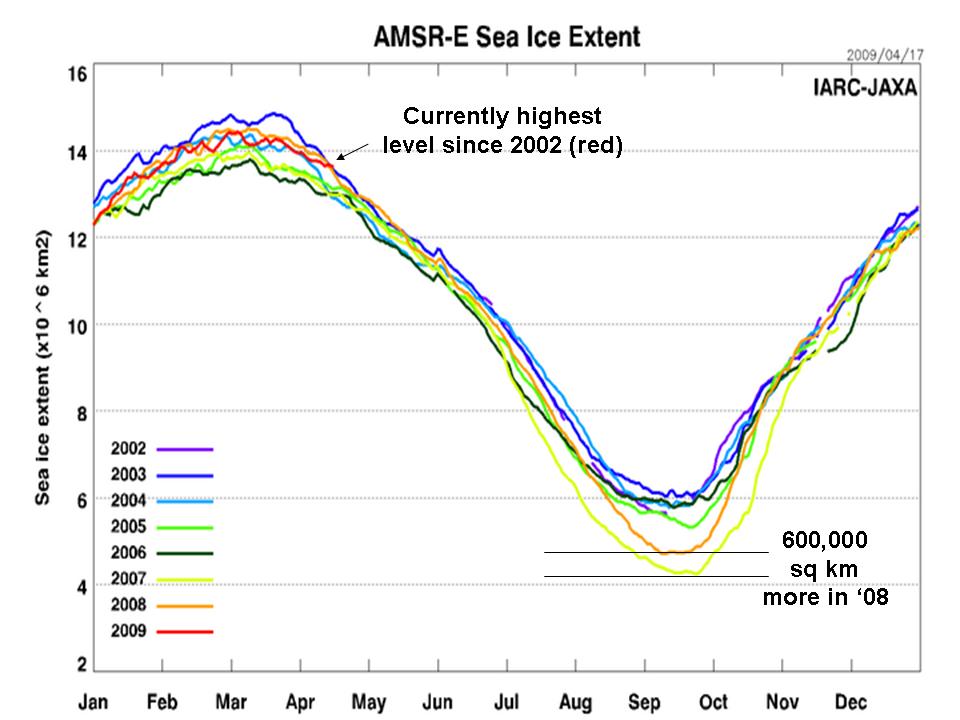
3) "Arctic Ice Threatens Northern Hemisphere
Posted on April 19, 2009 (note the date)
While the eastern Antarctic ice pack continues inexorable year over year growth, Arctic ice is greater than it’s been in the last 8 years, and showing massive expansion again this year."
http://icecap.us/images/uploads/AMSR-E.jpg4) "Antarctic sea ice grows to record extent while Arctic continues to shrink"
http://antarcticsun.usap.gov/science/contenthandler.cfm?id=27505) http://rs79.vrx.net/opinions/ideas/climate/.images/HolocenePeriods.png
The world is warming, or cooling, depending on the time scale you look at. See for yourself.6) The real problems are pollution in a general sense and deforestation. Given mans contribution to carbon is at best 3% and that we've removed so fucking many trees (look for yourself, fly over the Island of Borneo in google maps would be a good start, its gone, it's all gone)... what did you expect was gong to happen. "By Marlowe Hood (AFP) – Jul 14, 2011
PARIS — Forests play a larger role in Earth's climate system than previously suspected for both the risks from deforestation and the potential gains from regrowth, a benchmark study released Thursday has shown." http://www.google.com/hostednews/afp/article/ALeqM5j2BAdNIG5Q2FJlEdac1l-KXiTSCA?docId=CNG.dfe97e07f144a2d29eb615412e0c12be.a81That's right, in 2011 the geniuses that know all about CO2 got the revelation that trees eat the stuff. Next time somebody calls them "experts" rememnber that.
Possibly this was in response to NASA and the NOAA bitch-slapping the IPCC by pointing out in 2012 they'd sort of ignored this fact in their "models":
"8th December 2010 13:24 GMT - A group of top NASA and NOAA scientists say that current climate models predicting global warming are far too gloomy, and have failed to properly account for an important cooling factor which will come into play as CO2 levels rise."
http://www.theregister.co.uk/2010/12/08/new_model_doubled_co2_sub_2_degrees_warming/Which doubt caused Gaia-dude to recant, showing he has at least a modicum of intellectual integrity:
""James Lovelock, the scientist that came up with the 'Gaia Theory' and a prominent herald of climate change, once predicted utter disaster for the planet from climate change, writing 'before this century is over billions of us will die
-
Re:has the slashdot staff been replaced w/monkeys?
It's clearly a fake, but look at more of the comments. Numerous commenters above (some, it seems, not getting the joke) discuss seriously the implications of this, hinting that this might get NASA more funding. "Hey, there's oil," they say, "we know that the U.S. Congress will appropriate funds for that."
It costs $83,000 to get a gallon of water just into low earth orbit. Crude oil's at about $2 a gallon ($87.73/barrel). I fear some might need it spelled out. After all, this wasn't rejected in the firehose.
-
Re:FAKE!
Not so sure about that:
NASA still images; audio files; video; and computer files used in the rendition of 3-dimensional models, such as texture maps and polygon data in any format, generally are not copyrighted. You may use NASA imagery, video, audio, and data files used for the rendition of 3-dimensional models for educational or informational purposes, including photo collections, textbooks, public exhibits, computer graphical simulations and Internet Web pages. This general permission extends to personal Web pages.
This general permission does not extend to use of the NASA insignia logo (the blue "meatball" insignia), the retired NASA logotype (the red "worm" logo) and the NASA seal. These images may not be used by persons who are not NASA employees or on products (including Web pages) that are not NASA-sponsored.
From here.
-
Thats not too bad...
We don't need a program like this. We already have plenty of launch vehicles for cubesats... every rocket that goes up has some mass margin for at least a few cubesat. The money would be better spent prepping rockets for launch, not on some contest that is not guaranteed to produce results. http://www.nasa.gov/directorates/heo/home/CubeSats_initiative.html
-
The non mardi gras bead photo
Uh... also that photo is obviously this one: http://mars.jpl.nasa.gov/multimedia/images/?ImageID=4806
-
Late-Breaking News: PSYOPS!Laughter and derision swept across our fair red world today as the Council of Elders confirmed the success of an intelligence coup against the green diagonally-tilted controlling intelligences (and their accompanying green spherule-shaped periodic functions) who continue to operate from undisclosed locations on the sinister blue planet.
K'Breel, Speaker for the Council, spoke thus:
Today marks another victory in our ongoing psyops campaign against the blueworlders. Renjoice, podmates, at the consternation of our enemies! On the homefront, our forces continue to track and monitor the intruder's activity. Laser-resistance is not the only means we have to defeat the intruder. Late-breaking news indicate great results achieved through our psychological operations division.
When an elder member of the press corps suggested the psyops campaign in question consisted merely of deceiving "Editing Unit #5" into linking to http://nasaupdatecenter.us/press.html instead of http://marsrovers.jpl.nasa.gov/newsroom/pressreleases/20120928a.html, K'Breel had the young reporter's gelsacs slashed, after which the small, rounded particles were first catalyzed into plastic, and upon further heating, reduced to volcanic lapilli.
(An audio recording of Reporter #54550 screaming "Sorry, samzenpus, you put your foot in it today, I swear to CmdrTaco it wasn't me! No hard feelings! Don't devitrify me, 'bro!" as he was led away to the thermal polymerization chamber, has not been authenticated.)
-
hoax
Hang on, now. Check how the text in TFA matches this article.
You've been had.
The clue (besides the rather obvious mardi-gras beads in the photo) was the eighth paragraph. Curiosity hasn't been on Mars for eight and a half years. Opportunity has.
It's time for someone to stand up and say "Bazinga".
How did this get past the editors?
-
Re:Editors...
-
Re:Editors...
Here is a direct link to NASA:
"But the new observations have also raised new questions," adds Solomon. "Do the dark materials in the polar deposits consist mostly of organic compounds?
http://www.nasa.gov/mission_pages/messenger/media/PressConf20121129.html
-
Fake
From NASA:
The next news conference about the NASA Mars rover Curiosity will be held at 9 a.m. Monday, Dec. 3, in San Francisco at the Fall Meeting of the American Geophysical Union (AGU).
Rumors and speculation that there are major new findings from the mission at this early stage are incorrect. The news conference will be an update about first use of the rover's full array of analytical instruments to investigate a drift of sandy soil. One class of substances Curiosity is checking for is organic compounds -- carbon-containing chemicals that can be ingredients for life. At this point in the mission, the instruments on the rover have not detected any definitive evidence of Martian organics.
-
Slashdot has been trolled
That isn't a genuine press release. Here is the real release: http://mars.jpl.nasa.gov/msl/news/whatsnew/index.cfm?FuseAction=ShowNews&NewsID=1398
-
Hoax!
This article posted is almost copied verbatim from http://marsrovers.jpl.nasa.gov/newsroom/pressreleases/20120928a.html, with only a few words changed around. Plus, the css pages link offsite and are broken on that page. Who fell for this?
-
Re:Much more than that
I'll probably get down voted but I would rather point out the dangers of what Feynman called "Cargo Cult Science"
> What if the physics of a distant galaxy is different from the one around here?
It is. Wake me up when Scientists have discovered the strong-intergalactic and weak-intergalactic force, let alone White Holes.> We can now see more or less to the edge of the observable Universe
Again, another assumption. There is no "edge". You keep assuming a linear Euclidean space/time. That is akin to asking "What happened 'before' the beginning of the universe. There was NO BEFORE."Any contrary view that doesn't fit into the presupposed current dogma is ignored. ( http://electric-cosmos.org/arp.htm ) Ergo, the "Age" of the Universe is significantly off by ~7 billion years because Scientists are making some pretty major incomplete assumptions about red-shift and don't understand the Cycle of the Universes. The fact that the Mayan estimated the age of the universe at 16 billion years (which is slightly more accurate) then the SWAG (scientific wild-ass guess) of the current 13.7 billion year old estimate of Science ( http://map.gsfc.nasa.gov/media/060915/index.html ) should say something.
> Unless we discover infinite speeds
Again, that is an assumption. You don't *need* infinite speeds for FTL travel. You are limiting your thinking to moving in space-time, but it is also possible to move in the reciprocal time-space. The *analogy* of the classic "worm hole" is a good example.> then we would fill it in a few millennia - but if that was possible odds are someone else would have done it already.
1) I don't think you realize just HOW big space is,
2) The Universe ALREADY IS populated. We've only searched a TINY, TINY, TINY fraction of the physical dimension again using assumptions of what we THINK the properties of alien life would be. This story of using hairspray is proof of this idiocracy.You'll have proof of this in ~20 years that we are not alone.
> So we will forever know (through observation and direct contact) only very, very small part of the Universe.
Again, another assumption. My advice is that there are two words one should remove from ones vocab: never and forever, because sooner or later, one or the other tends to get proven wrong.> But it does not mean we are absolutely powerless to comprehend it.
Agreed. Science is the process (journey) of removing ignorance one at a time.> You underestimate the amount of thought that was,is and will be spent on the assumption in question.
No I do not. You are underestimating ALL *your* *assumptions* AND the implications.UNTIL we have *physically* BEEN there Scientists need to be honest and act with integrity "We
The first step towards knowledge is to admit "I don't know."
-
Re: Thoughts
Hey, I've got a bridge in New York I'm looking to sell, and you sound like just the right buyer...
The Hubble is based off Spy Satellite tech. Those can stare at clouds on the earth (not much dimmer than reflections off the moon) with no problems.
Oh, and if you don't believe someone trying to sell you the Brooklyn Bridge, then there's this...
http://www.nasa.gov/vision/universe/solarsystem/hubble_moon.html
-
Re:L4 and L5, of course.
How about using the same positions, but for stereoscopic ultra high res search and mapping of near Earth objects?
It would be better to place them near the sun in that case. And I'm not sure that their optical formula is the best for _finding_ objects. You want a wide field for that.
-
Re:L4 and L5, of course.
How about using the same positions, but for stereoscopic ultra high res search and mapping of near Earth objects?
-
Re:Natural Selection
1) Is 38% g enough for sustainable human life? We could build space stations with 1g by using tethers.
2) It doesn't have enough of a magnetosphere: http://science.nasa.gov/science-news/science-at-nasa/2001/ast31jan_1/
3) The moon and the asteroids would be more convenient sources of materials than Mars.We should build space stations with artificial gravity first. Then we can do 38% g and 1g for as long as we want and see how well humans do on those in the long term (you have two groups one at 0.38g and one at 1g for comparison - same environment, same air, same radiation, but different g).
Talking about Mars without even planning to build such space stations is talking about jumping before even learning to stand. Once you can build such space stations and then colonies, Mars actually becomes an expensive curiosity. We won't really need to go there for our needs.
-
Re:water
Ceres: smaller than Pluto, but much closer, completely surrounded by other hazardous rocks
Being completely surrounded by hazardous rocks does not seem to be an issue for the Dawn mission so far...
-
Re:water
They've already found that. Quite some time ago actually with the other rovers. Which actually still keep finding cool things (even water related) BTW.
-
Re:Primitive DNA
I don't think SAM could actually detect nucleotides. It could find a glop of something and note that it contained molecules in an 'organic' (carbon chain) configuration but I don't think it can actually resolve it to DNA.
But complex organics would be very, very interesting. Earth shattering perhaps (The 6000 year old earth).
-
Either it's life or overeager techies
"One for the history books" means life. Remember how important it was that one of the two earlier rovers found surface water by getting a wheel stuck in the mud? Remember how big a story that was? That is not getting into the history books. The most likely alternate possibility is that the techies are overblowing the importance of this because it is a big thing in their world.
Given the description of the instrument, it is likely that they got a successful result from a Viking-style experiment which they are taking as evidence for life.
For the results to truly be Earth-shaking, they have to have found Marvin the Martian's Illudium Q-36 space modulator.
-
Re:Banksters in on the scam now
Name one that has come true, if you can.
"The world will get warmer."
Proof: Domingues 2008, Nuccitelli 2012, NASA GISS, NOAA NCDC, Hadley Centre, and BEST 2011 (preliminary).
-
A trend is a trend
I suppose that this is related to the sea level rising observed by the NASA. One thing is speech with an agenda and another cold (ok, warm in this case) facts.
We could do something about it? We should? The problem is that there is no "we" there, probably the ones that could do something (and probably have a role in the current situation) won't.
-
darn!
I wanted to see a picture of the moon hole. Here's one on Mars, I'd like to see a robot investigate that!
-
NASA doesn't discover galaxies: astronomers do
I realise that the title of this article was carried over from the CBC article, but could we at least try to remember that it's astronomers that discover things like this high-redshift galaxy, not an administration like NASA in isolation? I don't mean to diminish the absolutely central role played by NASA in both Hubble and Spitzer, of course, but at the same time, a whole range of people, institutions, and organisations come together to make scientific discoveries like this possible, and I think it's important that we recognise that science is often a highly collaborative and international endeavour.
For example, there are 23 astronomers who co-authored the paper on this galaxy: 11 are from US institutions, 11 from European institutions, and 1 from a Chinese one. Note, I didn't say that they were (necessarily) American, European, and Chinese: in the list of co-authors, there are at least some Europeans working in the US and vice versa.
Also, the Hubble Space Telescope is a collaboration between NASA and ESA, the European Space Agency, albeit with NASA in this instance contributing the majority. There are other space missions including Herschel and Planck which are led by ESA, but in which NASA plays a minority role. Many space missions are collaborative in this way, in essence underpinning the mix of US-based, Europe-based, and other international astronomers who've written this paper.
In more detail, it can get even more complicated when you realise that NASA, ESA, and other space agencies themselves employ astronomers and other space scientists, so in that sense, discoveries can be made by those organisations too.
Speaking of which, it might have been more appropriate to give the links to the original US and European press releases from the Space Telescope Science Institute, NASA, and ESA to get the full story.
Anyway, despite the (important, I believe) pedantry, this is is an interesting discovery
-
Original link