Slashdot Mirror
Domain: nasa.gov
Stories and comments across the archive that link to nasa.gov.
Comments · 16,365
-
Re:How does this work?
You seem to be picturing the Big Bang as though it were like an explosion from a central site outwards. It wasn't like that at all: http://map.gsfc.nasa.gov/universe/bb_concepts.html
-
Re:nuclear accelerator
Ya mean an Ion thruster?
Of course NASA has pondered using Ion propulsion to get to Mars.
It seems how long it would take to get to Mars using ion propulsion depends on a number of considerations. But a figure bandied about last years was 39 days. -
Re:Terminology and Impact
You can watch it in action with a google earth plugin, but you have to fight with the camera to see what is going on. I know I have seen a good real-time animation before, but I can't remember where. It might have been J-track.
-
Astronomy Picture Of the Day?
"Apodizing"? Is that something that's geard towards producing amazing pictures fit for APOD, i.e. Astronomy Picture Of the Day?
-
A Barred spiral
Evidence of a few years ago, revealed that the Milky Way was a barred spiral, http://apod.nasa.gov/apod/ap050825.html, wonder how these two findings will mix.
-
Re:Only 20 light years???
FWIW, Voyager 1 is about 14-15 light-hours away now.
http://www.nasa.gov/vision/universe/solarsystem/voyager_agu.html "The consensus of the team now is that Voyager 1, at 8.7 billion miles from the Sun" http://www.google.co.uk/search?q=8.7+billion+miles+in+light+years 8.7 billion miles = 0.00147996943 light years
-
Re:The space race is not one you can win...
Hi MR AC! You want references I'll be happy to give them to you even though I'm not the original poster. Here you go. For those that don't want to TFL I'll summarize a few: The world's most accurate topographical maps thanks to sats, two little girls that wouldn't be alive thanks to severe UV allergies that were saved thanks to NASA designed suits, the LVAD artificial pump, based on the shuttle fuel pumps, the metal in your golf clubs, the suits worn by NASCAR to protect drivers from fire, there is quite a few there and the list is no means exclusive.
You can say what you will about NASA and the space race, but the research NASA has done and funded has seriously benefited us all. Oh and those flashdrives we all love? IIRC they were originally designed so sats could have non volatile memory that could take the G-forces and not be damaged. Considering I never go anywhere without my thumbdrive and flash MP3 player I have to say Yay NASA!
-
Re:Uuhhh... clumsy PR?
Sometimes I can't figure out why TFS links one source when there are better sources. It seems NASA's report is a far better FA than Discover Magazine. And here's a link to the official WMAP website.
-
Re:Uuhhh... clumsy PR?
Sometimes I can't figure out why TFS links one source when there are better sources. It seems NASA's report is a far better FA than Discover Magazine. And here's a link to the official WMAP website.
-
Re:What an utter waste we didn't push them into or
Why would they have to be uncontrolled?
Because every STS mission has different launch parameters. Different inclination, different altitude, eccentricities and orbital velocity, not to mention that since the exact launch time is unpredictable you're never even going to be anywhere near the RA of any previous tank. You'll end up with a swarm of ETs in all kinds of different orbits, effectively completely un-collectible.
Now, because we're talking rocket scientists here it's not like it never occurred to them to think of ways to use the tanks, at least on a per-mission basis. See here for a list of ideas. Mostly it has to do with making use of the unused fuel and using tethering to steal momentum from the tank so as to increase the effective payload.
My guess is that they decided not to bother because the payload boost payoff would generally be too unpredictable, which means that if you estimated wrong you've blown pretty well the whole mission. So since you're never realistically going to want to rendezvous with an old tank ever again (since you're always bringing up a new one), the only sensible thing is to bring them out of harm's way.
-
From nasa.govThis is off of NASA's website:
As a government entity, NASA does not license the use of NASA materials or sign licensing agreements. The agency generally has no objection to the reproduction and use of these materials (audio transmissions and recordings; video transmissions and recording; or still and motion picture photography), subject to the following conditions:
...- NASA material is not protected by copyright unless noted. If copyrighted, permission should be obtained from the copyright owner prior to use. If not copyrighted, NASA material may be reproduced and distributed without further permission from NASA.
- If a recognizable person, or talent (e.g., an astronaut or a noted personality engaged to narrate a film) appears in NASA material, use for commercial purposes may infringe a right of privacy or publicity. Therefore, permission should be obtained from the recognizable person or talent. If the proposed use of the NASA material could be viewed as a commercial exploitation of that person. However, if the intended use of NASA material is primarily for communicative purposes, i.e., books, newspapers, and magazines reporting facts of historical significance (constitutionally protected media uses), then such uses will generally be considered not to infringe such personal rights.
...
I don't know if the particular image is copyrighted, but clearly the person in photo is not recognizable. You could put any person in that space suit for that photo and not tell the difference.
-
Re:that sucks
NASA has always claimed that any photographic works produced by them or those acting as NASA employees are in the public domain.
http://www.nasa.gov/audience/formedia/features/MP_Photo_Guidelines.html
The interesting exception on that page, that I don't recall hearing about previously is:
If the NASA material is to be used for commercial purposes, especially including advertisements, it must not explicitly or implicitly convey NASA's endorsement of commercial goods or services. If a NASA image includes an identifiable person, using the image for commercial purposes may infringe that person's right of privacy or publicity, and permission should be obtained from the person.
On the surface, this sounds reasonable. Though I'm not sure it's reasonable to apply it to this specific case. i.e., just because you know it's you in the space suit doesn't mean anyone else does. There's nothing identifiable, any more than if it were a picture of you driving a car with heavily tinted windows.
Also, this isn't just some soft policy that NASA has regarding copyright that they are likely to change at any time on a whim. NASA's Charter explicitly calls for them to:
provide for the widest practicable and appropriate dissemination of information concerning its activities and the results thereof;
There is some legalese in the charter to provide for protecting trade secrets (presumably of contractors who build NASA equipment, like Boeing, for instance), and National Security related info (NASA does participate in military and defense related missions), but for the most part, info is as free as you could ever reasonably expect from anywhere.
More info:
http://www.nasa.gov/centers/goddard/multimedia/gtv_copyright.html -
Re:that sucks
NASA has always claimed that any photographic works produced by them or those acting as NASA employees are in the public domain.
http://www.nasa.gov/audience/formedia/features/MP_Photo_Guidelines.html
The interesting exception on that page, that I don't recall hearing about previously is:
If the NASA material is to be used for commercial purposes, especially including advertisements, it must not explicitly or implicitly convey NASA's endorsement of commercial goods or services. If a NASA image includes an identifiable person, using the image for commercial purposes may infringe that person's right of privacy or publicity, and permission should be obtained from the person.
On the surface, this sounds reasonable. Though I'm not sure it's reasonable to apply it to this specific case. i.e., just because you know it's you in the space suit doesn't mean anyone else does. There's nothing identifiable, any more than if it were a picture of you driving a car with heavily tinted windows.
Also, this isn't just some soft policy that NASA has regarding copyright that they are likely to change at any time on a whim. NASA's Charter explicitly calls for them to:
provide for the widest practicable and appropriate dissemination of information concerning its activities and the results thereof;
There is some legalese in the charter to provide for protecting trade secrets (presumably of contractors who build NASA equipment, like Boeing, for instance), and National Security related info (NASA does participate in military and defense related missions), but for the most part, info is as free as you could ever reasonably expect from anywhere.
More info:
http://www.nasa.gov/centers/goddard/multimedia/gtv_copyright.html -
Re:that sucks
NASA has always claimed that any photographic works produced by them or those acting as NASA employees are in the public domain.
http://www.nasa.gov/audience/formedia/features/MP_Photo_Guidelines.html
The interesting exception on that page, that I don't recall hearing about previously is:
If the NASA material is to be used for commercial purposes, especially including advertisements, it must not explicitly or implicitly convey NASA's endorsement of commercial goods or services. If a NASA image includes an identifiable person, using the image for commercial purposes may infringe that person's right of privacy or publicity, and permission should be obtained from the person.
On the surface, this sounds reasonable. Though I'm not sure it's reasonable to apply it to this specific case. i.e., just because you know it's you in the space suit doesn't mean anyone else does. There's nothing identifiable, any more than if it were a picture of you driving a car with heavily tinted windows.
Also, this isn't just some soft policy that NASA has regarding copyright that they are likely to change at any time on a whim. NASA's Charter explicitly calls for them to:
provide for the widest practicable and appropriate dissemination of information concerning its activities and the results thereof;
There is some legalese in the charter to provide for protecting trade secrets (presumably of contractors who build NASA equipment, like Boeing, for instance), and National Security related info (NASA does participate in military and defense related missions), but for the most part, info is as free as you could ever reasonably expect from anywhere.
More info:
http://www.nasa.gov/centers/goddard/multimedia/gtv_copyright.html -
An entire life as a has-been
Some of the early astronauts haven't done too well in later life. They were big heroes briefly, and then has-beens for decades.
Being an astronaut today must really suck. There are about 100 "active astronauts", most of whom will never get into space again. There has to be a layoff coming. Meanwhile, they get assigned to "lunch with an astronaut" duty.
-
The original image...
...is here.
-
Re:wide angle lens / curvature of earth
You can calculate the trajectory of a rocket easily. It's rocket science. http://exploration.grc.nasa.gov/education/rocket/rkthowhi.html
-
Re:19 miles isn't "space"
Apples to Apples, cynic.
Why can't people ever be happy when enterprising amateurs do something cool? -
Re:Not to piss in their cornflakes but...
Regarding the planet's moon (or lack thereof), Axial tilt and Axial precession become a question as well.
Another issue is the magnetic field. As in, does it have one? Without a magnetic field, the solar wind strips away the atmosphere. (As is believed to be what happened on Mars.)
-
Re:0G beer
that's a blob of water with air blown into it.
beer is carbonated/under pressure - bottom line - you need a gizmo to drink it:NASA did a couple experiments with carbonated beverages:
http://science.nasa.gov/science-news/science-at-nasa/2001/ast21sep_1/
By dispensing the drink into a collapsible bag inside the bottle, the pressure around the fluid can be constantly controlled, thus preventing the carbonation from coming out of solution too quickly. The image on the right shows the dispenser being used aboard the space shuttle. Note the tape stuck to the top-right corner of the dispenser that reads "50" -- astronaut humor. Image courtesy BioServe.
Similar technology should prove effective for carbonated space beers. Unfortunately it doesn't lend itself to the traditional frosty glass mug! Instead, beverages are dispensed into a special bottle (pictured above) that screws onto the dispenser. The bottle itself, which contains a collapsible bag, is internally pressurized. The pressure around the bag is slowly released as the beverage enters, maintaining the drink under constant pressure and producing a palatable soda or beer.
here's a piece about a space keg:
http://www.newscientist.com/article/dn276-beer-balls.html -
Re:Game changer
In other words, we'd be like insects to them.
Not necessarily. As a civilization, we have many branching arms of scientific research being explored, which does include some research into Faster-Than-Light travel. There are at least concepts being considered. Not much work is being done on them, but there is at least some.
Would any visiting aliens be more advanced than us? At least in the science of interstellar travel, they certainly would be, but probably not by much. Also, depending upon their priorities as a species, they may or may not have advanced as far as us in any number of other sciences. Also, there are many sciences which (as far as we know) are only relevant to life on earth, so there would certainly be plenty they could learn from us as well.
-
Re:Strange Canadians...
Eh? Over on the original NASA page, they've got "Canadian researchers Aaron van Donkelaar and Randall Martin at Dalhousie University, Halifax, Nova Scotia, Canada, created the map..." which certainly sounds Canadian to me.
-
Re:Bad calibration?
Yes, and also no. If you'd read the actual fine article over at NASA, you'll see Australia's white patches in the desert are more likely to be a lack of data rather than "off the scale". However, it does go on to state the following:
Wind, for example, lifts large amounts of mineral dust aloft in the Arabian and Saharan deserts
... which explains why Northern Africa has such a high concentration totally out of proportion to its industrial output.
-
Re:Shanghai's Air Quality
And on a side note, how come Slashdot submitters link to a summary, and not the Original NASA source?
-
Re:B-2 Stealth
I wonder how many "nines" reliability there is on a shuttle computer.
The reliability is high enough that it has little meaning.
http://www.nasa.gov/mission_pages/shuttle/flyout/flyfeature_shuttlecomputers.html
"Well, it has been 24 years since the last time a software problem required an on-orbit fix during a mission."
So a MTBF of 24 years?
"But perhaps the most meaningful statistic is that a software error has never endangered the crew, shuttle or a mission's success."
100% uptime, essentially? Assuming no computer problems on the last flight, they might actually achieve 100% uptime?
To pick some nits, I don't think they should be able to brag about decades of uptime/MTBF if those computers are only every switched on for a mission at most 18 days at a time - even Windows ME might manage that... (Though 100+ missions without critical computer errors is still a nice number.)
-
Re:B-2 Stealth
I wonder how many "nines" reliability there is on a shuttle computer.
The reliability is high enough that it has little meaning.
http://www.nasa.gov/mission_pages/shuttle/flyout/flyfeature_shuttlecomputers.html
"Well, it has been 24 years since the last time a software problem required an on-orbit fix during a mission."
So a MTBF of 24 years?
"But perhaps the most meaningful statistic is that a software error has never endangered the crew, shuttle or a mission's success."
100% uptime, essentially? Assuming no computer problems on the last flight, they might actually achieve 100% uptime?
-
Press release
You can find NASA's press release and video here
-
Maybe it's my eyes but...
Maybe it's my eyes but isn't the picture in the linked article showing a small, squat, bird-like creature, surfing on the ocean?
Or perhaps I've not been keeping up with the latest Mars news! -
ADS on the link and Official NASA Press Release
First of all, the title of the official press release is "Mars Rover Opportunity Aproaching Possible Meteorite" (so, it's not confirmed) and this http://marsrovers.jpl.nasa.gov/newsroom/pressreleases/20100921a.html is the original NASA Press Release.
Also something "weird". This site talks about network technology, and in the middle a post about a rock on Mars. Also there's a big blocking Video Ad right in the middle when you open the link. Frustrating.
-
Re:Something is missing
A) it's small. Small meteorites don't make much of a crater because their velocity is slowed much more than larger meteorites
B) the area that Opportunity is visiting has experienced substantial erosion on the bedrock surface, such that even if it did make a small dent in the surface, it could be eroded away by now. More durable rock types (such as the iron-nickel meteorites found previously, and also the hematite "blueberry" concretions that litter the surface) tend to accumulate on the surface as the softer rock is worn away. It's what geologists call a lag deposit.Incidentally, Opportunity has already moved a closer to the rock in question. The picture in the article was taken on Sol 2363, and there are now pictures downloaded to Sol 2367, such as this one, and this one. The higher-resolution "Panoramic Camera" images aren't fully downloaded, but you can see the edge of the rock. Looks like the next download pass they should have some pretty good shots. Check the "raw images" page for the Opportunity Rover in the next couple of days and there should be plenty of closer shots.
-
Re:Something is missing
A) it's small. Small meteorites don't make much of a crater because their velocity is slowed much more than larger meteorites
B) the area that Opportunity is visiting has experienced substantial erosion on the bedrock surface, such that even if it did make a small dent in the surface, it could be eroded away by now. More durable rock types (such as the iron-nickel meteorites found previously, and also the hematite "blueberry" concretions that litter the surface) tend to accumulate on the surface as the softer rock is worn away. It's what geologists call a lag deposit.Incidentally, Opportunity has already moved a closer to the rock in question. The picture in the article was taken on Sol 2363, and there are now pictures downloaded to Sol 2367, such as this one, and this one. The higher-resolution "Panoramic Camera" images aren't fully downloaded, but you can see the edge of the rock. Looks like the next download pass they should have some pretty good shots. Check the "raw images" page for the Opportunity Rover in the next couple of days and there should be plenty of closer shots.
-
Re:Something is missing
A) it's small. Small meteorites don't make much of a crater because their velocity is slowed much more than larger meteorites
B) the area that Opportunity is visiting has experienced substantial erosion on the bedrock surface, such that even if it did make a small dent in the surface, it could be eroded away by now. More durable rock types (such as the iron-nickel meteorites found previously, and also the hematite "blueberry" concretions that litter the surface) tend to accumulate on the surface as the softer rock is worn away. It's what geologists call a lag deposit.Incidentally, Opportunity has already moved a closer to the rock in question. The picture in the article was taken on Sol 2363, and there are now pictures downloaded to Sol 2367, such as this one, and this one. The higher-resolution "Panoramic Camera" images aren't fully downloaded, but you can see the edge of the rock. Looks like the next download pass they should have some pretty good shots. Check the "raw images" page for the Opportunity Rover in the next couple of days and there should be plenty of closer shots.
-
Re:Something is missing
A) it's small. Small meteorites don't make much of a crater because their velocity is slowed much more than larger meteorites
B) the area that Opportunity is visiting has experienced substantial erosion on the bedrock surface, such that even if it did make a small dent in the surface, it could be eroded away by now. More durable rock types (such as the iron-nickel meteorites found previously, and also the hematite "blueberry" concretions that litter the surface) tend to accumulate on the surface as the softer rock is worn away. It's what geologists call a lag deposit.Incidentally, Opportunity has already moved a closer to the rock in question. The picture in the article was taken on Sol 2363, and there are now pictures downloaded to Sol 2367, such as this one, and this one. The higher-resolution "Panoramic Camera" images aren't fully downloaded, but you can see the edge of the rock. Looks like the next download pass they should have some pretty good shots. Check the "raw images" page for the Opportunity Rover in the next couple of days and there should be plenty of closer shots.
-
Re:Something is missing
A) it's small. Small meteorites don't make much of a crater because their velocity is slowed much more than larger meteorites
B) the area that Opportunity is visiting has experienced substantial erosion on the bedrock surface, such that even if it did make a small dent in the surface, it could be eroded away by now. More durable rock types (such as the iron-nickel meteorites found previously, and also the hematite "blueberry" concretions that litter the surface) tend to accumulate on the surface as the softer rock is worn away. It's what geologists call a lag deposit.Incidentally, Opportunity has already moved a closer to the rock in question. The picture in the article was taken on Sol 2363, and there are now pictures downloaded to Sol 2367, such as this one, and this one. The higher-resolution "Panoramic Camera" images aren't fully downloaded, but you can see the edge of the rock. Looks like the next download pass they should have some pretty good shots. Check the "raw images" page for the Opportunity Rover in the next couple of days and there should be plenty of closer shots.
-
Re:Great! Now post pics of the Apollo Landers
-
Re:Grain of Salt
As the spacecraft goes around the moon it takes pictures during the day and during the night. You take the day ones and put them in one composite, and the night ones and put them in another.
The spacecraft didn't image the whole moon (a sphere!) from 200 km up, all in one shot.
It's just like this picture, where it's night all over the planet. Or this one, where it's day everywhere and there are no clouds.
-
Re:Grain of Salt
As the spacecraft goes around the moon it takes pictures during the day and during the night. You take the day ones and put them in one composite, and the night ones and put them in another.
The spacecraft didn't image the whole moon (a sphere!) from 200 km up, all in one shot.
It's just like this picture, where it's night all over the planet. Or this one, where it's day everywhere and there are no clouds.
-
Re:I thought Orion was dead
Legally, NASA is not allowed to compete in the commercial crew arena. This includes ISS access. The standard is here by the way.
-
Re:They're gonna feel like...
[citation needed]
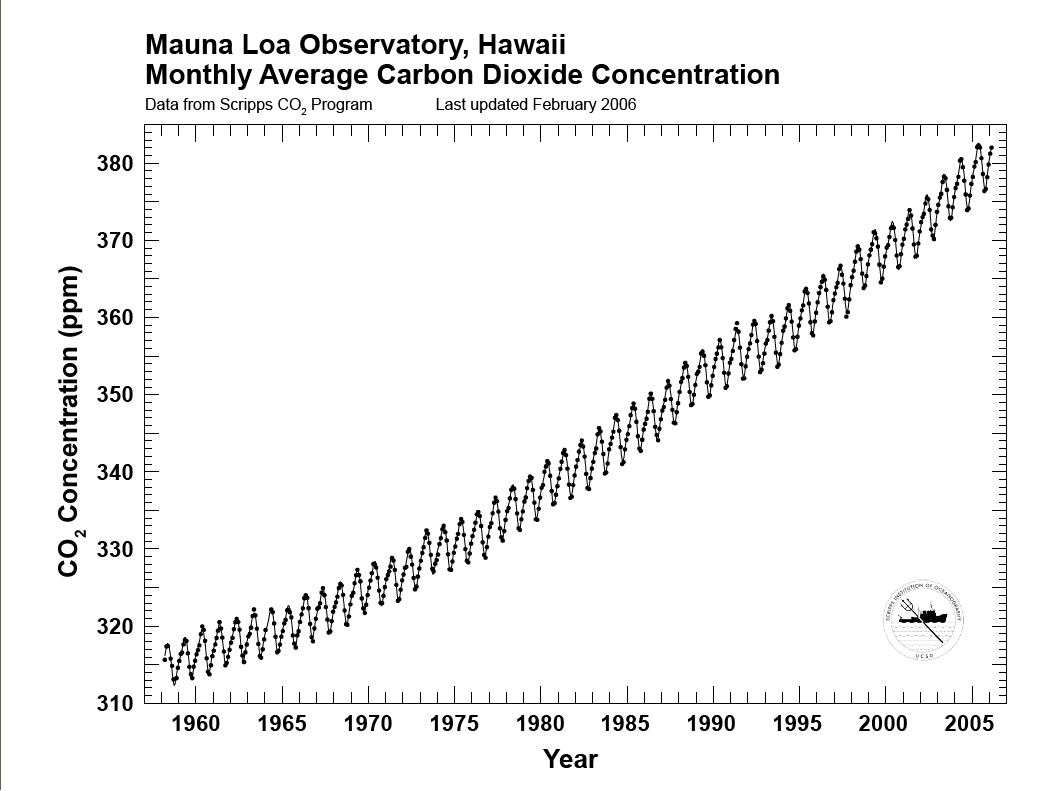
Global temps cooled and stayed there for 40 years during the post-WW2 economic boom. When carbon dioxide emissions were rising, and atmospheric co2 was rising, temps decreased.
I can go on... the warming-at-altitude problem. Greenhouse-based warming is supposed to heat the mid troposphere faster than the surface. But that's not what is happening. The troposphere is warming much slower than the surface.
The 2500 IPCC scientists who are "all in agreement"? Yeah, quite a few of those aren't scientists. And quite a few scientists didn't agree but got counted anyway.
I'm not saying AGW is impossible. It sure as hell isn't an undisputed fact. And guys like you frothing at the mouth... is that "sticking it to the man"? Toeing the AGW line is so NOT punk rock.
-
Aerosonde has been doing it for a while
The (former) little aussie that could
Aerosonde has been doing it for a while, hence aero-sonde. I believe they started doing crazy weather stuff some time before they were the first UAV to cross the Atlantic in 1998.
-
Is this a development of Helios I wonder?
Reminds me of the Helios prototype solar wing:
http://www.nasa.gov/centers/dryden/news/ResearchUpdate/Helios/index.html
http://www.nasa.gov/centers/dryden/news/FactSheets/FS-068-DFRC.html -
Is this a development of Helios I wonder?
Reminds me of the Helios prototype solar wing:
http://www.nasa.gov/centers/dryden/news/ResearchUpdate/Helios/index.html
http://www.nasa.gov/centers/dryden/news/FactSheets/FS-068-DFRC.html -
Re:Color Blind
You mean like STEREO?
http://www.nasa.gov/mission_pages/stereo/main/index.htmlExcept that perhaps you'd want them much, much, much, etc., further apart if you want to directly resolve parallax in objects at interstellar distances.
-
The NASA version
"Emerging Technologies May Fuel Revolutionary Launcher"
It looks more like the rail truck accelerates the launch vehicle to mach 1 which leaves the end of the track and the scramjet lights and carries it and its payload to mach 10 at about 20 miles altitude. The payload then separates from the launcher, the rocket ignites and sends the payload into orbit. The launch vehicle returns and lands for reuse.
This sounds a lot more feasible than a mach 10 rail gun!
-
Re:It will be a critical ability.
Poor intellectual judgement on his part? It's the accepted term. Just look at
http://spaceflight.nasa.gov/home/index.html, and the about 1,430,000 other results just at nasa.gov pages. -
Nothing new
The article unfortunately contains almost no information, except for the fact that ESA wants to do formation flying and is developing some testbed. This is not news, since ESA has been studying missions involving satellites flying in close formation for more than 10 years: for example the Darwin mission, which would have flown some telescopes at a few hundred meters to do optical aperture synthesis for detecting extra-solar planets (mission appears to be shelved right now) and XEUS which is a 'standard' 100 meter long x-ray telescope, but instead of physically connecting lens and focal plain it consists of 2 spacecraft that are virtually connected by a system that measures the mutual positions.
I had the pleasure of getting a tour on the JPL campus a few years ago, which to me seemed like a place where they build nothing else than super-cool over-engineered testbeds just for fun. I probably saw some early version of this testbed. They had a large hall with a smooth floor over which the 'satellites' could slide on air-bearings (3 degrees of freedom), on which a vertical piston was mounted (1 DOF) and finally an over-sized ball-air-bearing for the remaining 2 tilt DOFs. This provides a platform that can move freely in all degrees of freedom, which would carry a satellite-simulator consisting of small air-jets and a shitload of sensors to do the 'formation flying'. Very impressive, even if it was not operational at the time. If ESA would be starting now with their testbed, they would trail NASA by at least 5 years. Lets hope they have been doing something in the meantime.
-
Re:It will be a critical ability.Well, if we're going to be picky, if you check what your dictionary defines as a "wing", you'll probably find that the corresponding first definition is something to do with the flappy things on birds. Dictionary.com doesn't mention the "aeronautical" definition of "wing" until definition #9, so by the argument you used, we probably shouldn't call what aircraft do "flying", either, because their "wings" aren't biological structures, and don't flap.
AFAIK, "spaceflight" is pretty much the standard term for the technical subject, for instance, here's an introductory NASA page on the subject.
-
Re:Call Bruce Willis !!
According to http://neo.jpl.nasa.gov/news/news169.html, they're actually on not-dissimilar trajectories. So, it's not incredible that they could be both affected by, for example, a point source of a simple field. Such as an undetected mass. Not that I'm trying to start rumours.
-
Re:Extreme sharpshooting
-
Re:On a side note
Since when has ocean drilling even a part of space exploration? Or any drilling for that matter?
One of the anticipated problems of future space missions is that humans will need to find resources outside of the Earth environment. The amount of energy required to lift materials out of the gravity well of our planet is huge, so it makes sense to explore other options. NASA has researched laser drilling, deep drilling Mars for water, Moon drilling, low energy mobile drilling etc. NASA's remit is not just shooting satellites into orbit, it is also to conduct early stage R&D for exactly this kind of stuff.
And why the FUCK is NASA the only expert around to be able to help the stranded miners?
NASA employs many experts with the skills to do detailed drilling, modelling and geologic and seismic analysis.
Why does NASA have not only the desire, expertise, or the capability to test a BOP?
Who would you rather have test it? Deep sea drilling is a tight-knit industry. I would be surprised if there were any independent testing labs for this technology.