Slashdot Mirror
Domain: nasa.gov
Stories and comments across the archive that link to nasa.gov.
Comments · 16,365
-
Re:Forcing people into impoverished lives
You've personally analyzed the raw data yourself then? Or are you just repeating what the climate change believers say?
Have you? Or are you just repeating what the climate skeptics say?
Regardless, you're nit-picking and missing the larger point. There's clearly a difference of opinion on whether it has warmed since 1998. Arguments that it has not warmed are at least as persuasive as arguments that it has warmed. This is because it just doesn't seem very warm.
Climatologists at the NASA Goddard Institute for Space Studies (GISS) in New York City have found that 2008 was the coolest year since 2000. The GISS analysis also showed that 2008 is the ninth warmest year since continuous instrumental records were started in 1880.
The ten warmest years on record have all occurred between 1997 and 2008.
http://www.giss.nasa.gov/research/news/20080116/Sea levels haven't risen a noticeable amount.
Sea level rise is not climate change, but a predicted effect of a warmer global climate. Regardless, sealevels have been rising even in the past ten years the period we seem to be so hung up on in this thread. http://sealevel.colorado.edu/current/sl_noib_ns_global.jpg
You can get the data and performyour own analysis on it at: http://sealevel.colorado.edu/results.php Which has the data for the TOPEX/Poseidon and JASON data for you. These are satellite missions that amongst others measure ocean topography.People still talk about 1998 as the hottest year on record. There's a gathering consensus that it hasn't warmed since then. (See how consensus is useless in determining what's factual?)
People might be, but climate scientists are not, since single year measurements don't constituate a trend.
However, it looks like 2005 is the warmest year on record, though it is pretty close to 1998. http://data.giss.nasa.gov/gistemp/2005/
It is also of note that 1998 was a warm year in part due to an El Nino event.The larger point stands, regardless of whether it has or hasn't technically warmed in the last 10 years. Replace "it hasn't warmed" with "it doesn't seem to have warmed" if you're distracted by the wording.
-
Re:Forcing people into impoverished lives
You've personally analyzed the raw data yourself then? Or are you just repeating what the climate change believers say?
Have you? Or are you just repeating what the climate skeptics say?
Regardless, you're nit-picking and missing the larger point. There's clearly a difference of opinion on whether it has warmed since 1998. Arguments that it has not warmed are at least as persuasive as arguments that it has warmed. This is because it just doesn't seem very warm.
Climatologists at the NASA Goddard Institute for Space Studies (GISS) in New York City have found that 2008 was the coolest year since 2000. The GISS analysis also showed that 2008 is the ninth warmest year since continuous instrumental records were started in 1880.
The ten warmest years on record have all occurred between 1997 and 2008.
http://www.giss.nasa.gov/research/news/20080116/Sea levels haven't risen a noticeable amount.
Sea level rise is not climate change, but a predicted effect of a warmer global climate. Regardless, sealevels have been rising even in the past ten years the period we seem to be so hung up on in this thread. http://sealevel.colorado.edu/current/sl_noib_ns_global.jpg
You can get the data and performyour own analysis on it at: http://sealevel.colorado.edu/results.php Which has the data for the TOPEX/Poseidon and JASON data for you. These are satellite missions that amongst others measure ocean topography.People still talk about 1998 as the hottest year on record. There's a gathering consensus that it hasn't warmed since then. (See how consensus is useless in determining what's factual?)
People might be, but climate scientists are not, since single year measurements don't constituate a trend.
However, it looks like 2005 is the warmest year on record, though it is pretty close to 1998. http://data.giss.nasa.gov/gistemp/2005/
It is also of note that 1998 was a warm year in part due to an El Nino event.The larger point stands, regardless of whether it has or hasn't technically warmed in the last 10 years. Replace "it hasn't warmed" with "it doesn't seem to have warmed" if you're distracted by the wording.
-
There is no "global cooling"
[i]They have no explanation for why global temperature has not increased during the last ten years. They are just as astonished by the exceptionally cold, wet weather they see outside their window as everyone else.[/i]
No, actual scientists are not astonished because the magnitude of natural variability per year is significant, and the rest of the physics of the planet doesn't take a nap.
http://data.giss.nasa.gov/gistemp/2008/Fig1.gif
Do the above show something particularly odd or incompatible with mainstream climatological opinion in the last 10 years?
No.
-
Re:ESR said it very well - Open Source Science
Source and data to one of the models: http://www.giss.nasa.gov/tools/modelE/
This has been available for some time. And despite all the whining and yelling about closed source models and the like, over the years there have been no submissions from the open source community for fixes to bugs, aside from the occasion tweak for the makefile to compile on yet another platform.
There are also several books, multiple papers, etc. on how to write your own. There are several public sites that contain data you can use in your model as well.
In short, nobody is preventing you from educating yourself about atmospherics, computational fluid dynamics, and other related topics. Write your own. Write a paper. Show that the current consensus is horribly wrong. Win a Nobel.
~X~
-
Sea level rise
For Calvert Cliffs, Turkey Point, and the South Texas Project, there is a problem with sea level rise this century since these are in tidal areas. http://pubs.giss.nasa.gov/abstracts/2007/Hansen.html So, there are environmental concerns at these sites.
-
Re:A way to solve tsunamis problems on Earth ?
I wonder if we had anything observing the opposite side of the Sun when this happened.
The project's orbital information page states that the two spacecraft are currently separated by 128 degrees. (They orbit about 0.05 AU inside and outside earth's orbit, so that their orbital periods are 346 and 388 days, and their separation changes by about 44 degrees annually.) The entire sun will be visible when they achieve 180 degrees separation in February 2011. With earth based observations, the full sun will continue to be visible another eight years. A few months of contact will be lost in 2015 as they pass behind the sun. (If only Ulysses was still operating, we could get some polar views as well. It should be silently making its next solar passes sometime around 2013-2014.)
STEREOs lunar gravitational slingshot (animated at the project's orbital simulation page) was very cool.
They are supposed to be searching for Trojan asteroids as they pass through Earth's L4 and L5 Lagrangian points, but I've not heard of any results yet.
-
Re:A way to solve tsunamis problems on Earth ?
I wonder if we had anything observing the opposite side of the Sun when this happened.
The project's orbital information page states that the two spacecraft are currently separated by 128 degrees. (They orbit about 0.05 AU inside and outside earth's orbit, so that their orbital periods are 346 and 388 days, and their separation changes by about 44 degrees annually.) The entire sun will be visible when they achieve 180 degrees separation in February 2011. With earth based observations, the full sun will continue to be visible another eight years. A few months of contact will be lost in 2015 as they pass behind the sun. (If only Ulysses was still operating, we could get some polar views as well. It should be silently making its next solar passes sometime around 2013-2014.)
STEREOs lunar gravitational slingshot (animated at the project's orbital simulation page) was very cool.
They are supposed to be searching for Trojan asteroids as they pass through Earth's L4 and L5 Lagrangian points, but I've not heard of any results yet.
-
Re:Recent? Try February.
Actually, I confirmed it with one of the scientists (Joe Gurman) cited in the article -- there was an article from March that was inaccurate, and this was a correction to that previous article.
But, instead of marking it as a correction, it was posted as a new article. (I can't find the older article, so I don't know if it was removed)
They also linked straight to the movie, rather than to the explanation of what is being seen in the movie, or cite the original posting of the article, which had different images:
http://stereo.gsfc.nasa.gov/news/SolarTsunami.shtml
http://www.nasa.gov/mission_pages/stereo/news/solar_tsunami.htmlJoe also said that this was in fact "tsunami-like" in that it was the result of an initially downward wave that reflected back up, as opposed to other CMEs.
(and I probably should've added a disclaimer earlier -- I work for the STEREO Science Center)
-
Re:Recent? Try February.
Actually, I confirmed it with one of the scientists (Joe Gurman) cited in the article -- there was an article from March that was inaccurate, and this was a correction to that previous article.
But, instead of marking it as a correction, it was posted as a new article. (I can't find the older article, so I don't know if it was removed)
They also linked straight to the movie, rather than to the explanation of what is being seen in the movie, or cite the original posting of the article, which had different images:
http://stereo.gsfc.nasa.gov/news/SolarTsunami.shtml
http://www.nasa.gov/mission_pages/stereo/news/solar_tsunami.htmlJoe also said that this was in fact "tsunami-like" in that it was the result of an initially downward wave that reflected back up, as opposed to other CMEs.
(and I probably should've added a disclaimer earlier -- I work for the STEREO Science Center)
-
Re:Yo astronomers, I'm really happy for ya...
-
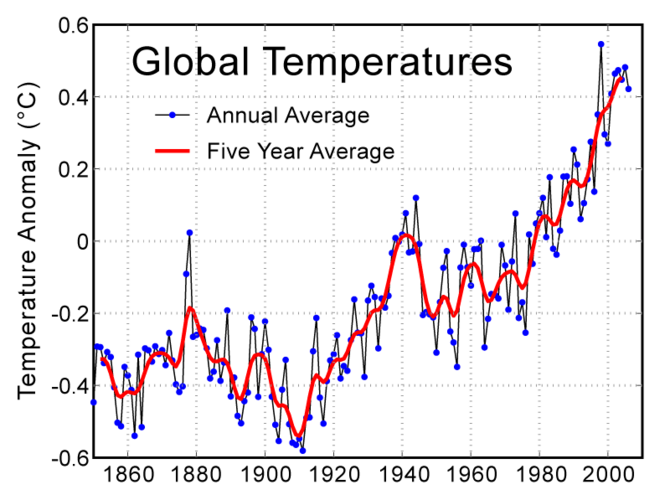
Re:Those who bear false witnessI see your guardian article and raise you with this NASA image of average land and ocean temperatures. Image.
You will please take note that since about 2003 the graph is trending down meaning decreasing temperatures.
Does this prove or disprove AGW? of course not! I'm not a denier; I just don't like to see people cherry picking a result and claiming that we face economic DOOM (anti-AGW) or day after tomorrow DOOM (AGW).
AGW proponents are quick to point out local and hemishpereical weather variations that do not apply to a global mean, but then turn around and point to the southern hemisphere ice pack as spelling doom for the world. Even while different parts of both antarctic and arctic icepack are thickening.
To diverage off topic a bit --several small islands around Greenland in 1950 were not connected to the mainland via ice. Between 1960 and 2003(?) the islands were covered and connected by ice. Now once again they are not covered by ice and that is evidence of DOOM? No.
-
Re:Falsibility.
1) You'll have to use average temperatures over some time period. NASA seems to prefer the fiveyear mean. As you can expect, it's not linear, and it never will be.
2) The prediction says "up to 6C"
3) This depends on the trends of fossil fuel consumption staying the same. They won't, but you're free to extrapolate from there. -
Re:The truth is global warming has stalled out
I submitted article with the real truth, wonder if slashdot will post it?
http://www.spiegel.de/international/world/0,1518,662092,00.html
If you look here it seems temperatures have been alternately going up and staying flat (or even cooling slightly) for 30 years or so, and we're about at the end of 30 years of "going up". Maybe the warming is on hold until around 2040?
Hey, that could mean that 2038 really is the end of the world -- the 2012 people have the right idea, they've just been working from the wrong calendar.
-
Re:How can they tell...
There is a natural variability that correlates to several known processes. There have been dips and peaks of greater magnitude since the start of the industry and beyond. The long term clear is very though; http://data.giss.nasa.gov/gistemp/2008/ and fits well with the increasingly accurate climate models that have been refined over time to include these know processes.
-
Seven year old servers might be more reliableActually, seven year old servers might be more reliable than modern units, due to construction being (just) before the advent of ROHS directive for construction of electronic equipment. Lead-free solders, whether appropriate or not, have problems with tin whiskers growing over time that can short out tiny components.
The cut-over point was Feb 2003 for the European Union with a number of other countries following suit shortly thereafter. ROHS-compliant Equipment built after that point may be subject to age-and-use related failures irrespective of whether there are rotating components or unstable environments involved.
Used equipment still running after 7 years? Will probably be reliable. Used equipment slightly newer than PP described? Borderline, I think. You'll have to consider hardware redundancy more carefully with the newer stuff.
-
Re:re Increase or decline?
We are also in a deep solar minimum.
http://science.nasa.gov/headlines/y2009/01apr_deepsolarminimum.htm
-
Re:Prediction depends on an unproven thesis
Uh, what does that fluctuation in that plot prove?
It proves that the solar output in that band of the EUV varies by over a factor of three during the solar cycle. That is a huge variation and as such should be included in the measurements of the total solar irradiation. But it is not. For example, ACRIMSAT measures only the 2000 nm to 200 nm window.
x-rays and EUV don't make it to the surface of the Earth anyway
True, they get absorbed in the very upper layers of the atmosphere. However, roughly 50% of the energy does reach the earth's surface through secondary effects such as fluorescence, ionisation-recombination emission, heating and conduction, heating and thermal emissions, and so on. The physics behind this is perfectly analogous to why of the infrared radiation captured by greenhouse gases about half the energy still ends up in space instead of being reflected back to earth.
-
Re:Prediction depends on an unproven thesis
And we know it's not an increase in solar output causing the warming we've observed.
Sorry, we do not know that. The conclusion that it cannot be because of the sun is based on space-based measurements of the total solar irradiance (TSI). These found a fairly stable 1365 W/m^2 (see for example here). But these measurements are wrong! Why? Because the EUV and X-ray part of the solar spectrum is not included.
Take for example ACRIMSAT. It is sensitive only down to 200 nm and as such it wholly misses out on the EUV and X-Ray bands. Moreover, to properly observe the whole x-ray flux you have to capture a fairly wide field of view that includes the corona as this X-ray image of the sun shows.
-
Re:How can they tell...
+1 informative. Next question:
How come the world temprature has dropped half a degree since 2000?
Look at the data.
Here: en.wikipedia.org/wiki/File:Instrumental_Temperature_Record.png,
or here
or here.Examine the data, and get back to me with the answer to this question: based on the data (and not on the opinions of some pundit telling you what to think), would you personally sign on to a statement that the global average temperate is dropping?
-
Carbon dioxide in the atmosphere [Re:How can they]
How do they know if the CO2 is from fossil fuels or from natural sources, is there actually a test for this?
CO2 is a molecule, containing one carbon atom and two oxygen atoms. One CO2 molecule is indistinguishable from another
Not at all. Carbon has three major isotopes. Carbon-14 is produced by nuclear reactions in the atmosphere, but decays with a half life of 5730 years, so fossil carbon has zero carbon-14. So, actually, all carbon dioxide molecules are not identical, and, in fact, you can tell which ones come from fossil sources.
However, if you look at the graphs of carbon dioxide concentation in the atmosphere, it's pretty hard to come up with any explanation other than that the carbon dioxide change comes from human activity.
(I'm sure the fringe can come up with some explanation. When you don't have to worry about plausibility or data, there's always some explanation to come up with.)
-
Re:re Increase or decline?
The politicization of climate data will prove to be a disaster in the long run. Everyone has an axe to grind.
Here's a link to some NASA data about temperature:
http://data.giss.nasa.gov/gistemp/2008/
Do we believe NASA when they say 2008 was the coolest since 2000? Is that just a tooth in the saw? Which trend to you believe? The one that shows temperatures generally increasing since 1880? Are the relatively flat temperatures between 1950 and 1980 an anomaly? Is it really correct to even assume the overall trend is anthropogenic? Or do we need to do some fancy footwork to make the data fit the hypothesis?
What we don't have is good, healthy debate.
-
No it doesn't
Read your parent post again. CRU is only one of very many research teams studying the Earth's climate. You could throw away every piece of data and every conclusion from them and there would be plenty of strong science left.
A theory is only as strong as the people, data, and process to support it.
Definitely true. The point being that there are many more people, data, and processes than CRU, that have led to the current understanding of the Earth's climate. Here's a short list of just the U.S. government agencies that are involved.
-
NASA too.
Example: http://beamartian.jpl.nasa.gov/maproom
-
Re:By all means
Follow up.
OK, According to NASA, there were 18 Shuttle/Mir missions. However, none of them occurred prior to 1991. Therefore ASTP was the only Soviet-US joint mission.
US Manned Space Missions from 1961-1991:
* Mercury - 6
* Gemini - 10
* Apollo - 11
* Skylab - 3
* ASTP - 1
* Shuttle - 44 (per Wikipedia)Soviet Space Missions from 1961-1991 (per Wikipiedia, includes ASTP): 66
That gives 141 missions. So out of 141 manned missions before the fall of the Soviet Union (your timeframe: "during cold war"), exactly 1 (or 2, depending how many times you count ASTP) were joint.
Would you care to explain how 1 out of 141 is the norm?
-
Re:Why is NASA answering Hollywood Questions?
Why is NASA answering these questions some of which surely are just jokes?
I'm not with NASA but the answer seems obvious to me, but it must not be obvious to everyone or your question wouldn't be redundant. Someone else asked it earlier and I already answered it.
Can't they tell the difference?
Yes, but the general public can't.
Why is it NASAs' job to handle this?
Where elase will you find so many astronomers and astrophysicists?
Not that educating isn't important, but instead of the symptom, go for the cure?
Education IS the cure. The disease is ignorance.
there should be laws called crimes against reality
I'm glad you're not a legislator. You would outlaw fiction.
what about damage to minds?
You're a member of the Partnership for a Drug Free America, aren't you? And drugs aside, I'm a big fan of a good mindfuck.
Isn't there some sort of rational response that should be made when we become aware of a vast swath of ignorant people?
Do you work for the department of redundancy department? NASA's rebuttal of this nonsense IS the rational response to nonsense that people believe.
Do your jobs which is managing space and research
Then bye bye NASA picture of the day and all the other good things I find at nasa.gov then.
-
Re:This is part of NASA's purvey.
True, but it's not like Hollywood movies are known to be purveyors of fine facts. If this is the first movie you've ever seen, well, OK, I suppose it might be ignorance, but if you've seen a couple of them and you still believe it, I think that falls squarely in the stupid category.
But, yeah, good for NASA. They should put 'combating ignorance' on their "What have we done for you lately?" page. -
Re:Why is NASA answering Hollywood Questions?
See #1 in the FAQ: http://earthobservatory.nasa.gov/Features/GlobalWarmingQandA/
-
Timezones
For the people who prefer to calculate using timezone offsets, the time is 0900 UTC, as reported by NASA.
Since I live in Singapore, with geographical time +0700, the meteor showers appear at 1600, which means I get to see nothing at all. However, NASA also reports another wave at 2100-2200 UTC which means that I get to watch 'em at 0400 tomorrow. (1400 PST Tuesday aftn.)
-
Re:Cringely is an idiot.
correction: the proper link would be this one.
-
Re:Cringely is an idiot.
A Space tether can be used to boots satellites acting like a dynamo circuit if a voltage potential is applied to the tether.
-
Re:Make sure.
This also leads me to think that you'd need less of a 'net' and more of a 'sheet'. One would then wonder, depending on altitude and sheet size, when atmospheric drag becomes an issue.
I remember an SF story over a decade ago where the author (maybe Pournelle?) had a similar sweeper idea and they used aerogels to scrub Earth orbit. I say let's call it a trap instead of a net or a sheet, since that describes its function as opposed to its form. That said, I don't think the orbital mechanics would work the way Cringely thought it might. Higher orbits go slower, so the hanging sheet/net (moving at the speed of the orbit of the center of mass of the sheet/tug) is going to be accelerated by impacts from the space junk which will lead the whole thing into a more elliptical orbit, not a shallower circular one. That's not a good way to arrange a slow spiral down to clean up orbits gradually. And that doesn't even begin to consider the stuff in eccentric orbits. So Cringely's idea isn't original, and if he read the same story I did and is subconsciously re-iterating the idea, he's not even getting it right. Now, if you balanced your trap with a larger solar sail and used it to keep your orbit more circular, you might have something.
As for atmospheric drag, if it's an issue for the trap, it will be an issue for anything flying that low. The space junk flying low enough for atmospheric drag to be a factor is a self-correcting problem.
-
Use the arm ?
I wonder if they've thought of using the robotic arm, either to dig away some of the sand obstructing the wheels or to support the rover while they try to move it. I know from driving 360 excavators that your arm can be most useful in that respect, especially if you move the arm backwards at the same time as pushing down and driving. Maybe the arm's not strong enough, or the rover can't operate its wheels and the arm at the same time, but surely that's just programming. An alternative is to pick up small stones and place them by the wheels to get some traction. There is a more complete pictorial record here.
-
Re:Because I Said So, That's Why!
Or are you a creationist troll ?
I'm a deeply confirmed atheist, so much so that I can't imagine trolls at all, other than as pejorative labels for creationists. This linked article was the first handy bit I could find that speaks directly to my post.
-
Re:Whats the hold up
Pointless? That's pretty much the reason you don't design interplanetary vehicles.
-
Re:Seriously cool ...
The Cassini Huygens probe. It has been in orbit around Saturn since 2004. It also took some very nice pictures of Jupiter on the way to Saturn.
http://www.jpl.nasa.gov/missions/missiondetails.cfm?mission=Cassini -
Re:Seriously cool ...
It will probably end up replacing my previous one
http://photojournal.jpl.nasa.gov/jpeg/PIA08329.jpg
The sun is being occulted, the reflection of the rings are seen on the dark side of Saturn. Not to mention the little faint blue dot just below the thickest part of the outer bulry ring, on the left side is supposedly Earth. -
Counting Your Chickens
Whenever there's one of these asteroid articles I go to JPL's impact risk page and calculate the current cumulative impact risk of all listed NEOs. I do this by taking the tables at http://neo.jpl.nasa.gov/risk/ and copying them into a spreadsheet. Column D is the cumulative impact risk per entry. I take the sum down both tables in that column.
According to the 10 NOV 2009 list of 259 NEOs, the cumulative impact risk over the next 100 years (plus a few extra years for the couple rocks calculated farther out) is 1.52%, or a 1 in 66 chance, or a 98.48% chance that none of these will hit Earth in the next hundred years.
None of THESE. This is the list of *known* NEOs. As TFA testifies, sometimes they sneak up on us.
-
Re:OH NOES!!!
And considering the state of this page, I don't have a lot of confidence in their efforts.
Geocities called... they want their website back!
-
According to NASA...
NASA states that
On average, objects the size of 2009 VA pass this close about twice per year and impact Earth about once every 5 years.That doens't make this seem like terrifying news?
-
Re:How Much Damage? Not much!
None. We were hit by one about 10 meters across on October 8th but no one wants to put the story out for some reason. http://neo.jpl.nasa.gov/news/news165.html
-
Re:Hardly noticeable if it impacted
The OP said "typical data", not "oh that number is bigger bigger is better right". You've simulated it with an asteroid slightly more dense than pure iron, traveling at a highly unrealistic velocity. Using less bogus values (courtesy of this), you get much more reasonable results: a 3.7 kT airburst at 36 km in the air.
-
Re:OH NOES!!!
Isn't it more likely that number was just made up to give a false sense of security?
Knowing NASA, no. Is there some component of your argument that isn't just baseless speculation?
This site is better, by the way: http://neo.jpl.nasa.gov/
-
Re:OH NOES!!!
If we know we're tracking 90% of NEOs, why not the other 10%? Isn't it more likely that number was just made up to give a false sense of security? I remember back in the 90s after the Shoemaker-Levy collision there was a brief increase in funding to NEO tracking; IIRC it didn't last past the end of the decade. And considering the state of this page, I don't have a lot of confidence in their efforts.
-
Re:An Application?
Astrobiology-- the study of whether life exists elsewhere in the universe-- is part of NASA's mission.
-
Re:An Application?
Astrobiology-- the study of whether life exists elsewhere in the universe-- is part of NASA's mission.
-
Re:Houston Has Similar Plans
You can't do this without outlawing combustion. While it's a nice theory to say that you'll be able to blow enough air through it, in practice the airflow in a dome is not like the airflow without a dome. And anyone who has been to Houston knows just how bad the air quality is, in fact, it is some of the worst in the USA. If you could remove Chinese pollution from the Jet Stream, it probably WOULD be the worst. Then again, if you put a dome over it, the city's residents could just gas each other to death, which would effectively stop them from polluting.
-
Re:GPS speed not accurate 100% of the time
How the court can even consider comparing stationary technology that operates up to a few hundred meters with something that is 20,000 kilometers away traveling at 14,000 km/h is beyond me. GPS accuracy is effected by builings, mountains, etc.
How can you consider your vision accurate based on signals reflected from a sun 149,476,000 km away?
GPSr LOCATION accuracy is affected by satellite constellation, reflected signals, signal blockage and atmospheric conditions.
However SPEED is known by doppler shift of the signal right at the antenna, which is not particularly impacted by any of those things.
But don't take my word for it, Dr. Stephen Heppe, the expert in the case, with a doctorate in electrical engineering and communications points out, "accurate...
PS: There was a great article from Goddard on knowing Earth location and GPS satellite locations from distant quasars (which appear fixed from us), let me dig it up from my Twitter account last week... Here you go: Celestial Map Gives Directions for GPS
-
Re:Professor Myrabo at RPI
So you say, but has it been done?
An object that is 0.6m across, moving at approximately 1 km/s, and is 384,000 km away.
Yes, about 40 years ago. http://science.nasa.gov/headlines/y2004/21jul_llr.htm
-
Re:Issues with such networks generalize to Mars
They are working with those already: http://www.nasa.gov/mission_pages/station/science/experiments/DTN.html
-
Re:Explanation Impossible
Did you even read what I wrote?
Simulations of stars in galaxies are approximations because:
1) there isn't an equation for an exact solution to any gravitationally bound system containing more than 5 objects.That's not what I said, numerical precision is not the issue. If you're only 10 decimal points accurate, that's still good enough. Numerical simulations, of for example, the solar system can be done (and have been done) relativistically to huge precision. Dark matter theories are implying that there's a 10x error. That's not accountable for by numerical precision!
2) stars in a typical galaxy are not uniform so the simulations must take this into account as a best guess.
Well duh. However, the simulations I was referring to perform a 'fit' of observed data. We know the observed velocities of stars in galaxies, and given that, a good model can predict the mass distribution of stars that can produce that motion. Using newtonian mechanics, this 'fit' can't be done, an extra "dark matter" term is required, where that dark matter doesn't behave like ordinary stars under gravitation. Using relativistic mechanics, the fit is an exact match to observed galaxies.
3) newton's equations are indeed incorrect however, Einstein's equations only dominate to a significant degree under unusual conditions.
You just made the exact same, unfounded assumption everyone else has! How the do you not see that it's a HUGE MISTAKE when observed reality doesn't match the predictions of your simplified model? How is that not enough of a clue that maybe the model may be oversimplified?
Galaxies are massive. Did you not notice that? It takes 10,000 years for either light or gravity to cross one, and they bend light to the point that we've got nice Hubble pictures of them looking like a reflection in a funhouse mirror. Higher order error terms can't be ignored every time with a wave of your hand. Nonlinear effects can be subtle, and will bite you in the ass if you ignore them.
In so far as dark matter is concerned, you are incorrect. Experiments like the Cryogenic Dark Matter Search are attempting to detect dark matter particles directly, we've got neutrino detectors looking for evidence of annihilation events... Particle accelerator experiments attempting to actually synthesize dark matter candidates.. To claim that there isn't a way to test the dark matter hypothesis would be grossly inaccurate.
Disclaimer: Physics isn't my major but I did study quite a bit of it in high school and college.There's way to test for dark matter, sure, but no test has even provided a slightest hint of anything that might be there. Physicists are claiming that 90% of the matter is invisible.. so where is it? That would mean that there would be... 10x more stuff around. I think we'd notice.