Slashdot Mirror
Domain: nasa.gov
Stories and comments across the archive that link to nasa.gov.
Comments · 16,365
-
Re:What's the contingency for these missions?
What sort of contingency do they have for sats like this? Do they just fabricate another one and try again in a year or two?
dunno but:
WASHINGTON - NASA's Orbiting Carbon Observatory failed to reach orbit this morning after a 4:51 a.m. EST liftoff from Vandenberg Air Force Base in California. A media briefing on the mishap has been tentatively scheduled for 7:15 a.m. from Vandenberg. The briefing will be carried on NASA TV.
It's now 0614 PST. Did anyone catch the media briefing? The only evidence I can see that the beeb was even aware of it is the line Nasa officials confirmed the launch had failed at a press conference held at 1300 GMT. But there is zero information in this article that you could not have gathered from other sources - the author of the bbc article obviously tapped a couple of sources, read some other articles (the link I place above, the OCO mission page, and others) and spit out a piece of trash we could have done without. Thanks, BBC! Your contribution to mainstream news will be forgotten in the mists of time. I hope.
-
Launch failed
-
Re:Wait... liquid???
Yes, but with only about 1% of the density of Earth's atmosphere, the wind would be nearly imperceptible.
Well I'm certainly no astrophysicist or even the armchair version. But it seems to me that wind levels on Mars can be quite energetic (relatively speaking).
At least enough to throw up some dust and act as dust devils.These have also been postulated to be on of the reason why the solar panels seemed to get cleaned from time to time for no apparent reason.
Murphy(c)
-
Conclusion mat...
What evidence do you have that this is your money?
The article gives a hint with the words "subscription based", three clicks and I managed to find the RFP, a quick skim gives the following quote: "Funding to design, develop, and deploy the MMO should be included in the proposer's business plan."
Apologies for interupting everyone's political flame fest, please continue... -
Re:A game?
the rovers did no serious science
-
Re:Big Bang
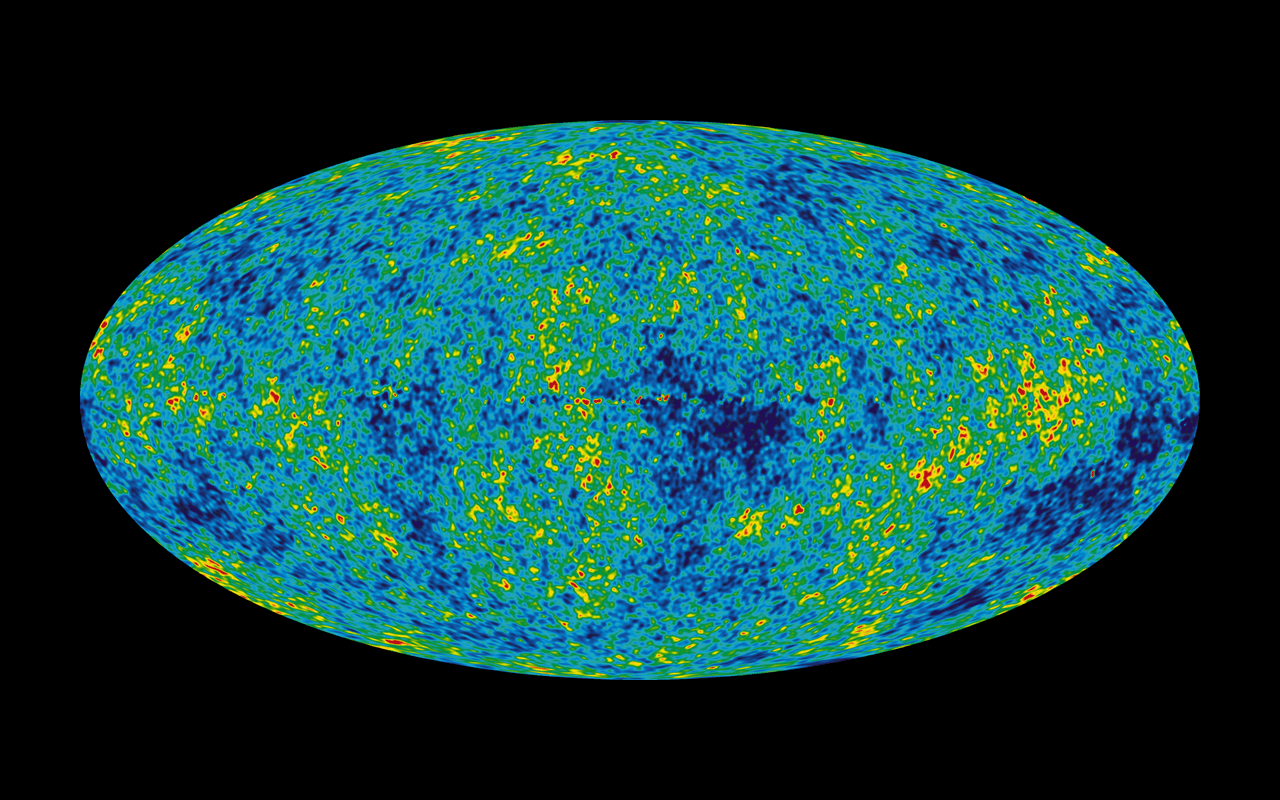
No, this was just a little Bang. The big one, we had already found. You can see a picture here.
-
Military applications
Space Based Solar Power (SBSP) is an economical way of delivering power to remote locations or areas isolated by war.
To deliver power to a certain places in Iraq and Afghanistan it costs well over $1USD/kWh, not mention the loss of human life.
The pentagon is seriously considering SBSP as a viable way to deliver power to not only these locations, but other places of humanitarian interest.
The technology to deliver and deploy SBSP payloads (for it will take many deployments) already exist. Improvements will undoubtedly be made, and with the hopeful completion of NASA's Ares V cargo launch vehicle SBSP will be economical for the rest of us. (under 20cents(USD)/kWh.)
As for the microwave radiation concern, it is not as scary as commonly depicted. (Can anyone recall the tale of the discovery of microwave radiation as a cooking tool--something to do with a Snickers bar melting in a pocket? [Who the heck carries a Snickers bar in their pocket?]) If the size of the receiving antenna is increased, the power of the transmitted signal may be decreased on a W/m scale. With a transmitter that can 'dither' the signal over a rather wide swath one can abate errors associated with tracking, solar anomalies and human error.
Military applications, however, are not quite as concerned with stray microwave beams.
Do not forget that SBSP is exposed to the sun for 24 hours--no interruptions!
On another note the Japanese are working on developing devices that may convert solar energy to transmittable energy in upwards of 40% efficiency by converting solar power to laser. -
Re:Oh gosh.
THIS is the way science works: you look at the evidence, squeeze it hard and see if it breaks. There is no doubt that the evidence for a soon-to-be-ice-free Arctic is broken. Ergo, the plausibility of dramatic climate change effects in our near future has gone down, no matter what anyone's politics drives them to prefer.
I don't think I'd go so far as to say the evidence is broken. Aside from what the article says, you might also be interested to know that right now we are in the coldest part of two major cycles with a significant impact on Arctic sea ice.
We are at the minimum of the 11-year solar cycle. Total Solar Irradiance will most likely increase significantly over the next year.
We are also at the cold end of the ENSO cycle - in a mild La Nina which will likely end this year. Models predict the current La Nina weakening through Spring 2009.
40% of variance in sea ice extent is linearly correlated with ENSO fluctuations. -
Re:Eleven Years?
My point was that with an annual budget of $17 Billion, it's hard to imagine nasa spending 1/5-1/4 of that on one deep space probe with an equivalent budget of what they were spending in the 60s. NASA had twice as much money or more to go around in the 60s ( http://en.wikipedia.org/wiki/NASA_budget ) and they had alot fewer earth science & environmental research responsibilities than they do now. If you dont want to be a troll, you should read the actual budget before accusing them of spending their budget on management, PR & swimsuit models.. I prefer the hard numbers to histrionics and hyperbole. http://www.nasa.gov/pdf/168652main_NASA_FY08_Budget_Request.pdf So for 2008 the total budget is $17.3 Billion $5.5 Billion for Science -- 1.5 Earth Science -- 1.0 Heliophysics -- 1.4 Planetary Science -- 1.6 Astrophysics $3.9 Billion for Exploration Systems -- 3.0 Constellation Systems (Orion) -- 0.85 Advanced Capabilities $0.55 Billion for Aeronautics Research $0.5 Billion for Cross Agency Support Programs (Education, Business Partnerships, etc.) $6.8 Billion for Exploration Capabilities -- $4.0 Space Shuttle -- $2.2 International Space Station -- $0.5 Space and Flight Support So if you really break it down the 1/3 of the budget is for hard science & research, 1/4 is for Orion/Next generation manned spaceflight, about 1/3 for existing manned spaceflight (shuttle & station) and the rest for education, etc. There isnt alot there to go around. And if this is all so important to you all, write to your senators. I for one think that $17 Billion for earth & planetary science & space exploration is a pretty sad pittance compared with our spending on same 40 years ago, and especially in light of our 3 Trillion dollar war in the middle east. We can spend all that money in Iraq & Afghanistan but people get their panties in a wad about spending any money on science & exploration. Sad.
-
Re:Not consistent?
Well the language might have been a little harsh but it does seem to me that if one has a good case to make - for global warming or anything else - then one doesn't need to exaggerate things. One doesn't, for example, need to claim NYC will be underwater.
And one doesn't need to claim, as did a recent NASA Astronomy Picture of the Day http://apod.nasa.gov/apod/ap090215.html article did, that melting the Ross ice shelf would raise global sea-levels by 5m - aside from the fact this has nothing to do with astronomy and so is clearly politically motivated - all one needs do is divide the volume of ice not already displacing water by the surface area of the oceans and one can see it doesn't come even close to the claim.
When scientists, government agencies and politicians start making stuff up it's legitimate to question their motivations. It also means one has to be at least a little careful about the claims of their fellow travellers.
And why would a group of scientists want to continue using flawed instrumentation just because it's what they have always used? It doesn't make sense. As another post said just get the better tech, develop a mapping from the old to the new and then keep using the superior instrumentation. But to just go on using equipment you know is providing faulty data...
As for your comment on "insightful" I agree it's poorly used on
-
Re:Rocket science?
We (rightfully) will want a further look at the data used all along regardless.
OK, here you go, have fun. All the data in modern climate science is freely available in massive quantities. (The GISS datasets are just one example.)
It's certainly true that there's a lot of crap journalism around climate change; please don't confuse the finger pointing at the moon for the moon itself. Go read RealClimate, or Scientific American (hell, even New Scientist if you like comics) or (better yet) search out the specialist journals.
I used the term "we" in that sentence a bit loosely.
While I appreciate your directing me to an FTP directory full of stuff more fit for someone who actually is working in the field, or can make meaningful use of, you missed the entire perspective from which a person like myself stands. Like much of the public at large, I don't give a shit what sensor 102.WG-72 says. I don't really feel the need to be an individual detective either. It's not a big enough part of the "big picture" and I don't have enough experience to really know if I'm looking at faulty data or not. Hell, the Oxygen sensor in my car has been telling me my engine is messed up since I bought it even though the engine is working fine. What people like myself want is a credible and non-hysterical overview of the problem at hand.
Wanting a factually correct summary of the problem and the possible solutions once the scientific community reaches a relatively common understanding can't be bad. Having an apparently sound method of getting to that summary is better. Pointing me (someone untrained in the use of it) at individual data points is next to useless.
- Toast
P.S. If you want I could go read a whole pile of journals, make my own theories up, and come back in here and start screaming about my own (uneducated) views about how the system works based on information I barely understand, to people I hardly know. Seems to be common practice for people to fail to acknowledge that they, in fact, know shit about what they speak and do not qualify as even remotely knowledgeable experts (this would be the public polarization I'm in reference to).
-
Re:Multiple Data Sources
In the end (or even the beginning) the only reasonable thing to do is to keep an eye on the current scientific situation yourself. I have the NASA Earth Observatory in my RSS feeds and if you take the time to read what's going on, you find that they occasionally do find inconsistencies and report them openly. Relying on the mass media for accurate conclusions is stupid at the best of times.
There are many issues at work with climate change, and for any one group to suggest hard conclusions based on the data we already have is disingenuous. Most any sane person accepts climate change. When you take into account historical records, geological records, fossil records, the precession of the equinoxes, the solar cycle, biological fluctuations and many many other factors, to simply state that we are causing global warming is way too simplistic an approach.
Before you get all huffy and call me a denier, of course what mankind does has an effect on the climate. But so does what plankton does. Of course being an intelligent species, we can recognise our part and try to minimise our impact. But that alone will not stop global warming. Why should we assume that because we think we can stop it, we should do so ? Because too many of us live near coastal areas ? That seems a little self important to me. And to risk a flame, that attitude is directly derived from the "earth is ours to do with as we will" notion which religion has ingrained in society. Do we believe everything else that religion demands ?
My suspicions about the climate change lobby were somewhat vindicated a little while ago when the BBC reported on some work by the Institute of Mechanical Engineers which takes as read, that we must stabilise average temperatures. I can't find the original document now, but the European Commission has stated that "The commission aims to limit the world's temperature increase to 2C." This is no longer about limiting CO2, it has become all out climate control. And we certainly do not know enough to experiment with that. Even if we could do it safely, do we really want to live in a world where commercial interests control whether your region gets rain today, this month, this year ? Fuck me, it's bad enough dealing with the MAFIAA !
In short, yes reduce our impact on the planet, but that's it - at least until we have a LOT more data. We can not hope to go back in time. And this has been my position all along, as any
Just remember that the diversity on this planet has arisen BECAUSE of climate change, not despite. -
Re:Rocket science?
We (rightfully) will want a further look at the data used all along regardless.
OK, here you go, have fun. All the data in modern climate science is freely available in massive quantities. (The GISS datasets are just one example.) It's certainly true that there's a lot of crap journalism around climate change; please don't confuse the finger pointing at the moon for the moon itself. Go read RealClimate, or Scientific American (hell, even New Scientist if you like comics) or (better yet) search out the specialist journals.
-
Let it die!
Pour more money into getting This one Right!
-
Good, but..
still plenty of data from other sources, NASA in this case showing a trend of ice melting... http://earthobservatory.nasa.gov/Newsroom/view.php?old=2006101923416
-
ConfusingThis is _very_ confusing. By the IJIS website, 2002 and 2003 were in average:
http://www.ijis.iarc.uaf.edu/en/home/seaice_extent.htm
But, then, look at this:
http://www.nasa.gov/centers/goddard/news/topstory/2003/1023esuice.htmlThe result has direct connections to NASA-funded studies conducted last year that found perennial, or year-round, sea ice in the Arctic is declining at a rate of nine percent per decade and that in 2002 summer sea ice was at record low levels. Early results indicate this persisted in 2003.
-
Re:How is this going to affect The Hubble?
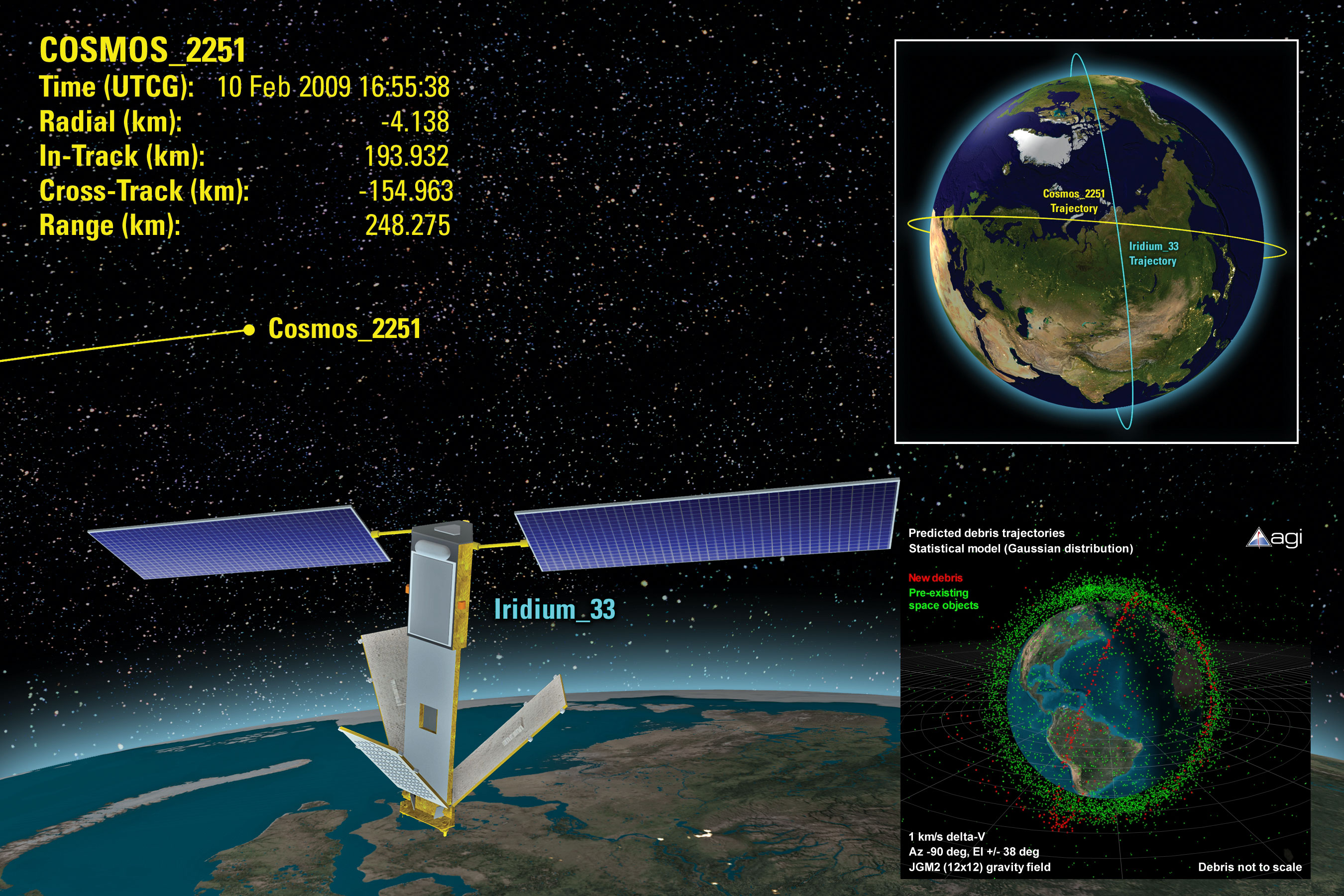
The collision happened at almost a right angle (see this diagram). As I understand it, the two satellites basically exploded into debris. While the center of mass of the cloud is mostly following a new trajectory based on the previous orbits, this cloud is probably expanding quickly in many directions. Many pieces were probably kicked out of the mostly circular orbits into highly elliptical ones, and therefore, could have apogees much higher than their original orbit.
-
Re:A possible shield
"Since the trajectories of the debris will lie in a relatively narrow plane"... I'm not sure this is true. This diagram from NASA suggests the cloud is moving in all directions. Remember, only the geo-stationary satellites are required to have equatorial orbits. Ground-sensing ones need to have inclined orbits, and some are even polar (particularly military).
-
Re:Eleven Years?
The bottom line is that even in LEO there is no mass production system, except perhaps for a single constellation like GPS.
Ahem... Spartan?
The Spartan Project Develops New Carriers
Spartan spacecrafts are designed to provide easy access to Earth orbit via the Space Shuttle for flying science experiments. Spartan uses proven technologies to provide a relatively inexpensive route to space for the scientific community. This is accomplished using basic carriers which, with the addition of a science experiment, become a complete spacecraft capable of fulfilling the science objectives of each mission. Spartan missions support stellar, solar, or Earth fine-pointing experiments, experiments requiring microgravity, and experiments requiring space environments away from the Space Shuttle.
And it was actually flown a few times too...=)
-
Re:Eleven Years?
The bottom line is that even in LEO there is no mass production system, except perhaps for a single constellation like GPS.
Ahem... Spartan?
The Spartan Project Develops New Carriers
Spartan spacecrafts are designed to provide easy access to Earth orbit via the Space Shuttle for flying science experiments. Spartan uses proven technologies to provide a relatively inexpensive route to space for the scientific community. This is accomplished using basic carriers which, with the addition of a science experiment, become a complete spacecraft capable of fulfilling the science objectives of each mission. Spartan missions support stellar, solar, or Earth fine-pointing experiments, experiments requiring microgravity, and experiments requiring space environments away from the Space Shuttle.
And it was actually flown a few times too...=)
-
Re:Include cleaners next time?
The next rover uses an RTG for power, so there won't be a need for wipers or any other such thing:
I guess the radiator portion of the RTG could get enough dust on it to cut down on its effectiveness, but Mars in general is still pretty cold, so I doubt there is nearly as big of an issue as dust on solar panels.
-
Origional source of information here
-
Re:Polluted by life?
-
Re:Pollution?
Any concern about the dense air pollution in NYC getting into the food? Doesn't seem like particularly "organic" food when the plants are feeding on car exhaust and cigarette smoke...
I guess you have to be a NASA scientist to know that plants clean the air. (PDF warning)
-
How about H2 feeders?
You can find a brief description here.
The article suggests that the hydrogen was produced only when rocks crack, meaning that the microbes' food supply was meager and sporadic. Now Freund has discovered a chemical process in Earth's crust that may produce enough hydrogen to feed a mass of underground life larger than the mass of all living things at the surface. "[T]he rocks around them will replenish the hydrogen supplyÃÂ--indefinitely, over eons of time," said Freund.
Talk about a shadow life form. -
Details, details
My much longer summary didn't get used, so I'll pass out some relevant links.
NASA Near Earth Object program: http://neo.jpl.nasa.gov/index.html
Impact risks are within. Pertinent to this article are the size estimates which are based on albedo (visual reflectivity) and so the mass and impact damage estimates.
The UK research team calculated that there should be 300 to 3000 dark comet bodies in system. We know of about 25, so there may be up to 100 times more. Current known Near Earth Asteroids total around 6000, with a similar estimate of ratio of known to unknown (1 : 10 to 100). Thus dark asteroids might be around 1% of total impact threat. It's how easily they're located that's the subject of TFA. We know they exist. Deep Space 1 investigated one of them.
Comets are listed under by the NEO program as Near Earth Comets. TFA stresses that completely outgassed comets may not appear easily in visible light as they would be mostly carbonaceous at the surface and have little coma. These would be pretty much invisible to visible light telescopes which are what are used by the NEO program. They would be more easily detected in the infrared (absorbed visible light has to re-radiate, and does so as heat). Space telescopes such as Spitzer would work great. Figure the odds on getting such devices brought to task when there's more 'important' science to be done.
The mass of these objects would be far less than similarly sized rocky bodies, and they would tend to be smaller overall. Consider a spongey body made of soft, runny (with chunks), powdery carbonaceous materials (including hydrocarbons), light gasses such as methane and some water. Cram that sucker into the atmosphere at miles per second. It will deform and take on the shape of the bow shock. The materials will vaporize and the hot vapor will be forced into the oxygen of the atmosphere. Given the relative softness, there's a good chance such a body will explode as an air burst rather than impact the surface/ocean.
An air burst including rapid oxidation of the material at the bow shock would look much like a fuel/air bomb: rapid expansion followed by implosion due to oxygen depletion. Say, 100 square miles of trees knocked down around ground zero but no visible burning because the burst would be at altitude. No remenants to be found because it all burnt up. Tunguska. Mass estimate 1/3 that of a rocky body.
Fearmongering? Three points:
1. 2008 TC3 was discovered October 6 2008. It was predicted to impact the next day. It did, over Sudan. It happens, several times a century, and now we know we can predict them correctly.
2. Dark cometary bodies would be harder to detect, with larger bodies being discovered only this early, if at all. If limited to ground based telescopes, the 'if at all' applies.
3. Impact risks are calculated per body. As more are detected, total known impact risk grows. Sum down the 4th column (cumulative impact risk) of the tables at http://neo.jpl.nasa.gov/index.html to get the total cumulative impact risk over the next 100 years for the bodies presently known. As a rough estimate, multiply by 10 to include the bodies not yet detected.It occurs to me that an individual might be responsible for causing an auto accident several times during their life time. Call it 'several times per century'. The risk is similar to that of an impact by a near earth object. If the combined cumulative impact risk estimate is, in your estimation, inconsequential, put your money where your math is -- drive around without insurance.
-
Details, details
My much longer summary didn't get used, so I'll pass out some relevant links.
NASA Near Earth Object program: http://neo.jpl.nasa.gov/index.html
Impact risks are within. Pertinent to this article are the size estimates which are based on albedo (visual reflectivity) and so the mass and impact damage estimates.
The UK research team calculated that there should be 300 to 3000 dark comet bodies in system. We know of about 25, so there may be up to 100 times more. Current known Near Earth Asteroids total around 6000, with a similar estimate of ratio of known to unknown (1 : 10 to 100). Thus dark asteroids might be around 1% of total impact threat. It's how easily they're located that's the subject of TFA. We know they exist. Deep Space 1 investigated one of them.
Comets are listed under by the NEO program as Near Earth Comets. TFA stresses that completely outgassed comets may not appear easily in visible light as they would be mostly carbonaceous at the surface and have little coma. These would be pretty much invisible to visible light telescopes which are what are used by the NEO program. They would be more easily detected in the infrared (absorbed visible light has to re-radiate, and does so as heat). Space telescopes such as Spitzer would work great. Figure the odds on getting such devices brought to task when there's more 'important' science to be done.
The mass of these objects would be far less than similarly sized rocky bodies, and they would tend to be smaller overall. Consider a spongey body made of soft, runny (with chunks), powdery carbonaceous materials (including hydrocarbons), light gasses such as methane and some water. Cram that sucker into the atmosphere at miles per second. It will deform and take on the shape of the bow shock. The materials will vaporize and the hot vapor will be forced into the oxygen of the atmosphere. Given the relative softness, there's a good chance such a body will explode as an air burst rather than impact the surface/ocean.
An air burst including rapid oxidation of the material at the bow shock would look much like a fuel/air bomb: rapid expansion followed by implosion due to oxygen depletion. Say, 100 square miles of trees knocked down around ground zero but no visible burning because the burst would be at altitude. No remenants to be found because it all burnt up. Tunguska. Mass estimate 1/3 that of a rocky body.
Fearmongering? Three points:
1. 2008 TC3 was discovered October 6 2008. It was predicted to impact the next day. It did, over Sudan. It happens, several times a century, and now we know we can predict them correctly.
2. Dark cometary bodies would be harder to detect, with larger bodies being discovered only this early, if at all. If limited to ground based telescopes, the 'if at all' applies.
3. Impact risks are calculated per body. As more are detected, total known impact risk grows. Sum down the 4th column (cumulative impact risk) of the tables at http://neo.jpl.nasa.gov/index.html to get the total cumulative impact risk over the next 100 years for the bodies presently known. As a rough estimate, multiply by 10 to include the bodies not yet detected.It occurs to me that an individual might be responsible for causing an auto accident several times during their life time. Call it 'several times per century'. The risk is similar to that of an impact by a near earth object. If the combined cumulative impact risk estimate is, in your estimation, inconsequential, put your money where your math is -- drive around without insurance.
-
I almost missed it
I got a screen capture but I almost missed it because I was thinking about the epoch in the scene on my background image. That is Apollo 17, Station 6 at about 91918279.
-
Re:both, plus Venus and Pluto
If you mean "we" humans, there were ten Soviet landers - 8 Venera, 2 Vega. Most lasted at least half an hour, some almost 2 hours.
http://nssdc.gsfc.nasa.gov/planetary/chronology_venus.html
The Unites States never attempted a landing, though one mission did send several probes into the atmosphere (they landed in the sense that a meteorite lands, but that's not what you meant).
Oh, someone re-processed the images, using modern computer technology. A great improvement over the very limited techniques of the time, they're pretty amazing:
-
Re:Both?
Except they are in opposite directions right now. http://space.jpl.nasa.gov/
-
Re:WHAT ??
Fascinating and sad.
Titan pic -
Interesting Mission ConceptsBoth the Europa and Titan mission would be very exciting missions. The Titan mission is a bit more ambitious though, with a NASA-built Titan orbiter that would map the surface at 50 meters per pixel (so not quite Google Earth resolution, but enough to define the major geologic processes that take place on Titan) and an Europe-built hot-air balloon and lander. The latter would land in the largest expanse of open liquid (methane instead of water) known outside of Earth.
The Europa mission is a bit more tame by comparison, but has a lot more technological development to back it up (which would help it come in somewhere close to its original budget). There are two orbiters. The NASA-built orbiter would explore the inner two large moons of Jupiter: Io and Europa; while the ESA-built orbiter would explore the outer two large satellites: Ganymede and Callisto. Unlike the Titan mission, no landers are planned with this mission, but the instruments on-board both spacecraft would allow it to provide more detailed global mapping of Europa and Ganymede than the Titan mission, which as mentioned before would only provide 50-m per pixel global mapping with selected areas at higher resolution imaged by the balloon (which would be limited to a relatively narrow latitude band since Titan's winds are mostly east-west).
The NASA-JPL website has a page with more detailed documents outlining the mission plans for each moon: http://opfm.jpl.nasa.gov/library/
-
Re:James Webb == Hubble Replacement
The article linked to showed the size comparison for the James Webb Space Telescope, and its spectral range vs. Hubble (further into IR, but also further into the visible spectrum)
No no -- not further into the visible than Hubble. The Hubble spectral range from that figure was for the NICMOS (infrared) camera only. It ignored all other Hubble instruments from far-ultraviolet through visible light!
By and large, the original assertion was correct -- Hubble's emphasis was on UV, visible and near-infrared wavelengths. Most of the "pretty pictures" came from the visible light cameras. James Webb will be a large telescope optimized for near/mid infrared observations, with some capability at the red end of the visible spectrum. Herschel is optimized for far-infrared and submillimeter wavelengths.
All three observatories are hugely significant and will give us very different views of the Universe.
-
Re:Cant wait
In addition to that, the JWST will feature a micro-shutter array, composed of over 62,000 individual shutters in the area of a postage stamp. The idea is that each shutter can be independently opened and closed so visible light from near, bright objects can be blocked out making it easier to view objects that are further away.
I had the opportunity to tour the clean room at Goddard Space Flight Center where the array is being fabricated. The techniques used seemed to mirror the techniques used to manufacture modern microprocessors. It was very interesting to be guided through the process, there are definitely some incredibly smart people at Goddard.
Here is some more information and pictures of the array.
-
James Webb == Hubble Replacement
There aren't any plans?
The article linked to showed the size comparison for the James Webb Space Telescope, and its spectral range vs. Hubble (further into IR, but also further into the visible spectrum)
-
Re:Infrared?
If it's in infrared, then it's NOT a Hubble replacement, it's a Spitzer replacement.
Isn't that David Paterson?
-
Infrared?
If it's in infrared, then it's NOT a Hubble replacement, it's a Spitzer replacement.
-
Re:So what about global warming ?
Correct me if I'm wrong (I'm not sure - some of them may be available)
Since you asked:
http://www.giss.nasa.gov/tools/modelE/
http://www.ccsm.ucar.edu/tools/
and some documentation with output (for reverse engineers
http://www-pcmdi.llnl.gov/ipcc/model_documentation/ipcc_model_documentation.php
I believe some grants/universities do forbid open sourcing code, or even making it available, at least fro some time. -
Related to the Maunder Minimum ?
The cold winter in 1709 was towards the tail-end of the "Maunder Minimum" in sunspots and solar activity. Given that sunspot numbers are again unusually low, maybe it will happen again.
-
Related to the Maunder Minimum ?
The cold winter in 1709 was towards the tail-end of the "Maunder Minimum" in sunspots and solar activity. Given that sunspot numbers are again unusually low, maybe it will happen again.
-
NASA: Worldwind
Nasa's Worldwind is an open source tool that has the same functionality, plus access to local plats as well. Despite the fact that I genuinely like google earth, I have found for most puposes I actually prefer Worldwind.
Currently windows only, and I have not tried it under Wine. The next version is being done in java and I presume should be cross platform.
Pug
-
Re:I'm more angry...
-
Re:It's my computer
Alternative: NASA's World Wind http://worldwind.arc.nasa.gov/
-
Link to Nasa
Here's a link to Nasa site about axel robot
http://www.nasa.gov/multimedia/podcasting/jpl-axel20090104.htmlIt seems to me it will never climb steep up hill.
-
Re:
IANANE (I Am Not A NASA Engineer) but, IMHO, it will be powered by using the tether as a power cord, using stationary rover's solar cells, who stays on the edge of the crater (not sure about mountains...), as in the image: http://www-robotics.jpl.nasa.gov/systems/systemImage.cfm?System=16&Image=414 Or maybe rechargeable batteries and periodical recharging from the main rover ?
-
Video
-
Re:Power Source?
IANANE (I Am Not A NASA Engineer) but, IMHO, it will be powered by using the tether as a power cord, using stationary rover's solar cells, who stays on the edge of the crater (not sure about mountains...), as in the image:
http://www-robotics.jpl.nasa.gov/systems/systemImage.cfm?System=16&Image=414Or maybe rechargeable batteries and periodical recharging from the main rover ?
-
NASA link
NASA's write-up with pics.
-
Just tell them somewhere where you -aren't-
The ISS is only 240 miles up. The astronauts can only see a small amount of Earth's surface at any given time. This was mentioned once on Astronomy Cast - which I highly recommend, and you can get it straight from the horse's mouth here:
http://spaceflight.nasa.gov/station/crew/exp7/luletters/lu_letter5.html -
Embarassing project
This project is embarrassing. It took five college seniors ("Wireless and Telecommunications Technology" majors, no less) a whole year to build and use a pointable ham VHF antenna comparable to a fringe-area TV antenna. That's all they built; the transceiver was a stock ICOM Ic-V8000, which is a ham mobile radio that's basically a CB radio with higher power (75W) and fewer restrictions built in. This is not exotic technology. NASA has a program devoted to doing this in high schools.
From their blog, the only big problem was getting permission to go on the roof of a building (a large flat roof) to put up the antenna. If they'd just headed out to an open field (they're using a radio intended for car installation, after all), mounted the antenna on a tripod, and aimed it by hand, they probably could have completed the project in a week.
Hams talk to the ISS all the time. When it's visible, it's only a few hundred miles away, after all. The only real problem is booking some astronaut time. If you don't want to bother with that, the ISS has an open packet repeater hams can use. It's only 9600 baud, using an old TNC. This technology is so old it was on Mir.
Their blog is like reading Twitter output:
Of course, we've been busy for real lately. There's a whole bunch of new stuff going on. Exciting stuff! For instance, we soldered the connectors to the control wires for our antenna's rotor. After all that was said and done, we were able to control the movement of our antenna from inside room N214. Here's a few pictures of us working on that.