Slashdot Mirror
Domain: nationalpriorities.org
Stories and comments across the archive that link to nationalpriorities.org.
Comments · 157
-
Re:Most taxes are legalized theft
-
Re:It's not going to work
It would cost no more than current systems
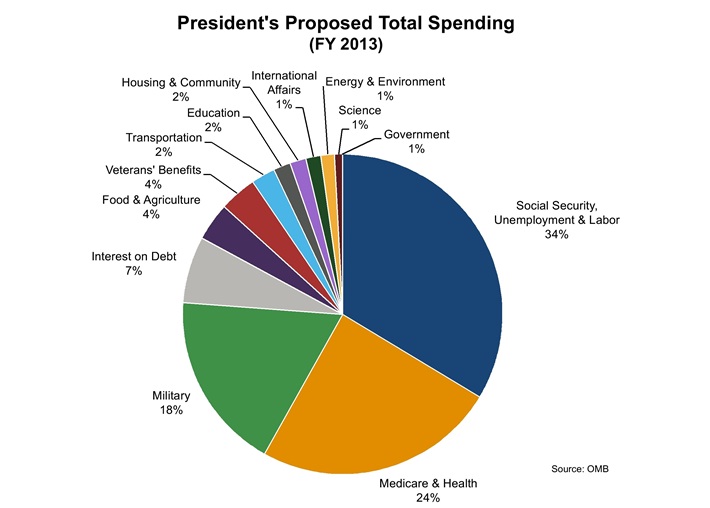
This is factually incorrect. Even assuming single payer medical care is done separately and paid for all the welfare in the US a generous (Obama's)probable discretionary budget generously proportioned (assume 100% of labor, agriculture, housing, veterans benefits, and internal affairs budget go to welfare) gives 320 billion to welfare. Divided by the population of the US that's a little over $1000 per person. Now add mandatory spending (the above link includes this information) and assume 100% of food and social security spending counts as welfare, again divide by the population of the US. That's about $4400 per person. Total: $5400 per person and that assumes not a cent is needed for program administration. Your proposed amount of basic income comes to $450 per person, per month. If you want that to rise to a number people can live on you're going to have to significantly raise taxes or print 33 to 50 percent more money.
Given the percentage of people who cannot be profitably employed today and given the rate at which technology is increasing that percentage I believe basic income is an absolute necessity. But we need to be realistic at how much it costs and create a realistic plan for implementing it. -
Re:normally id be all for this.
We might spend more money on defense than other countries (which happens to be the most important part of our budget, though I'm not saying it's not a tad large), but it helps to look at the budget as a whole. Only 16% of the said budget is spent on defense. Our problem is that the whole pie is too big ($3,900,000,000,000 or $3.9 Trillion).
-
Re:Good!
Of course, I'm sure we could afford to pave all of our roads with gold, have diamond-studded bike lanes, and solid titanium sidewalks if we didn't spend half our budget on wars, but hey, I'm not holding my breath.
We don't come anywhere close to spending "half our budget on wars." The military (plus veterans' benefits) only accounts for about 22% of total federal spending.
-
Re:Welcome to the New Oligarchy
[citation needed]
Corporate income taxes are expected to account for 13% of federal revenue in 2015, and it has been growing under Obama. Aside from a spike (or arch) under Bush around 2005, this is the highest it has been since 1979. When FDR took office, the number was about 12%. http://nationalpriorities.org/...
-
Re:Here is a thought..
So, you think your projections are better, or more informed?
More informed? Perhaps not, but definitely better. From that link (to a March 2010 story) I wrote the following:
What's really ugly about this is that the CBO is on Obama's side (via Democrat control of Congress). It's likely that the CBO has had to make a number of rosy assumptions (like accepting the administration's claim that war costs will drop to $50 billion per year over the long term) that lessen the estimated size of the deficits.
Googling around it appears that the cost of funding the wars in Afghanistan and Iraq is just shy of $100 billion.
Also, compare the CBO's 2010 projection to its 2009 projection. The deficits for FY 2010 and 2011 have increased substantially. That isn't GWB's fault.
At this point, I'm betting that we won't see an Obama budget with a deficit below a trillion dollars and the relatively low figures for 2012-2015 will turn out to be completely unrealistic without some serious budget cutting or an extremely vigorous economy.The 2012-2013 fiscal year didn't look so bad with a deficit about $140 billion greater than projections, but I was right on the previous two fiscal years. We'll see about the next two years.
For remarks, I don't see significant spending reductions or tax increases for the next couple of years. In addition, I think increased war spending (both Iraq and Afghanistan are getting a bit worse at this point) and Obamacare (the considerable health insurance subsidy and revenue reduction due to turmoil from the employer mandate) will load the deficit.
Obamacare is a big uncertainty for me at the moment. Currently, I believe it will fail hard, but over what time frame remains to be seen. I'm leaning towards 10 years before the problems get bad enough that the law is completely changed (not necessarily in a good way) rather than just incrementally fixed. -
Re:nice
HAHAHAHAHA!
Nope.
But this year they did spend another $8.1 billion dollars. Or as of May 2011 it was $835.9 billion. Or about $281 million dollars for each person who died in the 9/11 attacks. That doesn't include the defense budget used to bomb the shit out of the middle east.
$8.1 billion, and the only thing I've gotten out of it was felt up at the airport. And I didn't even get a "happy ending" with it... Come on, they make the privacy rooms for a reason, do it right.
-
Re:Roads don't build themselves.
Back in the 50's-80's the Federal Government somehow built a large network of roads called Highways boosting the economy for a minimal increase in taxes. Look at this graph: http://nationalpriorities.org/tools/taxday/breakdown-one-dollar/
You see the very first big bar? That could easily be cut down to 1/4 or 1/8 (the UK, the next largest military spender spends 1/10th of this per capita) without affecting actual defensive measures. Since the 60's the spending has doubled (inflation adjusted) and over the last decade the interest over the debt incurred on those figures are going up exponentially. And that's not including Iraq and Afghanistan which Bush (and the big O hasn't fixed it either) decided to cut out of the public numbers a couple of years ago. -
Re:some ideas Re:I agreeOk, I'm quoting the original points here for reference. By the way, I find it somewhat 'ironic' that the UK parliament is used as an example of a 'modern' democratic system when the US system was based upon the UK parliament.
1 get rid of a lot the states powers,
2 the parties need to get party discipline and throw out the "nutters".
3 have strict uk style election campaign limits
4 replace the vast expenditure on tv campaigning with uk model of party political broadcasts.
5 have more equal constituency sizes (which will stop small agricultural states leaching of the bigger ones)
6 force all organizations (Unions and Company) to run a political fund for any lobbying and have it confirmed by vote every 7 years with opt out allowed)(1) would require an amendment to the US constitution. The powers of the Federal Government are spelled out and those not explicitly spelled out are supposed to be reserved to the states. A general way to think about the US is 50 different countries, each with their own president government and constitution, with a common limited government superior to them to make sure they get along. To take more power away from the states and give it to the Federal Government, you'd have to amend the constitution.
(2) Easily done, but seems to misinterpret US elections. The parties could get rid of the 'nutters' (although who are the nuts depends on who you are) but that doesn't prevent the nutters from getting elected. The US doesn't vote for parties, it explicitly votes for individuals. One party or another can back an individual, but it's not required and on election day you're voting for a person, not a party.
(3) Probably some issues with our 1st amendment and prevention of individuals from running campaign adds. The US has a very broad definition of Freedom of Speech that is basically unheard of anywhere else in the world.
(4) See (2), basically the same reason of voting for an individual instead of a party.
(5) We would have to change how elector's districts are divided up and this would require an amendment of Article 1 Section 2. The electors are apportioned among the states, but no state can receive less than one. In order to have 'more equal' distribution, you would have to have one person representing people in multiple states. Also, I'm not necessarily sure of the point behind it. The parent pokes at "small agricultural states" receiving a disproportionate share of Federal Dollars. Well, see here. The agricultural states are (usually) the ones getting less back in dollars than they pay in taxes. The smallest one is Wyoming and it gets 84 cents back out of every dollar it pays in taxes. It looks like we do not have this as a problem.
(6) May actually be possible, but I'd like to know why "every 7 years" was chosen instead of something more often or less often.I'm still genuinely curious. Is your constitution based on voting for individuals, not political principles? Don't regard this as an attack, but I'd appreciate a short explanation
I answered this above without realizing you had asked this at the end of your post. I don't take it as an attack. The answer is yes and I realize the US is very much in the minority when it comes to this. Although, I wonder if you mean "political parties" instead of "political principles". The only time I know of when we don't vote for an individual, we are voting for a pair of individuals (President and Vice President). The President and Vice President are elected as a pair, one running for President and the other for Vice President. On no ballot I know of will you find Party X or Party Y except as a subheading under an individual who we are voting for. We also vote for a lot of things all the way down to Dog Catcher in some areas (no joke).
-
Re:It is just PR...
I read the reasoning and much of it was infrastructure rather than it not being there or straight out infeasible in all instances. China will swoop in sometime (not necessarily waiting until we leave) and invest in the good mines, as they are doing all over Africa and other parts of the world while our government is investing in failed banks and overunionized industries.
I don't see this as a bad thing, China is growing and they'll need copper from somewhere. And I don't think it's cost effective to keep the military there, what are we spending on Afghan will exceed $72B so that's 15 years max at the estimates.... and extracting that stuff isn't free nor is it ours.
-
Re:Spending is the goal
Government doesn't expand in terms of power and revenue because it's getting better, it expands because the economy is expanding.
http://www.nationalpriorities.org/Federal%20outlays%20and%20revenues
-
Re:because its too hard
Let's look at estimates on what we've pissed away on war
$1.05 trillion dollars total http://www.nationalpriorities.org/costofwar_home
$704 billion for Iraq http://en.wikipedia.org/wiki/Financial_cost_of_the_Iraq_War
$300 billion for Afghanistan http://www.usatoday.com/news/washington/2009-12-02-war-costs_N.htm
Now if we had a trillion dollars put into laying fiber to homes I'm pretty certain everyone could have fiber to the door, we wouldn't have pissed off a whole region that is likely to try and pay us back, we wouldn't have thrown away so many young lives and once again the US could out do other countries at something other than expanding waist sizes.
We managed to get electricity and phone lines to virtually everyone. Hell I knew people that couldn't even get proper plumbing, relying on the gravity of water coming down a mountain but they had a phone line. A lot of this was kicked off before we were the richest nation.
We can thank the government for this too due to the communications act of 1934. http://en.wikipedia.org/wiki/Universal_Service_Fund#Communications_Act_of_1934
As someone who has lived in a rural area (though actually not that far at all from two largish towns), I know full well the phone companies pretty much despise helping but do it because they have to. You can debate all you want about whether it is correct for the government to do that but do you honestly think we would be better off leaving huge chunks of the US in the stone age?
Even in the days before wide spread broadband, we had enough people in our area to get cable run back to the area but naturally companies weren't very helpful despite the fact some people were even willing to do something of the physical labor to get the cable back there. So it's not even like we're giving the opportunity to allow rural people to do it on their own.
Those populations might not be as dense as large cities but remember it's those areas with thinner populations providing most of the food for you. It would be unwise to leave farmers in the stone age because it would holding farming back and you would end up with a situation, like the Amish, where increasingly the youth get envious of those who have and move away from farming and we'd possibly be more dependant on other nations for food. It's bad enough oil countries have us by the balls. Would we really want to be held at ransom over food? -
Re:Taxes, taxes, taxes
You are incorrect. Most American bases now are no longer built directly by the military, but on cost-plus contracts by companies like KBR and Bechtel, who also provide the administrative personnel (who do things like cook and clean). This is war profiteering (as is the very idea of a cost-plus contract). Our soldiers are grossly underpaid for what they go through, and I've never met one who suggests that military action helps his own bottom line.
You are also under the misapprehension that we spend much money on things like "welfare" (do you include social security? medicare? WIC, which feeds poor children, is probably the closest thing that actually exists to what you probably mean, and its line item is around $4 billion, which is money paid to American farmers) or on unions. Setting aside your ignorance of the importance of unions, they do not actually receive money from the government. The closest thing you could point to is the bailout of GM, which helps GM's do-nothing douchebag fatcat managerial staff and shareholders more than anything else. (Most of the union expenditures at GM are actually going to provide medical care for retirees. You want to take away grandpa's health care?)
By contrast, Iraq and Afghanistan alone will cost over $1 trillion by 2010. (source) That doesn't take into account the Pentagon's normal operating budget, and it'd pay for about 250 years' worth of WIC...
-
Re:They are NOT Denying Global Warming
For the first time in 6 years the Iraq war is INCLUDED in the budget. Part of that 1.8 trillion dollars is the war that George Bush kept off the books the whole time he was in office.
TRY AGAIN
Do you have a citation? I do. It's the same site listed above, which is an anti-war site, btw.
To date, $915.1 billion dollars have been allocated to the wars in Iraq and Afghanistan. The national, state, and local numbers we provide are based on the total approved amounts through the end of Fiscal Year 2009.
In addition to this approved amount, the FY2010 budget shows a $130 billion request for more war spending. This would bring total war spending in Iraq and Afghanistan to more than $1 trillion. When all FY2010 war-related amounts are approved, we will adjust the counter so that it reaches the new total at the end of FY2010.
If you should compare the amount displayed on the numbers in our information sheets with the Cost of War counter, please note that the information sheets include all war spending approved to date, the same number that the counter will reach at the end of the 2009 fiscal year.
Looks like they are including what was in the budget.
Here's another one from the LA Times:
If Congress approves a request for another $87 billion, the Iraq war will have cost about $694 billion.
Here is a quote from another anti-war site. The title is Iraq War: The Cost of Bush Lies and His Influence of Not Being Accountable
$800 billion through mid-2009 in U.S. taxpayer money
Sorry. Either you're wrong or everyone else is.
-
Re:They are NOT Denying Global Warming
People whine about Obama spending a trillion dollars to bail out the American economy, when we've spent three times that much bailing out Iraq socially, and it hasn't worked; it just makes no sense to me.
BZZZZT! Wrong!
From HERE:
To date, $915.1 billion dollars have been allocated to the wars in Iraq and Afghanistan.
And from HERE:
The White House raised the 2009 budget deficit projection to a staggering $1.8 trillion today. For context, it took President Bush more than seven years to accumulate $1.8 trillion in debt.
So, let's see. $915 billion (Iraq war) is less than $1.8 trillion (Obama deficit). So you were off by 6X.
How can we take you seriously when you can't get your facts straight. Hell, you weren't even close.
-
Re:Am I missing something?
While I am typing this, the Iraq war has cost, in dollars, $590,785,085,624.
Which is considerably less than the $825 billion Obama stimulus package.
Almost 6 years of war (of which I spent 1 in Iraq), we will have spent less than the Obama Stimulus Package.
Did you ever wonder why South American countries hated us because of the Iraq war? I'm not sure why they would care...Maybe its because Central America received $46mil in 2003 when the war started, then it dropped to $20mil the next year.... and to $19mil the next. Uh ohes, the US isn't giving us our welfare check! Damn Bush and his Iraq War! Western Europe went from $60mil/year to $31mil/year from 2003 to 2006. Sad fucking face.
Of course France and Russia were making dolladollabills selling weapons for oil to the Iraqis under the table...undermining the entire UN Oil For Food program. They, of course, then take the high road by announcing their disdain for the war.
Don't get me wrong dude, Iraq was a bad idea from the beginning. Bush was betting on WMD, and he was wrong. He had good reason though, we prolly have merchant copies of the receipts somewhere. But for most of Americans, this war had ZERO impact on them...I see people enjoying SUV's, movies, restaurants, buying useless bullshit at Christmas...just like they always have. While I was in Iraq, you kept living your lives....just like you should.
And like I said, the withdrawal deal was signed months before the messiah took office. why not give him credit for the WWI armistice?
-
Re:Bad economics
You actually contradict yourself, and reality, quite a bit.
If you have a corporation, you use that corporation as a tax shelter. The higher the tax on your income, the less you will claim as an official salary from your company.
which means....higher wagesYou claim to increase your wages by decreasing your wages. Nice logic.
In truth, a small business owner will probably seek to shift their personal rewards to a more tax-advantageous status, like claiming part of the home as an office, handing over the car payment to the business, and structuring part of their income as a pre-tax benefit, like retirement investments and a medical expense account.
Or, probably more likely, they'll just decide that the tall demands of running a small business aren't worth the reward once Uncle Sam gets finished picking their pocket, and will fire the employees, sell off the assets and go work 9-5 for someone else.
In truth, you're not talking about a large-corporation executive who makes 1 million USD+/year, you're talking about a person who directly owns an S-corp with a dozen employees or fewer, and who's personal income appears, to the tax code, to be $150,000 - 800,000, even though this is actually operating income, which has little to do with his/her own personal wealth or cash flow.
This notion you have of who is wealthy and who is not has a couple of major problems. First off, people who own small businesses represent the bulk of people who the tax code considers to be earning between $200,000 and $800,000. Their real lifestyle, however, is middle-class professional, and is equivalent to a family making significantly less. Taxing these people, therefore, pulls the rug out from under your local landscaper, independent contractor, or dentist. And, what they'll turn around and do is fire people and contract their businesses because they can't afford to continue.
Second, of course, is that in the background, you assume to know what a "fair" level of income is and is not. I don't think you're qualified.
You then go on to claim that business owners who pay more federal income tax get it right back in the form of infrastructure improvements.
Tell that to the good people of Minnesota, who get only 19 cents of returning investment for every dollar they pay in federal tax. In fact, 31 out of the 50 states get back LESS than they send to Washington.
http://www.nationalpriorities.org/Publications/What-Came-to-Your-State-in-2005.htmlWhen you consider where tax money goes (mostly social security, medicare and defense), you'll see the flaw in your reasoning. It can't possibly be spent $1 for $1 to improve ANYTHING. Due to bureauocracy and centrally-planned objectives, government entities spend money less efficiently than anyone else to begin with!
You continue, claiming that investment in small business caused by high personal tax rates creates more credit for everyone.
Huh?
If I own a landscaping business, how exactly does my buying a new core aerator create credit for everyone? It doesn't. You're confusing stock purchasing and venture capital with basic capital expenditures. To borrow a phrase, I don't know one competent business person who would do that.The trouble we have is that no one IS saving. So claiming you have to take money away from people who are hoarding it is silly, because no one IS hoarding money.
Your entire post bases from one grand assumption: Someone, somewhere, is sitting on a pile of cash like Tiamat sits on a pile of gold. The problem is, it's not true in the slightest. This entire ride-up has been driven by negative saving. That's right, we - as individual citizens - have run the economy up by spending faster than we can make money or, recently, even hope to repay it. There must eventually be a reckoning, and that is now. People stopped spending because they finally hit the consequences of living beyond their means. Now, we must live beneath our means for a while....and it's quite a swing.
-
VERY x POWER OF A TOTALLY STUPID NUMBER ###### UP!
I see... land mines, nuclear missiles, a variety of air strike abilities including cruise missiles, the floating nuclear reactors and their strike power... not enough. They need to eliminate those black privates from the battle field so that their mums don't protest. What year are we going to learn the lesson! American Military Machine has pushed the country to the point of bankruptcy. That's not enough for them they need to make war doable and efficient. Increase the cost of hardware and line their own pockets. What OS are they going to run? Windows? Or something more 'friendly' a Mac OS. I think maybe a Mac OS and if they malfunction and a bomb comes up on the screen, they can then explode. You can't develop or manufacture weapons without the participation of people. If you put all the resources spent internationally into a creative field we would be living in heaven on Earth. The cost of war is never calculated to include the opportunities lost. http://www.nationalpriorities.org/costofwar_home The War in Iraq Costs $574,500,000,000 and counting. At a guess since WW2 we must be talking $20,000,000,000,000 or some other totally stupid number. This is an investment with a nil return. The same cash put into something that generated a true return wouldn't be lost to the system but expand our wealth on Earth. American's might have free heath care. Australia might have retained its leading scientists, education would be free to every nation, fusion reactors deployed... What has been lost is truly unknown we can only say that it is greater than a totally stupid number X compound interest. IE we have lost the opportunity for heaven on Earth for generations to come. How ###### up is that! VERY x POWER OF A TOTALLY STUPID NUMBER ###### UP! Yani
-
Re:Sadly philanthropy isn't profitable.
Well, since you mentioned, here are, imho, the problems with each of your alternatives:
1) Pass on the money while they still live, giving gifts to family/friends under the tax limits each year for many years.
This alternative invalidates your alternative #4. In fact, it is exactly what my grandfather did before he passed away in order to avoid inheritance tax: he transfered what he had to the name of his children. Of course then the children would have to register that income and pay taxes over that. But their tax bracket would be much lower than your proposed 90% tax. What, you think you could place limits on how much he could transfer? Watch Mickey Blue Eyes.
2) Pass on the money while they still live, giving it to charity with no limits.
Well, this point is really number (3) below. Except it happens before you die.
3) Allow the money to go to charity when they die, with no limits.
How fair or efficient is that? You could be perpetuating a rich person's eccentricity. In fact, just recently there was a very interesting debate around a rich woman who donated millions of her money to a charity to support... her dog! (see Rich Bitch). Her white maltese (called "Trouble") will get her own, tax-free, trust fund.
4) Have the government take most of it.
Would be a good idea, if the government were such a perfect agent for our society's welfare. Do you really trust the government to spend that money well? Think US$700bn, think US$25bn, think of the cost of the Iraq War. Then think about how much ($20k, $100k?) you parents will be leaving for you.
If you think your parents would leave a larger sum, you may have less to worry. As Warren Buffet, the 3rd richest man in the world, told us about, the tax system tends to be lighter on the rich.... The rich often pay less taxes, have good lawyers, creative accountants, resourceful private bankers...
A favorite Murphy Law states: Hard Problems have solutions that are simple, elegant, and wrong. But I am with you: it should be discussed...
-
Copied from another thread, but...
... had I known this thread would have come up, I would have posted it here.
The war in Iraq has cost America, at the time of writing, approximately 566 billion dollars.
The entire Apollo project, $25.4 Billion in 1969 dollars (or approximately $135 Billion in 2005 dollars.) Sources = (http://en.wikipedia.org/wiki/Apollo_program, http://www.nationalpriorities.org/costofwar_home [nationalpriorities.org])
So what I'm saying is, for the cost of the War in Iraq, America could have over four complete moon programs. Not moon missions, mind, four complete *programs*- built entirely from scratch.
Let's say NASA take one moon mission to *actually* return to the moon properly- with return trips, flybys, dozens of manned and unmanned missions, reuse of the hardware for other projects, etc. See http://en.wikipedia.org/wiki/List_of_Apollo_missions [wikipedia.org] for what this one single "mission" is buying, and remember that still leaves three whole other missions and change to do other things.
Let's spend two missions on doing all of the above, but for Mars. That means multiple manned missions, return journeys, the works. Give Mars the full lunar "One small step for man" treatment and assume it costs twice as much (and takes a lot longer).
We still have one mission left. Let's do something crazy with it- and I'm open to suggestions here. Permanent lunar settlement? Completely and utterly explore our planet's oceans (which we know less about than space, BTW...)? Solar-system wide Internet? (Aliens need lolcats too..)
This is what I meant by more funding. I mean to say that NASA, which has endured endless budget cuts since the 60's (which, I'll concede, have forged a more efficient government agency), deserves far, far, far more of America's money. America's money which is being horrifically misspent.
Essentially, what I'm trying to say is... yes, it's inefficient. Horribly so. So? Throw money at it. I'll say it again- THROW MONEY AT IT. The capslock shows I'm serious. NASA is one of the few (read- the only) organisation I'll say this about, but... throw money at it. Seriously. For the cost of the Iraq war, we could have had so much.
-
Re:From another Australian
Very well.
The war in Iraq has cost America, at the time of writing, approximately 566 billion dollars.
The entire Apollo project, $25.4 Billion in 1969 dollars (or approximately $135 Billion in 2005 dollars.) Sources = (http://en.wikipedia.org/wiki/Apollo_program, http://www.nationalpriorities.org/costofwar_home)
So what I'm saying is, for the cost of the War in Iraq, America could have over four complete moon programs. Not moon missions, mind, four complete *programs*- built entirely from scratch.
Let's say NASA take one moon mission to *actually* return to the moon properly- with return trips, flybys, dozens of manned and unmanned missions, reuse of the hardware for other projects, etc. See http://en.wikipedia.org/wiki/List_of_Apollo_missions for what this one single "mission" is buying, and remember that still leaves three whole other missions and change to do other things.
Let's spend two missions on doing all of the above, but for Mars. That means multiple manned missions, return journeys, the works. Give Mars the full lunar "One small step for man" treatment and assume it costs twice as much (and takes a lot longer).
We still have one mission left. Let's do something crazy with it- and I'm open to suggestions here. Permanent lunar settlement? Completely and utterly explore our planet's oceans (which we know less about than space, BTW...)? Solar-system wide Internet? (Aliens need lolcats too..)
This is what I meant by more funding. I mean to say that NASA, which has endured endless budget cuts since the 60's (which, I'll concede, have forged a more efficient government agency), deserves far, far, far more of America's money. America's money which is being horrifically misspent.
Essentially, what I'm trying to say is... yes, it's inefficient. Horribly so. So? Throw money at it. I'll say it again- THROW MONEY AT IT. The capslock shows I'm serious. NASA is one of the few (read- the only) organisation I'll say this about, but... throw money at it. Seriously. For the cost of the Iraq war, we could have had so much.
-
Re:$29 Million?
you could fight a war in Iraq for about 2.5 hours http://www.nationalpriorities.org/costofwar_home
-
Re: electoral college
Who's talking about pork? I'm talking about bipartisan agreement in favor of retarded policies because our method of electing a president gives priority to the local issues in states where the partisan split is close to 50-50.
Also, when has California not paid its "fair share"? According to this website, California gets $0.92 for every dollar it pays in taxes. -
Re:I use a more sophisticated strategy...
Well, land reclamation would be the simple obvious answer for New Orleans to preclude the recurrence of such devastating flooding, but it looks like we just don't have the money for such niceties.
-
Re:I'll admit, I'm a bit confused
Liberals, meet liberalism. It costs money
It seems to me that Conservatism also costs money.....
And before you go and whine that Bush and the GOP aren't real "Conservatives" that's what they are passing themselves off as and they are getting the lions share of the support from people who fashion themselves as Conservatives. Where were the Conservatives when Ron Paul needed the support during the primaries?
-
Less than 1 Day in Iraq
This is less than what 1 day in Bush's Iraq War. http://www.nationalpriorities.org/costofwar_home
-
Re:CriticsAre you kidding me? Could you imagine the infrastructure cost of a Chicago-LA maglev? Even at a relatively conservative $10M/mile, that's $20B. And at 300mph it would still take almost 7 hours.
If $20B is ridiculous, we must really be kidding about things that cost $500B, right? Let's think of an example. Just a minute...oh yes it just came to me: http://www.nationalpriorities.org/costofwar_home
You must be kidding me! What kind of irresponsible bureaucrat pays $500B for something?
-
Re:ummm... No.Sorry but that report says no such thing. And your reasoning is wrong.
Then you're not looking at the report. Please see table 35 - page 16 of the PDF. And in fact - since it's obvious you didn't read the report - here's the paragraph describing the table:
The per-unit subsidies are calculated as the subsidies allocated to each fuel type divided by the FY 2007 electricity generated by each fuel type (Table 35). Refined-coal-related generation receives the largest subsidy in absolute terms, at roughly $2 billion, as well as the highest perunit value at $29.81 per megawatthour. Renewable electricity production, in aggregate, received subsidies totaling $1.0 billion, but the per-unit subsidy in aggregate is $2.80 per megawatthour. On a fuel-specific basis, solar and wind subsidies receive the second-and-third highest per unit subsidies. However, the total value of subsidies received by each of these technologies was roughly in proportion to their relative share of net generation. As, a result, their respective per-unit subsidies are nearly equal. In the case of solar, the per-unit subsidy estimate of $24.34 per megawatthour is a function of the relatively high allocation of subsidies received, $14 million, and its low share of total electricity production. Wind received $724 million in subsidies, valued at $23.37 per megawatthour.
OK - solar and wind are the SECOND HIGHEST per-unit subsidy received. Solar is getting $24.34 per MWhr. Now look again at that table; what do you find for subsidies for nuclear and oil?
Nuclear: $1.59 per MWhr
Natural Gas and Petroleum Liquids (Big Oil): $0.25 per MWhrAnd where do we find solar and wind?
Solar: $24.34 per MWhr
Wind: $23.37 per MWhrThere's a reason why all solar and wind systems have other production means for backup: the sun doesn't always shine and the wind doesn't always blow. Baseload is the achilles heel.
In fact, did you know that all those wind turbines that power San Francisco are the MOST expensive source of energy down there? Know why? I'm good friends with one of the Boeing execs who headed up all the wind turbine research and deployment Boeing did back in the 80s and 90s...
With SF, when the wind is blowing, it tends to be cooler. When the wind stops blowing, the temperature skyrockets, and electrical demand skyrockets. And so all those 100 year old coal and gas powered electrical plants are ramped up (they're kept on a "low setting" so they can be started within a day) so the electrical demand can be met. Because windmills tend not to turn in still air.
And of course, the State of CA has mandated that alternative energy must be given priority in purchase AND be purchased at the highest rates paid. So those electrical costs of those 100 year old, inefficient plants in SF are what the city pays for the wind. And it HAS to buy the wind, even if the power is not needed.
Wind and solar exist SOLELY as a commercial industry because of subsidies, and heavy ones at that. Many people talk about the subsidies of "Big Oil" but they simply don't exist. Even if you wanted to add in the $106 billion per year ($530 billion over 5 years - your numbers are wrong) we've spent on the Iraq war for "Big Oil" (when in fact the majority of Middle East production goes to the EU, not the US, meaning we're paying to stabilize the energy sources of Europe and not us) you're still only adding another $0.11 per MWhr.
So add all that in, please! We're at $0.36 per MWhr for "Big Oil", and 67 TIMES that amount per MWhr for solar.
Bottom line: subsidies - in terms of dollars in to production out - are HEAVILY tilted towards alternative sources, and until you can get the subsidies down by an order of magnitude or more, alternatives will be an economic no-go.
-
Re:They wants it..."So enlighten us, about what specific service that should be cut."
How about stop waging expensive wars? -
Re:I find this so laughable...
Look who is talking....
The war on "terror" is estimated to cost:
$341.4 million per day http://www.nationalpriorities.org/costofwar_home
$720 Million Each Day http://www.washingtonpost.com/wp-dyn/content/article/2007/09/21/AR2007092102074.html
$100,000 per minute http://seattletimes.nwsource.com/html/politics/2002780385_spending03.html
Cost of Terror War Hits 430 Billion http://ipsnews.net/news.asp?idnews=34040 -
Re:DSL vs: ADSL
http://www.nationalpriorities.org/costofwar_home
Maybe those $4700 / household would be enough to give many of you people in USA fiber to your homes? -
Re:Good
Not so fast...
"Total spending was $2.3 TRILLION in 2007, or $7600 per person"
"Health care spending is 4.3 times the amount spent on national defense"
http://www.nchc.org/facts/cost.shtml
Cost of the war in Iraq, in total, 1.2 trillion.
$1,721 per person.
http://www.nytimes.com/2007/01/17/business/17leonhardt.html
http://www.nationalpriorities.org/costofwar_home -
Bush's State of Emergency Capitalism
I couldn't help but notice that Bush can spend $million of our money every 13 minutes or less in Iraq, but expects NASA, our program that is most universally respected and admired around the world, to get free help in teaching our young people how to do it when they get their chance.
-
those wars have to be paid for somehow
seeing as USA is currently the most indebted nation on the planet its only prudent that someone take the reigns and start paying back whats owed, and that will be with the only tool the government have; taxes.
remember the Iraq war is costing you currently approx $43500 per household per year, where do you think thats gonna come from ?
this sales tax is only the beginning of a very long,very steep road. -
Re:Hillary, anyone?He's officially on the record as saying that the government spending is largely out of control; furthermore has declared that earmarks need to be eliminated. Presumably cut in some instances and moved into the regular budget in others.
When compared with a defense budget of $480 billion and $140 billion more for the war on terror, I'm not entirely sure earmarks are the most pressing case of fiscal irresponsibility. For the 2008 budget, they comprised only $17 billion out of $2.9 trillion. As far as the present discussion goes, it's worth considering that it is McCain who is most adamant about keeping us in Iraq, a war which has cost half a trillion dollars already, and an estimated $3 trillion before it's all done.
I do sometimes wonder how we're going to pay for all of this...
-
Re:Got it all wrong
The children don't have any choice. They live where their parents live. If their parents come to the U.S. illegally, then the children are here too.
To me it is a practical question - the kids are here, so we might as well prepare them to be productive and self-supporting.
Even if the data provided by "FAIR" (the link you provided) are accurate, it is still a drop in the bucket compared to other expenditures (cost of the Iraq war: $4,681 per household, or about 6 times larger than the estimated cost of illegal immigrants). See: http://www.nationalpriorities.org/costofwar_home
Of course, the national debt is about $79,000 per person. http://en.wikipedia.org/wiki/United_States_public_debt
What could be done to stop individuals from coming into the U.S. illegally? While "more" certainly can be done, it seems that there is no way to stop it. Switch places for a minute - wouldn't you do everything possible to provide the best life for your family (even if that means sneaking across the boarder)? -
Meanwhile ...
Meanwhile, in other news, the cost of the war in Iraq is approximately $275 million USD per DAY. http://www.nationalpriorities.org/costofwar_home
So that $14 million is about an hour and a halfs worth of investment, on one of the technologies that would stop us having to fight any more "wars for oil" ever again.
Makes you think -
You're closer than you think
Total cost of the Iraq war: about $500 billion.
1 light-year = about 5,900 billion miles.
Which makes a light year about 12 * (cost of war in Iraq so far) * (mile/$)
(If you want a more precise number, use 11.83.) -
Re:Or, instead of feeding the patent troll
You're probably right, but I based my statement on what I found at http://www.nationalpriorities.org/costofwar_home which was found by a quick google for "cost of the war." Honestly though as with all things it's virtually impossible to give a real number for what it cost, give me enough time i could probably give you "proof" that it has only cost the us 10$.
-
Re:Rather pointless for energy reasons...
Take a look at http://www.nationalpriorities.org/costofwar_home on the cost of war.
Now, take a look at http://www.usatoday.com/money/companies/earnings/2005-10-27-xom_x.htm for Exxon profits.
Then, take a look at http://www.rigzone.com/news/article.asp?a_id=56496 which states Iraq is producing 2.4 million barrels a day.
If you are still not satisfied, take a look at Exxon's filing at: http://uk.reuters.com/article/oilRpt/idUKN0645391820080206
I understand that as a Bush supporter, you MUST attack the Enemy i.e, whoever talks the truth about Big Oil Profits and taxpayers.
I understand, but i still pity you. -
70 billion dollars for an LA-NY maglev train...
And the war in Iraq has cost how much so far?
-
Our president lost trillions...
and he also has no skilz.
Cost of Iraq war -
Re:$100 billlion is cheap
The war costs about $275 million a day - so $100 billion is more like the cost of the war for one year.
-
So...
So, about 1/5 of what's spent on iraq so far, never mind afghanastan...
http://www.nationalpriorities.org/costofwar_home
http://zfacts.com/p/447.html
http://www.msnbc.msn.com/id/11880954/
Hmmm... well infrastructure's not a priority, let's stick with blowing stuff up, and pissing people off. -
Nobody said anything about socializing it
But if a particular drug isn't potentially profitable enough for a company to pay for the phase III trials, or it would greatly benefit the country (and the world) for it to be available cheaply, is that really a bad use of millions of tax dollars?
The government would probably need to work with a generic manufacturer (the lowest bidder) to produce enough for the trials, after which the patent would be publicly-owned and licensed to whoever will agree to make it cheaply - hydrochlorothiazide costs a few dollars for a year's supply, and I doubt they'd price it below cost. (Enough money is already wasted on marketing already, thank you.)
Not to mention that relying exclusively on industry research might end up costing more in the long run. -
Re:I can feel the kindness
What public funded lab has the 1 billion US$ or more to bring a drug to the market?
None. But I know where a few (hundred) might have gotten the cash. -
Re:In archaic terms...
...military personnel are drooling morons...
Maybe not yet, but it is inching closer. -
Re:Impeach Them Already
"I'm still laughing at how the Bush administration is out smarting the democrats in Congress at every turn."
Laugh while you can.
Your sorry assed demagogues have succeeded in squandering international goodwill towards the U.S., sold military technology to China in order to insure low prices at Wal-Mart and guaranteed that not only *you*, but your children (if you stop doing the hand dance long enough to have any), and their children's chidren will be paying the price for their stupidity.
The long and short of it laughing boy, is that *your* party attempted to impeach a sitting president over a stain on a blue dress and failed, but have sufficiently befuddled the nation with misdirection and divisiveness that we are failing to impeach a president and his cronies who have lied to us, lead us into a quagmire, are shredding the constitution at every turn, and who felt the need to put safeguards in place to prevent them from being charged as war criminals like his father was.
So, yeah, good ahead and laugh, I for one will shed a tear. -
Re:Was Hubble worth it?If you want to consider real money, consider the > 450 billion dollars spent over the last 5 years on the Iraq war, or the 450 Billion dollar Defense budget spent every year which doesn't even include war operations.
According to this page, we have spend closer to $485 billion so far and the works out to about $275 million per day or $0.92 per day for every man, woman and child in America, versus only $0.003 per day over the life of Hubble. -
Coincidence?From TFA:
The cost of this plan is admittedly large, as any major change in the nation's infrastructure would be. The plan estimates $420 billion in subsidies are needed from 2011 - 2050 to fund the infrastructure and technology advances to make solar power more cost-competitive.
From costofwar:The War in Iraq Costs $483,838,893,498
If the figures are correct, we could have already paid the subsidies for the next 40 years to fund the infrastructure and technology advances needed if we hadn't invaded Iraq...