Slashdot Mirror
Domain: nongnu.org
Stories and comments across the archive that link to nongnu.org.
Comments · 557
-
Linterna MÃgica & FlashVideoReplacer
More anti-flash code at
https://savannah.nongnu.org/projects/linterna-magica/ (gpl v3)
http://webgapps.org/add-ons/flashvideoreplacer/ (gpl v3) -
Re:Finally! An interesting question.
Or he could save himself a ton of grief and just use rdiff-backup, which happens to use librsync, produces incremental differential backups, stores said backups as files you can simply browse, works equally well on local and remote filesystems, and is dead simple to use. I've used it for years now on a ton of systems.
-
Re:Really? Pangolin?
So, "sudo apt-get install whatever" is too complicated?
Actually, yes it is. That's the reason it never was the year of Linux right there. Sudo? apt-get? Linux is full of gobbledy-gook just like that.
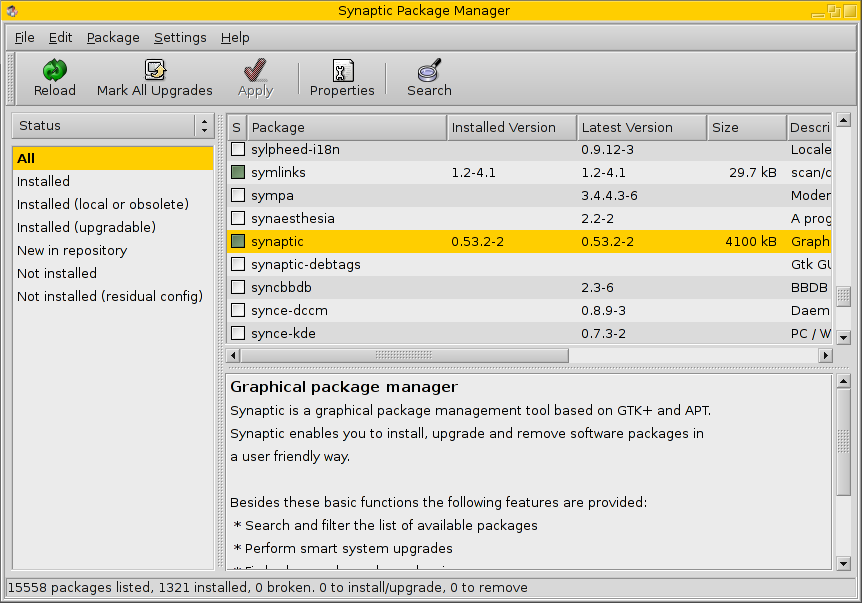
So if you're a member of the point-and-drool generation, use Synaptic, for heaven's sake. How hard is that?
-
A unified package manager
"For this to work, companies would first of all have to agree to run their update process through said package manager. You don't think this will ever happen, do you?
Ubuntu manages to do this through Synaptic and Update Manager -
New? Not so much...
davfs2 - mount a WebDAV-capable server as a filesystem. Dates back to at least 2009.
-
Re:Forget this garbage
You could use a client-side program with encryption that's designed to work with untrusted servers. A simple OSS example is duplicity; it supports backends like WebDAV and Amazon S3.
-
Re:Has anyone embedded Guile?
Guile 2.0 is a huge improvement over earlier releases. Scheme programs are now compiled for a custom VM with an optimizing compiler (not simply interpreted, and AOT or JIT native compilation are now much more practical goals), and Guile now supports hygienic macros, delimited continuations, Unicode, dynamic FFI, R6RS and more SRFIs, and comes with a new debugger and REPL, SXML, and a Web server, among other new standard modules. There's also a SLIME-like Emacs interface: http://www.nongnu.org/geiser/
It's definitely worth a second look if you previously evaluated Guile in the 1.x days.
-
Re:Replace flash now
You can replace flash for a couple of big sites right now with FlashVideoReplacer on mozillla. I have been using it for about a week or two now and it's not too bad.
https://addons.mozilla.org/en-US/firefox/addon/flashvideoreplacer/
Linterna Mágica is better than FlashVideoReplacer as it works with more browsers (Midori, Epiphany) and supports more websites (e.g. Dailymotion).
-
rdiff-backup
I'm surprised rdiff-backup hasn't been mentioned yet. It's a very nice piece of software, does incremental backups, and is easy to automate.
-
Re:Not Surprised
Flash videos on YouTube work fine in Midori if you use Linterna Mágica with Totem plugin.
-
Re:Expo and Scale
Also, couldn't anyone else put a similar FOSS PDF based display to put together their DE? And is that what GNU/Backbone is, or is that something else altogether? How far down is that project? (As an aside, what does the FSF's 'non-gnu' projects mean? Stuff that they license under something other than GPL?)
-
What I would like to see...
...is a Mechanical Turk / crowdsourcing engine for distributedly nuking crap patents with prior art. Occasionally, specific bad tech patents reach notoriety on
How many here would sign up to a service where you could subscribe to feeds for your fields / areas of expertise (e.g. "video compression algorithms" or "input devices", etc.), see an individual top-level claim and filing date, and get paid to point out examples of prior art that you are aware of?
Prior Art databases exist, but with some issues. EFF's Patent Busting project is a good start, but there are relatively few patents to bust, and no one with the incentive (other than ideological) to finance a specific action. I bet a lot of companies would be willing to pay a more than fair bounty for information that nukes a specific problematic claim in a competitor's overbroad patent.
Wishlist features:
* A quickstart guide for laymen / "non-lawyer professionals" on how to parse patent claim constructions, how to determine if prior work exactly matches ("prior art"), or "teaches" (alone or in combination with some other pieces) or "renders obvious" a claim, even if not an exact match. It can't make participants into patent lawyers overnight, but many do not even know the basics, and those basics would improve the quality of prior art submitted.* Advice/tools for determining effective priority date. There are plenty of things (provisionals, continuations, filings across various countries, etc.) that will bamboozle many casual patent-busters in deciding if a piece of art is "prior" or not.
* Random / Rainy day browse modes. Claim-a-day sent to your mobile?
(Before anyone thinks this would just create another tool that could be used for evil, remember that the patent office - presumably in any country - is not supposed to be granting patents for things that already exist in the first place... so correcting such a mistake is not really foul play.)
-
Re:Literate Programming as opposed to Illiterate
Yup; literate programming is the way. I wrote fangle, a literate untanger for texmac, and for lyx.
I use it for my daily job.
Literate programming means that instead of commenting your code (or feeling guilty for not doing so) you code your comments. Or rather you write a book about the problem your program solves, and in the narrative of the book you introduce aspects of code that solve the problem. As you do this you slowly reveal the solution - a well documented solution!
No-one is forced to use it, my replacement (when the day comes) can just edit the generated source if they want.
Also consider Mylyn Intent for Eclipse Java coding if you like that sort of thing.
-
Backup purposes?
We've been using deduplication products, for backup purposes
Here is your problem. Backups should not be copied in myriads of instances and deduplicated on top of that insanity. They should be incremental.
-
Re:Acronis
That is why you don't use rsync alone but something like rdiff-backup http://nongnu.org/rdiff-backup/
That way you have the current status as a 1:1 copy (like with rsync) but also have all previous backups as reverse diffs.
-
Re:Acronis
Rdiff anyone? Rsync with point in time restores. Good stuff.
-
There is Duplicity
Duplicity. It's written in Python with various back-end storage types (Disk, FTP, SFTP, Amazon S3, etc) It's especially useful for backups.
-
Re:Window close/minimize/maximize buttons
Pssst.....
Hey....
Ratpoison runs on linux.
Damn facts, getting in the way of a perfectly good sanctimonious rant.
-
TXR!
I'm also working on a text processing tool that deals with blocks of data is already here.
-
Re:Voxel based? No
it's not really analogous to a pixel (there's a layer of transformations between voxel and screen)
Actually it is. The thing that is often forgot is that pixels also get quite a bit of transformation when going to the screen, they might get scaled, blurred, blended, gamma-corrected and otherwise changed before they appear on the screen. Furthermore, image formats like JPEG don't store real pixels either, they store something that can be unpacked to pixels, but not perfectly some pixels will get changes along the way. A pixel isn't even necessarily a square on the screen, as most scaling algorithm will handle it as a singular sampling point, not an area. One can even apply a texture to a pixel and blend it with neighboring pixels, that's essentially how tilemaps work.
With voxels the situation is of course a little bit complicated, as there is no native way to display 3D data right now, so you can't just "blit" a voxel set into the video memory and have something show up, like you can do with pixels. There are also plenty of different ways of storing and compressing voxels. The underlying principle is however pretty much the same, just now in 3D instead of 2D. Thus if you want to store a 256x256x256 voxel image, you can just take 256 256x256 images and be done.
-
EPUB should be your e-book format of choice.
Homepage for the EPUB standard.
Why do I recommend EPUB so highly? Besides the fact that it's an open standard, that is?
There is a plug-in available for OO.o and LO called Writer2ePub that will save directly to EPUB, btw. The main support channel is through a MobileRead forum.
May I suggest that you spend some time browsing MobileRead before making any final decisions? In particular, I would like to call your attention to the Calibre, Sigil, and OpenInkpot forums.
Next, there is a package called eLyXer which does a pretty good job of converting LyX files to XHTML. EPUB relies heavily on a subset of XHTML as part of its specification so I've been experimenting with a new toolchain.
I write my documents in LyX to get good looking PDFs, then use eLyXer to get XHTML, then use the import/convert function of Calibre to get a good looking EPUB, then use Sigil to fine tune the final output. Since both eLyXer and the e-book conversion utility packaged as part of Calibre can be called from the command line, it would be possible to automate some of that work pretty easily. I haven't bothered with that as my needs are only for occasional use at the moment.
Another alternative would be to just write the journal in Sigil. That would probably mean abandoning PDFs and paper output entirely, though.
P.S. How come you didn't have an article focussing on Arduino in your initial issue??
-
Re:3 years ago
-
Re:The wisdom of using compression in archives
FWIW, the gnu ddrescue guys reccomend lzip.
-
Re:rsync?
And if you have large files which change often, it's worth considering rdiff-backup rather than rsnapshot since that will store deltas instead of a new copy of the file each time it changes.
-
Re:rsync?
If you solve the dual NAT problem separately then Duplicity is one good complete solution. It adds backup schedules, strong client-side encryption and is still able to do incremental backups. Setting it up requires one line of cron on the client side and some kind of remote account for storing the backup archives (SSH, SFTP, FTP). Choosing the correct command line options and handling the passwords requires some care though.
Duplicity uses the same base tech as rsync (librsync) and it's written in Python. It tries hard not to reinvent the wheel using tar for archive files and gpg for encrypting them. This means that extracting files from backups can even be done with standard tools if things get bad. It's available out of the box at least on Ubuntu and Debian. Also installing on CentOS went pretty smoothly with RPM available from project site.
-
rdiff-backup
See also:
rdiff-backup -
rdiff-backup
See also:
rdiff-backup -
Duplicity
Duplicity - Encrypted bandwidth-efficient backup using the rsync algorithm.
You can pretty much configure it to backup anything you want, to whatever you want. I use it with s3 myself, but it can do disk, ftp, ssh, etc. Compression and encryption are configurable.
-
Agent-Based Simulations of Economics
It's a good idea. See:
"How to Do Agent-Based Simulations in the Future: From Modeling Social Mechanisms to Emergent Phenomena and Interactive Systems Design "
http://www.santafe.edu/media/workingpapers/11-06-024.pdf
"Since the advent of computers, the natural and engineering sciences have enormously progressed. Computer simulations allow one to understand interactions of physical particles and make sense of astronomical observations, to describe many chemical properties ab initio, and to design energy-efficient aircrafts and safer cars. Today, the use of computational devices is pervasive. Offices, administrations, financial trading, economic exchange, the control of infrastructure networks, and a large share of our communication would not be conceivable without the use of computers anymore. Hence, it would be very surprising, if computers could not make a contribution to a better understanding of social and economic systems. While relevant also for the statistical analysis of data and data-driven efforts to reveal patterns of human interaction, we will focus here on the prospects of computer simulation of social and economic systems. More specifically, we will discuss the techniques of agent-based modeling (ABM) and multi-agent simulation (MAS), including the challenges, perspectives and limitations of the approach. In doing so, we will discuss a number of issues, which have not been covered by the excellent books and review papers available so far. In particular, we will de- scribe the different steps belonging to a thorough agent-based simulation study, and try to explain, how to do them right from a scientific perspective. To some extent, computer simulation can be seen as experimental technique for hypothesis testing and scenario analysis, which can be used complementary and in combination with experiments in real-life, the lab or the Web."And also:
http://www.brookings.edu/topics/agent-based-models.aspxOr what I started almost a decade ago, but then had a kid and left on the back burner:
http://savannah.nongnu.org/projects/simulchaord
"This project is mainly to develop simulations of chaordic organizations, processes, and systems under the GPL license, with "chaordic" used as defined by Dee Hock at http://www.chaordic.org/ and in his book "Birth of the Chaordic Age"."Something on the idea of a campaign to get more free software written about manstream and alternative economics:
http://slashdot.org/comments.pl?sid=2356864&cid=36936914 -
social encrypted cloud storage
There is a problem that the mainstream cloud storage options like DropBox, SkyDrive, MobileMe, Google Music, etc. all store your data unencrypted, meaning eventually the MafiAA will sue your asses based upon the media that you've archived there. Wuala encrypts documents using the document's own SHA as the symmetric key for deduplication, meaning they cannot read your documents, but any MafiAA like party can still identify your documents.
Afaik, you still need command line tools like duplicity, git-annex, and jgit for encrypted cloud storage via Amazon S3 or others. Syncany might fix this.
Imho, we need an encrypted cloud storage solution that is resistant to even traffic analysis and offer social functionality. It might resemble the following :
Layer 1. Anonymized ad serving and/or payment via digital cash systems : An advertiser gives you a coin when your app claims you've showed an ad, you anonymize that coin and give it to the hosing provider, hosting provider redeems coin with advertiser, adjusting their payout based upon the advertisers identity. Ideally, the hosting provider and advertiser shouldn't be able to trace their relationship to you unless they violate the protocol by comparing IP address, which you may defeat by using a trusted anonymizing bank. Anonymized payments could be are handled similarly but might create issues with banking laws if the coins represent real currency. Tor, I2P, and Freenet could also use this layer help their users earn money.
Layer 2. Anonymized automated bitlocker based storage : Your application creates a 'thread' on a host by uploading a 8192 bit RSA public key, creating a symmetric AES 512 key to save alongside the private key. Threads contain three types of messages : unsigned public messages that applications will ignore unless they're encrypted using the symmetric key, signed public messages that may be unencrypted, like maybe deleting an old message or closing the thread, and private hello messages that applications will ignore unless they're encrypted using the private key. Hosts are federated allowing users to submit their signed messages through other hosts to prevent their preferred host from identifying the thread owners IP address.
Threads are identified by their public key's SHA512. You may grant anyone read & 'reply' access to a thread by giving them the threads id and symmetric key. You may hash identifying information like your real name or email using SHA512 and submit that plus a thread id to lookup servers. You're real threads should NOT however be available for lookup. Instead, your application replies to hello messages by sending some real thread, ala work, family, whatever.
Oh, all thread content is accessible by anyone, all privacy is accomplished through cryptography. It's actually a feature that all this data becomes public once quantum computers can break 8192 bit RSA keys, which'll happen long after your dead.
Layer 3. You're application provides a 'social versioned file system' using a hosting layer thread or ten and pays the hosting provider using the ad serving layer. Imho, the underlying file format should be packed git repository extended to offer quasi-instant messaging attached to objects, roughly like github's comments.
End result : People archive their photo, video, music, etc. collections online, grant their friends access, and chat with their friends in instant messages affiliated with the files, roughly like facebook comments. Of course, the whole system works perfectly for collaborative private projects, like university homework assignments. All users are just some collection of threads they control but nobody knows what threads do what.
-
Re:Is using another third party service
Duplicity is handy if you're just wanting the same rsync experience, but with encryption.
If you need a nice Duplicity-like tool with a user friendly GUI, there's also Duplicati.
Too bad I don't have any mod points right now. Duplicati is awesome. You set it up, and it just runs on schedule. It doesn't overconsume resources, either.
Highly recommended for Windows if you only want to backup certain directories. (If you want to do a full system backup, you should just use Windows's backup tool).
Duplicity seems great too, and I'll definitely check it out if I ever run a Linux node outside of Amazon EC2.
-
Re:Can't beat unison
Just wonder if you've looked at rdiff-backup or rsnapshot and what the advantages/disadvantages might be versus StoreBackup, in your opinion. I'm in the research phase of setting up a home backup solution and had all but decided on one of those, but hadn't come across StoreBackup until seeing your comment.
-
Can't beat unison
Every two years or so, I critically evaluate my options for this problem--even going through the trouble of posting an AskSlashdot on the topic--and every time, I always come back to unison. There are many DIY, non-cloud managed solutions out there; see this article for a useful comparison matrix. I've even tried using git for automated versioning and syncing. However, none seem to work as cleanly as a unison setup combined with a DynDNS IP forward to my home box. Include snapshot backups using StoreBackup--the best backup tool, IMHO--and you have a setup that is tough to beat.
-
Re:Is using another third party service
-
Re:Try it in Linux
You should check out the rat poison window manager.
If you've ever used screen in a console, you'll be right at home. Where screen uses control-a
And it's really annoying. Outside of screen, ctrl-a (by default) jumps to the front of the line (I love vim, but can't get my head arround set -o vi).
In screen, ctrl-a enters command mode, I'm often halfway through editing the line before I realise what's happened. Sure I could remap, on hundereds of servers, but then it becomes non-standard and is more likely to catch me out when I get to a server that doesn't have the remapping.
-
Re:Try it in Linux
You should check out the rat poison window manager.
If you've ever used screen in a console, you'll be right at home. Where screen uses control-a, ratpoison uses control-t.
Keyboard commands for everything, and no mouse support!
As for the shutdown command, the proper way is shutdown -h now
(-h to halt, -r to reboot)
Of course you can also just run 'halt' to shut down with less typing. -
Re:Jumped The Shark...
Two things that you don't seem to realize:
1) Development on Synaptic seems to have stopped already, or at least slowed way down. http://www.nongnu.org/synaptic/ gives the last update as January 2009. However, I believe Debian has adopted it and maintains it. It hasn't changed enough to make a difference in that timeframe outside of bugfixes, at least that I can see.2) USC has been the *default* package manager since 10.04, though Synaptic still shipped. (see https://help.ubuntu.com/community/SoftwareCenterFAQ)
It really isn't that much of a hardship to drop Synaptic from the default install, as useful as it may be. The people that want it know where to get it, myself included.
-
Re:Some are WIP
How about duplicity?
What could also be cool for extra paranoia is a parity RAID like version where you could use different hosting providers for each 'disk' in your volume. That way any particular host only has a subset of the data chunks, and your data would survive losing a subset of hosts (the number depends on your chosen parity scheme).
No doubt someone has already tried that idea
-
Re:rsync.net FTW.
A technical footnote - I use duplicity for encrypted backups on my (personal) rsync.net filesystem:
There's been some rumbling about Tahoe-LAFS integration, which is mildly interesting...
-
Awe, man, This SUCKS!
Seriously. I had just written the automatic string internationalizer last month for a new language & IDE (to be released as FLOSS). You set your locale/language, and the locales/languages you want to support, then as you are coding you can enter a string followed by an 'I' -- then the IDE will automatically build the language table section of the code for you, and depending on the chosen language of the other readers and/or coders they will see the correct text in their language. eg:
greet' = "Good Morning \_. What would you like to do today?"I;
d' = 'Dialog(DLG_MESG);
d.say( interp( greet, user ) );
Behind the scenes (well, at the top of the file, actually ) the language strings get translated and replaced with something like an enum.
__INTL_Good_Morning = core.unique();
core.intlStr( __INTL_Good_Morning, "en", "Good Morning \_. What would you like to do today?" );
core.intlStr( __INTL_Good_Morning, "sp", "Buenos días \_. Qué te gustaría hacer hoy?" );
greet' = core.intlStr( __INTL_Good_Morning );
d' = 'Dialog(DLG_MESG);
d.say( interp( greet, user ) );
greet' = core.intlStr( "Buenos días \_. Qué te gustaría hacer hoy?"I );(This is an example, the string tables would contain more languages and can also be exported to a module -- something like a header file +
Each coder is required to input their own API key, and the plugin for translations allows different services to be used.
I was even adding support for variable name translations -- the operators and built in functions, keywords & library names can already be changed when the coder selects a different language pack (with or without IDE).The language supports full unicode all the way thu the compiler, so variable names don't have to end up like abc_uXXXX_uXXXX_uXXXX as in most C/C++ compilers that support unicode.
Additionally, as the compiler encounters strings that have yet to be internationalized, it can perform the (compile time) translation -- or default to the same known string for every language (emitting a warning) -- Manual Improvements to the translations can also be made (provided that someone knows the target language).
Basically, I wanted to factor out the programmer's native (spoken) language via the token abstraction layer, and enable truly globally collaborative software projects (in your native tongue). I won't be able to without a good translator service + API
FYI, at first the summary had me thinking that "a host of others" meant that other translation platforms would be closing too, but instead it means that Google's other APIs are being terminated.
From TFA:The Translate API is to be joined in closure by a raft of other interfaces, including those used for books data, blog searches, news searches, image searches, video searches, and the seldom-used Virtual Keyboard API. A full list of APIs affected is available on Google's Code blog.
Yeah, I might be one of the folks that enables users to "abuse" the translation service -- but results are cached, and isn't international collaboration what the translator service is for?! -- I wonder how much this will affect the twangdgtk folks -- I guess we'll have to fall back to just www.freetranslation.com?
-
What's in a name?
UNITY, the great DIVIDER
Anyway, Real Men use Xmonad, dwm or Ratpoison. Me? I'm a bit of a wimp, so I use Openbox.
Also, Compiz by itself is a surprisingly capable window manager, for all of you who like your jiggly windows and desktop cubes.
-
Re:Encryption?
There are a number of ways to encrypt files before uploading them anywhere, including Dropbox. However, I'd rather use a service with a standard interface, unobfuscated interface, such as IMAP or HTTP, which allows more flexibility.
For example, one can use GMail Filesystem over FUSE with eCryptfs to mount a file system that stores everything encrypted in a Gmail (and probably any IMAP) account.
Alternatively, one can use duplicity to make and restore encrypted backups using a wide variety of protocols, including IMAP, scp/ssh, ftp, rsync, HSI, WebDAV, Tahoe-LAFS, and Amazon S3.
-
Re:While a lot of people have complicated methods.
I also thought that Duplicity should be mentioned. It uses librsync, its dead easy to setup for backups and supports everything you can think of (encryption, deltas, recovery per time period, various upload means going from regular copy to sftp, scp, and the list goes on for a while)
Excellent tool http://duplicity.nongnu.org/
-
Re:Website. Gallery Software.
I did that and I've an additional backup of it (among other things) via http://duplicity.nongnu.org/ (excellent software by the way)
Additionally I only keep pictures I have reviewed and decided were worth keeping.Million of people make some gigs of pictures in 2 weeks during holidays and stash them, and never look at them - they couldn't it's just too many.
I prefer keeping 20 to 50 shots that are worthwhile.Likewise with videos. (i rarely keep any video to be honest, i'm not very good at that)
-
Online backup is almost always feasible
Unless you are working a lot with audio, video, or hi-res scientific measurements, or you actually pay for the amount of traffic you use instead of flatrate, online backup combined with local backup is the safest.
I recommend Duplicity. It is free software, it's reliable, it encrypts everything by default, it supports a number of communication protocols. It's of course incremental, so even if it will take a long time for the first transfer, later synchronisations should be snappier. Put a cheap file server in a friends house, pay for space in some web hotel, or use one of those fancy storage systems at Tahoe or Amazon.
-
Re:Then again,
You could give your store a name that makes no sense.
"Synaptic" is not the name of the app store. It's the name of the GUI for APT. And APT isn't the name of the app store either; it stands for Advanced Package Tool.
The real name of the app store? *drum roll* "package repository" that contains the "packages" that make up the "distribution".. Note the conspicuous lack of capitalisation and trademark symbols. Note the fact that no one demands you to use just Debian's (or Ubuntu's, or whoever's) repository; you can add more yourself or even start your own.
-
Then again,
You could give your store a name that makes no sense.
-
Windows key = Extra mod key
What exactly IS that windows key for?
I don't know about Windows or Mac, but in Linux you can configure the windows key to be a extra mod key, kinda like Shift and Alt.
A lot of keyboard oriented windows managers (which I personally enjoy using) require that you press a certain key to activate the window manager's commands.
For example, Ctrl-t on Ratpoison or StumpWM or the Alt key on Xmonad. In those cases, you can use the windows key instead of those.Or you can just learn emacs and start complaining that you need MORE keys on the keyboard
-
Windows key = Extra mod key
What exactly IS that windows key for?
I don't know about Windows or Mac, but in Linux you can configure the windows key to be a extra mod key, kinda like Shift and Alt.
A lot of keyboard oriented windows managers (which I personally enjoy using) require that you press a certain key to activate the window manager's commands.
For example, Ctrl-t on Ratpoison or StumpWM or the Alt key on Xmonad. In those cases, you can use the windows key instead of those.Or you can just learn emacs and start complaining that you need MORE keys on the keyboard
-
Re:Why no Synaptic for OS X? ..... Or Windows?