Slashdot Mirror
Domain: normankoren.com
Stories and comments across the archive that link to normankoren.com.
Comments · 18
-
Re:I've got a gigapixel camera...
Did you miss where we already have this?
First, we don't need a GPx in phones for this to come up -- phones are much more the equivalent of a 110 camera (cheap crap everyone carries everywhere, fits in a shirt-pocket) than a full-frame 135 camera (serious consumer on up to professional, needs its own strap or bag). 35mm film, in the real world, is no more than 20-30 MPx equivalent (more like 10 -- sophomoric arguments will suggest up to 100MPx, but if you see any analysis that doesn't address MTF (maths-light treatment), the author is either ignorant or deceptive)
Second, even for things that are just going to a 2MPx TV broadcast and 2MPx blu-ray, the film-fuckers say you need to capture it on film first, then digitize & downsample it, instead of capturing it at 4k with a modern video camera and downsampling, else it looks "uncinematic" (i.e. too real).
-
Re:Blue print company
An interview rather than a scientific article, I admit,
Well, yeah. It's complete rubbish. The subject of the interview is highly biased, and doesn't provide any source for his claims. How about some actual data? This one is old, and shows digital cameras that are seven years old outperforming a quality film stock: link.
How about other aspects of image quality? Digital beats film hands-down when it comes to signal-to-noise ratio (grain).
But of course, film has a greater dynamic range than digital, doesn't it? Nope. Another myth.
-
browser/monitor/you
seriously, you should be able to see those images just fine. It's either your browser software (different display settings for images?) your monitor (bad gamma setting?) or you (bad vision?). For your sake, I hope it's one of the first two.
This is a fair place to start with regards to option 2 (gamma setting)
http://www.normankoren.com/makingfineprints1A.html
( now there's an informative post ) -
I'd Rather Have Less Noise, Wider dMax
Sure, "faster" sensors will be a boon to the consumer market, and will surely have some applications in the pro market as well -- existing light press photography come to mind.
For me, though, the problem is not so much speed as it is noise and dynamic range. That's because a lot of the time I still do fine-art level landscape and studio glamour photography -- neither of which are speed starved, but even the finest digitals could still use even less noise and wider dynamic ranges.
While DSLRs have a huge advantage over handhelds in this regard, it would still be nice to see improvements in s/n such that the darker zones maintained their clarity and detail. Even the finest Canon cameras suffer to a degree in this regard, at least for people with very high standards. Some of us have those standards because that is what our clients demand - and in some cases we still must use film to meet their criteria.
It's a virtual law that to obtain the best noise performance you need to use the lowest ISO speed that the camera can attain. So instead of bottoming out at 100, like most DSLRs, I'd like to see 25. Or better, 12.
For more info, visit http://www.normankoren.com/digital_tonality.html -
Re:Haha!
f/32 and MAYBE f/45 if you have a good camera is usually about the limit before diffraction starts to affect a picture.
It depends on the size of the film or sensor. At f/32 and 550 nm light, the circle of confusion from diffraction will always be ~42 microns. But a 42 micron CoC on 8x10 inch sheet film is a lot more tolerable than on 35 mm film, which in turn is a lot more tolerable than on a sensor the size of my pinky fingernail.That's why Ansel Adams and colleagues who shot on large-format camera formed "Group f/64", but you'll rarely see a 35 mm camera lens that goes that far. Mine bottom out at f/16 to f/32.
-
Re:Resolution
I agree with most of what you said here, except for the thing about "ideal conditions"...there is no way to get "ideal conditions" with film...you're always going to have a high amount of grain in the image...and as such, the image quality will always fall below that 24MP mark...
Now, as for the validity of his claims, take a look at some of the links at the bottom of the page...specifically this one which explains that at 16MP, digital cameras actually get into the medium format range...or this one that deosn't try and come up with some arbitrary value for MegaPixels and actually gives a comparison of the different images...or this one which uses a figure closer to your figure (21.4MP) for film that finds the D60 (6MP) is about the same quality as 35MM...there's more, but I'll let you find the rest... -
I am volunteering
I think if everyone works together, launching payload into space will be easy. If you got everyone in a medium-sized town (54,000 people) to cooperate and have each person lift just 6 feet, you could get the payload into space without expensive rockets. I am stepping up to the plate and personally offering to lift the payload from 5400 feet to 5406 feet. Any takers for "5394 to 5400" or "5406 to 5412"?
-
Norman Koren
Norman Koren links to several test images on his site.
-
Re:Article not useful
So far, it looks like they're saying that dSLRs always have shallow depth of field, which is less than helpful.
Iff you know how to use it, any Digital or Film SLR should have whatever depth of field you need, and should be really fast to dial in the right setting. On my Canon AE-1 Program (a 1980 film SLR) it takes me seconds to dial the shutter speed to one that will force the aperature to what I want. Shooting portraits, I use a fast shutter to force a shallow depth of field; shooting landscapes, I use a slow shutter to force a wide depth of field.
For better results, sometimes I use the simplified zone system with the built-in lightmeter.
My Minolta DiMAGE 7 (a digital cam midway between a compact and a dSLR) only has wide depth of field. This can be handy for some shots, but I find it annoying for others. Also the shutter and aperature are awkward to adjust manually, which makes the simplified zone system difficult to use. I greatly prefer the clarity (and NO LAG!) of my SLR viewfinder to the LCD and evf of my digital camera. -
Another excellent source
With description of the optics and details of the resultion measurements is here. He created also his own chart which includes shades of grey for better measurements of MTF50.
-
Re:NOT the image quality of 35mm film
Interesting. So 16MP is ~ same as 100 ISO slide film.
But then there is the whole issue of digital camera interpolation. Which is why I really love the Foveon X3. But it's only used in a few very expensive cameras.
By inference, when digital cameras have 48MP, or Foveon goes 16MP, I will stop using my RDP III. -
Re:Overloaded = shouldn't happenActually overloading happens stochastically with nearly all audio reproduction depending on the source material (most recorded & mixed poorly) and/or the inappropriate volume level given the capabilities/performance of equipment. Yes, the world would be beautiful and ideal if everything were linear (which is what you are implying is doable and obligatory) but the reality is that electronic devices are generally so profoundly nonlinear it makes more sense to simply define "how badly nonlinear".
If this makes me sound like a Tube-a-phile, let me mention I'm an analog circuit designer and my profession and personal opinion that >90% of most tube-a-philes are ignorant fools. There are a handful of exceptions. Norman Koren, though he is out of the audio hobby, knows what he's talking about. His writings should be required reading and required baseline knowledge for anyone who wants to mindlessly spout off about tubes being better over transistors. He's pro-Tube, BTW. His analysis is some of the only cogent and technically correct writing I've seen on the subject. AFAIHS, most pro-Tube audiophile magazine articles are written by people without actually knowledge of or experience in analog circuit design (building one or two tube amplifiers in your garage doesn't count) so I'm always dubious but I'm open to qualified and valid arguments, either way. This question of Tube-vs.-Transistor is usually irrelevent with bad circuit design: transistor amplifiers can be as good as the best tube amplifiers and tube amplifiers can be as bad as the worst transistor amplifiers. Device technology is not some magic bullet and claiming such only demonstrates one's stupidity and ignorance.
That said, one need only look at the rise of MP3 to see that most of the population can't hear the difference if there ever was one. This is something that the RIAA complete missed. It's also something that SuperCD and AudioDVD format promoters seem to have fatally overlooked (from an MBA sense, the market cap for such formats are far smaller than they claim or seem to believe). Most environments in which we listen to music are noisy (car, office and even home), and further most of us can't hear well enough or have the ear training to discern bad from good even with moderate quality equipment. The available "channel capacity" between our audio sources and our ears is generally far less than the 16-bits dynamic range/44.1 KHz data rate due to this ambient noise floor. Add to that the channel capacity limits between our ears and brain: I had my hearing checked when I was 19 and even then I had no significant perception over 16 KHz (which is statistically "normal" for 19 yo males). I'm in my 40s now and I've noticed my hearing getting worse since that! My iPod and its MP3 are certainly lower quality than the ideal but I get to take my entire audio collection with me anywhere in the world - nothing like sitting on the beach in Nusa Dua, Bali and feeling a particularly obscure recording from your collection would be appropriate for the moment and just playing it! That and hearing fidelity limitations tends to trump the quality argument in most cases.
Golden Ear performance is a requirement for only a tiny and limited market of audiophiles and historical archival use. The claim that overload handling differences is real and potentially relevant. Mr. Koren's analysis shows (from the pro-Tube camp) distortion is often an artifact of bad circuit design rather than necessarily a device technology issue (esp read his article on negative feedback) - bad design pervades both the Tube and Transistor sides of the audio industry. Most people won't be able to tell the difference anyway, which, from an economic-forces-driving-technology-options-and-de
v elopment point of view, that's all the matters in the long run. Hence most audio is IC transistor-based, and increasingly, computer/synthesizer-based anyway.JG
-
Re:Limits of digital...
See the following site
Cannon beats 35mm
It puts 10 MP (specifically a cannon, which may be important, as lense and CCD design do have profound effects on the digital camera) as being the superior to 35mm film in every possible catagory, hence a 20 MP camera like this one fujifilm camera> would outperform a 70mm film in every possible catagory
With the added benifits of digital (being able to review the pictures, delete unnessassary photoes, send photos without the need to scan over the internet, one step adding photoes to photo editing software, cheaper cost of prints, no development costs; no one who has enough money to buy a good digital camera should be using a non-digital; The only remanining reasons are cost (because you allready own 70mm photo equipment, which is not cheap to replace), inability, and lazyness; But the cost issue is mostly a misnomer- Even though a 20MP digital costs a lot; the savings from not having to make extera prints to make sure that the client likes it, or having to piss off clients with prints they don't like and the development costs on those prints (assuming you do photography professionally, but why else would you have a 20mp camera or 70mm film camera?) will pay for itself soon enough.
The only people who should not have digital cameras RIGHT NOW, are, ironically, home users- who can get a good 35mm for $200, but would need to pay $700 for a good ~10MP digital camera, the difference of $500 would pay for a LOT of photo development! -
Re:What is 35mm equal to?
For fairly techincal and highly illuminating discussion look here.
The consensus of *photographers* (as opposed to pixel-counters) is that 6Mp semi-pro cameras (such as Canon D60 or 10D) are equal to 35mm film and 11Mp pro cameras (such as Canon 1Ds) surpass what 35mm film can offer.
Note that not all pixels are equal: a 6Mp consumer point-and-shoot will produce a noticeably worse image than, say, a Canon 10D. For reasons why follow the link above. -
Re:Important?
And 16 million colours is more than the eye can see, and 44,100 samples per second is more than the ear can hear. Throughout the march of technology we've heard these ridiculously arbitrary "limits" of our senses, and invariably they are discounted at a future time.
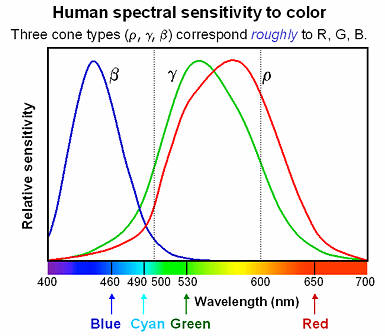
You seem to be suggesting that our senses have no limits. That is ridiculous. Our senses most definetly have limits. Here is a good graph showing our sensitivity to colors.
When people say that we can't see 16 million colors, that doesn't mean that the 16 million colors we get with 24 bits includes all the colors that we can see. -
Re:Color dimensions
Then why is it alway represented by a two dimensional pallet?
Always? 2 3 4 5 6 7 8 9 10 11 12 13 14
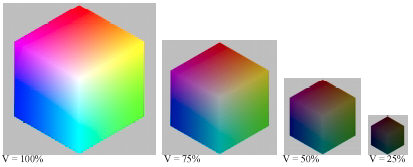
It is often represented two dimensionally because it is difficult to display it three dimensionally. Two dimensional displays most often display Hue and Saturation and completely discard Value.
Color can be coded as RGB (Red/Rreen/Blue) or HSV (Hue/Saturation/Value) or HSL (Hue/SaturationLightness) or YCbCr aka YUV aka YIQ (used in TV) or CMY (Cyan/Magenta/Yellow) or L*a*b* or XYZ. It always requires exactly three components. Note CMYK uses 4, but K is redundant, it improves the quality of ink printing.
it isn't "exact" either, since many humans are missing at least one of the dimensions.
That is precisely why I included the word "normal" in "normal human vision".
- -
Still more film vs. digital links
Also try this article.
This camera will be better than film. As a pro writer/photographer who already shoots digital only at 4mp (EOS-1D), I can say that 35mm film is dead but for those quaint "vintage" photographers who are doing "art" stuff.
The amount of ignorance about digital and about photography in general here on Slashdot is shocking! These people may be geeks, but they understand little about optics, current sensor technology, film chemistry, or human perception of resolution and dynamic range. -
Re:Photo-Quality
Norman Koren has a very good summary of digital camera resolution versus film on his site.