Slashdot Mirror
Domain: oberlin.edu
Stories and comments across the archive that link to oberlin.edu.
Comments · 36
-
I concur. The article is Bullshit.
This article is so full of it. There have indeed been other reports of injuries and some of deaths by meteorites/asteroids. Including as the parent response notes, the major catastrophes that happen when they do occur. We are right to worry about an event that WILL eventually happen, even though it is very rare. An event that when it happens will make up for all the minutes, days, weeks, months and years it didn't happen.
Reported deaths dating back to BCE.
It might not also be a bad idea to look at the orbits of all the known potentially hazardous objects (that means asteroids/comets, of a certain mass, that intersect Earth's orbit). It's a sobering graph.
-
Re:Try..
I've found at least one reliable citation. Note: if, in the future, someone says their Wi-Fi is "showing an error" and equates this to "being hacked," they're completely clueless. This shouldn't be on Slashdot.
-
Re:Staff shortages
The throngs of people could be replaced by robots; the designer can't.
and where do robots come from? a designer? who uses robots rather than throngs of people? is it robots all the way down?
besides i like the idea of replacing designers. it doesn't take a design genius to design the concrete monstrosities that have passed for contemporary architecture for the past 30 years. but here's an example of algorithmic design.
http://www.oberlin.edu/math/faculty/bosch/tspart-page.html
see... designers are replaceable with robots (or mathematicians).
-
Re:Already happened
http://elbitz.net/home.php is good, but they only open up registering every now and then (I remember I waited like 2 months to get my user). In general, though I just use the same popular torrent sites for everything else I get for books, too and I've gotten 6.28GB that way. Also, appear to have just found a
O'Reilly online http://www.oreilly.com/openbook/ | http://sysadmin.oreilly.com/ Computer books and manuals http://www.hoganbooks.com/freebook/webbooks.html | http://www.informit.com/itlibrary/ | http://www.fore.com/support/manuals/home/home.htm | http://www.adobe.com/products/acrobat/webbuy/freebooks.html The Network Book http://www.cs.columbia.edu/netbook/ Some #bookwarez.efnet.irc links http://www.extrema.net/books/links.shtml Some #bookwarez.efnet.irc fiction http://194.58.154.90:4431/enscifi/ Pimpas online books (Indonesia) http://202.159.16.55/~pimpa2000 | http://202.159.15.46/~om-pimpa/buku Security, privacy and cryptography http://theory.lcs.mit.edu/~rivest/crypto-security.html | http://www.oberlin.edu/~brchkind/cyphernomicon/ My own misc online reading material http://www.eastcoastfx.com/docs/admin-guides/ | http://www.eastcoastfx.com/~jorn/reading/ Computer books http://solaris.inorg.chem.msu.ru/cs-books/ | http://sweetrude.net/~cab/books/ | http://alaska.mine.nu/books/ | http://poprocks.dyn.ns.ca/dave/books/ | http://58-160.skarland.uaf.edu/books/ | http://202.186.247.194/~ebook/ | http://hooligans.org/reference/ Linux documentation http://www.linuxdoc.org/docs.html FreeBSD documentation http://www.freebsd.org/tutorials/ Sun documentation http://osiris.imw.tu-clausthal.de:8888/ | http://uran.vvsu.ru:8888/ SGI documentation http://newton.unicc.chalmers.se/ebt-bin/nph-dweb/dynaweb;td=2 | http://techpubs.sgi.com/library/tpl/cgi-bin/init.cgi IBM Online Redbooks http://www.redbooks.ibm.com/ Digital Unix documentation http://www.unix.digital.com/faqs/publications/base_doc/DOCUMENTATION/V40D_HTML/V40D_HTML/LIBRARY.HTM Filesystem Hierarchy Standard http://www.pathname.com/fhs/2.0/fhs-toc.html | http://www.linuxbase.com/ UNIX stuff http://ww -
Re:A little sad.
forgive me for replying to myself but...
forgot to post this interesting tidbit as well- google is getting into the energy monitoring game as well. they're trying to enlist utilities and "smart" meters to report household power usage.
there are also a slew of start-ups trying the same thing with households as well as larger institutions.
-
Re:Landfall projection?
When was the last time you heard of anyone getting killed by a meteorite?
It is often claimed that there are no "well documented" cases of a human being killed by a meteorite.
The problem with that statement is that most of the human race lives poorly documented lives.
According to this article, two people were killed by a meteorite last year in the Indian state of Rajasthan. But those reportedly killed were nomads, not folks living in an area where every aspect or their lives was recorded.
Here and is some info about injuries and damage (reportedly) caused by meteor strikes.
The risk of being killed, injured, or having one's property damaged by a meteorite is small, but non zero. If nothing else, barring a highly-effective planetary defense system we will eventually have a Tunguska-level event that will hit a populated area - there being more and more area populated by Homo sapiens with every passing year, the risk grows with time.
But the question of natural risk is non-informative of the legal and ethical implications of deliberately de-orbiting junk that you know might survive to the ground. Let's say that the risk of you getting hit by a meteorite is (pulling a number out of my ass) 1 in 10,000,000,000. Does that mean that it's acceptable for me to take a gun that has a 1 in 10,000,000,000 chance of being loaded, point it at you, and pull the trigger? Does the answer to that question change if I have to pay $10 to refrain from shooting? $100? $100,000?
We each do things every day that marginally increase the risk to other human beings. Figuring out what is an acceptable amount to increase somebody's risk is a hard enough problem that most of us simply ignore it most of the time.
-
Re:Only 30K lines anyway...I agree with most of your comments, and especially the spirit of keeping everything shipshape and avoiding the endless game of "who can be blamed". Two minor improvements: Any error handling through error return codes, probably to be replaced by exceptions, unless it turns the calling code into a wild mass of try/catch blocks. Sometimes instead of return codes, there are other good options. For example, you can spin a state machine out into an object, which in effect keeps the return codes safely in one place until you want to check them. In some cases, I love the Null Object Pattern. And sometimes it makes sense to have a request object and a response object, with the response carrying possible error-related info. Anything that *doesn't* belong together should be split into separate files (but don't make a file for just a single function - instead create a file with "leftovers"). For functions, maybe. But a lot of good objects really can have just one method. Ruby does that all the time with anonymous methods, for example, and sometimes that pattern is worth using in a more explicit language.
Also, more generally, I feel like unit tests are a much better place to store knowledge than comments.
Other than that, I agree completely! -
Re:world population
The way water is usually treated and dealt with by most urban societies is to not treat it like a mineral (aka gold or even steel), but to treat it as a flushing mechanism. In other words, the aquatic structures of most urban environments are designed to flush toxic wastes and other pollutants (primarily organic compounds of various varieties) into a place where it will eventually be dealt with.... that usually being the oceans of the world.
But that doesn't deal with it, all it does is pass it on to someone, or something, else to deal with. It may sound like something dirty that no one wants to put up with but prior to piping and the massive sewage created by it, people used to collect human waste and take it to farms to fertilize the crops. Unfortunately this allows pathogens to enter the food chain, but by composting it pathogens can be killed. I think this is one area where organics goes wrong. While organics encourages the use of manure from other animals such as chickens, cows, and pigs, it does not allow the use of humanure. Basically organics takes humans out of the loop and creates a deadend. Ask good gardeners and farmers what many plants like and they'll tell you nitrogen, guess what? Human urine has a lot of nitrogen. In some circles, such as with some Permaculturists, people recommend mixing urine with water, something like 1 to 10 parts, to water crops. Diluted like this there's little smell. Then with things like living machines sewage can be treated producing no odor while producing fertilizer. Living machines, patented, are being investigated by a number of universities and businesses. Oberlin College has created a living machine that is capable of treating all the waste water created by the Lewis Center at Oberlin. There's no reason a living machine can't be expanded. The end result being clean water and nutrient rich fertilizer. Ah, I see you bring up sewage later.
The technology also exists to have a magnitude order of improvement or better with the efficiency of water usage for agricultural purposes. Living in a desert area, I've seen some amazing low water consumption methods that can be applied to gardens and even commercial food production facilities.
Drip irrigation and soaker hoses are good, as is only watering in the morning. Watering then allows the soil to soak up some water where it can then reach plant roots before the sun and heat can evaporate the water. I use a soaker hose in my garden in the morning. This is what farmers in Israel have been doing, however they are now draining more and more water from the Jordan River. Water is the one thing Queen Rania has said Jordan will go to war over. However Jordan is also diverting water. Because so much of the river is being diverted the Dead Sea is drying up much as the Soviets caused the Aral Sea to die.
And otherwise the climate of Texas is pretty reasonable for human habitation, even though I would have to agree that western Texas in the summer is something you want to avoid unless you have some serious air conditioning available.
Ah but western Texas is great for wind farms. Just three wind farms in western Texas creates 116 megawatts of electricity.
I certainly can walk about 15 miles from my house where I'm typing this message, and enter not only what is designated as an official federal wilderness area, but also risk getting attacked by rattle snakes and cougars.
In Florida where I used to live I
-
Re:I remember watching Jurassic Park
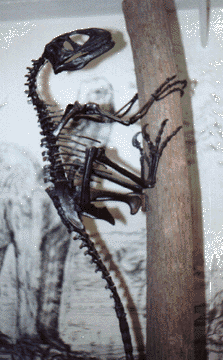
You would stand as much of a chance fighting a real dromaesaur/raptor (velociraptor, deinonychus, dromaesaurus, utahraptor etc) as you would fighting a tiger.
As for peripheral vision and not spotting stationary targets, that's absurd.
It had far better peripheral vision than a human.
The neck would about as flexible as a bird.
And it would likely use it's hands to fight aswell as it's feet:
http://www.oberlin.edu/faculty/kmhubbar/images/Dei nonychus.jpg
http://www.mathematical.com/dinodeino.gif
Jurrasic park is horribly inaccurate, the mere fact that the Velociraptor portrayed in the movie isn't a Velociraptor at all but more of a cross between a Deinonychus and a Utahraptor speaks volumes.
The real velociraptor was stupid and about the size of a wolf, and had a flat, funny-looking scull.
Now the Deinonychus on the other hand... -
No love for the mac crowd?
-
Little LISPer?
Does anyone remember the 'little LISPer'? That is what I learned on. One of the strangest, and perhaps most effective, CS books I ever owned.
http://www.cs.oberlin.edu/faculty/rms/htx_apps/lis per/llisp.html/
When the little LISPer went into its fourth printing they renamed it, it is now 'The Little Schemer'. -
Re:No decent langauges...Lots of languages have much simpler grammar than C. Some of them are based on Pascal. The Delphi compiler is famously fast partly because the grammar of the language is so simple. Functional languages are even simpler. I'm not talking about Lisp, which many people find unnatural, if not unreadable, but languages like Miranda and ML.
Here's an example of a generic Miranda function that implements quicksort using recursion:qsort [] = []
(From here: http://www.cs.oberlin.edu/classes/dragn/labs/stre
qsort (a:x) = qsort [b | b<-x; b<=a] ++ [a] ++ qsort[b | b <- x; b>a]a ms/mirandaexamples.m )
I doubt you could do that more tersely in C, and yet even if you're unfamiliar with the language, it is at least fairly readable. -
Re:Inca's and Zero
Which also brings up another good point; inventing. According the the European world, Christopher Columbus discovered North America in 1492. Discovered by the Europeans, that is. I find it very hard to discover land with human inhabitants. More than one group of people could have figured out the concept of zero, or discovered North America, or invented the telephone (Elisha Gray v. Alexander Graham Bell).
All depends on your point of view. http://www.oberlin.edu/external/EOG/OYTT-images/El ishaGray.html -
Re:Getting out of IT...
Excellent points. To which I would like to add a thought originally put forth by Byron Cosby in a letter to Computerworld concerning Alexander Hamilton's Report on the Subject of Manufactures.
To paraphrase Hamilton, it is necessary for a nation to keep all industries which are essential for security, independence, or the general well being within the national borders.
He goes further about having varied industry so that each may able to find his place, but it's a long read. Excerpts
-
See guys...
Do a Google search on solar cell window and you quickly realize that this is an old idea.
Korea's into it.
Oberlin too.
Apparently, Durham as well.
But what's important this time I guess is that it's a woman who "discovered" the idea.
And because women are equal to men, an equal number of discoveries must be credited to women. -
worldwide grid
Leave it to wired and you slashdot wankers to screw up a perfectly good idea.
The worldwide power grid idea was detailed in fuller's book Critical Path and its not a new idea by any stretch (
Yeah bucky was a ridiculous optimist, but the jist of this whole book (and his life's work for that matter) seems to be that if we can eliminate inefficiencies and work together on a global scale, there will be more than enough power/food/resources for everyone to live extremely well.
Of course the wired people decided to drop their grid on a truly crap-tastic map which kills the whole point. take a look at the worldwide grid on bucky fuller's dymaxion map which shows the earth as one giant continent without distorting the relative sizes of the landmasses.
Electricity demand is low on one side of the world at night, they send their excess capacity to the other side of the globe where it is day. and vice versa. same deal with summer/winter in the northern / southern hemisphere. of course we need to solve the sticky problem of transmission loss
and if you are whining about being without power for a day someone needs to unplug your ass and send you outside for a little nature. -
Re:Summary inaccurate ...
Bar codes have been in use for much longer than that - see for example these animal barcodes.
So has your reasoning skills. -
Re:You cannot possibly prove your point
I recall a TV ad that went on about getting a patent for things, and it said something like:
Who invented the telephone?
A) Alexander Graham Bell, or
B) Elisha Gray
And then it crossed it all out, and put C) Both!
Yet, hardly anyone has heard of Elisha Gray, yet Elisha actually invented the telephone before Bell. The problem? He submitted his patent two hours after Bell. And even though Bell's patent was actually flawed and incorrect, Bell still got the title of 'who invented the telephone'.
More information here.
Of course, it depends on how much you value fame. But, really, what is life about? Surely it'd be nice to have a legacy.
I agree with your opinion on Franklin, however. I just chose him as an example. -
what about elisha gray?
On Feb. 14, 1876, Gray filed with the U.S. Patent Office a caveat (an announcement of an invention he expected soon to patent) describing apparatus 'for transmitting vocal sounds telegraphically.' Unknown to Gray, Bell had only two hours earlier applied for an actual patent on an apparatus to accomplish the same end. It was later discovered, however, that the apparatus described in Gray's caveat would have worked, while that in Bell's patent would not have. After years of litigation, Bell was legally named the inventor of the telephone, although to many the question of who should be credited with the invention remained debatable.
-
Re:What about Fessenden!
Remember the name of the guy who showed up at the Patent Office 2 hours after Alexander Bell did? Neither does anybody else
What about Manzetti who applied for a "advice of patent" 5 years before Bell? I believe the name you're referencing is Elisha Gray. Interestingly, Gray's "caveat" (meaning he didn't have one built yet) would have worked while Bell's patent application did not. I read somewhere that Bell stole an idea from Gray's patent, but that has been disputed. Bell's claim was challenged hundreds of times and they never lost one. Here is a detailed history of the invention, including the patent wars. -
Be Thankful.
Thank our Lord Jesus Christ that the guilty do not know the sinful shelter of this wretched world. You should stay far, far away from godless sinners like the Center for Consitutional Rights who may try to tempt you to the path of sin.
-
Re:I'm not sure I see the real argument
-
Re:This is what our prison systems should be doing
Actually, television is becoming common in prisons all over the world as a tool to control inmate behavior.
Perhaps one useful approach would be to use closed circuit television to control what the prisoners see. Educational, religious, or therapeutic programs might provide them with more understanding of the world than the deceptive images and stories that they see on commercial television.
A prison should never ban commercial television. Rather, it should set up a contrast between the amoral, consumer oriented ethos and a fundamentally moral one. Some prisoners would get it and some wouldn't. However, simply showing commercial television might calm their behavior while in prison but it is possible it would do nothing to discourage criminal behavior when they are out of prison.
This view of prison life says:
The most senseless use of time in prison has to be constant television watching. There are adult men in prison who watch cartoons and soap operas for hours each day. They know all the soaps' characters, plots, and can figure all the possible scenarios of upcoming episodes. They live through the tube. They call television the "Boob Tube" because it will make you dumb if you aren't already. Its shameless, naked images will poison your mind and spirit. Its fantasy will rob you of all original creative thinking abilities. Constant television watching develops the dangerous habit of always wanting to be entertained, which causes laziness.One can see that television watching as a solution may be as bad as the disease.
-
Behold the power of zsh
Well, actually, thanks to
Surprisingly, some thought to actual usability went into this: the ANSI colors highlight the hostname, so I don't forget what system I'm on and blow something up; there are many blatant differences between the root and normal-user prompt ($ vs. #, coloring, privileged username in inverse video); zsh's RPROMPT parameters, which specifies text to go on the right side of the terminal window, was used to move the CWD over so that the location I type commands to doesn't change from line to line. Oh, and if a command fails, the exit status gets an eye-catching green background and is placed on the right-hand side, but separated from the CWD by a space.
And before I switched to zsh from bash, some of the systems I was on had normal-looking prompts, but the one I first learned UNIX on, well, didn't.
-
Behold the power of zsh
Well, actually, thanks to
Surprisingly, some thought to actual usability went into this: the ANSI colors highlight the hostname, so I don't forget what system I'm on and blow something up; there are many blatant differences between the root and normal-user prompt ($ vs. #, coloring, privileged username in inverse video); zsh's RPROMPT parameters, which specifies text to go on the right side of the terminal window, was used to move the CWD over so that the location I type commands to doesn't change from line to line. Oh, and if a command fails, the exit status gets an eye-catching green background and is placed on the right-hand side, but separated from the CWD by a space.
And before I switched to zsh from bash, some of the systems I was on had normal-looking prompts, but the one I first learned UNIX on, well, didn't.
-
Behold the power of zsh
Well, actually, thanks to
Surprisingly, some thought to actual usability went into this: the ANSI colors highlight the hostname, so I don't forget what system I'm on and blow something up; there are many blatant differences between the root and normal-user prompt ($ vs. #, coloring, privileged username in inverse video); zsh's RPROMPT parameters, which specifies text to go on the right side of the terminal window, was used to move the CWD over so that the location I type commands to doesn't change from line to line. Oh, and if a command fails, the exit status gets an eye-catching green background and is placed on the right-hand side, but separated from the CWD by a space.
And before I switched to zsh from bash, some of the systems I was on had normal-looking prompts, but the one I first learned UNIX on, well, didn't.
-
Re:Music Apps?
There's a class at Oberlin College this semester on writing music apps in python.
-
Re:Computers4KidsOn a related line, there are a lot of computer recycling organizations out there, such as Oberlin College's OCRP, you might try to find one near you. PEP National Directory of Computer Recycling Programs claims to have a fairly complete list.
Also there's the arsDigita Foundation which sponsers a prize for web service designed by high school age students and aDUni, a tution free computer science program. (Since I am an aDUni, this is a bit of shameless begging/advertising, but so far it has proven itself a very worthwhile program.)
-
Re:Continuations... in Javascript!Here's a quote from the link you referenced, under point 2.1:
In essence, every single line of code has a continuation that represents the entire future execution of the program.
The last expression in my third function, factfn():
factfn( n - 1, function ( p ) { return fn( n * p ) } );
The explanation h ere is more explicit, IMO:
Let us agree to write all programs so that whenever a subexpression is being evaluated, a procedure representing the current context is always applied to the answer produced by that subexpression. This one-argument procedure is called a continuation. Whenever any function in the program is executed, it is passed the continuation parameter representing the current context. Deep-recursive calls can be made tail recursive by augmenting the current continuation parameter with any actions required by the context of the current call.
The example on that page is the canonical example of factorial in cps style in Lisp-like languages:
(define fact-k
(lambda (n k)
(if (zero? n) (k 1)
(fact-k (1- n) (lambda (v) (k (* n v)))))))This program maps syntactically to my Javascript example, exactly: their n is my n, their k is my fn, and their v is my p.
To further demonstrate the apparent "continuation-ness" of the Javascript implementation, if you change the line in factfn() which reads "return fn(1)" to simply "return fn", factfn() will now return an unevaluated function to its caller. That function encapsulates the factorial of the value of n specified by the caller. You can then evaluate it, after the factfn() function has returned. The calling code would then look like this:
aFacFn = factfn( 5, function (x) { return x; } );
document.write( aFacFn( 1 ) );
When aFacFn(1) executes, it returns 120. It happens to arrive at this result by recursion. Nevertheless, the values of n which it uses internally come from function contexts (what that Python page is referring to as "frames") which are not (or no longer) on the traditional call stack. Since functions are first-class objects in Javascript, it pretty much has to support the concept of a frame detached from the call stack, and it does.
Having defended my position, I will say that no-one should seriously try to learn about these things using Javascript, or Python for that matter. When learning, it's much easier to work with these concepts in the context in which they're most effective, i.e. a true functional language. I picked Javascript for these examples because of its 1st-class function support and the fact that just about anyone reading this can run the code in their browser.
-
corporate police
This is just another scary example of how corporations are taking the place of the police. I recently read an interesting article about the FBI's invasion of people's (civil rights leaders, socialists, unions, etc) privacy here. I think the only diffrence is that this company is doing this from behind a computer, instead of putting bugs and wiretaps in your house... and they are doing it for profit rather than even the (often flimsy) argument that the privacy invasion they take place in is in the intrests of national security.
National Socialism = National Coporatism ?
-
Re:GIMP naming troubles?
Hence we have Gimp (Gimp is my photoshop)
Eek! This is not what GIMP expands to. Rather, it is the GNU Image Manipulation Program. In some times past, people have used the "G" for "Graphical", but the "P" has never been Photoshop.
Opinions on how to capitalize it are varied.
-- -
GeekPress commentsMy husband and I added this story to GeekPress at the same time. (His stayed up and mine got deleted since his write-up was more interesting.) Since he's busy doing an arthrogram, I'm posting his comments here.
He said:
This is an interesting way for the internet community to police itself with respect to behaviour that people find objectionable. As anonymous digital transactions become more commonplace, one's reputation may be one's most valuable asset, just as it is in the world of on-line auctions. Systems which tie one's actions back to one's online identity help maintain the strength of these sorts of reputation effects.
And in a separate comment:
As Tim May once pointed out, it's always easier to shed a bad online reputation than to build a good reputation. Someone with a bad rep can just change his or her online handle and start with a clean slate. This is one of the major weaknesses of using reputation effects to punish bad behaviour (as opposed to reward good behaviour.)
-- Diana Hsieh
-
Tim May's Cyphermonicon
I'd suggest Tim May's Cyphermonicon (not to be confused with Neal Stephenson's Cyrptomonicon).
-
Steganography makes this really absurd
Sure someone can frame you by planting an encrypted file for which you do not have the key on your computer. In fact, they could send you a file full of line noise, and claim that it's an encrypted plan to overthrow the government. But why bother? All they have to do is claim that that harmless looking
It seems this law not only shifts the burden of proof onto the accused, but it burdens them with proving the unprovable.
-
Re:Anonymous digital cash?
How does anonymous digital cash work?
It's reasonably complicated; consult Applied Cryptography or the Cyphernomicon for details. But the basic mechanism involves blinded digital signatures.I'll try to give a paper and envelopes version of a simple scheme; replace the envelopes with blinding (a reversable encryption operation on a message that allows a blinded message to be signed without the signer knowing its contents) and physical signatures with digital ones. IANA crytographer, so I invite correction on this.
I want to send you an anonymous money order. I write up 100 of them, each of the form "This is money order [random large id string]; pay to bearer $42." and place each one in an envelope. I go to the bank with all 100. They choose 99 of them to open and see that they're all for $42. So they have a high degree of certainty that the one they didn't pick is also for $42. They sign the envelope with a special ink that stains through onto the money order, and take my $42 (plus a handling fee, no doubt). I take the envelope, open it, and send you the money order. You cash it for $42. The id string uniquely identifies each order and prevents double spending.
More complicated algorithms allow the tracking of counterfiters while leaving legitimate transactions private, but they make my head hurt.
-
jam echelon day
These "hacktivists" seem to think that peppering their email with naughty words is a new idea. It isn't: "spook fodder" is at least ten years old (take a look at Tim May's 1992 Cypherno micon). The idea that they can "jam" Echelon is incredibly naive; if they're really concerned, they'd do better to encourage people to understand these surveillance systems and to use PGP - spreading misinformation about surveillance and encouraging one-day actions is counterproductive. Some of the hacktivist organizers have been told again and again (for example, by the foounders of Hack-Tic/xs4all) that their methods are misguided and useless, but they never listen. Hacking is about, among other things, understanding technical systems: if you promote misunderstanding, you've got no business calling yourself a "hack"-anything.