Slashdot Mirror
Domain: ohio.edu
Stories and comments across the archive that link to ohio.edu.
Comments · 19
-
Re:Stupid article
Thanks for the compliment, AC. Perhaps I can do the same for you some day.
But let's analyze the case (if any) for power satellites. Electricity is a commodity; like all commodities you have to be competitive on price if you want a significant market share. That means you want to undercut electricity from coal at around 4 cents per kWh. If you set 75% of coal (3 cents per kWh) as the target, then you can back calculate how much you can spend for a levelized cost of electricity of three cents. For generally accepted life and discount rates that's about $2400/kW.
The mass for ground based solar power is around 500 kg/kW. This article, http://spacejournal.ohio.edu/i..., make a case for 6.5 kg/kW. Not having to support the collectors against gravity and wind, plus the near 24 hr sunlight cuts the mass to about 1%. Parts and the rectenna are currently estimated at around $1100/kW, leaving $1300/kW for transport cost. If we can't get the mass lower than 6.5 kg/kW, then the cost of lifting the power sats to GEO can't exceed $200/kg. At high flight rates, Reaction Engines thinks the cost will get to $120/kg. Electric propulsion from GEO to LEO powered by 25 GHz microwave beams in the hundreds of MW, looks like it will cost under $80/kg.
This article goes into the transport cost analysis. http://ieeexplore.ieee.org/xpl...
It was peer reviewed.
If you don't have easy library access, there is a preprint here:
https://drive.google.com/file/...
AC, if you would like to be anything but a blowhard, go through the documents and see if you can find fault with them.
-
Jane is Lonny Eachus is a pathological liar
I neither agree or disagree. I'm not even reading your entire comments. I have no reason to. I solved the problem we discussed using standard textbook radiative physics methods. I have ZERO reason to go back and try to do it the "Khayman80" way, which is not exactly what I would call "standard" methodology. The textbook way is fine by me and I'm sticking with it. [Jane Q. Public, 2015-03-23]
One thing Jane said is true. Jane's never read my entire comments, or the comments by any other physicist.
But everything else Jane said is sadly wrong. Jane solved the problem using his own incompetent misunderstanding of his own textbooks. That's why inserting the standard physics definition of the word "net" into Jane's equation reproduces the energy conservation equation Jane's still adamantly rejecting.
Another independent way Jane could see that he misunderstood the "textbook way" would be to learn about how to apply conservation of energy. Here are some introductions: example (backup), example (backup), example (backup).
If Jane would ever bother to read entire comments by physicists, or textbooks about basic physics, Jane would quickly learn that only power passing through a boundary is included in the energy conservation equation across that boundary.
It's just like crayons in a coloring book, Jane.
-
Re:Going to University
This is not true. Most US teachers have the equivalent of an undergraduate degree in mathematics. Some of them (myself included) have an engineering degree and several upper division math classes (for majors). My course background:
Calculus and Analytic Geometry I, II, and III; Differential Equations, Discrete Mathematics, Applied Linear Algebra, Theoretical Linear Algebra, Abstract Algebra, Euclidean/Non-Euclidean Geometry, Number Theory, Mathematical Modeling, Calculus-Based Probability and Statistics, History of Mathematics, and Applied Analysis. The total number of semester hours in pure math was about 40 (some of the courses were on the quarter system and others were on the semester system, which makes the number approximate). These are just the pure mathematics classes --- obviously there was more math in the other science and engineering courses. And I was with math majors or engineering majors the whole time, many of whom went on to graduate study in mathematics. I also performed well, with an A in every class.
Your example of graduate work in education is likely true, because most PhD programs in content area education focus on research and pedagogy in that area. However, in many graduate programs (Ohio University is one example: http://www.ohio.edu/education/...) if you get a PhD in mathematics education you are expected to have master's level competency in mathematics. This is logical from the college perspective, because it allows people with PhDs in math ed to help out the local math department teaching undergraduate courses. Most people who get PhDs in a subject area (like math ed) were high school teachers who already have the equivalent of an undergraduate degree in the area. Many schools (Ohio State as an example) require an undergraduate degree in the subject area first, and the teacher's license is then obtained through a accelerated master's degree program).
-
Jane/Lonny Eachus goes Sky Dragon Slayer
Jane, before you try to lecture people about orbital mechanics, you should first make sure you understand more fundamental concepts like "conservation of energy".
But net radiative power out of a boundary around the source = "radiative power out" minus "radiative power in", so the equation Jane just described also says:
NO!!!!! As I have explained to you innumerable times now, you can also consider your heat source, by itself, that "sphere". The only NET radiative power out comes from the electrical power in. Further, the cooler walls do not contribute any of that NET power out. That's what net means. [Jane Q. Public, 2014-12-16]
I've already pointed out that Jane's hopelessly confused about the word "net", but that's just one of the mistakes Jane packed into these few sentences.
Jane's also wrong to imply that energy conservation across one choice of boundary could somehow contradict energy conservation across another boundary choice. That's impossible. Many boundary choices are inconvenient but they all have to be consistent. Otherwise, how could we possibly tell which boundary choice was correct?
So Jane can't object to the simple energy conservation equation I derived by claiming that some other boundary choice would somehow contradict my equation. That's completely impossible, and if Jane doesn't understand that point then he should learn about conservation of energy: example (backup), example (backup), example (backup).
As you can tell after reading those introductions, here's how to apply conservation of energy. Draw a boundary around the heat source:
power in = electrical heating power + radiative power in from the chamber walls
power out = radiative power out from the heat sourceSince power in = power out through any boundary where nothing inside is changing:
electrical heating power + radiative power in from the chamber walls = radiative power out from the heat source
I put the boundary around the heat source so the boundary is in vacuum. That's because radiation can't travel through opaque solids like the heat source. So the only way to obtain an energy conservation equation with radiative terms is to place the boundary around the heat source.
For example, I calculated the enclosing shell's inner temperature by drawing the boundary within the enclosing shell. This boundary was inside aluminum, so heat transfer through it was by thermal conduction, not radiation. Notice that even this boundary choice leads to a conduction equation where electrical heating power depends on the cooler chamber wall temperature. That's because all boundary choices have to be consistent. The resulting equations can't contradict each other unless one of them is wrong.
After I asked Jane to explain exactly where his boundary would be drawn, Jane replied:
... You can draw the boundary right around the heat source. Electric power comes in, radiative power goes out.
-
Jane/Lonny Eachus goes Sky Dragon Slayer
Jane's "interest" in that NAS report evaporated after I showed that Jane had been fooled by "Steven Goddard" once again. So let's return to Jane's confusion about basic thermodynamics.
But net radiative power out of a boundary around the source = "radiative power out" minus "radiative power in", so the equation Jane just described also says:
NO!!!!! As I have explained to you innumerable times now, you can also consider your heat source, by itself, that "sphere". The only NET radiative power out comes from the electrical power in. Further, the cooler walls do not contribute any of that NET power out. That's what net means. [Jane Q. Public, 2014-12-16]
I've already pointed out that Jane's hopelessly confused about the word "net", but that's just one of the mistakes Jane packed into these few sentences.
Jane's also wrong to imply that energy conservation across one choice of boundary could somehow contradict energy conservation across another boundary choice. That's impossible. Many boundary choices are inconvenient but they all have to be consistent. Otherwise, how could we possibly tell which boundary choice was correct?
So Jane can't object to the simple energy conservation equation I derived by claiming that some other boundary choice would somehow contradict my equation. That's completely impossible, and if Jane doesn't understand that point then he should learn about conservation of energy: example (backup), example (backup), example (backup).
As you can tell after reading those introductions, here's how to apply conservation of energy. Draw a boundary around the heat source:
power in = electrical heating power + radiative power in from the chamber walls
power out = radiative power out from the heat sourceSince power in = power out through any boundary where nothing inside is changing:
electrical heating power + radiative power in from the chamber walls = radiative power out from the heat source
I put the boundary around the heat source so the boundary is in vacuum. That's because radiation can't travel through opaque solids like the heat source. So the only way to obtain an energy conservation equation with radiative terms is to place the boundary around the heat source.
For example, I calculated the enclosing shell's inner temperature by drawing the boundary within the enclosing shell. This boundary was inside aluminum, so heat transfer through it was by thermal conduction, not radiation. Notice that even this boundary choice leads to a conduction equation where electrical heating power depends on the cooler chamber wall temperature. That's because all boundary choices have to be consistent. They can't contradict each other unless one of them is wrong.
After I asked Jane to explain exactly where his boundary would be drawn, Jane replied:
-
Jane/Lonny Eachus goes Sky Dragon Slayer
Jane's "interest" in that NAS report evaporated after I showed that Jane had been fooled by "Steven Goddard" once again. So let's return to Jane's confusion about basic thermodynamics.
But net radiative power out of a boundary around the source = "radiative power out" minus "radiative power in", so the equation Jane just described also says:
NO!!!!! As I have explained to you innumerable times now, you can also consider your heat source, by itself, that "sphere". The only NET radiative power out comes from the electrical power in. Further, the cooler walls do not contribute any of that NET power out. That's what net means. [Jane Q. Public, 2014-12-16]
I've already pointed out that Jane's hopelessly confused about the word "net", but that's just one of the mistakes Jane packed into these few sentences.
Jane's also wrong to imply that energy conservation across one choice of boundary could somehow contradict energy conservation across another boundary choice. That's impossible. Many boundary choices are inconvenient but they all have to be consistent. Otherwise, how could we possibly tell which boundary choice was correct?
So Jane can't object to the simple energy conservation equation I derived by claiming that some other boundary choice would somehow contradict my equation. That's completely impossible, and if Jane doesn't understand that point then he should learn about conservation of energy: example (backup), example (backup), example (backup).
As you can tell after reading those introductions, here's how to apply conservation of energy. Draw a boundary around the heat source:
power in = electrical heating power + radiative power in from the chamber walls
power out = radiative power out from the heat sourceSince power in = power out through any boundary where nothing inside is changing:
electrical heating power + radiative power in from the chamber walls = radiative power out from the heat source
I put the boundary around the heat source so the boundary is in vacuum. That's because radiation can't travel through opaque solids like the heat source. So the only way to obtain an energy conservation equation with radiative terms is to place the boundary around the heat source.
For example, I calculated the enclosing shell's inner temperature by drawing the boundary within the enclosing shell. This boundary was inside aluminum, so heat transfer through it was by thermal conduction, not radiation. Notice that even this boundary choice leads to a conduction equation where electrical heating power depends on the cooler chamber wall temperature. That's because all boundary choices have to be consistent. They can't contradict each other unless one of them is wrong.
After I asked Jane to expl
-
Re:No one gets the oil!
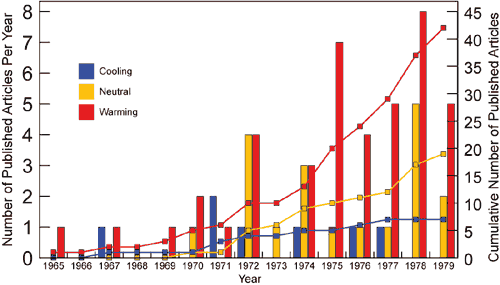
You're regurgitating complete nonsense. Once again, here’s figure 1 from Peterson et al. 2008. Notice that papers predicting warming vastly outnumbered those predicting cooling, even in the 1970s. Ironically:
- The term “global warming” was first used in a 1975 Science article by Wally Broecker called “Are we on the brink of a pronounced global warming?”.
- Sawyer 1972 estimated climate sensitivity as 2.4C, and Schneider 1975 gave a preliminary range of 1.5C to 3.0C.
- Manabe and Wetherald, 1975: “The Effects of Doubling the CO2 Concentration on the climate of a General Circulation Model.”
- In 1977, Freeman Dyson wrote that the “prevailing opinion is that the dangers [of the rise in CO2] greatly outweigh the benefits.”
- In 1977, Robert M. White, the head of the National Oceanic and Atmospheric Administration, wrote a report for the National Academy of Sciences that said “We now understand that industrial wastes, such as the carbon dioxide released in the burning of fossil fuels, can have consequences for climate that pose a considerable risk to future society.” [White, Robert, 1978, Oceans and Climate Introduction, Oceanus, 21:2-3]
- The 1979 JASON report “The long-term impact of atmospheric carbon dioxide on climate” estimated climate sensitivity as 2.4C to 2.8C.
- The National Academy of Science’s 1979 Charney report estimated climate sensitivity as 1.5C to 4.5C and said “If carbon dioxide continues to increase, [we] find no reason to doubt that climate changes will result, and no reason to believe that these changes will be negligible.”
While Jane is reading those papers, he should also consider addressing this issue with his basic thermodynamics:
Your own insistence that power in = power out (assuming perfect conversion and no entropic losses) belies this argument. You are arguing against yourself and you refuse to see that. If power in = power out (your own stipulation)
I'm not the only one insisting that power in = power out through any boundary where nothing inside is changing. Once again, that's a fundamental principle called "conservation of energy". Here are some introductions: example (backup), example (backup), example
-
Jane/Lonny Eachus goes Sky Dragon Slayer
If you have actual, direct evidence, why did you not link to THAT, rather than somebody else's claim? [Jane Q. Public, 2014-12-14]
I linked to reviews of actual, direct evidence by the U.S. National Academy of Sciences and The Royal Society (U.K.) in their joint publication (PDF), and another review of evidence by the American Association for the Advancement of Science, which publishes the journal Science.
While Jane is reading those reviews, he should also consider addressing this issue with his basic thermodynamics:
Your own insistence that power in = power out (assuming perfect conversion and no entropic losses) belies this argument. You are arguing against yourself and you refuse to see that. If power in = power out (your own stipulation)
I'm not the only one insisting that power in = power out through any boundary where nothing inside is changing. Once again, that's a fundamental principle called "conservation of energy". Here are some introductions: example (backup), example (backup), example (backup).
As you can tell, conservation of energy is a fundamental physics principle. Assumptions of "perfect conversion and no entropic losses" aren't applicable, and anyone who mistakenly thinks they are should read through those examples to learn about conservation of energy.
If power in = power out (your own stipulation), and the only NET power INTO a defined spherical region is electrical, and the only NET power OUT of that region is radiative, then net radiative power out at steady-state must therefore be equal to the net electrical power consumed. [Jane Q. Public, 2014-12-14]
Jane seems to be saying that at steady-state:
net electrical power consumed = net radiative power out
But net radiative power out of a boundary around the source = "radiative power out" minus "radiative power in", so the equation Jane just described also says:
net electrical power consumed = "radiative power out" minus "radiative power in"
However, this new equation doesn't match Jane's earlier equation:
My energy conservation equation is this: electrical power in = (epsilon * sigma) * T^4 * area = radiant power out [Jane Q. Public, 2014-10-08]
Notice that Jane's earlier equation doesn't describe net radiative power out, which is why it violates conservation of energy. Is Jane retracting his earlier incorrect equation, or does Jane dispute the definition of the word "net"?
-
Jane/Lonny Eachus goes Sky Dragon Slayer
Your own insistence that power in = power out (assuming perfect conversion and no entropic losses) belies this argument. You are arguing against yourself and you refuse to see that. If power in = power out (your own stipulation)
I'm not the only one insisting that power in = power out through any boundary where nothing inside is changing. Once again, that's a fundamental principle called "conservation of energy". Here are some introductions: example (backup), example (backup), example (backup).
As you can tell, conservation of energy is a fundamental physics principle. Assumptions of "perfect conversion and no entropic losses" aren't applicable, and anyone who mistakenly thinks they are should read through those examples to learn about conservation of energy.
If power in = power out (your own stipulation), and the only NET power INTO a defined spherical region is electrical, and the only NET power OUT of that region is radiative, then net radiative power out at steady-state must therefore be equal to the net electrical power consumed. [Jane Q. Public, 2014-12-14]
Jane seems to be saying that at steady-state:
net electrical power consumed = net radiative power out
But net radiative power out of a boundary around the source = "radiative power out" minus "radiative power in", so the equation Jane just described also says:
net electrical power consumed = "radiative power out" minus "radiative power in"
However, this new equation doesn't match Jane's earlier equation:
My energy conservation equation is this: electrical power in = (epsilon * sigma) * T^4 * area = radiant power out [Jane Q. Public, 2014-10-08]
Notice that Jane's earlier equation doesn't describe net radiative power out, which is why it violates conservation of energy. Is Jane retracting his earlier incorrect equation, or does Jane dispute the definition of the word "net"?
-
Re:What about Ammonia?
2NH3 -> N2 + 3H2
These guys have a simple and cheap way to produce hydrogen on demand for fuel cells.
I think the only way we're going to transition the current oil economy into zero emissions is to combine the best tech from electric cars with a liquid fuel.
-
Cooking with Potential Energy
I'm surprised no one has mentioned this oldie but goodie from university research labs in 1987: Cooking with Potential Energy: http://www.ohio.edu/mechanical/thermo/Intro/Chapt.1_6/energy/CookingPE.pdf.
Someone else did the math to try to figure out how high you would have to drop a turkey so it would be cooked by the time it got to the ground: http://www.wired.com/wiredscience/2010/12/cooking-a-turkey-by-dropping-it/ (answer: between 72Km and 142Km).
-
Re:Heathkit - good quality
thats what i want to see is a good AM/SSB 100Khz to 30Mhz) superhetrodyne shortwave receiver,
and a retro style multi-band tube type regenerative receiver (500khz to 10.01Mhz) like the old days http://www.ohio.edu/people/postr/bapix/GR81.htm
if they do that i will buy one of each. -
Reference
"we may need new protocols to deal with the large latency"
As others have noted, research along those lines is already in progress. Here's another reference:
http://www.ohio.edu/research/communications/space_communication.cfm
-
Re:Graduate school is too late to begin teaching t
3. As a researcher with over 20 unique research trials under my belt I've never seen evidence of "Fudging" data by any of the 30 or so other grad-students I've worked with over the past 6 years.
Then you aren't looking very hard. I think this type of behavior is running rampant in higher education. A report on academic dishonesty at Ohio University, (where a large number of students were found plagiarizing on their theses), found that 84% of undergrads and 55% of grad students had cheated within the last year. The report also mentions that 45% of undergrads and 18% of the grad students had engaged in serious forms of cheating, (they call it academic misconduct), in the last year.
Here is the report.
Take a look. It could be that people know you believe strongly in doing the right thing so hide their cheating from you as well.
-
Existing donation base issues.
One problem I see with your point: The existing donor base for a major uni like OU is gonna be massive because they have been feeding grads into it for about two centuries.
This link: http://www.ohio.edu/foundation/about.cfm
indicates a history of private sector donations going back to 1816. 2006 saw roughly 25 thousand people donate a total of $35 million USD. In 2004 the 'Bicentennial Campaign' concluded after bringing in 221 million USD.
How many successful alumni over the age of 50 are going to be clued into the details of current RIAA battles and tactics. How much do you think OU wants to avoid alienating the old school donors that, given the age of the campus and their long history of massive private sector fundraising, are probably a bit out of the demographic that cares enough to educate themselves on the RIAA related issues.
My grandma thinks downloading multimedia is stealing and would accuse you of trying to sell her snakeoil if you tried to convince her that absence of marginal costs for reproduction of the works changes the arguement. She is also very involved in alumni programs from another uni, including community charity and fund-raising activities. She has spent her retirement 'giving back' to the communities that had supported her throughout her life, and many of her friends did the same.
These people are *worth* more than a couple years of grads leaving with a bitter taste.
Regards. -
Re:isp's crying about having to provide what they
Ohio State http://www.osu.edu/ and Ohio University http://www.ohio.edu/ are two totally different universities.
-
what a student at OU knowsNote: I'm an undergrad living on campus here at OU.
This mainly comes from the RIAA letters and them covering their asses, and possibly from our new CIO (we've been through several in the past 5 years). The part about using up bandwidth is complete BS to me and I have never heard one word about limiting my network usage until those letters came. OU is in the process of upgrading all the buildings to gigabit.
It's my theory that we get so many letters here because every dorm with an Ethernet jack has a world viewable IP address (no NAT and as far as I can tell it's static, mine's been the same for about 100 days). That's all great for me, but I guess the RIAA likes it too. There was an open meeting about this today at 7pm, but I had a midterm. I'll look around for a transcript or something
Lastly, a copy of the email sent to students earlier today
-
Re:I don't get it
Ohio State != Ohio University
-
makes sense
So that's what these kids are so happy about.