Slashdot Mirror
Domain: paulgraham.com
Stories and comments across the archive that link to paulgraham.com.
Comments · 1,105
-
Re: I read too quickly for this
Entering "dwarsligger" into YouTube yields a 9 year old promotional video. This NYT article sounds like a Submarine.
-
Maker's Schedule, Manager's Schedule
I have always found this essay: http://www.paulgraham.com/make...
To be the best way to explain to managers/executives how to work with engineers.
-
Slashdot not all that different in some regards
The situation with Reddit is in some regards similar to what happens on Slashdot.
Bad comments seem to be a harder problem than bad submissions. While the quality of links on the frontpage of [HackerNews] hasn't changed much, the quality of the median comment may have decreased somewhat.
There are two main kinds of badness in comments: meanness and stupidity. There is a lot of overlap between the two—mean comments are disproportionately likely also to be dumb—but the strategies for dealing with them are different. Meanness is easier to control. You can have rules saying one shouldn't be mean, and if you enforce them it seems possible to keep a lid on meanness.
Keeping a lid on stupidity is harder, perhaps because stupidity is not so easily distinguishable. Mean people are more likely to know they're being mean than stupid people are to know they're being stupid.
The most dangerous form of stupid comment is not the long but mistaken argument, but the dumb joke. Long but mistaken arguments are actually quite rare. There is a strong correlation between comment quality and length; if you wanted to compare the quality of comments on community sites, average length would be a good predictor. Probably the cause is human nature rather than anything specific to comment threads. Probably it's simply that stupidity more often takes the form of having few ideas than wrong ones.
Whatever the cause, stupid comments tend to be short. And since it's hard to write a short comment that's distinguished for the amount of information it conveys, people try to distinguish them instead by being funny. The most tempting format for stupid comments is the supposedly witty put-down, probably because put-downs are the easiest form of humor. [5] So one advantage of forbidding meanness is that it also cuts down on these.
Bad comments are like kudzu: they take over rapidly. Comments have much more effect on new comments than submissions have on new submissions. If someone submits a lame article, the other submissions don't all become lame. But if someone posts a stupid comment on a thread, that sets the tone for the region around it. People reply to dumb jokes with dumb jokes.
Maybe the solution is to add a delay before people can respond to a comment, and make the length of the delay inversely proportional to some prediction of its quality. Then dumb threads would grow slower. [6]
And this
It's pretty clear now that the broken windows theory applies to community sites as well. The theory is that minor forms of bad behavior encourage worse ones: that a neighborhood with lots of graffiti and broken windows becomes one where robberies occur. I was living in New York when Giuliani introduced the reforms that made the broken windows theory famous, and the transformation was miraculous. And I was a Reddit user when the opposite happened there, and the transformation was equally dramatic.
It all sounds remarkably similar for me to what's happening here, honestly. Hopefully the Slashdot moderators are listening and thinking about ways to value contributors who introduce comments which inspire critical, independent thinking. My own personal experience has been that Slashdot's karma system is not at all rewarding people who introduce novel arguments. Arguments are generally rated according to whether or not they diverge from that which we've all been taught, and there is no emphasis upon the inherent value of critique which inspires thought -- and over time, change.
-
How to escape "The Pleasure Trap"
(using food as an example): http://web.archive.org/web/201...
And for screen time, books like:
* "Reset Your Child's Brain: A Four-Week Plan to End Meltdowns, Raise Grades, and Boost Social Skills by Reversing the Effects of Electronic Screen-Tim" by Victoria L. Dunckley MD"
* "Glow Kids: How Screen Addiction Is Hijacking Our Kids - and How to Break the Trance" by Nicholas Kardaras (Author)
See also for the big picture:
https://en.wikipedia.org/wiki/...
http://www.paulgraham.com/addi... -
Cigarette company sponsored Twilight Zone
Rod Serling had to smoke on camera as product placement because the Twilight Zone -- like many other popular TV shows -- was sponsored by the Chesterfeld cigarette company.
https://en.wikipedia.org/wiki/...
"Liggett & Myers [who produced Chesterfeld cigarettes] sponsored Dragnet, both on radio and on TV, during the 1950s. The 1954 theatrical version of Dragnet also had Chesterfield product placements, such as advertisements in scenes taking place at drug stores and news counters, or cigarette vending machines. Jack Webb as Sgt. Joe Friday was seen smoking Chesterfields in the movie and TV series. Also in the 1950s, Gunsmoke on both radio and TV was similarly sponsored primarily by Chesterfields and L&Ms. At the end of The Twilight Zone, for several seasons Rod Serling frequently smoked and promoted Chesterfields. In the 1940s and 1950s Ronald Reagan, Bob Hope, Bing Crosby, Perry Como, and Arthur Godfrey were among Chesterfield's official spokesmen; Chesterfield being one of the primary sponsors of the radio and TV programs of these stars during that time."Sad how then and now so much evil addiction is foisted on the world in order to make a buck.
https://en.wikipedia.org/wiki/...
http://www.paulgraham.com/addi...
http://web.archive.org/web/201...Smoking may have contributed to Sterling's tragic early death of heart attack at age 50.
https://en.wikipedia.org/wiki/...
"On May 3, 1975, Serling had a minor heart attack and was hospitalized. He spent two weeks at Tompkins County Community Hospital before being released.[66] A second heart attack two weeks later forced doctors to agree that open-heart surgery, though considered risky at the time, was in order.[67][68] The ten-hour-long procedure was carried out on June 26, but Serling had a third heart attack on the operating table and died two days later at Strong Memorial Hospital in Rochester, New York.[69] He was 50 years old.[63] His funeral took place on July 2."https://www.webmd.com/heart-di...
"About 20% of deaths from heart disease in the U.S. are directly related to smoking."Was promoting smoking in order to make the Twilight Zone was in a way Serling's own deal with the devil? Was it a good deal? I enjoyed the show and learned some important thought-provoking moral lessons from it. I admire Stirling for making it. But the deal perhaps took decades away from his life and the lives of many viewers. It's perhaps yet another cautionary tale from
-
Check why startups condense in America?
Check why startups condense in America? http://www.paulgraham.com/amer...
-
Why target nonexistent system
Well actually not so silly. An article on the hundred year computer language provided good insights that recommend it. These insights among others fueled the scientists who built Perl 6, a new advanced language. Or more closer to home, a cousin of mine invented the bar code. He did it in an interesting fashion, by dragging his fingers through sand at the beach and having an epiphany, apparently. The point being that laser scanners did not exist then as far as I know. It is a kind of bootstrapping.
http://www.paulgraham.com/hund... -
Re:The problem with breaking backward compatibilit
I think you ought to test/validate your assumptions and consider evaluating what Perl 6 has to offer. Many of the core Perl 6 developers had little experience or interest in Perl 5. The pace of development and number of committers seems to be accelerating.
Performance has gotten about 4 times faster in the last year.
The developer ecosystem is maturing. CPAN6 is here.
Perl 6 provides Inline::Perl5. Which allows backward compatible access to and mixing of Perl 5 and Perl 6. It also allows you to specify a versioned dialect of Perl 6. So in ~10 years when Perl 6.i is released. Your code targeting Perl 6.d functionality which has been deprecated in 6.e and removed in 6.f will still work.
The design and implementation of Perl 6 is clean and heavily influenced by Paul Graham's essay on The Hundred-Year Language. Most of Perl 6 is written in both Perl 6 and a subset of Perl 6 called Not Quite Perl (NQP). Which means Perl developers don't need to learn another language to become core developers.
Larry said that acceleration beats velocity. Perl 6 certainly seems to be accelerating. If you watch the video... there's a lot of exciting things baked into Perl 6. However the focus is on getting things right, clean, and fast (in that order). If/when performance gets within ~10-20% of Perl 5, Python, etc... I think the expressiveness and strangely consistent and clean language design will prompt many to re-evaluate their concept of Perl.
-
Maker's Schedule vs Manager's Schedule
A persistent problem in project management is that managers are on the manager's schedule while the developers and engineers are on the maker's schedule. This problem was described very well by Paul Graham in the original Maker's Schedule, Manager's Schedule article and was discussed here on Slashdot 8 years ago and it's still a problem. Failure to understand and appreciate these observations is the source of much wasted time on many software projects.
-
Lamentations about addiction on tablets ... maybe?
http://quoteinvestigator.com/2...
"The earliest instance known to QI of this prototypical claim was printed in the August 1908 issue of a periodical for bicyclists called "Bassett's Scrap Book". A short item contrasted the modern age to ancient times and presented a variation of the epigraph:
> The "good old times" seemed as bad to the "good-old-timers" as the present times seem to the modern man, as shown by the following translation on an inscription on a tablet in the Imperial Museum at Constantinople, Turkey:--
>> Naram Sin, 5000 B.C.
>> We have fallen upon evil times, the world has waxed old and wicked. Politics are very corrupt. Children are no longer respectful to their elders. Each man wants to make himself conspicuous and write a book."But see also:
https://en.wikipedia.org/wiki/...
"The lament for Sumer and Urim or the lament for Sumer and Ur is a poem and one of five known Mesopotamian "city laments"â"dirges for ruined cities in the voice of the city's tutelary goddess.
The other city laments are:
The Lament for Ur
The Lament for Nippur
The Lament for Eridu
The Lament for Uruk
In 2004 BCE, during the last year of King Ibbi-Sin's reign, Ur fell to an army from the east.[1] The Sumerians decided that such a catastrophic event could only be explained through divine intervention and wrote in the lament that the gods, "An, Enlil, Enki and Ninmah decided [Ur's] fate"[2]
The literary works of the Sumerians were widely translated (e.g. by the Hittites, Hurrians and Canaanites), and the world-renowned expert in Sumerian history, Samuel Noah Kramer, wrote that later Greek as well as Hebrew texts "were profoundly influenced by them."[3] Contemporary scholars have drawn parallels between the lament and passages from the bible (e.g. "the Lord departed from his temple and stood on the mountain east of Jerusalem (Ezekiel 10:18-19)."[4]"Part of what is going on in various ways in cities expecially for millennia "like moths to a flame":
https://mitpress.mit.edu/books...
https://en.wikipedia.org/wiki/...
http://www.paulgraham.com/addi...
http://web.archive.org/web/201...Related books maybe of interest (all easier read than done):
* "The Cyber Effect: A Pioneering Cyberpsychologist Explains How Human Behavior Changes Online" by Mary Aiken
* "Wired Child: Reclaiming Childhood in a Digital Age Paperback" by Richard Freed
* "Reset Your Child's Brain: A Four-Week Plan to End Meltdowns, Raise Grades, and Boost Social Skills by Reversing the Effects of Electronic Screen-Time Paperback" by Victoria L. Dunckley MD -
Paul Graham
Said it all about interruptions for programmers and other makers. http://www.paulgraham.com/make...
-
Re:Logis, Ethos, Pathos
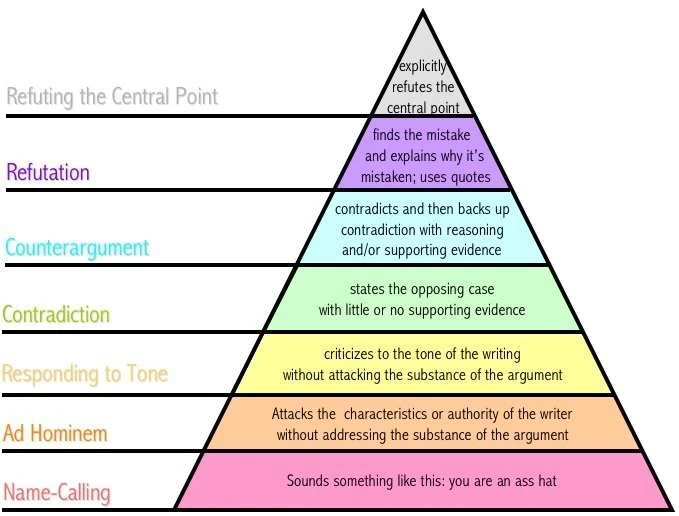
A lot of times the issue can be addressed by referring to the argument hierarchy, where lower levels are worse, higher levels are better. For a fuller exposition, Paul Graham goes into it.
TBH sometimes the lower levels are the most fun, but the top is the most satisfying. -
We worship at the altar of youth here.
The problem is that our industry, unlike every other single industry except acting and modeling (and note neither are known for "intelligence") worship at the altar of youth. I don't know the number of people I've encountered who tell me that by being older, my experience is worthless since all the stuff I've learned has become obsolete.
This, despite the fact that the dominant operating systems used in most systems is based on an operating system that is nearly 50 years old, the "new" features being added to many "modern" languages are really concepts from languages that are between 50 and 60 years old or older, and most of the concepts we bandy about as cutting edge were developed from 20 to 50 years ago.
It also doesn't help that the youth whose accomplishments we worship usually get concepts wrong. I don't know the number of times I've seen someone claim code was refactored along some new-fangled "improvement" over an "outdated" design pattern who wrote objects that bare no resemblance to the pattern they claim to be following. (In the case above, the classes they used included "modules" and "models", neither which are part of the VIPER backronym.) And when I indicate that the "massive view controller" problem often represents a misunderstanding as to what constitutes a model and what constitutes a view, I'm told that I have no idea what I'm talking about--despite having more experience than the critic has been alive, and despite graduating from Caltech--meaning I'm probably not a complete idiot.)
Our industry is rife with arrogance, and often the arrogance of the young and inexperienced. Our industry seems to value "cowboys" despite doing everything it can (with the management technique "flavor of the month") to stop "cowboys." Our industry is agist, sexist, one where the blind leads the blind, and seminal works attempting to understand the problem of development go ignored.
How many of you have seen code which seems developed using "design pattern" roulette? Don't know what you're doing? Spin the wheel!
Ours is also one of the fewest industries based on scientific research which blatantly ignores the research, unless it is popularized in shallow books which rarely explore anything in depth. We have a constant churn of technologies which are often pointless, introducing new languages using extreme hype which is often unwarranted as those languages seldom expand beyond a basic domain representing a subset of LISP. I can't think of a single developer I've met professionally who belong to the ACM or to IEEE, and when they run into an interesting problem tend to search Github or Stack Overflow, even when it is a basic algorithm problem. (I've met programmers with years of experience who couldn't write code to maintain a linked list.)
So what do we do?
Beats the hell out of me. You cannot teach if your audience revels in its ignorance and doesn't
-
We worship at the altar of youth here.
The problem is that our industry, unlike every other single industry except acting and modeling (and note neither are known for "intelligence") worship at the altar of youth. I don't know the number of people I've encountered who tell me that by being older, my experience is worthless since all the stuff I've learned has become obsolete.
This, despite the fact that the dominant operating systems used in most systems is based on an operating system that is nearly 50 years old, the "new" features being added to many "modern" languages are really concepts from languages that are between 50 and 60 years old or older, and most of the concepts we bandy about as cutting edge were developed from 20 to 50 years ago.
It also doesn't help that the youth whose accomplishments we worship usually get concepts wrong. I don't know the number of times I've seen someone claim code was refactored along some new-fangled "improvement" over an "outdated" design pattern who wrote objects that bare no resemblance to the pattern they claim to be following. (In the case above, the classes they used included "modules" and "models", neither which are part of the VIPER backronym.) And when I indicate that the "massive view controller" problem often represents a misunderstanding as to what constitutes a model and what constitutes a view, I'm told that I have no idea what I'm talking about--despite having more experience than the critic has been alive, and despite graduating from Caltech--meaning I'm probably not a complete idiot.)
Our industry is rife with arrogance, and often the arrogance of the young and inexperienced. Our industry seems to value "cowboys" despite doing everything it can (with the management technique "flavor of the month") to stop "cowboys." Our industry is agist, sexist, one where the blind leads the blind, and seminal works attempting to understand the problem of development go ignored.
How many of you have seen code which seems developed using "design pattern" roulette? Don't know what you're doing? Spin the wheel!
Ours is also one of the fewest industries based on scientific research which blatantly ignores the research, unless it is popularized in shallow books which rarely explore anything in depth. We have a constant churn of technologies which are often pointless, introducing new languages using extreme hype which is often unwarranted as those languages seldom expand beyond a basic domain representing a subset of LISP. I can't think of a single developer I've met professionally who belong to the ACM or to IEEE, and when they run into an interesting problem tend to search Github or Stack Overflow, even when it is a basic algorithm problem. (I've met programmers with years of experience who couldn't write code to maintain a linked list.)
So what do we do?
Beats the hell out of me. You cannot teach if your audience revels in its ignorance and doesn't
-
Reminds me of Yahoo.
They had the same confusion over being a media vs. a tech company. Though with the way FB has been trying to promote their own political agenda, they most definitely aren't behaving like a pure tech company that's only focused on their platform.
-
PR piece
I'm probably too cynical, but any story like this I assume it's a PR piece. Maybe pre-hyping some other announcement, or playing down the recent story about Apple expected life times.
-
The real question: Is ASD really a disorder?
Makes me wonder how long it's worth continuing to live, if it's just going to get worse from here.
Well there, let's just not get all worked up about this.
The question to me is wether ASD is really a disorder or rather a preposition that makes a person optimal for certain tasks and not good at others.
It is also measurably common that people who are more intelligent than the average are considered having an ASD, although they're just being less stupid and mundane than the people around them. The problem being that smart people look like crazy people to dumb people.
I favour this theory of genetic preposition. There are things such as abstract thinking, grasping meta-concepts, solving hard problems, not backing down from a fight, seeing beyond the general populations everyday horizon, etc. that 95% of the population would utterly despair at. People who come into my office have their skin crawling in just about sheer horror when they see my screens littered with code, editor and terminal windows
They also think I'm a weirdo because I rather read stoic philosophy or go tango dancing than get drunk on a saturday night. I, however, see no point whatsoever in going into Duesseldorfs cramped and hideously expensive old town to get loaded while loosing 50 euros or more a night. The girls think it's peculiar that I turn a date into an artful celebration and think I'm some romantic weirdo - which I am - but they *do* dig it once they get what I'm up to. Very much, AFAICT.
Likewise I don't get why anyone would rag on about someone behind his back and not be able to be straightforward when the person is around. I consider it cowardice. I do lie in social situations, just not as often as others. I'd rather be frank and straighforward - even if people think I'm a weirdo and awkward that way and it makes them uncomfortable. I love and crave to be popular, but I value knowlege and skill and honest over popularity in quite a few situations. Paul Graham was spot on about this.
I'd rather make a splash and be noticed than go unseen - which is more often than it is good for me - admitted.
I also like to debate - more often than people around me - which does make me annoying at times.Does that make me an ASD candidate - D as in "disorder"? I think not. I'm more predisposed to being a leader, innovator, bum or terrorist than a "regular guy" - which makes me exciting, interesting but sometimes also more stenuous to be around. Why bum? Just like many of 'us' I'd rather do nothing or slack off in front of my console that do something I consider utterly pointless. Why terrorist?
I'm a hunter / gatherer / pathfinder in a society with a large majority of settlers & farmers and every patch of land mapped out and explored already.
There is so much going wrong in our society, and a lot has to do with broken social traditions and superstition that someone who's diagnosed with "mild ASD" or whatever might just actually be the more healthy person. Elon Musk is a stutterer who can't finish a sentance without tons of ums and ahs and his muttering is difficult to understand at times - no way would I dare call im disordered. He's probably irritated that he has to explain the most fundamental underpinnings of his motivation again and again. AFAICT the man is a freaking genius - and just because he'd rather give away his patents to save the planet that rake in tons of short-term cash doesn't make him a freak - it makes him a healthy person with a very high moral standard.
Bottom Line:
"It is no measure of health to be well adjusted to a profoundly sick society." - Jiddu Krishnamurti
I couldn't say it any better.
-
Programming's a lot about design, so yes!
As a tech employer, I would not hire a liberal arts major for a technical position
As a programmer for ten years, I would definitely hire a liberal arts major for a programming position. After working alongside several and interviewing others, I have to echo the professor who wonders if his students have any kind of taste.
They may know the syntax. In fact anyone can learn that in a couple of weeks. What I keep running into, though, are programmers who can't program their way out of a paper bag, who would stare at me blankly if I quoted Brian Kernighan when he said "Controlling complexity is the essence of computer programming."
Actually lately it seems a liberal arts major is about as likely as a science major to know anything about design. But I will tell you that I would hire a gifted musician, painter, or journalist that shows the seed of understanding good design, over a humdrum programmer who's like, "If it runs it's good."
-
Two Reactions
First: Some of the best stuff I ever worked on was entirely by me. For one thing, you don't have to get your point across to another person to know what you are trying to accomplish. Its actually very hard for lots of people to share a vision and work on it.
Second: http://www.paulgraham.com/head... -
On Drugs, Performance and ADHD
What a load of shit. Luckily there are other MD's posting in the comments on just how biased this writer is. He's basically claiming ADHD is a kid's only issue, and all adults are just abusers. People like him must HATE people like myself...a doctor-monitored adderall prescription for several years now. With it, I'm able to more fully use my capabilities. Without it, people would always comment "your really smart, but..." due to all the random and chaotic things I would do and say. Honestly, without my prescription I'd probably either be dead or in jail. Even so, being unmedicated has already lead to the accidental death of someone VERY close to me...if I had been on it then I probably would have thought the situation through further. So this guy can go fuck himself, and I'd tell that to his face is ever given the chance.
My uncle tells me ADHD runs in our family. However, I consider the frictions in our family to be normal or based on psychological heritage brought down from a grandmother incapable of handling 4 children and having an immoral stance on her responsiblities. Plus living in an ending WW2 in Germany, including carpet bombings, fleeing Koenigsberg and Stetin to the Rhine area and being fugitives and 3rd class citizens as a result. Such things are passed down, no doubt.
I also think of my uncles ADHD fixation as an excuse for his alcoholism - he like to rag on how ADHD people work better with drugs. I would allot his problems to the regular beatings his generation received.However, I do have character traits that some people would consider "ADHD".
I wouldn't. Or at least I would consider them to be a disability. I would appreciate the theory that my brain works differently due to me moving around roughly once a year during most of my childhood and said psychological heritage.I'm basically a hunter-gatherer in a farmer-settlers world, or should I say: I'm adapted to hunter-gatherer mode in a world that is currently mostly adapted to farmer-settler mode. Yes, I'm one of those pretty much down with that theory.
While others have spent their entire childhood at one place, I had to move around a lot. I intimately and intuitively know things about this world and the people in them that others have to learn in hard lessons. I smell a con from 10 miles away, I can handle myself in a fight and I spot financial risks or flaws in complex systems (such as software architecture) in an instant. I find the usual vanity that comes with societies living in abundance strange, bizar, pointless, silly and sometimes flat-out repulsive. I recently re-read Paul Grahams Why Nerds are unpopular and I have to say the man once again pretty much hits home - read it if you can relate to what I am saying. That essay pretty much sums up my youth and the way I feel about the world and the people around me a lot of times. If I'm having ADHD it is not a disease, but a natural reaction to the at times bizar and backwords world around me.
However, there are things I struggle with that others have no problem dealing with. Regular chores or maintaining a home with more that two rooms. And who wouldn't? I'm just this week picking up Scala and starting a new company internal software project. A the side I'm keeping my mood by going out or doing some sort of contrast programm. I don't have *time* to do the laundry regularly.
I run up to speed when shit hits the fan. Basically I consider any other situation boring. Which, let's face it, it usually is.
I also see absolutely no point what so ever in performing in a job that is basically 90% pointless. I'm the lead developer in an agency and 90% of my work is politics and explaining to customers the difference between a client and a server and what the internet is and how it works. And the difference between Google and the Web - which very many people do not know or are aware of. And setting up WordPress and repairing the junkpile the last plugin-testing frenzy my project people left behind.
-
Re:Way too many humanities majors
I don't think you understand what engineers do
Solving equations and applying them to a requirement isn't "critical thinking".
Solving equations and applying them to a requirement? How is that even suppose to work? That's not how scientists or engineers work.
Critical thinking is knowing when and when not to apply those equations where there are no scientific theories to fall back on.
When there are no scientific theories to fall back on? Again, this is not how science or engineering works. It just does not happen that a researcher or a techie would find herself in a scientific-theory-less void with an equation on her hand considering whether to apply it or not. If you find yourself in that position you are not doing STEM.
The study of humanities can provide something called "perspective", which I find lacking in a lot of otherwise intelligent people who happen to be engineers. You can be excellent at engineering and make a product that no one wants to use and have your job shipped off to someone who is equally good at logic and solving equations, but whose education is limited to rote learning of STEM with hilarious results when they are faced with a requirement that necessitates the least bit of critical thinking.
Sorry, but this is just all wrong. First of all - studying humanities will not give you that kind of perspective, as in - understanding what kind of product will be successful. Paul Graham, for instance, studied philosophy and arts before switching to programming and his first big project - online galleries still ended up not being used by anyone.
You see, there are different kind of "perspectives". In humanities, you might learn the "historical", "philosophical", "anthropological", etc. perspective and none of them will help you understand much what products people want to use. That kind of understanding comes with experience in the business.
Second, don't assume people overseas are dumb and incapable of critical thinking. That's really arrogant.
Steve Jobs famously dropped out of college, but dropped in to take things like calligraphy courses. You needed good engineers at Apple to make a product, but you needed good designers and people willing to think... uh... differently about problems to make their product valuable to humans above and beyond their immediate technical capabilities. There are people who will buy an iPhone over a more modern and capable Android device because Apple is actually looking at more than pure engineering in making a device.
So where are all the other tech leaders with humanities degrees giving them the extra advantage? Bill Gates does not have one, nor does Elon Musk. Hewlett and Packard? Page and Brin? Lee Kun-hee? Jeff Bezos? None of them have one. I'm not saying that you can't have a humanities degree in order to be successful, it's just if you care to apply your precious critical thinking on your own statements you'll find that Jobs is kind of an outlier in the top tier of tech innovation.
I like solving problems that have clear answers and applying those answers. However, I derive a whole lot more satisfaction in what I do by being able to put it into the perspective of history and the human condition.
That sounds like hubris. I don't know who you are and what you do in real life but judging by your prose here, you don't seem like a person who needs to have his work put into the perspective of history and the human condition just yet. Don't sweat it - if it's good enough, other people are going to do that for you.
-
Bigger issue is tools of abundance to go with agr.
If we did not have weapons based on the tools of abundance like nuclear bombs as a result of harnessing abundant nuclear energy, aggression out-of-control would not be such a big global issue and threat (even if aggression could always be a local issue). Ironically, harnessing nuclear power and other forms of advanced technology that could produce abundance (including abundant destruction) like robots and new materials has removed the reasons for much aggression over material goods, but we still are stuck in our old mindset emphasizing aggression as a way to deal with material scarcity. So, for example, we are ready to use nuclear energy in the form of nuclear weapons delivered by robotic cruise missiles whose batteries were charged by solar panels to fight over oil fields on the other side of the planet from us -- instead of using nuclear energy (or robot-constructed solar panels or whatever) to generate power locally. Image what the 21st century could have been like without two Word Wars if 1910s and 1930s Germany had worked towards breakthroughs in solar power and energy efficiency and agricultural efficiency instead of trying to steal someone else's coal and land. Now Germany focuses inward on innovation and efficiency and is peaceful and the economic powerhouse of the European Union.
I wrote about this broad issue at length here:
"Open Letter to the Intelligence Advanced Programs Research Agency (IARPA)"
http://www.phibetaiota.net/201...
"The greatest threat facing the USA is the irony inherent in our current defense posture, like for example planning to use nuclear energy embodied in missiles to fight over oil fields that nuclear energy could replace. This irony arises in part because the USA's current security logic is still based on essentially 19th century and earlier (second millennium) thinking that becomes inappropriate applied to 21st century (third millennium) technological threats and opportunities. That situation represents a systematic intelligence failure of the highest magnitude. There remains time to correct this failure, but time grows short as various exponential trends continue.That's the big issue as I mention in my sig, and it plays out in other ways including with food, media, addiction, and so on as human traits adapted evolutionarily for scarcity cause difficulties when confronted with some sorts of modern abundance.
http://www.drfuhrman.com/libra...
http://en.wikipedia.org/wiki/S...
http://www.paulgraham.com/addi...
http://www.pdfernhout.net/the-...
http://www.nancycarlssonpaige....
http://dianeelevin.com/sosexys...All that said, cooperation within groups has also been a key trait of human beings.
"No contest: the case against competition"
http://www.shareintl.org/archi...But it is true that humans tend to have in group cooperation and out-group competition, something E.O. Wilson has written about. And human mating rituals also often revolve around proving something to stand out from the crowd, like James P. Hogan touches on in "Voyage From Yesteryear" depicting a culture where people compete by demonstrating excellence in some area. So, again, the biggest issue is not aggression or competition itself, but how those impulses are culturally directed. As. Mr. Fred Rogers' sang: "What do you do with the mad that you feel?" That is the question.
BTW, bacteria are actually the dominant species on this planet,
-
Re:Keep kids from computers as long as possible
While what you say is indeed true, in practice the farther human behavior changes from what we are adapted for, the more stress people are under and the more likely social systems and/or the people in them will fail. In the case of early development up to age two to four, it seems clear humans are wired for learning from social interactions with caregivers as well as physical hand-eye interactions with the natural environment including rocks, plants, sand, water, and so on. Still, on the plus side, one reason tablets are so successful with young children compared to interfaces that require a mouse or trackpad is that it supports the direct hand-eye manipulation young kids seem wired for.
So, while it is true that me could in theory do better, the human brain being flexible, it is not clear that anything we have done in modern times has overall made the experience of being a young child any better than it was 10,000 years ago (other than perhaps reduced infant mortality). Even the modern diet is mostly destructive to health, although obviously it is generally better than starving to death. Addictions also exploit human adaptations that once made sense (preferring sweet, fat, and salt) where when industrialized foods are engineered to emphasize those things to the exclusion of all else, the end result is people's health suffering even as their body tells them to keep eating junk. I've posted links several times before about books and essay by other people on how to escape the pleasure trap, on supernormal stimuli, and on the acceleration of addictiveness and similar things.
http://www.drfuhrman.com/libra...
http://www.amazon.com/Supernor...
http://paulgraham.com/addictio...
http://www.amazon.com/So-Sexy-...
http://www.amazon.com/War-Play...These things could apply to children of any age as well as adults. And likely that includes something TV and various games exploit, which is a "startle reflex" to moving things that forces the human mind to pay immediate attention to them, since in the past humans who did not may have died from a snake bite or tiger or whatever. But now, continually changing TV images can use that reflex to keep us captivated, even while our body or the rest of our lives suffer. For example:
http://en.wikipedia.org/wiki/O...
"In his 2007 book The Assault on Reason, Al Gore posited that watching television has an impact on the orienting response, an effect similar to vicarious traumatization."As people grow up through their mid-twenties, parts of the brain develop that provide more control for longer term planning, with perhaps some more hope of dealing with the worst of all this. But for young children, they are easy prey to people who would somehow make money of this, whether food scientists or media content providers or tablet software developers. And parents are so overburdened between two full-time wage earners and their own pleasure traps with extended families so broken up that there is little time for parents to deal with all the possible traps for their children. Kids remain resilient, and learn from everything they do, but there are still issues of long-term happiness and the quality of the experience. Or, in other words, manufactured ice cream may seem yummy, but it is ultimately is bad for the health if consumed in mass quantities. And if we spend all our will power resisting the lure of ice cream, then there is little left over to resist other things or do other tasks.
See also stuff on "Ego depletion"
http://en.wikipedia.org/wiki/E...
"Ego dep -
Most of them?
Most people can learn how to write a program that works. Few master design. Paul Graham wrote a great essay on design that captures what I mean: Taste for Makers. This is crucial because, as Brian Kernighan said, "Controlling complexity is the essence of computer programming."
I've worked with just a few web programmers and interviewed just a few more. But in talking with friends and coworkers, reading articles, and in general just living in America, I get the impression that a sense of design is not a prominent part of American culture. In general we think that bigger is better, newer is better, and expensive is better. In general these are really bad criteria.
Then again, maybe it's that people can't even program. Jeff Atwood tells about how many programmers struggle with even simple FizzBuzz Questions:
Write a program that prints the numbers from 1 to 100. But for multiples of three print "Fizz" instead of the number and for the multiples of five print "Buzz". For numbers which are multiples of both three and five print "FizzBuzz".
-
Re:This sounds silly ...
To defend your coworker here for a moment, I think he was talking about the general concepts of abstraction and DWIM (do what I mean). It is indeed true that Common Lisp and (perhaps to a slightly lesser extent) Scheme do this better than just about any other programming languages out there partially because it supports stuff like weak (actually, optionally strong) typing and first class functions long before 'modern' scripting languages popularized them, but mostly because by essentially having one single syntactic structure -- (DoThis To This Stuff) -- you are able to easily use self-analyzing and self-modifying code via macros. Since you brought up "it" in your post, I think a good and interesting example is Paul Graham's "anaphoric" macros from his book On Lisp ( http://www.paulgraham.com/onli... )
Macro definition of "aif": (defmacro aif (test-form then-form &optional else-form)
‘(let ((it
(if it
Now, the regular if is uses an (if this then_do_this else_do_this) form. Paul's macro functions exactly as if except the word "it" is now automatically variable referring to the value returned by 'this' in the preceeding if usage example. Thus, an example usage of aif:
(aif [really_friggin_long_to_type_and_computationally_expensive_thing] (print it) (print "null value error"))
The "it" variable is lexically scoped only within the aif, and in Lisp variables can be "shadowed" by interior redefinitions an arbitrary number of times (basically, once you hit the relevant ")" the higher-up definition of "it" takes over once again), so you can chain together consecutive or nested aifs seemlessly. And of course you can build aands, awhiles (very useful), etc. Note that usage of macros do not result in runtime slowdowns, only (potentially) compile-time slowdowns. Also note how simple of an example this is--look at how short that macro definition was. And once you train yourself to comprehend the ()s, it's perfectly and easily readable.
Common Lisp's generic functions (i.e. methods, except not hopelessly hobbled and limited in scope) are another good example of JustDoIt style programming. Also note that you can override the default definition of any operator/function so that, if you really felt like it, you could replace if's definition with aif.
None of this gets you out of actually defining what "it" is in JustDoIt (you are stuck with that in any language), but if done properly this kind of flexibility and abstraction results in code that is both more readable and more modular / maintainable. And it's a fast language, DAMN fast if you know what you're doing. Faster than Java, if you turn on the proper optimizations. No need for an interpreter--most of the heavy lifting can be done at compile time.
Just to show I'm not a total fanboy, almost all of the Lisps suffer from "good enough" syndrome and crotchety old man syndrome. The concept of M-Expressions (i.e. infix syntax, i.e. not having to use ()s all over the damn place) was abandoned because S-Expressions turned out to be so incredibly powerful. Power is good, but if you make it mandatory you jack up the learning curve unnecessarily, as well as make some things harder to read or as well as requiring more keystrokes to program... although I must say if you do pattern X more than once, you can always abstract out whatever pattern X is--just as aif abstracts out the pattern of evaluating an expression and then binding the return value to a disposable variable. That's the blessing/curse of Lisp. It's so easy for a journeyman Lisper to fix the warts in the language that no one ever fixes them in the language spec itself, and that unnecessarily scares off the noobs.
That, and there is just way, way too much fad-ism in computer languages... of which Java's popularity is possibly the best example. -
Why Educational Technology Has Failed Schools
"Stay on task" like a workhouse or factory? Whose task? To what end?
The new (yet old) paradigm is learner-directed education. A healthy kid's own natural curiosity and desire to succeed then helps him or he power through challenges (if it has not been wiped out before then through boredom/confusion or rewards/punishments). However, most software and even internet content is not that educational and so is a rough fit. We need more good stuff, especially FOSS educational simulations. If kids are not choosing to learn important things with at least some of their time, we need to ask why? What sort of messages are we sending kids about what we value as a society (like what is on TV)?
See also my essay:
"Why Educational Technology Has Failed Schools"
http://patapata.sourceforge.ne...
"Ultimately, educational technology's greatest value is in supporting "learning on demand" based on interest or need which is at the opposite end of the spectrum compared to "learning just in case"
based on someone else's demand.Compulsory schools don't usually traffic in "learning on demand", for the most part leaving that kind of activity to libraries or museums or the home or business or the "real world". In order for compulsory schools to make use of the best of educational technology and what is has to offer, schools themselves must change.
So, there is more to the story of technology than it failing in schools. Modern information and manufacturing technology itself is giving compulsory schools a failing grade. Compulsory schools do not pass in the information age. They are no longer needed. What remains is just to watch this all play out, and hopefully guide the collapse of compulsory schooling so that the fewest people get hurt in the process."That said, I strongly believe that there needs to be a way to ensure families have the resources they need to raise healthy educated kids (including paying for tutors and classes as desired). I feel a "basic income" from birth could be part of the answer to that (John Holt suggests that in "Escape from Childhood"), and would provide families with plenty of money to pay for their children's education as desired or time to teach their own. Until then, consider:
http://www.pdfernhout.net/towa...
"New York State current spends roughly 20,000 US dollars per schooled child per year to support the public school system. This essay suggests that the same amount of money be given directly to the family of each homeschooled child. Further, it suggests that eventually all parents would get this amount, as more and more families decide to homeschool because it is suddenly easier financially. It suggests why ultimately this will be a win/win situation for everyone involved (including parents, children, teachers, school staff, other people in the community, and even school administratorsAlso, there are so many addicting aspects to modern society, parents need better support in managing that for their children (rather than even more kid-targeted commercials and so on). The problem and some partial solutions:
http://en.wikipedia.org/wiki/S...
http://www.paulgraham.com/addi...
https://www.drfuhrman.com/libr...
http://www.pdfernhout.net/the-... -
Being reflective on pros and cons of technology...
"In other words, power corrupts. It should really be regarded like super-heroin: no matter your initial purposes for getting it, you will be addicted and unwilling to put it down, until keeping it and getting more is all that really matters to you anymore. Which explains why the world is so dysfunctional: every society is led by junkies."
If "power" is addictive, maybe that explains the outrage on Slashdot regarding a plea to limit internet speed and access?
More seriously, while you may well be right about the political motivation in this case, there was a recent Slashdot article on how social networks make people more depressed, and here are links to stuff by Paul Graham on the "Acceleration of Addictivess" and so on.
http://tech.slashdot.org/story...
http://www.paulgraham.com/addi...
http://www.amazon.com/Supernor...
http://www.sparringmind.com/su...
http://www.drfuhrman.com/libra...
http://www.amazon.com/Moths-Fl...
http://www.amazon.com/Autonomo...And something by Bill Joy on "How the Future Does Not Need Us".
http://archive.wired.com/wired...One other example of what we have lost:
http://en.wikipedia.org/wiki/N...
"Nature deficit disorder refers to a hypothesis by Richard Louv in his 2005 book Last Child in the Woods that human beings, especially children, are spending less time outdoors resulting in a wide range of behavioral problems.So there are many obvious negatives of modern technology. Look at all the concern on Slashdot about ubiquitous surveillance of everyone that was effectively impossible decades ago. I don't know what the general solution is for the USA regarding technological choices. Obviously Iran has its own political and social dynamics and what may be right for that culture may not be right in the USA. But I'd suggest we need a more reflective attitude towards technology and social systems connected to it. Maybe that would be hard in Iran with its current politics and censorship, but at least, in the USA and on Slashdot, we may want to be more reflective on both what we have gained and what we have lost.
For example, the Amish don't shun technology as much as ask whether specific technologies promote community or not.
http://www2.etown.edu/amishstu...
"Many outsiders mistakenly think that the Amish reject technology. It is more accurate to say that they use technology selectively. Televisions, radios, and personal computers are rejected outright, but other types of technology are used selectively or modified to fit Amish purposes. Amish mechanics also build new machines to accommodate their cultural guidelines. Moreover, the Amish readily buy much modern technology, such as gas grills, shop tools, camping equipment, and some farm equipment.
The Amish do not consider technology evil in itself but they believe that technology, if left untamed, will undermine worthy trad -
Writing
I'm going to answer this in a different way: what I knew when I started that I think most programmers, and most people, don't. That may sound arrogant, but I keep seeing it every day of my working life.
I wasn't a computer science major or anywhere close: I was a film major and English minor. It was the English that has helped me more than anything learn very quickly certain secrets to programming effectively. And yet it wasn't even the English classes themselves, because a lot of what is fashionable to teach in English is misleading or harmful.
What really happened was a certain approach to writing. It is taught clearly in just a few books, like The Elements of Style and On Writing Well. Reading these books literally changed my life. If I were to try to summarize it, it would be that the goal of writing is to reach the reader as plainly as possible, instead of writing in a flowery, fancy, or important-sounding way. To do that actually is the greatest amount of work. It actually is the opposite of everyone's inclination. Even for professional, longtime writers, it doesn't happen on the first draft or even the seventh draft. It involves adhering to certain non-glamorous principles like using as few words as possible and preferring the short word over the long one. It means putting yourself in the background. In short, in trying to be elegant.
-
Writing
I'm going to answer this in a different way: what I knew when I started that I think most programmers, and most people, don't. That may sound arrogant, but I keep seeing it every day of my working life.
I wasn't a computer science major or anywhere close: I was a film major and English minor. It was the English that has helped me more than anything learn very quickly certain secrets to programming effectively. And yet it wasn't even the English classes themselves, because a lot of what is fashionable to teach in English is misleading or harmful.
What really happened was a certain approach to writing. It is taught clearly in just a few books, like The Elements of Style and On Writing Well. Reading these books literally changed my life. If I were to try to summarize it, it would be that the goal of writing is to reach the reader as plainly as possible, instead of writing in a flowery, fancy, or important-sounding way. To do that actually is the greatest amount of work. It actually is the opposite of everyone's inclination. Even for professional, longtime writers, it doesn't happen on the first draft or even the seventh draft. It involves adhering to certain non-glamorous principles like using as few words as possible and preferring the short word over the long one. It means putting yourself in the background. In short, in trying to be elegant.
-
Why I Think Maths Has Been Unpopular Among Women
First of all, congrats to Ms. Mizrakhani for her award, and it is indeed notable. That put aside, there are a few important reasons why I think Maths education is f***ed up in university which prevents more girls and women from doing it. These reasons are:
-
While learning maths, the tests are given without an open material, and often require memorising proofs of many pages. This is while a good mathematician can easily look these up and does not need to keep them in his resident mind and that a mathematician or other real scientist is more about deducting and inventive thought than about memorising.
Finishing a maths degree requires a complete buyout into the system, which risks transforming the students into Captain Nemos who are cynical, destructive, people who think they are a "nobody", which is what "Nemo" means in Latin. Also see what I wrote about it in a different context.
Now girls are by their nature, have been more unwilling to become Captain Nemos, and also realise that in this day and age, being an amateur, who are people who love (= 'aime') what they do, and/or who cut corners and disobey the rules, or are willing to produce somewhat less stellar results, is much better than being a professional, which is a mostly 20th century fad. It is well known that in many fields of endeavour some people who are underage, and/or inexperienced, and/or less professional can beat the pros at their own game: software development, music, acting and film making, martial arts and other combat fighting, modelling, writing (blogging, novelling, etc.), being a waiter/waitress/shop clerk/shop vendor/etc, cooking, even sports. And yet maths education in our f***ked-up university system believes that a mathematician should be a "Captain Nemo"-like professional than a happy, well-rounded, polymath, amateur (a.k.a a "geek").
You can also see what I wrote about amateurs and hackers (a.k.a "Action heroes" in a different ccontext.).
-
Another problem is the fallout from Euclid's reported “There is no Royal road to Geometry” adage. Thing is, when teaching maths, you can and should skip some stuff and show the cool stuff. There is no need to teach the very basics and instead one can skip stuff. I recall that we didn't learn the Jewish Bible from its beginning to its end, and we also skipped eras when studying history, and stuff like that. A lot of the material I had to learn in my Electrical Engineering degree, such as the physics of semiconductors proved of zero utility to my work as a software developer, and later on as a writer/entertainer/philosopher, which is what I am now.
There are other problems with the academic world: instead of collecting donations at the end of the lectures or otherwise getting a motivation to be popular (like philosophers did at ancient times), the so-called scientists/philosophers are getting tenured positions, and don't want or need to try to improve (which makes their students unhappy). Currently, the world's best philosophers (or in their modern name: "scientists") are the various entertainers of the world: actors, screenwriters, authors, bloggers, models, musicians, T.V. celebrities, YouTube/etc. artists, talk show hosts, etc. etc. 50 or even 20 years from now, people are more likely to remember a famous actor, directory, blogger, or even - model - than a university professor of philosophy, which I cannot name a single one, and do not care to remember any one of them. And many more people are likely to read or watch an interview with Jennifer Lawrence, E
-
-
Re:When going into business with Friends
Good for them. Not all founders think that way. You might want to look at this Paul Graham essay.
-
Re:C++ and CppCMS
And C++ supports recursion, immutability, and the other hyped features of functional programming.
Yes, and at this rate, perhaps in another 20 years, it will have caught up with LISP (from the late 1950s).
-
Fools.
Years of experience, to me, is at least as important in programming as in any other field. Experience makes you better at your job, not just 25% better, several times better.
Programming is designing. The hard things in programming are design choices, not learning some new syntax. Anyone can learn a language in a matter of weeks. But a designer can keep improving over the course of his whole life. As Steve Jobs said, the difference between an average taxi driver and the best taxi driver in the world is maybe 10-30%. But between average software and the best, ten or a hundred times.
-
100 year language
I'm reminded of Paul Graham's interesting article: 100 year language. Everyone is sure it all be some formally convoluted stander based off Isabella, or dependent types etc. JS is a great utility language and offers programmers something that isn't trying to save the world. It may be around a lot longer than people think. As for Dart, it's really just JS rebranded under Google afaik.
-
Supernormal Stimuli & the Pleasure Trap
"As somebody who's going back to college, I'm really surprised to see how big the "ADD generation" is. They're everywhere, they can't focus, and they have a million ideas at once. I always thought the ADD craze you mentioned was bullshit too, but being around younger people I can see they are considerably different from the people I worked with back when I got my first degree. It really was a night and day difference when switching from being around thirty-somethings to twenty-somethings."
Explained in part: http://www.amazon.com/Supernor...
https://www.drfuhrman.com/libr...
http://www.paulgraham.com/addi...So, always on smartphones full of interesting content are just like sugar-laden donuts -- killing you with a seeming treadmill of pleasure that totally displaces other less-fun-or-pleasurable-in-the-short-term behaviors and nutrients needed for well-rounded health and success.
-
What it fixes?
-
Re:It's not difficult to prove at all
There are certainly older programmers who can produce much better software at faster rates than their younger counterparts, but it is difficult to prove and requires the employer to take a greater risk in hiring you.
...
Nothing can beat knowledge/experience. Nothing!
You can see how the effect is amplified in the case of programming and a subset of other fields, due to the nature of the problem space and power of the available tools.
-
Re:How to escape "The Pleasure Trap"
"The few weeks of discipline crap has been disproved, both scientifically and by human experience over and over again"
Citations needed... Examples where it can work:
http://www.drmcdougall.com/hea...
http://www.heartattackproof.co...
http://www.healthpromoting.com...I would agree that it can be a difficult path to walk sometimes in our society -- especially when the entire family does not make the change at once, and so essentially keeps re-infecting each other with bad eating habits by bringing junk food into the house. The battle of the "bulge" is generally lost or won in the supermarket, since food brought in to the home is pretty much guaranteed to be eaten in reverse order of healthfulness. As Paul Graham said in his essay:
http://paulgraham.com/addictio...
"Already someone trying to live well would seem eccentrically abstemious in most of the US. That phenomenon is only going to become more pronounced. You can probably take it as a rule of thumb from now on that if people don't think you're weird, you're living badly."How can talking about better urban planning be a "fantasy"? Communities can improve themselves. See for example, Albert Lea, MN:
http://www.bluezones.com/progr...
"Our team of experts Dan Burden, Dr. Brian Wansink, and Dr. Leslie Lytle, empowered the community to make a few small lifestyle and environmental changes. Citizens improved in four areas: eating better, becoming more active, connecting with one another and finding a greater sense of purpose, and reaped the positive benefits of revitalizing their bodies, their spirits and their town. The community made a variety of changes including adding workplace wellness policies, revised restaurant menu and vending machine offerings, community gardens, walking clubs, walking school buses and new hiking trails.
Community Successes
* Life expectancy increased an average of 3.1 years
* Participants lost a collective 12,000 pounds
* An average 21% drop in absenteeism by key employers
* City employees showed a 40% decrease in health care costs"Many cities in Europe have zoning policies that encourage walk-ability and discourage sprawl that leads to automobile dependency.
Also, for your other comments, it sounds to me like you're mostly just being pessimistic without really looking at alternatives such as I've outlined. We may lack the political will to improve ourselves, but for the most part, we collectively know how if we wanted to. Much of the stuff I've outlined is about moving forward. For example, with dish washing machines, high-powered blending machines, ceramic knives, improved heating devices and pots, home grocery delivery in many areas, YouTube example videos, and so on, home cooking is probably a lot easier than it has even been. And that is even before talking about the potential for home gardening robots and home cooking robots. Or even purchased prepared meals that are just prepared *better*.
See also: http://en.wikipedia.org/wiki/S...
As for women specifically, compared to a basic income, how is it "freeing" an individual to for her to separate her from her young children she cares about and move her from a position of great autonomy in the household and part of a distributed network of peers to one where she is statistically a bottom-ranked person on a hierarchy who has a boss staring at her back all the time and is subject to other degrading regulations (like when she can go to the bathroom)? And for the most part ultimately for little economic gain after paying for child-care expenses, a business wardrobe, more purchased meals, and a second car?
-
How to escape "The Pleasure Trap"
https://www.drfuhrman.com/libr...
"Scientific evidence suggests that the re-sensitization of taste nerves takes between 30 and 90 days of consistent exposure to less stimulating foods. This means that for several weeks, most people attempting this change will experience a reduction in eating pleasure. This is why modern foods present such a devastating trap--as most of our citizens are, in effect, "addicted" to artificially high levels of food stimulation! The 30-to-90-day process of taste re-calibration requires more motivation--and more self-discipline--than most people are ever willing to muster.
Tragically, most people are totally unaware that they are only a few weeks of discipline away from being able to comfortably maintain healthful dietary habits--and to keep away from the products that can result in the destruction of their health. Instead, most people think that if they were to eat more healthfully, they would be condemned to a life of greatly reduced gustatory pleasure--thinking that the process of Phase IV will last forever. In our new book, The Pleasure Trap, we explain this extraordinarily deceptive and problematic situation - and how to master this hidden force that undermines health and happiness."See also:
http://www.drfuhrman.com/libra...Also, advice to eat home-made food:
http://www.thersa.org/events/r...
http://www.thersa.org/events/v..."We're all time poor, and a lot of people are money poor too,"
Sadly, so true... Yet we in the USA so often ironically claim somehow we are "rich". As Iain Banks said in the Culture series: "Money is a sign of poverty".
Here is some advice on building a healthier and happier society from cultures that achieved that: http://www.bluezones.com/
Yet, adapting that for a world of "pleasure traps" or "supernornal stimuli" or "the acceleration of addictiveness" in the 21st century is a huge challenge.
http://en.wikipedia.org/wiki/S...
http://www.amazon.com/Supernor...
http://paulgraham.com/addictio...I think regulations and politics can help with that, but it has to probably be of a deeper more thoughtful form than much of what passes as mainstream politics today. Things like a basic income, an expanded gift economy, internet-empowered democratic decision making, rethinking education to move beyond "compulsory schooling", reconstructing our dwellings and towns and cities to be more walkable and human-friendly and sustainable and healthy, and so on...
-
Re:supplementing the diet of well-nourished adults
Healthy foods are not cheaper. You can get a full meal from mcdonalds for under $4.
That can live in the fridge for weeks and never go bad. Spend the same $4 on fresh foods and they will go bad in daysOkay, look, people might actually take your comments as advice, which is horrifying. But if I post to food reference, you'll think that I'm some sort of organic nut. So here's a link to Paul Graham's webpage (and if you don't know who he is, you should learn), with a suggestion on how to eat cheaply as a programmer...
The "ramen" in "ramen profitable" refers to instant ramen, which is just about the cheapest food available.
Please do not take the term literally. Living on instant ramen would be very unhealthy. Rice and beans are a better source of food. Start by investing in a rice cooker, if you don't have one.
Rice and Beans for 2n
olive oil or butter
n yellow onions
other fresh vegetables; experiment
3n cloves garlic
n 12-oz cans white, kidney, or black beans
n cubes Knorr beef or vegetable bouillon
n teaspoons freshly ground black pepper
3n teaspoons ground cumin
n cups dry rice, preferably brown
Put rice in rice cooker. Add water as specified on rice package. (Default: 2 cups water per cup of rice.) Turn on rice cooker and forget about it.Chop onions and other vegetables and fry in oil, over fairly low heat, till onions are glassy. Put in chopped garlic, pepper, cumin, and a little more fat, and stir. Keep heat low. Cook another 2 or 3 minutes, then add beans (don't drain the beans), and stir. Throw in the bouillon cube(s), cover, and cook on lowish heat for at least 10 minutes more. Stir vigilantly to avoid sticking.
If you want to save money, buy beans in giant cans from discount stores. Spices are also much cheaper when bought in bulk. If there's an Indian grocery store near you, they'll have big bags of cumin for the same price as the little jars in supermarkets.
-
Re:Blatant Shill
No. What's Arc?
It is a Lisp dialect that nobody uses.
-
Re:Get out of jail free card
Robert Morris is nothing like that. This is a guy who was so publicity shy after that stunt that he left his name off of things.
I also love how you claim that you can look up some MIT professor and declare his work is useless. Let's go look up Anonymous Coward online and see how much good work you've done!
-
Re:yep
So, basically you're admitting that by design, this law priced his current coverage out of his reach, and forced him to buy insurance through a government controlled market. Fuck you.
Government regulated. The only difference between an exchange and company-sponsored coverage is who subsidizes (if at all) your coverage. The government only steps in to ensure that things like "pre-existing conditions" and "recission" are no longer allowed, and to ensure that poorer folks get subsidized so they can actually afford their coverage.
For those who have coverage that's better than the exchange (say through an employer), the only change is that private insurers may decide to blame the government while raising prices... at that point, it's a good idea to see if the exchange is cheaper for what you get.
If you happen to be running a startup that's say, Ramen profitable [1], you'll love the fact that you're effectively capable of getting very inexpensive coverage.
-
Re:It's all about keeping interest
Reading Paul Graham's "Why nerds are unpopular" seems relevant if one wishes to dig deeper into this topic.
Geeks by their very definition have have interests that set them apart from the popular kids. "Geek" and "popular" just don't mix, though one could be popular among fellow geeks, but I'm pretty sure that wasn't what the OP had is mind.
-
Re:Translation:
(even though I'm not anywhere near as good as I think I am. But I don't know this).
I don't know about the rest, but this line is worth knowing. http://paulgraham.com/gh.html
"But hackers can't watch themselves at work. So if you ask a great hacker how good he is, he's almost certain to reply, I don't know. He's not just being modest. He really doesn't know."
I agree with the general sentiment of the essay... which is to say this line from the summary... "I work for a large software company and I'd rate myself a 7"... is meaningless drivel.
-
Obligatory Paul Graham referencePaul Graham wrote an essay about trying to replicate Sillicon Valley elsewhere.
http://www.paulgraham.com/siliconvalley.html
For Graham, it's mainly about two things: nerds (that create tech startups) and rich people (that invest in said startups):"I think you only need two kinds of people to create a technology hub: rich people and nerds. They're the limiting reagents in the reaction that produces startups, because they're the only ones present when startups get started. Everyone else will move.
Observation bears this out: within the US, towns have become startup hubs if and only if they have both rich people and nerds. Few startups happen in Miami, for example, because although it's full of rich people, it has few nerds. It's not the kind of place nerds like.
Whereas Pittsburgh has the opposite problem: plenty of nerds, but no rich people. The top US Computer Science departments are said to be MIT, Stanford, Berkeley, and Carnegie-Mellon. MIT yielded Route 128. Stanford and Berkeley yielded Silicon Valley. But Carnegie-Mellon? The record skips at that point. Lower down the list, the University of Washington yielded a high-tech community in Seattle, and the University of Texas at Austin yielded one in Austin. But what happened in Pittsburgh? And in Ithaca, home of Cornell, which is also high on the list?" -
Rat Park, Pleasure Traps, Supernomal Stimuli
http://en.wikipedia.org/wiki/Rat_Park
---
Rat Park was a study into drug addiction conducted in the late 1970s (and published in 1980), by Canadian psychologist Bruce K. Alexander and his colleagues at Simon Fraser University in British Columbia, Canada.
Alexander's hypothesis was that drugs do not cause addiction, and that the apparent addiction to opiate drugs commonly observed in laboratory rats exposed to it is attributable to their living conditions, and not to any addictive property of the drug itself.[1] He told the Canadian Senate in 2001 that prior experiments in which laboratory rats were kept isolated in cramped metal cages, tethered to a self-injection apparatus, show only that "severely distressed animals, like severely distressed people, will relieve their distress pharmacologically if they can."[2]
To test his hypothesis, Alexander built Rat Park, an 8.8 m2 (95 sq ft) housing colony, 200 times the square footage of a standard laboratory cage. There were 16 -- 20 rats of both sexes in residence, an abundance of food, balls and wheels for play, and enough space for mating and raising litters.[3]:166 The results of the experiment appeared to support his hypothesis. Rats who had been forced to consume morphine hydrochloride for 57 consecutive days were brought to Rat Park and given a choice between plain tap water and water laced with morphine. For the most part, they chose the plain water. "Nothing that we tried," Alexander wrote, "... produced anything that looked like addiction in rats that were housed in a reasonably normal environment."[1] Control groups of rats isolated in small cages consumed much more morphine in this and several subsequent experiments.
The two major science journals, Science and Nature, rejected Alexander, Coambs, and Hadaway's first paper, which appeared instead in Psychopharmacology, a respectable but much smaller journal in 1978. The paper's publication initially attracted no response.[4] Within a few years, Simon Fraser University withdrew Rat Park's funding.[5]
----Although other addictive paths in the brain may work differently than morphine, a limit of that study...
Other ideas about addiction as a "pleasure trap" relating to "supernormal stimuli":
http://www.drfuhrman.com/library/article16.aspx
http://www.amazon.com/Supernormal-Stimuli-Overran-Evolutionary-Purpose/dp/B0057DC3VYAnd the challenge of addiction may only get worse:
http://www.paulgraham.com/addiction.htmlUnless we rethink our daily physical, nutritional, and social interactions:
http://www.bluezones.com/Glad you found a way to get on an upward spiral of improving health.
-
Re:Back to BASIC
Then name some "good programs" written in Lisp.
Off the top of my head...
- ViaWeb. Read that link; it's worth it -- Paul talks about how his startup's success could be directly attributed to the decision to use Common LISP.
- My last employer's high-bandwidth real-time metrics analysis program. Sorry, closed-source, but we gave a talk about it at Clojure Conj.
- Incidentally, we weren't the only people to decide to use Clojure for that exact same problem -- Storm was written by Twitter to solve the same problem (distributed realtime number-crunching), and does so beautifully.
- ThreatGrid does large-scale real-time malware analysis. Guess what their platform is written in?
- Cascalog is one of the most widely-used library on top of Hadoop. Yup, it's in Clojure, a LISP.
- PuppetDB was developed by a good friend of mine over at Puppet Labs. Backend? Clojure.
- Datomic is perhaps one of the most interesting datastores out there -- moving the CPU work involved in queries out to the clients, making reads exceedingly scalable (and able to do things like blocking network calls with zero impact on other clients). Guess what it's implemented in? Right.
- Overtone is a "live programming" environment for music synthesis. If you have the time, Sam Aaron's talk using it to demonstrate the basics of psychoaccoustics (not to mention building the instruments he uses on-stage and using functional techniques to decompose Bach's canons and reconstruct them at will)
And so forth. Every conference has more people announcing interesting projects they've written, and I've only skimmed the very top -- ones which are exceptionally memorable. There's a lot going on, and more all the time.
-
Re:Back to BASIC
Here's some worthwhile reading on why Lisp has trouble staying put—possibly a little flamebait-y: Lisp is not an acceptable Lisp, The Lisp Curse, and Revenge of the Nerds. The core arguments seem to be (a) it's really easy to invent things in Lisp so no one can agree on how to do it, and (b) the lack of a coherent standard platform means there is no easy target for university courses or job descriptions.
-
Re:Lisp is just a representation of ASTs.
There's arguably a list of things that make a language into "a" Lisp, and not all of the languages that meet those criteria are actually forks or directly inspired by McCarthy et al.'s LISP programming language. GP was referring to this concept, but probably has a much looser understanding of what it means to be a Lisp. Tragically, TFA is mostly about APL.