Slashdot Mirror
Domain: pobox.com
Stories and comments across the archive that link to pobox.com.
Stories · 145
-
Fifth International Eiffel Programming Contest
Berend de Boer writes "After a two year hiatus, the Eiffel Struggle is organized again. This series of contests started in 1997. To enter, people have to submit an Eiffel application or library. Closing date is October 31. Entries are judged according to 12 criteria. Entries are ranked into gold, silver and bronze. In order of rank, winners will be able to pick one of the prizes ." -
SBC/Yahoo DSL, Hubs, and Mac OS X?
John wishes to get to the core of this issue: "I recently had to move to SBC/Yahoo DSL due to the demise of DirecTV internet. This provider uses PPoE and dictates that users access the service through EnterNet Classic. The only configuration they support is a direct ethernet connection between the DSL modem and the Mac's built-in ethernet port. In order to access files on other home computers (not sharing Internet access however) and a printer, I would need to connect an ethernet hub between the modem and the Mac. Yet SBC does not support this configuration, which I believe wold be a very common setup. Does anyone know if there is a way to set up this layout and successfully connect via PPoE?" -
"Time-Traveler" Busted For Insider Trading
Chester sent in a story that has been making the rounds for a bit, but if you haven't bumped into it, "Yahoo! TV came up with this weird story about a guy who caught police's attention by gaining $350 million from mere $800 in two weeks. The twisted part is that he justifies his knowledge about stocks by saying he is a time-traveler from year 2256!" -
Buying a Small, Light Linux Notebook Computer?
metamatic asks: "I'm planning to buy a notebook computer in the near future. Currently I'm looking at an iBook; however, they're a bit larger and heavier than I'd like. PC users are always telling me that PCs are faster and cheaper, and I'd be happy enough running Linux for what I want the notebook for. So: I'm looking for PC notebook computers that outperform the iBook. Must have USB and Firewire, built-in ethernet, and 802.11b support somehow (via a PC card slot is OK). Small is important, lightweight is important, long battery life is important. I don't care about screen size so long as it can do 800x600. Performance isn't a major concern, as I'm not going to be playing 3D games on it. Sounds easy? Here's the catch: I will not purchase Windows!" After all that this industry has gone through in recent years? Does one still have to pay the Microsoft tax when purchasing a laptop?"I have no Windows software and will not be running any, not even via WINE. I have no desire to go through the hassle of purchasing software I'm not going to use and then fighting to get a token rebate that doesn't actually equate to the cost of a Windows license. Nor am I interested in buying a machine that was purchased with a Windows license, and simply having Windows erased with no refund given.
So far I've found iDot Computers, who will sell laptops with no OS installed. Unfortunately, their lightest, smallest offering is a hefty 2.8kg brick, 3cm bigger than the iBook in width and depth. What I really want is something comparable to a Toshiba Libretto or Sony VAIO R505--except that neither of those companies want to sell me a machine without Windows.
I'm sure plenty of Slashdot readers have faced the same problem--what's the solution?" -
POE 0.25 Released
Casey West writes "Version 0.25 of the award-winning POE networking and multitasking framework has been released. This version is mainly a bug fix release." Read on for more... Thanks go out to everyone who helped make this release happen, especially our new committers and testers.- ActivePerl 5.8.0 is supported.
- Gentoo Linux is supported. Previously Perl would segfault.
- TCP clients and servers now support different kinds of sessions (Session, NFA, and custom types).
- TCP servers now gracefully handle aborted connections. This prevents them from stopping under heavy load.
- TCP clients and servers are more configurable in general.
- Several unimplemented features in Wheel::Run have been completed.
- POE::Kernel's call() honors array vs. scalar context now.
- Fixed a bug that sometimes prevented POE::Kernel from returning.
- Fixed a leak in signal dispatching. Terminal signals now destroy sessions at the proper times.
POE's web site contains detailed changes for every public release.
http://poe.perl.org/?POE_CHANGES
The latest tarball should be heading towards your favorite CPAN mirror. It is also on the web, and so is a Windows PPD. Users who need advanced notice of changes can follow it via anonymous CVS or POE's mailing list.
http://poe.perl.org/?Where_to_Get_POE http://poe.perl.org/?POE_Support_Resources
Thanks again to everyone who helped with this release.
About POE
POE is an award-winning networking and multitasking framework. It has been in active, open development for over four years. Its developer community has created a large and growing list of reusable components.
http://poe.perl.org/?What_POE_Is http://search.cpan.org/search?mode=module&query=PO E::Component
POE's robustness and performance have made it an integral part of mission critical applications since 1998. It is used in a wide variety of fields and in projects ranging from just a few lines of code to tens of thousands.
- Financial:
Market servers, clients, billing systems, and automated trading agents. - Web:
Commerce servers, content management systems, application servers, data warehousing, WAP proxies, ad exchanges, web crawlers/spiders, and a variety of specialized agents. - System Administration:
Large-scale host monitoring and maintenance, distributed load testing, a distributed file system (InterMezzo), radius monitoring, system log management and reporting, and spam detection. - Entertainment:
Interactive TV servers; mp3 jukeboxes and streaming servers; multi-server multi-game server monitoring, management, billing, and tournament control; and a plethora of IRC applications and agents. - Software Development:
Compile farm management, build management, distributed testing. - Monitoring and Automation:
X10 home control, weather station monitoring, alarm monitoring.
We look forward to hearing how POE has helped you.
-- Rocco Caputo / troc@pobox.com / poe.perl.org / poe.sf.net
" -
Microsoft Drops .NET Name For Next Windows Server
metamatic writes "C|net is reporting that Microsoft is dropping the name "Windows .NET Server" and going back to "Windows Server 200x" (where x is currently expected to be 3). Other products with .NET in the name are also being evaluated for renaming. Analysts are being quoted as saying that slapping .NET on so many Microsoft products has confused people as to what .NET actually means. Or could it be that customers know what it means, but nobody wants to buy it?" Obiwan Kenobi points out a similar article at ENT News -
AAAAAAAAA-size Li-Ion Cells
Jasin Natael writes "Thought Li-Ion batteries were all the same? Think again. Several universities, under a grant from the US Office of Naval Research, are miniaturizing the anodes and cathodes of Li-Ion batteries to nanoscale, hoping to make more efficient, smaller cells that last longer." -
Linux Equivalents for Novell's "Filer"?
Josh Berkus asks: "One of my clients would love to convert their entire office to Linux. But one thing keeps them tied to a NetWare file server: a little utility called 'Filer' Filer allows the sysadmins to retrieve deleted and overwritten files, up to a week after the event. With 70 secretaries using that server, that ability is crucial. I've looked around the Internet, but cannot find anything quite equivalent in the Linux world, except maybe hourly backups and that's a pain. What the client really needs is a utility/mod for the filesystem or network layer that archives files instead of over-writing or deleting them. I had one kernel hacker offer to write me something like that, but my client does not want to be a test case. Note, that we have nothing against Netware, it's just that this client has historically not been able to get good Novell support. Anybody know anything that's already in production like this? Is Reiser working on this for ReiserFS?" This sounds deceptively easy. If this was a personal machine, this would be easy, but the showstopper is that this has to work as a share meaning that this "trashcan" like functionality needs to be implemented at the filesystem level. While I can understand the submittors desire to not be a test case, if there doesn't exist a ready-made solution to this particular problem, how difficult would it be to add this on to ext2/ext3, Reiserfs or some other suitable open source filesystem and test it for reliability? -
OSI Launches Certification Program With Logo
Lao-Tzu writes "The Open Source Initiative has launched an OSI certification program. The OSI has trademarked a logo looking like a keyhole for their use as a graphical certification mark. Python.org is the first website to carry the new OSI logo." One might ask what took so long. -
Content Management Software - Build or Buy?
WallyHartshorn asks: "I'm the web coordinator for an agency (1,200 employees) with a web site consisting of roughly 2,500 static HTML pages, plus a few hundred Acrobat files, a dozen CGI scripts, etc. Currently, updates are done manually by a staff of 2 full-time web developers (including me) and 5 non-IT employees who have web page development as about 25% of their job responsibilities. We have been considering purchasing some web content management software, probably something on the lines of RedDot, eMPower, or Microsoft Content Management Server. We've also been considering using Zope or building something ourselves from the ground up. We only have two Perl programmers and nobody knows Python. Given the current budget limitations, we might have more luck getting permission to spend a few months writing our own software than we would getting approval to spend thousands of dollars on a pre-built package. On the other hand, I could also see a "build from the ground up" project turning into a maintenance nightmare. What experiences have people who run web sites of a comparable size had with building their own web content management software versus purchasing one? (Please keep in mind that we are not running a blog, a news site, or a community site, so something like Slash would not work.) Our content consists primarily of reference material and services.)" -
Slashback: Gopherectomy, Portacinema, Disunity
Slashback tonight with a quartet of updates. So, read on for more information on portable video viewing (and instant recording!), United Linux and one analysts view of What it All Means, Microsoft's answer to a Gopher hole, and why easily guessed passwords sometimes save the day.Throwing the gopher out with the bathwater. An Anonymous Coward writes: "As reported on News.com and discussed on Slashdot, MSIE's gopher support had a serious security vulnerability that allowed your machine to get ROOT'ed.
Well, it seems that Microsoft is unwilling or unable to make the fix, so it is removing support for the gopher protocol from IE. Not that MSIE's gopher support isn't very poorly implemented anyways."
Kept out of the U.S. by the secret conspiracy, no doubt. Buggalo writes "When I saw the article about the Pogo Flipster I thought I'd mention this too. Of course, it's not available in the US (not yet at least), but it sounds cool anyway. It plays MP4 video as well as MP3 audio. One thing that differentiates it from the Flipster is that this one includes video inputs so you don't even need a computer to get anything onto it. It also seems to have a larger screen. From what I can tell it has 64 megs of flash memory built in, and has an SD memory card slot as well. Sorry the website is in Japanese, but you can use Babelfish to translate it."
Not betting on a United front. dgb2n writes "Smart Money Magazine published an excellent article covering the business implications of the United Linux consortium. It provides some good insight into Red Hat's business model, stock price, and future prospects and names a potential winner in the Linux market."
At least this one aspect is happy. Hellkitten writes "The password for the database has been found, it was as simple as 'ladepujd', the name of the database's creator spelt backwards This previous Slashdot article explains the problem they had.
Aasentunet posted this notice, telling the password and thanking everyone that helped"
ZDNet has the story here as well."
-
Open Source Developed by Individuals, Not Large Groups
AlainRoy writes "A new article was just published in First Monday, which suggests that most open source projects have rather few developers." He excerpts from the study, done by Sandeep Krishnamurthy: "Based on a study of the top 100 mature products on Sourceforge...most OSS programs are developed by individuals, rather than communities. The median number of developers in the 100 projects I looked at was 4 and the mode was 1." -
HitchHiker's Documentary Scheduled for May 11 Release
Trazk writes: "Taken from the DA News Website: One year to the date of his death, Douglas Adams, renowned author of the best-selling cult classic, The Hitchhiker's Guide to the Galaxy, will be remembered in an 80-minute documentary film entitled Life, The Universe, and Douglas Adams. The production, by Joel Greengrass and Rick Mueller, will be available May 11 on VHS. The press release can be found at the Douglas Adams' Website" -
Transmitters for MP3 Portables?
kwerle writes "I have just received my new iPod, and am now faced with the issue of how I should hook it up to every stereo I own. For the car, I could just get one of those cd-to-cassette converters, but that just doesn't...feel right. What experience have you had with mp3/cd player transmitters (like this one from Arkon or the MK-90)? Any suggestions?" Don't forget about the iRock Update: 04/24 07:46 GMT by C : Errors in the URL for the iRock have been fixed. My apologies. -
User Interfaces in Free Software
Havoc Pennington wrote a piece on creating good user interfaces, with special attention toward GNOME 2. See also the advogato thread. -
U.S. Works Up Plans for Using Nuclear Arms
rjrjr writes: "The L.A. Times reports on the DoD's new stance on the use of nukes, including such comforting notions as nuclear bunker busters. What it all means is well explored in this cogent commentary." -
Retro-Futuristic Computing
HawaiianMayan asks: "Sure, if you're a collector you might have a working computer from the 60s or even the 50s in your basement or garage. But what about from the 20s or 30s? Lately I've been dreaming of a retro-futuristic computer, with all the convenience of a modern desktop (I don't want to deal with punchcards!), but styling from the early part of the 20th century. I'm wondering if any of the hardware hackers out there are working on anything like this. It would need an appropriate case, a manual typewriter keyboard, a black and white screen, preferably enlarged by a nice freznel lens, and lots and lots of nixie tubes, knobs, and blinkenlights. Would it be too much if the numeric keypad was a rotary dial?" Think about the computer props used from such classics like Max Headroom (both the movie and the TV series) and Brazil, and you'd be very close to what the submittor is looking for. I must admit, making a computer in this fashion would certainly be a break from the beige box and monitor! -
Universal's MP3.com Clone Loses in Court
erc writes: "According to this article, Universal Music Group's Farmclub.com online music service streamed songs without obtaining licenses from music publishers. According to the Court, Universal must obtain separate licenses for songs it wants to distribute over the net. Turn about, fair play!" Well, the courts are fairly consistent - if you don't have licenses from everyone and their brother, you can't play music online. -
A Stateless IP Phone In The Works From AT&T
Boli writes: "Ran across this broadband phone today. It appears to be based on the Virtual Network Computing work done at AT&T Labs Cambridge. The most interesting feature is that all apps run on a server while the phone is only a display and I/O device. This opens the possibility for a variety of devices to display the same stuff. Imagine transferring a call from the phone to your browser display to paste a graphics file, then transfer again to a cordless. The VNC tools are free (as-in-beer) today." AT&T says they even have a working wireless prototype working in their building. (And VNC is Free as in GPL as well, according to their front page.) How long till conventional phones are obsolete? -
Slashback: Mods, Books, Checkmate
Slashback tonight with more book reviews, more on the Human vs. Machine Duel in the Desert, more on the Star Wars sequel name -- just generally more.Quick, Danny, write faster! Danny Yee has written additional reviews of Jessica Litman's Digital Copyright , Naomi Klein's No Logo , and John Sundman's Acts of the Apostles . (You might want to flashback to earlier reviews of these by Michael Sims and Jon Katz, Warren A. Layton, and Hemos.)
From the Persian for "King" Frederic Friedel of Chessbase contributed some links which are especially interesting in light of the recently announced match between Deep Fritz and Vladimir Kramnik. He points to this link and this other link, saying "The latter has some nice quotes from Kramnik."
In addition, Frederic has links with more on Kasparov vs. Deep Blue, and Fritz in Space.
But the name is already perfect for a MAD parody ... RFINN writes: "If you haven't heard by now, Lucasfilm announced the name of Episode II. It's going to be called 'Attack of the Clones.' If you're like me, this stirs up pictures of Jedi running from giant red tomatoes and such. Do your civic duty and help change the name that has become the laughing stock of the sci-fi movie going community (and some of the actors themselves) by signing a petition to be sent to George Lucas."
Sold! to the man with the large contingent of lawyers! ncmusic writes "For all of you readers that have been following Bid For Power the DragonballZ Q3 mod. Funimation has issued a cease and desist order to the group. Funimation has excluse rights to DBZ in the US (and EU I think) and has sold exclusive video game rights to Infograms. Below is the announcement made on the site about the order. My question to the slashdot community is do you think this is fair? BFP is a FREE mod to an already existing game. Have their been any other precedence set for making mods based on characters from copyrighted work? And what advice do you have for the Bid For Power group?
'As many of you know Funimation owns the copyrights to Dragonball Z in the USA and has sold the exclusive rights to publish video games to Infogrames. On December 1st, 2000, the Bid For Power team received a cease and desist order from Funimation.
However, they seemed receptive to the notion of allowing Bid For Power to be released so long as certain conditions were met. We were put in touch with Infogrames who asked us, among other things, to recreate Bid For Power on Wild Tangent, a java-based engine, which would then be posted on the Dragonball Z website for people to play. This engine is incapable of running something as detailed as Bid For Power and we would have had to start work from scratch. Most of the team rejected the idea and talks went downhill from there. Without contact with Infogrames or Funimation the progress of Bid For Power slowed down even though we were sitting on a finished product and had been for some time.
We began dealing with Funimation directly in April when they asked us to send videos of gameplay to them so that they could have TOEI Japan review it. We sent the videos and heard nothing until we emailed them in July asking that we be allowed to release in August, since no objections had be made from TOEI Japan that we knew of. We were then sent another Cease and Desist order by way of Funimation.'"So the confirmed-as-rumor rumor has become real? This is the sort of thing that would be best kept in the realm of rumor.
-
Disk Storage Limits Loom 3-5 Years From Now
evanbd writes: "According to this article the major disk manufacturers all finally agreed on something. And it's not a good thing. Specifically, they all think that in about 3-5 years, the superparamagnetic limit will kick in and current technology will stop getting better. But wait, there's more. New technology won't be ready for something like ten years. I know superparamagnetism has been discussed before, but I hadn't seen it as quite this bad and this much of a sure thing." No matter how quickly storage advances arrive, there are certain dead ends will inevitably appear. -
The Perl Journal Bought by CMP
pudge (Slashcode wrangler, MacPerl maintainer, and use.perl editor) wrote in to tell us that The Perl Journal has been bought by CMP. This of course ends the ongoing struggles with Earthweb that has resulted in many subscribers (including me) going without what is one of the best technical journals being published today. CMP of course publishes several other good journals including Dr. Dobbs. Besides Jon Orwant (who will continue as Senior Contributing Editor) nobody is happier to see TPJ return then me! -
The GPL: A Technology Of Trust
Chip Salzenberg writes "Microsoft's attacks on the GNU General Public License (GPL) prompted me to analyze its technical merits, using insights from the book 'Nonzero' by Richard Wright. Since I'm a fan of Open Source for its pragmatic benefits, my own conclusions surprised the heck out of me." This is an interesting article promoting the GPL, the quintessential Free Software license, coming from a member of the Open Source Initiative.The GPL: A Technology Of Trust
Society is built on exchange. One particular form of exchange that we're genetically wired for is reciprocal altruism: speculative generosity with expectation of future payoff.
Open Source is a textbook example of reciprocal altruism. But this leaves the Open Source community vulnerable to parasitism. (This term comes from game theory; I'm not trying to insult anyone.) In a small group, trust comes from repeated interactions, and personal experience is adequate to recognize parasites and avoid them. But in a large group, interactions between any two people are often indirect and/or infrequent. Something more than experience is needed to engender trust between people who don't know each other, and who may never even meet.
Therefore, any large group must evolve a technology of trust. If it doesn't do so, it will fall victim to rampant parasitism, which will cause inefficiency, which will eventually bring stagnation and failure to compete -- that is, death.
The GPL is a technology of trust. Contributors to GPL'd projects trust that the GPL -- which depends on law, itself a technology of trust -- will prevent parasitism. They trust that if they contribute to a project, they will have access to the valuable goods built on their own work. So, while GPL'd projects can have forks, they can't have proprietary forks. And that makes all the difference.
This analysis may seem simple or even obvious. But its implications are far-reaching.
1. The GPL will eventually dominate Open Source (if it doesn't already). Both analysis and observation point to the GPL, or something like it, as the destiny of Open Source. More than any other current license, the GPL discourages parasitism; thus it enhances efficiency; thus it helps a culture outcompete rivals whose technologies of trust are less advanced. By making its host culture successful, the GPL -- or some future license built on it -- will finally win out.
2. We must preserve the GPL, for the sake of the community. When Microsoft attacks the GPL, it would be tempting for those of us who don't identify with ``Free Software'' to use as our primary reply that ``Open Source is more than the GPL.'' That would be a mistake. The GPL's peculiar strengths are crucial in the Open Source community's competition with other cultures who would love to see Open Source, let alone Free Software, gone and forgotten.
3. The GPL is good for business. Companies that use the GPL are neither foolish nor stupid. They simply want to trust that other companies won't be able to take unfair advantage of them, and the GPL gives them that immediate security while simultaneously allowing open cooperation. And in the general case, the GPL is a friend of business because it makes new and better efficiencies possible, and economies thrive on new and better efficiencies.
(On the other hand, we can agree with Microsoft that the GPL is bad for their current business. We can then proceed to use Microsoft's favorite word as we reply: Innovation won't stop just because you're not ready for it. The printing press was a good thing, after all, even though it forced professional scribes to change their business model. Adapt or die.)
In summary: We in the Open Source community need to stand with the FSF and defend the GPL against all comers -- not merely as a tactical move, but because the GPL is a valuable technology of trust. To outcompete other cultures, we must adopt technologies that work. And the GPL works.
-- Chip Salzenberg <chip@pobox.com>, member of the board of the Open Source Initiative
-
The GPL: A Technology Of Trust
Chip Salzenberg writes "Microsoft's attacks on the GNU General Public License (GPL) prompted me to analyze its technical merits, using insights from the book 'Nonzero' by Richard Wright. Since I'm a fan of Open Source for its pragmatic benefits, my own conclusions surprised the heck out of me." This is an interesting article promoting the GPL, the quintessential Free Software license, coming from a member of the Open Source Initiative.The GPL: A Technology Of Trust
Society is built on exchange. One particular form of exchange that we're genetically wired for is reciprocal altruism: speculative generosity with expectation of future payoff.
Open Source is a textbook example of reciprocal altruism. But this leaves the Open Source community vulnerable to parasitism. (This term comes from game theory; I'm not trying to insult anyone.) In a small group, trust comes from repeated interactions, and personal experience is adequate to recognize parasites and avoid them. But in a large group, interactions between any two people are often indirect and/or infrequent. Something more than experience is needed to engender trust between people who don't know each other, and who may never even meet.
Therefore, any large group must evolve a technology of trust. If it doesn't do so, it will fall victim to rampant parasitism, which will cause inefficiency, which will eventually bring stagnation and failure to compete -- that is, death.
The GPL is a technology of trust. Contributors to GPL'd projects trust that the GPL -- which depends on law, itself a technology of trust -- will prevent parasitism. They trust that if they contribute to a project, they will have access to the valuable goods built on their own work. So, while GPL'd projects can have forks, they can't have proprietary forks. And that makes all the difference.
This analysis may seem simple or even obvious. But its implications are far-reaching.
1. The GPL will eventually dominate Open Source (if it doesn't already). Both analysis and observation point to the GPL, or something like it, as the destiny of Open Source. More than any other current license, the GPL discourages parasitism; thus it enhances efficiency; thus it helps a culture outcompete rivals whose technologies of trust are less advanced. By making its host culture successful, the GPL -- or some future license built on it -- will finally win out.
2. We must preserve the GPL, for the sake of the community. When Microsoft attacks the GPL, it would be tempting for those of us who don't identify with ``Free Software'' to use as our primary reply that ``Open Source is more than the GPL.'' That would be a mistake. The GPL's peculiar strengths are crucial in the Open Source community's competition with other cultures who would love to see Open Source, let alone Free Software, gone and forgotten.
3. The GPL is good for business. Companies that use the GPL are neither foolish nor stupid. They simply want to trust that other companies won't be able to take unfair advantage of them, and the GPL gives them that immediate security while simultaneously allowing open cooperation. And in the general case, the GPL is a friend of business because it makes new and better efficiencies possible, and economies thrive on new and better efficiencies.
(On the other hand, we can agree with Microsoft that the GPL is bad for their current business. We can then proceed to use Microsoft's favorite word as we reply: Innovation won't stop just because you're not ready for it. The printing press was a good thing, after all, even though it forced professional scribes to change their business model. Adapt or die.)
In summary: We in the Open Source community need to stand with the FSF and defend the GPL against all comers -- not merely as a tactical move, but because the GPL is a valuable technology of trust. To outcompete other cultures, we must adopt technologies that work. And the GPL works.
-- Chip Salzenberg <chip@pobox.com>, member of the board of the Open Source Initiative
-
Slashback: Carpal, Displays, Asylum
Slashback tonight with another word on eInk's color displays for portable computing, a temporarily happy ending for Keith Henson; a cool online-movie update, and a slight return to the subject of carpal tunnel syndrome.But strenuous exercise might not be the answer ... Amigan writes: " Foxnews.com is reporting another story, based on a study done by the Mayo Clinic in Rochester, MN that significantly cuts in to the number of people claiming to be Carpal Tunnel suffers."
Of course, neither this nor the Canadian study mentioned shortly ago say that people don't suffer from true carpal tunnel afflictions -- only that it may be a widely mis-diagnosed condition.
Please drop quarters into your bedside cable modem kzinti writes: "Over two years ago CmdrTaco posted a story about a video clip archive and an animated short called 'Tripping the Rift' by Chris Moeller of 'King of the Hill.' TTR is a bawdy parody of popular science fiction like Star Trek and Star Wars, and is one of the funniest things you'll ever see. Alas, the clip available in 1999 from the archive (which has since shut down) was small and of poor quality. I recently decided to see if I could find a better quality copy on the net somewhere and struck gold at, wouldn't you know it, trippingtherift.com. Not only does this site have a newly posted, high-quality MPEG edition of TTR, but it also has a couple of DivX versions and links to Quicktime and other versions of TTR. The best news is that a second episode of TTR has been produced and should be available for download 'shortly.' Trip Now!"
Lookin' clever. Regarding Chris DiBona's walk through the recent Society for Information Display expo, SID Attendee writes: "Your SID correspondent missed one of the coolest demos, from eInk. These displays use charged particles with black & white pigments on opposing ends to form a pure reflective display. The contrast and resolution was great, easily like a newspaper. They consume zero power when the display is static, and can be made incredibly thin (less than 1mm). This could be the thing that makes ebooks/webpads for real. Color is on the horizon (they had a very crude color demo at the show).
PS - I wasn't that impressed with the OLEDs - many of the LCD displays outperformed them, and seem to have fewer lifespan issues."
Thanks for the first-hand report.
6 points for Canada! iamklerck writes: "Apparently the Scientology critic who was to go on trial for interfering with a religion has been granted "refugee" status in Canada. I wish him luck, as I'm sure we all do. Perhaps some day he'll be able to return to the U.S. without having his rights violated."
-
The Perl Journal Returns
pudge writes: "The Perl Journal is back in the hands of Jon Orwant, after a sorrowful chapter in the hands of EarthWeb. No details available yet, just the good news. He is now accepting article proposals for future issues, and Issue #20 will be printed and mailed soon." It's cool to see something decent being revived in a month when it seems like many companies are either failing or scaling back. -
Discussion Forums on the Corporate Intranet?
WallyHartshorn asks: "We are about to implement discussion forum software on our intranet at work. In preparation for this, I have been given the task of writing up a policy document. I'm curious as to what kinds of experiences other people have had with discussion forums on their company's intranet. (Just to clarify, I'm not seeking software recommendations) How much do they get used? What types of discussion areas seem to be the most useful. Forums for specific committees? Forums for specific departments? When a discussion area is to be used for a specific committee, is it useful to make the discussion area open for anyone to participate, or does that disrupt the discussion among committee members and make them less likely to voice their real opinions?""We are also going to have a general discussion area for socializing and discussing topics unrelated to work (weather, sports, movies, whatever). Is this generally a good idea, or does it cause too many problems and result in too much wasted time?"
Companies that have an intranet may benefit from having such a system, however like any tool, these can be abused (loss of productivity and political infighting for example), and such issues should be taken into account before the system is deployed. What policies can be attempted on such systems which will mitigate some of the drawbacks of discussion forums without curbing the benefits?
-
Quickies Knows Quickies. Quickies is Quickies.
We'll start this off with Ant's submission -- a hilarious story about The Endor Holocaust which no doubt follows the destruction of the 2nd Death Star. After reading something so clear, confuse your mind confuse your mind (thanks to The Musician). Now that you are adequately confused, cardoso sent us a ridiculous flash app where you can control dancers. This will put you in the mood to enjoy the most retro homepage ever, sent in by mvw Got some money to burn? Check out the Spinal Tap Guitar which features among other things, chrome exhaust pipes and a tachometer that (of course) goes to 11. If you're not a musician, maybe you'd be interested in Randy Rathbun's link to personalized action figures: I could send in my mugshot and be immortalized in plastic, standing forever atop my monitors with Darth, Goku, and Trinity! Or maybe you wanna buy a Dalek? If you're on more of a budget, Jay Novak sent us a great t-shirt from copyleft considering all the layoffs around the net companies. With all of these great things to waste cash on, you might need some cash: geekguy sent in a funny list of ways to cash in on Doom without wasting time making a game (like for example, Doom breakfast serial! Free BFG inside!) Just get id to license ya! For you do-it-yourselfers, mr100percent submitted what might be the most impressive automotive MP3 player ever. The Pathintosh is a beautifully integrated Mac complete w/ steering wheel controls, and a custom bezel. And finally, the eycandy. First up is davco9200's link to Daily Astronomy Astropix which is actually pretty sweet: today is Mars Dunes. Second and last of all, the pr0n: Jeff K sent in Unix-Sex which features sysadmins getting it on w/ Sun Hardware. Thats why we don't let them work 3rd shift. -
Mason 1.0 Released
Sowbug writes: "Perl programmers rejoice! Mason 1.0 was released today, though prerelease versions have been in operation for years at websites like TechWeb, Salon.com, and AvantGo. Congratulations, Jonathan Swartz (principal author of Mason)!" I don't know much about Mason, but it seems like another cool addition to the Cold Fusion/PHP world of embeddable code in Web pages. -
When Registrars Spam You, What Can You Do?
tregoweth asks: "Today I received a spam that began, 'Register your domain name as a .ST domain too! Just go to: http://www.nic.st.' Normally I use SpamCop to find who to complain to, but...what do you do when a registrar (including NSI) is spamming you? Especially one that's violating its own rules against spamming?"Here are the headers from tregoweth's SPAM message for those of you interested. It might be a good time to update those procmail filters:
Return-Path: <info@domain4u.st>
Received: from mate.pobox.com ([208.210.124.44])
by osgood.mail.mindspring.net (Mindspring Mail Service) with
ESMTP id t5i9v5.ukv.30ahi43
for <jyx@mindspring.com>; Sun, 7 Jan 2001 21:37:23 -0500 (EST)
Received: from mate.pobox.com (localhost [127.0.0.1])
by mate.pobox.com (Postfix) with ESMTP id 595687A192
for <jyx@mindspring.com>; Sun, 7 Jan 2001 21:37:23 -0500 (EST)
Received: from fep01-svc.swip.net (fep01.swip.net [130.244.199.129])
by mate.pobox.com (Postfix) with ESMTP
id 5A4AA7A1A3; Sun, 7 Jan 2001 21:37:22 -0500 (EST)
Received: from domain4u.st ([193.15.116.252]) by fep01-svc.swip.net
(InterMail vM.5.01.01.01 201-252-104) with SMTP
id <20010108023721.MDRP5361.fep01-svc.swip.net@domain4u.st>;
Mon, 8 Jan 2001 03:37:21 +0100
From: info@domain4u.st
Reply-To: info@domain4u.st
To: info@domain4u.st
Subject: Lock in your domain name now!
Message-Id: <20010108023721.MDRP5361.fep01-svc.swip.net@domain4u.st>
Date: Mon, 8 Jan 2001 03:37:21 +0100
For the record, www.domain4u.st and www.nic.st, the official registrar for Sao Tome, share the same IP address. Something smells fishy here. Is there anything that can be done about it? -
How Should Government Web Sites Be Designed?
Wally Hartshorn asks: "Do Slashdot's readers have some examples of government Web sites that they particularly like or dislike? I'm the Web coordinator for the Web site of a state government agency, and I am looking for some ideas to improve our site's usefulness and design. I've read numerous articles about Web design, but they virtually all focus on commercial sites, where the information to be provided tends to be short and voluntary. There are many good ideas to take from these articles. However, I'm reasonably certain that there are some very different issues to consider when designing a site that is trying to present regulatory requirements (to an audience that would really rather be doing something else) rather than a site focused on selling or providing news. Any suggested good/bad examples to visit?" I think the key word for government sites is 'accessibility'. Do you all agree or disagree? -
Floppy CDs And DVDs?
tregoweth writes: "A company (with no online presence that I can find) claims to have developed a way to make 'a completely functional digital disc that's five times thinner than a regular DVD or CD' and 'is also flexible enough to wrap around soda cans and be inserted into magazines without breaking,' according to Forbes.com. Does anyone else see floppy AOL CDs covering the landscape?" -
FBI Releases More Carnivore Information
tregoweth writes "CNet has a report about the FBI's release of new information concerning Carnivore, the result of a Freedom of Information Act lawsuit filed by the Electronic Privacy Information Center. Contradicting what the FBI has previously said, Carnivore can capture and archive 'unfiltered' Internet traffic." -
Organizing A Software Development Company?
kjh1 asks: "I am interested in forming a business with a friend of mine doing back-end Web development for potential clients across the States. I've been investigating our options as far as business structure goes (Corporation, S-Corp, LLC, partnership, etc.) and am still undecided as to which one is the best for us. Essentially, we have no real overhead or expenses but the time we spend coding. However, we would like to have some liability protection - the kind that a corporation/LLC would give us. We would also like to minimize the amount of money that we need to spend on lawyers and/or accountants.""Here are some of the questions that came up:
- What is the best business structure to help us meet our goals?
- What are the tax/legal issues surrounding coding in one state for a client in another state?
- Where is the business considered to be taking place?
- What if one of our 'employees' is working in a 3rd state (not the state of formation or of the client)?
- And to throw a monkey wrench into the whole mess, what if my friend is a foreign national? What are our options then?"
-
Cool Tech That's Only Available In Japan?
Ted Cabeen asks: "So a friend of mine is going to Japan soon, and has offered to bring me something back if I want anything. Therefore I ask you, what cool electronics are available in Japan that we can't get in the United States, yet?" Aside from the next Playstation, what other cool technology can you find in Japan that might be usable to a person who can't read kanji? -
Next Batman to be Directed By Pi's Darren Aronofsky
tregoweth writes: "Variety is reporting that Darren Aronofsky, director of 'Pi' and 'Requiem for a Dream,' will be directing the next Batman movie (the one after 'Batman and Robin,' not the 'Batman Beyond' movie). He'll co-write it with Frank Miller, and it will be based on 'Batman: Year One.'" Pi was amazing, so it'll be cool to see where Aronofsky takes the Dark Knight. -
Orphanages For Abandoned Free Software?
flea asks: "I recently went on a fishing expedition for a command-line, GPL'd document encoder/decoder for the Palm's popular DOC format. Using Google, I found lots of references to the Palm-OS-HOWTO, and a smattering of other sites, each of which refer to one of about 5 e-mail addresses for the author of the program, and a single Web site. All of the e-mail bounced back to me, and the URL is invalid. I don't have an FTP server to host the project from, and don't consider myself a very benevolent dictator, so I'd like to find a home for the source. I know there's a mechanism in place for people who want to adopt abandoned projects, but what about those of us who simply want to set the basket on the doorstep in hopes that someone competent will take it under their wing (forgive the metaphor-mixing)? If nothing else, an ftp site that can be indexed by Google so that people can FIND the source for such projects would be better than the current state of affairs." -
Gameboy Emulator For PalmOS
isaac was the first of many to point out: "Gambit Studios has finally released Liberty, a Gameboy emulator for PalmOS." Here's the FAQ; there are reviews and comments on PalmInfocenter and re-Visor.org. Speed appears to be an issue and everyone keeps suggesting Afterburner. And for the impatient, here's the Liberty download page. Update 3 hours later: Gambit says: "It has come to our attention that Liberty is having some problems with a number of devices (and many devices NOT having problems). Due to this we have decided to stop the download of this application until the problem is fully investigated and a solution is found." Oh well; ref. the first noble truth of the Buddha. Update another 3 hours later: OK, it's available again. -
Open Source Physical Security Systems?
Scott Hutton asks: "I'm shopping around for door access systems (e.g., CardKey) that can be managed from a Unix system, and preferably uses RF-based keys (rather than mag stripes). Obviously, something that is managed from a serial port is fine. What are folks using out there that doesn't require maintenance from a Windows System?" -
An Overview Of PNG; Mozilla M17 (Updated)
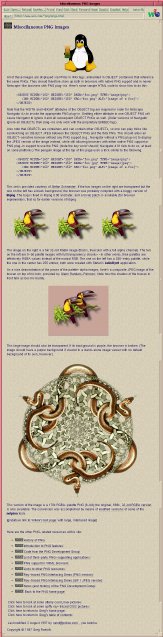
Mozilla's latest milestone, M17, arrived today(ish); early adopters, go thou and download. And while you're waiting, check out this summary of the state of the art of PNG written by Greg Roelofs. PNG is ready for prime time in its Mozilla incarnation (though there are a few outstanding issues). Imminent takeover of the net predicted. Film at 11. Update later by J: OK, so M17 isn't available yet. Mea culpa; Greg and I misread a planning page. Here are Greg's comments/corrections to clear up the matter.PNG, MNG, JNG and Mozilla M17
26 June 2000
by Greg RoelofsPNG support in Mozilla has improved greatly over the last few releases ("milestones"), and with each milestone comes a corresponding Slashdot posting and a lot of discussion. Unfortunately, not all of the discussion is entirely accurate, so here's a preemptive posting that attempts to update folks on the status of PNG support in Mozilla and other apps and to clear up some of the more common misconceptions. (This seems to be an annual event...)
Home Page
First of all, the PNG home page got booted off of cdrom.com in early March, and in early May it settled into what should be its absolutely final home:
This is currently hosted on freesoftware.com, Walnut Creek CD-ROM's new site for free software (quel surprise!), but if something should ever happen to Walnut Creek, libpng.org will be redirected appropriately. (On a related note, the new zlib URL is http://www.info-zip.org/pub/infozip/zlib/, which is also currently hosted on freesoftware.com.)
PNG Features for the Web
Insofar as this is ostensibly a Mozilla posting, let's have a brief rundown of the PNG features that are most useful to Web designers:
- alpha transparency - This is geek jargon for partial or variable transparency, and it lets you do nice effects that are independent of the background color(s), such as antialiased (non-jaggy) text, drop shadows, gradient fades, and translucency. PNG not only supports a full 8-bit alpha channel in grayscale and RGB images but also what amounts to an "RGBA palette" in colormapped images. The latter lets you do nice transparency without a huge hit in file size. For example, all but one of the transparent images on my PNG alpha-transparency test page are 8-bit or less; the lone exception (one of the toucans) is a 32-bit RGBA image, virtually indistinguishable from its 8-bit cousins. Note that PNG supports only unassociated (non-premultiplied) alpha, since the alternative is not lossless.
- gamma correction - Gamma allows you to display the same image on different platforms without looking too dark on some and too light on others. For best results it does require that both the designer's display system and the user's be calibrated, but even educated guessing is better than nothing in a viewing program (which is what Mozilla does). Warning! Watch out for Adobe Photoshop; version 5.0 had a serious factor-of-two bug in its PNG gamma support, and 4.0 also had some problems. (Things seem to be fixed in 5.5, however.)
- color correction - Where gamma has to do with image "brightness," color correction has to do with rendering shades of color precisely. PNG supports it, but not many applications do; it's pretty tricky to get right. Note that Photoshop 5.5 writes incorrect PNG "iCCP" chunks, and this will crash applications based on libpng 1.0.6. (Older versions of libpng ignore the chunk, and the soon-to-be-released libpng 1.0.7 will work around it.) Also note that feeding a valid iCCP chunk to PS 5.5 will hang it.
- compression - A lot of people have some seriously crazy ideas about
PNG's compression. Here's the straight dope:
- PNGs tend to be 15% to 20% smaller than equivalent GIFs on average. There are some GIFs, particularly 32- or 64-color ones, that are smaller than the best PNGs, but usually by only a couple of percent. There are also many that are more than twice as large as the corresponding PNGs, but these tend to be tiny images. (One exception is this image, which is dimensionally rather large yet only 1/3 the file size of the GIF version.)
- PNGs tend to be much larger than standard JPEGs. JPEGs are lossy, while PNGs are lossless; for natural (photographic) material, no lossless format can compete with JPEG--PNGs will typically be 5 or 10 times as large. On the other hand, for simple graphics or text-filled images with relatively few colors and sharp edges, JPEG is much worse, both in quality and in file size. (This means you, Slackware guys!) Use the proper tool for the job--no single image format is best in all cases.
- PNG is roughly comparable to JPEG-LS, the new lossless JPEG standard. On the Waterloo BragZone test suite, JPEG-LS beat PNG by 5% to 10% on natural images, but PNG beat JPEG-LS by 35% to 270% on "artistic" images. YMMV.
- PNG's compression method can be implemented in such a way that it is completely free of all known patents, but it can also be implemented in such a way that it infringes on patents held by PKWARE, Stac and others. You can guess which way zlib was written. Folks who are neither rich nor expert in patent law should probably stick to zlib- and libpng-based implementations.
- Unlike (LZW-based) GIF, in which the compression is basically deterministic--that is, you end up with pretty much the same data regardless of who does the compression--PNG's scheme leaves a lot of room for optimization. Some programs do a good job, some don't. The GIMP happens to be one of the good ones, as is pngcrush. Photoshop traditionally has been one of the not-so-good ones, although version 5.5 includes a "Save for Web" option that presumably invokes ImageReady. ImageReady 1.0 was mediocre and reportedly isn't much better in its current release (i.e., pngcrush beats it by 15% to 25%), but it is better than Photoshop's normal "Save as" option.
- The compression engine can't help clueless users who perform apples-and-oranges comparisons. If you start with a truecolor image and save it as both GIF and PNG, chances are the PNG will be 24-bit while the GIF will be 8-bit. Guess what? It's pretty tough to overcome that initial 3:1 deficit, no matter how good your compression engine is. (If you're not sure what kind of PNGs you have, check!) Also don't add a lot of text annotations to the PNG--unless you do the same to the GIF--and especially don't add a useless alpha channel to opaque images! (That last is directed at the Burn All GIFs folks...) Recompressing an image after it's been through JPEG compression is also a bad idea; JPEG leaves a lot of nasty little artifacts (often invisible to the naked eye) that screw up non-JPEG compressors.
- interlacing - PNG's interlacing scheme is two-dimensional, much like progressive JPEG, but unlike GIF--which uses a one-dimensional, line-based scheme. The upshot is that an interlaced PNG with text in it will be readable roughly twice as soon as the corresponding interlaced GIF.
- animation - Nope. But see MNG, below.
- MIME type - image/png. If PNG images on your server show up as broken images within Web pages and as gobbledygook text when referenced directly (i.e., as standalone URLs), you probably don't have the MIME type set up correctly. On the other hand, if they show up correctly for MSIE and some versions of Netscape but not others, you're probably running Microsoft's IIS server. Technically it's a bug in older versions of Netscape (versions 4.04 through 4.5), but consider switching to Apache anyway...
- browser compatibility - We'll get to that in a moment.
PNG Extensions and the Future
PNG is extensible. PNG is lossless. PNG is a single-image, raster (bitmap) format. One of its overriding design goals was backward compatibility. As a result, don't expect to see any sort of lossy compression methods (JPEG is doing a fine job of that, with the exception of transparency--but see JNG, below). Also don't expect to see any vector-based extensions--SVG with gzip content-encoding has that covered. Indeed, don't expect to see any new, incompatible compression methods for quite a while. Until there are lossless methods that can, on average, halve the size of PNG images, the cost in software compatibility is far too great. (Keep in mind that there still browsers that don't support progressive JPEG, and that was a relatively trivial change! And let's not even talk about JPEG 2000...)
PNG is also not going to become an animated format. Leaving multiple-image support out of PNG was a conscious design decision by the PNG development group, and it's still the right decision. Overloading a still image format with animation or video features merely confuses users and Web browsers, which have no way to distinguish still images from animations without prying into the data streams (which usually means downloading them first). Developers who prefer to program monolithically can always program for MNG instead; it's architecturally identical to PNG, and PNG is a pure subset of MNG.
Related Formats
MNG: As the previous paragraph suggests, the animated version of PNG is called MNG, for Multiple-image Network Graphics. It supports looping (including nested loops), clipping, deltas, and other features, plus everything PNG supports--including alpha transparency, of course. The home page is here:
Since this spring, a free reference library, libmng, has been under development by Gerard Juyn; its home page is at:
Note that the MIME type is video/x-mng; it has not yet been registered with the IETF. Undoubtedly there will be many misconfigured Web servers in coming years...
JNG: JNG is short for JPEG Network Graphics and is a proper subset of MNG, just as PNG is, but it's worth a separate mention. The idea is to combine the best of both worlds: JPEG's excellent compression and PNG's incredibly spiffy alpha transparency and color correction. JNG is almost identical to PNG, but in addition to standard IDAT chunks (which in JNG contain the alpha channel), there are also JDAT chunks that contain a standard JPEG/JFIF stream (suitable for handing off to libjpeg). From a developer's standpoint, if you've got support for both PNG alpha and ordinary JPEG/JFIF, adding JNG is a breeze. Of course, JNG is also supported by recent libmng betas. Its MIME type is image/x-jng.
Browser Status
Most browsers have supported PNG since at least late 1997 (when Netscape Navigator and Microsoft Internet Explorer finally did), but almost without exception, their support for alpha transparency has been abominable. Amazingly enough, it seems that 2000 may be the year that browsers finally support it, more or less ubiquitously. In April alone there were three newcomers, with another in May; so far this year, the total has more than doubled. Here's the current list of browsers that at least attempt to do alpha transparency correctly, with their supported platforms indicated in italics. If screen shots of the PNG alpha-transparency test page are available, they're linked to the browser name:
- Arena (Unix/X) - this was the first browser with good alpha support (at least for Unix, and I think anywhere). It died in 1998, however, and the final release tends to core-dump on PNG images. It always used its own "sandy" background pattern rather than that specified in the HTML. (Very old screen shot.)
- Browse (RISC OS) - Acorn's browser was the first to fully support PNG transparency and gamma correction, including background images, but it died along with Acorn itself in June 1999. The browser may or may not eventually show up in Pace Micro's digital set-top boxes. (Very old screen shot.)
- iCab (Macintosh) - this was the first Macintosh browser to support alpha transparency (since the 1.8 beta), but it doesn't do gamma correction yet.
- ICE Browser (Java) - ICEsoft's commercial browser for Java reportedly has full alpha support, but I haven't verified that.
- Internet Explorer (Macintosh) - version 5.0 added superb PNG support, including alpha, gamma and color correction. This is probably the best PNG-supporting browser available today. Unfortunately, the Windows and Unix versions seem to be a completely separate code base, so there's no telling when (or if) they'll have equally good support. (See the browsers page for details.)
- Konqueror (Unix/KDE) - I just heard that KDE's file-manager-cum-browser has full alpha support, but I haven't had a chance to check it myself. I'll try to get some screen shots added soon, however.
- Mozilla (Macintosh, Unix/X, Windows) - alpha was enabled in April, though there are a few gotchas: the Windows code is currently broken (bug 36694 and 19283, to be fixed by beta3), and the X code is a slightly nasty hack--it looks beautiful on 24-bit displays, but it's slow when scrolling, and the quality for users of 8- and 16-bit displays will be relatively poor. Nevertheless, it's a vast improvement over the previous code, and it's basically the only game in town for Unix users. Note that the infamous PNG interlacing bug (3195) was fixed in May, and Tim Rowley checked in initial MNG and JNG support on 12June.
- NetPositive (BeOS) - version 2.2, released in April, added support for alpha transparency; but like iCab, it doesn't yet do gamma correction. (It also doesn't display interlaced PNGs progressively.)
- Netscape - see Mozilla (which is basically what Navigator 6.0 will be).
- Sega Dreamcast Web Browser (Dreamcast) - version 2.0 of Planetweb's browser for the Sega Dreamcast game console, released in May, fully supports alpha transparency, but I don't have any screen shots yet.
- Webster XL (RISC OS) - R-Comp's RISC OS browser is claimed to have full alpha support, but I don't have verification, and it doesn't appear to be under development anymore.
- WebTV (WebTV) - surprisingly enough, WebTV has decent support for 32-bit RGBA PNGs, but its support for palette transparency is broken. In principle it should be easy to fix, but then again, it's a strange platform. (Note that the fonts look considerably better on a television screen.)
Honorable Mention goes to Siegel & Gale's PNG Live plug-in for Netscape, which was the only plug-in ever to manage alpha transparency (in Windows only). It died before ever getting out of beta, though, and plug-ins in general are useless for PNG. So is the HTML 4.0 OBJECT tag, but don't get me started...
Other Apps, Libs, etc.
I currently list some 500 distinct PNG-supporting packages (more if you break things like Microsoft Office into their constituent parts) in 8 categories (soon to be 9 or 10), not to mention a dozen pieces of hardware. PNG has now reached the point where even freeware authors generally don't bother to tell me when they've added support; it's largely taken for granted. (I do occasional Freshmeat sweeps, but I usually don't have time, and many entries don't mention PNG even if it's supported.) Quite a number of the apps include full source code, by the way--which is the way it should be, of course. ;-)
Within the libraries-and-toolkits category, there are a surprising number of independent PNG implementations (either encoders or decoders or both), including ones in C, C++, Java, JavaScript, Pascal, and even Ada95. PNG is now a standard part of Java 2 SE 1.3 and Tcl/Tk, and it is the main image format in the popular gd library and all of its Perl-based derivatives. In turn, this has led to its online use in areas as diverse as server statistics, chemical diagrams, computer-generated mazes, and weather maps.
Even better, PNG is the native, internal image format for a number of major applications (including Macromedia Fireworks and Microsoft Office), and it's becoming a popular icon format for advanced GUIs. It also ships as a standard part of BeOS, via the Translation Kit, and it's supported natively in the Windows Me shell (and possibly in Windows 2000 Professional).
Conclusion?
Ordinarily I'd mumble something about how PNG has finally achieved massive studliness and will soon be taking over the world, but what the hell--it has, it is, and if it's not obvious from what I've already written, another couple of lines won't make any difference. Go forth, visit the web site, write code, make lots of PNGs, etc., etc.
And Microsoft, pleeeeease get on the ball with Internet Explorer for Windows and Unix...
-
New Slash Version v1.0.3
pudge writes "Yo. We released slash-1.0.3. Bug reports and CVS and file downloads are on SourceForge. Slashcode is now hosted at Exodus with Slashdot and Freshmeat. " The scary part is that now Slashdot and Slashcode are totally synched up... which means programmers can e-mail diffs instead of bug reports and feature suggestions (hint hint hint!) -
Using USB As A KVM Switch?
Don Faulkner asks: "One of the features of USB that people are really excited about is the 'multi-headed support.' In other words, I should be able to connect several sets of [monitor, keyboard, mouse (and other stuff like joystick, printer, etc.)] to one computer, maybe distribute these throughout my house, and move seamlessly from one to the next. What if we turn this around? What if I wanted to control several computers in a rack, all from one location? This is done today with KVM (Keybard/Video/Mouse) switches, some of which are very sophisticated. Could USB do the same thing? Most computers have two USB ports, so you could theoretically daisy-chain the computers together, but this would be bad for reliability (take down one computer, and everything past it on the chain disappears). So, we would probably want to use a hub, and attach the head to that. Has anyone tried this? Anyone seen it done?" Here's an interesting sidenote: the USB 2.0 specs were just released. You might check out what they have to say about KVM switches. -
What Happened To Starbridge's Supercomputer?
ncmusic asks: "As seen in this story, whatever became of Starbridge and their cheap supercomputers? Was it all an elaborate hoax?" As far as I can tell, they are still around, but can anyone more familiar with them give us a heads-up on their progress? -
Is Netpliance Slamming Customers?
visionik writes: "Today I received a charge on my credit card for Netpliance i-opener service, even though I called them prior to ordering and verified that monthly service charges would not be put on that card. According to Netpliance, they will be charging monthly service on the cards of everyone who ordered an i-opener since March 1st, even though their Web site and support people indicated otherwise. I'm contesting the charges immediately, but thought this should be brought to the attention of everyone else who ordered an i-opener directly from Netpliance." visionik kept a small diary of his dealings with Netpliance. In part, it reads thus: (more)
But when visionik called Netpliance to inquire why the amount his credit card was charged was higher than he expected it to be, he learned that he was also being charged for service, including a prorated charge for service in March. He writes: "So I say I want to cancel the order. This guy laughs and says 'Fine, but you'll have to wait at least 30 days before we will [credit] your credit card.' That was enough. I told him I was contesting the charge and filing a complaint with my card company, to which this ballsy guy laughed again and said 'good luck'!"1. 3/11 I saw the article on Slashdot, and thought it would be a nifty project to run linux on, followed quickly by a thought that I didn't have time to mod it anyway, followed by another thought: hey, even better - i'll order one for my brother's birthday (which is monday the 27th)
2. 3/11 I called netpliance to verify that I could order the unit on my card, without service, and that my brother could subsequently sign up for services on his card. they said sure, no problem. i asked if it would arrive before the 27th, and they said -again- sure, no problem.
3. 3/11 I went ahead and ordered one a bit later in the day via the web form. The site said my total was $99 plus shipping ... nothing about service; and that the shipping would be 7-10 days.
I called Netpliance to ask them about this, and was surprised to reach a courteous human after only a few layers of voice-prompts. The sales representative I reached seemed taken aback by my questions, and surprised that the idea that anyone who'd been assured otherwise would be charged for the service. He quickly transferred me to one of his bosses, named Jerome. I asked Jerome whether people were being automatically charged for Netpliance's ISP service after being informed that they would not be via phone or the company's Web site.
He responded that signing up for the service was now required of all customers who purchase an i-opener from Netpliance. "According to the Web site, the service now automatically goes into effect two days after the order is recieved."
But what about those in visionik's situation? Asked whether all customers, like visionik, now being charged for the service had been aware of this change at the time of order, Jerome acknowledged that there may have been a gap between the change to automatic start of service and that policy being reflected on the Netpliance page. "I think it wasn't announced on the site [earlier in the month]. I hadn't looked at the Web site, so I'm not sure what it said. ... I'm not sure exactly when that change went into effect. There may have been a lag."
Might the i-opener again be sold without the service agreement-requirement? Jerome's diplomatic answer: "I'm not sure about that."
Jerome then transferred me to John, a customer-service supervisor, who confirmed that everyone who buys an i-opener direct from Netpliance is now being charged for the ISP service as well, and that there are "a couple" of people who are being charged although they did not sign up for the service or specifically asked not to be, but he did not indicate the actual number.
John described buying the i-opener device/service combination from Netpliance as a matter of convenience, and said "You can buy them at Circuit City and save shipping, or you can buy them from Netpliance and pay $40." For ones bought at Circuit City, currently the only i-opener's retail outlet, he said that to initiate service, "you do have to call. Our main focus is to sell it to our mainstream customers, a certain type of person we're aiming at."
Perhaps they should consider aiming at home-networkers looking for inexpensive flat-panel terminals as well.
-
Daemon News, March 2000
gsutter writes, "The March 2000 issue of the Daemon News ezine has been published at daemonnews.org. Articles include a description of the Netgraph networking subsystem and an introduction to IPC. Check it out. " -
DVD Cases: Help by Commenting to Feds on DMCA
Paul Burchard writes "The Copyright office is requesting comments by Feb. 10, 2000, on how broadly to interpret the exemptions in the Digital Millennium Copyright Act (DMCA) to its provisions against circumventing copy-protection technologies. As these features of the DMCA have been cited by lawyers from both sides in the DeCSS cases, the interpretation of the exemptions appears to still be up for grabs -- your comments could make a difference." Get involved and do this now. -
Man To Live In House for One Year
Barry K. Nathan writes "MSNBC is reporting that a geek is actually locking himself into a rented house for a year, to prove that e-commerce makes it possible. He's even changed his legal name to DotComGuy. He says, 'I'm going to come out being a loon,' but I think you have to be crazy already to even think of doing this in the first place... " Actually, it does appear that he can go in the backyard - and can have visitors. But still, I think I'd lose it after about two weeks or so. -
What is the Best ISDN Solution?
Brian Conneen asks: "I've recently found out that both DSL and Cable Modem access is at least 9 months away for my area. But I can get ISDN. I am giving serious consideration to ISDN, but wanted to know what users thought of it, and maybe get some suggestions on the best setups. (Internal Modem, External Router, etc..)" -
Tales From The Bazaar
Last week, The Bazaar, an Open Source meeting and exhibition, was held for the first time in New York City. It was not a well-attended event, with fewer than 3000 registered visitors, and the view from the show's main floor was downright dismal because most of the people there spent most of their time in tutorial sessions, not cruising the (sparse) display booths. But it was still an event many found valuable. Here are some "show tales" from Slashdot readers who were there. (click below)From Jordan Greenberg:
The Bazaar was my first real chance to meet any of the big names of the Linux community. Though I missed all of the daytime events due to work, I showed up just in time to be bored by Ralph Nader and retreat to the Andover.net party before things got too crazy. Once there I was able to chat with such legends as ESR, Bruce Perens, Maddog Hall, Jeff and Robin, and was even able to make RMS laugh about the whole to GNU or not to GNU Linux naming debate. Personally, I was never a big fan of saying GNU/Linux - I think it sounds awkward and confusing and I did not like RMS demanding that people in his presence use the GNU (right Chris?).
With almighty tequila coursing through my veins, I found myself in the midst of a sermon by RMS on why he believes we need GNU terminology - and coming from his mouth it suddenly made sense (or perhaps that was the tequila too). Linux, or GNU/Linux as RMS would have it, depends not only on the quality of the software but about the freedom within, granted by the GPL. By using the GNU prefix we remind ourselves and others of this. GNU/Linux is not just about the software, but about the ideals behind that software.
But it still sounds awkward. "The problem is," I said to RMS and the others that were still listening, "that you need a catchier name for it. How about calling yourself an "impaladin?"
"Impaladin?" asked RMS
"Yes, impaladin - Have GNU will travel"
RMS laughed - he approved
So feel free to use this new name - maybe even create an impaladin distribution or just laugh at it - but enjoy.
-------------
Isaac Salpeter's take:
The heart of this conference was not to be found on the exhibition floor, nor in the (repetitive axe-grinding of the) keynotes, but in the classes and general sessions. Suggestion for the future: more open discussions and cooperation, less Ralph Nader yammering about how much Microsoft sucks.
Best conversation overheard:
"So, will the Andover party have a cash bar?"
"No, there's free beer."
"Uh-oh, Stallman's gonna be pissed..."
--------------------
Annelise Anderson, representing FreeBSD, says:
Whatever its raw edges, The Bazaar conference was worthwhile for the usual networking reasons. The best of the networking went on at the reception hosted by andover.net and the follow-on reception at the FAO Schwarz toy store, an inspired location for this crowd. This one was thanks to FAO Schwartz and IBM.
The BSDs could -- should -- have had a stronger presence here, perhaps with a combined exhibit booth in addition to the volunteers demo-ing on their own computers. Patrick Lynch of the NY users' group organized a pan-BSD BOF; Bob Bruce showed up there and said we might see an IPO with FreeBSD's name on it before the middle of next year. My little Sony picturebook was a source of some amazement -- FreeBSD -current running on such a little thing, with a couple of those stunning Eterms. The publishers in attendance were generally unaware that along with the multiple Linux distros, FreeBSD and the other BSDs exist and transfer an enormous amount of the traffic on the Internet.
---------------
Adam Matos, Systems Administrator and Student, The Beacon School, writes:
While attending The Bazaar here in Manhattan, I found it to be fascinating that so many people support the Linux community. I came with a colleague and teacher of mine, Chris Lehmann, Technology coordinator for The Beacon School. Chris was the one who first showed me Linux and how useful it can be. At Beacon we use Linux on our primary servers and wanted to let others know that schools, too, use Linux.
I attended a tuturial Wednesday morning, Enterprise System Management, that was suposed to teach me about running Linux servers. I walked out 10 minutes into the tuturial. I took a quick look at what was planned for the session and noticed I knew a majority of it. Not because I think I know it all, but because we've done most of it at Beacon. Such things as configuring Samba and writing shell scripts were something I learned under Chris Lehmanns's coordination at school. With less than two years Linux experience, I've been given the title Systems Administrator.
As I leave The Bazaar, I feel more comfortable about how many other Linux enthusiasts are out there. Linux is something everyone I feel can start adapting to. People can change.
---------------
From Nopalzin Torrres, Systems & Network Administrator, IllusionFusion!:
I was nervous when I first arrived, but the Open Source community welcomed my desire to learn and contribute. I walked out of the Building Firewalls with Open BSD tutorial saying "Damn, I can really make this work". I also picked up some great info on Samba and Linux system admin. I had a great time and met some great guys.
---------------
starlady (AKA Jessica Lee Sheffield) finishes off by saying:
Having been to a show every month for the past four months, I thought I had some idea of what to expect when entering the exhibit floor, but my expectations were largely confounded as this was a much smaller show than I have experienced. I wasn't surprised to see Geek Compound 3.0 greet me as I walked through the door - Andover's .org pavilion, which was comprised of Linux.com, Linuxfund.org, NetBSD, KDE, and others, in addition to Slashdot and Freshmeat, of course. As I continued on through the floor looking for the UserFriendly booth, I noticed that several of the powerhouse booths at past shows, notably Red Hat and VA Linux, had a surprisingly subdued presence at this one, while Caldera (of "E-business!" fame at COMDEX) wasn't even in attendance.
The atmosphere at The Bazaar was very community-oriented, which is why it's a shame that the attendance was so low. Without the distractions of marketing ploys, people were free to discuss projects, collaboration, or simply say "Hey, I like your work." I had very nice conversations with some of the leading names in the Open Source community, and even witnessed a random guy walk up to Bob Young, notice his red beret, and ask, "Hey, are you with Red Hat or something?"
When Mr. Young nodded with a smile, the guy proceeded to ask him support questions, while I and Paul Ferris of LinuxToday snuck off before our snickering gave the game away. To his credit, Mr Young was very gracious in answering the man's questions and making him feel comfortable.
The relaxed nature of The Bazaar made it possible for smaller organizations to catch the eye and ear of the community and publicize their own open source efforts. One such was The Beacon School, an alternative public school in New York City where the students administrate Linux servers and run projects on them. The students are very enthusiastic and eager to be involved in the community, and I believe they made a very good impression on the attendees (except perhaps the ones that kept shooting the Nerf weapons kindly provided by Copyleft). Speaking of Nerf, Copyleft's "Shoot the Star Wars action figures, win a prize" campaign was a roaring success. I took a Slashdot frisbee home with me, so I can't complain. :)
All in all, I think The Bazaar was a success for its first year. The traffic wasn't as high as anyone would have liked due to bad placement within the Javits center, but I believe that is something they can improve in the future. The show was a great chance to see old friends and make new ones in the Open Source world, and I think a lot of positive things will come of that.
---------------
There were things that could have been improved, and the timing was wrong; theBazaar was held in the middle of finals week for most area colleges, which I believe was a big factor in the low attendance. And for some reason the heat in the Jacob Javits Convention Center wasn't working properly, which gave the whole thing a (literally) chilly atmosphere. Oh, well. Maybe next year's edition will be better-timed and better-attended.
-
Managing 'make' for Large Projects
bvmcg asks: "About every large project I look at has a different idea of the best way of managing its make process. One make file per directory, per target binary, or one overall. Options in a seperate config file or in the make file itself. On and on. Which project would you look at for the "ideal" example of make structure? Which one would the community do well to mimic when creating new projects? What key features do you like to see? Why?" We are almost, but not quite at the point where installing any packages from source is a 3 step process: "./configure; make; make install". Would improving the way we construct our "Makefiles" make this any easier?