Slashdot Mirror
Domain: publicradio.org
Stories and comments across the archive that link to publicradio.org.
Stories · 24
-
Earth Avoids Collisions With Pair of Asteroids
Hugh Pickens writes "According to NASA, a pair of asteroids — one just over three miles wide — passed Earth Tuesday and early Wednesday, avoiding a potentially cataclysmic impact with our home planet. 2012 XE5, estimated at 50-165 feet across, was discovered just days earlier, missing our planet by only 139,500 miles, or slightly more than half the distance to the moon. 4179 Toutatis, just over three miles wide, put on an amazing show for astronomers early Wednesday, missing Earth by 18 lunar lengths, while allowing scientists to observe the massive asteroid in detail. Asteroid Toutatis is well known to astronomers. It passes by Earth's orbit every four years and astronomers say its unique orbit means it is unlikely to impact Earth for at least 600 years. It is one of the largest known potentially hazardous asteroids, and its orbit is inclined less than half-a-degree from Earth's. 'We already know that Toutatis will not hit Earth for hundreds of years,' says Lance Benner of NASA's Near Earth Object Program. 'These new observations will allow us to predict the asteroid's trajectory even farther into the future.' Toutatis would inflict devastating damage if it slammed into Earth, perhaps extinguishing human civilization. The asteroid thought to have killed off the dinosaurs 65 million years ago was about 6 miles wide, researchers say. The fact that 2012 XE5 was discovered only a few days before the encounter prompted Minnesota Public Radio to poll its listeners with the following question: If an asteroid were to strike Earth within an hour, would you want to know?" -
Analyzing Climate Change On Carbon Rich Peat Bogs
eldavojohn writes "A new report (PDF) from Climate Central shows that climate change has been affecting some states more than others for the past 100 years. As you can see from a video released by NASA, things have become most problematic since the 70s. Among the states most affected is Minnesota, where moose populations are estimated to have dropped 50% in the past six years. Now the U.S. Department of Energy is spending $50 million on a massive project at the Marcell Experimental Forest to build controlled sections of 36 feet wide and 32 feet tall transparent chambers over peatland ecosystems. Although peat bogs only account for 3% of Earth's surface, they contain over 30% of carbon stored in soil. They aim to manipulate these enclosures to see the effects of warming up to 15 degrees, searching for a tipping point and also observing what new ecosystems might arise. The project hopes to draw attention and analysis from hundreds of scientists and researchers around the globe." -
University of Minnesota Launches Review Project For Open Textbooks
New submitter Durinia writes "Minnesota Public Radio is running a story about the University of Minnesota's Open Textbooks project. The goal of the project is to solicit reviews of college-level open source textbooks and collect those that pass muster onto their website. The project will focus first on high-volume introductory classes such as those for Math and Biology, because as David Ernst, director of the project, states in the interview: 'You know the world doesn't need another $150 Algebra One book. Algebra One hasn't changed for centuries, probably.'" Requirements for inclusion include: Open licensing (Creative Commons Attribution/Share Alike), complete content (no glorified collections of lecture notes), applicability outside of the author's institution, and print availability. -
Domestic Drilling Doesn't Decrease Gasoline Prices
eldavojohn writes "As the political rhetoric heats up, there's something puzzling about drilling inside the United States. Essentially, it doesn't reduce what we pay at the pump. From the article, 'A statistical analysis of 36 years of monthly, inflation-adjusted gasoline prices and U.S. domestic oil production by The Associated Press shows no statistical correlation between how much oil comes out of U.S. wells and the price at the pump.' If the promises that politicians made when they opened U.S. drilling were true, then we should be paying about $2 a gallon now. Instead it's $4 a gallon. Minnesota Public Radio pulls some choice quotes from both parties and wonders why this decades-old empirical observation goes seemingly completely unnoticed." -
Pickens Wind-Power Plan Comes To a Whimpering End
Spy Handler writes "In 2008, billionaire T. Boone Pickens unveiled his 'Pickens Plan' on national TV, which calls for America to end its dependence on foreign oil by increasing use of wind power and natural gas. Over the next two years, he spent $80 million on TV commercials and $2 billion on General Electric wind turbines. Unfortunately market forces were not favorable to Mr. Pickens, and in December 2010 he announced that he is getting out of the wind power business. What does he plan to do with his $2 billion worth of idle wind turbines? He is trying to sell them to Canada, because of Canadian law that mandates consumers to buy more renewable electricity regardless of cost." -
Minn. Supreme Court Upholds City's Right To Build Own Network
BcNexus writes with news from Minnesota that may have significance for cities around the US where municipal networks are either in place or planned: "Here's the latest development in a fight pitting a telecommunication company against government competition. The telco, TDS, took its fight all the way to the Minnesota Supreme Court because it thought the city had no right to serve people's internet, voice and television needs with its own network, but has failed." Also from Minnesota today, BcNexus writes "The State of Minnesota was the first to blink and chose to avoid a court showdown when it dropped its attempt to block online gambling sites." -
New Neutrino Detector Being Built In Minnesota
lithis writes "NOvA, a new neutrino detector, is being built in northern Minnesota. MPR has information on the project's funding and the International Falls Daily Journal talks about the environmental issues. This detector will complement the MINOS neutrino detector in the Soudan Underground Laboratory." -
New Food-Growth Product a Bit Hairy
MeatBag PussRocket writes "An article from Marketplace.org reports, 'A Florida company has developed an all-natural product that it says could revolutionize how food is grown in the US. It's called Smart Grow, but it might be a tough sell. It's inexpensive. It eliminates the need for pesticides, so it's environmentally friendly, but it's human hair. Plant pathologists at the University of Florida have found the mats eliminate weeds better than leading herbicides and can also make plants grow up to 30 percent larger.'" -
Look What's Cooking At Microsoft Labs
stinkymountain writes "Writer John Brandon spent two days at Microsoft Research Labs in Redmond and got an inside look at some pretty interesting projects under development, including a robotic receptionist, a new type of touch screen for people with fat fingers, and an electronic table that allows multiple people to collaborate in real time. Brandon also talks about some of these research projects on this NPR podcast." -
Face-Swapping Software To Protect Privacy
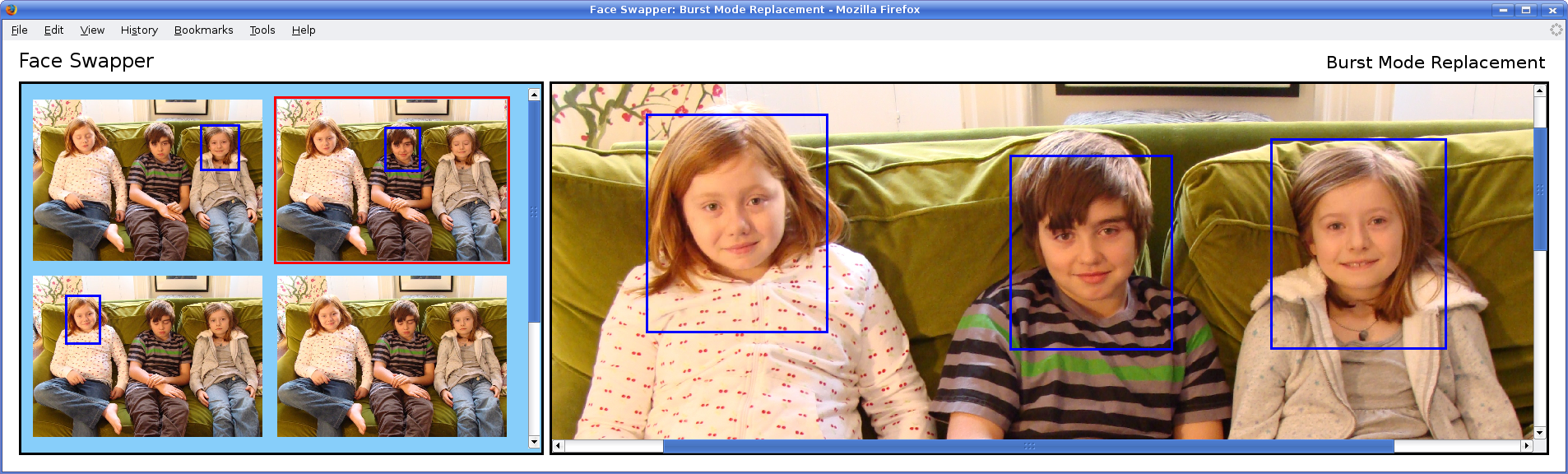
(0d0 writes "Some researchers at Columbia University's Computer Vision Labratory have developed software to automatically replace faces in batches of photos. Practical applications include protecting the identities of people in Google's Street View, coupling it with a digital camera's burst mode to create a perfect group photo, or protecting the identities of witnesses or law enforcement and military personnel. Other links to coverage include Boing Boing, American Public Media, and New Scientist." -
The 110 Million Dollar Button
Reservoir Hill writes "The 'I'm Feeling Lucky' button on Google's search page may cost the company up to $110 million in lost ad revenue every year according to a report on American Public Media's Marketplace. Tom Chavez says that since the company makes money selling ads on its search results page, the 1% of users who use the 'I'm Feeling Lucky' button never see Google's ads - the button automatically directs them to their first search result. So why does Google keep the button? Marisa Mayer, Google's vice president responsible for everything on the search page, says that 'it's possible just to become too dry, too corporate, too much about making money' and the 'I'm Feeling Lucky,' button reminds you that 'people here have personality.' Web usability expert Jacob Nielsen says the whimsy serves another business purpose: 'Oh we're just two kind of grad students hanging out and having a beer and having a grand old time,' not you know, 'We are 16,000 people working on undermining your privacy.'" -
Typing Patterns for Authentication
Kelson writes "NPR's Marketplace is reporting on a new authentication scheme. BioPassword tracks the way you type your password: how long each key is depressed, the time between keystrokes, and overall speed. When someone tries to log into your account, it compares the pattern to what it has on file. It only allows you in if both the password and patterns match. The technique has been around a while. World War II Morse code operators used it to determine whether a message was sent by an ally or an impostor." -
The Coevolution of Lice & Their Hosts
eldavojohn writes "It might be an uncomfortable subject but parasites are an interesting subject when it comes to evolution. Ever wonder if pocket gophers have lice? Well, they do. And most interesting of all is the evolution of these lice mirroring the evolution of gophers. To study the genes of lice may shed just as much light on evolutionary trees as studying the genes of the actual host the lice has evolved to. The most unsettling result from these studies is that human head lice and human pubic lice (crabs) vary so greatly that they are in two separate genera. There were similarities between our pubic lice and the lice found on gorillas. Scientists came to the conclusion, which they published today in BMC Biology, is just as striking as their earlier one about head lice. But it is hardly the same. We did not get pubic lice from other hominids. We got them from the ancestors of gorillas." -
What the GPLv3 Means for MS-Novell Agreement
eldavojohn writes to mention IT Business Edge has a dry but interesting interview with a lawyer (Antoinette Tease) on the effects the GPLv3 on the Microsoft & Novell alliance. From her answers: "Unlike prior versions of the GNU General Public License (GPL), which did not address patent rights, the current draft of the GPL version 3 has several provisions that address patent rights. Section 2 states that the license to use the open source code 'terminates if you bring suit against anyone for patent infringement of any of your essential patent claims' based on any version of the open source program." She goes on to say "the GPLv3 as currently drafted would impose an obligation on Novell to somehow 'shield' its customers from patent lawsuits brought by Microsoft, or, alternatively, to make the source code publicly available..." -
Blackberry Owners Chained to Work
seriouslywtf writes "New survey data suggests that Americans are split over whether Blackberrys are chaining them to work. While people who own Blackberries feel 'more productive', those with Blackberrys are more likely to work longer hours and feel like they have less personal time than those without. A Director of Marketing Strategies who owns a Blackberry pointed out that many employees feel obligated by employers who have handed out the devices. 'While being always on in a social context is a natural for young people, many of those in the 25-54 age group with families and corporate jobs are struggling with work-life blending. There is a need for the mainstream workplace culture to offer ways to counterbalance.'" Is the constantly connected, often mobile nature of the modern workplace a good thing, or not? -
NASA Commemorates Space Shuttle Tragedies
eldavojohn writes "Space.com is covering NASA's commemoration of the Apollo 1 crew & the last shuttle crews of both the Challenger and Columbia orbiters. The Apollo 1 crew was lost forty years ago yesterday to a fire while testing their spacecraft on a launch pad. From the article: 'While the nearly two decades separating NASA's three space disasters allowed room for the agency to grow complacent, the relatively short time between the 2003 loss of Columbia and the end of the shuttle program could avoid a repeat of such behavior.'" -
DRM Critique Airs On National Public Radio
An anonymous reader writes to point out that a critique of Digital Rights Management made it onto the mainstream media this morning. NPR's Marketplace Morning Report ran a piece noting that with the demise of the VHS format we risk losing fair-use rights since we now have only digital media. From the article: "As our country moves forward to regulate digital copying, I urge us all to bear in mind T. S. Eliot's famous saying. 'Good poets borrow; great poets steal.'" -
Handling Corporate Laptop Theft Gracefully
Billosaur writes "From NPR, we get a Marketplace story about the theft of corporate laptops and the sensitive data they may contain, specifically how to handle the repercussions. From the story: 'TriWest operates in about 21 states. It's based in Phoenix, Arizona. In December of 2002, somebody broke into the company's offices and stole two computer hard drives.And those hard drives contained the personal information of 550,000 of our customers from privates in the military all the way up to the chairman of the Joint Chiefs of Staff.' How they handled the situation earned them an award from the Public Relations Society of America." -
Electric Companies Get Involved With Broadband
Billosaur writes "The Marketplace Morning Report on NPR has an interesting piece on how electric companies are getting into the high-speed Internet business with 'Broadband over Power Lines', or BPL." From the article: "By purchasing the right equipment power companies can quickly offer Internet service to millions of new customers. There are several pilot projects being launched in the US, including one in the Pittsburgh suburb of Monroeville. That service is being offered by Duquesne Broadband -- a spinout of the local power company.'" -
War of the Worlds by the Star Trek Cast
eDavidLu writes "Here is a radio remake of The War of the Worlds. From the promo: 'Join actors from Star Trek and Star Trek: The Next Generation as they recreate this classic radio thriller. The breathless pace and convincing details make it clear why the 1938 broadcast of an eyewitness report of an invasion from Mars caused a nationwide panic in 1938. Originally performed by Orson Welles and his Mercury Theatre of the Air, War of the Worlds is truly the mother of all space invasions, offering a rare combination of chills, thrills and great literature.' My local NPR station KPCC broadcast this show last Saturday night, and the streaming audio for the entire program is available for one week only on their site. I was going to submit this story for Halloween eve, but KPCC was in the middle of a fund drive. Now that the fund drive is over, the slashdotting can begin. If you like this type of programming, remember to contribute to your local NPR station." Update: 11/05 17:53 GMT by Z : Edited for jerks. Thanks, guys. Seriously. Way to be responsible members of the internet community. -
Y2K: Hoax, Or Averted Disaster?
Allnighterking writes "Y2K -- remember the fear it generated? Cartoons were written about it. The dried food industry saw a boom. Doomsayers abounded. But in the end, no planes fell, no one died and the electric grid stayed up for three more years. Was it all a hoax? Or was it the result of careful and complete planning and upgrading. American RadioWorks has a series of articles talking about the disaster that never happened called Y2K You can either Listen in or read the Transcripts of each of the 3 broadcasts and decide for yourself. The over 100 Billion pumped into the US economy alone may well have fueled the boom and predicated the bust. Could the success at Y2K prevention have made the coming problem in 2038 something people will ignore?" -
Y2K: Hoax, Or Averted Disaster?
Allnighterking writes "Y2K -- remember the fear it generated? Cartoons were written about it. The dried food industry saw a boom. Doomsayers abounded. But in the end, no planes fell, no one died and the electric grid stayed up for three more years. Was it all a hoax? Or was it the result of careful and complete planning and upgrading. American RadioWorks has a series of articles talking about the disaster that never happened called Y2K You can either Listen in or read the Transcripts of each of the 3 broadcasts and decide for yourself. The over 100 Billion pumped into the US economy alone may well have fueled the boom and predicated the bust. Could the success at Y2K prevention have made the coming problem in 2038 something people will ignore?" -
Video Games Changing the Workplace
kwolf22 writes "Last night, Marketplace aired the story: The New Video Frontier (audio available). From the show description : 'Host David Brown talks to author Mitchell Wade (Got Game: How the Gamer Generation Is Reshaping Business Forever) about the video game industry and how first person shooter games will change workplace dynamics for the next generation of employees.' Mr. Wade brings up some interesting points about how persistance in gaming translates to persistance on the job." -
Video Games Changing the Workplace
kwolf22 writes "Last night, Marketplace aired the story: The New Video Frontier (audio available). From the show description : 'Host David Brown talks to author Mitchell Wade (Got Game: How the Gamer Generation Is Reshaping Business Forever) about the video game industry and how first person shooter games will change workplace dynamics for the next generation of employees.' Mr. Wade brings up some interesting points about how persistance in gaming translates to persistance on the job."