Slashdot Mirror
Domain: purdue.edu
Stories and comments across the archive that link to purdue.edu.
Stories · 119
-
More Colleges Try Forgoing Tuition For A Percentage of Future Income (yahoo.com)
"Some innovative colleges, in partnership with private investors and a small number of philanthropies, are experimenting with a new financing model called 'income share agreements' or 'ISAs,'" reports Yahoo Finance: With an ISA, instead of assuming a fixed debt obligation, students simply agree to pay an affordable percentage of their future income over a set time period, subject to an overall cap. High earners will have larger payments than low earners, but all will have an affordable payment, based on what they will actually be making. Importantly, when the college is providing some or all of the funding for the ISA, its return will be aligned with its students' post-college earnings, giving it economic incentives to make sure its students both graduate and find jobs. The college is, literally, invested in its students' success...
With ISAs, there is no principal or interest. Thus, they are much better suited for low income students as their financial obligations never exceed their ability to pay... In a recent paper commissioned by the Manhattan Institute, we looked at the small but growing number of colleges and universities offering ISA programs. Indiana's Purdue University launched the first such program in 2016. About a dozen other institutions have now followed suit, including Lackawanna College in Pennsylvania, Clarkson University in New York, and the University of Utah. Most of these pioneers offer ISAs to students as an alternative to non-subsidized federal loans, though a few are offering them as a complete substitute for borrowing... A common feature of all these ISA programs is that they require payments only when the graduate meets a certain income threshold. All impose time limits and caps on the total amount that needs to be repaid, though they differ widely in where they set those caps and limits. -
'Instantly Rechargeable' Battery Could Change the Future of Electric Cars (sciencedaily.com)
An anonymous reader quotes a report from Science Daily: A technology developed by Purdue researchers could provide an "instantly rechargeable" method that is safe, affordable and environmentally friendly for recharging electric and hybrid vehicle batteries through a quick and easy process similar to refueling a car at a gas station. John Cushman, Purdue University distinguished professor of earth, atmospheric and planetary science and a professor of mathematics, presented the research findings "Redox reactions in immiscible-fluids in porous media -- membraneless battery applications" at the recent International Society for Porous Media 9th International Conference in Rotterdam, Netherlands. Cushman co-founded Ifbattery LLC (IF-battery) to further develop and commercialize the technology. "Designing and building enough of these recharging stations requires massive infrastructure development, which means the energy distribution and storage system is being rebuilt at tremendous cost to accommodate the need for continual local battery recharge," said Eric Nauman, co-founder of Ifbattery and a Purdue professor of mechanical engineering, basic medical sciences and biomedical engineering. "Ifbattery is developing an energy storage system that would enable drivers to fill up their electric or hybrid vehicles with fluid electrolytes to re-energize spent battery fluids much like refueling their gas tanks." Mike Mueterthies, Purdue doctoral teaching and research assistant in physics and the third co-founder of Ifbattery, said the flow battery system makes the Ifbattery system unique. "Other flow batteries exist, but we are the first to remove membranes which reduces costs and extends battery life," Mueterthies said. Ifbattery's membrane-free battery demonstrates other benefits as well. "Membrane fouling can limit the number of recharge cycles and is a known contributor to many battery fires," Cushman said. "Ifbattery's components are safe enough to be stored in a family home, are stable enough to meet major production and distribution requirements and are cost effective." For the visual learners, Purdue Research Park has uploaded a video about Ifbattery's "instantly rechargeable" method. -
Scientists Find Chemical-Free Way To Extend Milk's Shelf Life For Up To 3 Weeks (digitaltrends.com)
An anonymous reader writes from a report via Digital Trends: Researchers at Purdue University and the University of Tennessee have found a non-chemical way to extend regular milk's shelf life to around 2-3 weeks, and without affecting the nutrients or flavor. The technology they've developed involves increasing the temperature of milk by just 10 degrees for less than a second, which is well below the 70-degree Celsius threshold needed for pasteurization. That quick heat blast is still able to eliminate more than 99 percent of the bacteria left from pasteurization. "The developed technology uses low temperature, short time (LTST) in a process that disperses milk in the form of droplets with low heat/pressure variation over a short treatment time in conjunction with pasteurization," Bruce Applegate, Purdue's associate professor in the Department of Food Science, explained to Digital Trends. "The resultant product was subjected to a taste panel and participants had equal or greater preference for the LTST pasteurized milk compared to normally pasteurized milk. The shelf was determined to be a minimum of two weeks longer than the standard shelf life from pasteurization alone." As for whether or not this method will make its way to store shelves, it won't in the near future. "Currently an Ohio-based milk processor is using this technology and distributing the milk," Applegate says. "The unit is approved for processing milk in Ohio and distribution nationwide. The product is currently being distributed, however it has not been labeled as extended shelf life milk. Once the commercial application is validated the milk will be labelled with the extended shelf life." Scientists from Duke University believe there may be a large source of hydrogen gas under the ocean, caused by rocks forming from fast-spreading tectonic plates. -
Purdue 'HUSH' Tool Promises 16% Battery Life Gain For Wasteful Android Phones
MojoKid writes: Researchers from Purdue University have developed a software tool for Android smartphones that purportedly slows down battery drain when handsets enter a sleep state. With the software tool installed, the researchers claim that smartphone battery life can be extended by nearly 16 percent. Called "HUSH," the software solution was developed in response to what the researchers say is the first large-scale study of smartphone energy drain occurring from everyday use by consumers. According to their research, apps drain 28.9 percent of battery power while the screen is turned off. HUSH dynamically identifies app background activities that it deems aren't useful to the user experience on a per-app basis and suppresses those apps when the screen is turned off. -
Scientists Identify Sixth Taste: Fat
New submitter shuheng writes with news that a study out of Purdue claims to have identified the sixth distinct taste known to humans: fat. The scientists say it should be called oleogustus which means "fatty taste" in Latin (abstract). Professor Richard Mattes said, Most of the fat we eat is in the form of triglycerides, which are molecules comprised of three fatty acids. Triglycerides often impart appealing textures to foods like creaminess. However, triglycerides are not a taste stimulus. Fatty acids that are cleaved off the triglyceride in the food or during chewing in the mouth stimulate the sensation of fat. The taste component of fat is often described as bitter or sour because it is unpleasant, but new evidence reveals fatty acids evoke a unique sensation satisfying another element of the criteria for what constitutes a basic taste, just like sweet, sour, salty, bitter and umami. -
Student Bookstores Beware, Amazon Comes To Purdue Campus
First time accepted submitter Kilroy1218 writes After freezing tuition past their original deadline Purdue University announced a partnership with Amazon today which aside from greatly competitive book pricing "will bring staffed customer order pickup and drop-off locations to Purdue's campus, as well as expedited shipping benefits phased in over the course of the 2014-2015 academic year." “This relationship is another step in Purdue’s efforts to make a college education more affordable for our students,” said President Mitch Daniels. “With the pressure on college campuses to reduce costs, this new way of doing business has the potential to change the book-buying landscape for students and their families.” -
Student Bookstores Beware, Amazon Comes To Purdue Campus
First time accepted submitter Kilroy1218 writes After freezing tuition past their original deadline Purdue University announced a partnership with Amazon today which aside from greatly competitive book pricing "will bring staffed customer order pickup and drop-off locations to Purdue's campus, as well as expedited shipping benefits phased in over the course of the 2014-2015 academic year." “This relationship is another step in Purdue’s efforts to make a college education more affordable for our students,” said President Mitch Daniels. “With the pressure on college campuses to reduce costs, this new way of doing business has the potential to change the book-buying landscape for students and their families.” -
'Approximate Computing' Saves Energy
hessian writes "According to a news release from Purdue University, 'Researchers are developing computers capable of "approximate computing" to perform calculations good enough for certain tasks that don't require perfect accuracy, potentially doubling efficiency and reducing energy consumption. "The need for approximate computing is driven by two factors: a fundamental shift in the nature of computing workloads, and the need for new sources of efficiency," said Anand Raghunathan, a Purdue Professor of Electrical and Computer Engineering, who has been working in the field for about five years. "Computers were first designed to be precise calculators that solved problems where they were expected to produce an exact numerical value. However, the demand for computing today is driven by very different applications. Mobile and embedded devices need to process richer media, and are getting smarter – understanding us, being more context-aware and having more natural user interfaces. ... The nature of these computations is different from the traditional computations where you need a precise answer."' What's interesting here is that this is how our brains work." -
McAfee Exaggerated Cost of Hacking, Perhaps For Profit
coolnumbr12 writes "A 2009 study (PDF) by the McAfee estimated that hacking costs the global economy $1 trillion. It turns out that number was a massive exaggeration by McAfee, a software security branch of Intel that works closely with the U.S. government at the local, state and federal level. A new estimate by the Center for Strategic and International Studies (and underwritten by McAfee) suggests the number is closer to closer to $300 billion (PDF), but even that much is uncertain. One of McAfee's clients, the Department of Defense, has used the $1 trillion estimate to argue for an expansion of cybersecurity, including 13 new teams dedicated to cyberwarfare. Despite the new data, Reuters said McAfee is still trying to exaggerate the numbers." The $1 trillion study has seen other criticism as well, so the new data is a step in the right direction. -
Let Them Eat Teslas
theodp writes "If you're a bright kid who wants to prepare for the 21st century workforce (PDF) by studying engineering at Purdue, the government will help your parents pay the $100,000 or so tuition tab with a 7.9% interest loan (plus 4% fees) that's likely to be non-dischargeable in bankruptcy and paid back with after-tax money. If, on the other hand, you want to buy a tricked-out $100,000 Model S, Tesla has teamed up with the government, Wells Fargo, and U.S. Bank on what it calls a 'Revolutionary New Finance Product' that enables those who play the game right to avoid paying sales tax, get the government to pick up the first $15,000 (no down payment needed!), and also receive a 2.95% bankruptcy-dischargeable loan for the balance, the payments for which could be tax-deductible. Yep, 'Revolutionary' may be about right!" -
Advance Warning System For Solar Flares Hinges On Surprising Hypothesis
cylonlover writes "Scientists may have hit upon a new means of predicting solar flares more than a day in advance, which hinges on a hypothesis dating back to 2006 that solar activity affects the rate of decay of radioactive materials on Earth. Study of the phenomenon could lead to a new system which monitors changes in gamma radiation emitted from radioactive materials, and if the underlying hypothesis proves correct (abstract), this could lead to solar flare advance warning systems that would assist in the protection of satellites, power systems and astronauts." -
Passive Optical Diode Created At Purdue University
wbr1 writes "Researchers at Purdue University have managed to create a silicon device that acts as a passive diode for infrared optical signals. From the Purdue news release: 'The diode is capable of "nonreciprocal transmission," meaning it transmits signals in only one direction, making it capable of information processing, said Minghao Qi (pronounced Chee), an associate professor of electrical and computer engineering at Purdue University. "This one-way transmission is the most fundamental part of a logic circuit, so our diodes open the door to optical information processing," said Qi.' One of the same researchers had already (using similar technology) created a way to convert laser pulses to RF." -
Passive Optical Diode Created At Purdue University
wbr1 writes "Researchers at Purdue University have managed to create a silicon device that acts as a passive diode for infrared optical signals. From the Purdue news release: 'The diode is capable of "nonreciprocal transmission," meaning it transmits signals in only one direction, making it capable of information processing, said Minghao Qi (pronounced Chee), an associate professor of electrical and computer engineering at Purdue University. "This one-way transmission is the most fundamental part of a logic circuit, so our diodes open the door to optical information processing," said Qi.' One of the same researchers had already (using similar technology) created a way to convert laser pulses to RF." -
Hybrid Technology Could Bring 'Quantum Information Systems'
An anonymous reader writes "Researchers at Purdue say the merging of plasmonics and nanophotonics is promising the emergence of new 'quantum information systems' far more powerful than today's computers. Plasmons are quasiparticles that combine electrons and photons. And by using them in place of the simple electrons of today's computers, they could overcome limitations in the operational speed of conventional integrated circuits. The technology hinges on using single photons for switching and routing in computers that would harness the exotic principles of quantum mechanics.'" -
Purdue Researchers Demonstrate Low-Power, Fast FeTRAM Memory
eldavojohn writes "Researchers at Purdue University's Birck Nanotechnology Center have released news of a proof of concept new ferroelectric transistor random access memory or 'FeTRAM.' This new technology is nonvolatile and the researchers claim it could use up to 99% less energy than current flash memory. Unlike most FeRAM technology that uses a capacitor, FeTRAM provides nondestructive readout by storing information using a ferroelectric transistor instead. From the article: 'The new technology also is compatible with industry manufacturing processes for complementary metal oxide semiconductors, or CMOS, used to produce computer chips. It has the potential to replace conventional memory systems.' So if they get this into production, you might not have to worry about your laptop cooking your genitals. They've been published in ACS (paywalled) and the professor leading the research has many patents filed relating to transistor nanotechnology." -
Purdue Students Building Moon Lander Rocket
tekgoblin sends words that a team of students at Purdue University are working on a project to build a rocket engine that could be used on a future Moon lander. Quoting: "Graduate students Thomas Feldman and Andrew Rettenmaier are part of a team developing a thrust chamber for NASA's Project Morpheus, which includes research to develop new technologies for future trips to the moon, Mars or asteroids. The rocket must meet stringent design and performance specifications related to factors including efficiency, size and weight limits, thrust and the ability to dynamically throttle the rocket from 1,300-4,200 pounds of thrust, Feldman said. ... A development test chamber has been designed and is ready for testing. This heavily instrumented chamber is far bulkier than the eventual flight chamber, and data from upcoming tests will be used to refine the flight engine's design." -
Cybersecurity Czar Job Is Useless, Says Spafford
Trailrunner7 writes "It's been about seven months since Obama announced his plan to hire a cybersecurity coordinator, and the job is still vacant. Several prominent security experts have turned the position down, and in an interview on Threatpost, Purdue professor Gene Spafford says that the position is pointless. 'It won't have any statutory authority. It won't have any budgetary authority. That does not give it much authority of any kind. So when I hear that there are supposedly people who have been interviewed for this cyber coordinator job and didn't take it, I'm not surprised. It's not a winning position. I'm not at all surprised by the fact that it's empty. That position is a blame-taking position,' Spafford said." -
Encrypted But Searchable Online Storage?
An anonymous reader asks "Is there a solution for online storage of encrypted data providing encrypted search and similar functions over the encrypted data? Is there an API/software/solution or even some online storage company providing this? I don't like Google understanding all my unencrypted data, but I like that Google can search them when they are unencrypted. So I would like to have both: the online storage provider does not understand my data, but he can still help me with searching in them, and doing other useful stuff. I mean: I send to the remote server encrypted data and later an encrypted query (the server cannot decipher them), and the server sends me back a chunk of my encrypted data stored there — the result of my encrypted query. Or I ask for the directory structure of my encrypted data (somehow stored in my data too — like in a tar archive), and the server sends it back, without knowing that this encrypted chunk is the directory structure. I googled for this and found some papers, however no software and no online service providing this yet." Can anyone point to an available implementation? -
Making Strides Toward Low-Cost LED Lighting
Roland Piquepaille writes "You all know that incandescent bulbs are pretty inefficient, converting only 10% of electricity into light — and 90% into heat. Light-emitting diodes, or LEDs, could soon replace incandescent and compact fluorescent bulbs in our homes. They are more efficient and environmentally friendly. But LED lights are currently too expensive because they are using a sapphire-based technology. Now, Purdue University researchers have found a way to build low-cost and bright LEDs for home lighting. According to the researchers, the LED lights now on the market cost about $100 while LED lights based on their new technology could be commercially available within a couple of years for a cost of about $5. It would also help to cut our electricity bill by about 10%." -
"Tabletop" Fusion Researcher Committed Scientific Misconduct
Geoffrey.landis writes "A Purdue University panel investigated allegations against nuclear engineering professor Rusi Taleyarkhan, finding that he had in fact committed scientific misconduct in his work. Taleyarkhan had published papers in which he reported seeing evidence of nuclear fusion in the collapse of tiny bubbles in a liquid subjected to ultrasonic excitation — a finding that would be groundbreaking, if true, but one that apparently could not be replicated by other researchers. The allegations against Taleyarkhan were made in March of 2006. A local Indiana paper gives the full list of allegations against Taleyarkhan, and the resolution of each by the panel. The full report (PDF) is also available. Of the nine specific allegations, only two were found to comprise scientific misconduct. The committee 'could not find any other instances of scientists being able to replicate Taleyarkhan's results without Taleyarkhan having direct involvement with the experiments,' but notes that this comes 'just short of questioning whether Taleyarkhan's results were fraudulent.'" We've discussed this gentleman's work and the scrutiny it has received several times, and members of the scientific community seem to have given him the benefit of the doubt in many cases. -
"Tabletop" Fusion Researcher Committed Scientific Misconduct
Geoffrey.landis writes "A Purdue University panel investigated allegations against nuclear engineering professor Rusi Taleyarkhan, finding that he had in fact committed scientific misconduct in his work. Taleyarkhan had published papers in which he reported seeing evidence of nuclear fusion in the collapse of tiny bubbles in a liquid subjected to ultrasonic excitation — a finding that would be groundbreaking, if true, but one that apparently could not be replicated by other researchers. The allegations against Taleyarkhan were made in March of 2006. A local Indiana paper gives the full list of allegations against Taleyarkhan, and the resolution of each by the panel. The full report (PDF) is also available. Of the nine specific allegations, only two were found to comprise scientific misconduct. The committee 'could not find any other instances of scientists being able to replicate Taleyarkhan's results without Taleyarkhan having direct involvement with the experiments,' but notes that this comes 'just short of questioning whether Taleyarkhan's results were fraudulent.'" We've discussed this gentleman's work and the scrutiny it has received several times, and members of the scientific community seem to have given him the benefit of the doubt in many cases. -
Purdue Students Win Rube Goldberg Contest
Dekortage writes "How long does it take to make a burger? Students from Purdue University's Society of Professional Engineers won the 2008 Rube Goldberg contest with a device that requires 156 steps to assemble a burger. According to the team captain, 'We put 4,000 to 5,000 man-hours into this machine since September, and all the hard work has been well worth it.' That's a long time to wait for dinner." Here's a video of the winning entry in operation. -
111 Years Ago, Indiana Almost Legislated Pi
I Don't Believe in Imaginary Property writes "On February 5, 1897, 111 years ago today, the Indiana legislature very nearly passed a bill 'introducing a new mathematical truth,' that would have erroneously established pi as the ratio 'five-fourths to four' or 3.2. The story explaining the rationale behind the bill and how they were prevented from legislating it when a real mathematician intervened is quite interesting, because the man who discovered the 'new mathematical truth' wanted to charge royalties, which could have made pi the first form of irrational property." -
111 Years Ago, Indiana Almost Legislated Pi
I Don't Believe in Imaginary Property writes "On February 5, 1897, 111 years ago today, the Indiana legislature very nearly passed a bill 'introducing a new mathematical truth,' that would have erroneously established pi as the ratio 'five-fourths to four' or 3.2. The story explaining the rationale behind the bill and how they were prevented from legislating it when a real mathematician intervened is quite interesting, because the man who discovered the 'new mathematical truth' wanted to charge royalties, which could have made pi the first form of irrational property." -
Cell Phone Radiation Detectors Proposed to Protect Against Nukes
crosshatch brings us news out of Purdue University, where researchers are developing a radiation detection system that would rely on sensors within cell phones to locate and track potentially hazardous material. From the Purdue news service: "Such a system could blanket the nation with millions of cell phones equipped with radiation sensors able to detect even light residues of radioactive material. Because cell phones already contain global positioning locators, the network of phones would serve as a tracking system, said physics professor Ephraim Fischbach. 'The sensors don't really perform the detection task individually,' Fischbach said. 'The collective action of the sensors, combined with the software analysis, detects the source. Say a car is transporting radioactive material for a bomb, and that car is driving down Meridian Street in Indianapolis or Fifth Avenue in New York. As the car passes people, their cell phones individually would send signals to a command center, allowing authorities to track the source.'" -
Detecting Cancer Without Drawing Blood
An anonymous reader informs us of research out of Purdue that allows for early detection of cancer without a blood sample. The technique involves shining laser light on surface veins, such as those in the wrist or cheek. -
Purdue Makes Trash To Electricity Generator
musicon writes "A group of scientists at Purdue University have created a portable refinery that efficiently converts food, paper, and plastic trash into electricity. The machine, designed for the U.S. military, would allow soldiers in the field to convert waste into power. It could also have widespread civilian applications in the future. Researchers tested the first tactical biorefinery prototype in November and found that it produced approximately 90 percent more energy than it consumed." -
Citigroup Plans Thumbprint ATMs For India's Poor
Brad Lucier points out a Financial Times report (carried by MSN Money) that Citigroup is rolling out a network of biometric ATMs aimed at illiterate Indian slum dwellers. From the article: "The machines will recognize account holders' thumbprints, eliminating the need for a personal identification number, and will have color-coded screen instructions and voiceovers to help guide them through transactions... Though India's population exceeds 1 billion, Citigroup estimates that there are only about 300 million bank accounts in the country... 'It's not a philanthropic exercise,' [PS Jayakumar, a Citigroup business manager in India] said. 'For it to be sustainable, we should break even and make a little bit of money.'" -
Purdue Streams a Movie At 7.5Gb/sec
the_psilo writes, "My friend just got back from the Supercomputing conference in Tampa, FL where she and the rest of the Purdue Envision Center rocked the High Performance Computing Bandwidth Challenge by streaming a 2-minute-long, 125-GB movie over a 10-Gb link at 7.5 Gb/sec. They used 6 Apple Xserve RAIDs connected to 12 clients projecting onto their tiled wall (that's 12 streams in all). Lots of accolades from the people who set up the challenge. More links to articles and reviews can be found at the Envision Center Bandwidth Challenge FAQ page." The two-minute video is a scientific visualization of a cell structure from a bacterium. The Envision Center site hosts a reduced version of the video. -
Purdue Streams a Movie At 7.5Gb/sec
the_psilo writes, "My friend just got back from the Supercomputing conference in Tampa, FL where she and the rest of the Purdue Envision Center rocked the High Performance Computing Bandwidth Challenge by streaming a 2-minute-long, 125-GB movie over a 10-Gb link at 7.5 Gb/sec. They used 6 Apple Xserve RAIDs connected to 12 clients projecting onto their tiled wall (that's 12 streams in all). Lots of accolades from the people who set up the challenge. More links to articles and reviews can be found at the Envision Center Bandwidth Challenge FAQ page." The two-minute video is a scientific visualization of a cell structure from a bacterium. The Envision Center site hosts a reduced version of the video. -
Purdue Streams a Movie At 7.5Gb/sec
the_psilo writes, "My friend just got back from the Supercomputing conference in Tampa, FL where she and the rest of the Purdue Envision Center rocked the High Performance Computing Bandwidth Challenge by streaming a 2-minute-long, 125-GB movie over a 10-Gb link at 7.5 Gb/sec. They used 6 Apple Xserve RAIDs connected to 12 clients projecting onto their tiled wall (that's 12 streams in all). Lots of accolades from the people who set up the challenge. More links to articles and reviews can be found at the Envision Center Bandwidth Challenge FAQ page." The two-minute video is a scientific visualization of a cell structure from a bacterium. The Envision Center site hosts a reduced version of the video. -
Reporting Vulnerabilities Is For The Brave
An anonymous reader writes "A recent post on the CERIAS weblogs examines the risks associated with reporting vulnerabilities. In the end, he advises that the risks (in one situation, at least) were almost not worth the trouble, and gives advice on how to stay out of trouble. Is it worth it to report vulnerabilities despite the risks, or is the chilling effect demonstrated here too much?" -
Spafford On Security Myths and Passwords
An anonymous reader writes "In a recent blog post, Eugene Spafford examines password security along with related issues and myths. In particular, he discusses how policies that may not necessarily make much sense anymore end up being labeled 'best practices,' and then propagated based on their reputation as such." -
Anatomy of a Virus
Roland Piquepaille writes "No, I'm not talking about a computer virus here, but about a real one, the Epsilon 15, which attacks the bacterium Salmonella. By writing a few lines of computer code, biologists from Purdue University have found a way to control a high-resolution microscope. This allowed them to look inside a virus. While previous teams were able to visualize the highly symmetric outer shell of other viruses, these researchers were able to see the whole structure of Epsilon 15, including its tail, its genome and even its core. This better knowledge of viruses which attack bacteria could lead to great advances in medicine, especially when antibiotics become inefficient because of bacteria resisting them." -
Physics Students Build Drivable Couch
Radish03 writes "Some of my fellow members of The Society of Physics Students at Purdue University have, in an effort to preserve our beloved, antique couch, motorized it. The blue vinyl couch, named Mojo, was spotted driving around the Purdue campus on Thursday. Mojo, which has been extensively reupholstered with duct tape, features headlights, a glove box, and a radio and sound system will be added soon. Mojo has recently received sponsorship from Duck Tape and after appearing in several local newspapers, is in on the road to New York and set to appear Monday morning on Good Morning America. There are also a few pictures and videos of the couch in action." -
Physics Students Build Drivable Couch
Radish03 writes "Some of my fellow members of The Society of Physics Students at Purdue University have, in an effort to preserve our beloved, antique couch, motorized it. The blue vinyl couch, named Mojo, was spotted driving around the Purdue campus on Thursday. Mojo, which has been extensively reupholstered with duct tape, features headlights, a glove box, and a radio and sound system will be added soon. Mojo has recently received sponsorship from Duck Tape and after appearing in several local newspapers, is in on the road to New York and set to appear Monday morning on Good Morning America. There are also a few pictures and videos of the couch in action." -
Physics Students Build Drivable Couch
Radish03 writes "Some of my fellow members of The Society of Physics Students at Purdue University have, in an effort to preserve our beloved, antique couch, motorized it. The blue vinyl couch, named Mojo, was spotted driving around the Purdue campus on Thursday. Mojo, which has been extensively reupholstered with duct tape, features headlights, a glove box, and a radio and sound system will be added soon. Mojo has recently received sponsorship from Duck Tape and after appearing in several local newspapers, is in on the road to New York and set to appear Monday morning on Good Morning America. There are also a few pictures and videos of the couch in action." -
Three-Dimensional Structure of HIV Revealed
Mutatis Mutandis writes "The BBC is reporting that a team of scientists from Oxford, Heidelberg and Munich has created the first accurate three-dimensional images of the HIV virus. The virus was found to have an average diameter of 125 nanometers, well below the wavelength of visible light. In the past the structure of viruses with a regular structure has been produced by 3D reconstruction techniques that work on a set of electron microscopy images of different viruses, but the irregular structure of HIV does not allow this. Scientists have now used a tomography technique that employs a series of images taken from a single virus, somewhat similar to the better known X-Ray CAT scan, but on a quite different scale." Structure also has a video of the 3-d rendering available for download. Relatedly an anonymous reader writes "A research team at Brown University has genetically modified bacteria found in yogurt so that the bugs produce a protein proven to block HIV infection in monkeys. The results offer hope for a microbicide that can prevent the spread of HIV, which now affects about 40 million people." -
Saving Energy in Small Office Buildings
Roland Piquepaille writes "Precooling a structure in the morning before temperatures rise has been done before. It later saves energy during times of peak demand and you might even have done it intuitively at home. But now, engineers from Purdue University have developed a control algorithm which promises to reduce energy consumption -- and electricity bills -- by as much as 30 percent for small office buildings which represent the majority of commercial structures. So far, this method has only been tested in California, but the researchers say that their control software could be used anywhere after minor adaptations." -
"Bookshelf" Computer Wins Design Contest
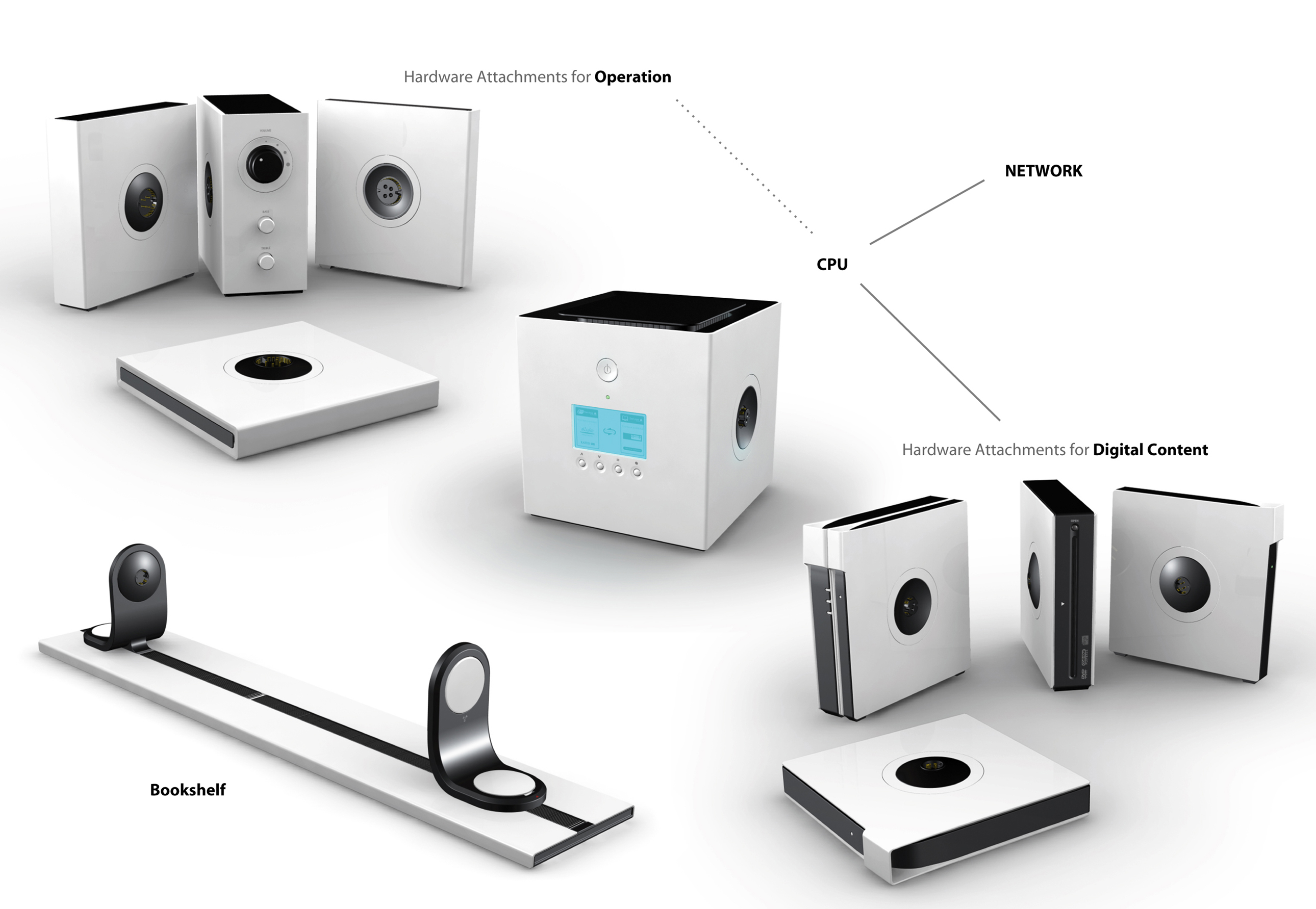
aibrahim writes "Industrial designers at Purdue University win a competition for next generation computer design sponsored by Microsoft. The design emulates a bookshelf, with hardware components that are "stacked" horizontally around a cube shaped CPU. The design attempts to address hardware issues from a user perspective and is pretty cool despite a focus on DRM." -
"Bookshelf" Computer Wins Design Contest
aibrahim writes "Industrial designers at Purdue University win a competition for next generation computer design sponsored by Microsoft. The design emulates a bookshelf, with hardware components that are "stacked" horizontally around a cube shaped CPU. The design attempts to address hardware issues from a user perspective and is pretty cool despite a focus on DRM." -
Fast, Accurate Detection of Explosives
It doesn't come easy writes "Fast, highly reliable detection of residues that could indicate the presence of explosives and other hazardous materials inside luggage is now possible with technology under development at Purdue University. Recent improvements to a previously developed prototype have proven successful at detecting at the picogram (trillionths of a gram) level in lab tests, about 1,000 times less material than previously required. From the article: 'In the amount of time it requires to take a breath, this technology can sniff the surface of a piece of luggage and determine whether a hazardous substance is likely to be inside, based on residual chemicals brushed from the hand of someone loading the suitcase.'" -
Patch & Workaround for Firefox Flaw Available
mcc writes "Yesterday Slashdot reported on a Firefox vulnerability which could allow remote code execution. Today Firefox has a patch and a configuration workaround, both of which immunize against the bug. If you are using Firefox you should immediately go to the URL 'about:config', type 'network.enableIDN' into the box, and verify that 'network.enableIDN' is set to 'false'." Update: 09/10 18:59 GMT by Z : Removed wayward colon. -
More Evidence for Tabletop Fusion
heptapod writes "Researchers at Purdue University have statistically significant evidence that their tabletop fusion experiments were successful. Yiban Xu's experiment different from an earlier Oak Ridge experiment using a different and cheaper source of neutrons than Oak Ridge's pulse neutron generator. Surpassing break-even point still eludes the grasp of science." -
More Evidence for Tabletop Fusion
heptapod writes "Researchers at Purdue University have statistically significant evidence that their tabletop fusion experiments were successful. Yiban Xu's experiment different from an earlier Oak Ridge experiment using a different and cheaper source of neutrons than Oak Ridge's pulse neutron generator. Surpassing break-even point still eludes the grasp of science." -
More Evidence for Tabletop Fusion
heptapod writes "Researchers at Purdue University have statistically significant evidence that their tabletop fusion experiments were successful. Yiban Xu's experiment different from an earlier Oak Ridge experiment using a different and cheaper source of neutrons than Oak Ridge's pulse neutron generator. Surpassing break-even point still eludes the grasp of science." -
Physicists Clarify Exotic Force
Azazel writes "A research group, including Purdue University physicist Ephraim Fischbach, has completed an experiment which shows that gravity behaves exactly as Isaac Newton predicted, even at small scales. Unfortunately for those in search of the so-called "Theory of Everything," the finding would seem to rule out the exceptions to his time-honored theories that physicists believe might occur when objects are tiny enough." -
Physicists Clarify Exotic Force
Azazel writes "A research group, including Purdue University physicist Ephraim Fischbach, has completed an experiment which shows that gravity behaves exactly as Isaac Newton predicted, even at small scales. Unfortunately for those in search of the so-called "Theory of Everything," the finding would seem to rule out the exceptions to his time-honored theories that physicists believe might occur when objects are tiny enough." -
Blank Keyboard
Raynach writes "A friend of mine recently sent me a link for Das Keyboard, the keyboard for UberGeeks. This keyboard is unique in that it has no inscriptions on the keys, which the maker touts will make you type 100% faster in a few weeks since it will keep you from looking at the keyboard. This keyboard also features individually weighted keyswitches, "The keys are divided into groups and their feedback springs are weighted differently; from 35 grams to 80 grams, which correspond to the strength of the finger that touches the keys." But is this "UberGeek" keyboard really worth the high price tag?" -
Pi: Less Random Than We Thought
Autoversicherung writes "Physicists including Purdue's Ephraim Fischbach have completed a study comparing the 'randomness' in pi to that produced by 30 software random-number generators and one chaos-generating physical machine. After conducting several tests, they have found that while sequences of digits from pi are indeed an acceptable source of randomness -- often an important factor in data encryption and in solving certain physics problems -- pi's digit string does not always produce randomness as effectively as manufactured generators do."