 Slashdot Mirror
"Bookshelf" Computer Wins Design Contest
aibrahim writes "Industrial designers at Purdue University win a competition for next generation computer design sponsored by Microsoft. The design emulates a bookshelf, with hardware components that are "stacked" horizontally around a cube shaped CPU. The design attempts to address hardware issues from a user perspective and is pretty cool despite a focus on DRM."
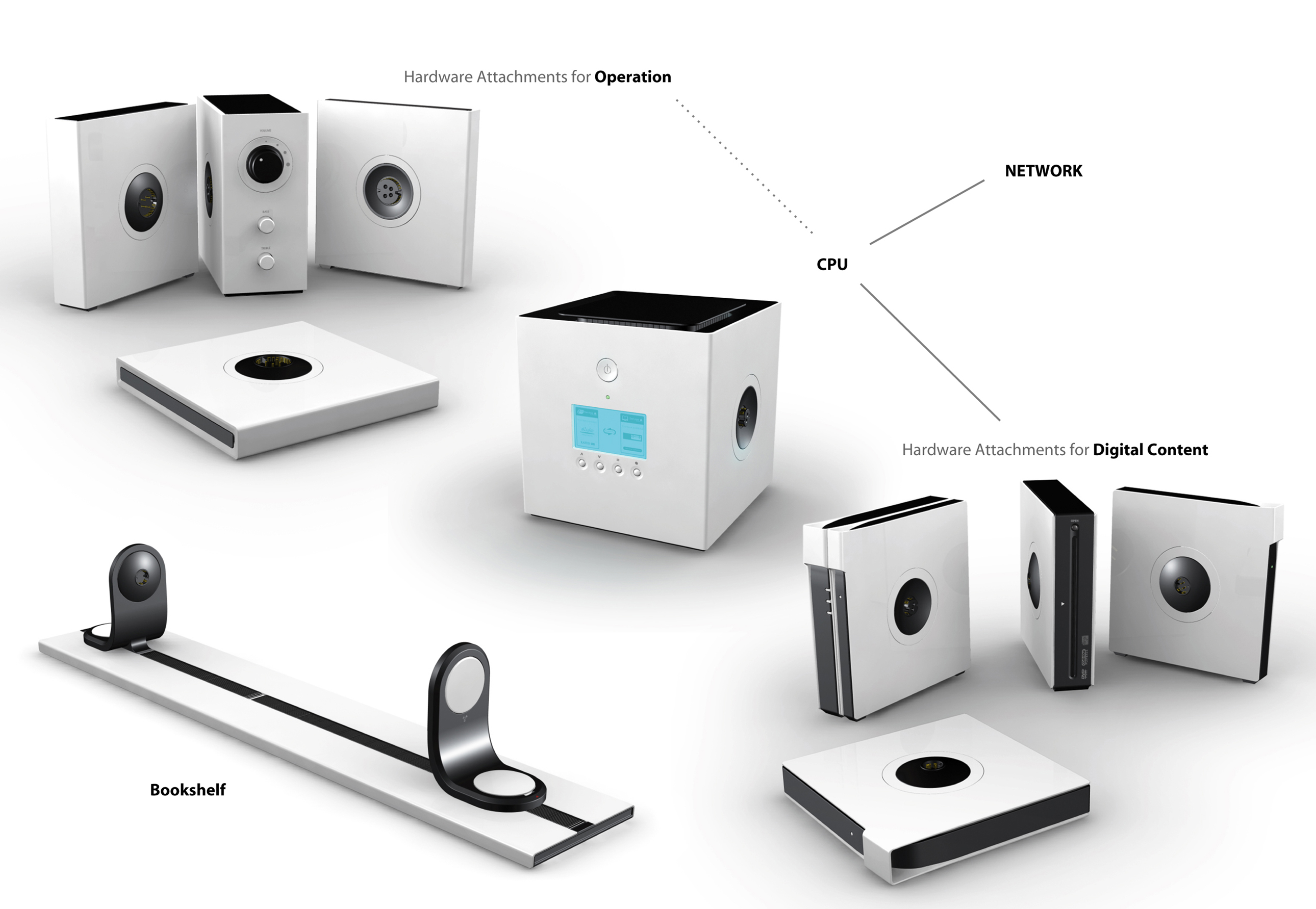
First of all, I'm always curious and a little suspicious when anything is a winner of a competition, "next generation computer design sponsored by Microsoft." My gut reaction to MS sponsored design is that the winner is going to be more about something Microsoft will leverage and much less about what is good for the consumer. Here's why:
Interesting design, but even more constrained in some ways than traditional computers. For my personal taste I much more prefer to put my computer somewhere completely out of sight and not taking up any desktop real estate. I'm not adding and modding so much that I need the "bookshelf metaphor" to accommodate my computing needs.
I'm not even sure I'm convinced this modular design will stem the constant support I give to friends of family when things don't work. Visually it looks simpler for managing a computer, I wonder that vendors would do any better creating truly modular and plug 'n play components for this design.
As for the DRM, from the article:
This new look is essentially a Bang and Olufsen computer -- lots of sizzle, but compared to what really could be done advancing computer design, not much new. If you're into eye-candy, this is for you.
and thus one more reason to stay away...
A lot of these are merely for show, and most people have never actually read their computers.
With present machines if you want to add a USB drive, just plug it in. But then where does it physically sit around. On your desk, I guess. If there are many such add-ons it becomes messy. So this design sorta addresses the mess issue.
I'd like to see a standard spec for stacking (verically) components. They can be connected at the back with USB.
Really, I don't look for a computer like that. I want to forget the "technical stuff", not have it nearby on a shelf.
Make a computer I can forget under some piece of furniture, or above a cupboard where I don't see it, and just let me use the computing power through a wireless keayboard/mouse + videoprojector. Now that would be nicer.
Computers (and OS) have to make themselves less intrusive, and DRM is also a blockroad that shall vanish, not increase, to reach that goal.
Really, I would never buy a computer like that one, I would even prefer a Dell laptop, though they are not that good either.
What is the greatest issue facing computing today? For the users, it is security, for some vendors, it is the security of their hold on some part of some market. DRM answers the second interest to the detriment of the first. The jury who awarded this prize don't understand this, or they do, and have themselves some interest, therefore are not impartial.
aka the "Dressing up a turd" competition.
Having to change the aesthetic of the computer to hide the fact your paid for content is under someone elses control is exactly that.
A Danish Modern computer case.
The simple truth is that interstellar distances will not fit into the human imagination
- Douglas Adams
Aside from the chicklet keyboard, it's claim to fame was expansion by stacking cartridges on the side.A little memory here, a printer port there, and you had a few feet sticking off the side.
http://www.oldskool.org/shrines/pcjr_tandy
Sounds like the same thing with a new paint job.
Was done back in the 80s.. I cant remember what company t was now, but i thought it was cool at the time.. Not practical, but a cool idea.
You started wtih a 'CPU block' and added 'extras' like a 'ram block', video, ports..
Now the DRM 'block;, can we not purchase that 'block' ? Id prefer my comptuer to be fully functional and under MY control.
---- Booth was a patriot ----
A guy at work has been talking about how nice a small, non-laptop cube would be which essentially had the equivalent of a docking station. He wanted to easily have one computer at a couple of locations, but doesn't want to be constricted by laptop shortcomings. If they left the CPU completely port free, and relied on those book-things to get a monitor/keyboard/mouse hookup - it'd be pretty cool.
You know what we be cool to put on that bookshelf? An Encyclomedia PC! This is by far the nicest form-following function I've seen home-brewed in a long time. I couldn't resist the chance to plug it.
-- I have fans? Wow.
First of all, way to go Purdue, I think it's a clean and functional design. If it was on the market, I'd buy it and promptly try to put FreeBSD on it. Very cool. --S
That reminds me of an idea I discussed with a friend sometime during University, it was something similar.
The main idea was a cube like the Apple computer (dont remember the model) and the idea was that, on that cube you only had the basic components (mobo+cpu) and then, this cube has at its sides USB (or firewire or even some kind of PCI-Express) connectors.
When the user buys a new device, she has to attach it to one side of the cube, say for example a CD-RW, you attach it on the top or on one side of the cube. Also, you could attach a "memory expander" where you could add more RAM. Or an Audio module (something like an audio card) or a Video module.
It sounded cool, but after thinking a bit more, it would end being an incredible beholder beast =o)
Ubuntu is an African word meaning 'I can't configure Debian'
It looks like a horizontal version of the vertical "Amiga Walker" http://www.blachford.info/computer/walker/walker.h tml
It was never functional as intended, but the top and bottom halves were meant to be separated and expansion modules placed in the middle. Which would make the top and bottom the equivalent to the bookends...
The bookends create a loop. Split the books to the left of the cd rom drive, pull it out, put a dvd drive in, and push it back together. Mount the dvd drive. Of course, Windows crashes when you do this (just like with Cardbus), but every other OS is okay with it.
The masses are the crack whores of religion.
The Microsoft sponsored design is a Mac Mini, a Nintendo Revolution, a Toaster and a Bookshelf?
I know the Xbox360 power supply can be a nice bread heater, so they have the toaster market covered, but does MS have competition in the digital boockshelf market?
The book The Design of Everyday Things discusses horrible design decisions in appliances, doors, locks, gadgets, computers, and basically anything with a user interface. The book shows how the same mistakes are made over and over by each new designer, issues of user interfaces as simple as buttons and levers, which many engineers know little to nothing about.
In this book, the author repeatedly criticizes designs with the phrase "It probably won an award." He attacks design awards as being given out to aesthetically pleasing or structurally innovative designs, but without sufficient consideration and testing by people who actually have to use the device.
xkcd.com - a webcomic of mathematics, love, and language.
I think it is the same sompetition, where an Indian (from Bangalore) won $50,000 for a comp named "schoolpak", more info on the competition can be found http://www.startsomethingpc.com>here
I have a coffee table book that explores the history of Apple's Advanced Design Group, and it has photographs of a prototype Apple 'puter that worked around the "bookshelf" paradigm. That would have been back in the early Nineties...
I'll see if I can't dig it up for more info (and maybe some pics).
Scott
"Hokey religions and ancient weapons are no match for a good blaster at your side, kid."
In the early-to-mid 1980's, Burroughs had a gray, cube-shaped desktop system called the B20, with system expansion modules (i.e. color video, disk drives) flush-mounted to the side. It ran a multi-user OS called BTOS; there was also CTOS, but I don't know what features made them different. We used B20s in Air Force Accounting and Finance Offices for word processing, spreadsheets, and graphics creation, until Sperry PCs appeared. B20s also ran an addictive game called "Rats." :-)
Side note: Burroughs merged with Sperry to form Unisys.
Dosen't that thing look like something Mac would build?
Hasn't Mickysoft been chasing Mac ever Bill first got started?
I can't believe that while computers could cut down on unnecessary transportation and manufacturing costs for digital media, Microsoft wants to introduce even more resource-hungry "disposable" hardware to help us continue to ruin the planet! This is worse than printer cartridge legislation preventing recycling - a new hard drive every time I upgrade my content???
This tagline was transcoded to result in at least one smirk. If you experience failure to smirk, please consult your Gen
Reminds me of the Acorn Risc PC. The case was built using 'slices' - when you'd used the expansion ports in one slice, you'd simply add another.
Some pretty bizarre slices were developed, including a pizza oven slice! See photos here: http://www.worldofwibble.com/aboutriscpc.html
The TI-99 http://oldcomputers.net/ti994a.html was heavily stackable.
I think the idea behind it hardware-wise seems good. It would be so much more convenient to be able to have every piece be interchangable, not to mention the fact that the amount of space you have to work with would be limited only by your shelf space, and not the case size. However, I highly doubt it will work.
First, since the components are so completely different from anything that's out now, it will be difficult to get people to adopt it simply because of intercompatibility.
Second, it's operating under the erroneous assumption that computer and entertainment system are synonymous. What effect will this DRM-focused machine have on its other functions? And will it be any good at doing non-DRM related functions.
Third, to design a computer primarily around the concept of "big brother is watching you" is just a bit creepy.
No, Apple actually did design the bookshelf computer back in the 80's, and it was an ingenious design (separate processor, drive, graphics, etc modules). Read AppleDesign; it's hard to get but can be found in some libraries. Practically pornography, and will make you weep at the wonderful designs that never made it out of their design shop.
Lies about crimes
Student #2 : "Damn! Microsoft is the Judge though, they'll nev e r (drops coffee) ... DIGITAL RIGHTS MANAGEMNET! DRM! DRM! DRM!"
Student #3 : "" (speechless)
Comment removed based on user account deletion
Burroughs OEM'd the B20 from Convergent Technologies (which called the product "NGEN"), along with their OS, CTOS, which burroughs renamed to BTOS. I worked for Prime Computer in the mid 1980s when they were also OEMing the same machine as an office workstation.
It didn't look as slick as this one, but it was clearly the same idea: You take a CPU module, stack next to it a hard drive module, next to that a floppy drive module, next to that a modem module, and so forth.
Unisys had an entire system like this back in the old days -- each component just had a bus connector on each side, you started with the CPU and added boxes to the ends until you had a long grey rectangle of a computer.
Of course that was:
1) Before there were only about 2 kinds of computer in the world
2) Before it would occur to people to patent shapes
Whence? Hence. Whither? Thither.
Thinking Beyond the Box: Microsoft Hardware-Design Competition Spurs Windows PC Innovation
You can find the laptop computer in the first photo in the personal productivity section. The computer that started this article is the entertainment section.
Microsoft / IDSA PC Design Competition
(flash required) IDSA News Thinking Beyond the BoxThese people look deep within my soul and assign me a number based upon the order I joined. -Homer Simpson
It just reminds me of the TI-99/4A expansion slot with a string of peripherals: see the second picture on this page. Luckily, TI also had a Peripheral Expansion Box where you could put your stuff in.
Next!
I went through the related links at the web site and found a full picture that did not need to be downloaded.(last link) And it looks like the modules fit into the trac like RAM on a main board; the trac itself is called "bookshelf".
What happens if someone accidently spilled a soda (or a beer for those of you that like beer) on the thing? It looks like liquid could run in between the snap in modules and down into the trac.
I say "No Thanks"
This has been another valuable and informative opinion from:
Catahoula!
Looked at the design.
Yep, it's right out of Convergent Technologies and Bourroughs playbook. Had 3 feet of CT box sitting on my desk in the mid to late 80's. All modular. Add components by attaching to the right and pulling the lever down to lock it in place. Great way to add memory, disk, and anything else you needed.
Downside - it took up SO much space. Oh, and CTOS did everything back then that modern OS's do today (for the most part).
The more things change, the more they remain the same.
Does function drive design, or should design drive function?? The 'modern' PC appears to be made the way it is for functionality purposes. The internal bus structure is faster than the external buses, so fast stuff goes there such as memory, video cards and disk drives. The external stuff aren't as fast, so long runs of cables are allowed.
I don't want my memory or video card sitting a couple of feet away from the CPU, with signals bouncing across several interconnects. The amount of noise in the system that will have to be overcome will surely result in decreased performance from current designs.
I don't want a computer that is designed around DRM instead of speed. DRM is not being requested by the masses, and results in pissed off customers. I want faster and better, not slower and less function. I want to be able to copy any DVD/CD to my hard drive so I can put my media on a shelf and never touch it again because the media is too fragile. I want to be able to copy it to my car/phone/media player so I can listen to it anywhere without buying more than one copy. Just like being able to carry a book anywhere and read it, I want to be able to take my music or video anywhere and enjoy it.
Any computer or system that doesn't provide the above, and CDs/DVDs that won't run unless used on an approved DRM device will not be purchased by me. Or if accidentally purchased, will be returned.
If they have come up with a fiber interconnect that the average Joe User can manage. Now that would be a great design idea.
I rarely read replies, it's my opinion and if you thought about your opinion a little more, I'm OK with that.
See: href=http://www.old-computers.com/museum/computer. asp?c=1059&st=1
Slashdot: Playing Favorites Since 1997
And that's the problem with this kind of design. Signal paths need to be as short as possible and with as few intermediate connections as possible. The design with the smallest possible CPU, short memory and GPU paths, and everything else on point connections using the highest possible serial clock speeds to minimise the actual number of signal lines and so reduce cross channel noise - that's the most efficient design, and with the rise of Firewire, Sata, USB-2, Gigabit Ethernet and optical connections, that's exactly where the industry is going.
Interestingly, this was forecast by Ivor Catt in the 1970s - though he failed to spot that the CPU itself needed to be as integrated as possible, and it is the peripherals that need the high speed serial links. Not surprisingly, given the state of the industry at the time.
Conclusion: looks nice but design actually sucks technically. Too many connectors, enforces a form factor that will often be inconvenient, and the issue is going away for other reasons (USB-2, Firewire, hardware miniaturisation)
Pining for the fjords
The Microsoft / IDSA PC Design Competition[startsomethingpc.com] is the link that requires flash not the IDSA.
Since they entered/won/recieved compensation for their design, I wonder if the design contest winners or Microsoft now own the rights to their design?
The designs looks exactly the same as an iPod, except the shape is closer to a square than the long, thin iPod rectangle.
FREE - Java, J2EE and Ajax Audiobooks for Software Developers - www.DeveloperAdvantage.com
It was Apple.
Lies about crimes
The "docking port" connection is cute, but it provides no functional advantage while it restricts layout options.
As for the rest--can anyone say "SCSI"?
I'm a Programmer. That's one level above Software Engineer and one level below Engineer.
Lucky you. I got my library to buy that book, wish I had, too. Its price is mirroring AAPL right now.
If you find that picture, maybe provide a link to a scan? It was really cool...
Lies about crimes
Walker??? It always reminds me of taking a dog for a walk or something old people use.
There is not much modularity in it except for teh insinuation of the name...
try this instead, and instead of the article topic too.... I mean, what will some digital DRM media look like when it gets shrunk down and flatten out? A CD/DVD??? So what are they really saying? That they want to sell you a harddrive with every movie??? And lets not for get about whether or not you can take it with you when you visit you friends.
Granted they following is from the year 1997.... but the concept is far more valid than what the article is about. And if you want to forget Amiga, then replace its name with LINUX (my main OS's at home today)....shrug... its about hardware....
http://threeseas.net/mind/pics/ModularA.gif
The Amiga seems to be the computer that fits into all the
cracks, gaps and holes in reguard to the computer industry. As such it
is difficult to fill the wants and needs of so many when it comes to
packaging. It does seem that one thing everyone wants is
expandability.
I believe there is a workable solutions that most will find
satisfactory and perhaps as a pleasent suprise. The concept is to
produce the Amiga into parts or blocks that may be attached and even
re-configured to fit the packaging needs of many. Such configuring
abilities certainly would increase the versatility of the system as
well as allow users to expand their system as they see fit.
I think from the manufacturing and service perspective, cost
would be reduced as a result of dealing with standard packaging blocks.
Electronically, the Amiga seems to have it's Amiga primary board, an
ability add/enable board and a CPU board. The Amiga primary board would
be standard in all Amigas where the ability add/enable board is used to
add or make available additional features of the Amiga. The CPU board
of course may also contain ram expansion and scsi or IDE interface. The
variables here would be the ability add/enable board and the CPU board
and this will allow price differences with the Amiga block.
The blocks attach to each other through a slot that is
accessable from both the top and bottom of the right side of the
block (see dark gray slot panel cover on the units top right side,
back-side top for the lap-top and hidden in the set top base.) There
is a "T" pass-thru card the internal boards plug into, which has a card
edge connector on it's top and bottom edge. The blocks are connected
using what would be a double sided card edge connector. Securing the
blocks together is done by removing the light blue rubber molding,
behind which is the securing screws. This rubber molding also functions
as the feet so the tower/stacked system, or even the desk-top may be
layed/sat on it's side (preferably on the right side, due mounting
direction of the cards that internally plug into the T pass-thru card.)
The systems in the image:
Lap-Top - Though not a slim unit but more like a small brief-case,
uses the standard Amiga Block (bottom), Floppy-plus block (may contain
up to two hard-drives), Key-board (full size standard), LCD panel (near
the size of a 13" monitor.) The block on the lower far end is the
battery pack and external port pass-thru. Additionally the LCD pane
What if all of your PCI cards, extra RAM, etc. came in cartridges a la old video games.
I foresee heat dispersion issues, especially with AGP cards. Otherwise, existing cards would already have a plastic shell protecting the PCB. Then there's also the temptation to blow on the edge connector instead of using the proper solution of rubbing alcohol on a cotton swab.
The jury who awarded this prize don't understand this, or they do, and have themselves some interest, therefore are not impartial.
Of course a jury from that industry/discipline dealing with industrial design has an interest in preserving intellectual property rights. Professional industrial designers, who might spend years on a project that actually sees production - and thus are spending/costing a lot of money in the process - wouldn't have those jobs or be able to do that sort of work if the people hiring them had no expectation of being able to recoup, protect, and generate income from their investment. Meaning, if Apple couldn't find any recourse against someone making perfect knock-offs of their iPod products, they'd certainly change how (and whether) they spend money innovating along those lines... knowing that someone else gets to run off and make low-overhead money off of their high-overhead innovation and design work.
It's scarcely a conflict of interest when people from that background, judging entries by people who also are or want to be in that line of work, recognize - however indirectly - that ownership of work is and should be as much of an issue as the creator of that work wants to make it. Happily, if their notion of ownership gets too much in the way of making good use of the product, people can just buy something else.
Personally, I find the project cited to be somewhat pretentious, and not something I'd really want to own. And... no one basing a real product around that design is going to get my money. They can take that into account or not, since that's how the market works.
Don't disappoint your bird dog. Go to the range.
It looks like an apple cube.
Nice looking design, but it leaves out something important: the human interface.
Without a keyboard, mouse/pen, and display it's not going to be very useful. And until video signals can be delivered wirelessly, this will mean you'll have clutter.
-ch
so fast stuff goes there such as memory, video cards and disk drives.
Disk drives "fast"? Hardly. Do people who aren't involved in, say, HDTV production or running a heavily-trafficked database-driven web site need disk drives that are significantly faster than the full-duplex 800 Mbps of the FireWire bus? Remember that if you have two hard drives on one bus, one can be reading or writing while the other is seeking.
I want to be able to copy any DVD/CD to my hard drive so I can put my media on a shelf and never touch it again because the media is too fragile.
Apparently, this system would let you do just that. You'd connect a hard drive that supports CPRM or some other MPAA approved data security system, and the "managed copy" feature of HD-DVD would let you put your favorite movies on that drive and keep the discs packed away. The copy would be tied to the drive in the enclosure, but then you could take the enclosure to any system with this sort of bookshelf-style 1394 daisy chain.
wirelss keyboard+"mouse" (or input devices to suit) large screen on wall(or on end of desk), sound output (using purely digital entirely drm compliant connectivity of course) via speakers that are tastfully integrated with the screen/room decor/where they sound best.
The actual computer? with those too difficult to understand cpu's and hard drives and magical wires, net connection? power?
Out of sight out of mind. So who cares what it looks like as long as it fits into the space it got put into.
I like artistry and artistic expression, but for something that needs to be used I chose utility over form, and this is just a set of boxes in "a style" no more or less valid than any other idea of what the correct way to make a personal computer is.
To see a real personal computer of tomorrow look what random folk are doing with mini-itx boards, putting them into all kinds of crazy stuff and making enclosures from scratch or recycling the cases from older devices and achieving something special that suits their needs and tastes. In some of these it really looks like the "out of sight, out of mind" mentality is making the aesthetics of the magic box of wires take second place to something that is simply there to be used, and it's neither pro nor anti drm.
While Apple may have done someting like that in the past, I'm sure the product I'm remembering was not an Apple product.
Too bad all my old BYTE magazines from the 80's are all put away or i would go look.
---- Booth was a patriot ----
It was a project named Jonathan (one of the original Open Mac projects). Here's a short desc Apple's Jonathan Project = Mac Mini
Limits what you can do... focus on being 'pretty'
all the 'artsy' types fawning over it... is it a mac?
Of course a jury from that industry/discipline dealing with industrial design has an interest in preserving intellectual property rights.
What I wrote don't imply denying intellectual property rights per se, and the Apple example you suggest is as good as any. What is at stake is industrial designers treating the computer as an entertainment machine, which is a convenient restriction to some industry, but has very serious implications for all other users of computers, who are many. This is an intrinsic design issue. As far as design is concerned, their design has what is a quality for some commercial interests and what is a fatal flaw for many (most?) computer users.
...at least for this kind of design. Why? Because of its modularity. Say, I visit a friend who also has a computer like that: I simply remove one of my hard disk modules at home and plug it into his setup. All of my music, videos and other data is immediately available and ready to be copied to another drive, no hassle with copying stuff to DVD and back, just plug & play. Oh, and if the hard disks are swapable: what about games, commercial applications or other stuff that is installed on them? This new modularity concept will bring a lot of headaches to people who wish to tie information to a certain user. Currently hotpluggable external drives are not the norm, nor are they easily transportable (hassle with power supply wall warts, sensitivity to jolting movements etc.) but if they become standard, won't the sneakernet gain increased relevance?
-- Language is a virus from outer space.
It's totally wasteful to make a computer trying to mimic the book, or bookshelf for that matter. One of the digital advantage is to eliminate the absolute need of physical presence of either paper or book or things like that. Now they are trying to replace relatively benign natural products such as paper and cloth with something that absolutely sinister -- plastic and toxical metal. When a book gets used, it can be recycled -- at least in principle -- and it's quite routine by now. AFAIS, there seems to be no obvious ways of recycling most of the parts in a computer "bookshelf" except by poinsoning other less advanced society. In both monetary and environmental terms, this is a step backward. Is business interest that more important than everything else? I beg to differ.
This makes me think of the "ownership society" that another moron is proposing. Both are trying to hold onto the one sin humans always have -- selfish greed. Why do morons have to make themselves look like morons?
I like anything that takes away the 20 KM of cables that are under my desk. have two screens, two music boxes, a UPS a modem/router a mouse/keyboard (wireless, but still has a cellphone, a camera, a handheld and a radio, a headset and a radio. Oh and tvcable in and out ad a printer and a scanner.
All interconnected to eachother by a bunch of cables. Most of them also have seperate cables for powersupply,
What I would like to see is a real industry standard that would take care of this, so i would not have to buy from one company, but instead can use a kind of Lego principle with all the hardware and minimise cables.
Wireless solves some, but not all of these problems.
Don't fight for your country, if your country does not fight for you.
There have been numerous designs like that before. The Mac Mini is the lastest example, with stackable components being increasingly available.
They look clean and nice, but they don't catch on. Why? Because they don't make economic sense. A lot of the case material is between components, where it actually impedes heat flow and ventilation. Each of the boxes needs its own fan and power components. And the connector design is tricky and costly, too, compared to internal connectors. Finally, the vendors that the customer can choose from is restricted by such designs; what good is an easily expandable system if my vendor only offers a tiny set of the possible expansions?
Their Shifttricycle is similarly stupid: learning to ride a bicycle is a fairly quick affair, and training wheels already ease the transition; spending a lot of money on a weird, mechanically complex bicycle just doesn't make sense.
I think these people are entirely missing the point of good design: good design combines form with function; they seem to forget about the "function" part.
Scott Shim won another design award last year for the SHIFT tricycle that transforms into a bicycle.
If you thought the DRM on the grand prize was scary, take a look at this
From the article:
Touchtron is a window to the future of Personal Computers, attuned to innovation at the component level. The Data Storage Unit shall either be located away from the user location or would be on the servers of Application Service Providers (ASP) to which the user shall have subscribed.
"... eliminates the most common problems - digital copyrights and inconvenient accessibility ..."
How does changing the physical design of the player eliminate the problem of digital copyright?
Oh wait, is it because once the content is downloaded via subscription to those 7" square, 2" thick modules, you can't move the content off of the modules - you have to take the physical thing itself? That'll be real convenient in all the places we already use CDs, DVDs, flash drives and MP3 players.
Besides that, I don't see this as a "personal computer" design. Looks to me more like an audio/video player design.
Web 2.0 == Giant Blogspam Circle Jerk
a computer I can forget under some piece of furniture, or above a cupboard where I don't see it,
Scenes from a conversation in your kitchen:
No, that's the toaster.
No, that's the microwave. You're getting warmer.
That's it. Pop your disc in.
No, that's not the EULA.
Yup, that's DRM, alright. Bar the doors, pull the drapes. Let me get my Glock. You want anything?
I would guess that's one of the reasons why they made it quite difficult to use an iPod to swap music. They don't use a standard USB cable; unless you enable certain options they won't show up as a standard external drive when plugged in; and even if you set them to this behaviour the folders with the actual music files in them are hard to find, spread out according to an internal database and renamed. Also, files protected by Apple's PlayFair can be copied but won't play on an unlicensed computer. I have no experience with iPods on Macs, I only use mine under ubuntu and win2k, but there are quite a lot of hurdles to jump; not enough to make copying impossible, but so that a casual user will be discouraged.
-- Language is a virus from outer space.
by NZheretic (23872) on Mon 08 Aug 02:57PM (#13266481)
This seems like a cool idea but it has a serious flaw. If ever this is launched the glossy marketing materials will tantalize you with promises of future XYZ book modules. Unfortunately the person who buys it will find that after the initial launch the manufacturer is forced to change the "book" format in version 2 (or goes out of business) and you will be left with yet another paperweight to dispose of on eBay.
This bookshelf box stuff is just a waste of space.
RS
Shoes for Industry. Shoes for the Dead.
Deja Bookshelf! Back in 1983, Silicon Valley startup Ampro Computers Inc. introduced a 'Bookshelf Computer' that consisted of a compact (7.3 high x 6.5 wide x 10.5 inches deep) cube-like box that could fit comfortably on a bookshelf along with book-sized expansion modules for additional disk drives and other peripheral functions. The expansion blocks interfaced to the main computer core via SCSI. The original Bookshelf Computer was based on a 4 MHz Z80 CPU running CP/M, while a second-generation model had an 8MHz 80186 CPU and ran IBM PC-DOS. Shortly after Ampro began shipping its Bookshelf Computers, Microsoft introduced a desktop software bundle it called the 'Microsoft Bookshelf.' Ampro subsequently informed Microsoft that its Microsoft Bookshelf product name infringed on Ampro's 'Bookshelf Computer' trademark, resulting in Microsoft purchasing the rights to the Bookshelf trademark from Ampro.
With the memory and pci-e controllers now getting embedded into the CPU to reduce latency here comes a design that not only makes the PC too big and greatly limits the industry to a crappy form factor but completely destroys low latency and performance? - If I were a judge, I would grant it the dumbest design of the 21st century - its been done in the 80s, 90s and proved not to work, are they just taking the mick now?
The speakers must be situated some distance from eachother or whats the point of stereo, most peripherals you want to actually be able to hotplug to the PC are digital cameras, mp3 players, webcams, etc that dont stack up and this makes expansion much more expensive and greatly reduces performance. Please someone tell me the upside.
Is it just because it has the acronym DRM smeared all over it?
... on a Mac. Lucida Grande is a dead giveaway.
The bits on the bus go on and off... on and off... on and off...
This looks exactly like something I saw at the Institute of Design at Illinois Institute of Technology in about 1996... freakily similar in fact - that won an award too.
Of course that looked kinda like something I had seen in an article from the 80's....
Which looked alot like the stuff they played with tin the 70's...
Oh screw it, it wont be commercially successful this time either. Those connections last about 13 seconds around a 3 year old kid, or a clumsy adult.
- Adam L. Beberg - The Cosm Project - http://www.mithral.com/
> does MS have competition in the digital boockshelf market?
No, and the reason is that MS owns the trademark on the word 'Bookshelf' (computer related) and copyright on the implementation of a computer in the form of a book for putting on the bookshelf.
In the early 1980s MS bought a company that produced a product called the 'Bookshelf Computer' that ran CP/M and was book sized (large book).
http://www.ddj.com/documents/s=989/ddj9507n/
I have a stack of ICL DRS300 computers here that were made in the late 80s and came in A4 sized parts that clipped together: K1 power supply, A2 CPU, D1 floppy drive, D4 hard drive, S1 tape drive, etc. Ran Concurrent-DOS or Unix (or both if you had two CPU units).
... that people on /. are becoming ever more dense to reality.
To pick on a few previous posts:
1. It's a DESIGN COMPETITION. Do any of you go to school? Competitions like this don't usually turn into an actual piece of retail equipment. It's DESIGN. Design? Holy crap!
2. The "bookshelf" part has nothing to do with the connectivity. Look at it. The connectivity occurs through the SIDES of the device (most of the gripes here), not through the "trac".
3. Yes, it's been done before. This is a slightly new spin on it. It's DESIGN.
4. There are situations where a design like this would probably prove beneficial. Not every design works for every person in every situation. A clunky biege case next to your receiver under your TV? I don't think so. The nice PVR-style case under your monitor? Who uses desktop cases anymore? A mini-ITX system? That can't run Half-Life 2!!! Not everything works in every place. Get over it.
"Up until now, personal computer designs seemed to be based on the issues of processing speed or performance rather than the user's convenience."
Yea right. DRM gives me convenience eh?
But it will probably give some far-east outfit an idea for a $50 Mini-ITC case. Thanks guys!
Open Source Drum Kit, LPLC deve board - mjhdesigns.com
This looks like an updated version of the original TI-99/4a computer, with the modules upended.
http://oldcomputers.net/index.html
Fortunately; TI eventually decided to put all the periphials in a single case, the P.E.B., ending up with a computer system that looked a lot like a modern PC.
The U.S. really needs an English to Wisdom dictionary.
I work a little bit with PLC's, and a few of the more advanced models follow a similar concept. You have a base module with the processor, core chips, and the power supply, then you add on functionality. With the PLC's, it's typically things like extra input or output modules or high speed counters. The reason it's economical to build the high-end PLC's this way, is because the applications are very different. Some may need 2 or 3 digital inputs and outputs. Some may need 40, with some of the channels being analog, as well as additional power supplies, relays, and ethernet connectivity. They all mount to a common chassis connection to the processor module, like this bookshelf idea.
With computers, however, there tends to be a fairly standard package containing the processor and motherboard, hard drive, ram, CD-ROM, and video, network and sound cards. You generally do not see drastic changes from this setup, and when you do, it's almost always with a PNP peripheral, like USB or firewire devices.
You just do not give up, and are stupid as they come.
v 1: supplement with leverage; "leverage the money that is
The above was from dict.org.
Ah the gutterboy that is flyinwhitey.
They don't use a standard USB cable; unless you enable certain options they won't show up as a standard external drive when plugged in
Huh?? What's non-standard about it?
When my GF got an ipod mini, I plugged its USB cable into the USB keyboard on my creaky 1990s PC (only has USB 1.1) running debian GNU/linux, and mounted it as a disk. I even copied some MP3 files over to the ipod and listened to them. Copying was kinda slow because the PC only had USB 1.1, but otherwise it seemed to work just fine...
We live, as we dream -- alone....
That is only part of the "features" of DRM.
Another feature is 'approved content' control. If in the future the content that you legally own becomes ' unacceptable ' you cease to have access to it. ( such as if the government decides the Ebook you bought 5 years ago is now 'bad' )
It can also enable *forced* upgrades of your 'media devices'. When the support dies so does your current content, regadless of legal ownership.
It also can ( eventually will ) prevent the use of non-blessed data at all ( be it legally yours or not ) , effectvly cutting out the 'little guy' and forcing you to use only things approved by the monopoly of the day. Sure there will be no legal restriction for the little guy to become approved, but the cost/hoops will make it nearly impossible for anyone but the big players to get thru.
Remember the story of the camel's nose? Letting DRM in the tent to 'protect IP rights' is the nose....
---- Booth was a patriot ----
Comment removed based on user account deletion
This idea was used in the Convergent Technologies systems in the early 80s (also remarketed by the old Burroughs Corporation as B20 systems). In production this worked well and made for fabulous demonstrations. However, this is just another form of closed system--no sizeable outside parties made modules that connected through the proprietary bus/connector--the vendor liked it that way to make more money and there was not enough critical mass/market to justify it. I believe IBM also made prototype systems with the same idea even earlier.
Back in the 80's a company called Datapoint already had this design for their IBM clone called a Vista-PC. So yeah, not new.
This has been done since the 40's. This is why they make yagies. Of course the guy who designed this artsy farty system forgot to design in the yagi. He forgot a dish too. And I can't see any edge connectors. If we used rabbit ears properly designed then the CPU unit could look like a cartoon character.
<sarcasm>The PC definitely should be a dumbed down box like the television set. Special 'content creation' hardware should be needed to author 'content.'</sarcasm>
It's no different than before, as a decent recording studio will always cost more than a $40 portable CD player. A bookshelf setup with FireWire drives would likely be sufficient for editing DV (standard definition) footage, and if you can afford an HDTV camera, sets, and lighting, you can probably afford a more capable computer.
What I meant is that the connector socket on the iPod side is not a standard USB type. Instead of using a standardized USB (or mini-USB) socket together with a standardized stereo line out Apple created their own version. That means that you have to take your cable with you if you want to hook up your iPod since none of the standard USB cables will fit.
-- Language is a virus from outer space.
... unfortunately it looks ugly.
It has however, have a standard spec: http://www.pc104.org/technology/PDF/PC104%20Spec%2 0v2_5.pdf
and has been around for quite some time (1992 by the looks of that document)
Random pictures for the uninitiated:
There are two types of people in the world: those who divide people into two types and those who don't.
i can not find the information right now, but they had some usa funded research about computer where you just throw parts in a box and they communicate with short distance radio waves.
removes all slots, thus requiring less space.
i haven't heard anything more about that, though.
Rich
Moto did this many years ago with the PowerStack:
/. reading - so I don't know where the DRM reference comes in, but the modular/stackable design is definitely nothing new.
http://www.corestore.org/Mvc-002s.jpg
http://www.corestore.org/powerstack.jpg
The bottom unit is the main computer (CPU, boot drives, etc.), the upper unit is a media expansion (more drives of various types), and I believe there were other expansion units available as well (with a cover plate above it to make it look nice). You could stack up and up and up, taking up the same footprint as a base unit - unlike the design in the article, where it stacks out to the sides and has a limited range.
Granted, I didn't read the article - I'm merely catching up on my
- Preferences: Solaris 10 (servers), Ubuntu (desktops), Solaris 11 (personal servers) -