Slashdot Mirror
Domain: qsl.net
Stories and comments across the archive that link to qsl.net.
Comments · 193
-
Re:as a amatuer radio operator....
I can't tell if you're trolling, but here are some positives for amateur radio spread spectrum:
Spread Spectrum Rule Recommendations by Phil Karn, KA9Q -
Spread Spectrum Rule Recommendations
Here's a good overview of the positives and negatives of spread spectrum modulation:
Spread Spectrum Rule Recommendations in Amateur Radio -
Here's a *real* WAP11 hack..
2.4 GHz to 900 MHz transverter
Based around the WAP11 to help overcome obstructions.
The maximum output of a Linksys WAP11 is 19.18 dBm (83 mW), by the way. There is an integrated TX AGC to control the linearity of the output RF power amplifier, this is what this power hack is controlling. You may have a higher output power, but your signal will be distorted. -
2.4 GHz to 900 MHz Transverter for Wireless LAN
Offtopic, but here is a link for a project to attempt converting 2.4 GHz 802.11b wireless LAN cards down to the 900 MHz band to help overcome non line-of-sight issues.
here's the link -
want some real distance?
Build antennae and you can boost your signal up to 5 or so miles. Apparently these guys did it with Proxim cards.
-
Generators and Motors...
Good idea, but I doubt it.
For large scale power generation, the generators do not use permanent magnets, but rather use electromagnets. These electromagnets are energized by a small current, then the generator spun up, and the electromagnets keep generating a magnetic field, either by being fed directly off the generator (like a car alternator works), or by simple induction (look here for how to do this yourself from common electric motors!!!). Permanent magnets tend to only be used on small generators like that used for bicycle lights, or for the spark generation on small engines (where I suppose it could make a difference).
As for motors, most AC motors, once again, are either induction based, or three phase with two sets of electromagnets - no permanent magnets used. Where it could get interesting though, for electric vehicles - where I think your idea might have merit. A lighter, but more powerful motor using these magnets (if they prove to be more powerful than other magnets, of course) would mean longer battery life. Still, I think some electric vehicles actually use AC motors as well, and do a DC->AC conversion. AC motors are used, I think, because even after the conversion from DC to AC, they are more powerful for a smaller package, and more efficient (of course, I could be wrong - someone enlighten me, please).
Also, smaller, lighter motors could mean smaller conventional DC motors, like smaller pager motors, smaller printer stepper motors, all the small motors that exist (smaller, lighter, more powerful kick-ass battlebot motors - yeah!!!)... -
Re:Fresnel Zone
The YDI calculations suck. They are stolen from other people.
Use these wireless link CGIs instead... -
this is possible with a 2.4ghz amp and two dishesif you have line of sight, get two high-gain dishes, two bi-directional amplifiers mounted at the antenna and some LMR-800 coax running to your 802.11 card. you'll have to come up with a way of interfacing the coax with your 802.11 card. get creative with a soldering iron and it shouldn't be a big deal.
i don't know what the legal power limit is for the 2.4ghz public band...but as long as no one complains, chances are you will have no problems.
this place has everything and it's probably all legal
this place has lots of cloices for high-gain antennas and good prices
-
Consider Amateur Laser
I'm not sure of the exact speeds yet, but we are going to be experimenting with using laser for linking APs in Brismesh. Here's some links:
http://www.qsl.net/wb9ajz/laser/laser.htm
http://www.arrl.org/tis/info/laser.html
http://www.gbonline.com/~multiplx/wireless/laser /
http://www.emn.org.uk/laser.htm
http://www.n1bug.net/tech/laser/alc_wa6ejo.html
That last link explains how to get around the modulation problems that can slow down standard laser diodes. You find some of these links useful.
David -
Re:Why it's no good for me (& many others)
Is anyone aware of an online service where I could plug in a route (not a single location) and get a listing of stations by genre along the way? I imagine this would be a popular add-on to the many online route/map services but none seem to have anything like this. What I'd like to see would be something like a listing of public radio station by frequency along my route; others would presumably prefer country stations, pop or rock programming, etc.
This is what RDS (Radio Data System) does in the UK and Europe. Apparently this is available in the US too, although on a much more limited scale (it's more or less universal here, and any new car radio supports it).
You get station ident on the display, traffic alerts from nearby stations and automatic search for particular types of program (PTY) - have your radio search for classical stations. -
Re:Putting it all together
out of curriousity, and cause im too lazy to look it up, what does RM stand for (other than "the malaysian currency" cause im not a dumbass) and about how many us dollars (plus any other currency you feel like adding)is it worth?
I just did a quick search on google and the first likely page I found: http://www.qsl.net/seanet2001/m'sia_currency.htm says the exchange rate in April 2001 was:
US$1.00 = 3.80 RM (Ringgit).
(I have no idea how the abbreviation for "Riggit" is "RM".)Thinking further about the setup they are proposing, it may not cost them all that much for the physical infrastructure; especially in comparison to the cost of a wired broadband setup. They still would have the fixed costs of installing the antenna(s) and connecting them to whatever routers and internet pipes. They'd also have the monthly costs of the bandwidth. I'm still wondering how they can make a profit considering how much bandwidth could be consumed in a month (unless they have a bandwidth cap? There was no mention of it in the article, but I'd sure expect they would institute one before long. Otherwise, their advertisement is effectively saying: "Buy a pizza, and be able to spam / webhost / etc. for free."
Another thought: how long is one entitled to free access for the price of that pizza? Could well be that it would be just one week's worth... what a nice synergy! "Honey? Our internet connection just got shut off again... could you please order a pizza?"
-
This puppy could be good for a lot more than games
Might be a nice, cheap input controller for my car MP3 player. That's a lot of UI functionality for $250-$300, compared to what you pay for off-the-shelf automotive display solutions.
-
Re:Buddy, can you spare the time?
I assume he didn't spend $2K just to play Doom.
Oh, I don't know. I spent way more than that building this just to play Quake... -
Re:distance/legal
Get a Technician Ham License and you can use lot's of power and be legal, 802.11b is in a ham band(2.4 Ghz I believe) please check this site as it has lot's of information for hams and people that aren't hams too concerning highspeed wireless data.http://www.qsl.net/kb9mwr/projects/wireless/ John KG4AKV
-
Re:I haven't touched a HAM RADIO
Do you remember A,b and C Classes? They were done away with in 1951. We are now back to them with Tech, General and Extra.
Ham Radio is not antiquanted, heck there are some folks doing hi power 802.11 IP based networks. -
Re:It's dead, Jim+ People needs screenshots(damn)
-
"GNet" in Boston areaThere's another effort around Cambridge / Somerville, Massachusetts, that seems to be making a transition from 9600bps traffic to 802.11 cards.
Check out http://205.159.169.11/.
Farther afield, it's too bad that only this Swedish group seems to be doing much with the point-to-point 10Mbps link.
-
Mobile hard drive longevity
First, IDE hard drives do not fare too well in a bumpy car. Anyone who has ever tried to do anything like this an an automobile can attest to this fact.
You should probably gather some more real-world data before making that assumption. The Maxtor 20 Gb drive in this installation:
http://www.qsl.net/ke5fx/cplayer.html
...has spent ~5000 miles in the back of a Porsche 968 with a 7-year-old suspension, ~4000 miles in the back of a Corvette, and over 1000 miles in the back of a Honda Accord with no hard-drive problems at all.
Even if it died tomorrow, I'd stand by the assertion that HD reliability is not a real problem. I think that drive cost $250 when I bought it -- it's probably less than $180 now. A lot cheaper than 10,000 miles' worth of gas, that's for sure.
Second, does anyone really need 80 GB of MP3 storage?
Yes. To many people, variety is as important as content. -
Re:This is great news!
What the fuck are you going to do with your very own spectrum? Hmm? Have you developed a technology that uses, say, 2.95 MHz - 3.3 MHz? Have you?
Yep.
Unfortunately, the other posters are probably right -- this allocation will end up being carved from the Amateur spectrum. It's hard to justify giving us so much space that most of us don't use. I'm very surprised we still have 1296 MHz, for instance. -
Re:Runs on LinuxFirstly it's not Just your thoughts in fact their not thoughts at all, just a knee jerk reaction to the word Linux in an article. The word Linux doesn't even appear on the Frontpage blurb, you have to see the full posting.
Also if you bothered to go to the home page of the project you would have seen that it is an effort by a bunch of Linux enthusiasts to build a high-speed wireless network in some parts of Canberra.
So the mention of Linux down the bottom of the post is actually quite subttle. The article could have been titled Linux Enthusiasts Put Old Pay-TV Dishes To Use -- As A LAN as that's what it is really about.
Next to reply to Now if you're going to put up a tutorial on writing a driver for this dinky little device, or one of the "making-of" type pages; if you actually go to the link you'll see on the page the section:
Antenna designs
Jason Hecker has an excellent document on his helical antenna design.
Tony Langdon has design details for a high gain 2.4 GHz omnidirectional antenna. Look for the links that refer to a 2.4 GHz antenna.
Finnally if I look at the Frontpage of
-
pricesI looked into buying some of the cards mentioned and found that there are none left
Alternatively you could build your own.
If anyone has some old cards for sale at reasonable price, I am in the Perth area W.A!
cya, Andrew...
-
Re:Hmmm...
Shit... forgot to close the second-to-last href tag. Try here for that last link (which also happens to be the most useful).
-
Hmmm...
IIRC, there was an article right here on
Anyway, if you have line-of-sight between the two houses, I'd go for wireless (preferably RF/microwave rather than 802.11 or other shorter-range types). Here's a list of links that you might want to take a look at:
Wireless Projects, Vendors, and Products: Big collection of links on all sorts of wireless networking. If you can't find something here, give up.
This is a general outline of wireless LAN.
Ah, here's a bit from
..Ah, here we are - the DIY 10Mbit/s microwave project that was linked from
Hope these help... -
Amateur SSTV has been operating for a while...
The amateur station aboard Mir (R0MIR) has been transmitting Slow-Scan Television (SSTV) for the past 6 months or so. Check out the following links for some great images received from the station (the second link includes a lot of links to other archives of Mir SSTV images):
http://www.qsl.net/wb8erj/mir-pix.htm
http://home.t-online.de/home/mrensen/m ir.htm
The cool thing about SSTV from Mir is that it is largely controlled by the station operators aboard , and is much more dynamic content-wise than stuff like weather satellites and stuff. They occasionally turn the camera on themselves, visiting shuttles, etc. Check it out, it's neat stuff. It is also fairly easy to receive and decode SSTV transmission using a soundcard, some freeware code and a radio capable of receiving the 2-meter amateur band. The following link has lots of info on SSTV (aside from the blink tags):
http://www.mbnet.mb.ca/~rraimb/
-
*Important!* Please note...
... that the link on the posted site goes directly to my project text description. If you visited the KE5FX site before I updated it with a link back to my home page, you probably didn't see the schematics, waveforms, and photos associated with the project.
The correct link to the project site's front page is http://www.qsl.net/ke5fx. Sorry for any confusion. -
I'm the author of the original 10-mbps project...
... referenced in the article, at http://www.qsl.net/ke5fx. I'm going to be sort of redundant here, and repost this message as a reply to the "first post", just to make sure all interested parties see it. I got to work late today, so my initial reply is lost somewhere in the noise at the bottom of the article.
Amusingly, I submitted the project page to Slashdot myself about a year ago, when I first got the link working. When the submission was rejected, I wrote to one of the well-known admins at Slashdot asking what I needed to do to make it
I just didn't think it was interesting enough.
Sorry.
--
| (admin name omitted) | Just want to be misunderstood,
| (admin name omitted) | I wanna be feared in my neighborhood.
| http://slashdot.org/ | Just want to be a moody man,
| codejockey*gangstero | say things that nobody can understand.
| flove*lovemachine*wr | --Pete Townshend, Misunderstood
Dejected, I was forced to admit that my news-for-nerds quotient just couldn't compete with the guy who built a PC case out of Zebrano wood, or whatever the story-of-the-day was at the time. Consequently, Rob gets major props from me for doing a better job writing up the submission than I did.
Now for the bad news: out of many thousands of hits my site's received over the past year, only one guy, an EE professor at a local university, has successfully duplicated my efforts. In my mind, that somewhat validates the unnamed Slashdot admin's decision not to publicize the project in the first place. People, this is not a project for beginners or casual electronics buffs! In the year since I finished the project, a couple of excellent alternative solutions for RF data links that make good use of off-the-shelf hardware and homemade antennas have come to light. For instance, there's a good page on the topic of modifying Proxim Symphony cards for long-range service at Low-Cost Wireless Network How-To. I would have to say that this is a better approach for 99% of the people who have looked at my microwave link page and thought about building it. Heck, in retrospect this is what I should have done, instead of putting in all that engineering time on a 100%-custom solution.
My own 10-megabit link has been running great since last June with only a couple of hours' downtime for maintenance and tweaks, and it's easily the most 'educational' project I've ever tackled. But I think it's important to temper peoples' expectations. If you are an experienced electronics hacker with access to a very well-equipped RF test bench or a university EE lab, and you just want to spend a lot of time and money building something something cool, then I highly recommend my microwave link project. If not, do yourself a BIG favor and check out the various wireless-Ethernet card tweaks that have been springing up on the Web.
-- John Miles, KE5FX -
I'm the author of the original 10-mbps project...
... referenced in the article, at http://www.qsl.net/ke5fx.
Amusingly, I submitted the project page to Slashdot myself about a year ago, when I first got the link working. When the submission was rejected, I wrote to one of the well-known admins at Slashdot asking what I needed to do to make it
I just didn't think it was interesting enough.
Sorry.
--
| (admin name omitted) | Just want to be misunderstood,
| (admin name omitted) | I wanna be feared in my neighborhood.
| http://slashdot.org/ | Just want to be a moody man,
| codejockey*gangstero | say things that nobody can understand.
| flove*lovemachine*wr | --Pete Townshend, Misunderstood
Dejected, I was forced to admit that my news-for-nerds quotient just couldn't compete with the guy who built a PC case out of Zebrano wood, or whatever the story-of-the-day was at the time. Consequently, Rob gets major props from me for doing a better job writing up the submission than I did.
Now for the bad news: out of many thousands of hits my site's received over the past year, only one guy, an EE professor at a local university, has successfully duplicated my efforts. In my mind, that somewhat validates the unnamed Slashdot admin's decision not to publicize the project in the first place. People, this is not a project for beginners or casual electronics buffs! In the year since I finished the project, a couple of excellent alternative solutions for RF data links that make good use of off-the-shelf hardware and homemade antennas have come to light. For instance, there's a good page on the topic of modifying Proxim Symphony cards for long-range service at Low-Cost Wireless Network How-To. I would have to say that this is a better approach for 99% of the people who have looked at my microwave link page and thought about building it. Heck, in retrospect this is what I should have done, instead of putting in all that engineering time on a 100%-custom solution.
My own 10-megabit link has been running great since last June with only a couple of hours' downtime for maintenance and tweaks, and it's easily the most 'educational' project I've ever tackled. But I think it's important to temper peoples' expectations. If you are an experienced electronics hacker with access to a very well-equipped RF test bench or a university EE lab, and you just want to spend a lot of time and money building something something cool, then I highly recommend my microwave link project. If not, do yourself a BIG favor and check out the various wireless-Ethernet card tweaks that have been springing up on the Web.
-- John Miles, KE5FX -
Great idea......the only problem is that there is no information up there yet (that I could find.) The best piece of info on that site was this link:
http://www.qsl.net/ke5fx/uwave.html
Definately something to watch, though. Maybe I can get my neighbor to get DSL and then beam it over microwave to me (I'm a little too far...)
dc
-- -
Process gain
Process gain is basically the improvement in signal-to-noise ratio that can be had in exchange for letting your signal take up more space than Mr. Shannon says it needs.
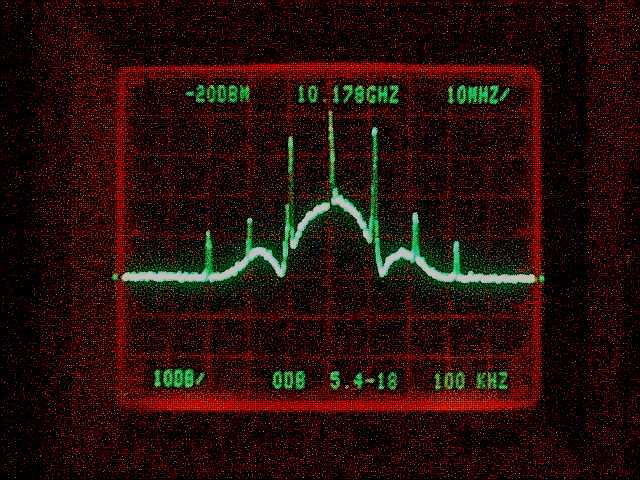
For example, Dixon's Spread Spectrum Systems says that for FM/FSK signals with over-unity deviation ratios, the process gain is 3 * (maximum deviation^2). The S/N ratio for the narrowband information being transmitted is effectively improved by allowing it to occupy more spectrum space than necessary. This is why I have my microwave link tweaked to chew up several dozen more MHz of prime 10-GHz real estate that it probably really needs.
As I understand it, another way to think of process gain in the general case is in terms of jamming immunity; i.e., how much power is it going to require in order to use an uncorrelated transmitter to jam the channel.
I'm sure there are different process-gain equations for various modulation mechanisms, but they are all going to boil down to the same basic idea: trading occupied BW for S/N. -
Process gain
Process gain is basically the improvement in signal-to-noise ratio that can be had in exchange for letting your signal take up more space than Mr. Shannon says it needs.
For example, Dixon's Spread Spectrum Systems says that for FM/FSK signals with over-unity deviation ratios, the process gain is 3 * (maximum deviation^2). The S/N ratio for the narrowband information being transmitted is effectively improved by allowing it to occupy more spectrum space than necessary. This is why I have my microwave link tweaked to chew up several dozen more MHz of prime 10-GHz real estate that it probably really needs.
As I understand it, another way to think of process gain in the general case is in terms of jamming immunity; i.e., how much power is it going to require in order to use an uncorrelated transmitter to jam the channel.
I'm sure there are different process-gain equations for various modulation mechanisms, but they are all going to boil down to the same basic idea: trading occupied BW for S/N. -
Oh well...
It's a pity they didn't consider turning the control and maintenance of these satellites over to AMSAT, since they're going to junk them anyway. They have the knowledge, expertice and infrastructure to deal with satellites.
...could have been real handy having those up there for emergency radio communications purposes.
Oh well, guess you can't win 'em all.
de VE3SLG -
wireless how-to
There is a wireless network how-to here that shows you how to modify an off-the-shelf 2.4 GHz card (Symphony) for higher power, and has some notes on wireless network security.
-
Re:Wireless LCD screen Linux terminal for $200
FYI, there is a low cost wireless how-to here. It shows you how to hack ISA Proxim Symphony 2.4 GHz wireless cards.
-
Re:802.11
Check out this page for external antenna modifications.
-
low cost wireless how-to
There is a how-to here that might be useful for increasing the range of 2.4 GHz wireless devices, such as Bluetooth.
-
some info on low power wireless devices
There is a wireless how-to at www.qsl.net/n9zia. There are some ideas for extending the range on low power wireless devices.
-
Low cost wireless network how-to
For those intrested, there is a how-to on building your own wireless network at http://www.qsl.net/~n9zia
-
wireless how-to
there is a low cost wireless how-to at www.qsl.net/n9zia
-
Re:Last Post!
If you can read this post, it's because I'm using a home-built 10 GHz Amateur Radio microwave link to share my office's T-1 line via 10-megabit/s Ethernet. See http://www.qsl.net/ke5fx for details and schematics.
Some of us were never much into the whole Morse Code thing to begin with. -
10 Mbs ethernet @10 GHz
-
Wireless sharing of >T1 bandwidth, on the cheapA couple of posts to this story have brought up a good point, which is that if you can find some inexpensive wireless LAN equipment and a sympathetic T1- or T3-owning host, you're in business. That is basically what I've been able to do, using a homemade microwave link for 10-mbit/s connectivity with my office. Details on this construction project are here.
The main article on that site contains a link to a mailing list populated by several experimenters who are looking at using this type of link to deliver bandwidth to underserved areas in the US and various foreign countries.
Although apparently not 'nerdly' enough for a Slashdot quickie topic, the microwave link was the subject of a thread at Technocrat.net, which can be found here. I'll be glad to answer any questions anyone has about this project, either here, on the mailing list, or at the email address below.
John Miles (ke5fx@qsl.net; tried to register but the
-
Re:Rambus will not die
Hate to break the news, but the problem isn't really with the Camino north bridge chip. It's a signal integrity problem with the Rambus system architecture. Nasty combination of crosstalk and a resonant mode in the data lines that takes received data out of signaling spec (the line fails to cross above the logic threshold when the RAM is sending a HIGH.)
Intel is taking the fall on this one as though it's a silicon problem because it doesn't really matter where the problem is, the 820-based product isn't going to ship. Inside of Intel there's a big bloodletting going on between the engineers and the suits, because the suits are having a hard time dealing with the concept that there are some things that can't be changed by management fiat and the engineers aren't real amused by egos under the delusion that they can order back the tide.
There's been some good discussion on this over on SI-LIST -
It depends on the bit rateSome encoders seem to be better at certain bit rates than others.
Under Win32, the so-called "Radium" variant of the Fraunhofer-IIS Professional codec is pretty much the undisputed quality champion at 128 kbps. The newer versions of the Xing encoder are almost as good, and way faster (30 seconds or less to compress a typical track on a fast Pentium II/III). On Win32 you want to stay away from older versions of Xing, and you also want to stay away from the gimmicky variable-bit-rate option on the newest version.
As far as a multiplatform encoder goes, the LAME (LAME Ain't an MPEG Encoder) project claims to have made numerous improvements over the standard ISO reference implementation on which most other freebie encoders are based. However, LAME is still far, far inferior to Radium/Fraunhofer at the usual 128K bit rate. I found that it was necessary to run LAME at 160 or even 192 kbps to achieve the same quality that Fraunhofer delivered at 128.
YMMV...