Slashdot Mirror
Domain: railfan.net
Stories and comments across the archive that link to railfan.net.
Comments · 16
-
Railfan.net moved their content...
...the link in the article now points to a blank page. Try this instead: http://southern.railfan.net/ties/1966/66-8.ZZZ/gauge.html
-
Re:That's a really great idea but...
It's too bad we already built cities and housing for 6.7 billion people. Maybe next time we could re-start with this in mind.
The concept was quite popular in Chicago: "A UNIVERSAL FREIGHT STATION on the Chicago freight tunnel system. Four of these freight stations give the general public access to the tunnel services. The tunnels link up with all the city's railway goods termini, and many private warehouses and stores also have direct links with the freight tunnels. These connexions consist of shafts and elevators that bring the tunnel cars up to ground level."
http://mikes.railhistory.railfan.net/r047.htmlI believe Capone used a similar system during the prohibition. Although his motive was more stealth over efficiency,
Even today transporting "goods" via underground tunnels remains popular
http://articles.cnn.com/2006-01-26/us/mexico.tunnel_1_tunnel-task-force-cross-border-tunnels-lauren-mack?_s=PM:US -
Re:Well, if not for car, how about a train?
-
Re:Nonsense.
The weirdest part of the original quote is the poster knows nothing about trains and steam engines, or what people believed a century ago. It does sound nice, but is totally wrong.
Take, for example, this story from 1895, a mere 114 years ago, of a speed run, which means everything tuned up to the max, considerable effort to keep all other traffic out of the way, etc, but hardly, "body falling apart" levels.
http://mikes.railhistory.railfan.net/r070.html
More topical, just a decade later in 1905, still over a century ago, there was a regular scheduled run, nothing special, just another run, from atlantic city to camden, that required an AVERAGE speed along the route above 60 MPH, a mile a minute. Sometimes it was late, but pretty much ran on time.
Don't downhill skiers generally get above 50 MPH too?
-
Re:They run fiber through a lot of weird places
London has a similar 8 station, automated miniature subway built in the early 1900's by the Royal Mail to haul mail around the city. Mail shoots deliver the sacks to the small, driver-less trains which haul the mail along the 20 mile track till it reaches the desired post office where it slides into mail-sack elevators and gets returned to the surface. Despite having been used for almost a century to deliver most of London's domestic mail though, hardly anyone even knows it exists.
Some nice pictures and info here: http://mikes.railhistory.railfan.net/r023.html -
"Brushless DC" vs "synchronous AC" motors.
An AC induction motor has the highest power/weight density of all electric motors. Brushless DC motors are only competitive for very small motors.
Er, no. A "brushless DC" and a "variable-frequency synchronous AC" motor are the same thing. Smaller motors tend to be called "brushless DC" and are driven by "motor controllers", while larger motors are called "variable-frequency AC" and are driven by "drives" or "inverters". The threshold is around 1KW. The difference in terminology comes from different industries.
All motors are AC at the windings, or they'd reach a steady state position and stop. "Commutation" refers to the means provided to switch power to the windings so the motor continues to chase the minimum position for the magnetic field. Commutation can be performed with brushes and a commutator (which is just a drum of contacts), with external electronics, or simply borrowed from the power line frequency. "Brushless DC" and "variable AC" motors are driven by external electronics. They're usually at least 3 phase devices; this allows starting from a stationary position without the possibility of being stuck at a neutral point.
This concept scales up just fine. Here's the General Electric AC6000, the most powerful locomotive in the world, driven by 3-phase AC variable-frequency motors. The software, written in C++, locks all the wheels together as if they were geared together, even though there's a separate motor for each axle. This allows more tractive effort without wheel slip than any previous locomotive. There are thousands of these locomotives (mostly the smaller AC4400, but a few hundred of the big AC6000) in use today.
-
Re:2 MEGAwatts?!?!
What you want is an old diesel-electric loco like the Alco S-2 which is basically a 1000 HP diesel generator and some electric motors that you won't need. Imagine having one of these sitting outside your data center battery room. Unlimited nerd points.
-
more info on the basis and a link
still haven't found the tech article but this is similar to what it was talking about...
"There was no salvation in using more than one steam engine on a single train, except in situations where extra power was needed for only a short distance, e.g., climbing a mountain grade. In normal operations, two steam engines would waste energy fighting against each other."
http://yardlimit.railfan.net/guide/locopaper.html -
Re:This is how it startsInstead you'll see the steady accretion of functionality that covers one situation after another, until there's nothing left for the 'driver' to do.
I doubt it. Driverless subway trains have been around for 70 years. Yet the vast majority of the world's subway trains are not controlled by AI. Despite:
Control can be centralized easily
You have a far simpler 'road network' to control
You have full knowledge of the location and destination of every train at any given moment
The 'freedom' of the trains are far less
It's a single system, you can replace all trains simultaneously.
Full automation of a subway system is far easier than an automobile/road network. Certainly the computing power to do it has been around for at least 20 years. So why hasn't it taken off? The answer is probably part psychological.
Anyway, my point is: Just because we have the technogy doesn't mean it's going to happen. And with automobiles, we don't even have the technology. So if it does happen, it's not going to happen anytime soon. -
Re:Shipping's a bitch
A 133-foot-long tractor-trailer with 192 tires and 16 axles [...] will take about five days to crawl about 17 miles...
Stuff like this is generally un/loaded in stages with multiple giant cranes. The engineer/builder of the structure provides detailed drawings and procedures for the lifting and manipulation of the load.
I used to have a small webpage about these big transport machines (often called "Schnabels" - this particular page is about Schnabel railroad cars), but passed it off to The Road Load Page.
Check it out if transporting heavy stuff interests you.
Paul -
Re:That's just the front end of the TBM
Yes. Greathead's shield solved the problem "how do you dig a tunnel in soft ground without cave-ins". TBMs built for soft ground incorporate a shield very much like Greathead's. The tunnel liner segments are assembled inside the rear of the cylindrical shield, and then the shield advances. That way, there's no unsupported tunnel roof at any time. In harder ground, it's not necessary to do that. In varied ground, things get complicated, for which see the New Austrian Tunneling Method, or NATM.
-
Re:Sounds good
Sure, easy retrofit.
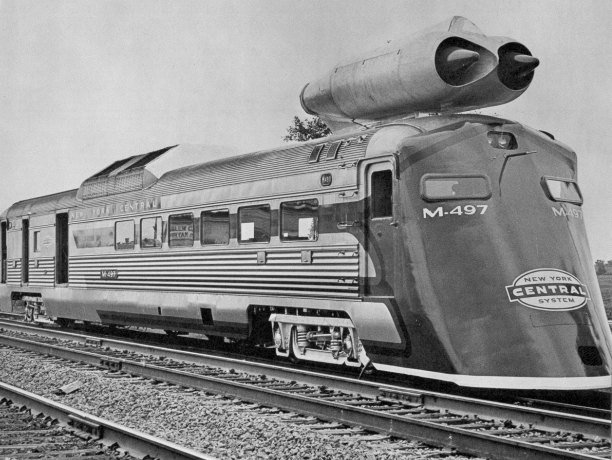
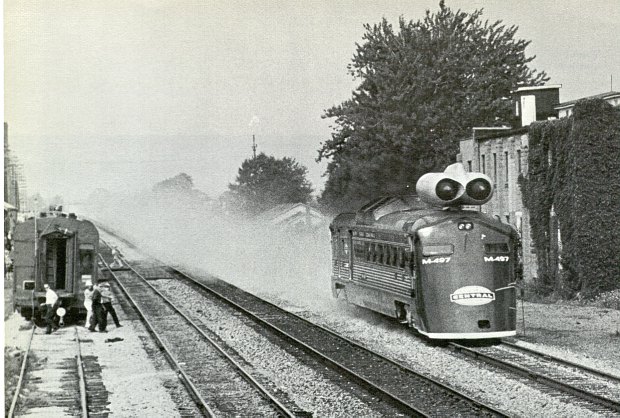
The New York Central did this in 1966 by sticking some surplus J-47 engines onto a regular passenger rail car. The M-497 reportedly got up to 155-mph, occasionally leaving the tracks from time to time over grade crossings.
You can read more about it here or look it up in a back issue of Invention & Technology Magazine from several years ago.
Then there was the UP gas turbines, some steam turbines, and even some government research into nuclear-powered steam turbine locomotives.
In short, a lot of reseach as been done in this area.
-
Jet train tests in 1966
Here's some information about the jet-powered M-497, tested in 1966 by New York Central. There's an interesting article about it in the Fall 1999 issue of Invention & Technology, if you have access to a copy.
Anyway, you've got to check out the pictures:
http://www.trainweb.org/railpix/ampix/nyc-m497s1.
j pg
http://www.trainweb.org/railpix/ampix/nyc-m497run1 -
Re:Nyet!
No it wouldn't. Trains crashing into the buffers happens fairly frequently. You end up with 45 people or 2 people, or even 0 people killed. The worst train crashes tend to be when two trains collide, but even in the non-western countries, the death toll is counted in the hundreds.
-
Re:Be careful of what you wish for.
In this context it might be relevant that this information has been used to disable railway systems important for security. Deutsche Bahn has no disliking for IndyMedia, but obviously they don't want the safety of their travelers jeopardized (This is wat happens if a ICE at full speed crashes).
I think the dutch judge made a wise decision. -
Re:Diesel
Per passenger, they are far more efficient than cars. Also, there are electric engines, particularly for commuter trains.
While I haven't looked up US models of current engine production (subject to change as need arises, anyway) I beleive they are similar to most european engines, that is Diesel-Electric (Follow link to GM EMD SD-45) The diesel engine actually generates electric current used to drive electric motors. Much light rail is already electric, and I've ridden electric rail across Switzerland.
--
Chief Frog Inspector