Slashdot Mirror
Domain: rit.edu
Stories and comments across the archive that link to rit.edu.
Stories · 46
-
Be True To Your CS School: LinkedIn Ranks US Schools For Job-Seeking Programmers
theodp writes "The Motley Fool reports that the Data Scientists at LinkedIn have been playing with their Big Data, ranking schools based on how successful recent grads have been at landing desirable software development jobs. Here's their Top 25: CMU, Caltech, Cornell, MIT, Princeton, Berkeley, Univ. of Washington, Duke, Michigan, Stanford, UCLA, Illinois, UT Austin, Brown, UCSD, Harvard, Rice, Penn, Univ. of Arizona, Harvey Mudd, UT Dallas, San Jose State, USC, Washington University, RIT. There's also a shorter list for the best schools for software developers at startups, which draws a dozen schools from the previously mentioned schools, and adds Columbia, Univ. of Virginia, and Univ. of Maryland College Park. If you're in a position to actually hire new graduates, how much do you care about applicants' alma maters? -
Google Flu Trends Gets It Wrong Three Years Running
wabrandsma writes with this story from NewScientist: "Google may be a master at data wrangling, but one of its products has been making bogus data-driven predictions. A study of Google's much-hyped flu tracker has consistently overestimated flu cases in the US for years. It's a failure that highlights the danger of relying on big data technologies.
Evan Selinger, a technology ethicist at Rochester Institute of Technology in New York, says Google Flu's failures hint at a larger problem with the algorithmic approach taken by technology companies to deliver services we all want to use. The problem is with the assumption that either the data that is gathered about us, or the algorithms used to process it, are neutral. Google Flu Trends has been discussed at slashdot before: When Google Got Flu Wrong." -
GNU Guile Scheme Gets a Register VM and CPS-Based IL
In late November, Andy Wingo pushed a new register VM to Guile's (the GNU implementation of the Scheme language) master branch. It brought a number of performance improvements, but led to a bit of a conceptual mismatch between the compiler's direct-style intermediate language and the virtual machine. Earlier this week Andy Wingo announced a new continuation-passing style intermediate language for Guile. From the article: "To recap, we switched from a stack machine to a register machine because, among other reasons, register machines can consume and produce named intermediate results in fewer instructions than stack machines, and that makes things faster. To take full advantage of this new capability, it is appropriate to switch at the same time from the direct-style intermediate language (IL) that we had to an IL that names all intermediate values. ... In Guile I chose a continuation-passing style language. ... Guile's CPS language is composed of terms, expressions, and continuations. It was heavily inspired by Andrew Kennedy's 'Compiling with Continuations, Continued' paper. ... The optimizations I have currently implemented for CPS are fairly basic. Contification was tricky. One thing I did recently was to make all non-tail $call nodes require $kreceive continuations; if, as in the common case, extra values were unused, that was reflected in an unused rest argument. This required a number of optimizations to clean up and remove the extra rest arguments for other kinds of source expressions: dead-code elimination, the typical beta/eta reduction, and some code generation changes." The article describes the CPS language provided by Guile and explains the reasons behind choosing CPS over SSA or A-Normal Form. The Guile manual contains draft documentation. The new VM and Intermediate Language will be released with Guile 2.2, which should be out later this year. -
Analyzing YouTube's Audio Fingerprinter
Al Benedetto writes "I stumbled across this article which analyzes the YouTube audio content identification system in-depth. Apparently, since YouTube's system has no transparency, the behaviors had to be determined based on dozens of trial-and-error video uploads. The author tries things like speed/pitch adjustment, the addition of background noise, as well as other audio tweaks to determine exactly what you'd need to adjust before the fingerprinter started mis-identifying material. From the article: 'When I muted the beginning of the song up until 0:30 (leaving the rest to play) the fingerprinter missed it. When I kept the beginning up until 0:30 and muted everything from 0:30 to the end, the fingerprinter caught it. That indicates that the content database only knows about something in the first 30 seconds of the song. As long as you cut that part off, you can theoretically use the remainder of the song without being detected. I don't know if all samples in the content database suffer from similar weaknesses, but it's something that merits further research.'" -
One of HST's Cameras Is Back In Action
StupendousMan writes "One of the two big cameras aboard the Hubble Space Telescope is the Wide Field and Planetary Camera 2, or WFPC2 for short. As the most recent HST status report indicates, the camera was recently powered up again and sent commands to take some test images. Today (Sunday, Oct 26), I received E-mail from a colleague at STScI indicating that the calibration images were 'nominal.' That's NASA-speak for 'fine and dandy.' The E-mail goes on to say 'The data look nominal, indicating that Hubble optical imaging capabilities are in fine shape. (We can expect more glorious Hubble images in the near future.) ... Science with WFPC2 has resumed, and plans are underway to restore ACS/SBC to service this coming week.' Let's hope that the other big instrument, the Advanced Camera for Surveys (ACS), also comes back to life successfully. We should find out in just a week or so." -
Ghostly Ring Found Circling Dead Star
Roland Piquepaille writes "An international team of scientists has found a strange ring around a dead star by using images taken by NASA's Spitzer space telescope. This star, called SGR 1900+14, belongs to a class of objects known as magnetars. According to NASA, a magnetar is 'a highly magnetized neutron star and the remnant of a brilliant supernova explosion signaling the death throes of a massive star.' So far, about a dozen magnetars have been found. An amazing thing about these stellar objects is their magnetic field. One of the researchers said that 'magnetars possess magnetic fields a million billion times stronger than the magnetic field of the Earth.' -
Symantec, Veritas Merger Approved
stuuf writes "Shareholders today voted to approve a merger between Symantec and Veritas. The deal, announced last December, was valued at $13.5 billion. However, some of Symantec's investors have backed off since then, and the merger, expected to close on July 2, is now valued at only $11 billion. Many of Symantec's products have been losing popularity recently; the merger may be good news for Veritas's competitors." -
FCC to Allow Wireless Access on Planes
isd_glory writes "The FCC has unanimously voted to allow wireless internet connections on airplanes. If everything goes according to plans, airplanes might be offering passengers internet service by as soon as 2006. Furthermore, the FCC is also soliciting comments about the possibility of lifting the in-flight ban on cellphone use. While this could be new profit source for the cash-strapped airlines, it might also be a new way to annoy your neighbor sitting next to you." -
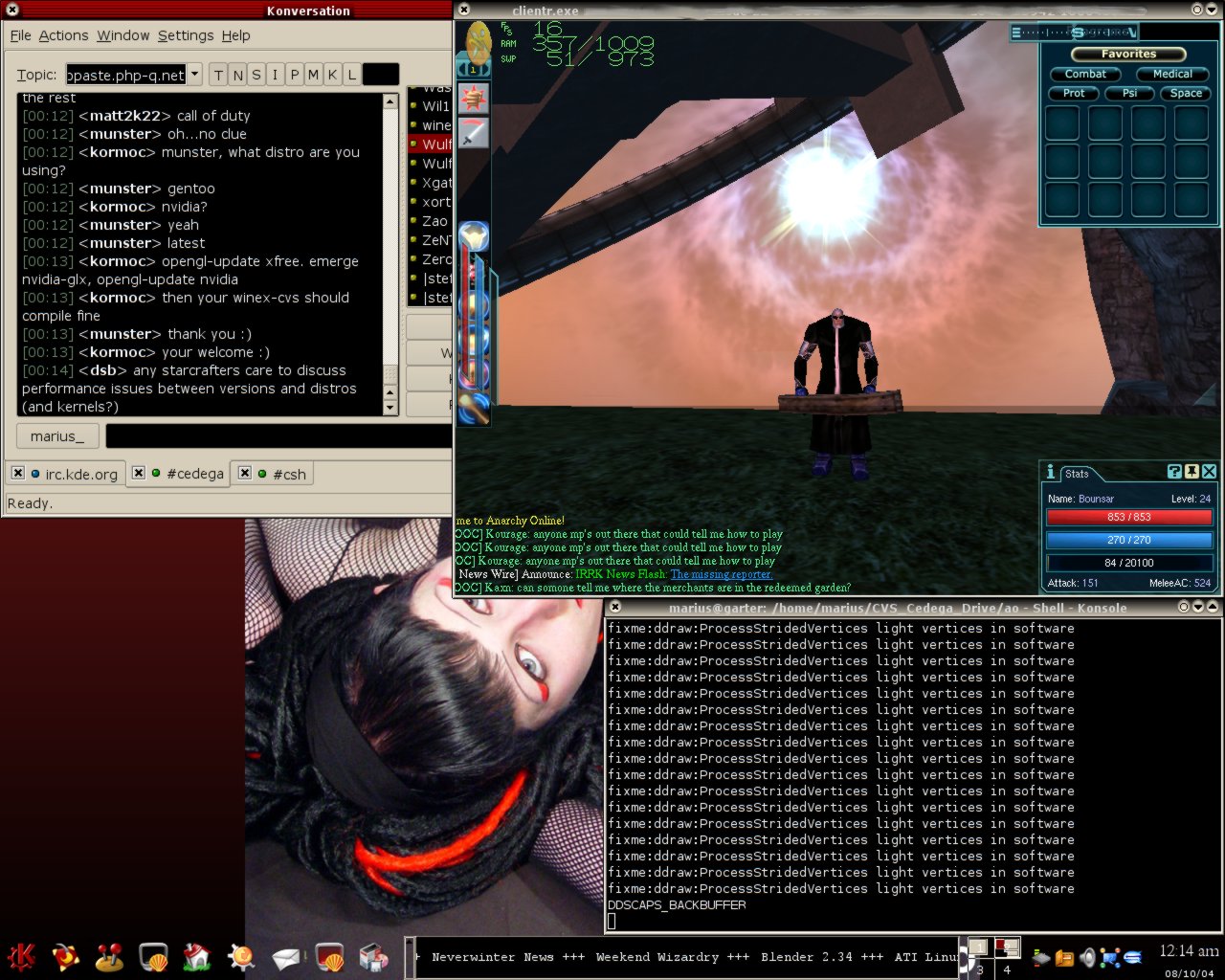
Anarchy Online - Finally Working On Linux
MrOion writes "Marius Grigoriu has posted a HOWTO for running the PC MMORPG Anarchy Online under Linux (screenshot). This is done using Cedega from Transgaming, in addition to the patch from Marius Grigoriu. A thread on the official Anarchy Online Messageboard contains more information on how the players are experiencing running AO under Linux." -
Anarchy Online - Finally Working On Linux
MrOion writes "Marius Grigoriu has posted a HOWTO for running the PC MMORPG Anarchy Online under Linux (screenshot). This is done using Cedega from Transgaming, in addition to the patch from Marius Grigoriu. A thread on the official Anarchy Online Messageboard contains more information on how the players are experiencing running AO under Linux." -
Anarchy Online - Finally Working On Linux
MrOion writes "Marius Grigoriu has posted a HOWTO for running the PC MMORPG Anarchy Online under Linux (screenshot). This is done using Cedega from Transgaming, in addition to the patch from Marius Grigoriu. A thread on the official Anarchy Online Messageboard contains more information on how the players are experiencing running AO under Linux." -
Are We Alone in the Universe?
cynic10508 writes "CNN is running a story about how ours might be a unique solar system. Of the 100+ systems currently known to contain planets, all contain seemingly only gas giants. However, this may be a case of current technology and techniques being unable to detect planets similar to Earth." There are also BBC and Space.com stories. -
4 New "Extremely Critical" IE Vulnerabilities
TopherTG writes "Buckle your seat belts folks. On what is looking to be the next Black Tuesday, with rumors of 9 new Windows security patches being released, Secunia is reporting on 4 new vulnerabilities in IE that allow for arbitrary code execution and placing content over other windows. Combined with the new Windows patches, it is likely more Download.Ject and Sasser like viruses will be emerging in the coming months." -
Use x86 Boxes to Compile Mac OS X Binaries
IceFox writes "While working on the KDE on Darwin project I have only had one Mac to do development with. At the same time I have been playing around with distcc for Linux/x86 compiling. Combining the two projects I built a Mac OS X cross-compiler (for Linux/x86) and have created the DistccPPCKnoppix distribution. DistccPPCKnoppix is a 46MB Knoppix distribution based on distccKnoppix; with it you can use your extra x86 computers to build Linux/x86 or Mac OS X/PPC binaries. It might not be as shiny as an Xserve cluster, but it is a heck of a lot cheaper." -
Use x86 Boxes to Compile Mac OS X Binaries
IceFox writes "While working on the KDE on Darwin project I have only had one Mac to do development with. At the same time I have been playing around with distcc for Linux/x86 compiling. Combining the two projects I built a Mac OS X cross-compiler (for Linux/x86) and have created the DistccPPCKnoppix distribution. DistccPPCKnoppix is a 46MB Knoppix distribution based on distccKnoppix; with it you can use your extra x86 computers to build Linux/x86 or Mac OS X/PPC binaries. It might not be as shiny as an Xserve cluster, but it is a heck of a lot cheaper." -
Optimizing distcc
IceFox writes "Having fallen in love with distcc and its ability to speed up compiling (insert anyone who compiles like Gentoo users or Linux developers). I recently got the chance to dive deeper into distcc. By itself distcc will decrease your build times, but did you know that if you tweak a few things you can get a whole lot better compile times? Through a lot of trial and error, tips from others, profiling, testing and just playing around with distcc, I have put together a nice big article. It shows how developers can get a bigger bang for their buck out of their old computers and distcc with just a few changes." -
Optimizing distcc
IceFox writes "Having fallen in love with distcc and its ability to speed up compiling (insert anyone who compiles like Gentoo users or Linux developers). I recently got the chance to dive deeper into distcc. By itself distcc will decrease your build times, but did you know that if you tweak a few things you can get a whole lot better compile times? Through a lot of trial and error, tips from others, profiling, testing and just playing around with distcc, I have put together a nice big article. It shows how developers can get a bigger bang for their buck out of their old computers and distcc with just a few changes." -
Happy Birthday, Von Neumann (And Linus!)
noims writes "Sunday is the one hundredth anniversary of the birth of John Von Neumann, the man with one of the strongest claims to the title of Father of Modern Computing. Although, as noted at the time by Mark Stanley of Freefall, several sources indicate that it may have been December 3rd." Update: 12/28 01:07 GMT by T : deja206 writes "Today (December 28, CET) also is Linus Torvalds' 34th birthday. Now we probably wouldn't be here talking about all this stuff if it weren't for him. Thank you for Linux, happy birthday!" -
FreeBSD 5.1 Released
LogicX writes "FreeBSD 5.1 is now available. Mirrors and press release are at FreeBSD.org. Enjoy." Here are the release notes for this new version. Update: 06/09 18:15 GMT by S : Here's a BitTorrent link at scarywater.net, and another BitTorrent link from the original poster. -
FreeBSD 5.1 Released
LogicX writes "FreeBSD 5.1 is now available. Mirrors and press release are at FreeBSD.org. Enjoy." Here are the release notes for this new version. Update: 06/09 18:15 GMT by S : Here's a BitTorrent link at scarywater.net, and another BitTorrent link from the original poster. -
World's Most Powerful Laser
mattlary writes "The Rochester Democrat and Chronicle reports that the University of Rochester plans on building the world's most powerful laser. The plans include upgrading the University's Omega laser with a pair of petawatt lasers. Sounds a lot like Real Genius to me." -
Sharp Ships Zaurus SL-5600; 5500 Available Cheap
Bill Kendrick writes "LinuxDevices is reporting the good news: Sharp is now shipping the Zaurus SL-5600 Linux-based PDA. Compared to the SL-5500 that's been out for the past year, this new model sports a 400MHz X-Scale CPU, twice the Flash (32MB), twice the RAM (64MB) a much better battery (1700 mAh), and a real speaker and mic. Learn more at Sharp's website." And IceFox writes "Well I wasn't expecting this to happen till next week, but I guess it was put up early. For a limited time on hsn.com you can get a Sharp Zaurus SL-5500 PDA for $198.92, combined with a hsn.com coupon you can bring the price down to $169.08. For anyone who has wanted to play with this Linux PDA here is your chance to get it for very cheap." Update: 03/18 02:03 GMT by T : Reader Brendan Hoar corrects the listed specs: "The specs for the SL-5600 are incorrect. It should be 64MB of flash, 32MB of SDRAM. It's technically *half* the RAM of the SL-5500, not twice the RAM." Thanks. -
Sysadmin Day. Yay.
Izeickl writes "The BBC is running an article about sysadmin day. One admin is quoted saying, 'We are unappreciated and no-one knows what we do for 364 days of the year.' Apparently even the online greeting cards are getting in on the action check out 123Greetings.com and put a smile on that cranky admins face! The starter of this day also has a page here." Well, most competent sysadmins probably have electronic greeting cards blocked at the router, but I suppose it's the thought that counts... Jeremy Sieminski submits a Mouse Pad Couch as the appropriate place for a sysadmin to rest his weary, uh, wrists. And of course if you've never read the BOFH stories, you're missing out. -
Sysadmin Day. Yay.
Izeickl writes "The BBC is running an article about sysadmin day. One admin is quoted saying, 'We are unappreciated and no-one knows what we do for 364 days of the year.' Apparently even the online greeting cards are getting in on the action check out 123Greetings.com and put a smile on that cranky admins face! The starter of this day also has a page here." Well, most competent sysadmins probably have electronic greeting cards blocked at the router, but I suppose it's the thought that counts... Jeremy Sieminski submits a Mouse Pad Couch as the appropriate place for a sysadmin to rest his weary, uh, wrists. And of course if you've never read the BOFH stories, you're missing out. -
Tron 2.0 Game
Conspiracy_Of_Doves writes "Gamespot has an article about the new Tron 2.0 game in the works to accompany the movie. It looks like they are being very true to the original, the new light cycles are even being designed by Syd Mead, the same guy who designed the old ones. You will get to visit locations from the movie, as well as play around inside desktops and PDAs." IGN has another article on the game. Watch out for the gridbugs. -
Shower mp3 Player?
Apreche writes "I was in the shower today humming a song that's been in my head. I started to really want to listen to music in the shower, but the best product I've ever seen is a shower cd player from the sharper image. Are there ANY waterproof mp3 players? I'm looking for about 30 minutes of music, all of the buttons in winamps main window, and stereo sound or better. I mean, now that I have all kinds of digital music, what good is it if I can't listen to it wherever and whenever I want?" -
Slashback: Bnetd, Salmon, Towers
Slashback tonight with more on Lord of the Rings (The Two Towers, specifically), various ongoing court battles, the true color of the universe, and more. Read on for the details.All I'm certain of is my true love's hair. CompaniaHill writes: "As previously reported on /., first they though it was turquoise. Then they found an error in their early calculations, and announced it was really beige. But doubts lingered, and color experts pointed out that an objective color as viewed from the theoretical blackness of space would appear different when viewed on Earth in typical daylight. So adjustments were made, and calculations were revised and rechecked by color scientists Michael Brill of McClendon Automation Inc. and Mark Fairchild of the Munsell Color Science Laboratories. And now, at last, Ivan Baldry and Karl Glazebrook, astronomers at Johns Hopkins University, using spectral data from the 2dF Galaxy Redshift Survey, have announced the final result: The universe is decidedly salmon. Really."
The milestones are getting closer together. Dare Obasanjo writes: "Xindice (http://xml.apache.org/xindice), the Apache native XML database has finally reached version 1.0. Xindice used to be called dbXML and was mentioned in my article on XML and databases."
Three From the Courts TheFrood writes: "It looks as though the battle between Blizzard and bnetd (as reported in previous stories here(1), here(2), and here(3))is heating up. Vivendi has sent another letter to the EFF, which has wasted no time responding."
ElitusPrime writes with an update in the strange case of Ken Hamidi, the Intel employee whose mass-mail to Intel employees brought charges of trespassing. Now the California Supreme Court may take another look at the case. Says ElitusPrime: "If this guy is put in jail, I can think of more then a few other spammers that need to go up the creek with him..."
In a very different case, pagan26 writes: "It seem that DMCA will have its day in court. With ElmcoSoft."
Well, at least you can trust their word, right? Masem writes: "According to MSNBC, the developers of the spyware program WinWhatWhere will no longer have their install program trample the bits of anti-spyware programs, after word broke that this behavior was occurring. However, no word has been made by a similar spyware program developed by SpectreSoft that does similar damage."
I will fork out to see this, happily. Pingsmoth writes "It looks like the faithful fans of Peter Jackson and Tolkien will be able to catch a glimpse of The Two Towers this Saturday. Lordoftherings.net is reporting, through a video of Peter Jackson, that a preview (read: not a trailer) of The Two Towers will be shown in theatres this Saturday, presumably attached to The Fellowship of the Ring. Maybe at the end? At any rate, it looks like I'll be seeing the film at least seven times now, and it's a good thing I got a morning shift tomorrow." For a more colorful description of this 4-minute tease, check out Ain't it Cool News' version.
-
Satellite Radio: Tune In or Turn Off?
Steve MacLaughlin writes: "After nearly a decade of buildup and anticipation satellite radio has finally hit the airwaves. By now you've probably seen a commercial or read an article about the digital satellite radio service. But what is behind all the hype? And does satellite radio have a viable future? To answer those questions Saltire decided to take an in-depth look at the new service's inner-workings, its potential, and its possible future." Read on for more of Steve's look at the current options and future possibilities for satellite radio service.Satellite radio has been a technology in the making for many years now. In 1992, the Federal Communications Commission (FCC) assigned part of the S-band (2.3 GHz) spectrum for nationwide broadcasting of a satellite-based Digital Audio Radio Service (DARS). In 1997, the FCC granted American Mobile Radio (now XM Satellite Radio) and CD Radio (now Sirius Satellite Radio) broadcast rights over that band. After several years of tinkering, courting investors and partners, and lining up their content these two companies are poised to finally make satellite radio a reality.
The Players
XM Satellite Radio (NASDQ: XMSR) and Sirius Satellite Radio (NASDQ: SIRI) paid an estimated $80 million each for their exclusive distribution rights to satellite radio. With numerous industry partners and investors these two companies are hoping to become the next giants of the media world.Washington, D.C. based XM Radio launched nationwide service on November 12, 2001, after two months of regional service. XM Radio currently offers 100 channels (71 music and 29 news, sports, talk, and children's programming). XM Radio has exclusive content relationships with C/NET, NASCAR, and others. XM Radio's most notable auto industry partner is General Motors. Cadillac now offers XM Radio standard on all new 2002 Sevilles and Devilles. XM Radio's service is available for a monthly subscription fee of $9.99.
New York City based Sirius Radio plans to launch their service in Denver, Houston, and Phoenix on February 14, 2002. A Sirius Radio spokesperson told Saltire that their service will be available nationwide by the third-quarter of 2002. Sirius Radio also offers 100 channels (60 commercial-free music and 40 news, sports, talk, and entertainment programming). Sirius Radio has exclusive content relationships with NPR, Hispanic Radio Network, and National Lampoon. Sirius Radio also has exclusive partnerships with DaimlerChrysler, Ford, and BMW. Sirius Radio's service is available for a monthly subscription fee of $12.95.
Although XM Radio and Sirius Radio have their distinct differences there are however some things that that they both share in common. Both services offer similar music channel genres. The big difference being that all of Sirius Radio's music channels are commercial-free as opposed to only about 30 such channels on XM Radio. Both services also share several news and entertainment providers like Bloomberg, CNBC, CNN, ESPN, and the Weather Channel.
XM Radio and Sirius Radio have also partnered with many of the same manufacturing partners including Alpine, Clarion, Delphi Delco, Panasonic, Pioneer, Sony, and Visteon. One very exciting product is Sony's "Plug and Play" DRN-XM01 model that works in both your car and home stereo system through the use of a $150 adapter kit. The two companies have also teamed up with similar retailers to help distribute satellite radio receivers, antennas, and other devices. These retailers include Best Buy, Circuit City, Crutchfield, Good Guys, and Tweeter.
Just The Facts
According to the Radio Advertising Bureau, 75% of all Americans age 12 and up listen to radio daily, and 95% listen every week. But their choices are almost always very limited. Consider the fact that more than 22 million listeners receive fewer than five FM stations, and the communications industry firm Veronis, Suhler & Associates noted that 50% of all existing radio stations only use one of three programming formats (Adult Contemporary, Country, and News/Talk/Sports).In many cases, huge segments of the music industry get little or no coverage by mainstream radio. One study indicated that up to 21% of annual music sales come from these totally ignored formats. This is especially true of ethnic music formats like African, Asian, Caribbean, or Hispanic. Combine this with the fact that more than 105 million listeners live outside the 50 largest radio markets and you quickly realize satellite radio's potential appeal.
Too Much Information
XM Radio uses two Boeing HS-702 satellites that are positioned over the East and West Coasts of the United States. The satellites, aptly named "Rock" and "Roll", maintain a geostationary orbit at 22,000 miles above the earth. XM Radio has a third back-up satellite on the ground should something go wrong in orbit.Sirius Radio uses three Space Systems/Loral 1300 satellites in a high altitude elliptical orbit. Sirius Radio contends that this ensures that each satellite will spend about 16 hours a day over the U.S., and that at least one satellite is over the country at all times. Sirius Radio also has a back-up satellite standing by just in case of problems.
Both companies transmit their signal on the S-band, at 12.5 MHz to radio receivers on the ground. Sirius Radio will use the in the 2320.0 to 2332.5 MHz frequency band. XM Radio already uses the 2332.5 to 2345.0 MHz frequency band. They will also use repeaters in urban areas where buildings and other obstructions may interfere with signal reception.
One On One
Saltire interviewed Chance Patterson, XM Radio's Vice President of Corporate Affairs, to get his take on satellite radio.- Saltire - What are some of the key differences between XM Radio and Sirius Radio?
CP - The biggest difference is that we have a fully developed and deployed system. We have a proven product that's great, and we developed the system with a retail focus, not just limited to the car. But we're not just an audio service. We've recruited the best people in the industry. These people really make our content come alive.Saltire - What will it take for XM Radio to succeed financially?
CP - We figure that we need 4.5 million subscribers to be profitable. There are more than 200 million registered vehicles in the United States. So we need less than 2.5% of all cars to reach that figure. And this doesn't take into account people who only use it in the home. We think the demand is definitely there.Saltire - How important is the auto industry to XM Radio's success?
CP - They are a part of it for sure. We have a full OEM (Original Equipment Manufacturer) system. We have partnered with GM, and they are also an investor. Right now Cadillac models already have the system. Over the next year more than 20 GM models will have factory-installed units.Saltire - What does satellite radio mean for listeners?
CP - People are spending more time in their cars and they want to be informed, and they want to enjoy that time a little more. XM can do that. If you're listening to the reggae channel you should feel like you're in Jamaica. It's really point-of-view radio.Saltire - What does satellite radio mean for traditional radio?
CP - XM doesn't disenfranchise AM/FM. Terrestrial radio will be forced to get better. Talk to the audience like they're older than 12 year olds. Talk to me about the music. Talk to me about the world when [the song] was written. That's what listeners really want.Saltire - But will people really pay for satellite radio?
CP - People said they'd never pay for cable television because TV was something they already got for free. Look at how that turned out. We're going to do the same thing for radio. The difference is that we already have all of the infrastructure. The one-millionth subscriber doesn't cost more than the first one. We'll offer better quality, less commercials, and more choice. We believe people will pay for their passions.
Word On The Street
Saltire solicited the unfettered opinions of individuals in the technology, radio, and automotive industry.- What do you think satellite radio means for advertisers?
"I think it can potentially be very good for advertisers. Specifically, by dividing the content available into so many categories, advertisers can probably make better assumptions about demographics. For example, XM Radio offers a dedicated NASCAR channel, dedicated BlueGrass channel, etc. The targeting is more granular than conventional radio where most stations do a little of everything, music, news, weather, traffic, etc. This should translate to more effective advertising potential for advertisers. That said, some of us are and will be willing to pay for commercial free options - I sure am." - Jason Foodman, technologist and Vice President of Business Development, Aladdin SystemsWhy do you think satellite radio has the potential to be a big success?
"Abetted by the Telecommunications Act of 1996 that relaxed ownership restrictions and made possible the creation of media behemoths, conventional radio programmers unwittingly sabotaged their own stations through pernicious cost-saving programming trends such as corporate-level programming, format duplication and computer automation. The result: bland, boring, sound-alike radio stations from town to town, up and down the dial all across America, which drive away listeners in droves. That's good for satellite radio services like XM and, soon, Sirius, since listeners may eventually find their way to satellite radio." - Michael Saffran, radio industry veteran and Senior News Specialist, Rochester Institute of TechnologyWhat does the auto industry really think about satellite radio?
"Everybody in the automotive/telematics value chain is excited about it. Well, maybe not everybody, but I've just been doing some interviews on a satellite based telematics project, and everybody I've talked to at OEMs, Tier 1 suppliers, cellular carriers, really likes the idea of satellite radio. I get the feeling they want this to work, if only because it lets them get a foot in the car door with subscription-based services." - Thomas R. Elliott, Vice President of North American Consulting, Strategy Analytics, Inc.
The Bottom Line
Both XM Radio and Sirius Radio agree that the market is big enough for two players. But as both services ramp up they need to find a way to stay in business. XM Radio recently reported a third-quarter '01 net loss of $70.8 million. Sirius Radio reported a net loss of $57 million for the same time period. XM Radio just announced financing to operate its business into the fourth-quarter of 2002. Sirius Radio has also publicly announced that they have enough cash to last until the fourth-quarter of 2002.To succeed both companies will need the support of the auto industry, and quickly. Getting satellite radios installed as standard equipment will help to build their subscriber base. The current $300 to $400 conversion cost might be a bit too steep for most consumers. Also, current receivers only support a single format (XM or Sirius). Future AM/FM/XM/SR models should also help boost more widespread usage.
Finally, there is enough content overlap to keep subscribers to either service happy. Perhaps the biggest decision is whether or not you want ads with your music. Sirius Radio's commercial-free music service can be yours for just $3 more each month than what XM Radio charges. The immense variety of music and other content should be a big hit if consumers can just find an easy way to get their hands on the technology. And reports of its CD-quality audio can only help to increase satellite radio's popularity. I'm still waiting to hear it for myself. Stay tuned.
- Saltire - What are some of the key differences between XM Radio and Sirius Radio?
-
Making Linux Recognize Vaio Docking Stations?
dknight asks: "I've recently moved my Sony Vaio SuperSlim R505TE Laptop to Slackware Linux. Let me tell you, it was quite an adventure. I'm still having one major problem though. The docking station connects to the laptop via a firewire connection, so it doesnt recognize the CD Rom. I've installed Firewire support in the kernel, but I'm still having a hard time getting this going. Has anyone else attempted this feat?" -
28-Megapixel Camera to Monitor the Night Sky
StupendousMan writes "Scientists at Sonneberg Observatory in Germany will start monitoring the sky every clear night (starting in October), using a curious combination: a 28-Megapixel CCD camera behind a 30-mm f/3.5 fisheye lens. As the first light test images show, the device can record nearly the full sky down to ninth magnitude (about 20 times fainter than the naked eye limit) every 5 minutes. The goal is to create a permanent record of bright objects, which could be used to discover comets and novae." -
Where Are the Cheap, Wireless Webpads?
IceFox asks: "Webpad terminals... Over the past two months I have been searching the web, from company to company looking for a cheap webpad. All the way back in 1999 there were promises of webpads. They were almost always terminals. Other then a touchscreen, slow 66mhz cpu, and a wireless card there was not much else in the machines. And they were going to retail for about 400-600 dollars. But where are they now?" <SARCASM>You know, we were supposed to have hovercars by now, too, and I haven't seen any of those flying around, either.</SARCASM> Sometimes the market works a little slower than we'd like. I think the market is currently more enamoured with the sexy new wearables market and the handheld market more than they are worried about webpads. Still, if anyone knows how much longer the wait will be, some updates would be appreciated."They are nowhere to be seen. Everywhere you look you see full webpad computers for $4k. Yah right I am going to pay that for a bad laptop. Why are companies making these huge items? Did I miss the anouncement that thin small webpads would not be the thing? Is it that the $400 webpad in 1999 can now be made in $200 and there is no profit? How can that be? There is no compatition so you would have all the profit! Does anyone out there know of a company that is selling right now wireless touch screen computers that have just enough to run as a terminal? I see all the time companies that will see you the mini computer with everything on it. Rip out the hard drive, parallel port, serial, ide controls, ps2, audio. Leave only the bare minimum. Ok maybe there isn't a company out there left doing this, but does anyone know of someone who is selling the parts that I can build such a thing? I can find touchpads here, small lcds there and small computers over there, but never can they all go together. I would love to have a terminal webpad in my living room. Load linux on it and use it to do anything and everything."
-
On-Line C/C++ Courses?
Jon_S asks: "I've been happily hacking on Linux for five years now, and actually started playing with computers back as a 7th grader in 1972 on a PDP-8. Somehow I didn't get into a directly computer-related field, but I soon will be. I'm going back for a masters in GIS and I will need to have some solid programming background. I've coded FORTRAN programs back in college, read lots of programming books, and have written my share of shell scripts. The one thing I haven't tackled is C or C++ programming." Put simply, the submittor is hoping to find some quality C/C++ courses on line. Any hints?"I know I can handle this stuff, I'm a certifiable geek, but to learn something you have to do it. The only way I see myself progressing this way is to take a course that will present the right types of programming challenges that I will need to develop my skill.
Searching on Google brings up tons of courses, but there is no way to tell whether any of these are any good. There are some great courses at RIT and I know this is a good school (friend of mine got a M.S. online there), but the good classes are filled this quarter and will probably next as well."
-
AI Advances
Nate Truitt writes "Research published in the journal "Artificial Life" reveals that autonomous agents -- software entities capable of independent action in dynamic, unpredictable environments -- can communicate with one another as they work to achieve a common goal. They actually develop a language of sorts...." It doesn't look like the paper is available yet, but I know that Giles has been willing to send copies by email of his other papers. -
Instant Messaging On Linux
IceFox writes: "In this first installment of a four part series, LinuxOrbit takes a look at AOL Instant Messaging clients available for GNU/Linux. Kaim, Gaim, and the official AOL Linux client are reviewed. It's interesting to note that open source projects are way ahead of AOL in developing a full featured AIM client for GNU/Linux." -
Surround Sound Quickies
Let's start this off with SanLouBlues's submission about a video made by splicing old 8bit video games (I don't think it'll work on Linux, but it's worth finding a box to watch this). And now, the senseless destruction portion of the show: stevenma sent an ISP's excuse letter, including a photo of the bullet damage from the wire! friedo knows how to make a hard drive squeal, but on purpose. If that's not enough destruction for you, knisa sent in a story about a meteor destroying a 1980 Ford. Slightly less-destructive violence was submitted by Steve Stag, who notes that Nerf has discovered that their weapons appeal to adults too. (well duh!) An anonymous reader noted that Liam Neeson's lightsaber from Phantom Menace is being auctioned off for charity. WhyPanic sent us a site that talks about Vintage Unix. An anonymous reader noted that in Finland, you pay traffic violations based on your income, and this dot-com millionaire was fined $70,000 for 20 miles/hour over the speed limit! Speaking of dot-coms, warland wonders if todays dot-coms would get funding if they tried to pitch their ideas today? And now for the truly strange stuff: conraduno sent in a palindromic C program. NinjaPablo sent in a link about a guy breaking a centipede 14-year-old record by scoring 7,111,111 points (and I thought breaking 200,000 on joust made me cool ;) head_the_mongoose sent us "Call Me Darth", a Darth Vader site that simply needs to be seen. -
Microprocessor Forum
Manufacturers are strutting their stuff at the Microprocessor Forum. Some of the rollouts: Turmoil writes "AMD has demonstrated working SMP. http://www.amd.com/news/prodpr/20165.html" hol writes: "German news site Heise.de reports that a German startup named PACT surprise-announced their processor design at the Microprocessor Forum in San Jose. Apparently this thing is a 128 cpu parallel computing deal which has its roots in the programmable gate array world." infodragon writes "All Linux Devices.com is running a pretty cool article about an X86 chip running on 1 AA battery. They demonstrated it by playing a VCD movie. They also say that mp3s can be decoded/played on it." -
LSDVD Starts Cooking
A reader writes: "The guys at LSDVD, now funded, are going to pay the powers that be the licensing fee and the per program royalties for the rights to make and sell a DVD player for Linux. This means that a free, give-em-hell, fight-the-power, Linux DVD player is a long ways off" - you can read the news on the homepage. Remember, LinDVD is also moving and shaking as well. -
LSDVD Starts Cooking
A reader writes: "The guys at LSDVD, now funded, are going to pay the powers that be the licensing fee and the per program royalties for the rights to make and sell a DVD player for Linux. This means that a free, give-em-hell, fight-the-power, Linux DVD player is a long ways off" - you can read the news on the homepage. Remember, LinDVD is also moving and shaking as well. -
William Gibson Interview @ AICN
Well, the slashdot crew is all out killing time and brain cells giving away the Beanie Awards at LinuxWorld (Best Real Propeller Beanie: Jay Sulzberger of the NYLUG). Look for the chock-full-of-fun wrap-up tomorrow, but in the meantime, forge5 writes "Ain't It Cool News has an excellent article on Alexandra DuPont interviewing William "FREAKING" Gibson. They talk about The Matrix, his books, and his X-Files episode. Check it out! " -
Amiga & Transmeta?
kmj9907 its all the buzz- apparently the latest rumor is that Amiga and Transmeta will be working together on the new line of Amiga boxes. There still isn't concrete news, but the rumors have been propogating as fast as electrons can carry them around the net. -
Sony to Sue Connectix
Millennium writes "By now you've all probably heard about Virtual Game Station, the Playstation emulator by Connectix for MacOS. Well, it appears Sony isn't too happy about it. They've filed for an injunction against Connectix, and are planning to sue for intellectual property rights violations. It looks, however, as though the law might not back Connectix up on this one. Either way, it looks as though this case could well bolster or destroy the emulation community, so it's one to follow. " Initially I sided with Connectix, but the more I thought about it, the more complex issue I realize it is. Let me know what you think. Update: It seems as though the IGN story is a rumour - my apologies. -
Detailed Nanotechnology Article
tomas writes "This is a very detailed/scientific article describing nanotechnology and the assemblers to build nanomachines. One use for said nanomachines would to replace the current lithography techniques used to make compter chips. This guy professes that nanotechnology will allow us to store a hundred billion billion bytes in the volume of a sugar cube. Else read an overview of how xerox is involved with nanotechnology " -
Apply for free Palm VII
-
Assitance w/ Linux and the RoadRunner Cable Service.
James B. Franks submitted this call for assistance: "I am looking for someone who has Linux running with Time-Warner's RoadRunner cable modem service. Time-Warner actually admits that there are people out there using it, but they don't officially support it. I have to finish wiring up the hose before I get it installed but I'm trying to plan ahead. Any tips would be appreciated." -
Possible Portables
What we have here is a site called Digital Concepts which basically has a bunch of interesting designs for PDAs of the future. A lot of funky Pilot variations, as well as laptops and stuff. Some of them aren't so far off. Others, well, we can hope. Thanks to Luke for sending this one in. -
Serious Y2k Site
luke sent us this link to what he describes as "a site containing a gigantic, documented, cross-linked collection of articles and personal commentary regarding the year 2000 'problem.'" Hype or not, it's sure generated a lot of steam. Update if you're looking for an even better Y2k site, check out Duh-2000, sent in by Adam Bisaro, which tracks the stupid things folks have said about y2k.