Slashdot Mirror
Domain: sciencemag.org
Stories and comments across the archive that link to sciencemag.org.
Comments · 1,625
-
Re:30000 years?
They found it in 63 per cent of the brains.
So organ transplant is likely to be a minor contributor.
There's been other studies indicating that fetal cells can end up in a human mother's blood: http://news.sciencemag.org/sciencenow/2010/12/fetal-dna-sequenced-from-mothers.html
-
Re:Where does extra energy go?
Actually, just this last year two rubidium atoms 20m apart were entangled ( https://www.sciencemag.org/content/337/6090/72.abstract ).
-
Paradigm shifts in Biology
Sydney Brenner, who won the Nobel Prize in Physiology or Medicine for his work on programmed cell death, wrote a nice essay in the journal Science (subscription required) describing what he saw as a major paradigm shift in the 1950s and 60s that created modern molecular biology. Prior to the discovery of the structure of DNA by Watson and Crick, biologists had been focusing on how DNA and its associated proteins might be carrying out the functions of the cell. The discovery of the structure of DNA, however, fundamentally changed how researchers approached these questions by revealing that DNA is really just carrying information. Brenner writes:
"We can now see exactly what constituted the new paradigm in the life sciences: It was the introduction of the idea of information and its physical embodiment in DNA sequences of four different bases. Thus, although the components of DNA are simple chemicals, the complexity that can be generated by different sequences is enormous. In 1953, biochemists were preoccupied only with questions of matter and energy, but now they had to add information. In the study of protein synthesis, most biochemists were concerned with the source of energy for the synthesis of the peptide bond; a few wrote about the “patternization” problem. For molecular biologists, the problem was how one sequence of four nucleotides encoded another sequence of 20 amino acids."
Indeed, following this paradigm shift, Watson and others quickly worked out the question of how the information encoded in DNA gets read by the cell and their work now forms the central dogma of modern molecular biology. Therefore, Kuhn's concept of paradigm shifts does indeed apply to biology.
-
Let me google that for you
Oh look, I found an interesting discussion about that very post from John Christy of UAH, posted on notorious denier Roger Pielke Jr's blog. The great thing about blogs as compared to scientific journals is that you get to choose your "pal review"! Who will notice if you mis–represent the original data, and use a flawed dataset?
One comment really nails it, and I can't link to it individually, so I'll just include it here:
The first thing I noticed when looking at Christy’s graph was that Hansen’s scenario B had been replotted to make it appear that it tracks scenario A very closely. It doesn’t, it never has. The graph on Real Climate uses the original data http://www.realclimate.org/images/Hansen
The next thing that was obvious was that the RSS and UAH temperature graph shows very little warming. I thought this issue was supposed to have been rectified after Spencer and Christy corrected the errors relating to orbital drift (meaning the temps were taken at progressively later times each day).
After making the corrections (version 5.2) the data now correlates with other global temperature records such as those of NASA and the CRU (remember when the skeptics always relied on the RSS / UAH temperature records, until it came to light that it was wrong).
Detail - http://www.sciencemag.org/cgi/content/fu
Summary - http://www.ssmi.com/msu/msu_data_descrip
UAH Data - http://vortex.nsstc.uah.edu/data/msu/t2l
RSS Data - http://vortex.nsstc.uah.edu/data/msu/t2l
Comparison Data - http://www.cru.uea.ac.uk/cru/data/temper
Hansen’s Data - http://pubs.giss.nasa.gov/docs/1988/1988
It appears that Christy has chosen to use the old data in his comparison. In effect, what he’s done is to exaggerate the warming predicted in Hansen’s Scenario B (the one Hansen always said was most likely) and then downplay the true amount of warming that has occurred.
When the real data are used it becomes apparent how accurate Hansen’s scenario B projections have actually been – not exact but pretty close. Considering Jim’s 1988 projections were based on single inputs then this is quite impressive. -
Re:Worlds Gone Mad
Resonant wireless energy transfer was published in Science in 2007 http://www.sciencemag.org/content/317/5834/83.abstract?sid=135a98e9-4946-4b04-ab80-9dab0d9b5bd3
-
Not as crazy as it sounds, thermoelectrics exmpl
Yeah, this is asking for a lot, and it probably won't meet its goals, but it's not as crazy as it sounds. Take the example of thermoelectrics -- solid state devices that can turn a heat difference in to electricity or vice versa. Efficient thermoelectric devices could be super useful, either for efficient, light weight refrigerators that never break (since they have no moving parts) or for a way to turn any source of heat -- including waste heat from your car -- in to electricity. The reason you don't see them everywhere is because they're currently not efficient enough to be worth it.
I realize the following is gated, but access it if you can and see the first plot. (Coincidentally, the author was Chu's deputy and is an excellent researcher.)
http://www.sciencemag.org/content/303/5659/777.full
Otherwise, see figure 3 here:
http://arxiv.org/pdf/1106.0888.pdf
The effectiveness of a material for thermoelectric devices is captured in one parameter called ZT -- the figure of merit. For about three decades, bismuth telluride was the best know material, with a ZT of a bit under 1 -- corresponding to about 10% of the Carnot efficiency (the theoretical maximum efficiency). To be competitive with conventional refrigerators, ZT has to be about 3 or larger.
In the early 90s, the DOD decided they wanted better thermoelectrics, so they started throwing money at the problem. You can see the result in the linked figure. Within a decade, ZT for the best materials shot up to about 2.5 at room temperature and 3.5 at higher temperatures -- to the point where they're starting to be useful.
More work is still needed before you'll see these commercially, but this is an example where government spending is and will be paying dividends; these are devices that will be generally useful, but languished for decades before the government gave research a kick. Battery funding could produce similar results.
-
Volcanoes aren't a major contributor to CO2
it is incredibly foolish to believe that humans are responsible for the melting of the polar icecaps. one volcano eruption puts off more CO2 than all of the emmissions that humans have put out since there were humans.
That statement is factually incorrect. Volcanos do not emit more CO2 than humans-- they emit less, by orders of magnitude.
http://www.agu.org/news/press/pr_archives/2011/2011-22.shtml
http://hvo.wr.usgs.gov/volcanowatch/archive/2007/07_02_15.html
http://www.agu.org/pubs/pdf/2011EO240001.pdf
http://www.skepticalscience.com/volcanoes-and-global-warming.htm
http://www.newscientist.com/article/dn11638-climate-myths-human-co2-emissions-are-too-tiny-to-matter.htmlFrom http://news.sciencemag.org/sciencenow/2011/06/scienceshot-volcano-co2-emission.html :
"A popular myth among climate change skeptics is that volcanic emissions of carbon dioxide dwarf those generated by humans. But a new report in today's issue of Eos reveals precisely the opposite: In a mere 2 to 5 days, smokestacks, tailpipes, and other human sources of CO2 spew a year's worth of volcanic emissions of that greenhouse gas. According to the paper, five recent studies suggest that volcanoes worldwide (such as Alaska's Shishaldin, shown) emit, on average, between 130 million and 440 million metric tons of CO2 each year. But in 2010, anthropogenic emissions of the planet-warming gas were estimated to be a whopping 35 billion metric tons. Individual events—such as Mount Pinatubo, whose major eruption in 1991 lasted about 9 hours—can produce CO 2 at the same rate that humans do, but they do so only for short periods of time. It would take more than 700 Mount Pinatubo-sized eruptions over the course of a year to emit as much carbon dioxide as people do, the study notes."Let me note that it is misinformed statements like this that tend to make real scientists dismiss global-warming deniers as crackpots. If you really want skepticism of anthropogenic global warming to be taken seriously, you need to have a basic understanding of the real world.
-
Re:One consistent theme
True, but corn is pretty much "the" go-to crop these days, as corn is in everything.
Other studies have also been conducted:
Soybeans don't get much of a boost.
Other studies talk about "crop yields" in the abstracts but I didn't bother to go into the full text to see which crops, as the problem generally seems to be with C4 based photosynthesis, which is used by most (all?) grains, already being saturated by standard atmospheric CO2 levels.
Now, we could wind up with different arable lands farther north, with longer growing seasons, but the hope of greater yields simply because "plants like CO2" does not jive with experimental results. If more extreme weather develops (more CO2 forcing more warming, forcing more water vapor into the air, storm systems fueled by warm wet air occurring more vigorously and more frequently) then the result could be topsoil erosion, reducing nutrient and water retention in farm lands, reducing crop yields. How these two effects balance out remains to be seen, but more crops simply because more CO2 definitely doesn't work.
We don't know the exact results of global warming, and I sure don't know the best course of action to deal with it, but we always have to make sure we're basing decisions on observable and measurable facts.
-
To Be Fair, He's Replacing Texan Ralph Hall
Hall's opposition was even more pronounced. One could even say that by appointing Lamar Smith, who only attacked "one sided coverage" (vs the 88 year old Hall's direct attack on the science), that Texas may be slowly warming up to the idea... http://news.sciencemag.org/scienceinsider/2011/12/ralph-hall-speaks-out-on-climate.html
-
Re:No significant change for a century.
recent data doesn't show any increase in rate of sea level rise:
http://sealevel.colorado.edu/Not sure what you're looking at there; that graph clearly shows the current rate is about twice what it was a hundred years ago. Fortunately we don't have to rely on our eyes, Church and White most recently calculated an acceleration of 0.009 mm/yr^2 over that period -- that's actually a downgrade from 0.013 mm/yr^2 in their 2006 paper. Ever done data analysis before? Trying to figure out the second derivative of noisy data is not an easy thing.
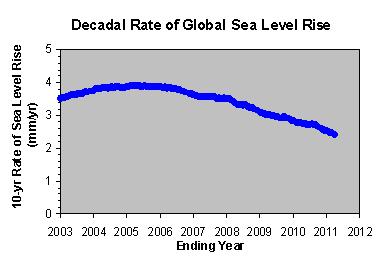
looking at the decadal rate of increase it has actually been falling off for last 5 years:
http://www.masterresource.org/wp-content/uploads/2011/09/sea_level_rise_fig1.jpgThat's a nice unattributed JPEG hosted at "Master Resource", a "free-market energy blog" with categories on Austrian economics, Ayn Rand, and objectivism. Fortunately I don't need to leave my criticisms at questioning the source of the material. If you look at your first link, you can see that the rate really did decline towards the beginning of 2011 where this 2nd chart stops before suddenly surging up again to match the preceding trends: so the trend over 2011 and 2012 is actually much higher than it was the preceding few years.
This is cherry-picked data -- it is very easy in any system containing noise to pick endpoints to make it appear that the overall trends have stopped. A great depiction of this is the escalator graph: How "Skeptics" View Global Warming. You need to look at the big picture -- every climate graph shorter than a decade is lying, because a decade is not long enough to show long-term climate trends. It is very easy to pick subdecadal trends that either exaggerate or mask longterm trends, so you need to look at the big picture.
A rather big factor that needs to be taken into account is that since the 1950's there has been a massive amount of ground water abstraction for agriculture that is estimated to contribute something like 0.4-0.8mm/year to sea level rise (15-25% of total).http://news.nationalgeographic.co.uk/news/2012/05/120531-groundwater-depletion-may-accelerate-sea-level-rise/
This is counter-acted by the amount of water that humans are storing in reservoirs, which account for 0.55mm/year: Impact of Artificial Reservoir Water Impoundment on Global Sea Level.
-
fiber recharge time less than 50 milliseconds
Sulphur, I don't have access through the paywall to the article, but I calculate the fiber recharge time to be less than 50 milliseconds:
"delivers 3% tensile contraction at 1200 cycles/minute"
The abstract explicitly states that they tested the carbon-nanotube fibers for up to 1-million cycles with a rep-rate of 1200 cycles/minute, so that gives us 20 Hz, so the recharge/rep time is less than 1/20th of a second = 50 milliseconds:
The article's abstract (Electrically, Chemically, and Photonically Powered Torsional and Tensile Actuation of Hybrid Carbon Nanotube Yarn Muscles) has this to say about how many times this Nanotube yarn muscle can be used:
.
We have designed guest-filled, twist-spun carbon nanotube yarns as electrolyte-free muscles that provide fast, high-force, large-stroke torsional and tensile actuation. More than a million torsional and tensile actuation cycles are demonstrated, wherein a muscle spins a rotor at an average 11,500 revolutions/minute or delivers 3% tensile contraction at 1200 cycles/minute. [bold text added by me to accentuate the answer, at least one million cycles demonstrated thus far] -
Re:The article
http://www.sciencemag.org/content/338/6109/928
.
Using the science magazine link without the ".full" suffix will at least get you the abstract and a little bit of interesting text, instead of a direct link to the pay-wall and a request for money to continue. Anyway, here's the abstract if you don't want to bother clicking:
;>)
Electrically, Chemically, and Photonically Powered Torsional and Tensile Actuation of Hybrid Carbon Nanotube Yarn Muscles
Artificial muscles are of practical interest, but few types have been commercially exploited. Typical problems include slow response, low strain and force generation, short cycle life, use of electrolytes, and low energy efficiency. We have designed guest-filled, twist-spun carbon nanotube yarns as electrolyte-free muscles that provide fast, high-force, large-stroke torsional and tensile actuation. More than a million torsional and tensile actuation cycles are demonstrated, wherein a muscle spins a rotor at an average 11,500 revolutions/minute or delivers 3% tensile contraction at 1200 cycles/minute. Electrical, chemical, or photonic excitation of hybrid yarns changes guest dimensions and generates torsional rotation and contraction of the yarn host. Demonstrations include torsional motors, contractile muscles, and sensors that capture the energy of the sensing process to mechanically actuate. -
Books thin the cortex
On the other hand, a recent paper suggests that books trim the cortex.
neuroscientist Martha Farah of the University of Pennsylvania and her colleagues recruited 64 children from a low income background and followed them from birth through to late adolescence....More than 10 years after the second home visit, the researchers used MRI to obtain detailed images of the participants' brains. They found that the level of mental stimulation a child receives in the home at age 4 predicted the thickness of two regions of the cortex in late adolescence, such that more stimulation was associated with a thinner cortex.
-
We're for the free market.. until we're not
The fact is that American capitalists have an interpretation of "the free market" meme that is indistinguishable from some ephemeral "right" to get rich through any means.
By their own analysis, wages go down when the supply of available labor goes up and wages go up when the labor market is tight.
So they act as though they just don't know whatever it is you're on about , and maybe you're a little racist or xenophobic or protectionist -or all three - when you point out that by prevailing on Congress to flood the market with H1Bs, you're putting your thumb on the scale of the "free market" in favor of business owners and to the disfavor of labor
American capitalism isn't now and never was about the free and fair functioning of a market for goods and labor. It was is and always will be about crony capitalism.
If wages are up, the free market solution to that problem is something we briefly had in the late 80s and early 90s - massive enrollment and enthusiasm on the part of the job seeking portion of the citizenry for Computer Science as a major. More labor chases those dollars and the labor market swells stabilizing wages. Everyone wins. But the idea that everyone wins makes American business owners want to puke.
You have to read Ron Hira from Rochester University and Norm Matloff - two guys who actually crunched the numbers on this topic - in order to understand that absolutely, indisputably, the H1B program is nothing but another of the ways the rich prey on the middle class and undermine their opportunities so that the rich can pocket a little more money:
http://roomfordebate.blogs.nytimes.com/2009/04/08/do-we-need-foreign-technology-workers/
http://blogs.sciencemag.org/sciencecareers/2011/09/answers-for-sen.html
-
Re:Yogurt does the same thing
Microbiologists disagree. The technical:
No significant changes in bacterial species composition or in the proportional representation of genes encoding known enzymes were observed in the feces of humans consuming the FMP.
Or the layman versions:
Reporting in Science Translational Medicine, researchers write that the bacteria in yogurt affect people’s digestion--but not by repopulating gut flora. Microbiologist Jeffrey Gordon talks about these findings and the future of using bacteria as therapy for digestive disorders such as diarrhea.
-
Re:some time the controversial works
My guess, the post was meant to be for Asthma.
-
This is old news
What bothers me about the article is that they pretend that the best data we had was 14000 years. In the 90's this lake was used to calculate back as far as 45000 years. See this article in Science from 1998.
Science 20 February 1998:
Vol. 279 no. 5354 pp. 1187-1190
DOI: 10.1126/science.279.5354.1187 -
Re:Further, I'd suggest...
Also, note to self: looking at fungal growth (see Wikipedia's PT extinction description), the PT-extinction appears to be spread out in one location: the African Karoo.
-
inaccurate summary
The harvard.edu news article, quoted in the slashdot summary is inaccurate. It says:
For the first time, they have measured the black hole's "point of no return"-- the closest distance that matter can approach before being irretrievably pulled into the black hole.
This reads as a claim that they've resolved the event horizon. That's not true, although there are good prospects for resolving the event horizon of a black hole in the near future.
As is made clear in the rest of the article, and in the abstract of the published paper, what they've really resolved is structure inside the innermost stable circular orbit (ISCO).
In units where G=1 and c=1, the radius of the event horizon is 2M, where M is the mass of the black hole. The radius of the ISCO, for a nonrotating black hole, is 6M, i.e., three times the radius of the event horizon. What they've resolved is structure at 5.5M.
The first author of the paper, Doeleman, seems to post all his papers on arxiv.org, but unfortunately this one doesn't seem to be there yet, and Science has their copy paywalled.
-
Re:Flawed assumptions.
Bees, ants, wasps, and nearly all other social insects are also adapted to living with a gender-bending endo-parasite.
Namely, the wolbachia parasite. It is a protozoan that inhabits cellular cytoplasm of the cells of those species of insects, and procreates through forcing males to develop as females, because it can only perptuate itself through the larger ova of those species, and not through the smaller sperm of those species.
As such, the centralized reproductive practice of those organisms is directly tied to the limitations imposed upon them by the highly aggressive wolbachia parasite.
Removal of the parasite through aggressive use of antibiotics has shown radical changes in cytoplasmic composition and embryonic development, which results in sexual infertility and even outright death in many infected species.
http://www.tandfonline.com/doi/abs/10.1080/0958315031000110355
Literally, these lifeforms have become very efficient host vehicles for their parasites, and their reproductive strategies more closely favor proliferation of the parasite than their own.
Essentially, the parasites have forces their hosts to evolve in such a way that the host's behavior has been altered significantly.
The effects of wolbachia infection on the behavior of insect model species has been well researched. Take for instance, a study of wolbachia on mosquitos.
http://m.sciencemag.org/content/323/5910/141.short
What I a getting at here is that the existence of communal reproduction centric organisms like bees and wasps does not negate the validity of the prior poster's statement, because the bees and wasps did not develop this strategy so much as have it impose upon them by a more aggressive species that does conserve the poster's conjecture.
-
Re:I am not an astrophysicist....
IANAP but i think this article says: YES to your question.
Interesting stuff! -
Re:Hmmm...
Well, "primary production increase" => google.com = about 134,000,000 results (0.27 seconds)
The results surprised Steven Running of the University of Montana and Ramakrishna Nemani of NASA, scientists involved in analyzing the NASA satellite data. They found that over a period of almost two decades, the Earth as a whole became more bountiful by a whopping 6.2%. About 25% of the Earth’s vegetated landmass — almost 110 million square kilometres — enjoyed significant increases and only 7% showed significant declines. When the satellite data zooms in, it finds that each square metre of land, on average, now produces almost 500 grams of greenery per year. Surprise: Earths’ Biosphere is Booming, Satellite Data Suggests CO2 the Cause
or if you want original sources
Recent climatic changes have enhanced plant growth in northern mid-latitudes and high latitudes. However, a comprehensive analysis of the impact of global climatic changes on vegetation productivity has not before been expressed in the context of variable limiting factors to plant growth. We present a global investigation of vegetation responses to climatic changes by analyzing 18 years (1982 to 1999) of both climatic data and satellite observations of vegetation activity. Our results indicate that global changes in climate have eased several critical climatic constraints to plant growth, such that net primary production increased 6% (3.4 petagrams of carbon over 18 years) globally. The largest increase was in tropical ecosystems. Amazon rain forests accounted for 42% of the global increase in net primary production, owing mainly to decreased cloud cover and the resulting increase in solar radiation. Climate-Driven Increases in Global Terrestrial Net Primary Production from 1982 to 1999
Oh who wrote that paper? " Ramakrishna R. Nemani1,*,, Charles D. Keeling2, Hirofumi Hashimoto1,3, William M. Jolly1, Stephen C. Piper2 Compton J. Tucker4, Ranga B. Myneni5, Steven W. Running1
Yes, I suspect your BS meter is running true. There seems to be a discontinuity between what Dr. Running said in 2003 about primary production and what he's saying in 2012. -
History repeats itself.Land ice is decreasing, but sea ice is increasing. This is not a good sign. Instead of geting third-hand accounts from right-wing faithfuls, why not read the original source:
- Measurements of Time-Variable Gravity Show Mass Loss in Antarctica
- Increasing rates of ice mass loss from the Greenland and Antarctic ice sheets revealed by GRACE
- Accelerated Antarctic ice loss from satellite gravity measurements
- Increasing Antarctic Sea Ice under Warming Atmospheric and Oceanic Conditions
- Simulation of Recent Southern Hemisphere Climate Change
- Interpretation of Recent Southern Hemisphere Climate Change
- Nonannular atmospheric circulation change induced by stratospheric ozone depletion and its role in the recent increase of Antarctic sea ice extent
This little canard about Antartic ice being okay will continue well beyond being a pants-on-fire bald-face lie. We will have to wait until it is *so* obvious that Antartica is losing ice, that even Glenn Beck has to admit it. But then, the forbes (and the conservative think tanks) will just slip right on to another canard.
History repeats itself. We've seen this before. -
History repeats itself.Land ice is decreasing, but sea ice is increasing. This is not a good sign. Instead of geting third-hand accounts from right-wing faithfuls, why not read the original source:
- Measurements of Time-Variable Gravity Show Mass Loss in Antarctica
- Increasing rates of ice mass loss from the Greenland and Antarctic ice sheets revealed by GRACE
- Accelerated Antarctic ice loss from satellite gravity measurements
- Increasing Antarctic Sea Ice under Warming Atmospheric and Oceanic Conditions
- Simulation of Recent Southern Hemisphere Climate Change
- Interpretation of Recent Southern Hemisphere Climate Change
- Nonannular atmospheric circulation change induced by stratospheric ozone depletion and its role in the recent increase of Antarctic sea ice extent
This little canard about Antartic ice being okay will continue well beyond being a pants-on-fire bald-face lie. We will have to wait until it is *so* obvious that Antartica is losing ice, that even Glenn Beck has to admit it. But then, the forbes (and the conservative think tanks) will just slip right on to another canard.
History repeats itself. We've seen this before. -
History repeats itself.Land ice is decreasing, but sea ice is increasing. This is not a good sign. Instead of geting third-hand accounts from right-wing faithfuls, why not read the original source:
- Measurements of Time-Variable Gravity Show Mass Loss in Antarctica
- Increasing rates of ice mass loss from the Greenland and Antarctic ice sheets revealed by GRACE
- Accelerated Antarctic ice loss from satellite gravity measurements
- Increasing Antarctic Sea Ice under Warming Atmospheric and Oceanic Conditions
- Simulation of Recent Southern Hemisphere Climate Change
- Interpretation of Recent Southern Hemisphere Climate Change
- Nonannular atmospheric circulation change induced by stratospheric ozone depletion and its role in the recent increase of Antarctic sea ice extent
This little canard about Antartic ice being okay will continue well beyond being a pants-on-fire bald-face lie. We will have to wait until it is *so* obvious that Antartica is losing ice, that even Glenn Beck has to admit it. But then, the forbes (and the conservative think tanks) will just slip right on to another canard.
History repeats itself. We've seen this before. -
Re:Left orbit earlier this month
No, this is indeed using data from the DAWN spacecraft, using the Gamma Ray and Neutron Detector (GRaND). The original research paper is available here
-
Re:Press coverageIt's pretty clear that the denialists have been armed with the talking point of confusing north from south. Let me break it down into grunts for you: the hydro-dynamics of the north polar region are dominated by a thin, lower in volume and mass, ice cap, covering water, and the hydro-dynamics of the south polar region dominated by a thicker ice pack over rock and isolated bodies of water. There are a number of salient differences, one of which is the difference between the volume of ice pack and the size of ice coverage, as well as the size of cyclical variation, which swamps the long term trend in the short run. Much of the denialist bullshit that you and others spew relies on blatant peak to trough cherry picking, as well as failure to cyclically adjust correctly, however the evidence for the trend has been out there for almost a decade at this point ( http://www.sciencemag.org/content/302/5648/1203.short )
Since you don't know the difference between north and south, water and land, surface are and volume, humidity and temperature, maximum and average, it is a complete waste of time to even discuss anything with you. Merely to note that you are yet another anonymous far right wing troll on the internet, who may or may not be being paid to preach genocide on the internet. Next to that truth, there's nothing anyone can say that is worse.
However, in the off chance anyone is reading this far, some useful actual science can be found at:
- "Modelling the influence of snow accumulation and snow-ice formation on the seasonal cycle of the Antarctic sea-ice cover" http://www.springerlink.com/index/R23VXQQD8VPTJ5W0.pdf
- "Snowfall-Driven Growth in East Antarctic Ice Sheet Mitigates Recent Sea-Level Rise" http://wuos.org/content/308/5730/1898.short
- "Variability of Antarctic sea ice 1979–1998" http://www.agu.org/pubs/crossref/2002/2000JC000733.shtml
- "Recent Antarctic ice mass loss from radar interferometry and regional climate modelling" http://www.nature.com/ngeo/journal/v1/n2/abs/ngeo102.html
- High impact peer reviewed journals, as opposed to squibs from the far right wing WSJ editorial page. As Samuel L. Jackson might say, "Science, m****rf*****r do you speak it?" (Go on troll mods, rate me down, it's something you'll be ashamed of one day, smothering the truth to protect the lies. But being nice doesn't stop people who do evil for money or kicks, only the shunning of society.)
-
Re:Yay, we're pigeons!
I believe it was a reference to a 1964 paper: http://www.sciencemag.org/content/146/3643/549.abstract
But I'm not willing to spend $20 to read the paper and see if it confirms this anecdote. -
Re:Hey, where have I seen that plane before?
The problem with that argument is that if genome and culture develop in lockstep, then either 1) there cannot be any significant differences between cultures, or 2) there must be significant, culturally-determined genetic differences between cultures. But there clearly are differences between cultures, so it can't be 1). And humans are not genetically diverse enough for 2) to be plausible.
We're talking about "in lockstep" over evolutionary timescales, i.e. tens of thousands of years at a minimum. And by culture here I mean the whole body of learned behavior (as opposed to inherited). Of course, modern cultures, which are at most a couple thousand years old, cannot obviously correspond to genetic differences.
That said, there is actually some correspondence. For example, there is a gene (7R allele of DRD4) that is more prevalent among cultures with recent nomadic history (Mongols, Indians etc), and it seems to correlate with the higher likelihood of taking riskier but more rewarding choices (over safe but little rewarding) in controlled experiments.
We would look for skulls that had been bashed in with blunt tools, or ribs damaged by sharp tools, in significant enough numbers that we would know that we were looking at group violence, not just one-on-one. That is what does not show up in the archaeological evidence until 10k-13k years ago.
When you have groups of 10-15 people, it's going to be hard to distinguish group violence and one-on-one violence. With chimps we can make the difference between fights within a group and raids on another group because we actually observe a bunch of chimps gather and move to the territory outside of their own and kill other chimps. How do you determine that from a bunch of bone fragments, though?
Yes, this is possible, and an interesting argument. If we found a culture who lives in proximity to its nearest neighbor, but does not engage in war, would the argument be able to accommodate that?
Well, it's all guesswork, ultimately. It's hard to make controlled experiments on such matters on actual human populations. However, it is rather telling that a strong rise in archeological evidence of what clearly was massive warfare (as in groups of dozens or hundreds of individuals) correspond to the estimated date of the rise of agriculture.
As a side note, we have a great many different societies all over the world today - including some tribes in Amazon which aren't even out of Paleolithic. And vast majority of them seem to have a good grasp of what war is, and practice it regularly, even the Paleolithic guys.
Also, from a purely theoretical perspective, ethologists have build some very convincing models that show that parochial altruism (and the behaviors that follow from it, such as xenophobia and warfare) pretty much inevitably comes up in the evolution of social primates, since, at the stage when you have relatively small groups (of under 100 people) who are mostly relatives, ganging up together against other guys is evolutionary advantageous because it increases the likelihood of spreading your genes (most of which you share with the group) around. It also seems to explain why chimps in particular engage in similar behavior - of all great apes, their social structure is closest to human hunter/gatherer societies, while gorillas and orangutans are much less similar.
On the practical side of things, we do know that there is a single hormone - oxytocin - which in both humans and chimps seems to promote both altruistic behavior towards member of one's own group (tribe etc), and aggressive behavior (e.g. xenophobia) towards members of other groups. There have been a number of controlled experiments on modern humans establishing correlation for both.
You may also find this article interesting, as it explores the topic of warfare in context of human evolution in considerable detail, including some interesting mathematical models:
http://www.sciencemag.org/content/324/5932/1293.full -
Re:Amazing invention
I briefly read about the topic over a year ago. It's not my field, and I don't recall the source at all.
With a quick search, the only thing paper I was able to find (who's summary sounds remotely close) is this one: http://www.sciencemag.org/content/321/5887/385
-
Re:Hmm
Even the pyramids won't last that long.
Monuments are the wrong clue to look for. Food production is where it's at -- agriculture already takes up about 40% of our land surface.
The effect of fishing trawlers, to name one example, is such that it currently overshadows all natural processes in determining the distribution of new sedimentary layers on the ocean floor. A civilisation at our level of ecological impact would be geologically significant; a few goat herders not so much.
A biosphere, however, leaves its mark on a world.
I must respectfully disagree. While an advanced macroscopic surface biosphere would indeed be easily detectable, these types of organisms would not. I would nevertheless argue that they are almost certainly extant on both our neighbouring planets.
-
Re:No magnetosphere, no mass
While there is no global magnetic field today, strong crustal magnetism suggests that it must have had such a field in the past. Dynamo activity would have stopped once the core-mantle heat flow became unfavorable to core convection.
-
An ineffective ban [Re:Suprising how?]
No. I have looked into the HIV/AIDS thing enough to be willing to bet that if it isn't the entire story it is pretty close to it. But when the banhammer came down in the 1980s on any dissent (the science is settled! Settled I say!) there was still some room for doubt.
You mean, the AIDS denier Peter Duesberg? This guy: http://www.sciencemag.org/site/feature/data/cohen/266-5191-1642a.pdf
This 1980s "ban" on dissent you mention-- you mean the one that allowed him a major article in 1989, "Human immunodeficiency virus and acquired immunodeficiency syndrome: correlation but not causation" in the Proceedings of the National Academies of Sciences? That "1980s" ban?
Pretty ineffective "ban" I'd say, since he continued publishing his theories well into the 2000s, long long after they were thoroughly discredited. Turns out, the science actually was settled, and, well guess what-- the scientific researchers really did know what they were doing.
Duesberg has the unique distinction among wackos, though, that his rhetoric of "HIV doesn't cause AIDS so go ahead and have sex even if you're HIV positive, it won't hurt anybody (but don't take those antiviral drugs!)" actually did result in killing large numbers of people.
-
Re:Nice change...
. I haven't seen the Science article, but you can read the abstract at http://www.sciencemag.org/content/337/6097/957 [sciencemag.org] They apparently built a phlyogenetic tree, which isn't too terribly different from mainstream views (which vary considerably to begin with). They also used what they call "phylogeographic" techniques, which apparently is something like what is done to trace the origin and dispersion of haplotypes.
I have the paper article here, and it seems the used some basic vocabulary terms to act as a kind of "DNA" to identify each language. Then they tracked changes to the "DNA" over time (gain and loss of cognates), apparently like you would do if you were tracing a virus outbreak. That had all been done before, but I think here is the new thing they did (I'll quote it from the paper):
We combined phylogenetic inference with a relaxed random walk model of continuous spatial diffusion along the branches of an unknown, yet estimable, phylogeny and the most probably geographic ranges at the root and internal nodes. This phylogeographic approach treats language location as a continuous vector (longitude and latitude) that evolves through time along the branches of a tree and seeks to infer ancestral locations at internal nodes on the tree while simultaneously accounting for uncertainty in the tree).
-
Re:Nice change...
And the various efforts to pin down its origin seem to be pretty scientific
Except for the venerable old tradition of discovering that - surprise! - it arose in the researcher's own country.
I haven't seen the Science article, but you can read the abstract at http://www.sciencemag.org/content/337/6097/957
They apparently built a phlyogenetic tree, which isn't too terribly different from mainstream views (which vary considerably to begin with). They also used what they call "phylogeographic" techniques, which apparently is something like what is done to trace the origin and dispersion of haplotypes.
Sounds like a good approach in principle, but from what the map at the NYT article implies about the origin and spread of the Indo-Iranian sub-family, is almost certainly wrong. AFAIK the only hint that any IE language was ever spoken west of Iran and south of the Black Sea is the http://en.wikipedia.org/wiki/Indo-Aryan_superstrate_in_Mitanni, which is thought to be an intrusion of IE words into upper-class terminology, not an actual language spoken in the area. (Though, as indicated by the Wikipedia article, there's an oddity in that the vocabulary seems to be more closely related to the Indic than to the geographically much nearer Iranian branch of Indo-Iranian.)
Of course, like FTL neutrinos and solar-driven variations in radioactive decay rates, if this "almost certainly wrong" analysis turns out to be correct, it will make things interesting for the field.
-
Re:Silly Words
Apologies, I realized that! But I forgot to acknowledge it - me bad.
Though I must strongly disagree with your sig!!! The neutrinos are not mutating, they simply can't decide which gender to settle on!
As 'evidence' that neutrinos have gender...
http://www.sciencemag.org/content/334/6054/304.short
[...]
Recently, however, the case for sterile neutrinos has grown stronger, bolstered by a new analysis of data from nuclear reactors. So last month 60 physicists from around the world gathered to hash out the arguments for and against the existence of sterile neutrinos and to try to decide whether it's worth staging a dedicated experiment to settle the matter.
[...]
[Smilies omitted, due to budget constraints!] -
Re:Clone possibility?
IIRC, the team managed to get 91% of the genome down 'pretty accurately'. That is a technological tour-de-force in and of itself but likely not enough to 'clone' somebody. Unless, perhaps, you added additional 'spacer' DNA - like from a frog.
"I'm French, how do you think I got this outrageous accent?"
"What are you doing in England then?"
"Mind your own business."Na, would never work.
-
New technique makes it all possible now
Ancient DNA has proven difficult to sequence or clone, because it is fragmentary, and most of it breaks down into single strands after it is extracted from bone.
However, a new technique developed at the Max Planck Institute for Evolutionary Anthropology in Leipzig, Germany, sequences single stranded DNA. Scientists just announced they used the technique to fully sequence Denisovan DNA from a bone fragment found in a cave in Siberia. They're going to go back to sequence their library of hundreds of Neandertal DNA specimens.
How long before they make Dolly Denisovan?
-
Re:7.5 days?
Using Kepler's 3rd Law, a^3 = p^2, with a = average orbital separation in AU (Earth to Sun distance), and p the orbital period in years: a = (7/365)^(2/3) = 0.07 AU. 1 solar radius is about 0.0046 AU. Go to the original paper here: http://www.sciencemag.org/content/early/2012/08/27/science.1228380.abstract and you see the larger star is about the size of our Sun, the smaller star 1/3 the size. 0.07 AU/0.0046(AU per radius) = 15.2 Solar radius separation between the stars. So, close but not close to overlapping.
-
Re:Almost Meaningless
Explorers have unsuccessfully sought a Northwest Passage for a lot longer than climate satellites have been orbiting the Earth, so it seems likely that the current minimum dates back to pre-industrial times, at least.
But if you're arguing that "we need more research", then by all means advocate for that to your congressional representatives. House Republicans have been trying to slash climate research funding for a long time. They're also trying to prohibit the National Institutes of Health from funding health economics studies. I wonder what issue that might relate to?
See no evil, hear no evil...
-
pigeons have been taught to do this already
and no explanation in terms of self-awareness was used to explain it:
Citation:
https://www.sciencemag.org/content/212/4495/695.shortFull:
http://drrobertepstein.com/downloads/Epstein-Self_Awareness_in_the_Pigeon-Science-1981.pdfSo now robots can do what pigeons can do. Self-awareness is a hypothetical construct http://psychclassics.yorku.ca/Skinner/Theories/ which may not be very useful.
-
Re:climate change is the only consistency
First we're currently in a "warm period" (interglacial) that began around 11,500-13,300 years ago (the last ice age began around 26,000 years ago). From the Wikipedia article on Global Cooling:
As for the prospects of the end of the current interglacial (again, valid only in the absence of human perturbations), it isn't true that interglacials have previously only lasted about 10,000 years; and Milankovitch-type calculations indicate that the present interglacial would probably continue for tens of thousands of years naturally. Other estimates (Loutre and Berger, based on orbital calculations) put the unperturbed length of the present interglacial at 50,000 years.
Additional references:
Eight glacial cycles from an Antarctic ice core
An Exceptionally Long Interglacial Ahead? -
Re:Don't panic!
-
Re:Now he joins "The Skeptical Environmentalist"
Sadly, critics of Lomborg never seem to engage directly with his arguments.
That is not true. There are many wide-ranging opinions on what to do about climate change, and Lomborg's voice is represented by those who see current renewable technologies as immature.
The reason why most scientifically minded people don't bother with Lomborg, is that he was found guilty of fabricating data, plagiarism, and selective sourcing. In academic circles, his reputation is shot. He was investigated, found guilty, but then investigated again, the ruling overturned. It is an interesting story in academic fraud versus academic freedom. But that fact that Lomborg's seminal work contains egregious errors is no secret. -
Just buy one less F-22 Raptor
-
Re:food?
its scary because no matter how hard we worked in centuries past we couldn't cross corn with a starfish, or fruit with squid
Yeah, nature could never mix aphid with fungus or sea slug with algae or witchweed and sorghum, right?
and THAT is why GMO is scary
Appeal to nature. Even if your first point weren't horribly uninformed nonsense, it still wouldn't mean that genetic engineering is bad. It times past we couldn't isolate viruses kill them and inject them right into our veins, but that doesn't mean vaccines are bad either, and fallacies are especially bad when applied to highly studied topics.
because frankly some of the shit they are coming up with can't even be truly classified as plant anymore.
So a new protein suddenly changes what kingdom something is in? That's ridiculous. I guess that makes you a virus since humans need a viral transgene to develop the placenta.
-
Re:food?
its scary because no matter how hard we worked in centuries past we couldn't cross corn with a starfish, or fruit with squid
Yeah, nature could never mix aphid with fungus or sea slug with algae or witchweed and sorghum, right?
and THAT is why GMO is scary
Appeal to nature. Even if your first point weren't horribly uninformed nonsense, it still wouldn't mean that genetic engineering is bad. It times past we couldn't isolate viruses kill them and inject them right into our veins, but that doesn't mean vaccines are bad either, and fallacies are especially bad when applied to highly studied topics.
because frankly some of the shit they are coming up with can't even be truly classified as plant anymore.
So a new protein suddenly changes what kingdom something is in? That's ridiculous. I guess that makes you a virus since humans need a viral transgene to develop the placenta.
-
Re:food?
Grafting does not influence the genome or the genome settings.
Technically, that's not true, although I doubt the gene transfer will get into the fruit producing buds.
-
Re:Cool.
Except that forests in Europe, North America, the Caucasus and Central Asia , are expanding; in fact Net Primary Production is up 6% (3.4 petagrams of carbon over 18 years).
-
Re:Stop foisting your beliefs on us with hoaxes
>>(...) evolution has been an insanely successful theory. We literally wouldn't have today's understanding of biology without it.
If you and the previous commenter give some documented examples, you might make me believe in macro-evolution again. I already believe DNA allows certain variation within species ( micro-evolution ).
http://en.wikipedia.org/wiki/Macroevolution>> You seem to be terribly confused. First, there has been no "retraction", just publication of two papers which disagree with the original one.
I'll trust you on that one
>> the actual claim was "We found this bacterium living in an arsenic-rich environment on earth , (....) That never meant "OMG BACTERIA CAN GROW ABSOLUTELY ANYWHERE IN THE UNIVERSE!!!!!".
You're quite alone in your opinion. I googled hundred of major magazines, newspapers and blogs. They somehow made the same association I did:
Time magazine: “Scientists who hope to discover alien life someday”
http://www.time.com/time/health/article/0,8599,2034601,00.html
http://www.telegraph.co.uk/science/space/8174040/Life-as-we-dont-know-it-discovery-could-prove-existence-of-aliens.html
http://news.yahoo.com/scientists-nasas-form-life-untrue-015324767.html
http://gizmodo.com/5704158/nasa-finds-new-life>>You're parroting a really stupid creationist lie () that Zadel's fraud had anything to do with evolution or abiogenesis.(...)nobody outside of creationists ever thought Zadel's paper had any implications for abiogenesis.
On the hoax, the reputable Science magazine stated:
"they initially hailed the result, which appeared to have major implications for the pharmaceutical industry as well as for understanding of the origins of life."
http://www.sciencemag.org/cgi/pdf_extract/265/5168/21>> failed fruit fly experiments ( ) you've grossly misinterpreted the meaning of the results as a fatal failure for evolution. (The abstract you linked pretty clearly indicates that evolution took place!)
The abstract states: “We conclude that, at least for life history characters such as development time, unconditionally advantageous alleles RARELY arise, are associated with SMALL net fitness gains or CANNOT FIX because selection coefficients change over time.” [ emphasis mine ] http://www.ncbi.nlm.nih.gov/pubmed/20844486
>> nothing more than an example of creationist quote mining
I did not mine for quotes. I was informed of many problems of abiogenesis at a presentation by Dr. Wing Sung. Such as lack of protection from UV damage in reducing atmospheres and from oxidation reactions in atmospheres like ours.
Background on Dr. Sung: http://www.youtube.com/watch?v=QoVZe1NhmOI
I still have photocopies of his presentation slides with sidenotes in Mandarin. I can scan and email them to you if you like.
>> (...) have to expect from people who have decided that anything which contradicts their interpretation of a religious text must ipso facto be false. (...) They're not in it to discover reality, they're in it to preserve their delusions.
Before seeing Dr. Sung's presentation, I used to be a theistic evolutionist. I accepted your “reality”, sir. I accept the gap theory.