Slashdot Mirror
Domain: sciencemag.org
Stories and comments across the archive that link to sciencemag.org.
Comments · 1,625
-
Correct ... as born out by 2011 researchA pointer to solid evidence for what you say can be found e.g. this post:
http://science.slashdot.org/st...
Which point to this article http://blogs.sciencemag.org/sc... which cites this article http://sciencecareers.sciencem... , which cites this researcher Matlof in this paper: http://heather.cs.ucdavis.edu/...
The long and the short of it: "It boils down to cheap, compliant labor." -- Norman Matloff.
-
Correct ... as born out by 2011 researchA pointer to solid evidence for what you say can be found e.g. this post:
http://science.slashdot.org/st...
Which point to this article http://blogs.sciencemag.org/sc... which cites this article http://sciencecareers.sciencem... , which cites this researcher Matlof in this paper: http://heather.cs.ucdavis.edu/...
The long and the short of it: "It boils down to cheap, compliant labor." -- Norman Matloff.
-
More basic than just finding the results they want
The basic flaw is worse. They didn't just run one test, find the results they wanted and go with it. They ran a test with only an idea of what they wanted, then took all the results they got and picked out ones that were positive for conditions or treatments they could go with. It's like going into a test for a drug to treat heart attacks, finding that it doesn't do anything for heart attacks but does seem to lower cholesterol levels, and announcing that the trials of your new cholesterol medication were positive.
Having to declare up front what their goals are destroys the ability to cherry-pick like this. What we're seeing with the drop in positive results isn't so much the difference in clinical effectiveness of the drugs but the dragging into the spotlight of the pharma companies' ability to predict what their drugs will do and how well they'll do them. There's a very interesting blog here that covers a lot of this, and one conclusion that keeps coming up again and again is that medical biochemists and researchers don't really have a good way of predicting from lab results what a compound will do in a live human. It also highlights fairly often how the drug companies will keep pushing a drug through trials even though the results aren't encouraging. It's a common attitude in business and finance, that now that you've invested this much money in something you have to get some return out of it to justify the cost. It's also a common failing in gambling, the belief that now that you're in the hole you have to dig yourself out somehow. But in gambling, if you're holding a bad hand your best bet is to fold. Don't worry about how much you've already got in the pot, it's already lost. Fold and cut your losses before you throw any more money away. Drug companies are notoriously bad at making that decision to walk away. They're also notoriously bad at dealing with a field where there aren't many good rules you can follow to get results. MBAs like process and procedure and predictable results, and right now biochemical research is in a situation where the new stuff is all likely out in areas where there isn't a lot of research, there isn't a good map of the territory and you're going to be doing a lot of "poke it with a pointy stick and let's see what it does" work.
-
One small step... [Re:How do you...]
The whole idea that cow burps could produce enough carbon to destroy the planet is why so many people deny even the possibility that emitting industrial quantities of carbon can change the climate. It just makes the whole issue sound ridiculous. Methane may be 20 times as powerful a greenhouse gas as CO2, but because of its reactivity it does not persist in the atmosphere in the same way.
There's some insight in that comment-- compared to the 40 trillion kilograms of carbon dioxide emitted into the atmosphere by combustion of coal, the amount of warming by cows is small. However, although it is smaller effect, it is not negligible contributes. According to the original article:
Each year worldwide, the methane produced by cud-chewing livestock warms Earth’s climate by the same amount as 2.1 billion tons of carbon dioxide, a little more than 4% of the greenhouse gas emissions related to human activity.
So, here's a way to affect 4% of the problem (not solve, but affect), with no effect on standard of living whatsoever-- it's a small step, but with essentially no cost: cow methane production is of no economically value.
What bothers me, however, is that the article is talking about burps, while the problem is cow emissions. Not all cow methane emissions are burps.
-
Re:Local CO2
pouring into the atmosphere at a rate of more than 100x what nature produces
... man, go back to elementary school. That hasn't happened, isn't happening, and isn't going to happen. [Jane Q. Public, 2015-07-31]
Yes it is. As the NAS explains on page 6 here:
"In nature, CO2 is exchanged continually between the atmosphere, plants and animals through photosynthesis, respiration, and decomposition, and between the atmosphere and ocean through gas exchange. A very small amount of CO2 (roughly 1% of the emission rate from fossil fuel combustion) is also emitted in volcanic eruptions. This is balanced by an equivalent amount that is removed by chemical weathering of rocks."
So natural CO2 emissions are balanced, and our fossil fuel emissions are roughly 100x faster than volcanic emissions. That's why "actual science" shows that our current CO2 emissions rate is unprecedented over the last 300 million years.
And if you read the rest of that NAS document, you'd discover that "actual science" shows that our unprecedentedly rapid CO2 emissions are a cause for concern.
-
Re:Improving data [Re:The Gods]
... Karl et al. conclusion is an outlier. And you don't have to be a scientist to know it... if it weren't, there wouldn't have been news media all over the place reporting "No 'Hiatus' After All". Outliers are outliers. They can be recognized from their conclusions, as I did, but by lay people they can also often be recognized by the media uproar they stir. Simple logic says that if it hadn't been NEWS, it wouldn't have made a stir in the news. [Jane Q. Public, 2015-07-23]
Jane's method of spotting outliers via media uproar is cute, but it would be more rigorous to actually look at Fig 1 (a) and (b). The new global trend's central estimate is within the error bars of the old estimate.
... All it takes is simple logic to clearly show that Karl et al. results are an outlier. I didn't exactly make this up, either. Lots of others have been saying it. In fact, even many of the big news sources haven't dared to touch Karl with a 10-foot pole. It's just that -- ahem -- "credible".
Again, spotting outliers via media uproar isn't as rigorous as actually looking at the data. So let's reproduce Fig 1(b) in Karl et al. 2015, which shows trends from 1998 to 2012. Let's calculate those trends for all the land/ocean, global, and satellite datasets listed here:
HadCRUT4 trend: +0.050 ± 0.139 C/decade (2 sigma)
NOAA trend: +0.079 ± 0.131 C/decade (2 sigma)
Karl(2015) trend: +0.086 ± 0.148 C/decade (2 sigma)
GISTEMP trend: +0.100 ± 0.141 C/decade (2 sigma)
Berkeley trend: +0.096 ± 0.137 C/decade (2 sigma)
HadCRUT4 krig v2 trend: +0.111 ± 0.152 C/decade (2 sigma)
Karl(2015) krig trend: +0.111 ± 0.157 C/decade (2 sigma)
RSS trend: -0.055 ± 0.246 C/decade (2 sigma)
UAH trend: +0.054 ± 0.251 C/decade (2 sigma)
All these trend estimates are consistent with my previous statement: there hasn't been a statistically significant change in the warming rate, and there isn't a statistically significant difference between the projected and observed trends.
Do these results support Jane's claim that Karl et al. 2015 is somehow an "outlier"?
-
Re:Improving data [Re:The Gods]
... Karl et al. conclusion is an outlier. And you don't have to be a scientist to know it... if it weren't, there wouldn't have been news media all over the place reporting "No 'Hiatus' After All". Outliers are outliers. They can be recognized from their conclusions, as I did, but by lay people they can also often be recognized by the media uproar they stir. Simple logic says that if it hadn't been NEWS, it wouldn't have made a stir in the news. [Jane Q. Public, 2015-07-23]
Jane's method of spotting outliers via media uproar is cute, but it would be more rigorous to actually look at Fig 1 (a) and (b). The new global trend's central estimate is within the error bars of the old estimate.
... All it takes is simple logic to clearly show that Karl et al. results are an outlier. I didn't exactly make this up, either. Lots of others have been saying it. In fact, even many of the big news sources haven't dared to touch Karl with a 10-foot pole. It's just that -- ahem -- "credible".
Again, spotting outliers via media uproar isn't as rigorous as actually looking at the data. So let's reproduce Fig 1(b) in Karl et al. 2015, which shows trends from 1998 to 2012. Let's calculate those trends for all the land/ocean, global, and satellite datasets listed here:
HadCRUT4 trend: +0.050 ± 0.139 C/decade (2 sigma)
NOAA trend: +0.079 ± 0.131 C/decade (2 sigma)
Karl(2015) trend: +0.086 ± 0.148 C/decade (2 sigma)
GISTEMP trend: +0.100 ± 0.141 C/decade (2 sigma)
Berkeley trend: +0.096 ± 0.137 C/decade (2 sigma)
HadCRUT4 krig v2 trend: +0.111 ± 0.152 C/decade (2 sigma)
Karl(2015) krig trend: +0.111 ± 0.157 C/decade (2 sigma)
RSS trend: -0.055 ± 0.246 C/decade (2 sigma)
UAH trend: +0.054 ± 0.251 C/decade (2 sigma)
All these trend estimates are consistent with my previous statement: there hasn't been a statistically significant change in the warming rate, and there isn't a statistically significant difference between the projected and observed trends.
Do these results support Jane's claim that Karl et al. 2015 is somehow an "outlier"?
-
Re:Improving data [Re:The Gods]
... the "raw vs adjusted" argument has no bearing on the fact that the Karl paper reaches different conclusions, based on the available data, than just about everyone else, AND used highly questionable methods to reach those conclusions.
That's an opinion, not a fact. [Dumb Scientist]
Absolute bullshit. Karl et al. conclusion is an outlier.
If Jane/Lonny's opinion that Karl et al. used "highly questionable" methods were widely shared by scientists, Jane/Lonny wouldn't have had to say things like this to Dr. Gavin Schmidt (director of NASA's Goddard Institute for Space Studies) after Dr. Schmidt disagreed with Jane/Lonny's uninformed opinion.
... Karl et al. conclusion is an outlier. And you don't have to be a scientist to know it... if it weren't, there wouldn't have been news media all over the place reporting "No 'Hiatus' After All". Outliers are outliers. They can be recognized from their conclusions, as I did, but by lay people they can also often be recognized by the media uproar they stir. Simple logic says that if it hadn't been NEWS, it wouldn't have made a stir in the news. [Jane Q. Public, 2015-07-23]
Jane's method of spotting outliers via media uproar is cute, but it would be more rigorous to actually look at Fig 1 (a) and (b). The new global trend's central estimate is within the error bars of the old estimate. Ironically, Jane/Lonny made the same mistake two years ago regarding Cowtan and Way 2013, which yielded a trend similar to Karl et al. 2015. Perhaps Jane/Lonny forgot about that while ranting about "outliers"?
If Jane/Lonny would actually calculate a trend estimate with autocorrelated uncertainties (either using the code I've repeatedly given him, or by writing his own) then he'd realize that Karl et al. 2015 really wasn't news. For instance, years before Karl et al. 2015, I'd already told Jane/Lonny that "There hasn't been a statistically significant change in the warming rate, and there isn't a statistically significant difference between the projected and observed trends."
Again, I said this to Jane/Lonny long before Karl et al. 2015. Even without Karl et al. 2015, it's still clear that there hasn't been a statistically significant change in the warming rate, and there isn't a statistically significant difference between the projected and observed trends.
That's not news to anyone who's calculated a trend estimate with autocorrelated uncertainties. Have you done that yet? Will you ever do that, Jane/Lonny?
Apparently NOAA and NASA think nobody in 1937 knew how to read a thermometer. I find that idea... unlikely. [Lonny Eachus, 2015-07-04]
No adjustment p
-
Re:Improving data [Re:The Gods]
... the "raw vs adjusted" argument has no bearing on the fact that the Karl paper reaches different conclusions, based on the available data, than just about everyone else, AND used highly questionable methods to reach those conclusions.
That's an opinion, not a fact. Informed opinions require understanding simple facts about the adjustments that were already used before Karl et al. 2015 proposed an incremental improvement. A prerequisite to understanding Karl et al. 2015 is acknowledging the fact that NOAA's adjustments (before and after Karl et al.) show less global surface warming over the last century than the raw data do.
... we've had no significant warming since around 1900. Surprise! The government's own unmanipulated data shows that quite clearly. [Jane Q. Public, 2014-05-13]
Nonsense. The government's own "unmanipulated" data show even more global surface warming since around 1900 than their "manipulated" data do. Calling necessary adjustments "manipulations" is bad enough, but hopefully we can agree that it would be stupid to call those adjustments fraud?
There are issues with how temperatures get adjusted, but calling it fraud is just lazy and stupid. [Brandon S]
It's only stupid to those who don't understand how and to what extent it has been done. [Lonny Eachus, 2015-06-03]
Wow. Will Jane/Lonny ever understand the extent to which adjustments reduce global surface warming over the last century compared to raw data? If so, will he retract his accusation?
Actually NASA (or was it NOAA?) changed their tune again and are saying it [the hottest year in our very short records] was 1937. Gotta keep up with this stuff, man. The raw, unadjusted temperature records always have said 1937. It's the adjustments that are questionable, not the historical record. [Jane Q. Public, 2014-09-15]
It was warmer in 1937, when there was no significant CO2 release! That's natural causes! [Lonny Eachus, 2015-07-07]
... 1937 was probably the warmest year in "modern times". 1937 data has been gathered from all over. It's widely recognized to be a globally very hot year. NOAA's own historic temperature data show it clearly. From sources all over the world, not just USA. Of course, they've since "adjusted" temperatures of that period downward. [Lonny Eachus, 2015-07-04]
Nonsense. Karl et al. 2015 Fig 2(b) (backup) shows that NOAA has been adjusting the 1937 global surface temperature upward before and after Karl et al. 2015. Not downward, Jane/Lonny. Upward.
NOAA's adjustments to data are many times higher than the amount of "record" temp. they claimed last year. Think about that. [Lonny Eachus, 2015-06-09]
Okay. I thought about how NOAA's adjustments reduce the global surface warming rate over the last c
-
Re:Improving data [Re:The Gods]
... the "raw vs adjusted" argument has no bearing on the fact that the Karl paper reaches different conclusions, based on the available data, than just about everyone else, AND used highly questionable methods to reach those conclusions.
That's an opinion, not a fact. Informed opinions require understanding simple facts about the adjustments that were already used before Karl et al. 2015 proposed an incremental improvement. A prerequisite to understanding Karl et al. 2015 is acknowledging the fact that NOAA's adjustments (before and after Karl et al.) show less global surface warming over the last century than the raw data do.
... we've had no significant warming since around 1900. Surprise! The government's own unmanipulated data shows that quite clearly. [Jane Q. Public, 2014-05-13]
Nonsense. The government's own "unmanipulated" data show even more global surface warming since around 1900 than their "manipulated" data do. Calling necessary adjustments "manipulations" is bad enough, but hopefully we can agree that it would be stupid to call those adjustments fraud?
There are issues with how temperatures get adjusted, but calling it fraud is just lazy and stupid. [Brandon S]
It's only stupid to those who don't understand how and to what extent it has been done. [Lonny Eachus, 2015-06-03]
Wow. Will Jane/Lonny ever understand the extent to which adjustments reduce global surface warming over the last century compared to raw data? If so, will he retract his accusation?
Actually NASA (or was it NOAA?) changed their tune again and are saying it [the hottest year in our very short records] was 1937. Gotta keep up with this stuff, man. The raw, unadjusted temperature records always have said 1937. It's the adjustments that are questionable, not the historical record. [Jane Q. Public, 2014-09-15]
It was warmer in 1937, when there was no significant CO2 release! That's natural causes! [Lonny Eachus, 2015-07-07]
... 1937 was probably the warmest year in "modern times". 1937 data has been gathered from all over. It's widely recognized to be a globally very hot year. NOAA's own historic temperature data show it clearly. From sources all over the world, not just USA. Of course, they've since "adjusted" temperatures of that period downward. [Lonny Eachus, 2015-07-04]
Nonsense. Karl et al. 2015 Fig 2(b) (backup) shows that NOAA has been adjusting the 1937 global surface temperature upward before and after Karl et al. 2015. Not downward, Jane/Lonny. Upward.
NOAA's adjustments to data are many times higher than the amount of "record" temp. they claimed last year. Think about that. [Lonny Eachus, 2015-06-09]
Okay. I thought about how NOAA's adjustments reduce the global surface warming rate over the last c
-
Re:Pollinators
This has been considered. From the article:
"In addition to land-use changes, we investigated whether pesticide use affected shifts in thermal and latitudinal range limits among bumblebees. Spatially detailed, annual pesticide measurements, including neonicotinoid insecticides, were available for the United States after 1991. Neither total pesticide nor neonicotinoid applications there relate to observed shifts in bumblebee speciesâ(TM) historical ranges or thermal limits (table S1). Neonicotinoid effects known from individual and colony levels certainly contribute to pollinator declines and could degrade local pollination services. Neonicotinoid effects on bumblebees have been demonstrated experimentally using field-realistic treatments (20). These locally important effects do not âoescale upâ to explain cross-continental shifts along bumblebee speciesâ(TM) thermal or latitudinal limits. The timing of climate changeâ"related shifts among bumblebee species underscores this observation: Range losses from speciesâ(TM) southern limits and failures to track warming conditions began before widespread use of neonicotinoid pesticides (figs. S2 and S3). "
-
Re: Coral dies all the time
Well, you took the time to write all that out, so I'll do you the courtesy of a response, but I will point out that none of it is worth saying without citations (which was the entire point of this thread).
You call it "common knowledge", but when it contradicts the published, peer-reviewed results from any number of studies, which are compiled, published and endorsed by organisations like NOAA, CRU, CSIRO, and the IPCC in numerous countries, then your "common knowledge" doesn't seem to be all that common at all. I provided linked citations of reputable sources for my claims, so you'll need data at least as reputable (please, no blogs or news articles). I've heard claims just like yours countless times, and nobody has yet provided any reliable data to back them up.
"[surface temperature stations] are mostly not very accurate" - a vague claim, but in aggregate they can still give a very accurate picture of the temperature trend.
"[satellites] have their readings INCREASED every year...The current "correction" is about
"the depths of the ocean are not warming... It rarely goes below 100 meters much less 200 meters." - the data shows that ocean heat content has been rising steadily down to 2,000m. Below that, NASA finds no significant change. But there's a huge amount of energy going into that top 2km of the world's oceans.
"there is no way to know how much [sea level rise] is the result of a climate change and how much is climate cycle." - well, we know that sea level rise accelerated significantly in the last 150 years. We know that it's consistent with predictions based on thermal expansion and measured ice loss. If it's part of a long-term cycle, there needs to be a cause, and there's no credible evidence of any cyclic cause at that timescale.
"There are regions that are losing ice and regions that are gaining ice... How much ice are you saying has melted... just give me your rough estimate." - Shepherd et al 2012 finds a net ice mass loss of over 200 gigatonnes/year for the last couple of decades, using multiple lines of evidence.
"ice extent is very easy to estimate. And ice extent doesn't show a decline." I cite ice mass because it's what matters, for rising heat content and for sea levels. Ice extent is a fairly inaccurate indicator of overall ice melt. That said, ice extent has been declining in the Arctic and Greenland while increasing in the Antarctic (despite overall ice mass decreasing there by around 70 Gt/y).
"if the ice packs were melting over all to any significant degree you'd see a great deal more sea level rise than we have seen thus far... We can look at the volume of water in the oceans and compare the change to your ice loss figures." - Yes, and it matches well with what we've observed, including accounting for thermal expansion (which, if you're tacitly admitting exists, requires significant ocean warming).
Citations - yes please. At this stage, if you have any further claims to make, I want to see only links to reputable published data and peer-reviewed studies, not talk of "common knowledge" or speculation from laymen or reporters.
-
Re:Welcome to Fascist America!
"When we look at the last 6,000 years, the impact of human activity on our climate is unmistakable. There are no major large natural cycles over the last 6,000 years
I have little doubt that it is. So what? It is also INconsistent with even the IPCC's early temperature reconstructions. It also "conveniently" leaves out the MWP and the Little Ice Age...
Good grief. After Jane objected to my statement that "Dr. Hayhoe is presenting mainstream science," I showed that Dr. Hayhoe's statements are consistent with those from the NAS and several peer-reviewed papers. I also showed that Dr. Hayhoe's statements were more accurate than Jane/Lonny's repeated claims about the last 6,000 years.
As usual, in response Jane simply ignores all that and jumps to the next regurgitated contrarian talking point. Jane seems to have abandoned his objection to my statement that Dr. Hayhoe is presenting mainstream science. Now, Jane is claiming mainstream science itself is inconsistent.
Once again, Jane is fractally wrong. Long ago, I shared an IPCC graph of temperature reconstructions. Note that the axes of these temperature reconstructions are labeled with actual numbers. Despite Jane's claims, Marcott et al. 2013 isn't inconsistent with IPCC reconstructions, and both Marcott et al. and the IPCC show the MWP and the Little Ice Age.
Why does Jane dispute this? Asking Jane for a link is unpleasant and unproductive, but Jane seems to be confusing the IPCC 1990 Fig 7.1(c) hand-drawn cartoon with an actual temperature reconstruction. Note that this cartoon cites two papers, both of which are mainly about the climate in Europe, and notes "... it is still not clear whether all the fluctuations indicated were truly global...".
Why is Jane surprised that an actual global temperature reconstruction from 2013 isn't identical to a hand-drawn cartoon from 1990 which appears to be mainly based on temperatures in Europe rather than the globe? Maybe Jane's surprised because he used to cite the "Wegman Report" before he realized they had blatantly misrepresented this cartoon by (accidentally?) adding numbers to the scale and redrawing the curve to make it look less like a cartoon.
But Wegman's (accidental?) "mistakes" don't change the fact that it was a hand-drawn cartoon mainly based on temperatures in Europe rather than the globe, and that its axis wasn't labeled with actual numbers.
It's strange that Jane confused this unlabeled cartoon with an actual temperature reconstruction, because Jane often criticizes graphs with no numbers and no labels on th
-
I'm very skeptical
Part of the problem is the great difficulty involved in comparing things between scales of millions or tens of millions of years and mere centuries. Maybe if the current rate was sustained for a few thousand or hundred thousand years it would start to be comparable in magnitude to a mass extinction. The conditions would have to persist a long time before you start knocking out, say, 50% of the species. Secondly, many of the species that have gone extinct are ones that are on the precipice of extinction anyway because their numbers and geographic distribution is very limited. This is relevant for two reasons: A) they stood a good chance of going extinct anyway regardless of humans, and B) it's doubtful they would have shown up as fossils in the first place to be counted as part of the standing diversity -- i.e. there are a lot of species that would come and go without any notice if dealing with an ancient record. Show me the hugely important and widespread species that go extinct, because those will be the ones that matter.
When paleontologists look at mass extinction events we're talking wholesale extinction of entire groups (e.g., whole families), not merely a few species, including species that until the extinction were common and widely distributed as fossils. Extinctions such as the passenger pigeon might be something comparable between the two records, ancient and modern, but something like the dodo that went extinct due to human interference? It's probable we never would have known it existed as a fossil in the first place, were we looking at the present time in the same way as we do fossils. And even with the passenger pigeon extinct there are plenty of other similar species. Kill off all pigeon species and it would be more like the sort of thing that happens at a mass extinction.
This study also focuses on vertebrates. Mass extinctions are wholesale disruptions of just about everything, not only vertebrates, and while there are plenty of other species that have gone extinct, vertebrates have the disadvantage of being rather large and edible. They have higher resource demands and are more vulnerable compared to many other creatures that won't catch as much direct human attention. The paper argues that they are a good choice because of the comparably better modern and ancient records, which is a good point, but vertebrates also seem to have a higher turnover (species originations and extinctions) than many other groups.
Don't get me wrong: we probably are accelerating extinction rates. But this paper is considering a bigger question: are we doing so at "mass extinction" scale. I don't think we're even close. Not yet anyway.
Original paper is here and is open access.
-
Re:DNA?
Mary Schweitzer's been working on this since 1993 when she found soft-tissue in a fossil and nobody would believe that's what she'd found. Her latest paper is getting fragments of the protein chains from a T-Rex. Back in 1993 she was told that any soft tissue at all was entirely and completely impossible. Don't know how realistic it is, but I really want to believe some manner of circumstances allow T-Rex clones in the future.
-
Re:Replace with what?
The Sahara desert was a jungle a few thousand years ago
This is an oft-quoted partial truth. Parts of the current Sahara were jungle, but the desert as a whole has existed for millions of years.
-
Re:Two problems with this article
First and foremost, this result is achieved with "corrected commercial ship temperature data", " corrected ship-to-buoy calibrations", and other adjustments. However, I don't see any information on where we can go to examine their adjustment techniques.
As mixed_signal point out that sort of stuff is detailed in the supplemental material that accompanies most published scientific papers.
-
Re:Two problems with this article
First: There is additional supplemental material linked from the article, e.g. http://www.sciencemag.org/cont...
Second: Can you point these out specifically and what indicates this is the authors' "goal" ? Their stated goal is to review the temperature data set. They're reporting what they found. And the data is there to see.
Finally: You're confusing the estimate of the warming in the 20th century with the IPCC's forward estimate of warming in the 21st century. The authors of the paper are stating that the revisions to the data set based on aligning buoy with other temperature measurements mainly affects the period from 1998 forward, where significantly more buoy data was added to the set, that the data for the prior period isn't affected much by these adjustments, and that the resulting trends are similar throughout the period, thus the "hiatus" was an artifact of misaligned data in the data set.
Perhaps you should read up on how the data sets are merged and aligned before assuming it's "massaging." It should all be open and published for review. For example, ERSST version 4 is available here: http://www.esrl.noaa.gov/psd/d...
-
Re:suckers
If we're going to include damages caused by solar thermal plants, shouldn't we also include the damages we learned about from studying the effects of rapid CO2 emissions during the end-Permian, PETM, etc.?
Since the authors themselves don't come to any real conclusions, and only suggest, again there is no way to estimate. Do hydro dams cause ocean acidification? Does an increase of 50PPM CO2 in the atmosphere cause significant ocean acidification?
Jane completely ignores the PETM paper, which has nothing to do with ocean acidification. Hydro dams (which don't and can't contribute most of the power in the USA or in the world) cause ocean acidification only to the limited extent that they rapidly increase CO2 in the atmosphere. So once again it's meaningless to ask if an increase of 50PPM CO2 in the atmosphere causes significant ocean acidification. If that 50 ppm increase occurs over centuries or millenia, it's less likely to cause significant ocean acidification than if it occurs over decades because of the higher rate of increase.
... You have pretty much implied what your answer would be, but the truth is that these are unknowns.
No, I've already told you that your second question is meaningless because paleoclimate evidence shows that ocean acidification depends on the rate of CO2 emissions, not the amount in the atmosphere.
There's a difference between "unknown" and "unknown to Jane".
... Be afraid if you like, but I won't join you. While the paper rather vaguely and timidly suggests that there may be danger in rapid changes of pH, the fact remains that corals, many shellfish, and giant ammonoids evolved in the Cambrian Period when CO2 concentration was many times -- in some cases over a hundred times -- what it is today. Correction: CO2 levels in the Cambrian are estimated to be well over 10 times what they are now. Not a hundred or hundreds. Still, we've had only a rise in recent times of roughly 14%... nowhere near 1250% (from 400 to 5000 ppm). [Jane Q. Public, 2015-06-04]
Once again, you're mistakenly calculating the absolute value of atmospheric CO2 ("400 to 5000 ppm") rather than calculating its rate of change. Once again, if atmospheric CO2 increases slowly, ocean pH doesn't change significantly because it's buffered by carbonates and land weathering on long time scales. See Fig. 2 in Honisch et al. 2012 (PDF):
"When CO2 dissolves in seawater, it reacts with water to form carbonic acid, which then dissociates to bicarbonate, carbonate, and hydrogen ions. The higher concentration of hydrogen ions makes seawater acidic, but this process is buffered on long time scales by the interplay of seawater, seafloor carbonate sediments, and weathering on land."
It's incredibly ironic that Jane Q. Public and Lonny Eachus both p
-
Re:suckers
If we're going to include damages caused by solar thermal plants, shouldn't we also include the damages we learned about from studying the effects of rapid CO2 emissions during the end-Permian, PETM, etc.?
Since the authors themselves don't come to any real conclusions, and only suggest, again there is no way to estimate. Do hydro dams cause ocean acidification? Does an increase of 50PPM CO2 in the atmosphere cause significant ocean acidification?
Jane completely ignores the PETM paper, which has nothing to do with ocean acidification. Hydro dams (which don't and can't contribute most of the power in the USA or in the world) cause ocean acidification only to the limited extent that they rapidly increase CO2 in the atmosphere. So once again it's meaningless to ask if an increase of 50PPM CO2 in the atmosphere causes significant ocean acidification. If that 50 ppm increase occurs over centuries or millenia, it's less likely to cause significant ocean acidification than if it occurs over decades because of the higher rate of increase.
... You have pretty much implied what your answer would be, but the truth is that these are unknowns.
No, I've already told you that your second question is meaningless because paleoclimate evidence shows that ocean acidification depends on the rate of CO2 emissions, not the amount in the atmosphere.
There's a difference between "unknown" and "unknown to Jane".
... Be afraid if you like, but I won't join you. While the paper rather vaguely and timidly suggests that there may be danger in rapid changes of pH, the fact remains that corals, many shellfish, and giant ammonoids evolved in the Cambrian Period when CO2 concentration was many times -- in some cases over a hundred times -- what it is today. Correction: CO2 levels in the Cambrian are estimated to be well over 10 times what they are now. Not a hundred or hundreds. Still, we've had only a rise in recent times of roughly 14%... nowhere near 1250% (from 400 to 5000 ppm). [Jane Q. Public, 2015-06-04]
Once again, you're mistakenly calculating the absolute value of atmospheric CO2 ("400 to 5000 ppm") rather than calculating its rate of change. Once again, if atmospheric CO2 increases slowly, ocean pH doesn't change significantly because it's buffered by carbonates and land weathering on long time scales. See Fig. 2 in Honisch et al. 2012 (PDF):
"When CO2 dissolves in seawater, it reacts with water to form carbonic acid, which then dissociates to bicarbonate, carbonate, and hydrogen ions. The higher concentration of hydrogen ions makes seawater acidic, but this process is buffered on long time scales by the interplay of seawater, seafloor carbonate sediments, and weathering on land."
It's incredibly ironic that Jane Q. Public and Lonny Eachus both p
-
Re:suckers
Solar farms are already observed to fry birds and blind pilots. Not to mention the huge amount of landscape they consume. And in high latitudes, not only to they take up even more (and more ecologically sensitive) area, they aren't even usable a good part of the year.
Concentrated solar thermal plants can fry birds or blind pilots, but solar PV panels don't. They don't take up ecologically sensitive landscapes when they're mounted on roofs, and that distributed nature can be more resilient than putting all our eggs in a large centralized power plant. We need to build more nuclear power plants, but we also need more renewables like solar, wind/wave, tidal, geothermal, and maybe even osmotic power.
In my area, they don't even come close to competing with other sources for cost.
Does that cost include the damages caused by the CO2 emissions of those other sources? If we're going to include damages caused by solar thermal plants, shouldn't we also include the damages we learned about from studying the effects of rapid CO2 emissions during the end-Permian, PETM, etc.?
-
Re:Any materialized predictions? (Re:Sudden?)
My prediction would be the debates over whether human-caused climate change exists and is important or impactful w/acceptance of a need to change will still be ongoing for 15 years at least, with no major predictions accepted as valid or invalid by the opposing parties, because there are very strong economic, political, and commercial/personal brand interests by many people, and especially powerful people with deep pockets in the outcome of this debate on both sides, And politics tends to always trump science, logic, and rational action, at least for the short term.
See James Hansen's paper on Climate Impact of Increasing Atmospheric CO2: http://www.sciencemag.org/cont...
-
Re:Any materialized predictions? (Re:Sudden?)
That doesn't explain record sea ice extents at a time when it is claimed that ocean, not particularly land, temperature is increasing. I'm not trying to claim it's irrelevant. But it certainly does not seem sufficient. [Jane Q. Public, 2015-05-22]
There are reasons to doubt the land ice melting connection to Antarctic sea ice, but I don't think that's one of them. I mentioned real reasons by citing Swart and Fyfe 2013, Polvani and Smith 2013 and referencing fig. 2 and fig. 4(e) from Parkinson and Cavalieri 2012 (PDF).
But ocean warming is sufficient to thin West Antarctic ice sheets, as I've explained:
"West Antarctica is among the most rapidly warming regions on Earth, with an ice sheet that's vulnerable to the warming oceans because it's mainly grounded below sealevel."
"Because West Antarctica juts out into the Antarctic Circumpolar Current (ACC), those warming waters are thinning its ice sheet at an accelerating rate.
The fact that West Antarctica is mainly grounded below sealevel means that ocean warming causes rapid land ice thinning there. Also, the fact that the bedrock is deeper farther inland from the grounding line has "interesting" consequences. See Rignot et al. 2014 and Joughin et al. 2014.
-
Science: It's a Girl Thing!
-
Re: The Death of Punishment
And as each group kills members of the other group, they're both encouraged to continue killing in retribution. The mentality is the same for common street gangs and for nations.
Science magazine had a special issue on human conflict. http://www.sciencemag.org/site...
tldr: Human groups have always killed each other. But they've also reconciled with each other.
The model is South Africa, where some of the worst criminals were pardoned in order to get a resolution.
No dipshit.. If you kill someone, we will kill you.
That worked when people were fighting with bows and arrows. Once modern weapons came along, that attitude wound up in wars in which both sides were massacred.
-
Re:Do we really need a artcle about so called sexi
This story probably sparked the recent interest.
The reaction to the reviewer's comments were way overblown - he was addressing the topic. It was a social science paper. If 5 males had written a paper that concluded men are better drivers than women, a very subtle way to ask the authors to review their findings would be to suggest the partner with some female researchers to ensure their paper doesn't come off as having a biased viewpoint. This one was no different.
-
Re:Do we really need a artcle about so called sexi
This story probably sparked the recent interest.
-
The actual paper
In case you missed the link, 2.2 Ã... resolution cryo-EM structure of Î-galactosidase in complex with a cell-permeant inhibitor
Right now it is paywalled but as the authors are all NIH employees it shouldn't remain that way for long. If you really want to see the article sooner than that, your local public library likely subscribes to Science -
Re:What? - Question Solved.
Okay, 39/100 is an absolute, total and complete failure in all possible regards. Legitimate scientific fields don't get recognized for being able to backup 39% of there research.
Yes, that's why we abandoned the pseudo-science of medicine ages ago. Oh, wait...
Given the little data we have, psychology is 'average'. We won't know if they're doing exceptionally well, or exceptionally poorly, until more studies are done not only on reproducibility in psychology, but in other fields as well.
Reproducibility problems aren't often investigated, and very few fields are actively studying the issue. I suspect that we'll find serious problems in virtually all branches of science as these studies continue. Nature has already taken action. I expect this crisis to hit even physics which is certainly not immune to controversy.
There's also the question of fraud, to which no branch of science is immune. It would be difficult to determine, but very helpful, if reproducibility problems could be divided between methodological problems and fraudulent or falsified results. It's difficult enough to stop computer generated articles from slipping through. How much more difficult would it be to find "real" papers with falsified data?
If nothing else, this should stress the importance of replication in all fields. Scientists are humans, after all, not the purely objective machines you imagine them to be. It's a dangerous belief, often held by non-scientist "science fans", which ultimately undermines the whole enterprise in the minds of the public.
-
Re:Gender Gap
A fair desire. I don't have data on all such councils; but I do have a study for offering STEM tenure to identical resumes by gender.
http://sciencecareers.sciencem...
And unlike simple correlation issues ("hey: there's more men than women here") this study shows actual bias based on gender.
-
Re:EPA has exceeded safe limits, needs curbing
"There is ample evidence of Ocean acidification to suggest that CO2 needs to be treated as a pollutant."
Then I'm sure you'll have no problem providing that evidence of this and of any harm..
I can tell you ahead of time corals have genes that switch on to handle heat and co2 and they have survived 7000 ppm CO2 in the past and that this is not affecting reefs which by some miracle are only dying near man where he pollutes; in the open ocean coral is fine.
Tree of life with time scale
http://rs79.vrx.net/opinions/i...Historic co2
http://upload.wikimedia.org/wi...Corals can turn certain genes on and off to cope with heat
http://www.sciencemag.org/cont...Dr. Bruce Carlson produced a wonderful video demonstrating the resilient capacity of coral reefs if humans would simply stopped interfering with nature.
http://www.advancedaquarist.co...Palau's coral reefs surprisingly resistant to ocean acidification
http://nsf.gov/news/news_summ....Total reef losses due to climate change are unlikely
http://www.advancedaquarist.co...For cold water corals, warming is beating acidification to drive a growth spurt
http://arstechnica.com/science... -
Re:Sad state of research in the West
PS. US scientists are also pursuing embryonic gene therapy (albeit using different technology). Of course, because they're not simply trying to win massive publicity, and want to actually understand the system first, they're using mouse embryos for now.
-
Re:Baptists are already writing this week's sermon
Nothing has been overturned here. Just a question settled, perhaps.
Full disclosure: the lead author is Martin Brasier, who just happens to be the guy who discovered slightly younger 3.4 billion year old fossils just 20km away.
-
I call utter bullshit.
"Ocean acidification killed off more than 90 per cent of marine life 252 million years ago, scientists believe"
Nonsense published in The Independent in April 2015.In an attempt to frighten people about rising CO2 and ocean acidification The Independent ran a story postulating ocean acidification could have been responsible for massive die-offs we know as major extinction events. This is unlikely. Translate "scientists believe" as "a couple of guys had a crazy idea and wrote it up.". In a climate of increasing CO2 this might resonate with some, but rising CO2 has now stalled.
Global energy-related emissions of carbon dioxide stalled in 2014
Preliminary IEA data point to emissions decoupling from economic growth for the first time in 40 years
http://www.iea.org/newsroomand...If it was so acid why didn't the coral die out? It's by far the most sensitive to pH. The fact is, coral has survived 7000 ppm CO2 in the past much higher than the 400ppm of today.
http://rs79.vrx.net/opinions/i...
http://upload.wikimedia.org/wi...How? It has genes it can switch on that let it ignore heat and pH, that's why. Have they not surveyed all the literature?
Mechanisms of reef coral resistance to future climate change
In less than 2 years, acclimatization achieves the same heat tolerance that we would expect from strong natural selection over many generations for these long-lived organisms.
http://www.sciencemag.org/cont...Palau's coral reefs surprisingly resistant to ocean acidification
January 16, 2014 - Marine scientists working on the coral reefs of Palau have made two unexpected discoveries that could provide insight into corals' resistance and resilience to ocean acidification.
http://nsf.gov/news/news_summ....JJ Scheel (1968:Page 25) proved in the 1950s aquatic life doesn't care about pH at all which you can prove to yourself at home. Transfer any fish from water of pH 9 to water of pH 4.5 and back again - they simply don't care about pH. One of the great aquarium myths along with "nitrates are deadly" (Not with an LD of 2200 ppm for marine larvae they're not) and "Plant bulbs" are essential (no, intensity matters, spectrum not one bit).
It's a widely held myth they do but again, the literature suggests otherwise and I've verified it's right on countless occasions and you can too.
Mythbusters rates this one: utter nonsense. Supervolcanoes blocked out the sun. When you have no light, warmths or plant life, pH of the water, irrelevant to aquatic life, is the least of your problems. Every species alive today survived this, there's no reason to think they won't if it were to happen again - which is isn't.
Refs:
http://rs79.vrx.net/opinions/i...
http://nsf.gov/news/news_summ....
http://www.sciencemag.org/cont...
https://books.google.ca/books?...
http://upload.wikimedia.org/wi... -
I call utter bullshit.
"Ocean acidification killed off more than 90 per cent of marine life 252 million years ago, scientists believe"
Nonsense published in The Independent in April 2015.In an attempt to frighten people about rising CO2 and ocean acidification The Independent ran a story postulating ocean acidification could have been responsible for massive die-offs we know as major extinction events. This is unlikely. Translate "scientists believe" as "a couple of guys had a crazy idea and wrote it up.". In a climate of increasing CO2 this might resonate with some, but rising CO2 has now stalled.
Global energy-related emissions of carbon dioxide stalled in 2014
Preliminary IEA data point to emissions decoupling from economic growth for the first time in 40 years
http://www.iea.org/newsroomand...If it was so acid why didn't the coral die out? It's by far the most sensitive to pH. The fact is, coral has survived 7000 ppm CO2 in the past much higher than the 400ppm of today.
http://rs79.vrx.net/opinions/i...
http://upload.wikimedia.org/wi...How? It has genes it can switch on that let it ignore heat and pH, that's why. Have they not surveyed all the literature?
Mechanisms of reef coral resistance to future climate change
In less than 2 years, acclimatization achieves the same heat tolerance that we would expect from strong natural selection over many generations for these long-lived organisms.
http://www.sciencemag.org/cont...Palau's coral reefs surprisingly resistant to ocean acidification
January 16, 2014 - Marine scientists working on the coral reefs of Palau have made two unexpected discoveries that could provide insight into corals' resistance and resilience to ocean acidification.
http://nsf.gov/news/news_summ....JJ Scheel (1968:Page 25) proved in the 1950s aquatic life doesn't care about pH at all which you can prove to yourself at home. Transfer any fish from water of pH 9 to water of pH 4.5 and back again - they simply don't care about pH. One of the great aquarium myths along with "nitrates are deadly" (Not with an LD of 2200 ppm for marine larvae they're not) and "Plant bulbs" are essential (no, intensity matters, spectrum not one bit).
It's a widely held myth they do but again, the literature suggests otherwise and I've verified it's right on countless occasions and you can too.
Mythbusters rates this one: utter nonsense. Supervolcanoes blocked out the sun. When you have no light, warmths or plant life, pH of the water, irrelevant to aquatic life, is the least of your problems. Every species alive today survived this, there's no reason to think they won't if it were to happen again - which is isn't.
Refs:
http://rs79.vrx.net/opinions/i...
http://nsf.gov/news/news_summ....
http://www.sciencemag.org/cont...
https://books.google.ca/books?...
http://upload.wikimedia.org/wi... -
Re:No mention of sulfur
The article doesn't claim that the rates of acidification are the same, just that we are releasing carbon at a similar rate.
The actual research that the article was based on is a pH reconstruction, not carbon concentration.
-
Re:When was that again?
What are you talking about? Every self-respecting nerd should know that they're still here.
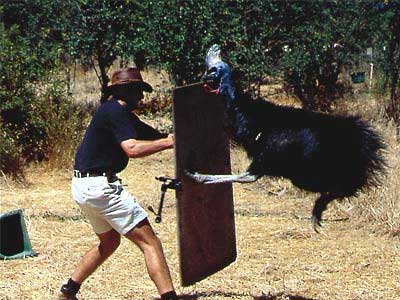
People need to stop picturing all dinosaurs as looking like some kind of leathery reptiles. I mean, we not only know now that velociraptor was feathered, but even how many secondary wing feathers it had (14). Jurassic park would have maybe not been as scary had their "raptors" looked like this.
Meanwhile, some of their descendants today look like this and attack like this.
-
Re:This is interesting....
Evolution is *predictive*? Really?
Yes Really
http://ncse.com/rncse/17/4/pre...And Newtonian mechanics falls apart with more than two bodies!
http://fc08.deviantart.net/fs7...
Really, Earth, Moon, Apollo 11 that sounds like more than 2
For the general 3 body problem
http://news.sciencemag.org/phy...
Is Ignorance your bliss ?
-
Re:Simple Request
If you read and understood TFS you would note that they indeed make this inference. You'd have to read the paper to see the details.
You might want to look at an accompanying editorial for more details but here is some additional info:
The blood-brain barrier, a tightly packed layer of cells that lines the brain's blood vessels, protects it from infections, toxins, and other threats but makes the organ frustratingly hard to treat. A strategy that combines ultrasound with microscopic blood-borne bubbles can briefly open the barrier, in theory giving drugs or the immune system access to the brain. In the clinic and the lab, that promise is being evaluated.
This month, in one of the first clinical tests, Todd Mainprize, a neurosurgeon at the University of Toronto in Canada, hopes to use ultrasound to deliver a dose of chemotherapy to a malignant brain tumor. And in some of the most dramatic evidence of the technique's potential, a research team reports this week in Science Translational Medicine that they used it to rid mice of abnormal brain clumps similar to those in Alzheimer's disease, restoring lost memory and cognitive functions. If such findings can be translated from mice to humans, “it will revolutionize the way we treat brain disease,” says biophysicist Kullervo Hynynen of the Sunnybrook Research Institute in Toronto, who originated the ultrasound method.
Some scientists stress that rodent findings can be hard to translate to humans and caution that there are safety concerns about zapping the brain with even the low-intensity ultrasound used in the new study, which is similar to that used in diagnostic scans. Opening up the blood-brain barrier just enough to get a beneficial effect without scorching tissue, triggering an excessive immune reaction, or causing hemorrhage is the “crux,” says Brian Bacskai, a neurologist at Massachusetts General Hospital in Boston who studies Alzheimer's disease and used to work with Hynynen.
My emphasis.
-
Re:WTF AM I DOING HERE!
Yes, this will be interesting - but the results may not be as scary as you might think. Assuming this pans out (the first three letters of the word assume are...) and the results are clinically apparent, even a modest benefit would save 'the system' quite a bit of money. Alzehiemer's patients are very expensive to maintain. They live for years, they can be otherwise healthy. They need a lot of human supervision (which doesn't come cheap).
So even if the equipment manufacturers charge and arm and leg for the procedure the overall health care dollar might go down. Another interesting issue is that this is a pretty cheap treatment - standard ultrasound machines, no expensive drugs* and a protocol that may well be so simple as to be effectively unpatentable.
So stay tuned. Quite a bit of work to do but some the 8 digit UIDs might be able to take advantage of the treatment (again, assuming that they are not running for their lives from a Zombie / Ebola / Ted Cruz infestation).
* Some of the treatments do work better with microbubbles which might end up costing some money. See the accompanying editorial for more info (needs a Science subscription).
-
Re:I'm all for this
research is needed to understand and manage risks arising from the use of the CRISPR-Cas9 technology. Considerations include the possibility of off-target alterations, as well as on-target events that have unintended consequences. It is critical to implement appropriate and standardized benchmarking methods to determine the frequency of off-target effects and to assess the physiology of cells and tissues that have undergone genome editing. At present, the potential safety and efficacy issues arising from the use of this technology must be thoroughly investigated and understood before any attempts at human engineering are sanctioned, if ever, for clinical testing. As with any therapeutic strategy, higher risks can be tolerated when the reward of success is high, but such risks also demand higher confidence in their likely efficacy.
-
I have four words for you:From http://www.sciencemag.org/cont...
Synthesis of many different types of organic small molecules using one automated process Junqi Li, Steven G. Ballmer, Eric P. Gillis, Seiko Fujii, Michael J. Schmidt, Andrea M. E. Palazzolo, Jonathan W. Lehmann, Greg F. Morehouse, and Martin D. Burke
Moleculers! Moleculers! Moleculers! Moleculers!
-
magic ingredient: perfluorodecyltrichlorosilane
AFAIK, FDTS is already used to coat MEMS-like devices (e..g, microfluid channels and nano-lithography stamps) because it chemically forms a monolayer coating that is lubricating and moisture resistant. Unfortunately, it is a bit nasty as it is highly corrosive, flammable chemical that smells a bit like hydrochloric acid.
The interesting thing with this is that they found a way to coat titanium dioxide nanoparticles (the same stuff in sunblock and some white paints) with it and create a suspension in ethanol so you can apply it like paint over an adhesive and it drys in a way that sticks to the adhesive in a way that they claim to be somewhat robust against damage. Here's the video and some supplementary material...
I'm not exactly sure how the adhesive (basically claimed to use "evo-stick" apparently some ethyl-acetate based adhesive like superglue available in the UK) sticks to the coated nanoparticles, but still is lubricating on the other side though (a similar problem with non-stick frying pans). There doesn't appear to be much discussion about this and my chemistry-fu is a bit rusty... Maybe some kind of covalent layer bonding or something...
-
open, reproducible science bill
It's actually, the "open, reproducible science bill":
The bills, introduced by a mostly Republican cast of sponsors in both the House and the Senate, would require that EPA use only publicly available, reproducible data in writing regulations and seek to remake the membership and procedures of the agency’s science advisory panels.
http://news.sciencemag.org/env...
One might think that the name "secret science bill" was dreamed up by a Democratic staffer intending to kill the bill, but that's actually the name Republicans gave the bill; Republicans really are bumbling idiots. If they had it called the "open, reproducible science bill", it would have stood a much better chance.
As to the content of the bill, there is a real problem with the EPA and other government agencies using immature science and irreproducible results as the basis of legislation, but that problem can't be fixed through new laws. The only way to reign in the EPA is to cut it down in size substantially or abolish it altogether and have state agencies deal with these issues.
-
Re:Lots of weird crap coming out of Congress latel
http://news.sciencemag.org/env...
"The bills, introduced by a mostly Republican cast of sponsors in both the House and the Senate, would require that EPA use only publicly available, reproducible data in writing regulations and seek to remake the membership and procedures of the agency’s science advisory panels."
No, I haven't read the bill. Are you calling TFA a liar? Because at this point, it's you or it. TFA is clear. "[The Bil] Would requite that the EPA only use [...] reproducible data." -
Re:Were you there?
-
Re:No story?
I'm guessing that this is the link: http://news.sciencemag.org/cli...
-
The Missing Link
-
Story link
Found this link in submissions...- http://news.sciencemag.org/cli...
-
Only right-wing nuts need apply
http://science.slashdot.org/st...
Posted by samzenpus on Wednesday September 10, 2014 @06:12PM
from the skeletons-in-the-closet dept.
sciencehabit writes Valerie Barr was a tenured professor of computer science at Union College in Schenectady, New York, with a national reputation for her work improving computing education and attracting more women and minorities into the field. But federal investigators say that Barr lied during a routine background check about her affiliations with a domestic terrorist group that had ties to the two organizations to which she had belonged in the early 1980s. On 27 August, NSF said that her 'dishonest conduct' compelled them to cancel her temporary assignment immediately, at the end of the first of what was expected to be a 2-year stint. Colleagues who decry Barr's fate worry that the incident could make other scientists think twice about coming to work for NSF. In addition, Barr's case offers a rare glimpse into the practices of the Office of Personnel Management (OPM), an obscure agency within the White House that wields vast power over the entire federal bureaucracy through its authority to vet recently hired workers.http://news.sciencemag.org/peo...
In her 11 August response, Barr questioned whether the special agent who conducted the investigation “can be an impartial evaluator of academic scientists, or anyone with liberal political beliefs.” As evidence, she points to a posting on a blog maintained by the agent, a veteran who served in Iraq, and his family. The item is a copy of a popular Internet meme about an incident that supposedly took place in an introductory college biology course.
According to the story, a “typical liberal college professor and avowed atheist” declares his intent to prove that there is no God by giving the creator 15 minutes to strike him from the podium. A few minutes before the deadline, a Marine “just released from active duty and newly registered” walks up to the professor and knocks him out with one punch. When the professor recovers and asks for an explanation, the Marine replies, “God was busy. He sent me.”