Slashdot Mirror
Domain: scientificamerican.com
Stories and comments across the archive that link to scientificamerican.com.
Comments · 1,496
-
Correct M/5 birth ratio: ~105/205
Here's the problem I'm seeing with everyone's "it's not 50/50" result - comparing females vs. males alive today is not the same as females vs. males births. Also, I'll cite my reference:
http://www.scientificamerican.com/article.cfm?id=why-is-life-expectancy-lo
The assumption is that it's current day, world ratio - obviously defining time or region will adjust the numbers, but the question is vague and we haven't been counting all births since humanity began.
-
Re:In a school, yes.
Troll, but I'll bite:
Many of those kids will go home and browse porn there instead. Though I doubt porn "causes harm" to young bucks, it serves to reinforce the message of when it is not appropriate to view porn.
Apparently the National Science Foundation never got the memo, or even the gene for common sense. -
800 lb gorilla
Sure, assuming you notice your errors in the first place and that depends on what you want to believe or are focused on. http://www.scientificamerican.com/podcast/episode.cfm?id=how-we-fool-ourselves-over-and-over-10-06-19
-
Re:Compounded Charges...
The problem with heroin is that people steal to get money to buy it.
Then book them for stealing. Anything else is pre-crime.
Also, http://www.scientificamerican.com/article.cfm?id=portugal-drug-decriminalization
-
Re:So let me get this right...
Insofar as fusion power is concerned, its certainly a myth that environmental organizations are holding us back. Nobody knows what a commercially viable fusion plant would look like.
Good point. I completely miss from the discussion the fact that not only nobody really knows how such a plant would be able to work, but also that there are good arguments pointing towards it being completely impossible to build one that works in any reasonable way. Having to be able to recover every neutron is one issue. Designing materials that can withstand the stresses long enough and reliably enough for production use is another one.
Here is a nice article covering the arguments against it (Unfortunately it is paywalled. Also, the lead-in sounds way more optimistic than the rest of text).
In sum, there are lots of very good reasons to cancel ITER and use the money for something else.
-
Re:Fusion Reactor... Crisis?!
You have out-obtused me, I have little idea what your localities share in common.
Do you mean to insist that they lack the money or stability to operate nuclear plants? That isn't exactly entirely attributable to fission itself. And Toshiba wants to sell them safe, small scale, self contained nuclear generation. The U.S. could be tasked with providing the islands with power, the U.S. Navy has long experience safely operating floating reactors (money is an issue there, but if we want to 'continue living in a civilization', we might have to stop worrying about it so much).
I'm about evenly split on governments spending $20 billion on new fission generation vs fusion research, but I'm not very optimistic about fusion, mostly based on the numbers in a recent Scientific American article:
http://www.scientificamerican.com/article.cfm?id=fusions-false-dawn
The engineering requirements for the jacket on a tritium consuming fusion reactor are 'hilarious'. There is no better word. The targets for laser ignition also present 'interesting' production challenges. Meanwhile, uranium reactors 'fucking work', with political problems preventing them from being built, not fundamental technical challenges.
-
Re:Slight Misfire above....
Their advantage is that they are extremely light sensitive, almost down to detecting a single photon.
I read recently that the rods can detect single photons, but that the brain rejects any signal that was caused by less than 7 photons. How cool is that? Our brains have a built-in noise filter.
-
Not exactly science fiction
http://www.scientificamerican.com/article.cfm?id=human-animal-chimeras or http://news.nationalgeographic.com/news/2005/01/0125_050125_chimeras.html As a matter of fact, there is a controversy over a related patent that was issued in 1999 (google EP 380646). Canada has already passed national legislation with regards to this issue. This is not fiction, folks. Nor does the legislator deserve to be mocked for the concern he has on the issue. I haven't read the bill, so there may well be good reason to deride this law
-
Re:Sheep herding
Actually it's not that absurd- at least the human-animal hybrid part.
Most humans want to have special rights that other animals don't have. Despite what PETA and the rest think, we're going to be eating animals, experimenting on them, killing them.
So the problem is then: what happens when you have a human-animal hybrid?
At what percent do we regard the entity as human? And how do we calculate that percentage?
After all I see people talk about ripping organs out from a human-animal hybrid and then putting them into a human.
So the recipient becomes a human-animal hybrid too right? Does the recipient then lose rights to be considered human? Why not? If not, why doesn't the source human-animal hybrid have human rights too?
What if the "animal" human-animal hybrid turns out to be a bit more human than expected and just can't talk as well?
Or what if a bunch of hybrids turn out to be "better than human"? And use our example to justify killing or enslaving us?
Prohibiting the creation of such hybrids will reduce the scope of such problems (it won't get rid of them totally).
Don't get me wrong I'm not against progress. But we really should consider the long term consequences. Is society ready? Are our laws ready?
We're at the stage where "doing stuff just because it can be done" can have greater and more serious long-term consequences.
p.s. on the subject of transplants see:
http://www.sciencedirect.com/science?_ob=ArticleURL&_udi=B6VM8-416C9CR-3&_user=10&_coverDate=06%2F30%2F2000&_rdoc=1&_fmt=high&_orig=search&_sort=d&_docanchor=&view=c&_searchStrId=1358101317&_rerunOrigin=google&_acct=C000050221&_version=1&_urlVersion=0&_userid=10&md5=43ba4a34044b04938f90894d2e7e2c25Those are anecdotal and perhaps skewed, however I won't be surprised if some stem cells from the transplanted organs float around and start changing things a bit.
After all see:
http://www.scientificamerican.com/article.cfm?id=baby-to-brain
http://www.scientificamerican.com/article.cfm?id=fetal-cells-microchimerism
-
Re:Sheep herding
Actually it's not that absurd- at least the human-animal hybrid part.
Most humans want to have special rights that other animals don't have. Despite what PETA and the rest think, we're going to be eating animals, experimenting on them, killing them.
So the problem is then: what happens when you have a human-animal hybrid?
At what percent do we regard the entity as human? And how do we calculate that percentage?
After all I see people talk about ripping organs out from a human-animal hybrid and then putting them into a human.
So the recipient becomes a human-animal hybrid too right? Does the recipient then lose rights to be considered human? Why not? If not, why doesn't the source human-animal hybrid have human rights too?
What if the "animal" human-animal hybrid turns out to be a bit more human than expected and just can't talk as well?
Or what if a bunch of hybrids turn out to be "better than human"? And use our example to justify killing or enslaving us?
Prohibiting the creation of such hybrids will reduce the scope of such problems (it won't get rid of them totally).
Don't get me wrong I'm not against progress. But we really should consider the long term consequences. Is society ready? Are our laws ready?
We're at the stage where "doing stuff just because it can be done" can have greater and more serious long-term consequences.
p.s. on the subject of transplants see:
http://www.sciencedirect.com/science?_ob=ArticleURL&_udi=B6VM8-416C9CR-3&_user=10&_coverDate=06%2F30%2F2000&_rdoc=1&_fmt=high&_orig=search&_sort=d&_docanchor=&view=c&_searchStrId=1358101317&_rerunOrigin=google&_acct=C000050221&_version=1&_urlVersion=0&_userid=10&md5=43ba4a34044b04938f90894d2e7e2c25Those are anecdotal and perhaps skewed, however I won't be surprised if some stem cells from the transplanted organs float around and start changing things a bit.
After all see:
http://www.scientificamerican.com/article.cfm?id=baby-to-brain
http://www.scientificamerican.com/article.cfm?id=fetal-cells-microchimerism
-
Re:In the closet? Interesting choice of words
i started with "Expelled," and I quickly ended the fiasco. You've got to be kidding me.
-
Re:In the closet? Interesting choice of words
i started with "Expelled," and I quickly ended the fiasco. You've got to be kidding me.
-
Re:And how would you do that?
I've little to no idea of the procedures and parts you wrote of but I think it speaks eloquently to the Scientific American article that points out BP is the only entity with what is seen as viable technology and the know how to implement it. Any forced change over from BP to U.S. government control of the spill catastrophe might interfere with technical management and solution deployment. I would like to see BP made to comply with total transparency and openness as regards all information requirements necessary to fully understand the entire incident.
-
Some links via Arts and Letters Daily
Here are some links (provided to you via Arts and Letters Daily):
The Associated Press
Sci Am
Discover
James Randy
Roger KimballThe Man's last essay. It's titeled Oprah Winfrey: Bright (but Gullible) Billionaire.
-
Scientific American Profile of Martin Gardner
-
Scientific American Profile of Martin Gardner
-
Re:What...
Numerous researchers in synthetic biology have been trying to do exactly that.
Here is an example Open Wetware BioBricks
Synthetic biology has two paradigms the first is the top down approach which deals with gene knock outs to look for minimal sets necessary for life that can then be tailored to suit specific needs/tasks. The other approach is the bottom up which have inspiration from the Miller-Urey experiments. They are trying to spontaneously generate a new biological system from scratch. Some researchers in this camp trying to create synthetic cellular components in hopes of putting all the synthetic parts together to create a functioning cell such as synthetic Golgi bodies
There has been some promising results from both approaches. It is a pretty exciting time in Biology. -
Re:Help me understand oil dispersants
I found a good article in the Scientific American re dispersants. The article says they are a tool in the shed, but often be part of the problem. As you say, the dispersants increase the surface area of the oil and this increases the bacteria who eat the oil, depleting the oxygen, sending the oil in three directions and making some of it sinking to the bottom where is coats and is ingested by shellfish. It can even kill fish eggs. Here is the link: http://www.scientificamerican.com/article.cfm?id=spill-clean-up-chemicals&page=2.
-
Re:Well, OK, there is nuclear.
Current rollout of renewables is clearly not sufficient because carbon emissions continue to rise at the top end of IPCC projections. And new coal fired facilities are still being built (and not just in China).
Of course new coal power plants are still being built, because they pass external costs to others they are still the cheapest power source for those whop build them. If however caps or carbon taxes were placed on coal then the picture would be different. Of course some accuse cap and trade or similar ideas of harming the poor. That can be mitigated though, the average increase on people's utility bill can be offset by reducing their income tax the same amount. And for those who do not pay income tax then a credit could be given to them. Say for instance the average residential power bill went up $1000 a year they could be given a check for $1000 at the beginning of the year. Or so they won't spend it all on something else at once, they can be given $120 a month. It can even be included on their EBT card.
Besides China India is also building coal fired power plants fast. Kyoto exempted both nations from carbon emission limits. However China is doing more than just using coal. China is the world's fastest, largest, green energy market. Notice that that link is to an article on Bloomberg Businessweek's website and Bloomberg isn't exactly known as an environmental hotbed.
The problems with wind and solar are that they are not base load
I have already addressed the baseload. One, geothermal can be used as the baseload. Two, because Natural Gas fired power plants can quickly be ramped up or slowed down, unlike both coal and nuclear power, they can be used for the baseload until cleaner alternatives emerge.
When the wind doesn't blow and the sun doesn't shine they don't produce power.
The sun is always shining somewhere and the wind is always blowing somewhere. As I have also stated power blackouts costs US businesses almost $100 Billion a year, according to a sidebar to SciAm's A Solar Grand Plan businesses loss $80 Billion a year from blackouts. The US National Grid is old and failing so it needs to be rebuilt period. Rebuilt it can use High-voltage direct current or HVDC powerlines from coast to coast and north to south. HVDC loses less energy over long distances than AC does, of course there is power loss from conversion from AC to DC then back but it's not as much as the loss from AC transmission over long distances. And while Concentrated Solar Power may need to be converted, depending on whether steam or something else is used to drive a generator, PVs don't.
I was referring to enhanced or engineered geothermal
Okay, however geothermal is being used commercially. Just not "enhanced or engineered geothermal" whatever those are, all those plants where it is used requires enhancements and engineering.
As to whether nuclear appeals to state planners or businesses, even if that assertion is true (which it may or may not be) who cares? What we want is the best decision.
If it takes state planners likely it's not a good idea. Government has to support nuclear power because businesses won't, it's too risky. Mind you I'm not saying everything government does is bad, there are areas where it does well relatively, but it can do better in areas by making sure others pay all their costs, keeping a level playing field, and regulating monopolies. Businesses though are investing in and supporting solar and wind power as well as geothermal, tidal, and other energy
-
Re:Well, OK, there is nuclear.
We absolutely MUST replace coal fired electricity generation with low CO2 methods. Coal is the worst CO2 emitter.
I didn't say anything about replacing coal in the post you replied to. All I said was that nuclear power appeals to state planners not businesses.
I very much doubt that current renewable technologies are sufficient. The only stuff that is immediately deployable is wind and solar.
They are sufficient now. Those who build off the grid do so every day. And yea, solar and wind is employable today unlike nuclear power. According to Infoplease the Palo Verde 2, Ariz. is the largest reactor in the US, at 1,335 MWs. According to Wiki construction started in 1976 with it's first year of commercial operation in 1988, 12 years later. Now take wind turbines, erect and connect 10 5 megawatt turbines a month, and there are larger turbines, and in 1 year you've added 600 MWs or in 2 years 1,200 MWs. That's almost as much as Palo Verde 2 provides, in 1/6 the tyme. SciAm's A Solar Grand Plan says solar power "could supply 69 percent of the U.S.'s electricity and 35 percent of its total energy by 2050." The Wind Energy Resource Atlas of the Unites States, created by the National Renewable Energy Lab of the Department of Energy, details the wind potential of various regions of the US. The Rocky Mountains along contain enough potential energy to electrify the US, but that's not the only region with large wind potential. On the East Coast from Massachusetts to North Carolina offshore wind farms could "supply all the energy needs of much of the East Coast and then some". From British Columbia to Southern California on the Pacific Coast could provide a lot as well. Actually hook a hard left in S Ca through AZ and NM to western Texas and the wind potential grows.
For baseloads geothermal is good though not for all of the baseload. Until large scale storage is available currently used power plants could provide the baseload.
Enhanced geothermal is very promising but there is still no commercial size power station.
Ah but there is commercial scale geothermal right now. In CA geothermal provided 13,000 gigawatt-hours of electricity in 2007. It provides 20 percent of Hawaii's Big Island electricity. Geothermal provides 27% of Philippine's energy. Geothermal is even available and used in New York City.
If it comes to raising the planet's temperature by 5C or nuclear power, I'd have to say nuclear is the clear choice.
Fine, let businesses pay for it not taxpayers. No loan guaranties, limited liability, or other subsidies. However left to their own devices corporations will not build nuclear power plants.
When all is said and done, I think that the carbon pollution problem will only be solved by inexpensive clean electricity. Some hard choices will have to be made.
Unfortunately there is no inexpensive clean electricity. Well, except for the Negawatt, the energy not produced due to energy efficiency or simply cutting the energy used. Therein lies the hard choice, people don't want to give up what they have even if they will s
-
Re:interestingly, themselves sometimes touted
Here are citations for a GWP of 72 over 20 years:
Those above do not, AFAIK, take into account the greenhouse gases that are formed when the methane itself reacts with other parts of the atmosphere. They all talk about the methane breaking down quickly, but carbon dioxide and ozone are two of the gases formed when that happens IIRC.
There are also reports that don't mention time frames that list methane as anywhere from 10 to 58 times as effective as carbon dioxide as a greenhouse gas.
The 100-year figure you're likely to read is anywhere from 20 to 33 GWP for methane, with 33 being common in recent reports.
I'm not a climatologist, but I know how to read news sites and I know how to search the fucking web for my damn self. Do you?
-
Re:Um yea, right
By performing controlled experiments, researchers have found that Carbon Dioxide Does Not Boost Forest Growth.
If carbon dioxide does not stay in the atmosphere for hundreds of years, how do you explain the rising concentration of the gas over the past 100 years?
-
Re:hmmIt is also worth mentioning that alpha-dog libertarian anti-environmentalist and the chief editor of Skeptic Magazine, Michael Shermer, now subscribes to AGW. In his own words:
Because of the complexity of the problem, environmental skepticism was once tenable. No longer. It is time to flip from skepticism to activism.
-
Re:It's 2010!
Fusion is awfully damn hard. The easiest proposals depend on a magnetic bottle we don't know how to build surrounded by perfect shielding that we don't know how to make (it has to capture nearly every neutron released by the fusion reaction and use it to convert lithium into tritium; you can make the tritium in a fission reactor, but getting enough of it that way would cost about $100 million a week at today's prices. Once you have the tritium, you have to make sure you use damn near all of it, and hydrogen has a fun habit of leaking.).
Laser pinches offer a different path to fusion, but they also need a lot of fuel, about 90,000 pellets a day. Current facilities make about 6 pellets a year, at a cost of $1 million per.
Lest you think I am just some crank making stuff up, this is from a Scientific American article published in March (sorry about the paywall):
http://www.scientificamerican.com/article.cfm?id=fusions-false-dawn
And those are just the fuel problems.
That doesn't mean it is impossible, but we aren't anywhere close, even though we are close to technical breakeven (where a reaction releases more energy than was used to initiate it).
-
First? Not according to Slashdot.
In 2008 a story was posted on slashdot about a woman getting brain surgery remotely in Calgary Alberta Canada. And here's a story in SciAm about remote surgery done across the Atlantic ocean between NY and Strasbourg France in 2001.
-
Fusion power dream
The March 2010 edition of Scientific American has an article that raises some significant doubt that we will ever be able to use fusion as a commercial source of power. The problems aren't about ignition, they are more fundamental engineering problems...
-
Re:Flashback!
Do you have any data on batteries? Because from what I understand electric cars are basically worse the ICE (unless you are driving a Hummer) because of the amount of energy used in the creation and recycling of the highly poisonous batteries. Although I agree completely that coal has got to go, as they not only pollute with greenhouse gasses but with radioactive waste.
From what I understand until we come up with better energy storage and retrieval technology electric cars are only good for those that run on smug. So while I fully support alternative energy sources for the grid, such as nuclear, solar, and wind farms, for motor vehicles it would probably be better to offer tax incentives to get the older gas guzzlers off the road and get folks to drive less fuel sucking cars.
As someone from one of the poorer rural states (which means lots of mileage driven and pretty much zero public transportation) I can tell you a lot of those older vehicles are on the road not because folks like blowing gas, but simply because they can't afford to get rid of them in this dead economy. Anything that would help working folks get rid of those older SUVs and gas blowing V8s would be a good thing in my book. But from what I understand with electrics and hybrids the battery tech just isn't good enough to make them come out ahead in the long run.
-
Re:Good move...
US Coal mining deaths per exajoule electricity produced: 4.5
To make a more comprehensive and useful comparison, you should include all the deaths from radioactive coal ash and mercury.
-
The really tragic fact about Greens,
is that they're stupid.
1) A ban on nuclear power here in CaliforniaExcept environmentalists or greenies didn't stop nuclear power. As the Hooked on Subsidies article the pro freemarket CATO Institute republished, originally published by "Forbes", said it is state actors not the market that decides what nuclear power plants are built. Even in France and other nations, here's the relevant paragraph:
"How do France (and India, China and Russia) build cost-effective nuclear power plants? They don't. Governmental officials in those countries, not private investors, decide what is built. Nuclear power appeals to state planners, not market actors."The "Hooked on Subsidies article brings up the Olkiluoto Nuclear Power Plant being built in Finland. The French government owned business Areva and Siemans were building it, however Siemens sold it's interest to Areva. As of this tyme last year cost overruns have caused it's "3 billion euro price tag, about $4.2 billion", to climb at least 50 percent. Market Watch published a story about a study that warns of steep cost overruns at new reactors.
2) The Sierra Club successfully shutting down a massive solar plant. (What? Solar is a green energy? But think of all the DESERT that would be covered by those panels! 25 tortoises live there!) Good luck getting more companies to put money into proposing green power generators, assholes. Similar stories exist for wind and tidal projects across the country.
I'm glad I don't donate to the Sierra Club. They're not the only hypocrites though. On the Atlantic Coast there are those who oppose offshore wind farms. Even Ted Kennedy opposed a wind farm, in Cape Cod. The Wind Energy Resource Atlas of the United States" lays out the wind potential of various regions of the US. The Rocky Mountains alone has enough potential to supply all of the US with energy. Meanwhile SciAm published the article A Solar Grand Plan lays out how solar power can "supply 69 percent of the U.S.'s electricity and 35 percent of its total energy by 2050." Then there are other potential energy sources as well. Geothermal energy supplied California with 13 terawatts or 4.5% of the electricity used in CA in 2007. One geothermal project in Hawaii is the Puna Geothermal Venture and it supplies the big island of 20% of it's electricity. The SciAm article Hawaii Says Aloha (Greetings) to Clean, Renewable Energy says geothermal energy can be expanded to supply more electricity:
"Last January, Hawaii signed an agreement with the U.S. Department of Energy (DoE) that would make the Aloha State the country's most aggressive in pursuing renewable energy. By 2030, it plans to obtain 70 percent of its power from clean energy (40 percent from renewables and 30 percent from energy efficiency). Outstripping California's goal of 33 percent by 2020, the Hawaii initiative is a green light for clean-tech experts and enthusiasts to set up shop in the heart of the Pacific and may become a blueprint (or greenprint) for the rest of the country."
Geothermal isn't only available in the west either. It is being used now in
-
The really tragic fact about Greens,
is that they're stupid.
1) A ban on nuclear power here in CaliforniaExcept environmentalists or greenies didn't stop nuclear power. As the Hooked on Subsidies article the pro freemarket CATO Institute republished, originally published by "Forbes", said it is state actors not the market that decides what nuclear power plants are built. Even in France and other nations, here's the relevant paragraph:
"How do France (and India, China and Russia) build cost-effective nuclear power plants? They don't. Governmental officials in those countries, not private investors, decide what is built. Nuclear power appeals to state planners, not market actors."The "Hooked on Subsidies article brings up the Olkiluoto Nuclear Power Plant being built in Finland. The French government owned business Areva and Siemans were building it, however Siemens sold it's interest to Areva. As of this tyme last year cost overruns have caused it's "3 billion euro price tag, about $4.2 billion", to climb at least 50 percent. Market Watch published a story about a study that warns of steep cost overruns at new reactors.
2) The Sierra Club successfully shutting down a massive solar plant. (What? Solar is a green energy? But think of all the DESERT that would be covered by those panels! 25 tortoises live there!) Good luck getting more companies to put money into proposing green power generators, assholes. Similar stories exist for wind and tidal projects across the country.
I'm glad I don't donate to the Sierra Club. They're not the only hypocrites though. On the Atlantic Coast there are those who oppose offshore wind farms. Even Ted Kennedy opposed a wind farm, in Cape Cod. The Wind Energy Resource Atlas of the United States" lays out the wind potential of various regions of the US. The Rocky Mountains alone has enough potential to supply all of the US with energy. Meanwhile SciAm published the article A Solar Grand Plan lays out how solar power can "supply 69 percent of the U.S.'s electricity and 35 percent of its total energy by 2050." Then there are other potential energy sources as well. Geothermal energy supplied California with 13 terawatts or 4.5% of the electricity used in CA in 2007. One geothermal project in Hawaii is the Puna Geothermal Venture and it supplies the big island of 20% of it's electricity. The SciAm article Hawaii Says Aloha (Greetings) to Clean, Renewable Energy says geothermal energy can be expanded to supply more electricity:
"Last January, Hawaii signed an agreement with the U.S. Department of Energy (DoE) that would make the Aloha State the country's most aggressive in pursuing renewable energy. By 2030, it plans to obtain 70 percent of its power from clean energy (40 percent from renewables and 30 percent from energy efficiency). Outstripping California's goal of 33 percent by 2020, the Hawaii initiative is a green light for clean-tech experts and enthusiasts to set up shop in the heart of the Pacific and may become a blueprint (or greenprint) for the rest of the country."
Geothermal isn't only available in the west either. It is being used now in
-
Re:That Old Tune?
Anyone that's done a little research knows the scientists there really did some questionable stuff. They would also know that they've (CRU/IPCC) been taken to task by others in the scientific community for doing so.
There was a small amount of criticism from the scientific community regarding small details, but the consensus was that the leaked emails did reveal a conspiracy, and did not alter any of the science. See: Nature, Scientific American New Scientist, the Royal Society.
-
Irrational fear and misinformation
Canadian nuclear plants emit 40 times more tritium every day when functioning normally than the Vermont Yankee leak emitted in a year:
http://atomicinsights.blogspot.com/2010/03/how-much-tritium-leaked-from-vermont.htmlA 1 GW(e) natural gas turbine will emit about 9 curies/year,* which is 20 times the rate of radiation from the VT Yankee leak at its highest.
Oh, and natural gas "fracking" produces toxic and radioactive wastewater. This article from last summer discusses EPA tests that found nasties from the fracturing fluid in domestic well water:
http://www.scientificamerican.com/article.cfm?id=chemicals-found-in-drinking-water-from-natural-gas-drilling
New York State is doing fracking in something called Marcellus shale. This article from last fall says that surface wastewater from these sites was found to contain Ra-226 in concentrations "thousands of times" the limit for drinking water:
http://www.scientificamerican.com/article.cfm?id=marcellus-shale-natural-gas-drilling-radioactive-wastewater
This page
http://www.epa.gov/radiation/tenorm/oilandgas.html
says, "more than 18 billion barrels of waste fluids from oil and gas production are generated annually in the United States".-Carl
* Radioactivity of fossil gas. This abstract
http://rpd.oxfordjournals.org/content/97/3/259.abstract
gives 200 Bq/m^3. It doesn't say where they measured, but given context of the paper I'll assume it was at the consumer end of the line, at STP. I don't know if gas used at electrical plants is any fresher, but I'll assume it's no more stale. Pure methane has an energy content of 55.5 kJ/g and a density of 667 g/m^3, or about 5 Wh(e)/L from a 50%-efficient combined-cycle plant. So about 40Bq/Wh, or 1 nanoCurie per Wh, or 9 Curies/GW-yr. -
Irrational fear and misinformation
Canadian nuclear plants emit 40 times more tritium every day when functioning normally than the Vermont Yankee leak emitted in a year:
http://atomicinsights.blogspot.com/2010/03/how-much-tritium-leaked-from-vermont.htmlA 1 GW(e) natural gas turbine will emit about 9 curies/year,* which is 20 times the rate of radiation from the VT Yankee leak at its highest.
Oh, and natural gas "fracking" produces toxic and radioactive wastewater. This article from last summer discusses EPA tests that found nasties from the fracturing fluid in domestic well water:
http://www.scientificamerican.com/article.cfm?id=chemicals-found-in-drinking-water-from-natural-gas-drilling
New York State is doing fracking in something called Marcellus shale. This article from last fall says that surface wastewater from these sites was found to contain Ra-226 in concentrations "thousands of times" the limit for drinking water:
http://www.scientificamerican.com/article.cfm?id=marcellus-shale-natural-gas-drilling-radioactive-wastewater
This page
http://www.epa.gov/radiation/tenorm/oilandgas.html
says, "more than 18 billion barrels of waste fluids from oil and gas production are generated annually in the United States".-Carl
* Radioactivity of fossil gas. This abstract
http://rpd.oxfordjournals.org/content/97/3/259.abstract
gives 200 Bq/m^3. It doesn't say where they measured, but given context of the paper I'll assume it was at the consumer end of the line, at STP. I don't know if gas used at electrical plants is any fresher, but I'll assume it's no more stale. Pure methane has an energy content of 55.5 kJ/g and a density of 667 g/m^3, or about 5 Wh(e)/L from a 50%-efficient combined-cycle plant. So about 40Bq/Wh, or 1 nanoCurie per Wh, or 9 Curies/GW-yr. -
Re:Coal
The funny thing about this whining about nuclear plants is that coal ash is more radioactive than nuclear waste.
-
Fossil fuels are very expensive from externalities
Fossil fuel costs for defense and pollution easily rack up into hundreds of billions of dollars per year. As suggested in the book Brittle Power in 1982, renewable energy has been cheaper for decades than fossil fuels (or nuclear) when you include *all* the externalities.
http://en.wikipedia.org/wiki/Brittle_PowerWe just pay for fossil fuel use through our taxes and national debt for the military, and through health costs from mercury pollution and other forms of pollution that lead to health problems (even wonder why much fish is now unsafe to eat from mercury?), systemic risk like of economic disruption or global war over oil, and so on.
http://www.energyandcapital.com/articles/oil-gas-crude/461By the way, it takes more electricity and natural gas to refine a gallon of gasoline from oil than an electric car would need to go the same distance, so all that oil is completely wasted -- except it is profitable for some to fleece the public treasury.
http://www.evnut.com/gasoline_oil.htm
http://en.wikipedia.org/wiki/ExternalityGE had a cost-competetive production ready electric vehicle built from off-the-shelf parts built in the late 1970s -- you can see it in the Schenectady, NY science museum.
That our elected officials have allowed this public fleecing using fossil fuels, including the destruction of the health of our rivers, oceans, and humanity through smog and mercury, to go on since the Reagan years is an unspeakable tragedy of widespread corruption and ignorance which wider access to pubic records might help some with.
For the cost of less than one half-year of US defense spending the USA could shift to all renewables, eliminating the need for much of the defense budget.
http://www.scientificamerican.com/article.cfm?id=a-solar-grand-plan
http://www.earth-policy.org/index.php?/books/pb3/pb3_table_of_contents
http://www.lexrex.com/enlightened/articles/warisaracket.htmAs Jimmy Carter said in 1979:
http://www.pbs.org/wgbh/amex/carter/filmmore/ps_crisis.html
"""
We are at a turning point in our history. There are two paths to choose. One is a path I've warned about tonight, the path that leads to fragmentation and self-interest. Down that road lies a mistaken idea of freedom, the right to grasp for ourselves some advantage over others. That path would be one of constant conflict between narrow interests ending in chaos and immobility. It is a certain route to failure.
All the traditions of our past, all the lessons of our heritage, all the promises of our future point to another path, the path of common purpose and the restoration of American values. That path leads to true freedom for our nation and ourselves. We can take the first steps down that path as we begin to solve our energy problem.
""" -
Re:Increased geological activity?
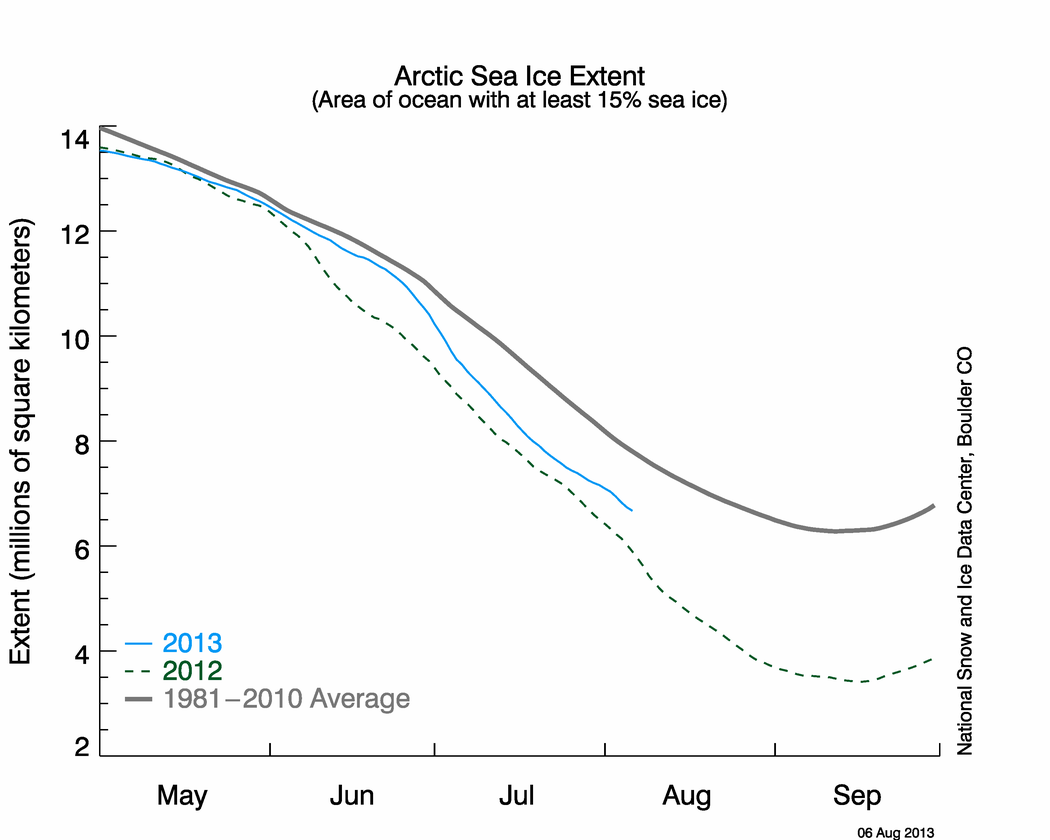
Earthquakes look pretty typical to me, notoriety isn't the same thing as frequency or intensity. Also the glaciers have been melting for the entire Holocene, so that's really not unusual and to top it all off the polar ice caps have rebounded to normal levels. Some scientists have made a similar assertion to icecap melting leading to increased vulcanism;
They said there was no sign that the current eruption from below the Eyjafjallajokull glacier that has paralysed flights over northern Europe was linked to global warming. The glacier is too small and light to affect local geology. Ice cap thaw may awaken Icelandic volcanoes
that isn't the case here.
-
Debris from last week's asteroid?
I wonder if it could be a piece of debris from the asteroid that made a close pass to Earth about a week ago, in a spiral orbit since then. Just because it made a big light show doesn't mean the material was huge. The piece of debris could have started out the size of a softball, and (if it made it to the ground at all) could have been smaller than the size of a pea upon impact.
-
Re:one day the whole universe will shut down
I'm assuming that was a serious question.
It was, as I stated in my post there is more than one scientific theory about the universe and it's future.
The explanation is too long for a post on slashdot, but I highly recommend you watch 'A Universe From Nothing' by Lawrence Krauss for an explanation of why the universe will end with a whimper.
Here's one, by the same person you cited, Lawrence M Krauss. The End of Cosmology?. And a video of it. Now it's not playing in my browser so I don't know if it's the same video as the one you link to however it's subtitle is "An accelerating universe wipes out traces of its own origins". Now that does sound like a whimper. Oh, yea at more than an hour the video you link to is too long.
Falcon
-
Re:one day the whole universe will shut down
I'm assuming that was a serious question.
It was, as I stated in my post there is more than one scientific theory about the universe and it's future.
The explanation is too long for a post on slashdot, but I highly recommend you watch 'A Universe From Nothing' by Lawrence Krauss for an explanation of why the universe will end with a whimper.
Here's one, by the same person you cited, Lawrence M Krauss. The End of Cosmology?. And a video of it. Now it's not playing in my browser so I don't know if it's the same video as the one you link to however it's subtitle is "An accelerating universe wipes out traces of its own origins". Now that does sound like a whimper. Oh, yea at more than an hour the video you link to is too long.
Falcon
-
Re:I guess it depend on your priorites.
I take it as a given that is what government does. It wastes money. Period. If people actually found the things government did useful, they would voluntarily fund it... like they choose to buy food or clothing...
Except big agriculture businesses like Archer Daniels Midland and Cargill get billions of dollars in taxpayer subsidies. When most people go grocery shopping they do not pay the full price of the food at the register.
I'm not an expert on a national grid. Suffice to say either one would be a good choice. I would personally go for more space funding as electricity seems to work just fine for me. Yet, we still can't get to space easily. But that's just me. maybe your wish is a national grid.
Failures in the grid cost US businesses billions of dollars a year. The print edition of A Solar Grand Plan had a side bar saying $80 Billion was lost a year. An investment to rebuild the grid will pay back before many other investments.
Falcon
-
Re:Energy not Power and Batter Life
Uhhhhh....if you are simply wanting to capture solar energy, wouldn't using molten salt be not only much cheaper but also more efficient?
After all it is certainly cheaper to have some mirrors focus the sun on a tank than to try to build truly efficient solar panels (last I heard the best were around 30% efficient and VERY expensive) and molten salt would at the same time solve the storage problem without the need for the expensive battery.
According to Scientific American we could have nearly 70% of our electricity needs met by solar by 2050 at a cost of 420 billion, using molten salt as part of the plan. Considering the amount of greenhouse gasses that would save by getting rid of coal it seems like a good deal to me. Add in subsidies to get folks into electric vehicles and we could finally stop using foreign oil, which lets be honest is well worth the price to keep from giving tankers full of money to militants like the Sauds.
-
Re:Quoi.
Made-up scenario?
The Census has already admitting to giving information on Japanese-Americans for the purpose of their internment at concentration camps during WWII.
After denying it for decades, they finally admitted giving names and addresses of Japanese-Americans to the military.
Generally, if the government tells you X, the truth is likely Not X.
-
Prove It, Implement Fix, Pay Out FamiliesIf this is true, recreate the phenomenon in a lab. Test your hypothesis by exposing the circuitry in question to similar radiation in a lab. While you can't test thousands of sets of circuitry, being able to recreate it by increasing the amount of radiation and testing or automating the testing and dosage cycle and letting it run until the malfunction is noted or another failure occurs.
It's not out of the question, IBM noted in the 90s:Extensive background radiation studies by IBM in the 1990s suggest that computers typically experience about one cosmic-ray-induced error per 256 megabytes of RAM per month. If so, a superstorm, with its unprecedented radiation fluxes, could cause widespread computer failures.
You have to fix this though. As a large manufacturer you have to accept this risk just like your competitors do. Airlines accept this risk and triple check their data because people's lives are at risk. As a car manufacturer, you are in the exact same position.
I hope the fix they already rolled out as a recall includes triple checking data or -- if the article is correct -- we won't see a drop in these horrible accidents. I hope for drivers and public safety that it does. It's led to death and possibly wrongful incarceration. Restitution is in order. Take testing motor vehicles seriously. -
Re:but
http://www.ap.org/
http://www.bbc.co.uk/
http://www.theregister.co.uk/
http://online.wsj.com/home-page
http://www.nytimes.com/
http://www.washingtonpost.com/
http://www.cnn.com/
http://www.c-span.org/
http://www.nationalgeographic.com/
http://www.popularmechanics.com/
http://www.scientificamerican.com/
Need I go on? -
Re:Bullshit (Mod parent down)
What bullshit. The privacy protections regarding census answers were put in place AFTER the Japanese internment camps as a RESPONSE.
No, good sir, what you write is indeed bullshit.
Says Says Scientific American in 2007:
The Second War Powers Act of 1942 temporarily repealed that protection [census confidentiality] to assist in the roundup of Japanese-Americans for imprisonment in internment camps in California and six other states during the war.
According to the same article, the Census Bureau denied this for decades.
It's true that in response, the privacy of the census was further codified:
The legal confidentiality of census information dates to 1910, and in 1954 it became part of Title 13 of the U.S. Code
After doing some research, it's clear that the Slashdot summary is accurate. If the "summary reads as is [sic] those protections were disregarded in that roundup", it's because they were. I pity the mods that fell for you.
-
Re:Just the number of residents?
As an aside, the census had nothing to do with the Japanese internment during WWII. At most it made calculating the number of Japanese-Americans easier, allowing the round up to be more accurate. Maybe. Given how easy it is to separate people by obvious ethnic ancestry, the round up would have occurred any way. Besides which, it's not as if either of scenarios mentioned in the OP actually provided anything more than numbers. They didn't provide addresses, names, or any actual personal information. Merely the number who marked a certain ethnicity in a certain county.
So yes, these people are still just paranoid.
Bullshit, total and utter bullshit. And those who modded the parent up as informative are idiots.
-
RE: Fusion - More Hypefull than Hopefull
This process requires fusion & was even mentioned at the end of this Scientific American podcast.The podcast points out that fusion's PR about the hoped for "break even point" is somewhat misleading - to put it mildly.
Fusion's False Dawn episode page
http://www.scientificamerican.com/podcast/episode.cfm?id=wheres-my-fusion-reactor-10-03-17 -
Re:It's the unrecognized irony that kills you...
Thanks for the reply.
How is there a natural scarcity of materials when the Earth is so big, and the solar system is even bigger?
"Advanced Automation for Space Missions"
http://www.islandone.org/MMSG/aasm/How is there a scarcity of energy when the Earth receives 10,000 times what the human race uses from sunlight (and there are also vast geothermal energy reserves)? Nuclear missiles to fight over oil fields and land are so ironic, because the same technologies would let us build habitats in space or build solar panels (or nuclear power systems). For half of one year's US defense budget, the USA could move to entirely renewable energy sources with energy efficiency, and be way more intrinsically secure than depending on long supply lines that need to be guarded by soldiers.
http://www.scientificamerican.com/article.cfm?id=a-solar-grand-plan
http://www.earth-policy.org/index.php?/books/pb3/pb3_table_of_contents
http://en.wikipedia.org/wiki/Brittle_PowerSo, I'd suggest that when people fight over land and raw materials, it is mainly either through ignorance, lack of imagination,
http://www.juliansimon.com/writings/Ultimate_Resource/
or through some sort of racket.
http://www.lexrex.com/enlightened/articles/warisaracket.htm
"WAR is a racket. It always has been. It is possibly the oldest, easily the most profitable, surely the most vicious. It is the only one international in scope. It is the only one in which the profits are reckoned in dollars and the losses in lives. A racket is best described, I believe, as something that is not what it seems to the majority of the people. Only a small "inside" group knows what it is about. It is conducted for the benefit of the very few, at the expense of the very many. Out of war a few people make huge fortunes."I'll agree with you that power over other people is a motivator for some people, but maybe we have to stop worshiping such people and start labelling that as mental illness? Another vision of an abundant society where that does not happen is James P. Hogan's "Voyage From Yesteryear":
http://en.wikipedia.org/wiki/Voyage_from_YesteryearWhether "people" are on top of the food chain is a matter of opinion. Bacteria and fungi eat humans in the end. And humans are roughly 90% bacterial cells by numbers and 10% by weight (mostly in the colon).
Maybe rather than create mind reprogramming technology, what we need to do is stop using the kind we invented already, which is present in compulsory schools, which were designed to create obedient soldiers and robot-like workers who would do whatever they were told, no matter how vile or boring:
http://www.johntaylorgatto.com/chapters/7a.htm
"""
The particular utopia American believers chose to bring to the schoolhouse was Prussian. The seed that became American schooling, twentieth-century style, was planted in 1806 when Napoleon's amateur soldiers bested the professional soldiers of Prussia at the battle of Jena. When your business is renting soldiers and employing diplomatic extortion under threat of your soldiery, losing a battle like that is pretty serious. Something had to be done.
The most important immediate reaction to Jena was an immortal speech, the "Address to the German Nation" by the philosopher Fichte--one of the influential documents of modern history leading dire -
Re:Hmm...
The census isn't a threat to your privacy.
No, just to your freedom.
"The U.S. Census Bureau Gave Up Names of Japanese-Americans in WW II"
-
Good old green trans fats.
So now your "Zero Trans Fat" cookie contains an equally damaging amount of saturated fats from the palm oil.
Let's also not forget that the increased demand for palm oil is leading to the destruction of rain forests. Rain forests that wouldn't be destroyed if we just went back to hydrogenated soybean oil.
What's a health-conscious, environmentally-aware New Yorker to do?