Slashdot Mirror
Domain: sourceforge.net
Stories and comments across the archive that link to sourceforge.net.
Comments · 31,462
-
Re:It's the package selection process
1. Port the application to Windows
2. Get people addicted to it (that's the hardest part).
3. Make sure that new developments are always available on Linux first (so that there's a real incentive to switch to Linux).
There is a considerable proportion of users of AnyAPP [fake link, for effect only! Do not follow.] who actively, and vigorously and vocally DO NOT WANT NEW FEATURES. While bug fixes, and security updates are a sad necessity, feature upgrades are often a serious annoyance to users. What is often required is to get AnyJOB done by AnyAPP, a program that works well enough AND THEN STOPS CHANGING! Learning curves might be fun for some people, but they're normally just an impdiment to getting the damned job done and getting home to the family/ bar/ disco/ land.
Which reminds me to buckle down and learn the 473 new features of this week's new version of the data management system.4. At some time, introduce Linux-only features.
5. After enough users have switched to Linux, drop Windows support.
Ah, Zealotry. Very nice. I think you'll find that you and your fellow Zealots are on the 6th circle down, along with the Christians, the Atheists, and the Taxmen. Sorry, but the Jews were right after all.
(Sorry - watched Rowan Atkinson's stage show last night.) And for those of you who didn't go before you died, may I point out that the advert is for Eternal Torment WITHOUT Relief.6. ???
7. Profit!
What is the purpose of these final steps? Something reserved for future developments, or some horrible kludge for compatibility backwards with some archaic system?(Sorry, the last two lines just had to come!
Ah. Humour. I see. Very good. Most amusing. "Droll" is hardly the word. -
Re:The advantage then of buying real CD's
I know it does strip out the mp3tags but I dont care about that.
You can use id3cp from http://id3lib.sourceforge.net/ to transfer the tags. -
Re:Multiple-disk failures? Why?!
Absolutely -- a system like that should be ready for one node going down for a short time. Yes. But handling multiple-disk failures will not give you that, if all of those disks happen to be inside that single node
That is why there is forthcoming mirroring support for Starfish - which would allow you to mirror files across nodes to guarantee node-level redundancy. So, if a power supply, cooling fan, or OS kernel fails in a storage node and takes it down - you are still guaranteed to be able to retrieve the file from a different storage node.
Now, are you gaining much from working at a file-system level, rather than offering a device (SCSI, FC, or SATA)? It seems like a lot more OS-specific drivers need to be written using a file-system approach? Is it worth it?
It is actually the other way around - you reduce the amount of code that you have to write by several factors when authoring file systems as POSIX-compliant user level programs. Starfish is built on top of FUSE, which means that it works without modification on Linux and Mac OS X - a Windows port is forthcoming. Even without a windows port, Starfish file systems can be mounted via Samba or NFS.
Due to the way Starfish is designed, we didn't have to implement any OS-specific drivers... in fact, there is hardly anything that is OS specific in Starfish.
-- manu -
Re:XBMC
Note! You do not need Visual Studio to develop XBMC for Linux, nor do you need the XDK (Xbox Development Kit), you do not even need Microsoft Windows. Those are only needed when you develop XBMC for Xbox.
If are are competent with C/C++ programming-language then all you need to start with developing XBMC for Linux (to help in the porting project) is a x86-based computer running Linux, (Ubuntu 7.04 is recommended). The software development tool used to develop XBMC under Linux is called Kdevelop, which is also free and open source.
http://xbmc.svn.sourceforge.net/viewvc/*checkout*/ xbmc/branches/linuxport/XBMC/README.linux -
about Thief
http://www.thief2x.com/ -- simply amazing, try it
http://sourceforge.net/projects/opde -- not yet there, but something to watch out for -
I started something like this...
...some time ago, but didn't really finish it. It was planned as a universal updater, so that not each and every software has to implement its own update routine, and bother the user the moment it's supposed to start with "new version available". Here goes:
http://sourceforge.net/projects/usus/
It actually runs, but the demo XML that lists the avaialble software versions is way old, and the list is small, so no practical value ATM. Anyone wants to beef it up, be my guest.
Magnus -
Re:There may be an existing solution ...
There is also appupdater, along with quite a few others already mentioned (winget). Most of the ones I have looked at have room for improvement.
I'm having a very hard time understanding the last sentence about the registry... It leaves me with the idea that the plan is to re-package all of these different Windows apps; Why would you do that when all of these Windows apps already come with their own custom installers/uninstallers and stuff? Sounds like a real nightmare. To me, the advantage of bringing a package management system to Windows would be to easily install/update apps from one central location. What am I missing? -
Appupdater
http://www.sourceforge.net/projects/appupdater
Unlike most Windows package managers, this will automatically find programs already installed on your system and keep them up to the newest version. -
Re:Expect problems and bugs with OS software?
If you're trying to suggest BSODs are a thing of the past, I have just two things to say:
PAGE_FAULT_IN_NONPAGED_AREA
IRQ_NOT_LESS_THAN_OR_EQUAL
Those are due to driver bugs. Page fault in non paged area means a bad pointer - you touched a page that was marked as not present, but since the area is unpaged the OS can't do anything to fix it.
IRQL not less than or equal is more interesting. NT has a concept of IRQL. It's an abstraction, and it means which interrupts are enabled. The lowest level in kernel mode is PASSIVE_LEVEL which means the scheduler is enabled. The next highest level is DISPATCH_LEVEL where it is not. Above that are the hardware interrupt levels. Now consider a spinlock, an OS synchronisation primitive. These are to protect shared resources. Drivers call KeAcquireSpinLock() to get them, do some stuff and then KeReleaseSpinLock() to release them. On a SMP system, KeAcquireSpinLock needs to raise IRQL and then acquire the lock. On a single processor system it just raises the IRQL.
http://ext2fsd.sourceforge.net/documents/irql.htm
So IRQL in Windows NT is very important thing. If the system is running at a raised IRQL, someone is holding a spinlock, or an interrupt is in progress.
Lots of kernel routines are documented in the DDK as being only callable at a certain maximum IRQL. Typically, IRQL_NOT_LESS_THAN_OR_EQUAL is caused by touching paged data at a raised IRQL which can't work as the pager risks a deadlock when it tries to acquire spinlocks to page it in, or less likely by calling a function which is documented as not being callable at that IRQL.
If you look at the stackframe, you can see which driver is to blame and either disable or update it. If the system has always been unstable, check the RAM.
Interestingly enough, Microsoft are experimenting with static code analysis and automated test cases to catch driver errors like this
http://www.inf.uni-konstanz.de/soft/teaching/ws05/ seminar/scpresentation.pdf -
Already exists
-
Re:Oh no
http://windows-get.sourceforge.net/ Maybe we can google these things?
-
Tenebrae
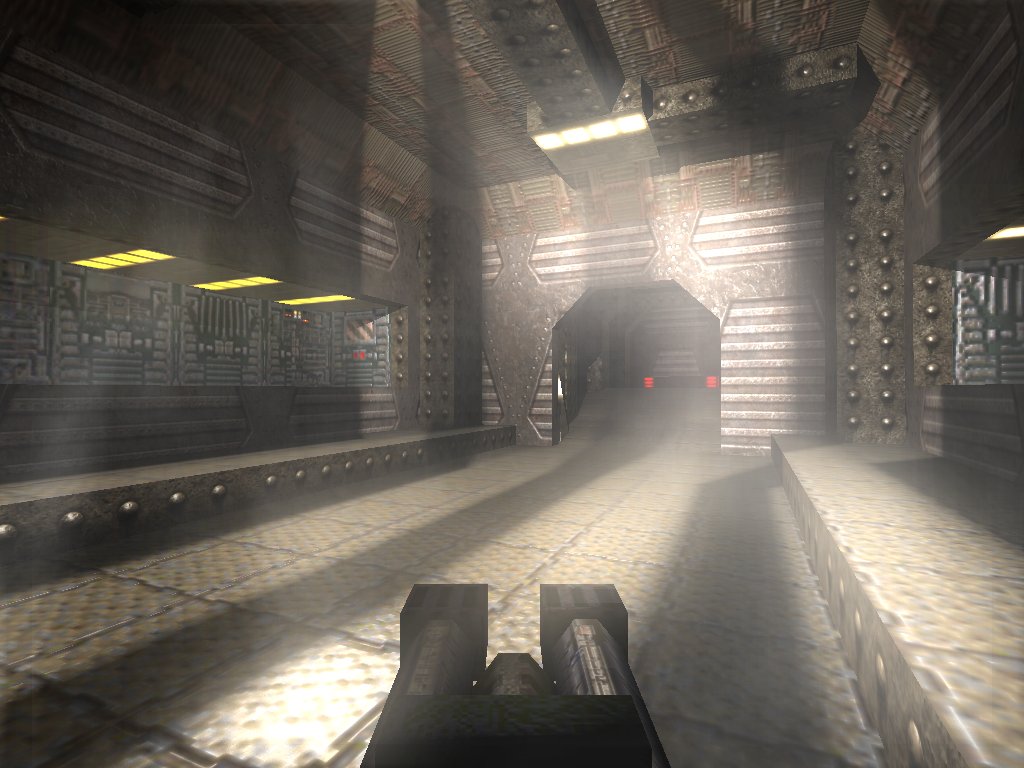
Check the Tenebrae engine: http://tenebrae.sourceforge.net/ it is based on Quake1 but it's bulked up. Its graphics approach the ones of Doom3.
Screenshots:
http://tenebrae.sourceforge.net/shots8/TN_quake000 99.JPG
http://tenebrae.sourceforge.net/shots8/quake93.jpg
http://tenebrae.sourceforge.net/shots8/TN_quake001 01.JPG
http://tenebrae.sourceforge.net/shots8/TN_quake000 20.JPG -
Tenebrae
Check the Tenebrae engine: http://tenebrae.sourceforge.net/ it is based on Quake1 but it's bulked up. Its graphics approach the ones of Doom3.
Screenshots:
http://tenebrae.sourceforge.net/shots8/TN_quake000 99.JPG
http://tenebrae.sourceforge.net/shots8/quake93.jpg
http://tenebrae.sourceforge.net/shots8/TN_quake001 01.JPG
http://tenebrae.sourceforge.net/shots8/TN_quake000 20.JPG -
Tenebrae
Check the Tenebrae engine: http://tenebrae.sourceforge.net/ it is based on Quake1 but it's bulked up. Its graphics approach the ones of Doom3.
Screenshots:
http://tenebrae.sourceforge.net/shots8/TN_quake000 99.JPG
http://tenebrae.sourceforge.net/shots8/quake93.jpg
http://tenebrae.sourceforge.net/shots8/TN_quake001 01.JPG
http://tenebrae.sourceforge.net/shots8/TN_quake000 20.JPG -
Tenebrae
Check the Tenebrae engine: http://tenebrae.sourceforge.net/ it is based on Quake1 but it's bulked up. Its graphics approach the ones of Doom3.
Screenshots:
http://tenebrae.sourceforge.net/shots8/TN_quake000 99.JPG
http://tenebrae.sourceforge.net/shots8/quake93.jpg
http://tenebrae.sourceforge.net/shots8/TN_quake001 01.JPG
http://tenebrae.sourceforge.net/shots8/TN_quake000 20.JPG -
Tenebrae
Check the Tenebrae engine: http://tenebrae.sourceforge.net/ it is based on Quake1 but it's bulked up. Its graphics approach the ones of Doom3.
Screenshots:
http://tenebrae.sourceforge.net/shots8/TN_quake000 99.JPG
http://tenebrae.sourceforge.net/shots8/quake93.jpg
http://tenebrae.sourceforge.net/shots8/TN_quake001 01.JPG
http://tenebrae.sourceforge.net/shots8/TN_quake000 20.JPG -
MSI
An apt-get equivalent for windows would be a very cool thing, I hope you succeed.
You might want to reconsider the decision not to use MSI as a back-end. I am not familiar with the details of the technology, but some of the supported features are command-line and GUI installs, and administrative network installs. And if you don't already know, Microsoft has released some open-source (!) tools for generating MSI packages: http://wix.sourceforge.net/ -
Re:Too much emphasis on instruction flow
Try FlowDesigner</Blatant plug>
-
Just look around
A lot of efforts are being done to simplify the parallel programming, both on micro scale and component scale. Just look through lambda-the-ultimate archives. Micro scale is mostly invisible to application programmers, and it is mostly done by compilers when they use SSE and friends, one of notable efforts of making it more explicit is OpenMP. On component scale, most of them are based on the message passing concurrency model (after you grok it, it is really really simple). The best effort that I have seen from point of view of usability is E programming language. I tried to clone its core ideas in my pet project AsyncObjects Framework, but usability is less than E's one because of the framework clutter.
-
Re:Oh How I Wish It Were That Easy
-
Well, yes, it *is* a dupe, but...
Seems to me to be a dupe of http://it.slashdot.org/article.pl?sid=05/12/10/17
...you have to understand, that when the algorithm was first published, Bruce Schneier roundhouse kicked it so hard it just completed its eighteen month trip around the sun, and arrived back at the frontpage.1 4256
--
Slashcode bug # 497457 - unfixed since December 2001 - Go look it up! -
Re:Qt?
Well on the qtfpsgui download page there is binaries for linux, windows and OS X. Amarok recently was made to work on Windows http://amarok.kde.org/blog/archives/374-Amarok2-b
u ilds-on-Windows.html As for Konversation, Kopete and K3b they will also be available on OS X and windows once KDE 4 is out. -
3D on LUA
This is a great thread. There are so many 3D alternatives out it will be great to see what this thread comes up with. I am only disappointed this topic didn't get rated as a major story on Slashdot.
Not to downplay the benefits of programming in C++, I think it is better to focus game development using scripting language rather than for C++. When I started writing games on the Apple II+ I wrote everything in 6502 assembly but with lores B&W graphics. Today the successful game developer no longer has that luxury.
Game development now requires imagination, creativity, artistic talent and often times story telling ability in addition to programming talent. IMHO it is better to balance your time developing all the different parts of a game than to waste cycles on the ins and outs of C++ (or assembly). I believe this is why the LUA (open source) scripting language has seen so much success in the development of video games. Games such as Grim Fandango and Escape from Monkey Island published by Lucasarts and Neverwinter Nights and MDK2 developed by Bioware were written in LUA. More information about LUA can be found here: http://www.lua.org/ and here: http://www.gamedev.net/reference/programming/featu res/lua.
There are no less than five (and probably more) major 3D engines tied to LUA: Ogre3D (using Emma3D http://emma3d.sourceforge.net/, Irrlicht http://irrlicht.sourceforge.net/ (using https://sourceforge.net/projects/irrlua/, Apocalyx http://apocalyx.sourceforge.net/, Luxina http://www.luxinia.de/, and Electro http://www.evl.uic.edu/rlk/electro/index.html
I am just getting started learning LUA (for a 2D game - another advantage of learning LUA - the ability to grow) so I make no claims to know which 3D engine is the best. There may be other 3D engines integrated to LUA out there and I would love to hear from other people who have experience developing games using LUA and from people developing 3D games using LUA. -
3D on LUA
This is a great thread. There are so many 3D alternatives out it will be great to see what this thread comes up with. I am only disappointed this topic didn't get rated as a major story on Slashdot.
Not to downplay the benefits of programming in C++, I think it is better to focus game development using scripting language rather than for C++. When I started writing games on the Apple II+ I wrote everything in 6502 assembly but with lores B&W graphics. Today the successful game developer no longer has that luxury.
Game development now requires imagination, creativity, artistic talent and often times story telling ability in addition to programming talent. IMHO it is better to balance your time developing all the different parts of a game than to waste cycles on the ins and outs of C++ (or assembly). I believe this is why the LUA (open source) scripting language has seen so much success in the development of video games. Games such as Grim Fandango and Escape from Monkey Island published by Lucasarts and Neverwinter Nights and MDK2 developed by Bioware were written in LUA. More information about LUA can be found here: http://www.lua.org/ and here: http://www.gamedev.net/reference/programming/featu res/lua.
There are no less than five (and probably more) major 3D engines tied to LUA: Ogre3D (using Emma3D http://emma3d.sourceforge.net/, Irrlicht http://irrlicht.sourceforge.net/ (using https://sourceforge.net/projects/irrlua/, Apocalyx http://apocalyx.sourceforge.net/, Luxina http://www.luxinia.de/, and Electro http://www.evl.uic.edu/rlk/electro/index.html
I am just getting started learning LUA (for a 2D game - another advantage of learning LUA - the ability to grow) so I make no claims to know which 3D engine is the best. There may be other 3D engines integrated to LUA out there and I would love to hear from other people who have experience developing games using LUA and from people developing 3D games using LUA. -
3D on LUA
This is a great thread. There are so many 3D alternatives out it will be great to see what this thread comes up with. I am only disappointed this topic didn't get rated as a major story on Slashdot.
Not to downplay the benefits of programming in C++, I think it is better to focus game development using scripting language rather than for C++. When I started writing games on the Apple II+ I wrote everything in 6502 assembly but with lores B&W graphics. Today the successful game developer no longer has that luxury.
Game development now requires imagination, creativity, artistic talent and often times story telling ability in addition to programming talent. IMHO it is better to balance your time developing all the different parts of a game than to waste cycles on the ins and outs of C++ (or assembly). I believe this is why the LUA (open source) scripting language has seen so much success in the development of video games. Games such as Grim Fandango and Escape from Monkey Island published by Lucasarts and Neverwinter Nights and MDK2 developed by Bioware were written in LUA. More information about LUA can be found here: http://www.lua.org/ and here: http://www.gamedev.net/reference/programming/featu res/lua.
There are no less than five (and probably more) major 3D engines tied to LUA: Ogre3D (using Emma3D http://emma3d.sourceforge.net/, Irrlicht http://irrlicht.sourceforge.net/ (using https://sourceforge.net/projects/irrlua/, Apocalyx http://apocalyx.sourceforge.net/, Luxina http://www.luxinia.de/, and Electro http://www.evl.uic.edu/rlk/electro/index.html
I am just getting started learning LUA (for a 2D game - another advantage of learning LUA - the ability to grow) so I make no claims to know which 3D engine is the best. There may be other 3D engines integrated to LUA out there and I would love to hear from other people who have experience developing games using LUA and from people developing 3D games using LUA. -
3D on LUA
This is a great thread. There are so many 3D alternatives out it will be great to see what this thread comes up with. I am only disappointed this topic didn't get rated as a major story on Slashdot.
Not to downplay the benefits of programming in C++, I think it is better to focus game development using scripting language rather than for C++. When I started writing games on the Apple II+ I wrote everything in 6502 assembly but with lores B&W graphics. Today the successful game developer no longer has that luxury.
Game development now requires imagination, creativity, artistic talent and often times story telling ability in addition to programming talent. IMHO it is better to balance your time developing all the different parts of a game than to waste cycles on the ins and outs of C++ (or assembly). I believe this is why the LUA (open source) scripting language has seen so much success in the development of video games. Games such as Grim Fandango and Escape from Monkey Island published by Lucasarts and Neverwinter Nights and MDK2 developed by Bioware were written in LUA. More information about LUA can be found here: http://www.lua.org/ and here: http://www.gamedev.net/reference/programming/featu res/lua.
There are no less than five (and probably more) major 3D engines tied to LUA: Ogre3D (using Emma3D http://emma3d.sourceforge.net/, Irrlicht http://irrlicht.sourceforge.net/ (using https://sourceforge.net/projects/irrlua/, Apocalyx http://apocalyx.sourceforge.net/, Luxina http://www.luxinia.de/, and Electro http://www.evl.uic.edu/rlk/electro/index.html
I am just getting started learning LUA (for a 2D game - another advantage of learning LUA - the ability to grow) so I make no claims to know which 3D engine is the best. There may be other 3D engines integrated to LUA out there and I would love to hear from other people who have experience developing games using LUA and from people developing 3D games using LUA. -
Qt?
So it looks like right now it mostly supports Qt with some gtk stuff coming along. Anyone else find that odd? Today you can compile your Qt apps on Linux, Mac and Windows and get native look and feel. Why would I want to wrap that with a vmmachine? Just yesterday I ran across an app written in Qt for HDR imaging that is written with Qt and is for the mac, linux and windows.
-
Re:Huh?
If you can get my mom to understand that sentence, I will pay you $500.
"Dear user: Insert the CD. Type make all; make install. Press return and go for coffee."
Like this, they aren't hiding that they're kind of copying what Java does.
Except, this doesn't just copy Java - You could more accurately say it copies Bochs (though I don't claim it as an actual ripoff, just conceptually). Rather than giving the programmer a "toy" VM with special hooks for multimedia functionality as Java does, this sounds more like it gives the use a "real" emulated machine to work with, letting the programmer use whatever tools they already feel comfortable with rather than forcing a remarkably "C++ but not"-like language on the developer.
Additionally, while Java will always require the use of an emulated JVM (yeah, Sun's plan to have JVM coprocessors in every machine really panned out, eh?), targetting an idealized x86 Linux machine means this could finally address one of my peeves about calling it a "VM" - It could actually run under virtualization rather than emulation. -
Re:Doom or Quake...
http://xreal.sourceforge.net/xrealwiki/
from their faq:
Q: I'm looking for an engine for our game project. What can XreaL offer?
A: XreaL provides a complete toolchain for game content creation. You will get:
the Quake 3 Arena engine with many renderer tech updates
a customized GtkRadiant level editor for Q3A/Doom3 style hybrid mapping
a customized XMap compiler based off Q3Map1
a customized BSPC aas compiler
new Blender3D scripts like an -
done
-
Re:#2 is not an issue with enterprise applicationsthe MySQL client library is as GPL as the server
Right, to avoid any licensing restrictions for your commercial, closed source application that uses MySql as the database vendor, you don't bundle any of the MySql software but you do say in your installation documentation what they need to do to make MySql work with your software including what client libraries to download and install.
Let me provide an example. I just recently started an open source project. This is obviously not a great example because this project is open source and will always and forever be so. For the sake of illustration, let us pretend that it is a closed source application. The technology is HTML+Javascript on the client and traditional LAMP on the server. There is, however, a small J2SE command line utility included that is useful for publishing content by transferring it from a local instance of MySql to the instance of MySql that will serve the content to the intended audience. I don't bundle or include any MySql code with this project but I do mention in the README file that this utility depends on mysql-connector-java-3.1.14 (not included). Again, I am talking about an open source project but even if this was closed source, I would not be in violation of the GPL because I did not include the MySql driver. I only documented that it needed that driver.
Of course, in the case of a corporation wanting to acquire and deploy an application that uses MySql, they would prefer to purchase the commercial license. This is precisely why MySql provides one.
-
Re:Delphi
Thanks. I don't use IRC much anymore either, sadly, which is why ViRC development has stopped. I have been porting parts to C#, so a rewritten ViRC 3 may be in the future, but there are still issues with ViRC 2 that deserve some attention.
The project is already up on sourceforge for anyone who's interested. -
Re:qmail not there??
Not trying to troll or anything, but... Nope, I still run it on my old hardware off my DSL line for personal email. So granted, I'm not a "mainstream" mailserver-user. But I chose qmail+vpopmail+mysql+Courier-IMAP a few years ago when I set up my server, and when I recently upgraded, I saw no compelling reason to switch. Why learn something new when the old thing works?
There are also plenty of recent patches and addons to keep it alive, like qmail-spp. I'm sure there are people who hate the idea of so many patches and addons, but I like it because it gives me lots of flexibility to attempt to combat spam and such. -
BibTeX managers, and other bibliographyI'm writing academic papers using LaTeX, and finally remanaged my reference management. Most of the references I use these days are available electronically, and I've started dumping them all in the same directory, "bibliography". Then I use BibDesk (I'm on a Mac) to categorize and link to the file.
For me using LaTeX, this is especially handy given that I'll want to cite many of these in actual papers. However, even for things I'm not going to cite, it helps a good bit in organization. You can search by authors, keywords, dates, whatever. I use keywords to tag whatever subjects it refers to (as far as my interests identify subjects), and an extra keyword if I have a specific project/paper in mind for it.
If you don't use Mac, there's similar things on other platforms.
-
KDissert
You might want to check out the kdissert program. It runs in KDE, but if you have the proper libraries and dependencies, you should be able to run it on any WM.
The description follows (taken from Ubuntu 7.04, I'm sure the description is the same for other distros as well)
kdissert is a mindmapping tool for supporting the creation of complex documents: dissertations, theses, presentations, and reports. It supports pictures and features several document generators: LaTeX reports, LaTeX slides (based on Prosper and Beamer), OpenOffice.org documents, HTML, and plain text.
A mindmap is a multicolored and image centered radial diagram that represents semantic or other connections between portions of learned material. For example, it can graphically illustrate the structure of a thesis outline, a project plan, or the government institutions in a state. Mindmaps have many applications in personal, family, educational, and business situations. Possibilities include note-taking, brainstorming, summarizing, revising and general clarifying of thoughts.
Though this application shares some similarities with general-purpose mindmapping tools like FreeMind or Vym, the very first goal of kdissert is to create general-purpose documents, not mindmaps.
The kdissert website is located here. The program was designed to manage and organize disserations, which from what you described, is probably very similar to the work you're doing.
If you're looking for a tool more oriented towards 'mindmapping', there is Vym (website), which seems very interesting, and FreeMind (website), written in Java, though I have no experience with it.
It sounds like from what you described, and the solutions others are offering, you are more interested in a 'general-purpose' document where you can list your sources, and if needed, map links, connections, and references to the various sources you're using. Vym might be more to your taste, since the layout is provides a great deal of information in very (imho) visually appealing format, with the ability to link objects together in complex ways (such as doumenting various reference sources in a paper, where they appear and/or referenced in other works, etc.) Such tools like Vym and KDissert are really only limited by your own mind, though the differences between the programs are sufficient enough that each one should be evaluated individually, since all three accomplish similar goals in very different ways.
~ow3n
-
Re:PDF
http://sourceforge.net/projects/pdfcreator/ is open source and Just Plain Works (tm). No hassle.
-
Re:PDF
For Windows there's either the paid route (Adobe Acrobat Suite), or you can use PDFCreator which uses ghostscript. GS used to produce really nasty looking output years ago on Windows (circa the late 90's), but that's not the case anymore.
For linux, print to ps then use something like ps2pdf (once again GhostScript).
-
programming is cold?
Uh huh. How many remember when the object oriented code revolution was going to eliminate the need for programmers because it would allow business people to just link objects together to easily write any application imaginable? This is why an adviser of mine in college told me to change majors since there won't be any jobs in computer science. That was 20 years ago. Good thing I didn't listen. I figured someone would have to write these objects, and I am pretty good at that.
This time, programming jobs will disappear because of magical elves "offshore" that are able to translate business logic into code despite not having 1) any idea what your business is or does and 2) any contextual experience with which to make reasonable rational decisions when the specification has a logic flaw. Oh, but by 2010, business specifications will have no logic flaws...probably because the people putting them together finally got their objects. The objects don't quite allow you to write your own application, but instead promise to automate spec writing. Right.
I don't know about you guys, but I am not worried. I am glad I have been around long enough that this stuff makes me laugh.
As for the dead and dying languages?
Assembly will never die, because some things just need to be that fast and that custom. A friend of mine writing missile guidance code at Raytheon comes to mind.
C will never die because we will always need device drivers. There are always more devices, ones we haven't even thought of yet. Some programs simply don't need classes. Yes, you could write it using classes, but why? Object oriented code for the sake of being object oriented is dumb. Device drivers don't need classes.
C++ will never die because it is so multi-purpose, it is a good bet when you're not sure exactly what your application requirements will be up front. Many applications evolve greatly from conception to completion. In such a case, having an ultra-flexible language is your friend. (by the way, writing a web application in C++ is far from impossible. It can even be straight forward and rewarding: see http://sourceforge.net/projects/witty/ )
Java will live a long life because there is a whole generation of programmers who think it is better than C++ because it doesn't have pointers and you don't have to worry about memory...until they grow up and discover that they actually want those things. But, with the breadth of the API's, the ever-improving JVM's and now generics and an embedded relational database (Derby)...ok, I admit, Java is ok. It is not what I would have invented, but not so bad. At least there is JNI.
Python, PHP, Ruby, Perl, Tcl, bash, ksh, et al are fun scripting languages that have their place. Some will survive, new ones will arrive. Who cares.
HTML,XML,Javascript - please, for the love of God, can't we all get together and kill this mess? Writing a web application should not be so cumbersome and limiting. We have all these great programming languages and API's allowing for beautiful, readable and self-documenting expression and for what 99% of world views our work through is this garbage? You can blame IE if you want, but Firefox has taken hold and it is ours. Let's change the world...wide web anyway.
C#, um, seriously? This I know: if you know one programming language and it is tied to a single non-standards based OS and a single type of application, you really need to learn a new one. No need to quit your job, just learn something new while you're picking up your paycheck. Visual Studio 2005 now actually has decent STL support. You don't even have to change IDE. The boss won't have any idea.
The rest will have their niche uses. We're smart people. We won't cry when their gone. I didn't cry after writing a kick-ass, cross-platform, thread-safe, database class that wrapped Sybase's ctlib only to see that product's market share disappear. Instead I learned not to tie a class interface to any particular vendor's -
Forget Slingbox
I've been using MPEG4IP since before a Slingbox was trendy, not sure buy maybe before it was released. It's not exactly meant to be used the way I used it, but I can stream audio and video from my TV card and I can change channels when I want as well.
-
Re:Yes
And from the gamer point of view,
nethack, doom, solitare, mines: what more do you need?
http://themanaworld.org/about.php
http://arianne.sourceforge.net/ -
Re:PC version planned?
I don't know about an official Guitar Hero for PC, but you can check out Frets on Fire. http://fretsonfire.sourceforge.net/ It's nicely open source for Windows and Linux.
-
Re:PC version planned?
I don't think there's a PC version planned but you should really check out Frets on Fire. It's a guitar hero clone for the computer. It says it is also compatible with the actually guitar controller although I can't verify this myself.
If you run a search for "frets on fire song pack" you'll also find links to torrents on some songs to download. They even have the Guitar 1 and 2 songs.
I've been playing with it the past couple days and it seems pretty good.
Wiki Link -
Why I like Windows.
1) Windows security ain't so bad... if you have a firewall
So far, my windows xp (sp2) firewall has kept my machine free from viruses. That, and I don't download shady software from entertainment websites. I scan regularly my machine with Ad-Aware, Clamwin and once in a while Hijack this, or a rootkit finder, just to be sure. So far I haven't found any evil zombifying my PC, and I've been using it for years.
2) The problem with Linux is that the learning curve is too steep (or actually too shallow?) for Windows users. It's not that things are hard, just VERY DIFFERENT.
The problem is when Linux zealots or megalomaniac linux programmers refuse to accept the fact that many users DON'T WANT or DON'T HAVE TIME to relearn things.
For example: When selecting text, if you press shift and move the arrows, you select text. And if you press ctrl+shift+arrows, you select whole words. In Linux i try this and end up typing numbers. WTF?
Another example: For dialogs, OK is at the left and Cancel is at the right. But on some window managers (or whatever they're called), OK is at the right and Cancel is at the left, and there's no way to change that. Cutting and pasting in a shell window is so different from using a DOS prompt. And where the heck is Control panel?
In short, I want something that looks and feels IDENTICAL to Windows. Having to learn a different way to do what I was accustomed to do is so much annoying, and I don't have time for that. Hey! Haven't you heard the phrase "the customer is always right?" I'm sick tired of Linux brainiac overlords telling me how I should do things, instead of helping me do things MY WAY. If you want ME to use YOUR operating system, just stop lecturing me, k? And if I ever hear the phrase "RTFM" or "program it yourself" again, then screw you. It's not my obligation to use Linux. If *YOU* complain that *I* don't use it, that's *YOUR* problem. Capicci?
3) But the most important factor to consider is software that is Windows-only. I love winamp. I've grown accustomed to like its interface (the classic 2.0, not the new one), and I like the plugins to play other formats, for example, amiga mod files.
I tried XMMS and other alternatives. Sometimes I couldn't play at all (I know, i used an old distro, but anyway, it didn't "just work".
Another windows-only program I love is Irfanview. And virtualdub, and the list goes on and on. I have a full set of software that I've grown to like and feel comfortable with for doing my daily tasks. If I switch, it's starting all over again, and sometimes there isn't an equivalent software at all (For virtualdub, there's AVIDemux, but the last time i tried to use it, it crashed on me).
How to solve this? Cross-platform programs is IMO the best of both worlds. If I like a program, I can be 100% sure that when I switch, I can use it again and keep working on it. But it's so frustrating to find that some apps are Linux-only, or cross-platform attempts are done so bad that they mess up the whole interface (in my experience the best cross-platform apps are made with wxWidgets. They feel so natural on windows...)
So, why don't they make the apps cross-platform? Until I find myself comfortable enough, I won't be able to use them. And I really don't want to reboot every time i want to do something specific (If I have to reboot, what's the point of having a multitasking OS?). And I don't want to reformat my hard drive to use FAT32 because the Linux distro can't read NTFS drives.
And where the heck can I find a Gambas for Windows? So far I've seen NO open source alternatives to Visual Basic for Windows. No, I _HAVE_ to switch to Linux before GETTING STARTED with them! Nice move, eh?
My conclusion is that when Linux programmers are open-minded enough so that they build cross-pla -
Re:Fishing for Drivers
Hmmm?
Several points.
1. Console mode should work regardless. Driver, Shmiver.
2. VESA mode should work regardless. You should be able to get into Xorg if need be. Also, this is how any of the major graphical installers will work.
3. That's an older card; I'd be shocked if that wasn't automatically discovered by . I suspect that SaX2 (from openSuSE) would do it.
4. The GATOS http://gatos.sourceforge.net/supported_cards.php project seems to indicate that it would support your card, and that has been merged into Xorg.
In sum; I think you should put that puppy in and boot. I don't think you'll have any problems. -
Re:If m$ is too pricey
I tried looking for alternative documentation, but all I could find was endless sample macros - useless if what you need is reference material - and adverts for some guy's book, which is apparently really good, but if I'm going to pay for proprietary material I might as well just use the proprietary software I already own instead of having to wait days for a book to be delivered. So I gave up.
I very quickly found a tremendous amount of available documentation. The OOo macros book I presume you're talking about happens to be under a free documentation license, which means it is anything but proprietary.
http://www.pitonyak.org/oo.php
http://sourceforge.net/projects/ooomacros/ -
Discontinued projects
Yeah. The GATOS project would have worked with this, however it seems to be discontinued for modern kernels. Even if it weren't, the documentation seems pretty horrid, so I couldn't tell either way.
-
Re:May It Rest in Agony!
That's true, but with gcc it's a better practice to keep them in separate files. It's documented here: http://prc-tools.sourceforge.net/doc/prc-tools_3.
h tml#SEC18 -
Re:palm interface on a linux kernel?
Although Palm has done this before, I doubt they will do it again. Around 2001, they offered 3.5 (I think) as a paid upgrade for Palm III users. They also had other upgrades for other models. I don't think it was very successful because a few years later, they stopped offering the upgrades.
FWIW, there is already an open-source project to get Linux on a tungsten: http://palmtelinux.sourceforge.net/ -
Re:But can those features be incorporated?
ODF and UOF will be harmonized http://www.oasis-open.org/archives/office/200609/
m sg00029.html And you can convert ODF and UOF with http://odf-to-uof.sourceforge.net/index.html -
Familiar Name
Speaking to US broadcaster CBS, Intel's chairman
For a second I thought the Intel chairman was moonlighting as an open source developer: http://backuppc.sourceforge.net/