Slashdot Mirror
Domain: sourceforge.net
Stories and comments across the archive that link to sourceforge.net.
Comments · 31,462
-
Re:Anonymous developments?
-
Re:It's Time my Son
Actually yes. I went on an nfs tuning jihad a year ago. The results varied, sometimes I got a huge improvement, sometimes none at all between different boxen/configs. This is for linux only btw, tuning solaris for nfs is a totally different monster.
http://nfs.sourceforge.net/ Gives you some info
Most of the tuning faqs i went through were crap and elementary once you get to gigE an such. My current settings are simple:
mount options:
rsize=8192,wsize=8192 : Best I've seen so far, and works well with jumbograms, have experimented with everything between 1024-32768 in both udp and tcp.
noatime
export options:
async,vers=2 : If you just need speed, big improvement because mount tends to ignore async in negotiation a lot -
Use BackupPC
Just over one year ago I had the hard drive on my primary box die a sudden death (no chance to recover anything). That became sort of the last straw for me (fortunately, I did have the most important data backed up). I began to search for a good backup solution. After doing a bit of research, I settled on using BackupPC ( http://backuppc.sourceforge.net/ ). I have an old 500Mhz pentium Linux box which is dedicated to running the backup server. I only have one 160GB drive in that box which is used for the backup pool. Currently it is at 81% capacity (but the usage grows very slowly. I am backing up about 5 other computers throughout the house (all in the middle of the night, when I am usually not awake). The machines being backed up have probably an average of 100GB of storage each (it is a mix of Linux/FreeBSD/Win2k boxes). Each backed-up machine runs an rsync daemon which BackupPC uses to grab the data off the machine. I have been very pleased with the results. I have one weeks worth of backups (1 or 2 full, and the rest incremental) of each machine. I have a second 160GB hard drive in the backup server which I can use to make a 2nd full backup of the entire backup pool (I just have to shut down the backup server, plug in the 2nd hard drive, boot from Knoppix CD and run 'dd' to copy the original drive to the 2nd drive). Some users of BackupPC use external USB drives to copy the backup pool. I don't have any USB drives, and the second 160GB drive was originally purchased for growing the size of the pool (which has not been necessary in a years time).
BackupPC makes extensive use of hard links for identical files, which is why copying the backup pool is a little more challenging--it is the reason many folks do a full disk copy to make a backup of the backup pool itself. However, I don't feel the need to backup the pool very often (I don't need many backups of backups), and even if I did it's not that difficult of a job.
All in all, I am very happy with the solution I ended up with. It does the job well, and restoring files is pretty easy (using the web interface). BackupPC also emails me automatically if one of the machines it is supposed to back up has not been backed up recently (like, if it was shut off or unplugged from the network for a few days for some reason). Very nice feature. I would highly recommend BackupPC to folks looking for a reasonably cheap and reliable backup solution for their home network. It is highly configurable, and not too difficult to set up (and hey, it's free [dollars-wise] and open source, written in Perl, which makes it easy for me to customize). -
Re:Anonymous developments?
What about Freenet?
-
Okay, maybe not the first.
Another thing wrong with the story is that they didn't post a link to the CD: Anonym.OS LiveCD.
That's the first time I've ever known a Slashdot editor to be sloppy. -
Re:Still can have bugs
"Take the supposed wonderful language of ADA. What databases can it talk to? What type of user interface can you construct? Can it talk HTTP or HTTPS? Can it do SOAP? Can it spawn threads or processes?"
Some of the Ada bindings available include:
GNADE (http://gnade.sourceforge.net/ supports ODBC, MySQL 3.X and 4.X, PostgreSQL and SQLite. There are also Ada bindings for Oracle.
The main cross-platform UI kit is GtkAda (https://libre2.adacore.com/GtkAda/) - it works with the glade GUI builder. There are also some Windows-specific kits, including Claw (http://www.rrsoftware.com/html/prodinf/claw/claw. htm).
Web programming is supported by Ada Web Server (https://libre2.adacore.com/aws/). It handles SOAP.
Threads and support for concurrency are part of the language standard. Processes can be spawned via expect-like packages usually available with the compiler.
See http://www.adapower.com/, http://www.adaworld.com/, http://libre.adacore.com/ and http://www.adaic.com/ for additional resources.
- Ed -
The Poor Man's RAID Array
As CmdrTaco, I'm sure you have money coming out of your ears that you've harvested from the pseudo-religion that is Slashdot.
But for those of you with fewer fiscal resources, I will tell you the stories of my friend and me, a.k.a. The Master Rebaters.
My story is a simple one. I love music. I have over 1,000 CDs and have spent a lot of time meticulously ripping them with my friend CDex. So, I have some 350-400GB of data that I would like to archive. There are a multitude of possibilities but, since I'm short on cash, I opted for a simple $13 RAID 1 controller
My friend, however, opted for a huge and expensive RAID 6 array controller made by Promise. Then he waited and waited until there was a 250 GB Maxtor rebate at CompUSA or Outpost and went in and bought five with cash. Then he filled out the rebates for relatives and played the waiting game. Huge initial investment but he received a lot of money back slowly. Result, a 1.1 ~ 1.2 TB RAID array. He got a lot more storage and more efficient use of the disks since a RAID 6 with striping allows for drives to be rebuilt in the array.
What he wasn't planning on was the logistics of what he would have to do to his Antec case as a result of all these drives. Fans. Airflow. Heat. These all became huge issues for him--especially in the summer. I'm not sure what your situation is with a case but I made no alterations to my case.
Now, there's a lot of things I skipped over that you can take into consideration, like SATA or ATA? 7,200 RPM or 10,000 RPM? 8MB or 16MB buffer? Striping size? etc. Honestly, those issues aren't worth my time to mess with. Sure sure, I'm losing precious ms seek/read time on my disks but I'm not that motivated.
In the end, if you're only looking for half a TB, do what I did. Those 500 GB drives will only get cheaper and if one blows, just pop another in. And if you really need that room to grow, grab the nice RAID controller that supports RAID 0-6 and just use two 500GBs leaving the other three slots open for the future when you might buy them and RAID 6 it.
What fails? The old IBM Deathstars. Beware! -
HAI Omnistat
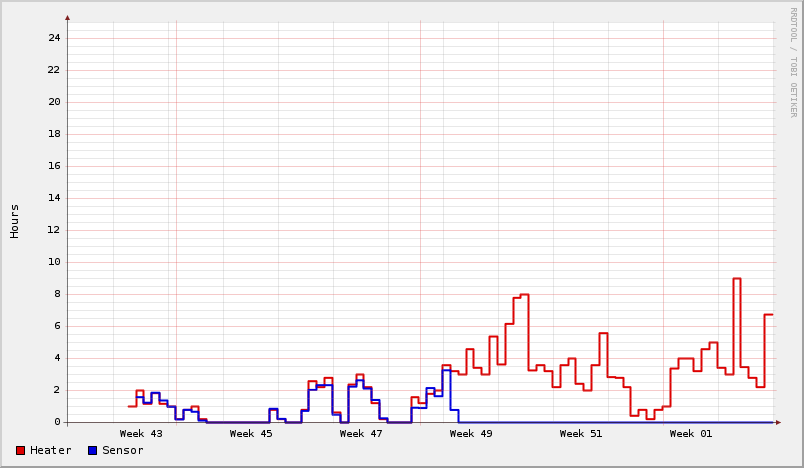
I use a HAI Omnistat RC-80 computer controllable thermostat (available here for about $160, or cheaper on ebay), a serial cable (made from CAT 5 cable), and some software I wrote (available here) for computer control.
The thermostat operates on it's own (no risk of freezing pipes if the software chokes), but you can reprogram it through the serial port, including changing mode (heat/cool/off), temperature set point (seperate for heat and cool), the schedule for automatic setback for weekdays/saturday/sunday (4 times per day), or setting the clock. You can also read all the settings/current temperature from the thermostat. It even keeps track of how long the heater/AC has been on for the past week. I have a cron job that reads this everynight, does a difference based on the last nights reading, and generates graphs using rrdtool. (Example here).
With a little bit of procmail processing, I can send my server at home to get status information, or turn the heat up before I drive home from work. If you want to do dual zone, you can just get a second thermostat, you can put multiple thermostats on the same serial cable (I haven't tested that though). If you need more complex scheduling, a cron job can take care of that, and just reprogram the thermostat daily, or constantly.
-
Re:Yeah, but...
Yes it does, ELILO supports booting from EFI.
-
Re:Top...Since I had never tried it the way you mentioned, I had to try it out...you're right. It's impossible to do it that way, which is pretty stupid.
To be fair, there are zero items in the project feature requests or bug reports about this, so it's not likely that the devs know that it's broken. I have (hopefully) brought it to someone's attention.
I'm glad that wasn't the first thing I ever tried to do with inkscape, or I probably would never have bothered learning to use it. This guy *really* knows how to use it.
-
Glass Houses
People who live in glass houses should not throw stones.
-
camserv
try camserv
http://cserv.sourceforge.net/ -
Re:x86 Mac Users now Feel like amd64 Linux users
Apple does provide Java plugins with their OS. However, the NSAPI (Netscape Plugin API) Java plugin that they bundle only does Java 1.3.1 and it has been fairly problematic for us. Maintaining it does not seem to be a priority for them - instead they are focusing on their newer Java plugin which uses a different Mac OS X-specific plugin API (which we don't support right now).
Luckily for us, Steven Michaud has created JEP, which we use for Java support in our Mac OS X products. See here for more details:
http://javaplugin.sourceforge.net/
-Josh Aas -
Camsource
Camsource: http://camsource.sourceforge.net/ has met my needs in the past. It's rather flexible and should work with any Video4Linux cam. (I had a USB webcam) It supports making the cam images available in a variety of formats and can do archiving, motion detection, ftp uploading, multipart streaming and probably more.
-
Re:In a word...
I'm confused. Is Einstein a hardware emulator for the ARM CPU and Newton hardware (vaguely similar to, say, arcem), which requires a copy of the Newton ROM image to run?
Or is it something like Wine, a reimplementation of the Newton OS letting you run existing apps, but only on ARM hardware?
Unless there is work happening on a free reimplementation of the Newton OS, I'd say the platform is pretty much dead. -
DIY Zoning
In the spirit of what people idealize
A collection of bits and pieces of knowledge to explain how to put together mostly off-the-shelf inexpensive equipment and make a temperature zoning system out of it, and a software product that allows you to control the hardware.
-
Re:Better Replacement Product
Maybe you meant ntfsclone (http://linux-ntfs.sourceforge.net/man/ntfsclone.
h tml/), that's probably the best OSS Ghost replacement around. It's reportedly better than Ghost at backing up NTFS partitions. -
Re:IDEA all the way!Eclipse is not bad - IDEA is expensive, and Eclipse is a decent free alternative. But if you have the money, there's no reason not to use IDEA. Eclipse has always seemed to me like a poorly-executed IDEA clone. Similar to most open-source desktop software, really.
I'd agree. I have used both extensively, and IDEA has always had a much better UI. For something that I spend many hours a day using, that's very important to me. It's sort of like the difference between the iPod and Brand X MP3 player. It's not that there's anything very wrong with most of the MP3 players, but there's something so right about the iPod.
Note that they also regularly offer half-price personal licenses for people just doing their own thing.
Eclipse has always seemed to me like a poorly-executed IDEA clone. Similar to most open-source desktop software, really.
Yep! Another fellow opines that Eclipse is Bizarro IDEA.
IDEA has a 30-day free trial - why don't you download it and give it a spin?
I second that. Make sure you really use it for something serious, too, and take the time to learn some of the handy keystrokes and the more common refactorings. Ones I use at least hourly:- Ctrl-Q: show definition (and docs, if any) of symbol under the cursor
- Ctrl-B: jump to definition of symbol under the cursor
- Ctrl-Alt-Left Arrow: back to previous location (like back in your browser, it has a stack of visited edit locations)
- Ctrl-N: find class by name
- Ctrl-Shift-N: find non-Java file by name
- Ctrl-Alt-Shift-N: find any method by name
- Ctrl-Alt-V: extract highlighted expression as variable
- Ctrl-Alt-N: Inline highlighted variable or method
- Ctrl-Alt-M: extract highlighted block as method
- Ctrl-F6: global symbol rename (does it via the parse tree, so variables or methods with the same name in different contexts won't be touched; if you rename a class or package, it takes care of all filenames and related import statements)
- Ctrl-Shift-F6: change method signature (again, global based on the parse tree)
If you're just a casual Java developer or find the price a big deal, then Eclipse is perfectly adequate. For me, though, it's very much worth the money. -
Try these...
This is by no means an ad. Just a helpful bit of information. Bluej and Dr. Java have worked well for me in the past. Bluej has more (in my estimation unneeded) frills then Dr. Java, bu that's a personal preference. Dr. Java has a very shallow learning curve, and setup is simple: run the installer, and point it to your tools.jar class path. Both are free; Bluej was "developed and maintained by a joint research group at Deakin University, Melbourne, Australia, and the University of Kent in Canterbury, UK." while Dr. Java was developed at Rice University in Houston, TX. Just my two cents.
-
Re:Students often get steep discounts
I know of several:
Office Suite
Operating system
Software -
Re:Ah, the ABM treaty...You are missing the point. Cygwin is a POSIX compatibility library and a bundled set of (primarily-GNU) utilities. It also includes things like an X server. These same utilities can also run on top of a Linux kernel, a BSD kernel, a Solaris kernel, etc. The one part of the common Free Software stack that they don't include is Linux.
The Linux kernel is a tiny part of a Free Software system. Many of us manage to run 100% Free Software systems without Linux. Of the five machines I use regularly, three run 100% Free Software, one is an OS X box with a lot of Free Software and some proprietary things (including the windowing system), and one is a Linux palmtop with a predominantly (but not exclusively) Free Software software stack. Every single one of these machines is capable of running the majority of the user-visiable software bundled with Cygwin, and only one runs Linux (and that's really a toy, rather than a machine I actually use to get work done).
For well over 90% of Linux users, the fact that they are running Linux is irrelevant - they never write any code that goes close enough to the kernel to need Linux-specific features - and so emphasising the 'Linux' nature of the system is misleading. When you do this referring to a system that doesn't even contain a Linux kernel then it's just plain insulting to all of the people who have spent time and effort developing the software that you are describing. The Linux kernel can run as a windows app, so should Linux be described as a 'Linux Program?' Would you say that running Linux is a 'good way of getting people used to Windows?' The same applies to your statement.
-
Recommended NTP clientsSince nobody has mentioned anything about clients yet, here are my suggestions:
-
Re:TFA misses a lot.
Freevo works great with lirc. (Others have mentioned Myth.)
-
Better Replacement Product
I tell you what, remove your Symantec Ghost and use a better and free (as in beer and speech) product called QtParted.
-
My own HTSRV project status
I have had a MythTV box running for a few months (after earlier unsuccessful attempts with freevo and older MythTV versions.
I boght a Hauppauge PVR350 card (analog TV) and used the "MythTV on Fedora" howto (google) and I was very satified with the results. So satisfied that I bought another Hauppauge PVR500 card so that I ended up with 3 tuners.
My setup is non-standard for two reasons:
1. My HTserver (HTSRV) is located in my server room. This considerably improves the WAF and keeps the living room nice and clean and quiet. I transport the A/V signals over CAT5 (using two baluns) to the point where the cable-TV enters the house. There a modulator mixes the signal with the regular cable channels so I can watch my MythTV HTserver's TV-Out anywhere in the house.
2. Now I needed a way of controlling my MythTV server from behind any of my TV sets. To solve that I used my SqueezeBoxes ( http://www.slimdevices.com/ ). I wrote a Slimserver plugin (Perl) that taps into LIRC and allows me to control the MythTV server with the remotes from the Squeezeboxes.
I'm thinking of replacing my living room audio system with a pair of powered speakers so that I'll end up with 'just' a TV, a small Squeezebox and two speakers. No 5.1 speaker setups for me, I just can't stand all that clutter.
There's another interesting project that I plan to look into. It uses Hauppauge's small and inexpensive $69 MediaMVP boxes (miniature diskless computers that run linux with Remotes and TV-Out) to build MythTV and SlimServer frontends:
http://mvpmc.sourceforge.net/idx.php?pg=main
This is nice because it allows you to watch different programs & recordings on different TV-sets, which my current setup doesn't allow you to do. Worth looking into if you're interested in a distributed media network rather than just a boring HTPC or HTSRV
X. -
Re:Ah, the ABM treaty...
About the only thing worth doing under 'Doze anymore is running certain peripherals, like the printer and scanner, that are fairly low-usage, with crappy FOSS driver support.
Printers and scanners work fine as long as you buy them from companies that actually support open source, like HP. My last printer and scanner were from Canon, and they worked fine as well. -
mplayer OS X
-
Canned Spam
One word... Spambayes (http://spambayes.sourceforge.net/) In 5 months at 250+ messages per day, it hasn't made a single error. And this was done with training only 20 messages as good or bad. My brother has been using it for over 8 months on two domains to the tune of 1500+ per day... and not one error.
But in response to the article, yes spam is a problem. And no, you're not the only that has noticed.
Run a trace to find the originating IP, attempt to confirm identity, try to isolate an address, then send the contents of the spam folder to them (auto mail can be useful.) Nobody likes getting 8000 spam in one day. -
Mplayer too.
Mplayer OS X is another good one.
-
Try PHPki
1. I installed PHPki and used it as a CA,
2. Generated oodles of certificates for our entire staff (SMIME certs, so they work with Outlook 2K and 2K3)
3. Published each of their certificates to the Global Address List
4. Had everyone set the option in Outlook to include their public cert as an attachment to signed/encrypted emails
5. Had everyone install the CA's root cert on their machine
Now they can send eachother signed and encrypted emails, all WITHOUT any kind of Microsoft CA or server. It's important in our environment that the private certs NOT be stored where the email/Exchange admins have access to them, so while it takes a little manual labor, it's FREE and works very very well. -
3rd Party Filling the void?
I am the first to admit that I had no idea I could even get WMP for my PowerBook.
However, I'm not sure there is a void that needs filling.
MplayerOSX has always worked great for playing anything on my Mac that Quicktime couldn't handle. -
Re:Probably not and here's why ...
elilo http://sourceforge.net/projects/elilo is a linux bootloader for efi. Until Darwine comes along for intel it should be possible to load linux on an intel mac and run windows programs through wine for anyone who wants windows functionality. I don't really see the need myself at the moment
-
Fix spam problems by moving to GMail? O RLY?
--My spam in the past 2 months is less than I had 10 years ago. I post my main address unobfuscated on
Sounds fantastic.
Except.
GMail has no defenses against spammers who send out their spam-blasts with your GMail address in their forged "From:" field.
I've (twice) opened up tickets with GMail on this issue and gotten no human response. I've posted in the GMail help forum on two different occasions, no response. (I also saw at least two posts per week of people who were having the same issue asking for help/advice -- so it's clearly something they're aware of if they skim those forums.)
Since there are less than 20 file formats for bounce messages in common use (Sendmail's, qmail's, Exim's, etc), it would be trivial for them to flag bounce messages separately -- (they're already flagging phishing messages separately from other spam.) Until they do something, I still get an average of 10 spam a day to my Gmail account. (This started a few months after having the account, when I posted my unobfuscated GMail address on my homepage.)
Slashcode bug # 497457 - unfixed since December 2001 - Go look it up! -
My approach...
I had a MythTV box for about two years and it did it's job wonderfully. The only problem I had is that I really don't watch that much TV, and MythTV rewuired me to pretty much dedciate an entire system to that task. I finally found a better solution for my needs, and that's just vcr and TVTime. I use TV Time to watch live TV, and VCR + mplayer to watch prerecorded shows. There's a web frontend for VCR, but I don't use it, it's just easier for me to set up cronjobs. So if you're not looking for an HTPC but rather just adding HT capabilities to your main system, I'd suggest a set up like this. There when you need it, out of the way when you don't. No extra processes or services that need to be running.
-
Re:OK, so I better switch to digital now ...
Thanks. The gPhoto link therein was actually where my greatest interest was. I guess time lapse might have been a bad example. How about having a camera commanded to shoot an image when triggered by another event, such as tripping an LED beam path by a wild animal or trespasser, or when requested by someone accessing a web site. The idea is I want to have the computer do it when I'm not there (or located remotely).
-
Re:It's a lot simpler than that.
I don't think it'll be that hard. All we have to do is get GRUB working on the thing and I bet Windows running the ACPI Uniprocessor HAL will pick up the devices. GRUB has an EFI port, IIRC.
The Linux kernel 2.6 series supports EFI and the help message says that ELILO already supports EFI. Of course, guessing from the name, you would have to switch back to a LILO like loader. -
Re:really?
I suppose the amount of spam that I get on my home email account seems to have gone down a bit, but there is still plenty coming in on Gmail - most of it gets caught in the filter, but the occasional one gets through, but even that gets filtered because I usually have my home email client check Gmail through POP3.
For my home system, I use POPFile (http://popfile.sourceforge.net/), which has a nearly perfect (99.34%) accuracy rating after using it for almost three years now.
N. -
It depends
There's lots of factors.
At work, I get very little spam. My company's filter, coupled with SpamBayes with a year of training does extremely well. The bigger problem is that I occasional miss e-mails that vanish in the ether.
With my GMail account, about 30% of my e-mail is spam that gets through. I'm hopeful that number will go down with training or Google tweaking their service.
It does seem that the days of getting wildly pornographic images in my work e-mail are long gone. Sniff. -
elilo?
I'm pretty sure this hasn't been tested yet, but could one use elilo to boot Windows on a MacIntel machine?
http://sourceforge.net/projects/elilo
- Necron69 -
Re:Don't... make... me... choose...
Check out OSXNews which is getting there as a newsreader, and is in a similar style to the Apple applications.
-
Re:Deleting files
How is this post insightful? Both Gnome and KDE supports the concept of a trash-can, which is pretty similar to what Windows has to offer.
What is the meaning of keeping files on the disk that you have deleted anyhow? That is what backups are for. I personally recommend: BackupPC (incremental, on-the-fly, total, compressed, remote, minimal-storage and Free backup solution for Linux) -
One thing Thunderbird really needs...
is good Bayesian filtering of spam.
I really miss the SpamBayes plugin that I used in Outlook. And the standalone server option doesn't work nearly as well for me.
Most people don't need this, but I want this, also: the ability to hit a button and send all selected messages, as individual inline messages and not one attachment, to an address or two I have previously specified. Why? Because I want to send all the spam I select to uce@ftc.gov and to Spamcop. -
Re:who cares?
-
Re:"Patch?"
My Final Fantasy "III" cart has the Relm sketch bug (to my consternation). If you peruse some of the ROM DAT files, you'll note that many images are marked (v1.0) or (v1.1).
-
Re:Big Brother and the iTunes Company
That's interesting
What I forgot to mention in my original post is that I do not use iTunes. I rip my cds using CDex and then listen to them using Quintessential Player. Never had a need for iTunes and, frankly, I've never really been interested in Apple. -
Re:Food chainReading NTFS has existed for some time (first released in 1997 - and is quite stable). Writing to NTFS, however, is a whole other ball park.
From http://linux-ntfs.sourceforge.net/info/ntfs.html:
The new driver, introduced in 2.5.11, has some write code, but it's very limited. The driver can overwrite existing files, but it cannot change the length, add new or delete existing files.
Adding write support will take a long time. NTFS is built like a database. Any changes you make, necessitate making changes in many places, for consistency. Make a mistake and the filesystem will be damaged, make too many mistakes and the filesystem will be destroyed.MS could "open up" NTFS and sell the driver, but Linux would not be able to use it. No software under the GPL may contain licensed technology that requires royalty fees.
-
GAIM
will solve all of your problems http://gaim.sourceforge.net/
-
The harder they grip....
...the more shall slip through their fingers.
http://rfsd.sourceforge.net/
Or similar projects for ext2.
If the giant flash companies (or whoever is in danger of paying a FAT royalty) instead put that moderate amount of money towards a few full time developers for alternative file system drivers for Windows, we won't need FAT.
And that's a good thing, because FAT is ancient.
The bigger question is what about VFAT support on Linux. It's not THAT big of a question anymore, since just about everyone I know runs their Windows XP partitions (and Vista, I presume) on NTFS, and has to work around proper file system support anyways.
The best answer to Linux support is most likely going to be things like captive NTFS. That way, you can use a MS implementation, and thus not violate any pattents. -
Re:Food chainThere are infact several choices of upto date maintained Ext2/3 drivers for Windows.
- ext2fsd which has support for Win64 (x64)
- ext2ifs by John Newbigin (the one linked by parent). It says on the website "This version probably does not work under XP SP2".
- ext2ifs by Stephan Schreiber. It's freeware but doesn't appear to be Open Source (so presumeably contains no GPL'd code). There are Windows XP screenshots on the site and it's x86 only.
-
Re:alternatives and extent
People are asking what the alternatives are. Well, ext filesystems are great, if you're using Linux, but they are totally unreasonable if you, like 98% of the market, is using Windows. Get rid of that idea.
Ever tried ext2fsd ?