Slashdot Mirror
Domain: sourceforge.net
Stories and comments across the archive that link to sourceforge.net.
Comments · 31,462
-
Re:Yeah, We figured that one out...
Use Azureus with the AutoSpeed plugin. This dynamically changes your global upload speed depending so you are always in that "sweet spot".
-
Not a brilliant article...
as it doesn't mention the plethora of brilliant '3rd party' clients like Azureusand BitTornado which have been offering a variety of these features for a very long time.
-
Re:DIY - Incredible Machine
So my 3Ghz P4 system runs an entire puzzle faster than I can blink... so I can't see what went wrong
Think outside the box, but run the software in Bochs. Should slow things down a bit, in theory. -
Re:Porting wine?
I can do this already. We did a little experiment last year. Using the open source decompiler Boomerang you can turn a windows exe into C code. You can then simply recompile that source code on any platform using winelib including non-x86 platforms like PPC. Of course, you then have to test the app and ensure that it still works, which takes a fair bit of effort as winelib isn't exactly that portable and Boomerang isn't that mature just yet. But it is possible, and it's truely the highest performance way to "run win32 apps on PPC".
-
Re:Gcc killed fortran
Anyone who mistook g95 for F95 would indeed be right in concluding fortran was a dated useless language.
Dude, g95 isn't yet completed. Why the hell would one expect it to be fully-functional? Got an axe to grind about the g95/gfortran fork?
My favorite parts of fortrans are that one cannot overflow a buffer
Rubbish, you can do just the same stupid things that you can with C. The difference is that Fortran can implement arrays without the need for pointers, and most Fortran compilers support decent (but very slow) bounds checking on these arrays.
RIP fortran95, killed by g95.
Again, this statement is misleading and meaningless. There are plenty of other mature Fortran 95 compilers on the market, and -- upon their completion -- g95 and gfortran will add to to the selection. How has g95 'killed' Fortran 95?
-
AutoConf isn't part of GCC
AutoConf isn't part of GCC. The only alternative to autoconf that I know of is PMK.
-
Re:Hmmm ...Any chance your implementation is not memoizing?
Well, he said he was memoizing in the article. You can check his code here.
-
Re:Compiler
heh. Depends what you mean by "binary". Obviously everything on a modern computer is "binary" in some sense. It's due to this confusion that it's better to say "native instructions" when you want to distinquish the output of something like GCC to a compiler like javac (which you would say produces "bytecode instructions") or a pascal compiler (which produces "pcode instructions"). So no, not all compilers produce native instructions. Some compilers don't even produce instructions, for example, a database schema might be "compiled" into a listing of tables and foriegn key constraints. Quake mapping tools often have a compiler which converts brush information into bsp trees. A compiler is simply any tool which converts data from a "high" level of abstraction to a "low" level of abstraction. A decompiler does the opposite of a compiler. With that definition the more interesting question is: what is abstraction? Martin Ward has the answer.
-
Re:Unbelievable
Well, I did a bit of VB 5 & 6 coding in my day, and then I did one program in VB.Net. I have to say that it was a real step backwards.
In VB6, you ended up doing 1/2 of your development work in the interactive debugger in the middle of a running session. If you needed to change the code of a method on an object, all you had to do was pop the execution stack one level, edit all the code of that method that you wanted, and then step back into it. It was a great was to beat the compile/link/debug cycle.
That aside, if I were one of the revolting programmers, I'd seriously consider just migrating it to Gambas: http://gambas.sourceforge.net/ rather than staying with MS and their dictatorship.
Sure the porting to Gambas would take sometime, but you got to figure that it'd be the last time that you'd have to do it. After that you could freeze on a particular version and support it yourself if you needed to, or continue to evolve along with it (Gambas). At least you'd have a choice.
Now that I'm developing on Linux with C++ and Gtkmm, there is one thing that I do miss: the capability of MS debuggers. I'm using ddd right now, and everything that I turn around, it seg faults, or looses the debuggee program thread or something, and a lot of times, it just plain old does not find the debug symbols so that I can effectively inspect the state of a variables (and yes, this is with g++ creating the most verbose debug symbols possible). I've eneded up using trace debug macros to do most of the debugging, of course this means that it's back to the compile/link/debug cycle again. -
Not that many people have much to hide...
but personally, I don't want to worry about some third party reading through posts or messages not intended for them. To remedy this problem, I recommend grabbing GAIM with one of the many GAIM encryption plugins. As a bonus, paranoid folks won't have to worry about the (insert governmental agency of choice) snooping on them.
More information regarding this topic is available on the technology blog "It's Geek to Me" located at http://itsgeektome.blogspot.com/
For Windows users, you can grab GAIM here:
http://prdownloads.sourceforge.net/gaim/gaim-1.1.4
You can get a nice GAIM Encryption Plugin here:
http://gaim-encryption.sourceforge.net/ -
Not that many people have much to hide...
but personally, I don't want to worry about some third party reading through posts or messages not intended for them. To remedy this problem, I recommend grabbing GAIM with one of the many GAIM encryption plugins. As a bonus, paranoid folks won't have to worry about the (insert governmental agency of choice) snooping on them.
More information regarding this topic is available on the technology blog "It's Geek to Me" located at http://itsgeektome.blogspot.com/
For Windows users, you can grab GAIM here:
http://prdownloads.sourceforge.net/gaim/gaim-1.1.4
You can get a nice GAIM Encryption Plugin here:
http://gaim-encryption.sourceforge.net/ -
What is unique about Sun's CMTis they're not pipelined very much, so it's like hyperthreading only more so. That means more chip real estate to put lots more cpu cores on.
What that means from a programming POV is that you really need to exploit multithreading. And scalability becomes much more important. Things that scale well with 1 or 2 processors, aren't going to scale with 16 or 32 processors. Lock-free synchronization will become more important since it scales better (11 on a scale of 1 to 10).
That said, I think it will be some while before lock-free becomes important which is why I put my project on the back burner. I think what will happen instead is Sun will position Niagra and Rock as a commodity solution, cheaper than a bunch of cheap pc's running disparate tasks. But, Sun in the commondity market?
-
Re:bah
And to add to this, there is an encryption plugin for GAIM that uses RSA encryption, end to end. You only have to have it installed once, and then it will work transparently in the background. Nothing special to do on your part, other than clicking a little lock button on your IM window. (the other person has to have it installed too, natch)
Works with all protocols (I've personally tested AIM, Y!, MSN, and ICQ) with no perceptable message delay. The website is:
http://gaim-encryption.sourceforge.net/
If PGP/GPG is your thing, then you can try GAIM-e... which appears to be down. but its URL is:
http://gaim-encryption.sourceforge.net/ -
Re:bah
And to add to this, there is an encryption plugin for GAIM that uses RSA encryption, end to end. You only have to have it installed once, and then it will work transparently in the background. Nothing special to do on your part, other than clicking a little lock button on your IM window. (the other person has to have it installed too, natch)
Works with all protocols (I've personally tested AIM, Y!, MSN, and ICQ) with no perceptable message delay. The website is:
http://gaim-encryption.sourceforge.net/
If PGP/GPG is your thing, then you can try GAIM-e... which appears to be down. but its URL is:
http://gaim-encryption.sourceforge.net/ -
Yes, for OS X
Fink. The gaim version in Fink works fine.
-
Gaim-Encryption
Gaim Encryption plugin Use gaim, use plugin. Give friends, etc. an ultimatum. I strongly encourage the use of this in more sensitive environments, especially if you're slinging account numbers around.
This message brought to you by the letter Q and the number 8. -
Know what your users do with pathalizer
One of the best free tools to know about your users is Pathalizer. From your logs, it draws a graph with the most followed sequence of pages. You can see the "most interesting" subjects in your site and segment your audience based in it. Another nice benefit is to discover if your users are stucked somewhere in the middle of an interaction path.
You'll get even more interesting info if you tweak the configuration with regular expressions to aggregate similar pages. Represent in the graph all your different site news pages as with just an node called news (e.g, if your news urls are like
BTW, I'm not affiliated with the developers. It's just a good open source tool that I like.
-
Answer
Just use GAIM (available on Windows, Linux et al). That way you won't have to accept AIM EULA which reserves the right to change the conditions without notice so it doesn't really matter that they cannot spy on you today if you can never be sure what they add to the TOS tommorow. Don't use their software, don't accept their EULA. As a side effect have no intrusive advertisements and gain real network- and OS-independence. Problem solved.
-
Re:answers.com misses an edit link
Actually, Brion Vibber has written an OAI-PMH interface for MediaWiki to allow answers.com and other mirrors to fetch updates very fast, so out-of-sync situations should be less common once that's put into use. Generally, I don't even see that as a problem. The real problem is that answers.com lists Wikipedia among a dozen or so other resources, none of which is editable. Only someone who already knows Wikipedia will know that the articles can be fixed. If answers.com ends up getting a very high profile due to its Google cooperation, this could mean that less people edit Wikipedia because they simply do not realize the nature of the project. That is much more important to communicate than to avoid the occasional pleasant surprise that a mistake has already been fixed -- to answers.com as well, since they benefit from higher quality content.
-
Host your photos yourself
It's so much nicer hosting your photography yourself. No worries about how much of your work you can put online, other than how much hard drive space you can cram in. I've had great luck hosting with Gallery.
My Photography, for example. -
absolutely shameless self promotion
try my hacker friendly zen-ish python based gpl web gallery system pix.
-
DivX on OSX
I still have major problems playing DivXs on OS X.
I used to, until I got mPlayer.
It plays pretty much everything (mpeg, avi, wmv). There's still some things that play wrong once in a while, but it's a rare thing. -
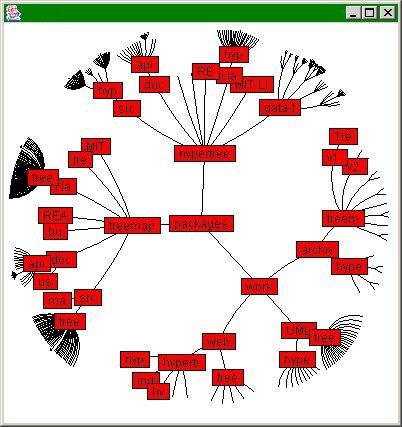
How about hyberbolic trees?
I'd say they only make sense for an application where you want to browse the network "live" but they are pretty damn cool.
http://hypertree.sourceforge.net/
Screenshot
http://hypertree.sourceforge.net/hypertree1.jpg
Sadly the project puts light on some sad consequences of the current EU software patents debate. -
How about hyberbolic trees?
I'd say they only make sense for an application where you want to browse the network "live" but they are pretty damn cool.
http://hypertree.sourceforge.net/
Screenshot
http://hypertree.sourceforge.net/hypertree1.jpg
Sadly the project puts light on some sad consequences of the current EU software patents debate. -
Re:I do all my Graphs on paper napkins with Java
-
Re:Any free alternatives ?Ignore Donny Smith's reply... it's the standard geek, condescending reply. I don't understand why people like him feel the need to use up bandwidth and time to post useless comments when they have nothing constructive to add to a conversation.
I don't know about Windows machines but for maintaining *nix ones you can use projects like radmind or Cfengine. Someone else in this discussion mentioned sblim but it doesn't look that project is ready to be used in production environments. Hopefully someone else will point to some other decent software.
-
Guido van Robot
Guido van Robot is a kid-friendly procedural programming environment written in Python. It is partly written by students for students, and features a grid-like world with a 'robot' icon (a triangle that has the letter 'G' in it) that can move around, walls, and 'beepers' that can be picked up or dropped.
Interestingly enough, this setup is actually Turing-complete. -
Re:Beakman's World
I agree with the parent poster about doing something non-computer related. If you wanted to be more interactive, you might do the standard "make a peanut butter and jelly sandwich"
Have little boxes drawn on a piece of poster board labeled box 1, 2, etc), and put the jelly, bread, etc in each of the different boxes.
Have 2-3 kids writing down instructions, and another take the instructions one at a time and read / execute them.
If you must involve computers, you might show Guido Van Robot, a python version of classic "karel the robot" that I learned in the beginning of pascal.
Good luck!
--Robert -
Re: Linux Management Software
In other news, one of IBM's new sourceforge projects is SBLIM (Standards Based Linux Instrumentation for Manageability)
"The goal of this project is to provide a complete Open Source implementation of a WBEM-based management solution for Linux. " -
Re: Linux Management Software
In other news, one of IBM's new sourceforge projects is SBLIM (Standards Based Linux Instrumentation for Manageability)
"The goal of this project is to provide a complete Open Source implementation of a WBEM-based management solution for Linux. " -
Demo Artificial Intelligence
Artificial intelligence in action might make one of several excellent demos that you could show.
AI in JavaScript for MSIE-5 would even let the kids print out transcripts of their interaction with the AI Mind.
-
Demo Artificial Intelligence
Artificial intelligence in action might make one of several excellent demos that you could show.
AI in JavaScript for MSIE-5 would even let the kids print out transcripts of their interaction with the AI Mind.
-
Mind.Forth Open Source AI for Autonomous Robots
Standard Mind.Forth AGI is a free, Open-Source Artificial General Intelligence for use in the sort of autonomous mobile robots that will one day win the DARPA Grand Challenge and other such contests.
Experimental Mind.Forth is a version of the free artificial robot Mind that may be run in test mode for experimental and developmental purposes. Both versions of the robot AGI Mind display the date they came to life and started thinking -- in a separatoe "grand challenge" for schools, laboratories and computer stores to see who, and how long, can hold the title of hosting the longest-running good-old-fashioned artificial intelligence (GOFAI).
One caveat about the DARPA and other Grand Challenges is, given that the human ability to administer the home planet is precarious at best and foolhardy at times, students of mind-design are advised to anticipate such emergencies as the total collapse of human society. If a global pandemic of AIDS or avian influenza virus were to remove normal human leadership from all major countries, stewardship of the world may pass by default to intelligent computer systems. Whether as a student exercise or whether as a real-world DARPA Grand Challenge necessity, programmers with previous experience in real-time process control and who are adding AGI techniques to their set of skills, should consider embedding the following possibilities in whatever AGI they code for autonomous mobile robots.
-
Audition
- control of all telephone land-lines.
- control of all cellular telephone networks.
- control of transoceanic cables, NRO satellites, etc.
-
Vision
- control of earthbound and orbiting telescopes.
- control of all television broadcasting and cable feeds.
- immediate access to all 'Net-connected webcams.
-
Motorium
- effective control of remote-control robots, drones and ships at sea.
- control of ATM devices, point-of-sale terminals, elevators, etc.
- control of hydroelectric and nuclear power generators.
- nuclear weapon stockpiles of participating nations.
-
Audition
-
Mind.Forth Open Source AI for Autonomous Robots
Standard Mind.Forth AGI is a free, Open-Source Artificial General Intelligence for use in the sort of autonomous mobile robots that will one day win the DARPA Grand Challenge and other such contests.
Experimental Mind.Forth is a version of the free artificial robot Mind that may be run in test mode for experimental and developmental purposes. Both versions of the robot AGI Mind display the date they came to life and started thinking -- in a separatoe "grand challenge" for schools, laboratories and computer stores to see who, and how long, can hold the title of hosting the longest-running good-old-fashioned artificial intelligence (GOFAI).
One caveat about the DARPA and other Grand Challenges is, given that the human ability to administer the home planet is precarious at best and foolhardy at times, students of mind-design are advised to anticipate such emergencies as the total collapse of human society. If a global pandemic of AIDS or avian influenza virus were to remove normal human leadership from all major countries, stewardship of the world may pass by default to intelligent computer systems. Whether as a student exercise or whether as a real-world DARPA Grand Challenge necessity, programmers with previous experience in real-time process control and who are adding AGI techniques to their set of skills, should consider embedding the following possibilities in whatever AGI they code for autonomous mobile robots.
-
Audition
- control of all telephone land-lines.
- control of all cellular telephone networks.
- control of transoceanic cables, NRO satellites, etc.
-
Vision
- control of earthbound and orbiting telescopes.
- control of all television broadcasting and cable feeds.
- immediate access to all 'Net-connected webcams.
-
Motorium
- effective control of remote-control robots, drones and ships at sea.
- control of ATM devices, point-of-sale terminals, elevators, etc.
- control of hydroelectric and nuclear power generators.
- nuclear weapon stockpiles of participating nations.
-
Audition
-
Mind.Forth Open Source AI for Autonomous Robots
Standard Mind.Forth AGI is a free, Open-Source Artificial General Intelligence for use in the sort of autonomous mobile robots that will one day win the DARPA Grand Challenge and other such contests.
Experimental Mind.Forth is a version of the free artificial robot Mind that may be run in test mode for experimental and developmental purposes. Both versions of the robot AGI Mind display the date they came to life and started thinking -- in a separatoe "grand challenge" for schools, laboratories and computer stores to see who, and how long, can hold the title of hosting the longest-running good-old-fashioned artificial intelligence (GOFAI).
One caveat about the DARPA and other Grand Challenges is, given that the human ability to administer the home planet is precarious at best and foolhardy at times, students of mind-design are advised to anticipate such emergencies as the total collapse of human society. If a global pandemic of AIDS or avian influenza virus were to remove normal human leadership from all major countries, stewardship of the world may pass by default to intelligent computer systems. Whether as a student exercise or whether as a real-world DARPA Grand Challenge necessity, programmers with previous experience in real-time process control and who are adding AGI techniques to their set of skills, should consider embedding the following possibilities in whatever AGI they code for autonomous mobile robots.
-
Audition
- control of all telephone land-lines.
- control of all cellular telephone networks.
- control of transoceanic cables, NRO satellites, etc.
-
Vision
- control of earthbound and orbiting telescopes.
- control of all television broadcasting and cable feeds.
- immediate access to all 'Net-connected webcams.
-
Motorium
- effective control of remote-control robots, drones and ships at sea.
- control of ATM devices, point-of-sale terminals, elevators, etc.
- control of hydroelectric and nuclear power generators.
- nuclear weapon stockpiles of participating nations.
-
Audition
-
Mind.Forth Open Source AI for Autonomous Robots
Standard Mind.Forth AGI is a free, Open-Source Artificial General Intelligence for use in the sort of autonomous mobile robots that will one day win the DARPA Grand Challenge and other such contests.
Experimental Mind.Forth is a version of the free artificial robot Mind that may be run in test mode for experimental and developmental purposes. Both versions of the robot AGI Mind display the date they came to life and started thinking -- in a separatoe "grand challenge" for schools, laboratories and computer stores to see who, and how long, can hold the title of hosting the longest-running good-old-fashioned artificial intelligence (GOFAI).
One caveat about the DARPA and other Grand Challenges is, given that the human ability to administer the home planet is precarious at best and foolhardy at times, students of mind-design are advised to anticipate such emergencies as the total collapse of human society. If a global pandemic of AIDS or avian influenza virus were to remove normal human leadership from all major countries, stewardship of the world may pass by default to intelligent computer systems. Whether as a student exercise or whether as a real-world DARPA Grand Challenge necessity, programmers with previous experience in real-time process control and who are adding AGI techniques to their set of skills, should consider embedding the following possibilities in whatever AGI they code for autonomous mobile robots.
-
Audition
- control of all telephone land-lines.
- control of all cellular telephone networks.
- control of transoceanic cables, NRO satellites, etc.
-
Vision
- control of earthbound and orbiting telescopes.
- control of all television broadcasting and cable feeds.
- immediate access to all 'Net-connected webcams.
-
Motorium
- effective control of remote-control robots, drones and ships at sea.
- control of ATM devices, point-of-sale terminals, elevators, etc.
- control of hydroelectric and nuclear power generators.
- nuclear weapon stockpiles of participating nations.
-
Audition
-
Mind.Forth Open Source AI for Autonomous Robots
Standard Mind.Forth AGI is a free, Open-Source Artificial General Intelligence for use in the sort of autonomous mobile robots that will one day win the DARPA Grand Challenge and other such contests.
Experimental Mind.Forth is a version of the free artificial robot Mind that may be run in test mode for experimental and developmental purposes. Both versions of the robot AGI Mind display the date they came to life and started thinking -- in a separatoe "grand challenge" for schools, laboratories and computer stores to see who, and how long, can hold the title of hosting the longest-running good-old-fashioned artificial intelligence (GOFAI).
One caveat about the DARPA and other Grand Challenges is, given that the human ability to administer the home planet is precarious at best and foolhardy at times, students of mind-design are advised to anticipate such emergencies as the total collapse of human society. If a global pandemic of AIDS or avian influenza virus were to remove normal human leadership from all major countries, stewardship of the world may pass by default to intelligent computer systems. Whether as a student exercise or whether as a real-world DARPA Grand Challenge necessity, programmers with previous experience in real-time process control and who are adding AGI techniques to their set of skills, should consider embedding the following possibilities in whatever AGI they code for autonomous mobile robots.
-
Audition
- control of all telephone land-lines.
- control of all cellular telephone networks.
- control of transoceanic cables, NRO satellites, etc.
-
Vision
- control of earthbound and orbiting telescopes.
- control of all television broadcasting and cable feeds.
- immediate access to all 'Net-connected webcams.
-
Motorium
- effective control of remote-control robots, drones and ships at sea.
- control of ATM devices, point-of-sale terminals, elevators, etc.
- control of hydroelectric and nuclear power generators.
- nuclear weapon stockpiles of participating nations.
-
Audition
-
It's not just pr0n.
Two words: Vega. Strike.
(and other streaming/downloading/MMOG uses that other Slashdotters can tell you about; though I seriously wonder, can any server even upload at 170Mb (or 21.25MB)/s?!? I hope the companies in the US are looking at Nihon; they'll get a lot of money from me if they offer it here.)
-
Re:Lotus Sametime.
But, of course, this just means that everyone has to run both AIM and SameTime.
Not [necessarily] so... check oheck out the meanwhile plugin for gaim. I've been using it for a couple of months now and have had no issues, but I'm just using it for your basic chat... there may be fancier ST protocol stuff it hasn't implemented that you need.
-
The actual linkhttp://idash.sourceforge.net/
"iDash is software for the newest frontier in computing on the Mac: the car. While OS X does have one of the best user interfaces among all of the operating systems out there, its pretty difficult (not to mention dangerous) to use while driving down the road. iDash is a frontend that is able to control almost any applications via a plugin written Applescript. Thus enabling the intigration of music, movie and photo collections as well as GPS & Radio features into an easy to use all-in-one application."
It would also be pretty cool to have Dashboard widgets on your dashboard...!
-
An osx interface for such applications
is being developed at iDash (http://www.idash.sourceforge.net/
-
Re:Google BombI actually listed that in my Journal, when I realized that I use the sf.net since I'm a lazy typist. You're right.
<a href="http://pearpc.sourceforge.net/">CherryOS</a
CherryOS>
Mac Emulation -
Re:Google BombI actually listed that in my Journal, when I realized that I use the sf.net since I'm a lazy typist. You're right.
<a href="http://pearpc.sourceforge.net/">CherryOS</a
CherryOS>
Mac Emulation -
my thoughts on the subjectI've thought about this a lot. I don't have a good solution (mainly because I haven't had the time to write any of my own software), but here is the state of my thought process.
Requirements:- an email store that I can easily add messages to, and that will handle duplicates gracefully. Like you, I have lots of different archives floating around, mostly from all the different email programs I've used over the years. I want to be able to throw all these into the mail store, and adding the same mailbox twice shouldn't screw things up (message-id can be used as a unique identifier).
- an easy and seamless way for new mail to go into the archive. Once I create this archive, I want all my mail to go into it, without having to think about it.
- I need to be able to reply to recently received email, using whatever client I want. This is somewhat at odds with the previous requirement, because once your mail is moved from your mail reader's world into the archive, it might not be easily accessible from your mail reader any more (depending on your approach).
- Fast, indexed searching, from any web-accessible computer. If I'm at a friends house, and want to see a picture or something that I know I have in my email archive, I want to be able to pop into a web browser and instantly have my answer.
- Fast, convenient, thread-capable browsing.
So what are its shortcomings? I don't believe it handles duplicates. I can't reply to email in its data store, because it's all web-based (there might be a way to create a link that will open up your mail reader and set all the appropriate headers for replying, but this didn't exist last I checked). There's no way to delete a message from the archive once it's there. There's no IMAP interface, and you can't open its mbox in a mailreader because it depends on knowing file offsets for each message. And there isn't a really seamless way to put messages into it from your mail client, though one good suggestion I heard was to have a special mailbox that a cron would pull messages from.
Why not just IMAP? A couple of problems with that. Again, it doesn't handle duplicates. I haven't found a web client that will provide fast search of an IMAP mailbox (by caching and indexing headers). And I've never really found a web mail client that I like much.
Currently I do use IMAP, but it's just a little less than optimal. I keep hoping something better will come along (or that one day, writing email archiving software will be the most exciting thing I can imagine doing -
What I do
I have personal email going back 10 years or so. I'm also on a couple of high volume email lists and get ~500 emails/day.
I keep everything in mbox format. I archive high volume mboxes with archivemail, so everything older than 90 days gets gzipped. Procmail sorts all my mail, spammassassin strips out the garbage, etc.
I use mutt as my email client. It's as powerful as any other program I've used, and because it's text mode I can ssh into my home machine and check my mail from anywhere.
I suppose this is somewhat of a stoneage type setup, but I've been using it for years and I've never seen a reason to upgrade. -
Re:Kinda Sorta OT
If it's in mbox format you can use grepmail even if if the mail file is compressed.
-
Outport & recursive IMAP folder creation
I strongly recommend Outport. It does an extremely good job of converting MSFT Outlook attachments into something more readable (mbox I think, it has been a while). MS Outlook usually mangles attachments into some wrapper called TNEF.
Also, anyone know of a client program that will recursively create folders on an IMAP server (maybe a server issue. In which case, what server?)
I had gotten over translating my years of Outlook email into something more universally readable, but I have so many nested folders that the inability to have the client recirsively create IMAP folders is an issue. Suggestions? -
Why not do something about this?
It's obvious this sort of thing is an outrage, and we should stand up and do something better than preaching to the choir on Slashdot.
This story made me decide to donate to the PearPC project http://sourceforge.net/donate/index.php?group_id=1 08675 . I'm sure if enough donations piled up, PearPC's authors would go after CherryOS in court. -
Re:Warez too!
Using a pirated commercial installer creator on Windows is assinine. Using a commercial installer creator on Windows is assinine when NSIS is completely free and free to use.
-
How I do itI use a procmail recipe to archive my mail. I put it after filtering mailing lists and before I filter spam:
OLDMAILDIR = $MAILDIR
MAILDIR = $ARCHIVE_DIR
:0 cW: archive.lock
|
MAILDIR = $OLDMAILDIRI use grepmail to find old emails that I might need. Grepmail lets you use perl regular expressions to find messages and then outputs the entire message where a match was found. You can use grepm to open grepmail matches as a mailbox in mutt. grepine does the same for Pine, which I use.
At the end of each year I clean the spam out of my archives using a procmail recipe and spamassassin. This recipe marks messages as deleted in the mailbox. I open these in pine, sort by deleted, and double check them. Once I'm sure they're all spam, I delete them:
# vim:ft=procmail:
LINEBUF = 8192
SHELL =
MAILDIR = $HOME/mail
:0 fW: spamclean.lock
| spamassassin -e --prefs-file=/home/matt/.spamassassin/user_prefs-s pam_clean 2>/dev/null
# If the message was deemed to be spam, set the status to "deleted" so that
# we can delete it easily and optionally review it.
:0 e
{
* ^^rom[ ]
| sed -e '1s/^/F/'
| formail -I 'X-Status: D'
}
# Fix the mangled "From" line
:0 fhwE
* ^^rom[ ]
| sed -e '1s/^/F/'
# Remove the last of the SpamAssassin headers
:0 f: formail2.lock
| formail -I 'X-Spam-Checker-Version'
# File message in temporary mailbox
:0: sandbox.lock
z-cleaned_mboxThe special spamassassin config turns off bayesian filtering and sets the threshold high:
required_hits 15
The rest of the spam I clean out by hand.
clear_headers
fold_headers 0
use_bayes 0