Slashdot Mirror
Domain: sourceforge.net
Stories and comments across the archive that link to sourceforge.net.
Comments · 31,462
-
Re:This is more complex....
"If so, please ship me the next complete program that you've worked on and I'll freely distribute it- that would be fair would it not?"
Sure... Specific device drivers are complete programs that enable a device to work under a given operating system. Here, let me put them up on a website for you to download so you can get right to the task at hand- I'd send them to you, but I'm kind of busy right at the moment trying to be the CTO of a startup, working on porting games to Linux, and being Lead Software Engineer at a different startup.
http://vsbc6.sourceforge.net
http://sourceforge.net/projects/pport1/
Go knock yourself out now...
(Sorry, cheap shot, I know, but you set yourself up for it all the same...)
It is all a lie (losing compensation due to file downloads...) because most labels are the ones ripping off the artists in the first place. You're the exception not the norm. It's a lie because there's other means for people to get the music- and pay for it. Means that have little relation to what the RIAA member labels seek to achieve.
And a simple question back- is it justifiable in any way for someone to take a copyrighted work and distribute it without compensation to the individuals that made it?
No it's not justifiable to distribute it without compensation to the individuals that made it. What the labels consider to be compensation is highly debateable. And file sharing isn't precisely right, but it's not 100% wrong like you and the *AA orgs make it out to be. Ever hear of the American Home Recording Act (AHRA)? If I make a copy of a friend's record, this is a similar act to filesharing- and the AHRA provides a compulsory license (with a ZERO amount) to non-commercial duplication of this nature. In that, whether it's "fair" or not, it's legal. Is that one costing you thousands of dollars? Better deal with it- it's completely legal and fair to everyone since someone DID pay you for your troubles and they're not taking your public performance rights away from you in the process. -
Re:This is more complex....
"If so, please ship me the next complete program that you've worked on and I'll freely distribute it- that would be fair would it not?"
Sure... Specific device drivers are complete programs that enable a device to work under a given operating system. Here, let me put them up on a website for you to download so you can get right to the task at hand- I'd send them to you, but I'm kind of busy right at the moment trying to be the CTO of a startup, working on porting games to Linux, and being Lead Software Engineer at a different startup.
http://vsbc6.sourceforge.net
http://sourceforge.net/projects/pport1/
Go knock yourself out now...
(Sorry, cheap shot, I know, but you set yourself up for it all the same...)
It is all a lie (losing compensation due to file downloads...) because most labels are the ones ripping off the artists in the first place. You're the exception not the norm. It's a lie because there's other means for people to get the music- and pay for it. Means that have little relation to what the RIAA member labels seek to achieve.
And a simple question back- is it justifiable in any way for someone to take a copyrighted work and distribute it without compensation to the individuals that made it?
No it's not justifiable to distribute it without compensation to the individuals that made it. What the labels consider to be compensation is highly debateable. And file sharing isn't precisely right, but it's not 100% wrong like you and the *AA orgs make it out to be. Ever hear of the American Home Recording Act (AHRA)? If I make a copy of a friend's record, this is a similar act to filesharing- and the AHRA provides a compulsory license (with a ZERO amount) to non-commercial duplication of this nature. In that, whether it's "fair" or not, it's legal. Is that one costing you thousands of dollars? Better deal with it- it's completely legal and fair to everyone since someone DID pay you for your troubles and they're not taking your public performance rights away from you in the process. -
Re:Tcl Tk
As noted in a previous response, Tk actually has a themed widget extension call tile:
http://tktable.sourceforge.net/tile/
This works well enough for production apps now, but it will also become part of the Tk core in the near future. They interoperate with all existing Tk widgets, and the extension works with Perl's Tcl::Tk binding and with Tkinter.
Even without that, it is not more than a dozen lines of code to polish up the look of most Tk apps, it is just that many don't put that last spit and polish step into their code. -
Re:Hopeful
I found that combining IceWM with ROX-Filer makes for a really lean and nice desktop environment. ROX-Filer can do things like remembering MIME types, etc.
-
Re:Cluttered IDE
Just an FYI, I believe they are going to remove the MDI environment sometime in the future.
See Here -
OpenVPN
Go look at my very first JE a while back and I point out that OpenVPN is cross platform (Windows, Linux, MacOS X, BSDs, etc...) and works fairly well. Be warned that you need to use the latest Beta with Windows XP as SP2 breaks the last stable version. I've been using it going from Linux to Linux and it works great. Full access to my network at home from anywhere. All you need to do is open on UDP port and this will actually tunnel TCP and UDP traffic, so even Voice over IP will work with this for a private IP phone setup. Check it out. It's worth the effort.
As a side note, I used to use SSH tunnels. That worked very well for me too, but it required a good deal of setup and mapping ports on the remote end to ports on the local end. It's great as far as cross-platform goes, and if you don't have things changing much on your network, it really works well, but it won't handle UDP traffic. Not to mention, when I used it with VNC, I had to map remote ports to local ports that were unused. So if I connected to 'mymachine:1' at home, I would connect to '127.0.0.1:21' at work since I couldn't stomp over
I'll also mention that I'm using OpenVPN in "routing" mode. I throw all traffic destined for my home network to the tun1 interface that openVPN brings up on my local machine. You can also use openVPN in bridged mode which is a bit more of a headache to set up since you need to know how to break your network up into ranges for each location. Bascially subnetting. But the advantage of bridged mode is that broadcasts will be carried over the tunnel. OpenVPN is about the closest you get in a free project to having a virtual ethernet cable going from one end of the connection to the other. In the end, I think this is what you want. Hope this helps. -
for those who'd rather Gtk than Qt
-
for those who'd rather Gtk than Qt
-
Re:Hopeful
Everyone else has given examples.. here's mine
Blackbox.
Small/Fast/not windows-like at all
saves resources for your programs!
http://blackboxwm.sourceforge.net/ -
StandardThere are many IDE's for Linux, but most of them only supports a few languages. Has there been any efforts to agree on a standard grammar for parsers and lexers and syntax highlighting? Which possibilities are available? (Sorry if I am asking a stupid question here, I am not a computer scientist)
I am referring to something like semantic for emacs http://cedet.sourceforge.net/semantic.shtml.
-
Re:REALbasicIf you're looking for a free, cross-platform Basic, have a look at wxBasic. It's based on wxWidgets, an excellent cross-platform C++ library (yes, the widgets are native on Mac, Windows and Linux).
It's still beta, the IDE is only now being developed, and the Mac port doesn't exist yet (any volunteers?), but it fits the "free" criteria...
-
Tk getting a makeover
It's called "tile" and the goal is to make Tk look native on all platforms, in a 21st century sort of way.
http://tktable.sourceforge.net/tile/
Combine that with starkits, and you have 0 dependencies. Just distribute one file. -
Crush VB for database apps?
Now, if it ran in Windows too, it would truly crush VB for database applications.
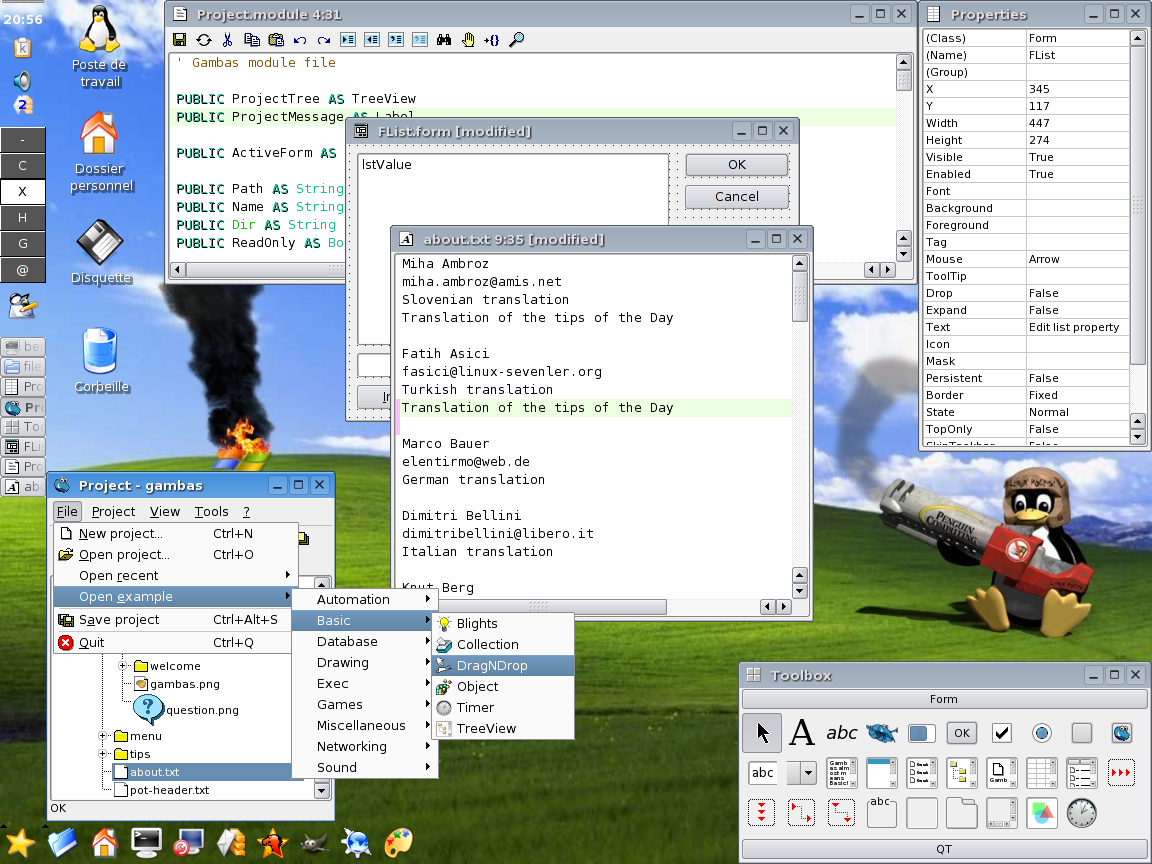
Hrm.. Like the Windows flag is burnt?
I wonder if it was really that necessary to be so childish, right on their front page.
It doesn't help their cause anyway, or defeat generalizations about "Linux being for childish basement geeks".
Oh well... To my question: Why would it crush VB
"Finish and clean the database component."
Oh, the irony! -
Funny wallpapers ...
Oh well
-
Funny wallpapers ...
Oh well
-
Cluttered IDE
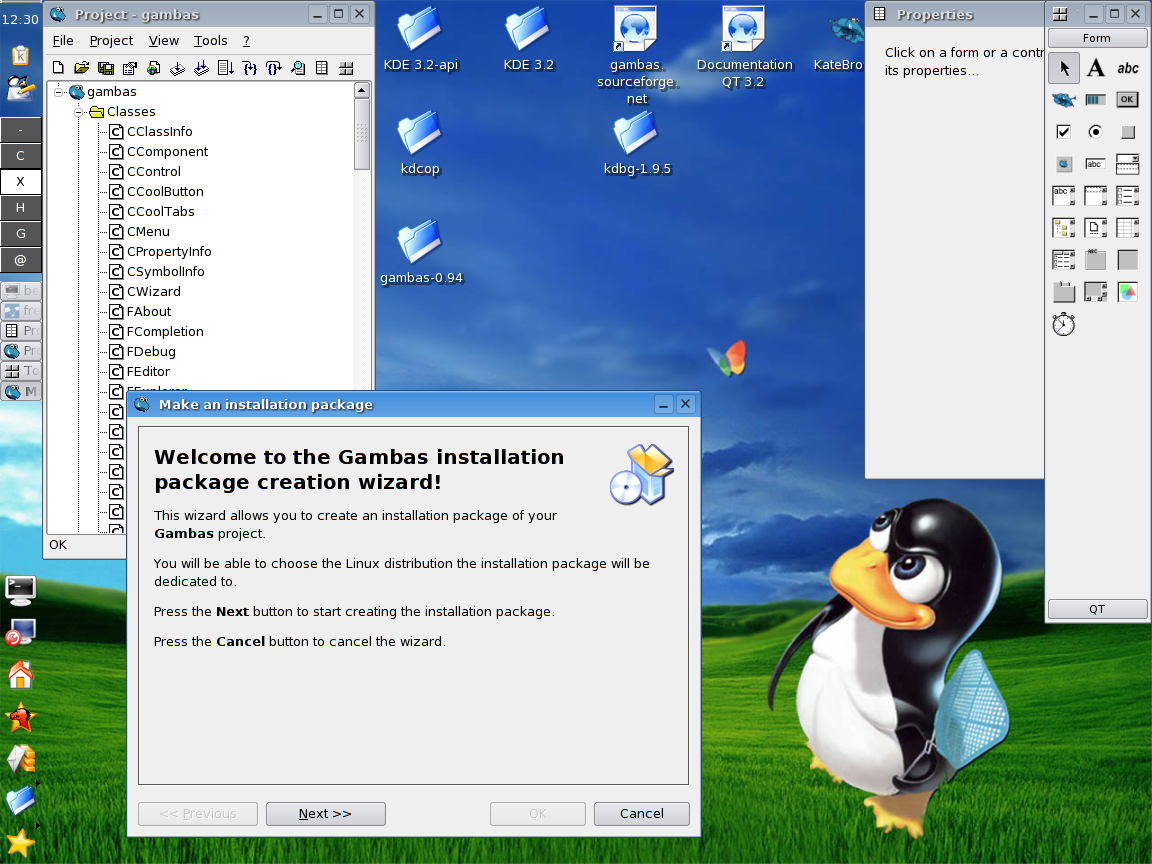
Maybe I'm in the minority here, but I don't like the "spread-out" IDE layout they've got going on here. It reminds me too much of the GIMP, and not in a good way. Perhaps it's my Windows background, but I want a single window with toolboxes and sidebars inside that window (see Visual Studio or KDevelop). This "Let's have a bunch of floating windows with nothing tying them together" approach just makes me think the developers are trying to copy Mac apps rather than Windows apps, with the main drawback of not having a single app menu across the top of the screen to tie everything together (yes, I know that various desktop environments can optionally move app menus to the top of the screen, but how consistent are they? Will they keep the menu from the "Project" window up top when I have the "Toolbox" window focused? Do they know that the "Properties" window and code window are related, and should raise together?). I'm not saying that copying from either is bad or wrong, just that if you're going to do it, do it right.
-
Re:Series 60
I am very satisfied with a Series 60 version of Symbian Putty. It works great with my Nokia 6600 by using GPRS services of major Finnish cellular operators.
I can easily use Pine and Irssi in my Unix screen. Actually I've found that using the phone's own mail client is much clumsier.
Small screen of 6600 is surprisingly no problem. The only limitation is slow text input. T9 helps you to input fast normal text, but finding some special characters may take a while. The developers of Symbian Putty have been really helpful and actually added some special key shortcuts after my request. -
Update: New Sourceforge project
If anyone happens to read this and is interested, I've created a sourceforge project for it.
-
What about the ANT technology
While this is a great case, there are now P2P technologies that furthur complicate matters for the RIAA. Like the technology that powers MUTE
This method, however, does slow the rate at which files are obtained. But for a lot of users, the extra security is worth the extra couple of hours. -
Re:Missing Old Cell Phones/Plans
Nokia 1100. Nokia 3120 (if you want color).
I'll keep my though. A SmartPhone seems kind of useless until you get one and then you realize all the stuff you can do with it (e.g. GPRS modem anywhere I have cell service, remote control for XMMS using bemused+bluetooth, wasting lots of time,
To each his own I guess.
-
Re:Social tagging on audioscrobbler
"Audioscrobbler builds a profile of your musical taste using a plugin for your media player
iRate does a similar thing, working like a radio-station for creative-commons licensed music... Rate songs on a scale 1-5, and it automatically downloads things that you might like. -
The MPAA is gonna lose.They can live without the 3% of their market that's made up of hardcore nerds, but the nerds probably won't live without the 25% or more of their entertainment that comes from mainstream media distributors.
Like hell you say. I only buy non-RIAA affiliated music from CD Baby, or download free tracks with iRate. You know what? I like this stuff a lot better than most of the crap that passes for music on the advertising clogged radio and TV stations.
Want some? Here's a small sample:
- Metal - Celldweller (CD Baby)
- Electronic/Industrial - More Machine Than Man (CD Baby)
- Acoustic - Okkervil ("Westfall" via iRate)
- Rap - Poverty ("I'm Hatin'" via iRate)
- New Age - Circle of Mansions ("Sky Machine" and "Number Nine" via iRate though I cannot google a link for either ATM. Try "Left Me." That's good too)
- Electronic - Atari Baby ("Share your love (Aspect Mix)" via iRate)
- Easy Listening - Sheryl Clapton ("Magic Door" via iRate)
- Hard Rock/Metal - Dazychain ("Too Much God" via iRate)
- Industrial - Firewerk (CD Baby)
- Punk Rock - Limit ("Mr. DJ" via iRate)
The same will happen to the MPAA. It's only a matter of time. The MPAA fears bandwidth and BitTorrent. They say it's because of piracy. Either they are really stupid, or they think we are. They just don't like competition.
-
Re:Open it up!
If it were open enough that anyone could write apps for it, I'd snatch it up right away.
Like this? http://sourceforge.net/projects/lsm/
-
Re:OpenVPN
Just to clarify what appears to be confusion. OpenSSL provides the key exchange and authentication options within OpenVPN, but doesn't handle the tunneling. Instead, OpenVPN uses ESP, the same as IPSec. Basically, think of it as the IPSec payload, but without AH or IKE, running over UDP. While many SSL/TLS tunnels use TCP, this is not required with OpenVPN. See the OpenVPN security model for details.
-
Re:(OT) Panorama
Try Hugin, it's an open source GUI front end to Panorama Tools, and it works wonderfully--I've used it in Win32 and under Linux, but it's also supposed to run on OS X.
The real trick is to use enblend to do the final stitching (hugin will arrange and orient the pictures then output them as individual
Dunno what NASA uses, but I'd guess it's either super expensive (isn't everything NASA buys super expensive?) or that it was done in-house. -
Any advice about adding OpenVPN to the WRT54G?
Amazing! Thanks. Any advice about how to install OpenVPN on the WRT54G? Which package would you recommend? Do the OpenWrt packages have an adminstration console? I don't see any mention of that. It looks complicated, since I read that there is no Wi-Fi Protected Access (WPA) until installed.
Also, I note that OpenVPN will NOT work on Windows XP SP2 unless the pre-release version 2.0 is used. I suppose you don't care if you are using a WRT54G at both ends of the VPN. I'm not knowledgeable about this, but I guess that running VPN software on a WRT54G would be more secure than running it on a PC.
I note that Sveasoft provides firmware with PPTP VPN software, but there seems to be some question about whether PPTP is sufficiently secure.
Just guessing, but this seems to be a considerable job to configure. I wish there were a commercial release with the OpenVPN built in.
OpenWrt.
Linksys WRT54G Wireless-G Broadband Router.
Linksys WRT54GS Wireless-G Broadband Router with SpeedBooster.
WRT54GS has updated chipset.
WRT54GS Under $70.
Both Linksys products have GPL'd firmware.
There is intense interest in the WRT54G and WRT54GS. One company, Sveasoft, provides upgraded firmware. -
Good news
Good news to see people aren't limited by these inane limits companies place on consumers. Reminds me of my recent dealing with Verizon Wireless and their draconian multimedia system. However the good people at http://bitpim.sourceforge.net/ have an awesome piece of software to help getting your pictures, sounds, and contacts.
-
SmallBasic
Like many here, I learned the "old school" basics first. They were simple, fast, and gave immediate results. You could concentrate on learning the language without all the overhead getting in the way. And you could learn a LOT before you reached the limits of the language. I am getting ready to introduce my kids to programming, and I'm going to use SmallBasic http://smallbasic.sourceforge.net/. This is a small project on SourceForge that has ongoing development. I've been very happ with it so far.
YMMV. -
Logo lives!I'm a big fan of Logo. One of the reasons is that it's not written for programmers, it's written for kids who may or may not become programmers. It has things that would make normal programmers cringe -- like all the shortcuts (FD for FORWARD). But have you seen a young child type? Believe me, FD is enough of a struggle, "intention-revealing selectors" is not one of their top priorities.
Really Logo wasn't intended to teach programming (though of course it did that). It was intended to teach math, and algorithmic thinking, and thinking in general. And, paired with the right teacher and an interested pupil, it's really great at that. Without realizing it, a child can end up learning not just geometry (through the turtle graphics), but a lot of pre-algebra. I think programming is a far more accessible way to introduce algebra than the traditional techniques; even young children can understand variables in programs, when the declarative variables that are used in mathematics are much more challenging.
It's also a better language than many of "teaching" languages, like Basic. It's an old-school version of Lisp, with a little tweak to avoid the parenthesis. And don't be fooled by things that call themselves Logo when they are just turtle graphics. Turtle graphics are cool, but just a piece of the equation. (Though not-so-coincidentally, Python has built-in turtle graphics).
If you are really interested in programming as education, I might recommend the book Mindstorms, which is a classic about some of the theory behind teaching with Logo. It's not a practical guide, though many of those also exist.
If you are looking for a Logo implementation, on Windows I would recommend Elica, MSWLogo, and UCBLogo, in that order. On Mac or Linux, you can use UCBLogo, Turtle Tracks (a cross-platform Java implementation), or on Mac one of a number of (rather expensive) commercial Logos. If you are a programmer and feel like fiddling alongside your child, you might try my project PyLogo, which is cross-platform and written in Python, but quite rough around the edges. Or if you want something that is Logo, but pretends to be a general-purpose scripting language, look at Rebol. Or for a slightly-lame but functional embedded robot Logo, Cricket Logo. Or for older people, NetLogo is a massively-multitasking implementation to use to play around with autonomous entities (e.g., ant simulations). NetLogo is kind of the successor to StarLogo.
For more information on Logo, you can look at the Logo Foundation, or get in touch with many helpful users in the LogoForum Yahoo Group.
-
Linux on the nintendo DS
I found out a few minutes ago that apparently the site offering the $1000 bounty for loading up linux on the DS didn't just go down, it was apparently attcked, which would obviously have brought it down. however, there is a sourceforge project http://sourceforge.net/projects/nitro/ to bring the DS online using techniques that are apparently better than tunneling. The project will be written in C and is in the pre-alpha stages.
-
Guida van Robot
GVR is like karel, but with more python coolness. They also maintain a list of a fes karel-related links on their site.
-
Re:Python
Python is a wonderful choice: it is easy to learn & quick to code in, but can be scaled up to larger projects. For the younger children who need to understand even more basic computer concepts, it can also be scaled down:
PyLogo is Logo implemented in Python
Guido van Robot is similar, but so much cooler.
Finally, livewires has an excellent Python tutorial. -
Re:my experience with games under Linux...
I've had great luck running older games with DOSBox. I don't know if you've tried it, but it's one more trick for keeping legacy support.
-
Re:Huh?"I use an incredible device called the Pod XT that makes life very easy for recording, noodling around, or juicing up the amp. "
I just looked at the Pod XT page...very interesting. It shows MIDI in/out, but, also USB port on it. Have you used this to connect to a Linux box running ardour? I'm just a beginner guitar, but like playing around with the idea of recording, and have been looking at open source sequencers and music tools.
Could you expand on what you've done/tried with the Pod XT? I'm really looking for something to quickly hook my guitar into my computer...
Other music software:
- Rosegarden
- Hydrogen Drum sequencer
- Ardour: Digital Audio Workstation
- Audacity Sound Editor
- JACK Audio connection kit (Low latency)
- ZynAddSubFX Software synthesizer
Anyway, these are a few of the things I'm looking at, but, just having a hard way to find to get a guitar into my computer without expensive MIDI connectors and pickups...
Any insight here if the Pod could be used or if you have links or experience with this would be greatly appreciated!!
-
Re:Huh?"I use an incredible device called the Pod XT that makes life very easy for recording, noodling around, or juicing up the amp. "
I just looked at the Pod XT page...very interesting. It shows MIDI in/out, but, also USB port on it. Have you used this to connect to a Linux box running ardour? I'm just a beginner guitar, but like playing around with the idea of recording, and have been looking at open source sequencers and music tools.
Could you expand on what you've done/tried with the Pod XT? I'm really looking for something to quickly hook my guitar into my computer...
Other music software:
- Rosegarden
- Hydrogen Drum sequencer
- Ardour: Digital Audio Workstation
- Audacity Sound Editor
- JACK Audio connection kit (Low latency)
- ZynAddSubFX Software synthesizer
Anyway, these are a few of the things I'm looking at, but, just having a hard way to find to get a guitar into my computer without expensive MIDI connectors and pickups...
Any insight here if the Pod could be used or if you have links or experience with this would be greatly appreciated!!
-
Re:Huh?"I use an incredible device called the Pod XT that makes life very easy for recording, noodling around, or juicing up the amp. "
I just looked at the Pod XT page...very interesting. It shows MIDI in/out, but, also USB port on it. Have you used this to connect to a Linux box running ardour? I'm just a beginner guitar, but like playing around with the idea of recording, and have been looking at open source sequencers and music tools.
Could you expand on what you've done/tried with the Pod XT? I'm really looking for something to quickly hook my guitar into my computer...
Other music software:
- Rosegarden
- Hydrogen Drum sequencer
- Ardour: Digital Audio Workstation
- Audacity Sound Editor
- JACK Audio connection kit (Low latency)
- ZynAddSubFX Software synthesizer
Anyway, these are a few of the things I'm looking at, but, just having a hard way to find to get a guitar into my computer without expensive MIDI connectors and pickups...
Any insight here if the Pod could be used or if you have links or experience with this would be greatly appreciated!!
-
Re:Huh?"I use an incredible device called the Pod XT that makes life very easy for recording, noodling around, or juicing up the amp. "
I just looked at the Pod XT page...very interesting. It shows MIDI in/out, but, also USB port on it. Have you used this to connect to a Linux box running ardour? I'm just a beginner guitar, but like playing around with the idea of recording, and have been looking at open source sequencers and music tools.
Could you expand on what you've done/tried with the Pod XT? I'm really looking for something to quickly hook my guitar into my computer...
Other music software:
- Rosegarden
- Hydrogen Drum sequencer
- Ardour: Digital Audio Workstation
- Audacity Sound Editor
- JACK Audio connection kit (Low latency)
- ZynAddSubFX Software synthesizer
Anyway, these are a few of the things I'm looking at, but, just having a hard way to find to get a guitar into my computer without expensive MIDI connectors and pickups...
Any insight here if the Pod could be used or if you have links or experience with this would be greatly appreciated!!
-
Buy ReplayTV
here are my options
The simplest and most platform-agnostic solution is to buy ReplayTV with autoconfig'd built-in ethernet. The Java-based DVArchive UI lets you control/stream/move shows between any LAN/WAN connected ReplayTVs or Java-enabled platform. It's uPNP-based so you can rig up some nice scripting. Think of each RTV as a loosely coupled scriptable capture device with significant on-device storage.
You use something like the ReVue UI to convert the RTV MPEGs to vanilla MPEGs, and burn to DVD or convert to MPEG-4 and burn/store/stream as required. Because ReplayTV recordings are unemcumbered by DRM and have a 4-year headstart on Tivo in sharing shows, you can go to online sites like Poopli and browse/download tens of thousands of shows stored on the networks of other ReplayTV owners. If you buy the right RTV model you also get automatic commercial advance - which when it works is like magic! -
Re:Open Office?
Go here...,
then here.
Enjoy!
(tig) -
Re:Open Office?Once upon a time, Apple had a downloadable X server for Jaguar. Then they removed the link to it when Panther came out.
In the mean time, you can get the X.org (or is it XFree86?) version of X11 to install on any OS X via Fink. This is probably your best bet.
However, if you only want to run OpenOffice.org, there's a program called NeoOffice/J that eschews X11 and POSIX-crap for Java and OS X shtuff. While imperfect, it's about as stable as the original and doesn't require fiddling with special "OpenOffice.org launcher" programs that never quite work the way you want anyway. Other than appearance, NeoOffice/J works like a regular Mac OS X app.
-
Re:OpenVPN
i also recommend openvpn. supported on a majority of systems: windows 2k/xp, linux, mac os x, bsds, & solaris. here's the howto.
imho, great example of kernel/user-land separation: tun/tap virtual device driver is the only kernel-side part, the rest is in user-land. no more having freeswan keep the system from cleanly shutting down because of a lost reference to a network device. but there is overhead from context switches between kernel & user, though it's a trade-off i think is worthwhile.
you can do ip or ethernet tunneling, depending how far down the osi model you want to go and how much overhead you are willing/able to process. with a single wireless client in my household, i do ethernet tunneling, as it frees me from having to do any ip routing and configuring a wins server (which i've found problematic with windows 2000 and samba 2.2 on debian stable).
openvpn openvpn can use shared key or tls, just depends on what you want. you can quickly develop a proof of concept with shared keys (prove software installation, network communication, etc work) and then "upgrade" to tls.
openvpn uses openssl for it's encryption/authentication engine. that means that all the scrutiny and improvements openssl receives (security analysis, assembly encoded algorithms, hardware engines, etc) benefits openvpn. i'm interested in doing openvpn on the via epia platform with hardware-assisted openssl serving as wireless xterminals.
encrypting lots of bandwidth means lots of processor cycles, and depending on the speed of your processors and the bandwidth between the two, expect some slow down. this is not particular to openvpn, but any (software) encryption, so choose your hardware accordingly (with lots of benchmarking for your particular use case).
ipsec is a valid option, though i prefer openvpn. ipsec is a standard, and is supported on more platforms than openvpn (especially embedded systems & dedicated hardware), but is firstly cumbersome to configure and secondly compatibility is theoretically possible between all implementation but not guaranteed. i once connected windows 2000 and linux/freeswan using ipsec. nate carlson's howto is invaluable. with linux 2.6 it's even harder to implement ipsec with iptables because neither the in-kernel ipsec implementation nor openswan support virtual interfaces (ipsec[0-9]). supposedly it's "possible" using iptables to tag packets, but i won't consider it "practical" until it's easy enough to be documented in a howto.
-
Linux based VPN gateways
Are cheap, easy to setup and mantain, highly flexible and very cost-effective.
Depending on what you're planning to do, you can use any of the several VPN implementations out there, just to name a few:
* PoPToP, a PPTP server, compatible with the VPN client that Windows has always has,
* vpnd, really easy to set up, ideal gw to gw VPN solution, seems a little outdated but works great over slow links,
* OpenVPN, a highly portable, flexible and multiplatform VPN solution, which supports gw to gw and gw to host style VPNs,
* etc. There is also LinVPN, FreeS/WAN / Openswan, et al
Best regards. -
Re:OpenVPN
I agree with this. OpenVPN even has some nice little user friendly tools to access the VPN from Windows, etc.
http://openvpn.sourceforge.net/gui.html -
OpenVPNI recently started using OpenVPN and it works great. It took a little bit to set it up in the multi-client configuration, but it wasn't bad.
I'm going to set everyone in my company up using it. We're small and everyone works either on customer sites or from home. This will allow us to more easily share resources. It works with Linux, Windows, etc.
I highly recommend it.
-
OpenVPN
Theres always http://openvpn.sourceforge.net/ which has clients and servers for windows, or you could always tunnel pppd over ssh, http://www.tldp.org/HOWTO/VPN-HOWTO/ for details
-
Re:Tension must be horrendous
You miss important detail.
each cable must support the weight to the next kite, but each cable must also take its turn as the weakest link and be the final connection for all work product to be delivered to the generating hub.
Its probably a slow moving apparatus, so the force moment for 100,000 KWatts (at 1 Meter per second) is in the neighborhood of 100,000 Kgrams. That's a strong fishing line.
even at 10 Meters per second, the force moment is 10,000 Kgrams.
One optimization problem is that this force is not consistently experienced throughout the loop - which means that every link must be over engineered by several orders of magnitude.
the idea of generally catching more air is good though
A Vertical wing array
AIK -
An alternative is a vertical wing array
The kite has the potential to capture a minute percentage of power available for a given operational site. For safety reasons one needs a diameter roughly equal to the extended length which is roughly 1.5 times the operating altitude. The theoretical capacitity of a site is 59% of the available wind moment across the site in a plane perpendicular to the wind direction. A Kite would occupy only the tiniest fraction of this capacity and as such is highly ineffecient with respect to real estate. A Vertical wing array on the other hand interfaces all of the wind available to a site, and while it has aspects in common with a kite, it may resolve some of the issues mentioned here - primarily in that it does not seek the fastest air at impractical altitude, but simply increases surface area in low wind conditions for higher power to cost ratios. AIK
-
Using JavaHMOSince the TivoToGo service is based on the same protocol, with some extensions, that was used for the Home Media Option to show hosted photos and music, I'm hopeful that the folks at JavaHMO will be able to add support for transferring videos to and from the TiVO for us Linux users.
In fact, since the current version of the TiVO software won't let you do the transfer back, this would be GREAT added functionality.
---
More on this and other opinions of mine can be found here
-
no, you do need to doc
You should read about XP (extreme programming)...
I have. And way back into last century even.
You're right that the initial idea is always different after seeing prototypes. But for this exact reason you shouldn't document your code. Code should be disposable, so don't waste time writing other than what the computer needs.
And this is where I'll have to strongly disagree with you. Even "Extreme Programming Installed" (a book I personally belive wonders off a bit from Beck's best XP) says to use UML.
Additionally, some of what I've seen in the best projects is the use of good Javadoc, DOC++, Doxygen or some such comments. The best time to write those is while the design is fresh in people's minds, such as in writing up initial tests or first writing each class. Additionally, it's much easier to keep up to date, and helps greatly as people need to go in and refactor code. Oh, and Eclipse has good Javadoc support, and having Javadoc comments helps it work even better.
Of course, I've gone Extreme myself on different projects by writing Docs in XML. Just poke a single XML with different XSLT stylesheets and get end-user API documentation, internal implementor guide documentation, and full test case source code all from that single sparse XML source. (But especially with all the workflow benefits one gets in Eclipse from having proper Javadoc comments around, those are well more that "disposable").
-
Re:Alphabet soup....
Until I got to the end of the blurb I thought this was about user mode linux...and now, of course, I have no idea what it is.
Well, I'm definitely not trying to troll here or anything, but in this instance I'd be willing to give the poster the benefit of the doubt on the TLA use here. Given the target audience (Slashdot tech-heads), and the prevalence of UML in the tech field (among other things there are literally hundreds of available books on the modeling language, but no easily found ones on User Mode Linux), it's not that unreasonable to assume that most would know the Unified Modeling Language, and that those aware of User Mode Linux would fall in the group that probably 'should' know about the UML.
Of course, writing it out long-hand is always handy, and a few links sprinkled around could help.